Prove that
\[
\int_{0}^{\frac{1}{2}\pi}\ln(\sin x)\,\mathrm{d}x=\int_{0}^{\frac{1}{2}\pi}\ln(\cos x)\,\mathrm{d}x=\tfrac{1}{2}\int_{0}^{\frac{1}{2}\pi}\ln(\sin2x)\,\mathrm{d}x-\tfrac{1}{4}\pi\ln2
\]
and
\[
\int_{0}^{\frac{1}{2}\pi}\ln(\sin2x)\,\mathrm{d}x=\tfrac{1}{2}\int_{0}^{\pi}\ln(\sin x)\,\mathrm{d}x=\int_{0}^{\frac{1}{2}\pi}\ln(\sin x)\,\mathrm{d}x.
\]
Hence, or otherwise, evaluate \({\displaystyle \int_{0}^{\frac{1}{2}\pi}\ln(\sin x)\,\mathrm{d}x.}\)
You may assume that all the integrals converge.
Given that \(\ln u< u\) for \(u\geqslant1\) deduce that
\[
\tfrac{1}{2}\ln x < \sqrt{x}\qquad\mbox{ for }\quad x\geqslant1.
\]
Deduce that \(\dfrac{\ln x}{x}\rightarrow0\) as \(x\rightarrow\infty\) and that \(x\ln x\rightarrow0\) as \(x\rightarrow0\) through positive values.
Using the results of parts (i) and (ii), or otherwise, evaluate \({\displaystyle \int_{0}^{\frac{1}{2}\pi}x\cot x\,\mathrm{d}x.}\)
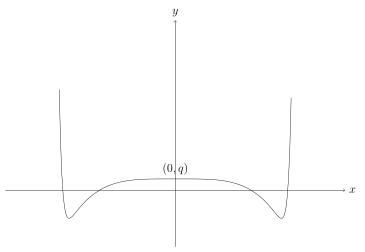
Sketch the graph of the function \(\mathrm{f}\), where \(\mathrm{f}(x)=x^{1760}-x^{220}+q\),
and \(q\) is a constant. Find the possible numbers of \textit{distinct
}roots of the equation \(\mathrm{f}(x)=0\), and state the inequalities
satisfied by \(q\).
When \(q = 0\) the roots are \(-1, 0, 1\)
There can be \(0, 2, 3, 4\) roots.
There will be no roots if \(q > -\min (x^{1760} - x^{220})\) since the whole graph will be above the axis.
There will be \(2\) roots if \(q = -\min (x^{1760} - x^{220})\) or \(q > 0\)
There will be \(4\) roots if \(0 > q > -\min (x^{1760} - x^{220})\).
There will be \(3\) roots if \(q =0\)
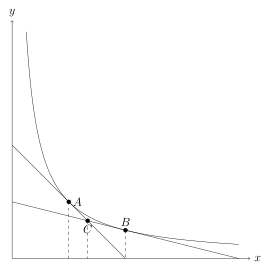
Let \(A\) and \(B\) be the points \((1,1)\) and \((b,1/b)\) respectively, where \(b>1\). The tangents at \(A\) and \(B\) to the curve \(y=1/x\) intersect at \(C\). Find the coordinates of \(C\).
Let \(A',B'\) and \(C'\) denote the projections of \(A,B\) and \(C\), respectively, to the \(x\)-axis. Obtain an expression for the sum of the areas of the quadrilaterals \(ACC'A'\) and \(CBB'C'\). Hence or otherwise prove that, for \(z>0\),
\[
\frac{2z}{2+z}\leqslant\ln\left(1+z\right)\leqslant z.
\]
\begin{align*}
&& y &= 1/x \\
\Rightarrow && \frac{\d y}{\d x} &= -1/x^2
\end{align*}
Therefore the tangent at \((1,1)\) will be \(\frac{y - 1}{x-1} = -1 \Rightarrow y = -x + 2\) and at \((b, 1/b)\) will be \(\frac{y-1/b}{x-b} = -\frac{1}{b^2} \Rightarrow y = -\frac{x}{b^2} + \frac{2}{b}\)
The intersection will be at
\begin{align*}
&& x + y & = 2 \\
&& x + b^2 y &= 2b \\
\Rightarrow && (b^2-1)y &= 2(b-1) \\
\Rightarrow && y &= \frac{2}{b+1} \\
&& x &= \frac{2b}{b+1}
\end{align*}
Therefore \(\displaystyle C = \left (\frac{2b}{b+1}, \frac{2}{b+1} \right)\).
The areas of the two trapeziums will be:
\begin{align*}
[ACC'A'] &= \frac12 \left (1 + \frac{2}{b+1} \right) \left (\frac{2b}{b+1} - 1 \right) \\
&= \frac12 \cdot \frac{b+3}{b+1} \cdot \frac{2b - b - 1}{b+1} \\
&= \frac 12 \frac{(b+3)(b-1)}{(b+1)^2}
\end{align*}
\begin{align*}
[CBB'C'] &= \frac12 \left (\frac{2}{b+1} + \frac{1}{b} \right) \left (b- \frac{2b}{b+1} \right) \\
&= \frac12 \cdot \frac{3b+1}{b(b+1)} \cdot \frac{b^2+b-2b}{b+1} \\
&= \frac 12 \frac{(3b+1)b(b-1)}{b(b+1)^2} \\
&= \frac12 \frac{(3b+1)(b-1)}{(b+1)^2}
\end{align*}
The area under the curve between \(A\) and \(B\) will be:
\begin{align*}
\int_1^b \frac{1}{x} \d x &= \left [\ln x \right]_1^b \\
&= \ln b
\end{align*}
The area of a rectangle of height \(1\) from \(A\) will clearly be above the curve and will have area \(b-1\).
The area of \(ACBB'C'A'\) will be:
\begin{align*}
[ACBB'C'A'] &= [ACC'A']+[CBB'C'] \\
&=\frac 12 \frac{(b+3)(b-1)}{(b+1)^2}+ \frac12 \frac{(3b+1)(b-1)}{(b+1)^2} \\
&= \frac12 \frac{(b-1)(4b+4)}{(b+1)^2} \\
&= \frac{2(b-1)}{b+1}
\end{align*}
By comparing areas, we must have: \(\frac{2(b-1)}{b+1} \leq \ln b \leq b-1\) and since \(b > 1\) we can write it as \(1 + z\) for \(z >0\), ie:
\(\displaystyle \frac{2z}{2+z} \leq \ln (1 + z) \leq z\).
[By considering the area of \(ABB'A'\) which is
\begin{align*}
[ABB'A'] &= \frac12 \left (1 + \frac{1}{b} \right) \left ( b- 1 \right) \\
&= \frac12 \frac{(b+1)(b-1)}{b}
\end{align*}
we can tighten the right hand bound to \(\displaystyle \frac{(2+z)z}{2(z+1)} = \left (1 - \frac{z}{2z+2} \right)z\)
The functions \(\mathrm{x}\) and \(\mathrm{y}\) are related by
\[
\mathrm{x}(t)=\int_{0}^{t}\mathrm{y}(u)\,\mathrm{d}u,
\]
so that \(\mathrm{x}'(t)=\mathrm{y}(t)\). Show that
\[
\int_{0}^{1}\mathrm{x}(t)\mathrm{y}(t)\,\mathrm{d}t=\tfrac{1}{2}\left[\mathrm{x}(1)\right]^{2}.
\]
In addition, it is given that \(\mbox{y}(t)\) satisfies
\[
\mathrm{y}''+(\mathrm{y}^{2}-1)\mathrm{y}'+\mathrm{y}=0,\mbox{ }(*)
\]
with \(\mathrm{y}(0)=\mathrm{y}(1)\) and \(\mathrm{y}'(0)=\mathrm{y}'(1)\).
By integrating \((*)\), prove that \(\mathrm{x}(1)=0.\)
By multiplying \((*)\) by \(\mathrm{x}(t)\) and integrating by parts, prove the relation
\[
\int_{0}^{1}\left[\mathrm{y}(t)\right]^{2}\,\mathrm{d}t=\tfrac{1}{3}\int_{0}^{1}\left[\mathrm{y}(t)\right]^{4}\,\mathrm{d}t.
\]
Prove also the relation
\[
\int_{0}^{1}\left[\mathrm{y}'(t)\right]^{2}\,\mathrm{d}t=\int_{0}^{1}\left[\mathrm{y}(t)\right]^{2}\,\mathrm{d}t.
\]
The integral \(I\) is defined by
\[
I=\int_{1}^{2}\frac{(2-2x+x^{2})^{k}}{x^{k+1}}\,\mathrm{d}x
\]
where \(k\) is a constant. Show that
\[
I=\int_{0}^{1}\frac{(1+x^{2})^{k}}{(1+x)^{k+1}}\,\mathrm{d}x=\int_{0}^{\frac{1}{4}\pi}\frac{\mathrm{d}\theta}{\left[\sqrt{2}\cos\theta\cos\left(\frac{1}{4}\pi-\theta\right)\right]^{k+1}}=2\int_{0}^{\frac{1}{8}\pi}\frac{\mathrm{d}\theta}{\left[\sqrt{2}\cos\theta\cos\left(\frac{1}{4}\pi-\theta\right)\right]^{k+1}}.
\]
Hence show that
\[
I=2\int_{0}^{\sqrt{2}-1}\frac{(1+x^{2})^{k}}{(1+x)^{k+1}}\,\mathrm{d}x
\]
Deduce that
\[
\int_{1}^{\sqrt{2}}\left(\frac{2-2x^{2}+x^{4}}{x^{2}}\right)^{k}\frac{1}{x}\,\mathrm{d}x=\int_{1}^{\sqrt{2}}\left(\frac{2-2x+x^{2}}{x}\right)^{k}\frac{1}{x}\,\mathrm{d}x
\]
Sketch the graph of
\[
y=\frac{x^{2}\mathrm{e}^{-x}}{1+x},
\]
for \(-\infty< x< \infty.\)
Show that the value of
\[
\int_{0}^{\infty}\frac{x^{2}\mathrm{e}^{-x}}{1+x}\,\mathrm{d}x
\]
lies between \(0\) and \(1\).
First notice the integrand is always positive over the range we are integrating, so the integral is greater than \(0\). Since \(\frac{x}{1+x} \leq 1\) for \(x \geq 0\) we can note that:
\begin{align*}
\int_0^{\infty} \frac{x^2e^{-x}}{1+x} \d x &=\int_0^{\infty} \frac{x}{1+x}xe^{-x} \d x \\
&< \int_0^\infty xe^{-x} \d x \\
&= \left [ -xe^{-x} \right]_0^{\infty} + \int_0^{\infty} e^{-x} \d x \\
&= 0 + 1 \\
&= 1
\end{align*}
and so we are done.
Using the substitution \(x=\alpha\cos^{2}\theta+\beta\sin^{2}\theta,\) show that, if \(\alpha<\beta\),
\[
\int_{\alpha}^{\beta}\frac{1}{\sqrt{(x-\alpha)(\beta-x)}}\,\mathrm{d}x=\pi.
\]
What is the value of the above integral if \(\alpha>\beta\)?
Show also that, if \(0<\alpha<\beta\),
\[
\int_{\alpha}^{\beta}\frac{1}{x\sqrt{(x-\alpha)(\beta-x)}}\,\mathrm{d}x=\frac{\pi}{\sqrt{\alpha\beta}}.
\]
Using the suggested substitution, we can find.
\begin{align*}
&& x &=\alpha\cos^{2}\theta+\beta\sin^{2}\theta \\
&& x-\alpha &=\alpha(\cos^{2}\theta-1)+\beta\sin^{2}\theta \\
&&& = (\beta - \alpha) \sin^2 \theta \\
&& \beta - x &= -\alpha\cos^{2}\theta+\beta(1-\sin^{2}\theta) \\
&&&= (\beta-\alpha)\cos^2 \theta \\
&& x &=\alpha\cos^{2}\theta+\beta\sin^{2}\theta \\
\Rightarrow && \frac{dx}{d\theta} &= (\beta - \alpha) 2 \cos \theta \sin\theta \\
\\
&&\int_{\alpha}^{\beta}\frac{1}{\sqrt{(x-\alpha)(\beta-x)}}\,\mathrm{d}x &= \int_0^{\pi/2} \frac{1}{(\beta - \alpha)\sin\theta \cos \theta} (\beta - \alpha) 2 \cos \theta \sin \theta \, d \theta \\
&&&= \int_0^{\pi/2} \frac{1}{\bcancel{(\beta - \alpha)}\bcancel{\sin\theta \cos \theta}} \bcancel{(\beta - \alpha)} 2 \bcancel{\cos \theta \sin \theta} \, d \theta \\
&&&= \int_0^{\pi/2} 2 d \theta \\
&& &= 2 \frac{\pi}{2} = \boxed{\pi}
\end{align*}
If \(\alpha > \beta\) we can rewrite the integral as:
\begin{align*}
\int_{\alpha}^{\beta}\frac{1}{\sqrt{(x-\alpha)(\beta-x)}}\,\mathrm{d}x &= \int_{\alpha}^{\beta}\frac{1}{\sqrt{(x-\beta)(\alpha-x)}}\,\mathrm{d}x \\
&= -\int_{\beta}^{\alpha}\frac{1}{\sqrt{(x-\beta)(\alpha-x)}}\,\mathrm{d}x \\
&= -\pi
\end{align*}
Where the last step we are directly using the first integral with the use of \(\alpha\) and \(\beta\) reversed.
Finally, using the substitution \(xt = 1\), we fortunately lose the \(\frac1{x}\) term:
\begin{align*}
&& x &= \frac{1}{t} \\
&& \frac{dx}{dt} &= -\frac1{t^2} \\
\\
&& \int_{\alpha}^{\beta}\frac{1}{x\sqrt{(x-\alpha)(\beta-x)}}\,\mathrm{d}x &= \int_{\alpha}^{\beta}\frac{t}{\sqrt{(\frac{1}{t}-\alpha)(\beta-\frac{1}{t})}} \frac{-1}{t^2}\,\mathrm{d}t \\
&& &= \int_{\frac1{\alpha}}^{\frac1\beta}\frac{-1}{\sqrt{(1-t\alpha)(t\beta-1)}}\,\mathrm{d}t \\
&& &= \int_{\frac1{\alpha}}^{\frac1\beta}\frac{-1}{\sqrt{\alpha\beta}\sqrt{(\frac1{\alpha}-t)(t-\frac1{\beta})}}\,\mathrm{d}t \\
&& &= \frac1{\sqrt{\alpha\beta}}\int_{\frac1{\alpha}}^{\frac1\beta}\frac{-1}{\sqrt{(\frac1{\alpha}-t)(t-\frac1{\beta})}}\,\mathrm{d}t \\
&&&= \boxed{\frac{\pi}{\sqrt{\alpha\beta}}}
\end{align*}
Where again the last step we are using the intermediate integral, with the roles of \(\alpha\) and \(\beta\) replaced with \(\frac{1}{\beta}\) and \(\frac1{\alpha}\)
Let \(y=\mathrm{f}(x)\), \((0\leqslant x\leqslant a)\), be a continuous curve lying in the first quadrant and passing through the origin.
Suppose that, for each non-negative value of \(y\) with \(0\leqslant y\leqslant\mathrm{f}(a)\), there is exactly one value of \(x\) such that \(\mathrm{f}(x)=y\); thus we may write \(x=\mathrm{g}(y)\), for a suitable function \(\mathrm{g}.\)
For \(0\leqslant s\leqslant a,\) \(0\leqslant t\leqslant \mathrm{f}(a)\), define
\[
\mathrm{F}(s)=\int_{0}^{s}\mathrm{f}(x)\,\mathrm{d}x,\qquad\mathrm{G}(t)=\int_{0}^{t}\mathrm{g}(y)\,\mathrm{d}y.
\]
By a geometrical argument, show that
\[
\mathrm{F}(s)+\mathrm{G}(t)\geqslant st.\tag{*}
\]
When does equality occur in \((*)\)?
Suppose that \(y=\sin x\) and that the ranges of \(x,y,s,t\) are restricted to \(0\leqslant x\leqslant s\leqslant\frac{1}{2}\pi,\) \(0\leqslant y\leqslant t\leqslant1\).
By considering \(s\) such that the equality holds in \((*)\), show that
\[
\int_{0}^{t}\sin^{-1}y\,\mathrm{d}y=t\sin^{-1}t-\left(1-\cos(\sin^{-1}t)\right).
\]
Check this result by differentiating both sides with respect to \(t\).
The blue area is \(F(s)\) the red area is \(G(t)\), the dashed rectangle (which is a subset of the red and blue areas) has area \(st\) therefore \(F(s) + G(t) \geq st\). Equality holds if \(f(s) = t\).
\begin{align*}
&& \int_0^t \sin^{-1} y \d y + \int_0^{\sin^{-1} t} \sin x \d x &= t \sin^{-1} t \\
\Rightarrow && \int_0^t \sin^{-1} y \d y &= t \sin^{-1} t - \left [ -\cos (x) \right]_0^{\sin^{-1} t} \\
&&&= t \sin^{-1} t - (1- \cos (\sin^{-1} t))
\end{align*}
Let \(y = t \sin^{-1} t - (1- \cos (\sin^{-1} t))\) then,
\begin{align*}
\frac{\d y}{\d t} &= \sin^{-1} t +t \frac{\d}{\d t} \l \sin^{-1} (t) \r - \sin ( \sin^{-1} t) \frac{\d}{\d t} \l \sin^{-1} (t) \r \\
&= \sin^{-1} t
\end{align*}
as required
Explain why the use of the substitution \(x=\dfrac{1}{t}\) does not demonstrate that the integrals
\[
\int_{-1}^{1}\frac{1}{(1+x^{2})^{2}}\,\mathrm{d}x\quad\mbox{ and }\quad\int_{-1}^{1}\frac{-t^{2}}{(1+t^{2})^{2}}\,\mathrm{d}t
\]
are equal.
Evaluate both integrals correctly.
When we apply the substitution \(x = \frac1{t}\), \(t\) runs from \(-1 \to -\infty\) as \(x\) goes from \(-1 \to 0\). Then it runs from \(\infty \to 1\) as \(x\) runs from \(0 \to 1\). So we would be able to show that:
\[ \int_{-1}^{1}\frac{1}{(1+x^{2})^{2}}\,\mathrm{d}x = \int_{-1}^{-\infty}\frac{-t^{2}}{(1+t^{2})^{2}}\,\mathrm{d}t + \int_{\infty}^1 \frac{-t^{2}}{(1+t^{2})^{2}}\,\mathrm{d}t \]
Let \(x = \tan u, \d x = \sec^2 u \d u\)
\begin{align*}
\int_{-1}^1 \frac1{(1+x^2)^2} \d x &= \int_{u = -\pi/4}^{u = \pi/4} \frac{\sec^2 u}{(1+\tan^2 u)^2} \d u \\
&= \int_{u = -\pi/4}^{u = \pi/4} \frac{1}{\sec^2 u} \d u \\
&= \int_{-\pi/4}^{\pi/4} \cos^2 u \d u \\
&= \int_{-\pi/4}^{\pi/4} \frac{1 + \cos 2 u}{2} \d u \\
&= \left [ \frac{2u + \sin 2u}{4} \right]_{-\pi/4}^{\pi/4} \\
&= \frac{\pi}{4} + \frac{1}{2}
\end{align*}
Let \(t = \tan u, \d t = \sec^2 u \d u\)
\begin{align*}
\int_{-1}^1 \frac{-t^2}{(1+t^2)^2} \d x &= \int_{u = -\pi/4}^{u = \pi/4} \frac{-\tan^2 u \sec^2 u}{(1+\tan^2 u)^2} \d u \\
&= -\int_{u = -\pi/4}^{u = \pi/4} \frac{\tan^2 u}{\sec^2 u} \d u \\
&= -\int_{-\pi/4}^{\pi/4} \sin^2 u \d u \\
&= -\int_{-\pi/4}^{\pi/4} \frac{1 - \cos 2 u}{2} \d u \\
&= -\left [ \frac{2u - \sin 2u}{4} \right]_{-\pi/4}^{\pi/4} \\
&= \frac{1}{2}-\frac{\pi}{4}
\end{align*}
Let
\[
I=\int_{-\frac{1}{2}\pi}^{\frac{1}{2}\pi}\frac{\cos^{2}\theta}{1-\sin\theta\sin2\alpha}\,\mathrm{d}\theta\, ,
\]
where \(0<\alpha<\frac{1}{4}\pi\). Show that
\[
I=\int_{-\frac{1}{2}\pi}^{\frac{1}{2}\pi}\frac{\cos^{2}\theta}{1+\sin\theta\sin2\alpha}\,\mathrm{d}\theta\, ,
\]
and hence that
\[
I=\frac{\pi}{\sin^{2}2\alpha}-\cot^{2}2\alpha\int_{-\frac{1}{2}\pi}^{\frac{1}{2}\pi}\frac{\sec^{2}\theta}{1+\cos^{2}2\alpha\tan^{2}\theta}\,\mathrm{d}\theta.
\]
Show that \(I=\frac{1}{2}\pi\sec^{2}\alpha\), and state the value of \(I\) if \(\frac{1}{4}\pi<\alpha<\frac{1}{2}\pi\).
A definite integral can be evaluated approximately by means of the Trapezium rule:
\[
\int_{x_{0}}^{x_{N}}\mathrm{f}(x)\,\mathrm{d}x\approx\tfrac{1}{2}h\left\{ \mathrm{f}\left(x_{0}\right)+2\mathrm{f}\left(x_{1}\right)+\ldots+2\mathrm{f}\left(x_{N-1}\right)+\mathrm{f}\left(x_{N}\right)\right\} ,
\]
where the interval length \(h\) is given by \(Nh=x_{N}-x_{0}\), and \(x_{r}=x_{0}+rh\). Justify briefly this approximation.
Use the Trapezium rule with intervals of unit length to evaluate approximately the integral
\[
\int_{1}^{n}\ln x\,\mathrm{d}x,
\]
where \(n(>2)\) is an integer. Deduce that \(n!\approx\mathrm{g}(n)\), where
\[
\mathrm{g}(n)=n^{n+\frac{1}{2}}\mathrm{e}^{1-n},
\]
and show by means of a sketch, or otherwise, that
\[
n!<\mathrm{g}(n).
\]
By using the Trapezium rule on the above integral with intervals of width \(k^{-1}\), where \(k\) is a positive integer, show that
\[
\left(kn\right)!\approx k!n^{kn+\frac{1}{2}}\left(\frac{\mathrm{e}}{k}\right)^{k\left(1-n\right)}.
\]
Determine whether this approximation or \(\mathrm{g}(kn)\) is closer to \(\left(kn\right)!\).
We can approximate the integral by \(N\) trapeziums, each with height \(x_{i+1}-x_{i} = \frac{x_N-x_0}{N} = \frac{h}{N}\). The will have area \(\frac{(f(x_i)+f(x_{i+1}))h}{2}\) and summing all these areas we will get:
\[\frac12 h \l f(x_0) + f(x_1) + f(x_1)+f(x_2) + \cdots + f(x_{N-1})+f(x_N) \r = \frac12 h \l f(x_0) +2 f(x_1) + + \cdots +2f(x_{N-1})+f(x_N) \r\]
But this is approximately the integral \(\displaystyle \int_{x_0}^{x_N} f(x) \d x\)
\begin{align*}
&& \int_1^n \ln x \d x &= [x \ln x]_1^n - \int_1^n x \cdot \frac{1}{x} \d x \\
&&&= n \ln n - n+1 \\
&&&\approx \frac12 \l \ln 1 + 2\sum_{k=2}^{n-1} \ln k + \ln n \r \\
&&&= \ln (n!) - \frac12 \ln n \\
\Rightarrow && \ln (n!) &\approx n \ln n + \frac12 \ln n - n + 1 \\
\Rightarrow && n! &\approx \exp(n \ln n + \frac12 \ln n - n + 1) \\
&&&=n^{n+\frac12}e^{1-n}
\end{align*}
Since \(\ln x\) is a concave function, we should expect all the trapeziums to all lie under the curve, therefore this is always an underestimate for the integral, ie \(n! < g(n)\)
\begin{align*}
&& \int_1^n \ln x \d x &= n \ln n - n+1 \\
&&&\approx \frac12 k^{-1} \l \ln 1 + 2\sum_{r=1}^{k(n-1)-1} \ln \l 1+\frac{r}{k} \r + \ln n \r \\
&&&=\frac{1}{2k} \l 2\sum_{r=1}^{k(n-1)-1} \l \ln(k+r) - \ln k)\r + \ln n\r \\
&&&=\frac1{k} \l \ln ((k+k(n-1)-1)!) - \ln(k!) - (k(n-1)-1) \ln k+\frac12\ln n \r \\
&&&=\frac1{k} \l \ln ((kn-1)!) - \ln(k!) - (k(n-1)-1) \ln k+\frac12 \ln n \r \\
&&&=\frac1{k} \l \ln ((kn)! ) -\ln k -\ln n - \ln(k!) - (k(n-1)-1) \ln k+\frac12\ln n \r \\
&&&= \frac1{k} \l \ln ((kn)! ) - \ln(k!) - (k(n-1)) \ln k - \frac12 \ln n\r \\
\Rightarrow && \ln ((kn)!) &\approx kn \ln n - kn + k + \ln(k!) + (k(n-1)) \ln k + \frac12 \ln n\\
\Rightarrow && (kn)! &\approx n^{kn+\frac12}e^{-k(n-1)}k!k^{k(n-1)} \\
&&&= n^{kn+\frac12} k! \l \frac{e}{k} \r^{k(1-n)}
\end{align*}
I would expect this approximation to be a better approximation for \((kn)!\) since it is created using a finer mesh.