Integration
Use the substitution \(x = 2-\cos \theta \) to evaluate the integral $$ \int_{3/2}^2 \left(x - 1 \over 3 - x\right)^{\!\frac12}\! \d x. $$ Show that, for \(a < b\), $$ \int_p^q \left( x - a \over b - x\right)^{\!\frac12} \!\d x = \frac{(b-a)(\pi +3{\surd3} -6)}{12}, $$ where \(p= {(3a+b)/4}\) and \(q={(a+b)/2}\).
The function \(\f\) satisfies \(0\leqslant\f(t)\leqslant K\) when \(0\leqslant t\leqslant x\). Explain by means of a sketch, or otherwise, why \[0\leqslant\int_{0}^{x} \f (t)\,{\mathrm d}t \leqslant Kx.\] By considering \(\displaystyle \int_{0}^{1}\frac{t}{n(n-t)}\,{\mathrm d}t\), or otherwise, show that, if \(n>1\), \[ 0\le \ln \left( \frac n{n-1}\right) -\frac 1n \le \frac 1 {n-1} - \frac 1n \] and deduce that \[ 0\le \ln N -\sum_{n=2}^N \frac1n \le 1. \] Deduce that as \(N\to \infty\) \[ \sum_{n=1}^N \frac1n \to\infty. \] Noting that \(2^{10}=1024\), show also that if \(N<10^{30}\) then \[ \sum_{n=1}^N \frac1n <101. \]
Find \(\displaystyle \ \frac{\d y}{\d x} \ \) if $$ y = \frac{ax+b}{cx+d}. \tag{*} $$ By using changes of variable of the form \((*)\), or otherwise, show that \[ \int_0^1 \frac{1}{(x+3)^2} \; \ln \left(\frac{x+1}{x+3}\right)\d x = {\frac16} \ln3 - {\frac14}\ln 2 - \frac 1{12}, \] and evaluate the integrals \[ \int_0^1 \frac{1}{(x+3)^2} \; \ln \left(\frac{x^2+3x+2}{(x+3)^2}\right)\d x \mbox{ and } \int_0^1 \frac{1}{(x+3)^2} \; \ln\left(\frac{x+1}{x+2}\right)\d x . \] [Not on original paper:] By changing to the variable \(y\) defined by $$ y=\frac{2x-3}{x+1},$$ evaluate the integral $$ \int_2^4 \frac{2x-3}{(x+1)^3}\; \ln\!\left(\frac{2x-3}{x+1}\right)\d x.$$ Evaluate the integral $$ \int_9^{25} {\big({2z^{-3/2} -5z^{-2}}\big)}\ln{\big(2-5z^{-1/2}\big)}\; \d z.$$
Show SolutionShow, by means of a suitable change of variable, or otherwise, that \[ \int_{0}^{\infty}\mathrm{f}((x^{2}+1)^{1/2}+x)\,{\mathrm d}x =\frac{1}{2} \int_{1}^{\infty}(1+t^{-2})\mathrm{f}(t)\,{\mathrm d}t. \] Hence, or otherwise, show that \[ \int_{0}^{\infty}((x^{2}+1)^{1/2}+x)^{-3}\,{\mathrm d}x =\frac{3}{8}. \]
Show SolutionThe integral \(I_n\) is defined by $$I_n=\int_0^\pi(\pi/2-x)\sin(nx+x/2)\,{\rm cosec}\,(x/2)\,\d x,$$ where \(n\) is a positive integer. Evaluate \(I_n-I_{n-1}\), and hence evaluate \(I_n\) leaving your answer in the form of a sum.
Show SolutionLet $$ {\rm I}(a,b) = \int_0^1 t^{a}(1-t)^{b} \, \d t \; \qquad (a\ge0,\ b\ge0) .$$
- Show that \({\rm I}(a,b)={\rm I}(b,a)\),
- Show that \({\rm I}(a,b)={\rm I}(a+1,b)+{\rm I}(a,b+1)\).
- Show that \((a+1){\rm I}(a,b)=b{\rm I}(a+1,b-1)\) when \(a\) and \(b\) are positive and hence calculate \({\rm I}(a,b)\) when \(a\) and \(b\) are positive integers.
- Let \(u = 1-t, \d u = -\d t\), then: \begin{align*} \mathrm{I}(a,b) &= \int_0^1 t^a(1-t)^b \d t \\ &= \int_{u=1}^{u=0} -(1-u)^a u^b \d u \\ &= \int_0^1(1-u)^a u^b \d u \\ &= \mathrm{I}(b, a) \end{align*}
- \begin{align*} \mathrm{I}(a+1,b)+\mathrm{I}(a,b+1) &= \int_0^1 t^{a+1}(1-t)^b + t^a(1-t)^{b+1} \d t \\ &= \int_0^1 (t+(1-t))t^a(1-t)^b \d t \\ &= \int_0^1 t^a(1-t)^b \d t \\ &= \mathrm{I}(a,b) \end{align*}
- Integrating by parts with \(\frac{du}{dt} = t^a, v = (1-t)^{b}\)\begin{align*} \mathrm{I}(a,b) &= \int_0^1 t^a (1-t)^b \d t \\ &= \left [ \frac{t^{a+1}}{a+1} (1-t)^b \right ]_0^1 + \int_0^1 \frac{t^{a+1}}{a+1} b(1-t)^{b-1} \\ &= \frac{b}{a+1} \int_0^1 t^{a+1}(1-t)^{b-1} \d t \\ &= \frac{b}{a+1} \mathrm{I}(a+1,b-1) \end{align*} Claim: \(\mathrm{I}(a,b) = \frac{a!b!}{(a+b+1)!}\) Proof: Note that \(I(a,0) = \frac{1}{a+1}\) so the formula holds for this case. We will induct on \(b\). The base case is done. Suppose that for \(b = k\) our formula is true, ie: \(\mathrm{I}(a,k) = \frac{a!k!}{(a+k+1)!}\) for all \(a\) (and fixed \(k\)) \begin{align*} \mathrm{I}(a,k+1) &= \frac{k+1}{a+1} \mathrm{I}(a+1,k) \\ &= \frac{k+1}{a+1} \frac{(a+1)!k!}{(a+1+k+1)!} \\ &= \frac{a!(k+1)!}{(a+(k+1)+1)!} \end{align*} So the formula is true for \(b=k+1\). Therefore, since it is true if \(b=0\) and if \(b=k\) is true then \(b=k+1\) is true, it is true for all values of \(b\).
Find constants \(a_{0}\), \(a_{1}\), \(a_{2}\), \(a_{3}\), \(a_{4}\), \(a_{5}\), \(a_{6}\) and \(b\) such that \[x^{4}(1-x)^{4}=(a_{6}x^{6}+a_{5}x^{5}+a_{4}x^{4}+a_{3}x^{3}+ a_{2}x^{2}+a_{1}x+a_{0})(x^{2}+1)+b.\] Hence, or otherwise, prove that \[\int_{0}^{1}\frac{x^{4}(1-x)^{4}}{1+x^{2}}{\rm d}x =\frac{22}{7}-\pi.\] Evaluate \(\displaystyle{\int_{0}^{1}x^{4}(1-x)^{4}{\rm d}x}\) and deduce that \[\frac{22}{7}>\pi>\frac{22}{7}-\frac{1}{630}.\]
Show SolutionFind constants \(a,\,b,\,c\) and \(d\) such that $$\frac{ax+b}{ x^2+2x+2}+\frac{cx+d}{ x^2-2x+2}= \frac{1}{ x^4+4}.$$ Show that $$\int_0^1\frac {\d x}{ x^4+4}\;= \frac{1}{16} \ln 5 +\frac{1}{8} \tan^{-1}2 .$$
Show Solution- Show that \[ \int_{0}^{1}\left(1+(\alpha-1)x\right)^{n}\,\mathrm{d}x=\frac{\alpha^{n+1}-1}{(n+1)(\alpha-1)} \] when \(\alpha\neq1\) and \(n\) is a positive integer.
- Show that if \(0\leqslant k\leqslant n\) then the coefficient of \(\alpha^{k}\) in the polynomial \[ \int_{0}^{1}\left(\alpha x+(1-x)\right)^{n}\,\mathrm{d}x \] is \[ \binom{n}{k}\int_{0}^{1}x^{k}(1-x)^{n-k}\,\mathrm{d}x\,. \]
- Hence, or otherwise, show that \[ \int_{0}^{1}x^{k}(1-x)^{n-k}\,\mathrm{d}x=\frac{k!(n-k)!}{(n+1)!}\,. \]
- \begin{align*} u = 1+(\alpha-1)x: && \int_0^1 (1 + (\alpha - 1)x)^n \d x &= \int_{u=1}^{u=\alpha} u^n \frac{1}{\alpha - 1} \d u \\ &&&= \left [\frac{u^{n+1}}{(n+1)(\alpha-1)} \right]_1^\alpha \\ &&&= \frac{\alpha^{n+1}-1}{(n+1)(\alpha-1)} \end{align*}
- \begin{align*} && \int_0^1 (\alpha x + (1-x))^n \d x &= \int_0^1 \sum_{k=0}^n \binom{n}{k} \alpha^k x^k (1-x)^{n-k} \d x \\ &&&= \sum_{k=0}^n \alpha^k \int_0^1 \binom{n}{k} x^k (1-x)^{n-k} \d x \end{align*} Therefore the coefficient of \(\alpha^k\) is \(\displaystyle \int_0^1 \binom{n}{k} x^k (1-x)^{n-k} \d x\)
- The coefficient of \(\alpha^{k}\) in \(\displaystyle \frac{\alpha^{n+1}-1}{(n+1)(\alpha-1)}\) is \(\displaystyle \frac1{n+1}\). Therefore \begin{align*} && \frac1{n+1} &= \binom{n}{k} \int_0^1 x^k(1-x)^{n-k} \d x \\ \Rightarrow && \int_0^1 x^k (1-x)^{n-k} \d x &= \frac{k!(n-k)!}{(n+1)n!} \\ &&&= \frac{k!(n-k)!}{(n+1)!} \end{align*}
Show that \[ \int_{0}^{1}\frac{1}{x^{2}+2ax+1}\,\mathrm{d}x=\begin{cases} \dfrac{1}{\sqrt{1-a^{2}}}\tan^{-1}\sqrt{\dfrac{1-a}{1+a}} & \text{ if }\left|a\right|<1,\\ \dfrac{1}{2\sqrt{a^{2}-1}}\ln |a+\sqrt{a^{2}-1}| & \text{ if }\left|a\right|>1. \end{cases} \]
Show SolutionLet \(\mathrm{f}(x)=\dfrac{\sin(n+\frac{1}{2})x}{\sin\frac{1}{2}x}\) for \(0 < x\leqslant\pi.\)
- Using the formula \[ 2\sin\tfrac{1}{2}x\cos kx=\sin(k+\tfrac{1}{2})x-\sin(k-\tfrac{1}{2})x \] (which you may assume), or otherwise, show that \[ \mathrm{f}(x)=1+2\sum_{k=1}^{n}\cos kx\,. \]
- Find \({\displaystyle \int_{0}^{\pi}\mathrm{f}(x)\,\mathrm{d}x}\) and \({\displaystyle \int_{0}^{\pi}\mathrm{f}(x)\cos x\,\mathrm{d}x}.\)
- \(\,\) \begin{align*} && 2\sin \tfrac12 x \sum_{k=1}^n \cos kx &= \sum_{k=1}^n 2\sin \tfrac12 x \cos kx \\ &&&= \sum_{k=1}^n \left ( \sin(k+\tfrac12)x - \sin(k - \tfrac12)x \right) \\ &&&= \left ( \sin\tfrac32x - \sin\tfrac12x \right) + \\ &&&\quad \quad \left ( \sin\tfrac52x - \sin \tfrac32 x \right) + \\ &&&\quad \quad \quad +\cdots + \\ &&&\quad \quad \quad \quad +\left ( \sin(n+\tfrac12)x - \sin(n - \tfrac12)x \right) \\ &&&= \sin(n+\tfrac12)x - \sin \tfrac12 x \\ \Rightarrow && \sin(n+\tfrac12)x &= \sin \tfrac12 x + 2\sin \tfrac12 x \sum_{k=1}^n \cos kx \\ \Rightarrow && f(x) &= 1 + 2 \sum_{k=1}^n \cos kx \end{align*}
- \(\,\) \begin{align*} && \int_0^{\pi} f(x) \d x &= \int_0^{\pi} \left (1 + 2 \sum_{k=1}^n \cos kx \right) \d x \\ &&&= \pi + 2 \left [ \sum_{k=1}^n \frac{1}{k} \sin k x\right]_0^\pi \\ &&&= \pi \\ \\ && \int_0^{\pi} f(x) \cos x \d x &= \int_0^{\pi} \left (\cos x + 2 \sum_{k=1}^n \cos kx \cos x \right) \d x \\ &&&= 0 + \sum_{k=1}^n \left ( \int_0^{\pi} 2 \cos k x \cos x \d x \right) \\ &&&= \sum_{k=1}^n \left ( \int_0^{\pi} (\cos (k+1)x - \cos (k-1) x)\d x\right) \\ &&&= -\pi \end{align*}
Show that \(\cos 4u=8\cos^{4}u-8\cos^{2}u+1\). If \[ I=\int_{-1}^{1} \frac{1}{\vphantom{{\big(}^2}\; \surd(1+x)+\surd(1-x)+2\; }\;{\rm d}x ,\] show, by using the change of variable \(x=\cos t\), that \[ I= \int_0^\pi \frac{\sin t}{4\cos^{2}\left(\frac{t}{4}-\frac{\pi}{8}\right)}\,{\rm d}t.\] By using the further change of variable \(u=\frac{t}{4}-\frac{\pi}{8}\), or otherwise, show that \[I=4\surd{2}-\pi-2.\] \noindent[You may assume that \(\tan\frac{\pi}{8}=\surd{2}-1\).]
Show SolutionFind \[ \int_{0}^{\theta}\frac{1}{1-a\cos x}\,\mathrm{d}x\,, \] where \(0 < \theta < \pi\) and \(-1 < a < 1.\) Hence show that \[ \int_{0}^{\frac{1}{2}\pi}\frac{1}{2-a\cos x}\,\mathrm{d}x=\frac{2}{\sqrt{4-a^{2}}}\tan^{-1}\sqrt{\frac{2+a}{2-a}}\,, \] and also that \[ \int_{0}^{\frac{3}{4}\pi}\frac{1}{\sqrt{2}+\cos x}\,\mathrm{d}x=\frac{\pi}{2}\,. \]
Show Solution- Suppose that \[ S=\int\frac{\cos x}{\cos x+\sin x}\,\mathrm{d}x\quad\mbox{ and }\quad T=\int\frac{\sin x}{\cos x+\sin x}\,\mathrm{d}x. \] By considering \(S+T\) and \(S-T\) determine \(S\) and \(T\).
- Evaluate \({\displaystyle \int_{\frac{1}{4}}^{\frac{1}{2}}(1-4x)\sqrt{\frac{1}{x}-1}\,\mathrm{d}x}\) by using the substitution \(x=\sin^{2}t.\)
- \begin{align*} && S + T &= \int \frac{\cos x + \sin x }{\cos x + \sin x} \d x \\ &&&= \int \d x \\ &&&= x + C \\ && S - T &= \int \frac{\cos x - \sin x}{\cos x + \sin x} \d x \\ &&&= \ln( \cos x + \sin x) + C \\ \Rightarrow && 2S &= x + \ln(\cos x + \sin x) + C \\ \Rightarrow && S &= \frac12 \left ( x + \ln(\cos x + \sin x) \right) + C \\ \Rightarrow && 2T &= x - \ln(\cos x + \sin x) + C \\ \Rightarrow && T &= \frac12 \left ( x - \ln(\cos x + \sin x) \right) + C \end{align*}
- \begin{align*} && I &= \int_{1/4}^{1/2} (1-4x)\sqrt{\frac1x-1} \d x \\ x = \sin^2 t, \d x = 2 \sin t \cos t \d t: &&&= \int_{\pi/6}^{\pi/4} (1-4\sin^2 t) \sqrt{\frac{1-\sin^2 t}{\sin^2 t}} 2 \sin t \cos t \d t\\ &&&=\int_{\pi/6}^{\pi/4} (1-4\sin^2 t)\frac{\cos t}{\sin t} 2 \sin t \cos t \d t \\ &&&= \int_{\pi/6}^{\pi/4} (1-4\sin^2 t) 2 \cos^2 t \d t \\ &&&= \int_{\pi/6}^{\pi/4} \left ( 2\cos^2t - 8 \sin^2t \cos^2 t \right) \d t \\ &&&= \int_{\pi/6}^{\pi/4} \left ( 1+\cos2t - 2 \sin^2 2t \right) \d t \\ &&&= \int_{\pi/6}^{\pi/4} \left ( 1+\cos2t +(\cos 4t-1)\right) \d t \\ &&&= \left[\frac12 \sin 2t + \frac14 \sin 4t \right]_{\pi/6}^{\pi/4} \\ &&&= \left ( \frac12 \right) - \left (\frac12 \frac{\sqrt{3}}{2} + \frac14 \frac{\sqrt{3}}{2} \right) \\ &&&= \frac{4-3\sqrt{3}}{8} \end{align*}
If \[ \mathrm{f}(x)=nx-\binom{n}{2}\frac{x^{2}}{2}+\binom{n}{3}\frac{x^{3}}{3}-\cdots+(-1)^{r+1}\binom{n}{r}\frac{x^{r}}{r}+\cdots+(-1)^{n+1}\frac{x^{n}}{n}\,, \] show that \[ \mathrm{f}'(x)=\frac{1-(1-x)^{n}}{x}\,. \] Deduce that \[ \mathrm{f}(x)=\int_{1-x}^{1}\frac{1-y^{n}}{1-y}\,\mathrm{d}y. \] Hence show that \[ \mathrm{f}(1)=1+\frac{1}{2}+\frac{1}{3}+\cdots+\frac{1}{n}\,. \]
Show SolutionShow that
- \(\dfrac{1-\cos\alpha}{\sin\alpha}=\tan\frac{1}{2}\alpha,\)
- if \(\left|k\right|<1\) then \({\displaystyle \int\frac{\mathrm{d}x}{1-2kx+x^{2}}=\frac{1}{\sqrt{1-k^{2}}}\tan^{-1}\left(\frac{x-k}{\sqrt{1-k^{2}}}\right)+C,}\) where \(C\) is a constant of integration.
- \begin{align*} \frac{1-\cos \alpha}{\sin \alpha} &= \frac{1-(1-2\sin^2 \frac{\alpha}{2})}{2 \sin \frac \alpha2 \cos \frac\alpha2} \\ &= \frac{2 \sin^2 \frac \alpha2}{2 \sin \frac \alpha2 \cos \frac\alpha2} \\ &= \frac{\sin \frac \alpha2}{ \cos \frac\alpha2} \\ &= \tan \tfrac{\alpha}{2} \end{align*}
- \begin{align*} \int\frac{\mathrm{d}x}{1-2kx+x^{2}} &= \int \frac{\d x}{(x-k)^2+1-k^2} \\ &= \frac{1}{1-k^2}\int \frac{\d x}{\left (\frac{x-k}{\sqrt{1-k^2}} \right)^2+1} \\ &= \frac{1}{\sqrt{1-k^2}} \tan^{-1} \left (\frac{x-k}{\sqrt{1-k^2}} \right)+C \end{align*}
By means of the change of variable \(\theta=\frac{1}{4}\pi-\phi,\) or otherwise, show that \[ \int_{0}^{\frac{1}{4}\pi}\ln(1+\tan\theta)\,\mathrm{d}\theta=\tfrac{1}{8}\pi\ln2. \] Evaluate \[ {\displaystyle \int_{0}^{1}\frac{\ln(1+x)}{1+x^{2}}\,\mathrm{d}x}\qquad\mbox{ and }\qquad{\displaystyle \int_{0}^{\frac{1}{2}\pi}\ln\left(\frac{1+\sin x}{1+\cos x}\right)\,\mathrm{d}x}. \]
Show SolutionIf \(\mathrm{Q}\) is a polynomial, \(m\) is an integer, \(m\geqslant1\) and \(\mathrm{P}(x)=(x-a)^{m}\mathrm{Q}(x),\) show that \[ \mathrm{P}'(x)=(x-a)^{m-1}\mathrm{R}(x) \] where \(\mathrm{R}\) is a polynomial. Explain why \(\mathrm{P}^{(r)}(a)=0\) whenever \(1\leqslant r\leqslant m-1\). (\(\mathrm{P}^{(r)}\) is the \(r\)th derivative of \(\mathrm{P}.\)) If \[ \mathrm{P}_{n}(x)=\frac{\mathrm{d}^{n}}{\mathrm{d}x^{n}}(x^{2}-1)^{n} \] for \(n\geqslant1\) show that \(\mathrm{P}_{n}\) is a polynomial of degree \(n\). By repeated integration by parts, or otherwise, show that, if \(n-1\geqslant m\geqslant0,\) \[ \int_{-1}^{1}x^{m}\mathrm{P}_{n}(x)\,\mathrm{d}x=0 \] and find the value of \[ \int_{-1}^{1}x^{n}\mathrm{P}_{n}(x)\,\mathrm{d}x. \] {[}Hint. \textit{You may use the formula \[ \int_{0}^{\frac{\pi}{2}}\cos^{2n+1}t\,\mathrm{d}t=\frac{(2^{2n})(n!)^{2}}{(2n+1)!} \] without proof if you need it. However some ways of doing this question do not use this formula.}{]}
Show SolutionBy considering the area of the region defined in terms of Cartesian coordinates \((x,y)\) by \[ \{(x,y):\ x^{2}+y^{2}=1,\ 0\leqslant y,\ 0\leqslant x\leqslant c\}, \] show that \[ \int_{0}^{c}(1-x^{2})^{\frac{1}{2}}\,\mathrm{d}x=\tfrac{1}{2}[c(1-c^{2})^{\frac{1}{2}}+\sin^{-1}c], \] if \(0 < c\leqslant1.\) Show that the area of the region defined by \[ \left\{ (x,y):\ \frac{x^{2}}{a^{2}}+\frac{y^{2}}{b^{2}}=1,\ 0\leqslant y,\ 0\leqslant x\leqslant c\right\} , \] is \[ \frac{ab}{2}\left[\frac{c}{a}\left(1-\frac{c^{2}}{a^{2}}\right)^{\frac{1}{2}}+\sin^{-1}\left(\frac{c}{a}\right)\right], \] if \(0 < c\leqslant a\) and \(0 < b.\) Suppose that \(0 < b\leqslant a.\) Show that the area of intersection \(E\cap F\) of the two regions defined by \[ E=\left\{ (x,y):\ \frac{x^{2}}{a^{2}}+\frac{y^{2}}{b^{2}}\leqslant1\right\} \qquad\mbox{ and }\qquad F=\left\{ (x,y):\ \frac{x^{2}}{b^{2}}+\frac{y^{2}}{a^{2}}\leqslant1\right\} \] is \[ 4ab\sin^{-1}\left(\frac{b}{\sqrt{a^{2}+b^{2}}}\right). \]
By making the change of variable \(t=\pi-x\) in the integral \[ \int_{0}^{\pi}x\mathrm{f}(\sin x)\,\mathrm{d}x, \] or otherwise, show that, for any function \(\mathrm{f},\) \[ \int_{0}^{\pi}x\mathrm{f}(\sin x)\,\mathrm{d}x=\frac{\pi}{2}\int_{0}^{\pi}\mathrm{f}(\sin x)\,\mathrm{d}x\,. \] Evaluate \[ \int_{0}^{\pi}\frac{x\sin x}{1+\cos^{2}x}\,\mathrm{d}x\quad\mbox{ and }\quad\int_{0}^{2\pi}\frac{x\sin x}{1+\cos^{2}x}\,\mathrm{d}x\,. \]
Show Solution- Evaluate \[ \int_{0}^{2\pi}\cos(mx)\cos(nx)\,\mathrm{d}x, \] where \(m,n\) are integers, taking into account any special cases that arise.
- Find \({\displaystyle \int\sqrt{1+\frac{1}{x}}\,\mathrm{d}x}.\)
Evaluate
- \({\displaystyle \int_{-\pi}^{\pi}\left|\sin x\right|\,\mathrm{d}x,}\)
- \({\displaystyle \int_{-\pi}^{\pi}\sin\left|x\right|\,\mathrm{d}x},\)
- \({\displaystyle \int_{-\pi}^{\pi}x\sin x\,\mathrm{d}x},\)
- \({\displaystyle \int_{-\pi}^{\pi}x^{10}\sin x\,\mathrm{d}x.}\)
- \begin{align*} \int_{-\pi}^\pi |\sin x | \d x &= \int_{-\pi}^{0} - \sin x \d x + \int_0^\pi \sin x \d x \\ &= \left [\cos x \right]_{-\pi}^{0} +[-\cos x]_0^{\pi} \\ &= 1-(-1)+(1)-(-1) \\ &= 4 \end{align*}
- \begin{align*} \int_{-\pi}^\pi \sin | x | \d x &= \int_{-\pi}^0 - \sin x \d x + \int_0^\pi \sin x \d x \\ &= 4 \end{align*}
- \begin{align*} \int_{-\pi}^\pi x \sin x \d x &= \left [ -x \cos x \right]_{-\pi}^\pi + \int_{-\pi}^{\pi} \cos x \d x \\ &= \pi -(-\pi) + \left [\sin x \right]_{-\pi}^\pi \\ &= 2\pi \end{align*}
- \begin{align*} \int_{-\pi}^{\pi} x^{10} \sin x \d x &\underbrace{=}_{x^{10}\sin x \text{ is odd}} 0 \end{align*}
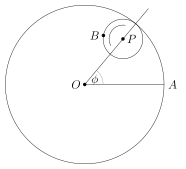
In the figure, the large circle with centre \(O\) has radius \(4\) and the small circle with centre \(P\) has radius \(1\). The small circle rolls around the inside of the larger one. When \(P\) was on the line \(OA\) (before the small circle began to roll), the point \(B\) was in contact with the point \(A\) on the large circle.
- By a substitution of the form \(y=k-x\) for suitable \(k\), prove that, for any function \(\mathrm{f}\), \[ \int_{0}^{\pi}x\mathrm{f}(\sin x)\,\mathrm{d}x=\pi\int_{0}^{\frac{1}{2}\pi}\mathrm{f}(\sin x)\,\mathrm{d}x. \] Hence or otherwise evaluate \[ \int_{0}^{\pi}\frac{x}{2+\sin x}\,\mathrm{d}x. \]
- Evaluate \[ \int_{0}^{1}\frac{(\sin^{-1}t)\cos\left[(\sin^{-1}t)^{2}\right]}{\sqrt{1-t^{2}}}\,\mathrm{d}t. \] {[}No credit will be given for numerical answers obtained by use of a calculator.{]}
- \begin{align*} y = \pi - x, \d y = -\d x: && \int_0^{\pi} x f(\sin x) &= \int_{y = \pi}^{y = 0}(\pi - y) f(\sin(\pi-y))- \d y \\ &&&= \int_0^{\pi} (\pi -y) f(\sin y) \d y \\ \Rightarrow && 2 \int_0^{\pi} x f(\sin x)\d x &= \pi \int_0^{\pi} f(\sin x) \d x \\ &&&= \pi \int_0^{\pi/2} f(\sin x ) \d x + \pi \int_{\pi/2}^{\pi} f(\sin x ) \d x \\ &&&= \pi \int_0^{\pi/2} f(\sin x ) \d x +\pi \int_{y=\pi/2}^{y=0} f(\sin (\pi-y) ) (-\d y) \\ &&&= 2 \pi \int_0^{\pi/2} f(\sin x) \d x \\ \Rightarrow && \int_0^{\pi} x f(\sin x)\d x &= \pi \int_0^{\pi/2} f(\sin x) \d x \end{align*} Therefore if \(f(x) = \frac1{2+\sin x}\), letting \(t = \tan \frac{x}{2}\) we have \(\sin x = \frac{2 t}{1+t^2}, \frac{dt}{\d x} = \frac12 (1+t^2)\) \begin{align*} && \int_0^{\pi} \frac{x}{2 + \sin x } \d x &= \pi \int_0^{\pi/2} \frac{1}{2 + \sin x} \d x \\ &&&= \pi \int_{t = 0}^{t = 1} \frac{1}{2+\frac{2t}{1+t^2}} \frac{2}{1+t^2} \d t \\ &&&=\pi \int_0^1 \frac{2}{2t^2+2t+2} \d t\\ &&&=\pi \int_0^1 \frac{1}{(t+\tfrac12)^2 + \tfrac34} \d t\\ &&&= \pi \left [\frac{1}{\sqrt{3/4}} \tan^{-1} \frac{u}{\sqrt{3/4}} \right ]_{u=1/2}^{3/2} \\ &&&= \frac{2 \pi}{\sqrt{3}} \left ( \tan^{-1} \sqrt{3} - \tan^{-1} \frac1{\sqrt{3}} \right) \\ &&&= \frac{2 \pi}{\sqrt{3}} \left ( \frac{\pi}{3} - \frac{\pi}{6} \right) \\ &&&= \frac{\pi^2}{3\sqrt{3}} \end{align*}
- Let \(u = (\sin^{-1} t)^2, \frac{\d u}{\d t} = 2(\sin^{-1} t) \frac{1}{\sqrt{1-t^2}}\) \begin{align*} \int_{0}^{1}\frac{(\sin^{-1}t)\cos\left[(\sin^{-1}t)^{2}\right]}{\sqrt{1-t^{2}}}\,\mathrm{d}t &= \int_{u=0}^{\pi^2/4} \frac12 \cos u \d u \\ &= \frac12 \sin \frac{\pi^2}{4} \end{align*}
Show by means of a sketch, or otherwise, that if \(0\leqslant\mathrm{f}(y)\leqslant\mathrm{g}(y)\) for \(0\leqslant y\leqslant x\) then \[ 0\leqslant\int_{0}^{x}\mathrm{f}(y)\,\mathrm{d}y\leqslant\int_{0}^{x}\mathrm{g}(y)\,\mathrm{d}y. \] Starting from the inequality \(0\leqslant\cos y\leqslant1,\) or otherwise, prove that if \(0\leqslant x\leqslant\frac{1}{2}\pi\) then \(0\leqslant\sin x\leqslant x\) and \(\cos x\geqslant1-\frac{1}{2}x^{2}.\) Deduce that \[ \frac{1}{1800}\leqslant\int_{0}^{\frac{1}{10}}\frac{x}{(2+\cos x)^{2}}\,\mathrm{d}x\leqslant\frac{1}{1797}. \] Show further that if \(0\leqslant x\leqslant\frac{1}{2}\pi\) then \(\sin x\geqslant x-\frac{1}{6}x^{3}.\) Hence prove that \[ \frac{1}{3000}\leqslant\int_{0}^{\frac{1}{10}}\frac{x^{2}}{(1-x+\sin x)^{2}}\,\mathrm{d}x\leqslant\frac{2}{5999}. \]