Integration
You need not consider the convergence of the improper integrals in this question.
- Use the substitution \(x = u^{-1}\) to show that \[\int_0^{\infty} \frac{\sqrt{x}-1}{\sqrt{x(x^3+1)}} \, dx = 0.\]
- Use the substitution \(x = u^{-2}\) to show that \[\int_0^{\infty} \frac{1}{\sqrt{x^3+1}} \, dx = 2\int_0^{\infty} \frac{1}{\sqrt{x^6+1}} \, dx.\]
- Find, in terms of \(p\) and \(s\), a value of \(r\) for which \[\int_0^{\infty} \frac{x^r - 1}{\sqrt{x^s(x^p+1)}} \, dx = 0,\] given that \(p\) and \(s\) are fixed values for which the required integrals converge.
- Show that, for any positive value of \(k\), it is possible to find values of \(p\) and \(q\) for which \[\int_0^{\infty} \frac{1}{\sqrt{x^p+1}} \, dx = k\int_0^{\infty} \frac{1}{\sqrt{x^q+1}} \, dx.\]
- \begin{align*} && I &= \int_0^{\infty} \frac{\sqrt{x}-1}{\sqrt{x(x^3+1)}} \, dx \\ x = u^{-1}, \d x = -u^{-2} \d u: && &= \int_{u=\infty}^{u = 0} \frac{u^{-1/2} - 1}{\sqrt{u^{-1}(u^{-3}+1)}} (-u^{-2}) \d u \\ &&&= \int_0^\infty \frac{u^{-1/2} -1}{\sqrt{1+u^3}} \d u \\ &&&= \int_0^\infty \frac{1-\sqrt{u}}{\sqrt{u(u^3+1)}} \d u \\ &&&= -I \\ \Rightarrow && I &= 0 \end{align*}
- \begin{align*} && I &= \int_0^{\infty} \frac{1}{\sqrt{x^3+1}} \, dx \\ x = u^{-2}, \d x = -2u^{-3} \d u: && &= \int_{u = \infty}^{u = 0} \frac{1}{\sqrt{u^{-6}+1}} (-2u^{-3}) \d u \\ &&&= \int_0^\infty \frac{2}{\sqrt{1+u^6}} \d u \\ &&&= 2\int_0^{\infty} \frac{1}{\sqrt{x^6+1}} \, \d x \end{align*}
- \begin{align*} && I &= \int_0^{\infty} \frac{x^r - 1}{\sqrt{x^s(x^p+1)}} \, dx \\ x = u^{-1}, \d x = - u^{-2} \d t: &&&= \int_{u=\infty}^{u = 0} \frac{u^{-r}-1}{\sqrt{u^{-s}(u^{-p}+1)}} (- u^{-2}) \d u \\ &&&= \int_0^\infty \frac{u^{-r}-1}{\sqrt{u^{4-s}(u^{-p}+1)}} \d u \\ &&&= \int_0^\infty \frac{1-u^{r}}{\sqrt{u^{4-s+2r}(u^{-p}+1)}} \d u \\ &&&= \int_0^\infty \frac{1-u^{r}}{\sqrt{u^{4-s+2r-p}(1+u^p)}} \d u \\ \end{align*} Therefore if \(4-s+2r-p = s\) or \(r = \frac{p}2+s-2\) we have \(I = -I\), ie \(I = 0\).
- \begin{align*} && I &= \int_0^{\infty} \frac{1}{\sqrt{x^p+1}} \, dx \\ x = u^{-t}, \d x = -t u^{-t-1}:&&&= \int_{u = -\infty}^{u = 0} \frac{1}{\sqrt{u^{-pt}+1}} (-t u^{-t-1}) \d u \\ &&&= t \int_0^\infty \frac1{\sqrt{u^{-pt+2t+2}+u^{2t+2}}} \d u \end{align*} Therefore if \(\begin{cases} 2t+2 &= q \\ 2t+2 -pt &= 0 \end{cases}\), ie \(q = 2t+2, p = 2 + 2/t\) we will have found the \(p, q\) desired for any \(t\) (or \(k\)). [Alternatively] Let \(\displaystyle I(p) =\int_0^{\infty} \frac{1}{\sqrt{x^p+1}} \, dx\), then clearly \(I(p)\) is decreasing and as \(p \to \infty\) \(I(p) \to 1\), so our integral can take any values on \((1, \infty)\) and so for any positive value we can find two values with a given ratio. In particular given \(k\) and \(p\) we can find a suitable \(q\).
You need not consider the convergence of the improper integrals in this question. For \(p, q > 0\), define $$b(p,q) = \int_0^1 x^{p-1}(1-x)^{q-1} \, dx$$
- Show that \(b(p,q) = b(q,p)\).
- Show that \(b(p+1,q) = b(p,q) - b(p,q+1)\) and hence that \(b(p+1,p) = \frac{1}{2}b(p,p)\).
- Show that $$b(p,q) = 2\int_0^{\pi/2} (\sin\theta)^{2p-1}(\cos\theta)^{2q-1} \, d\theta$$ Hence show that \(b(p,p) = \frac{1}{2^{2p-1}}b(p,\frac{1}{2})\).
- Show that $$b(p,q) = \int_0^\infty \frac{t^{p-1}}{(1+t)^{p+q}} \, dt$$
- Evaluate $$\int_0^\infty \frac{t^{3/2}}{(1+t)^6} \, dt$$
- \begin{align*} && b(p,q) &= \int_0^1 x^{p-1}(1-x)^{q-1}\, \d x \\ u = 1-x, \d u = -\d x && &= \int_{u=1}^{u = 0} (1-u)^{p-1}u^{q-1} (-1) \, \d u \\ &&&= \int_0^1 (1-u)^{p-1}u^{q-1} \d u \\ &&&= \int_0^1 u^{q-1}(1-u)^{p-1} \d u \\ &&&= b(q,p) \end{align*}
- \begin{align*} b(p+1,q) + b(p,q+1) &= \int_0^1 x^p(1-x)^{q-1} \d x + \int_0^1 x^{p-1}(1-x)^{q} \d x \\ &= \int_0^1 \left (x^p(1-x)^{q-1} + x^{p-1}(1-x)^{q}\right) \d x \\ &= \int_0^1 x^{p-1}(1-x)^{q-1} \left (x + (1-x) \right) \d x \\ &= \int_0^1 x^{p-1}(1-x)^{q-1} \d x \\ &= b(p,q) \end{align*} Therefore \(b(p+1,q) = b(p,q) - b(p,q+1)\), in particular \(2b(p+1,p) = b(p+1,p)+b(p,p+1) = b(p,p) \Rightarrow b(p+1,p) = \frac12 b(p,p)\) as required.
- \begin{align*} && b(p,q) &= \int_0^1 x^{p-1} (1-x)^{q-1} \d x \\ x = \sin^2 \theta, \d x = 2 \sin \theta \cos \theta \d \theta && &= \int_{u=0}^{u = \pi/2} \sin^{2p-2} \theta (1-\sin^2 \theta)^{q-1} \cdot 2 \sin \theta \cos \theta \d \theta \\ &&&= 2 \int_0^{\pi/2} \sin^{2p-1} \theta \cos^{2q-2} \cos \theta \d \theta \\ &&&= 2 \int_0^{\pi/2} \sin^{2p-1} \theta \cos^{2q-1} \theta \d \theta \end{align*} \begin{align*} b(p,p) &= 2\int_0^{\pi/2} (\sin \theta)^{2p-1}(\cos \theta)^{2p-1} \d \theta \\ &= 2 \int_0^{\pi/2} \left (\frac12 \sin 2\theta \right)^{2p-1} \d \theta \\ &= \frac1{2^{2p-1}} 2 \int_0^{\pi/2} (\sin 2 \theta)^{2p-1} \d \theta \\ &= \frac1{2^{2p-1}} 2 \int_{x=0}^{x=\pi} (\sin x)^{2p-1} 2 \d x\\ &= \frac1{2^{2p-1}} 2 \int_{x=0}^{x=\pi/2} (\sin x)^{2p-1} \d x\\ &= \frac1{2^{2p-1}} 2 \int_{0}^{\pi/2} (\sin x)^{2p-1} (\cos x)^{0} \d x\\ &= \frac1{2^{2p-1}} b(p,\tfrac12) \end{align*}
- \begin{align*} &&b(p,q) &= \int_0^1 x^{p-1}(1-x)^{q-1} \d x \\ t = \frac{x}{1-x}, \d t = (1-x)^{-2} \d x &&&= \int_{t=0}^{t = \infty} \left ( \frac{t}{1+t} \right)^{p-1} \left ( 1-\frac{t}{1+t} \right)^{q+1} \d t\\ x = \frac{t}{1+t} && &=\int_0^\infty t^{p-1} (1+t)^{-(p-1)-(q+1)} \d t \\ &&&= \int_0^{\infty} \frac{t^{p-1}}{(1+t)^{p+q}} \d t \end{align*}
- \begin{align*} I &= \int_0^\infty \frac{t^{3/2}}{(1+t)^6} \, dt \\ &= b( \tfrac52, \tfrac72) \\ &= b( \tfrac52, \tfrac52+1) \\ &= \tfrac12 b( \tfrac52, \tfrac52) \\ &= \frac12 \cdot \frac1{2^{4}} b(\tfrac52, \tfrac12) \\ &= \frac{1}{2^5} \cdot 2 \int_0^{\pi/2} (\sin \theta)^{4} \d \theta \\ &= \frac1{2^4} \int_0^{\pi/2}\left (\frac{1-\cos 2 \theta}{2} \right)^2 \d \theta \\ &= \frac1{2^6} \int_0^{\pi/2}\left (1 - 2 \cos 2 \theta + \cos^{2} 2 \theta \right) \d \theta \\ &= \frac1{2^6} \int_0^{\pi/2}\left (1 - 2 \cos 2 \theta + \frac{\cos 4 \theta + 1}{2} \right) \d \theta \\ &= \frac1{2^6} \left [\frac32 \theta - \sin 2 \theta + \frac18 \sin 4 \theta \right]_0^{\pi/2} \\ &= \frac1{2^6} \frac{3 \pi}{4} \\ &= \frac{3 \pi}{2^8} \end{align*}
In this question, the following theorem may be used without proof. Let \(u_1, u_2, \ldots\) be a sequence of real numbers. If the sequence is
- bounded above, so \(u_n \leqslant b\) for all \(n\), where \(b\) is some fixed number
- and increasing, so \(u_n \leqslant u_{n+1}\) for all \(n\)
- By considering \((\sqrt{x_n} - \sqrt{y_n})^2\), show that \(y_{n+1} < x_{n+1}\), for \(n \geqslant 0\). Show further that, for \(n \geqslant 0\)
- \(x_{n+1} < x_n\)
- \(y_n < y_{n+1}\).
- Let \[ \mathrm{I}(p,q) = \int_0^{\infty} \frac{1}{\sqrt{(p^2 + x^2)(q^2 + x^2)}}\,\mathrm{d}x, \] where \(p\) and \(q\) are positive real numbers with \(q < p\). Show, using the substitution \(t = \frac{1}{2}\!\left(x - \dfrac{pq}{x}\right)\) in the integral \[ \int_{-\infty}^{\infty} \frac{1}{\sqrt{\left(\frac{1}{4}(p+q)^2 + t^2\right)(pq + t^2)}}\,\mathrm{d}t, \] that \[ \mathrm{I}(p,q) = \mathrm{I}\!\left(\mathrm{a}(p,q),\, \mathrm{g}(p,q)\right). \] Hence evaluate \(\mathrm{I}(x_0, y_0)\) in terms of \(M\).
- Show that making the substitution \(x = \frac{1}{t}\) in the integral \[\int_a^b \frac{1}{(1+x^2)^{\frac{3}{2}}}\,\mathrm{d}x\,,\] where \(b > a > 0\), gives the integral \[\int_{b^{-1}}^{a^{-1}} \frac{-t}{(1+t^2)^{\frac{3}{2}}}\,\mathrm{d}t\,.\]
- Evaluate:
- \(\displaystyle\int_{\frac{1}{2}}^{2} \frac{1}{(1+x^2)^{\frac{3}{2}}}\,\mathrm{d}x\,;\)
- \(\displaystyle\int_{-2}^{2} \frac{1}{(1+x^2)^{\frac{3}{2}}}\,\mathrm{d}x\,.\)
- Show that \[\int_{\frac{1}{2}}^{2} \frac{1}{(1+x^2)^2}\,\mathrm{d}x = \int_{\frac{1}{2}}^{2} \frac{x^2}{(1+x^2)^2}\,\mathrm{d}x = \frac{1}{2}\int_{\frac{1}{2}}^{2} \frac{1}{1+x^2}\,\mathrm{d}x\,,\] and hence evaluate \[\int_{\frac{1}{2}}^{2} \frac{1}{(1+x^2)^2}\,\mathrm{d}x\,.\]
- Evaluate \[\int_{\frac{1}{2}}^{2} \frac{1-x}{x(1+x^2)^{\frac{1}{2}}}\,\mathrm{d}x\,.\]
- Let \(\mathrm{f}\) be a continuous function defined for \(0 \leqslant x \leqslant 1\). Show that \[\int_0^1 \mathrm{f}(\sqrt{x})\,\mathrm{d}x = 2\int_0^1 x\,\mathrm{f}(x)\,\mathrm{d}x\,.\]
- Let \(\mathrm{g}\) be a continuous function defined for \(0 \leqslant x \leqslant 1\) such that \[\int_0^1 \big(\mathrm{g}(x)\big)^2\,\mathrm{d}x = \int_0^1 \mathrm{g}(\sqrt{x})\,\mathrm{d}x - \frac{1}{3}\,.\] Show that \(\displaystyle\int_0^1 \big(\mathrm{g}(x) - x\big)^2\,\mathrm{d}x = 0\) and explain why \(\mathrm{g}(x) = x\) for \(0 \leqslant x \leqslant 1\).
- Let \(\mathrm{h}\) be a continuous function defined for \(0 \leqslant x \leqslant 1\) with derivative \(\mathrm{h}'\) such that \[\int_0^1 \big(\mathrm{h}'(x)\big)^2\,\mathrm{d}x = 2\mathrm{h}(1) - 2\int_0^1 \mathrm{h}(x)\,\mathrm{d}x - \frac{1}{3}\,.\] Given that \(\mathrm{h}(0) = 0\), find \(\mathrm{h}\).
- Let \(\mathrm{k}\) be a continuous function defined for \(0 \leqslant x \leqslant 1\) and \(a\) be a real number, such that \[\int_0^1 \mathrm{e}^{ax}\big(\mathrm{k}(x)\big)^2\,\mathrm{d}x = 2\int_0^1 \mathrm{k}(x)\,\mathrm{d}x + \frac{\mathrm{e}^{-a}}{a} - \frac{1}{a^2} - \frac{1}{4}\,.\] Show that \(a\) must be equal to \(2\) and find \(\mathrm{k}\).
- By integrating one of the two terms in the integrand by parts, or otherwise, find \[\int \left(2\sqrt{1+x^3} + \frac{3x^3}{\sqrt{1+x^3}}\right)\,\mathrm{d}x\,.\]
- Find \[\int (x^2+2)\frac{\sin x}{x^3}\,\mathrm{d}x\,.\]
- Sketch the graph with equation \(y = \dfrac{\mathrm{e}^x}{x}\), giving the coordinates of any stationary points.
- Find \(a\) if \[\int_a^{2a} \frac{\mathrm{e}^x}{x}\,\mathrm{d}x = \int_a^{2a} \frac{\mathrm{e}^x}{x^2}\,\mathrm{d}x\,.\]
- Show that it is not possible to find distinct integers \(m\) and \(n\) such that \[\int_m^n \frac{\mathrm{e}^x}{x}\,\mathrm{d}x = \int_m^n \frac{\mathrm{e}^x}{x^2}\,\mathrm{d}x\,.\]
- Show that \[ \int_{-a}^{a} \frac{1}{1+\mathrm{e}^x}\,\mathrm{d}x = a \quad \text{for all } a \geqslant 0. \]
- Explain why, if \(\mathrm{g}\) is a continuous function and \[ \int_0^a \mathrm{g}(x)\,\mathrm{d}x = 0 \quad \text{for all } a \geqslant 0, \] then \(\mathrm{g}(x) = 0\) for all \(x \geqslant 0\). Let \(\mathrm{f}\) be a continuous function with \(\mathrm{f}(x) \geqslant 0\) for all \(x\). Show that \[ \int_{-a}^{a} \frac{1}{1+\mathrm{f}(x)}\,\mathrm{d}x = a \quad \text{for all } a \geqslant 0 \] if and only if \[ \frac{1}{1+\mathrm{f}(x)} + \frac{1}{1+\mathrm{f}(-x)} - 1 = 0 \quad \text{for all } x \geqslant 0, \] and hence if and only if \(\mathrm{f}(x)\mathrm{f}(-x) = 1\) for all \(x\).
- Let \(\mathrm{f}\) be a continuous function such that, for all \(x\), \(\mathrm{f}(x) \geqslant 0\) and \(\mathrm{f}(x)\mathrm{f}(-x) = 1\). Show that, if \(\mathrm{h}\) is a continuous function with \(\mathrm{h}(x) = \mathrm{h}(-x)\) for all \(x\), then \[ \int_{-a}^{a} \frac{\mathrm{h}(x)}{1+\mathrm{f}(x)}\,\mathrm{d}x = \int_0^a \mathrm{h}(x)\,\mathrm{d}x\,. \]
- Hence find the exact value of \[ \int_{-\frac{1}{2}\pi}^{\frac{1}{2}\pi} \frac{\mathrm{e}^{-x}\cos x}{\cosh x}\,\mathrm{d}x\,. \]
- \(\,\) \begin{align*} && I &= \int_{-a}^a \frac{1}{1+e^x} \d x \\ &&&= \int_{-a}^a \frac{e^{-x}}{e^{-x}+1} \d x \\ &&&= \left [ -\ln(1 + e^{-x} ) \right ]_{-a}^a \\ &&&= \ln(1 + e^a) - \ln(1 + e^{-a}) \\ &&&= \ln \left ( \frac{1+e^a}{1+e^{-a}} \right) \\ &&&= \ln \left ( e^a \frac{1+e^a}{e^a+1} \right) \\ &&& = a \end{align*}
- Suppose \(g\) is continuous and \(\int_0^a g(x) \d x = 0\) for all \(a \geq 0\) then \(g(x) = 0\) for all \(x\). Proof: Differentiate with respect to \(a\) to obtain \(g(a) = 0\) for all \(a\) as required. \begin{align*} && a &= \int_{-a}^a \frac{1}{1+ f(x)} \d x \\ \Leftrightarrow && 1 &= \frac{1}{1 + f(a)} + \frac{1}{1 + f(-a)} \tag{FTC} \\ \Leftrightarrow && (1+f(x))(1+f(-x)) &= 2+f(-x) + f(x) \\ \Leftrightarrow && f(x) f(-x) & = 1 \end{align*}
- \(\,\) \begin{align*} && J &= \int_{-a}^a \frac{h(x)}{1 + f(x)} \d x \\ y = - x: &&&=\int_{-a}^a \frac{h(-y)}{1 + f(-y)} \d y \\ &&&= \int_{-a}^a \frac{h(y)}{1 + f(-y)} \d y \\ \Rightarrow && 2J &= \int_{-a}^a h(x) \left ( \frac{1}{1+f(x)} + \frac{1}{1+f(-x)} \right) \d x \\ &&&= \int_{-a}^a h(x) \d x \\ &&&= \int_{-a}^0 h(x) \d x + \int_0^a h(x) \d x\\ &&&= \int_0^a h(-x) \d x + \int_0^a h(x) \d x \\ &&&= 2 \int_0^a h(x) \d x \\ \Rightarrow && J &= \int_0^a h(x) \d x \end{align*}
- First notice that \(h(x) = \cos x = h(-x)\). Also notice that if \(f(x) = e^{2x}\) then \(f(x)f(-x) = 1\) so \begin{align*} && K &= \int_{-\frac12 \pi}^{\frac12\pi} \frac{e^{-x}\cos x}{\cosh x} \d x \\ &&&= \int_{-\frac12 \pi}^{\frac12\pi} \frac{2h(x)}{1+f(x)} \d x \\ &&&= 2 \int_0^{\frac12 \pi} h(x) \d x \\ &&&= 2 \int_0^{\frac12 \pi} \cos x \d x \\ &&&= 2 \end{align*}
- Show that, for \(n = 2, 3, 4, \ldots\), \[ \frac{d^2}{dt^2}\bigl[t^n(1-t)^n\bigr] = n\,t^{n-2}(1-t)^{n-2}\bigl[(n-1) - 2(2n-1)t(1-t)\bigr]. \]
- The sequence \(T_0, T_1, \ldots\) is defined by \[ T_n = \int_0^1 \frac{t^n(1-t)^n}{n!}\,e^t\,dt. \] Show that, for \(n \geqslant 2\), \[ T_n = T_{n-2} - 2(2n-1)T_{n-1}. \]
- Evaluate \(T_0\) and \(T_1\) and deduce that, for \(n \geqslant 0\), \(T_n\) can be written in the form \[ T_n = a_n + b_n e, \] where \(a_n\) and \(b_n\) are integers (which you should not attempt to evaluate).
- Show that \(0 < T_n < \dfrac{e}{n!}\) for \(n \geqslant 0\). Given that \(b_n\) is non-zero for all~\(n\), deduce that \(\dfrac{-a_n}{b_n}\) tends to \(e\) as \(n\) tends to infinity.
- Use the substitution \(x = \dfrac{1}{1-u}\), where \(0 < u < 1\), to find in terms of \(x\) the integral \[\int \frac{1}{x^{\frac{3}{2}}(x-1)^{\frac{1}{2}}}\,\mathrm{d}x \quad \text{(where } x > 1\text{).}\]
- Find in terms of \(x\) the integral \[\int \frac{1}{(x-2)^{\frac{3}{2}}(x+1)^{\frac{1}{2}}}\,\mathrm{d}x \quad \text{(where } x > 2\text{).}\]
- Show that \[\int_2^{\infty} \frac{1}{(x-1)(x-2)^{\frac{1}{2}}(3x-2)^{\frac{1}{2}}}\,\mathrm{d}x = \tfrac{1}{3}\pi.\]
- \(\,\) \begin{align*} && x &= \frac1{1-u} \\ \Rightarrow && \d x &= \frac{1}{(1-u)^2} \d u \\ && I &= \int \frac{1}{x^{\frac32}(x-1)^{\frac12} } \d x \\ &&&= \int \frac1{(1-u)^{-\frac32}u^{\frac12}(1-u)^{-\frac12}} (1-u)^{-2} \d u \\ &&&= \int u^{-\frac12} \d u \\ &&&= 2\sqrt{u} + C \\ &&&= 2\sqrt{1-\frac{1}{x}} + C \end{align*}
- \(\,\) \begin{align*} && J &= \int \frac{1}{(x-2)^{\frac32}(x+1)^{\frac12}} \d x \\ y = x+1: &&&= \int \frac{1}{(y-3)^{\frac32}y^{\frac12}} \d y \\ y = 9(3-u)^{-1}: &&&= \int \frac1{\left (9(3-u)^{-1}-3 \right)^{\frac32}3(3-u)^{-\frac12}} \frac{9}{(3-u)^2} \d u \\ &&&= \int \frac1{\left (3u(3-u)^{-1} \right)^{\frac32}3(3-u)^{-\frac12}} \frac{9}{(3-u)^2} \d u \\ &&&= \frac{1}{\sqrt3} \int u^{-\frac32} \d u \\ &&&= -\frac2{\sqrt3} u^{-\frac12} + C \\ &&&= -\frac2{\sqrt3} \sqrt{\frac{y}{3(y-3)}} + C \\ &&&= -\frac2{3} \sqrt{\frac{x+1}{x-2}} + C \\ \end{align*}
- \(\,\) \begin{align*} && K &= \int_2^{\infty} \frac{1}{(x-1)(x-2)^{\frac12}(3x-2)^{\frac12}} \d x \\ y = x - 1: &&&=\int_{y=1}^{\infty} \frac{1}{y(y-1)^{\frac12}(3y+1)^{\frac12}} \d y \\ y = (1-u)^{-1}: &&&= \int_{u=0}^{u=1} \frac{1}{(1-u)^{-1}(u(1-u)^{-1})^{\frac12}((4-u)(1-u)^{-1})^{\frac12}} \frac{1}{(1-u)^2} \d u \\ &&&= \int_0^1 \frac{1}{u^{\frac12}(4-u)^{\frac12}} \d u \\ &&&= \int_0^1 \frac{1}{\sqrt{4-(u-2)^2}} \d u \\ &&&= \left [-\sin^{-1} \left ( \frac{2-u}{2} \right) \right]_0^1 \\ &&&= \sin^{-1} 1 - \sin^{-1} \tfrac12 \\ &&&= \frac{\pi}{2} - \frac{\pi}{6} = \frac{\pi}{3} \end{align*}
In this question, \(\mathrm{f}(x)\) is a quartic polynomial where the coefficient of \(x^4\) is equal to \(1\), and which has four real roots, \(0\), \(a\), \(b\) and \(c\), where \(0 < a < b < c\). \(\mathrm{F}(x)\) is defined by \(\mathrm{F}(x) = \displaystyle\int_0^x \mathrm{f}(t)\,\mathrm{d}t\). The area enclosed by the curve \(y = \mathrm{f}(x)\) and the \(x\)-axis between \(0\) and \(a\) is equal to that between \(b\) and \(c\), and half that between \(a\) and \(b\).
- Sketch the curve \(y = \mathrm{F}(x)\), showing the \(x\) co-ordinates of its turning points. Explain why \(\mathrm{F}(x)\) must have the form \(\mathrm{F}(x) = \frac{1}{5}x^2(x-c)^2(x-h)\), where \(0 < h < c\). Find, in factorised form, an expression for \(\mathrm{F}(x) + \mathrm{F}(c-x)\) in terms of \(c\), \(h\) and \(x\).
- If \(0 \leqslant x \leqslant c\), explain why \(\mathrm{F}(b) + \mathrm{F}(x) \geqslant 0\) and why \(\mathrm{F}(b) + \mathrm{F}(x) > 0\) if \(x \neq a\). Hence show that \(c - b = a\) or \(c > 2h\). By considering also \(\mathrm{F}(a) + \mathrm{F}(x)\), show that \(c = a + b\) and that \(c = 2h\).
- Find an expression for \(\mathrm{f}(x)\) in terms of \(c\) and \(x\) only. Show that the points of inflection on \(y = \mathrm{f}(x)\) lie on the \(x\)-axis.
By first multiplying the numerator and the denominator of the integrand by \((1 - \sin x)\), evaluate $$\int_0^{\frac{1}{4}\pi} \frac{1}{1 + \sin x} dx.$$ Evaluate also: $$\int_{\frac{1}{4}\pi}^{\frac{1}{3}\pi} \frac{1}{1 + \sec x} dx \quad \text{and} \quad \int_0^{\frac{1}{3}\pi} \frac{1}{(1 + \sin x)^2} dx.$$
Show SolutionThe function \(f\) is defined, for \(x > 1\), by $$f(x) = \int_1^x \sqrt{\frac{t-1}{t+1}} dt.$$ Do not attempt to evaluate this integral.
- Show that, for \(x > 2\), $$\int_2^x \sqrt{\frac{u-2}{u+2}} du = 2f\left(\frac{1}{2}x\right).$$
- Evaluate in terms of \(f\), for \(x > 0\), $$\int_0^x \sqrt{\frac{u}{u+4}} du.$$
- Evaluate in terms of \(f\), for \(x > 5\), $$\int_5^x \sqrt{\frac{u-5}{u+1}} du.$$
- Evaluate in terms of \(f\) $$\int_1^2 \frac{u^2}{\sqrt{u^2+4}} du.$$
- Let \(2t = u\), \begin{align*} \int_2^x \sqrt{\frac{u-2}{u+2}} du &= \int_{t=1}^{t=x/2} \sqrt{\frac{2t-2}{2t+2}}2 \d t \\ &= 2\int_{t=1}^{x/2} \sqrt{\frac{t-1}{t+1}} \d t \\ &= 2f\l\frac{x}{2}\r \end{align*}
- Let \(v = u-2\), \begin{align*} \int_0^x \sqrt{\frac{u}{u+4}} du &= \int_{v = 2}^{x+2} \sqrt{\frac{v-2}{v+2}} \d v \\ &= 2 f \l \frac{x+2}{2} \r \end{align*}
- Let \(v = u-2, \d v = \d u\) \begin{align*} \int_5^x \frac{u-5}{u+1} du &= \int_3^{x-2} \frac{v-3}{v+3} \d v \\ &= \int_1^{\frac{x-2}{3}} \frac{3t - 3}{3t+3} 3 \d t \\ &= 3 f \l \frac{x-2}{3} \r \end{align*}
- Let \(v = u^2, \d v = 2u \d u\)\begin{align*}\int_1^2 \frac{u^2}{\sqrt{u^2+4}} du &= \int_1^2 \sqrt{\frac{u^2}{u^2+4}} u \d u \\ &= \int_1^4 \sqrt{\frac{v}{v+4}} \frac12 \d v \\ &= f \l \frac{4+2}{2} \r - f \l \frac{3}{2} \r \\ &= f(3) - f(\frac32) \end{align*}
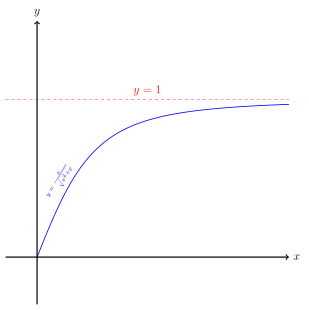
- Let $$f(x) = \frac{x}{\sqrt{x^2 + p}},$$ where \(p\) is a non-zero constant. Sketch the curve \(y = f(x)\) for \(x \geq 0\) in the case \(p > 0\).
- Let $$I = \int \frac{1}{(b^2 - y^2)\sqrt{c^2 - y^2}} \, dy,$$ where \(b\) and \(c\) are positive constants. Use the substitution \(y = \frac{cx}{\sqrt{x^2 + p}}\), where \(p\) is a suitably chosen constant, to show that $$I = \int \frac{1}{b^2 + (b^2 - c^2)x^2} \, dx.$$ Evaluate $$\int_1^{\sqrt{2}} \frac{1}{(3 - y^2)\sqrt{2 - y^2}} \, dy.$$ [ Note: \(\int \frac{1}{a^2 + x^2} \, dx = \frac{1}{a} \tan^{-1} \frac{x}{a} + \text{constant.}\) ] Hence evaluate $$\int_{\frac{1}{\sqrt{2}}}^1 \frac{y}{(3y^2 - 1)\sqrt{2y^2 - 1}} \, dy.$$
- By means of a suitable substitution, evaluate $$\int_{\frac{1}{\sqrt{2}}}^1 \frac{1}{(3y^2 - 1)\sqrt{2y^2 - 1}} \, dy.$$
- \(\,\)
- \(\,\) \begin{align*} && y &= \frac{cx}{\sqrt{x^2+p}} \\ && \d y &= \frac{c(x^2+p)-cx^2}{(x^2+p)^{3/2}} \d x \\ &&&= \frac{cp^2}{(x^2+p)^{3/2}} \d x\\ && I &= \int \frac1{(b^2-y^2)\sqrt{c^2-y^2}} \d y \\ &&&= \int \frac{1}{\left ( b^2 - \frac{c^2x^2}{x^2+p} \right) \sqrt{c^2 - \frac{c^2x^2}{x^2+p} }} \d y \\ &&&= \int \frac{(x^2+p)^{3/2}}{((b^2-c^2)x^2+pb^2)\sqrt{c^2p}}\frac{cp}{(x^2+p)^{3/2}} \d x \\ &&&= \int \frac{\sqrt{p}}{((b^2-c^2)x^2+pb^2)} \d x \\ p=1: &&&= \int \frac{1}{(b^2-c^2)x^2+b^2} \d x \end{align*} When \(b = \sqrt{3}, c = \sqrt{2}\) \begin{align*} && I_1 &= \int_1^{\sqrt{2}} \frac{1}{(3 - y^2)\sqrt{2 - y^2}} \d y\\ &&&= \int_{x =1 }^{x=\infty} \frac{1}{3+x^2} \d x \\ &&&= \left [ \frac{1}{\sqrt{3}} \tan^{-1} \frac{x}{\sqrt{3}} \right]_1^\infty \\ &&&= \frac{\pi}{2\sqrt{3}} - \frac{1}{\sqrt{3}} \frac{\pi}{6} \\ &&&= \frac{\pi}{3\sqrt{3}} \end{align*} \begin{align*} && I_2 &= \int_{\frac{1}{\sqrt{2}}}^1 \frac{y}{(3y^2 - 1)\sqrt{2y^2 - 1}} \d y \\ x = \frac1y, \d x = -\frac1{y^2} \d y &&&= \int_{x=\sqrt{2}}^{x=1} \frac{x^2}{(3-x^2)\sqrt{2-x^2}}\cdot \left ( -\frac{1}{x^2} \right ) \d x \\ &&&= \int_1^{\sqrt{2}} \frac{1}{(3-x^2)\sqrt{2-x^2}} \d x \\ &&&= I_1 = \frac{\pi}{3\sqrt{3}} \end{align*}
- \(\,\) \begin{align*} && I_3 &= \int_{\frac{1}{\sqrt{2}}}^1 \frac{1}{(3y^2 - 1)\sqrt{2y^2 - 1}} \d y \\ x = 1/y, \d x = -1/y^2 \d y &&&= \int_{x=1}^{x=\sqrt{2}} \frac{x}{(3-x^2)\sqrt{2-x^2}} \d x \\ u = x^2, \d u = 2x \d x &&&= \int_{u=1}^{u=2} \frac{\frac12}{(3-u)\sqrt{2-u}} \d u \\ v=2-u, \d v = -\d u &&&= \frac12\int_{v=0}^{v=1} \frac{1}{(1+v)\sqrt{v}} \d v \\ &&&=\left [\tan^{-1}\sqrt{v}\right]_0^1 \\ &&&= \frac{\pi}{4} \end{align*}
The function \(\f\) is defined by \[ \phantom{\ \ \ \ \ \ \ \ \ \ \ \ (x>0, \ \ x\ne1)} \f(x) = \frac{1}{x\ln x} \left(1 - (\ln x)^2 \right)^2 \ \ \ \ \ \ \ \ \ \ \ \ (x>0, \ \ x\ne1) \,.\] Show that, when \(( \ln x )^2 = 1\,\), both \(\f(x)=0\) and \(\f'(x)=0\,\). The function \(F\) is defined by \begin{align*} F(x) = \begin{cases} \displaystyle \int_{ 1/\text{e}}^x \f(t) \; \mathrm{d}t & \text{ for } 0 < x < 1\,, \\[7mm] \displaystyle \int_{\text{e}}^x \f(t) \; \mathrm{d}t & \text{ for } x > 1\,. \\ \end{cases} \end{align*}
- Find \(F(x)\) explicitly and hence show that \(F(x^{-1})=F(x)\,\).
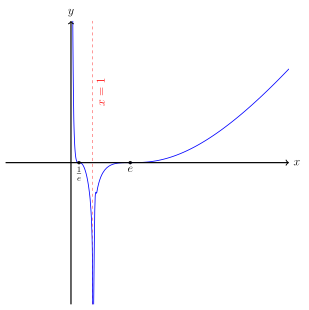
- Sketch the curve with equation \(y=F(x)\,\). [You may assume that \(\dfrac{ (\ln x)^k} x\to 0\) as \(x\to\infty\) for any constant \(k\).]
- First consider \(0 < x < 1\), so \begin{align*} && F(x) &= \int_{1/e}^x f(t) \d t \\ &&&= \int_{1/e}^x \frac{1}{t\ln t} \left(1 - (\ln t)^2 \right)^2 \d t \\ u = \ln t, \d u = \frac1t \d t: &&&= \int_{u=-1}^{u=\ln x} \frac{1}{u}(1-u^2)^2 \d u \\ &&&= \int_{-1}^{\ln x} \left ( u^3 - 2u+\frac1u \right) \d u \\ &&&= \left [ \frac{u^4}{4} - u^2+ \ln |u| \right]_{-1}^{\ln x} \\ &&&= \frac{(\ln x)^4}{4} -(\ln x)^2 + \ln |\ln x| - \frac14+1 \end{align*} Now consider \(x > 1\) \begin{align*} && F(x) &= \int_{e}^x f(t) \d t \\ &&&= \int_{e}^x \frac{1}{t\ln t} \left(1 - (\ln t)^2 \right)^2 \d t \\ u = \ln t, \d u = \frac1t \d t: &&&= \int_{u=1}^{u=\ln x} \frac{1}{u}(1-u^2)^2 \d u \\ &&&= \int_{1}^{\ln x} \left ( u^3 - 2u+\frac1u \right) \d u \\ &&&= \left [ \frac{u^4}{4} - u^2+ \ln |u| \right]_{1}^{\ln x} \\ &&&= \frac{(\ln x)^4}{4} -(\ln x)^2 + \ln| \ln x| - \frac14+1 \end{align*} Notice that \begin{align*} F(x^{-1}) &= \frac{(\ln x^{-1})^4}{4} -(\ln x^{-1})^2 + \ln| \ln x^{-1}| - \frac14+1 \\ &= \frac{(-\ln x)^4}{4} -(-\ln x)^2 + \ln| -\ln x| - \frac14+1 \\ &= \frac{(\ln x)^4}{4} -(\ln x)^2 + \ln| \ln x| - \frac14+1 \\ &= F(x) \end{align*}
- \(\,\)
The functions \(\s\) and \(\c\) satisfy \(\s(0)= 0\,\), \(\c(0)=1\,\) and \[ \s'(x) = \c(x)^2 ,\] \[ \c'(x)=-\s(x)^2. \] You may assume that \(\s\) and \(\c\) are uniquely defined by these conditions.
- Show that \(\s(x)^3+\c(x)^3\) is constant, and deduce that \(\s(x)^3+\c(x)^3=1\,\).
- Show that \[ \frac{\d }{\d x} \, \Big( \s(x) \c(x) \Big) = 2\c(x)^3-1 \] and find (and simplify) an expression in terms of \(\c(x)\) for $\dfrac{\d }{\d x} \left( \dfrac{\s(x)}{\c(x)} \right) $.
- Find the integrals \[ \int \s(x)^2 \, \d x \ \ \ \ \ \ \text{and} \ \ \ \ \ \ \int \s(x)^5 \, \d x \,. \]
- Given that \(\s\) has an inverse function, \(\s^{-1}\), use the substitution \(u = \s(x)\) to show that \[ \int \frac{1}{(1-u^3)^{\frac{2}{3}}} \, \d u = \s^{-1}(u) \, + \text{constant}. \]
- Find, in terms of \(u\), the integrals \[ \int \frac{1}{{(1-u^3)}^{\frac{4}{3}}} \, \d u \ \ \ \ \ \ \text{and} \ \ \ \ \ \ \int {(1-u^3)}^{\frac{1}{3}} \, \d u \,. \]
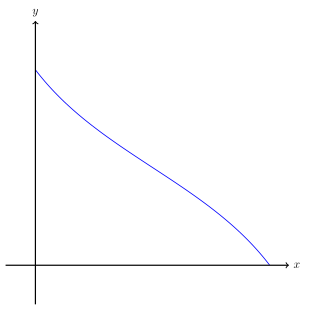
- Let \[ \f(x) = \frac 1 {1+\tan x} \] for \(0\le x < \frac12\pi\,\). Show that \(\f'(x)= -\dfrac{1}{1+\sin 2x}\) and hence find the range of \(\f'(x)\). Sketch the curve \(y=\f(x)\).
- The function \(\g(x)\) is continuous for \(-1\le x \le 1\,\). Show that the curve \(y=\g(x)\) has rotational symmetry of order 2 about the point \((a,b)\) on the curve if and only if \[ \g(x) + \g(2a-x) = 2b\,. \] Given that the curve \(y=\g(x)\) passes through the origin and has rotational symmetry of order 2 about the origin, write down the value of \[\displaystyle \int_{-1}^1 \g(x)\,\d x\,. \]
- Show that the curve \(y=\dfrac{1}{1+\tan^kx}\,\), where \(k\) is a positive constant and \(0 < x < \frac12\pi\,\), has rotational symmetry of order 2 about a certain point (which you should specify) and evaluate \[ \int_{\frac16\pi}^{\frac13\pi} \frac 1 {1+\tan^kx} \, \d x \,. \]
- \(\,\) \begin{align*}
&& f(x) &= \frac1{1+\tan x} \\
&& f'(x) &=-(1+\tan x)^{-2} \cdot \sec^2 x \\
&&&= - (\cos x+ \sin x)^{-2} \\
&&&= - (1 + 2 \sin x \cos x)^{-1} \\
&&&= - \frac{1}{1+\sin 2x}
\end{align*}
\(\sin 2x \in [0, 1]\) so \(1+\sin 2x \in [1,2]\) and \(f'(x) \in [-1, -\tfrac12]\)
- \(\displaystyle \int_{-1}^1 g(x) \d x = 2g(0) \)
- Let \(g(x) = \frac{1}{1 + \tan^k x}\) then \(g(x)\) has rotational symmetry of order \(2\) about the point \((\frac{\pi}{4}, \frac12)\) which we can see since \begin{align*} g(x) + g(\tfrac12\pi - x) &= \frac{1}{1 + \tan^k x} + \frac{1}{1 + \tan^k(\tfrac12\pi - x)} \\ &= \frac{1}{1+\tan^k x} + \frac{1}{1+\cot^k x} \\ &= \frac{1}{1+\tan^k x} + \frac{\tan^k x}{\tan^k x + 1} \\ &= 1 = 2 \cdot \tfrac12 \end{align*} Therefore \[ \int_{\frac16\pi}^{\frac13\pi} \frac 1 {1+\tan^kx} \, \d x = \frac{\pi}{6} \cdot \frac12 = \frac{\pi}{12}\]
- Use the substitution \(u= x\sin x +\cos x\) to find \[ \int \frac{x }{x\tan x +1 } \, \d x \,. \] Find by means of a similar substitution, or otherwise, \[ \int \frac{x }{x\cot x -1 } \, \d x \,. \]
- Use a substitution to find \[ \int \frac{x\sec^2 x \, \tan x}{x\sec^2 x -\tan x} \,\d x \, \] and \[ \int \frac{x\sin x \cos x}{(x-\sin x \cos x)^2} \, \d x \,. \]
- \(\,\) \begin{align*} && I &= \int \frac{x}{x \tan x + 1} \d x \\ &&&= \int \frac{x \cos x}{x \sin x + \cos x} \d x \\ u = x \sin x + \cos x , \d u = x \cos x \d x: &&&= \int \frac{\d u}{u} \\ &&&= \ln u + C \\ &&&= \ln (x \sin x + \cos x) + C \\ \\ && J &= \int \frac{x}{x \cot x - 1} \d x \\ &&&= \int \frac{x \sin x }{x \cos x - \sin x} \d x \\ u = x \cos x - \sin x, \d u = x \sin x \d x: &&&= \int \frac{1}{u} \d u \\ &&&= \ln u + K \\ &&&= \ln (x \cos x -\sin x) + K \end{align*}
- \(\,\) \begin{align*} && I &= \int \frac{x \sec^2 x \tan x}{x \sec^2 x - \tan x} \d x \\ u = x\sec^2 x-\tan x, \d u = 2x \sec^2 x \tan x&&&= \frac12 \int \frac{1}{u} \d u \\ &&&= \frac12 \ln (x \sec^2 x - \tan x) + C \\ \\ && J &= \int \frac{x \sin x \cos x}{(x - \sin x \cos x)^2} \d x \\ u = x \sec^2 x -\tan x, \d u=2x \frac{\sin x}{\cos^3 x} &&&= \int \frac{x \sin x \cos x}{\cos^4x(x\sec^2 x -\tan x)^2} \d x \\ &&&= \frac12 \int \frac{1}{u^2} \d u \\ &&&= -\frac12u^{-1} + K \\ &&&= \frac{1}{2(\tan x - x \sec^2 x)} + K \end{align*}
- The inequality \(\dfrac 1 t \le 1\) holds for \(t\ge1\). By integrating both sides of this inequality over the interval \(1\le t \le x\), show that \[ \ln x \le x-1 \tag{\(*\)} \] for \(x \ge 1\). Show similarly that \((*)\) also holds for \(0 < x \le 1\).
- Starting from the inequality \(\dfrac{1}{t^2} \le \dfrac1 t \) for \(t \ge 1\), show that \[ \ln x \ge 1-\frac{1}{x} \tag{\(**\)} \] for \(x > 0\).
- Show, by integrating (\(*\)) and (\(**\)), that \[ \frac{2}{ y+1} \le \frac{\ln y}{ y-1} \le \frac{ y+1}{2 y} \] for \( y > 0\) and \( y\ne1\).
- \(\,\) \begin{align*} (x \geq 1): && \int_1^x \frac{1}{t} \d t &\leq \int_1^x 1 \d t \\ \Rightarrow && \ln x - \ln 1 &\leq x - 1 \\ \Rightarrow && \ln x & \leq x - 1 \\ \\ (0 < x \leq 1):&& \int_x^1 1\d t &\leq \int_x^1 \frac{1}{t} \d t \\ \Rightarrow&& 1- x &\leq \ln 1 - \ln x \\ \Rightarrow&& \ln x &\leq x - 1 \end{align*}
- \(\,\) \begin{align*} (x \geq 1): && \int_1^x \frac{1}{t^2} \d t &\leq \int_1^x \frac{1}{t} \d t \\ \Rightarrow && -\frac1x+1 &\leq \ln x - \ln 1 \\ \Rightarrow && 1 - \frac1x &\leq \ln x \\ \\ (0 < x \leq 1): && \int_x^1 \frac{1}{t} \d t &\leq \int_x^1 \frac{1}{t^2} \d t \\ \Rightarrow && \ln 1 - \ln x & \leq -1 + \frac{1}{x} \\ \Rightarrow && 1 - \frac1x &\leq \ln x \\ \end{align*}
- \(\,\) \begin{align*} (1 < y): && \int_1^y \left (1 - \frac1{x} \right)\d x &\leq \int_1^y \ln x \d x \\ \Rightarrow && \left [x - \ln x \right]_1^y & \leq \left [ x \ln x - x\right]_1^y \\ \Rightarrow && y - \ln y - 1 &\leq y \ln y - y +1 \\ \Rightarrow && 2y-2 & \leq (y+1) \ln y \\ \Rightarrow && \frac{2}{y+1} & \leq \frac{\ln y}{y-1} \\ (0 < y < 1): && \int_y^1 \left (1 - \frac1{x} \right)\d x &\leq \int_y^1 \ln x \d x \\ \Rightarrow && \left [x - \ln x \right]_y^1 & \leq \left [ x \ln x - x\right]_y^1 \\ \Rightarrow && 1 - (y - \ln y) &\leq -1-(y \ln y-y) \\ \Rightarrow && 2-2y &\leq -(y+1)\ln y \\ \Rightarrow && \frac{2}{y+1} &\leq \frac{-\ln y}{1-y} \tag{\(1-y > 0\)} \\ \Rightarrow && \frac{2}{y+1} &\leq \frac{\ln y}{y-1} \\ \\ (1 < y): && \int_1^y \ln x \d x &\leq \int_1^y (x-1) \d x \\ \Rightarrow && \left [x \ln x -x \right]_1^y &\leq \left[ \frac12 x^2 - x \right]_1^y\\ \Rightarrow && y \ln y - y +1 &\leq \frac12y^2 - y+\frac12 \\ \Rightarrow && y \ln y &\leq \frac12 \left (y^2-1 \right) \\ \Rightarrow && \frac{\ln y}{y-1} &\leq \frac{y+1}{2y} \\ \\ (0 < y < 1) && \int_y^1 \ln x \d x &\leq \int_y^1 (x-1) \d x \\ \Rightarrow && \left [x \ln x -x \right]_y^1&\leq \left[ \frac12 x^2 - x \right]_y^1\\ \Rightarrow && -1-(y \ln y - y +1) &\leq-\frac12 - \left ( \frac12y^2 - y\right)\\ \Rightarrow && \frac12 \left (y^2-1 \right) &\leq y \ln y \\ \Rightarrow && \frac{\ln y}{y-1} & \leq \frac{y+1}{2y} \tag{\(y-1 < 0\)} \end{align*}
Note: In this question you may use without proof the result \( \dfrac{\d \ }{\d x}\big(\!\arctan x \big) = \dfrac 1 {1+x^2}\,\). Let \[ I_n = \int_0^1 x^n \arctan x \, \d x \;, \] where \(n=0\), 1, 2, 3, \(\ldots\) .
- Show that, for \(n\ge0\,\), \[ (n+1) I_n = \frac \pi 4 - \int _0^1 \frac {x^{n+1}}{1+x^2} \, \d x \, \] and evaluate \(I_0\).
- Find an expression, in terms of \(n\), for \((n+3)I_{n+2}+(n+1)I_{n}\,\). Use this result to evaluate \(I_4\).
- Prove by induction that, for \(n\ge1\), \[ (4n+1) I_{4n} =A - \frac12 \sum_{r=1}^{2n} (-1)^r \frac 1 {r} \,, \] where \(A\) is a constant to be determined.
- \(\,\) \begin{align*} && I_n &= \int_0^1 x^n \arctan x \d x \\ &&&= \left [ \frac{x^{n+1}}{n+1} \arctan x\right]_0^1 - \int_0^1 \frac{x^{n+1}}{n+1} \frac{1}{1+x^2} \d x \\ &&&= \frac{1}{n+1} \frac{\pi}{4} - \frac{1}{n+1} \int_0^1 \frac{x^{n+1}}{1+x^2}\d x \\ \Rightarrow && (n+1)I_n &= \frac{\pi}{4} - \int_0^1 \frac{x^{n+1}}{1+x^2}\d x \\ && I_0 &= \frac{\pi}{4} - \int_0^1 \frac{x}{1+x^2} \d x \\ &&&= \frac{\pi}{4} - \left [\frac12 \ln(1+x^2) \right]_0^1 \\ &&&= \frac{\pi}{4} - \frac12 \ln 2 \end{align*}
- \(\,\) \begin{align*} && (n+3)I_{n+2} + (n+1)I_n &=\left ( \frac{\pi}{4} - \int_0^1 \frac{x^{n+3}}{1+x^2} \d x \right)+ \left (\frac{\pi}{4} - \int_0^1 \frac{x^{n+1}}{1+x^2} \d x \right) \\ &&&=\frac{\pi}{2}+ \int_0^1 \frac{x^{n+1}+x^{n+3}}{1+x^2} \d x \\ &&&=\frac{\pi}{2}+ \int_0^1 x^{n+1} \d x \\ &&&= \frac{\pi}{2} + \frac{1}{n+2} \\ && 3I_2 + I_0 &= \frac{\pi}{2} + \frac{1}{2} \\ \Rightarrow && 3I_2 &=\frac{\pi}{4} + \frac12 \ln 2 + \frac12 \\ && 5I_4 + 3I_2 &= \frac{\pi}{2} + \frac14 \\ \Rightarrow && 5I_4 &= \frac{\pi}{2} + \frac14 - \left ( \frac{\pi}{4} + \frac12 \ln 2 + \frac12\right) \\ &&&= \frac{\pi}4-\frac12 \ln 2-\frac14 \\ \Rightarrow && I_4 &= \frac15 \left (\frac{\pi}4-\frac12 \ln 2-\frac14 \right) \\ &&&= \frac1{20} \left (\pi - 2\ln 2 -1 \right) \end{align*}
- Claim: \[ (4n+1) I_{4n} =\frac{\pi}4-\frac12 \ln 2 - \frac12 \sum_{r=1}^{2n} (-1)^r \frac 1 {r} \,, \] Proof: Base case we have just shown above Assume true for \(n = k\), consider \(n = k+1\), then \begin{align*} && (4(k+1)+1) I_{4(k+1)} &= \frac{\pi}{2} + \frac{1}{4(k+1)} - (4k+3)I_{4k+2} \\ &&&= \frac{\pi}{2} + \frac{1}{4(k+1)} - \left (\frac{\pi}{2} + \frac{1}{2(2k+1)} - (4k+1)I_{4k} \right)\\ &&&= (4k+1)I_{4k} - \frac12 \left ( \frac{1}{2k+2} - \frac{1}{2k+1}\right) \\ &&&= \frac{\pi}4-\frac12 \ln 2 - \frac12 \sum_{r=1}^{2k} (-1)^r \frac 1 {r} - \frac12 \left ( \frac{1}{2k+2} - \frac{1}{2k+1}\right)\\ &&&= \frac{\pi}4-\frac12 \ln 2 - \frac12 \sum_{r=1}^{2(k+1)} (-1)^r \frac 1 {r} \\ \end{align*} as required.
The Schwarz inequality is \[ \left( \int_a^b \f(x)\, \g(x)\,\d x\right)^{\!\!2} \le \left( \int_a^b \big( \f(x)\big)^2 \d x \right) \left( \int_a^b \big( \g(x)\big)^2 \d x \right) . \tag{\(*\)} \]
- By setting \( \f(x)=1\) in \((*)\), and choosing \(\g(x)\), \(a\) and \(b\) suitably, show that for \(t> 0\,\), \[ \frac {\e^t -1}{\e^t+1} \le \frac t 2 \,. \]
- By setting \( \f(x)= x\) in \((*)\), and choosing \( \g(x)\) suitably, show that \[ \int_0^1\e^{-\frac12 x^2}\d x \ge 12 \big(1-\e^{-\frac14})^2 \,. \]
- Use \((*)\) to show that \[ \frac {64}{25\pi} \le \int_0^{\frac12\pi} \!\! {\textstyle \sqrt{\, \sin x\, } } \, \d x \le \sqrt{\frac \pi 2 } \,. \]
- Let \(f(x) = 1, g(x) = e^x, a = 0, b = t\), so \begin{align*} && \left ( \int_0^t e^x \d x \right)^2 &\leq \left (\int_0^t 1^2 \d x \right) \cdot \left (\int_0^t (e^x)^2 \d x \right) \\ \Rightarrow && (e^t-1)^2 &\leq t \cdot (\frac12e^{2t} - \frac12) \\ \Rightarrow && \frac{e^t-1}{e^t+1} & \leq \frac{t}{2} \end{align*}
- Let \(f(x) = x, g(x) = e^{-\frac14 x^2}, a = 0, b = 1\) \begin{align*} && \left ( \int_0^1 xe^{-\frac14 x^2} \d x \right)^2 &\leq \left (\int_0^1 x^2 \d x \right) \cdot \left (\int_0^1 (e^{-\frac14x^2})^2 \d x \right) \\ \Rightarrow && \left ( \left [-2e^{-\frac14x^2} \right]_0^1 \right)^2 & \leq \frac{1}{3} \int_0^1 e^{-\frac12 x^2} \d x \\ \Rightarrow && \int_0^1 e^{-\frac12 x^2} \d x & \geq 12(1-e^{-\frac14})^2 \end{align*}
- Let \(f(x) = 1, g(x) = \sqrt{\sin x}, a = 0, b = \tfrac12 \pi\), then \begin{align*} && \left ( \int_0^{\frac12 \pi} \sqrt{\sin x} \d x \right)^2 &\leq \left (\int_0^{\frac12 \pi} 1^2 \d x \right) \cdot \left (\int_0^{\frac12 \pi}|\sin x| \d x \right) \\ &&&= \frac{\pi}{2} \cdot 1 \\ \Rightarrow && \int_0^{\frac12 \pi} \sqrt{\sin x} \d x & \leq \sqrt{\frac{\pi}{2}} \end{align*} Let \(f(x) =(\sin x)^{\frac14}, g(x) = \cos x, a = 0, b = \tfrac12 \pi\), so \begin{align*} && \left ( \int_0^{\frac12 \pi} (\sin x)^{\frac14} \cos x \d x \right)^2 &\leq \left (\int_0^{\frac12 \pi} \cos^2 x \d x \right) \cdot \left (\int_0^{\frac12 \pi}\sqrt{\sin x} \d x \right) \\ \Rightarrow &&\left ( \left [\frac45 (\sin x)^{\frac54} \right]_0^{\frac12 \pi} \right)^2 & \leq \frac{\pi}{4} \int_0^{\frac12 \pi}\sqrt{\sin x} \d x \\ \Rightarrow && \frac{64}{25\pi} &\leq \int_0^{\frac12 \pi}\sqrt{\sin x} \d x \end{align*}
For any function \(\f\) satisfying \(\f(x) > 0\), we define the geometric mean, F, by \[ F(y) = e^{\frac{1}{y} \int_{0}^{y} \ln f(x) \, dx} \quad (y > 0). \]
- The function f satisfies \(\f(x) > 0\) and \(a\) is a positive number with \(a\ne1\). Prove that \[ F(y) = a^{\frac{1}{y} \int_{0}^{y} \log_a f(x) \, dx}. \]
- The functions f and g satisfy \(\f(x) > 0\) and \(\g(x) > 0\), and the function \(\h\) is defined by \(\h(x) = \f(x)\g(x)\). Their geometric means are F, G and H, respectively. Show that \(H(y)= \F(y) \G(y)\,\).
- Prove that, for any positive number \(b\), the geometric mean of \(b^x\) is \(\sqrt{b^y}\,\).
- Prove that, if \(\f(x)>0\) and the geometric mean of \(\f(x)\) is \(\sqrt{\f(y)}\,\), then \(\f(x) = b^x\) for some positive number \(b\).
- \begin{align*} && a^{\frac{1}{y} \int_{0}^{y} \log_a f(x) \, dx} &= e^{\ln a \cdot \frac{1}{y} \int_{0}^{y} \log_a f(x) \, dx} \\ &&&= e^{\ln a \cdot \frac{1}{y} \int_{0}^{y} \frac{\ln f(x)}{\ln a} \, dx} \\ &&&= e^{ \frac{1}{y} \int_{0}^{y} \ln f(x) \, dx} \\ &&&= F(y) \end{align*}
- \(\,\) \begin{align*} && H(y) &= e^{\frac1y \int_0^y \ln h(x) \d x} \\ &&&= e^{\frac1y \int_0^y \ln (f(x)g(x))\d x} \\ &&&= e^{\frac1y \int_0^y \left ( \ln f(x)+\ln g(x) \right)\d x} \\ &&&= e^{\frac1y \int_0^y \ln f(x) \d x +\frac1y \int_0^y \ln g(x) \d x} \\ &&&= e^{\frac1y \int_0^y \ln f(x) \d x }e^{\frac1y \int_0^y \ln g(x) \d x} \\ &&&= F(y)G(y) \end{align*}
- Suppose \(f(x) = b^x\), then \begin{align*} && F(y) &= b^{\frac1y \int_0^y \log_b f(x) \d x} \\ &&&= b^{\frac1y \int_0^y x \d x}\\ &&&= b^{\frac1y \frac{y^2}{2}} \\ &&&= b^{\frac{y}2} = \sqrt{b^y} \end{align*}
- Suppose the geometric mean of \(f(x)\) is \(\sqrt{f(y)}\) then the geometric mean of \(f(x)^2\) is \(f(y)\) by the the second part.
In this question, you are not permitted to use any properties of trigonometric functions or inverse trigonometric functions. The function \(\T\) is defined for \(x>0\) by \[ \T(x) = \int_0^x \! \frac 1 {1+u^2} \, \d u\,, \] and $\displaystyle T_\infty = \int_0^\infty \!\! \frac 1 {1+u^2} \, \d u\,$ (which has a finite value).
- By making an appropriate substitution in the integral for \(\T(x)\), show that \[\T(x) = \T_\infty - \T(x^{-1})\,.\]
- Let \(v= \dfrac{u+a}{1-au}\), where \(a\) is a constant. Verify that, for \(u\ne a^{-1}\), \[ \frac{\d v}{\d u} = \frac{1+v^2}{1+u^2} \,. \] Hence show that, for \(a>0\) and \(x< \dfrac1a\,\), \[ \T(x) = \T\left(\frac{x+a}{1-ax}\right) -\T(a) \,. \] Deduce that \[ \T(x^{-1}) = 2\T_\infty -\T\left(\frac{x+a}{1-ax}\right) -\T(a^{-1}) \] and hence that, for \(b>0\) and \(y>\dfrac1b\,\), \[ \T(y) =2\T_\infty - \T\left(\frac{y+b}{by-1}\right) - \T(b) \,. \]
- Use the above results to show that \(\T(\sqrt3)= \tfrac23 \T_\infty \,\) and \(\T(\sqrt2 -1)= \frac14 \T_\infty\,\).
- \(\,\) \begin{align*} && T(x) &= \int_0^x \! \frac 1 {1+u^2} \, \d u \\ &&&= \int_0^{\infty} \frac{1}{1+u^2} \d u - \int_x^\infty \frac{1}{1+u^2} \d u \\ &&&= T_\infty - \int_x^\infty \frac{1}{1+u^2} \d u \\ u = 1/v, \d u = -1/v^2 \d v: &&&= T_\infty - \int_{v=x^{-1}}^{v=0} \frac{1}{1+v^{-2}} \frac{-1}{v^2} \d v \\ &&&= T_\infty - \int_{0}^{x^{-1}} \frac{1}{1+v^2} \d v \\ &&&= T_\infty - T(x^{-1}) \end{align*}
- Let \(v = \frac{u+a}{1-au}\) then \begin{align*} && \frac{\d v}{\d u} &= \frac{(1-au) \cdot 1 - (u+a)\cdot(-a)}{(1-au)^2} \\ &&&= \frac{1-au+au+a^2}{(1-au)^2} \\ &&&= \frac{1+a^2}{(1-au)^2} \\ \\ && \frac{1+v^2}{1+u^2} &= \frac{1 + \left ( \frac{u+a}{1-ua} \right)^2}{1+u^2} \\ &&&= \frac{(1-ua)^2+(u+a)^2}{(1-ua)^2(1+u^2)} \\ &&&= \frac{1+u^2a^2+u^2+a^2}{(1-ua)^2(1+u^2)} \\ &&&= \frac{(1+u^2)(1+a^2)}{(1-ua)^2(1+u^2)} \\ &&&= \frac{1+a^2}{(1-ua)^2} \end{align*} if \(a > 0, x < \frac1a\) then \begin{align*} && T(x) &= \int_0^x \frac{1}{1+u^2} \d u \\ &&&= \int_{v=a}^{v=\frac{a+x}{1-ax}} \frac{1}{1+u^2} \frac{1+u^2}{1+v^2} \d v \\ &&&= T\left ( \frac{x+a}{1-ax} \right) - T(a) \\ \\ \Rightarrow && T(x^{-1}) &= T_\infty - T(x) \\ &&&= T_\infty - 2T\left ( \frac{x+a}{1-ax} \right) + T(a) \\ &&&= T_\infty - 2T\left ( \frac{x+a}{1-ax} \right) + T_\infty-T(a^{-1}) \\ &&&= 2T_\infty - 2T\left ( \frac{x+a}{1-ax} \right) -T(a^{-1}) \end{align*} \(b > 0, y > \frac1b\) then \(y> 0, b > \frac1y\) (same as letting \(x = \frac1y, a = \frac1b\) \begin{align*} && T(y) &= 2T_\infty - 2T \left ( \frac{\frac1y+\frac1b}{1-\frac1{by}} \right) + T(b) \\ \Rightarrow && T(y) &= 2T_\infty - 2T \left ( \frac{b+y}{by-1} \right) + T(b) \\ \end{align*}
- Letting \(y = b = \sqrt{3}\) in the final equation \begin{align*} && T(\sqrt{3}) &= 2T_{\infty} - T \left ( \frac{\sqrt{3}+\sqrt{3}}{\sqrt{3}\sqrt{3}-1} \right) -T (\sqrt{3}) \\ &&&= 2T_\infty - 2T(\sqrt{3}) \\ \Rightarrow && T(\sqrt{3}) &= \tfrac23 T_\infty \end{align*} Let \(x = \sqrt2 - 1, a = 1\) so, \begin{align*} && T(\sqrt2 -1) &= T \left ( \frac{\sqrt2-1+1}{1-\sqrt2+1} \right)-T(1) \\ &&&= T \left ( \frac{\sqrt{2}}{2-\sqrt{2}} \right) - T(1) \\ &&&= T(\frac{\sqrt{2}(2+\sqrt{2})}{2}) - T(1) \\ &&&= T(\sqrt{2}+1) - T(1) \\ &&&= T_\infty - T(\sqrt2-1)-T(1) \\ \Rightarrow && T(\sqrt{2}-1) &= \frac12T_\infty-\frac12T(1) \\ && T(1) &= T_\infty - T(1) \\ \Rightarrow && T(1) &= \frac12 T_\infty \\ \Rightarrow && T(\sqrt2-1) &= \frac12T_\infty - \frac14T_\infty \\ &&&= \frac14 T_\infty \end{align*}
Show that \[ \int_0^a \f(x) \d x= \int _0^a \f(a-x) \d x\,, \tag{\(*\)} \] where f is any function for which the integrals exist.
- Use (\(*\)) to evaluate \[ \int_0^{\frac12\pi} \frac{\sin x}{\cos x + \sin x} \, \d x \,. \]
- Evaluate \[ \int_0^{\frac14\pi} \frac{\sin x}{\cos x + \sin x} \, \d x \,. \]
- Evaluate \[ \int_0^{\frac14\pi} \ln (1+\tan x) \, \d x \,. \]
- Evaluate \[ \int_0^{\frac14 \pi} \frac x {\cos x \, (\cos x + \sin x)}\, \d x \,. \]
- \begin{align*} && I &= \int_0^{\frac12 \pi} \frac{\sin x}{\cos x + \sin x } \d x\\ &&&= \int_0^{\frac12 \pi} \frac{\sin (\frac12 \pi - x)}{\cos (\frac12 \pi-x) + \sin (\frac12 \pi-x) } \d x\\ &&&= \int_0^{\frac12 \pi} \frac{\cos x}{\sin x + \cos x } \d x\\ \Rightarrow && 2I &= \int_0^{\frac12 \pi} 1 \d x \\ \Rightarrow && I &= \frac{\pi}{4} \end{align*}
- \begin{align*} && I &= \int_0^{\frac14 \pi} \frac{\sin x}{\cos x + \sin x } \d x\\ &&&= \int_0^{\frac14 \pi} \frac{\sin (\frac14 \pi - x)}{\cos (\frac14 \pi-x) + \sin (\frac14 \pi-x) } \d x\\ &&&= \int_0^{\frac14 \pi} \frac{\frac1{\sqrt{2}} \cos x - \frac{1}{\sqrt{2}} \sin x}{\frac1{\sqrt{2}} \cos x + \frac{1}{\sqrt{2}} \sin x + \frac1{\sqrt{2}} \cos x - \frac{1}{\sqrt{2}} \sin x} \d x \\ &&&= \int_0^{\frac14 \pi} \frac{\cos x - \sin x}{2 \cos x} \d x \\ &&&= \left [\frac12 x + \ln(\cos x) \right]_0^{\pi/4} \\ &&&= \frac{\pi}{8} -\frac12\ln2 - 1 \end{align*}
- \begin{align*} && I &= \int_0^{\frac14\pi} \ln (1+\tan x) \, \d x \\ &&&= \int_0^{\frac14 \pi} \ln \left (1 + \tan \left(\frac{\pi}{4} - x\right) \right) \, \d x\\ &&&= \int_0^{\frac14 \pi} \ln \left (1 +\frac{1 - \tan x}{1+ \tan x} \right) \, \d x\\ &&&= \int_0^{\frac14 \pi} \ln \left (\frac{2}{1+ \tan x} \right) \, \d x\\ &&&= \frac{\pi}{4} \ln 2 - I \\ \Rightarrow && I &= \frac{\pi}{8} \ln 2 \end{align*}
- \begin{align*} && I &= \int_0^{\frac14 \pi} \frac x {\cos x \, (\cos x + \sin x)}\, \d x \\ &&&= \int_0^{\frac14 \pi} \frac {\frac14 \pi - x} {(\frac1{\sqrt{2}} \cos x + \frac{1}{\sqrt{2}} \sin x) \, (\frac{2}{\sqrt{2}}\cos x)}\, \d x \\ &&&= \int_0^{\frac14 \pi} \frac {\frac14 \pi - x} {\cos x \, (\cos x + \sin x)}\, \d x \\ \\ \Rightarrow && I &= \frac{\pi}{8} \int_0^{\pi/4} \frac{\sec^2 x}{1 + \tan x} \d x\\ &&&= \frac{\pi}{8} \left [\ln (1 + \tan x) \right]_0^{\pi/4} \\ &&&= \frac{\pi}{8} \ln 2 \end{align*}
- Given that \[ \int \frac {x^3-2}{(x+1)^2}\, \e ^x \d x = \frac{\P(x)}{Q(x)}\,\e^x + \text{constant} \,, \] where \(\P(x)\)and \(Q(x)\) are polynomials, show that \(Q(x)\) has a factor of \(x + 1\). Show also that the degree of \(\P(x)\) is exactly one more than the degree of \(Q(x)\), and find \(\P(x)\) in the case \(Q(x) =x+1\).
- Show that there are no polynomials \(\P(x)\) and \(Q(x)\) such that \[ \int \frac 1 {x+1} \, \, \e^x \d x = \frac{\P(x)}{Q(x)}\,\e^x +\text{constant} \,. \] You need consider only the case when \(\P(x)\) and \(Q(x)\) have no common factors.
- \begin{align*} && \int \frac {x^3-2}{(x+1)^2}\, \e ^x \d x &= \frac{\P(x)}{Q(x)}\,\e^x + \text{constant} \\ \underbrace{\Rightarrow}_{\frac{\d}{\d x}} && \frac{x^3-2}{(x+1)^2}e^x &= \frac{P'(x)Q(x)-Q'(x)P(x)}{Q(x)^2}e^x + \frac{P(x)}{Q(x)}e^x \\ \Rightarrow && \frac{x^3-2}{(x+1)^2} &= \frac{(P(x)+P'(x))Q(x)-Q'(x)P(x)}{Q(x)^2} \\ \Rightarrow && Q(x)^2(x^3-2) &= ((P(x)+P'(x))Q(x)-Q'(x)P(x))(x+1)^2 \\ \Rightarrow && Q(-1) &= 0 \\ \Rightarrow && x+1 &\mid Q(x) \end{align*} We have \(\frac{x^3-2}{(x+1)^2}\) has degree \(1\) (plus some remainder term). Therefore \begin{align*} 1 &= \deg \l (P(x)+P'(x))Q(x)-Q'(x)P(x)\r - 2 \deg Q(x) \\ &= \deg P(x) + \deg Q(x) - 2 \deg Q(x) \\ &= \deg P(x) - \deg Q(x) \end{align*} as required. Suppose \(Q(x) = x+1, P(x) = ax^2+bx+c\) then \begin{align*} && \frac{x^3-2}{(x+1)^2} &= \frac{(P(x)+P'(x))(x+1)-P(x)}{(x+1)^2} \\ \Rightarrow && x^3-2 &= (P(x)+P'(x))(x+1) - P(x) \\ \Rightarrow && x^3-2 &= (ax^2+bx+c+2ax+b)(x+1) - (ax^2+bx+c) \\ &&&= a x^3+ x^2 (2 a + b) + x (2 a + b + c)+b \\ \Rightarrow && a &= 1 \\ && b &= -2 \\ && c &= 0 \end{align*} So \(P(x) = x^2-2x\)
- \begin{align*} && \int \frac1{x+1}e^x \d x &= \frac{P(x)}{Q(x)}e^x + c \\ \Rightarrow && \frac{1}{x+1} e^x &= \frac{P'(x)Q(x)-Q'(x)P(x)}{Q(x)^2}e^x + \frac{P(x)}{Q(x)}e^x \\ \Rightarrow && \frac{1}{x+1} &= \frac{(P(x)+P'(x))Q(x)-Q'(x)P(x)}{Q(x)^2} \end{align*} Therefore \(Q(-1) = 0\) and so \(x +1 \mid Q(x)\). Considering degrees, we must have that \(P(x)\) has degree \(1\) less than \(Q(x)\). Consider also the number of factors of \(x+1\) in the numerator and denominator. Since \(P(x)\) and \(Q(x)\) have no common factors, the \(Q(x)\) could have \(q\) factors and \(P(x)\) must have none. The denominator therefore has \(2q\) factors and the numerator must have \(q-1\) factors (coming from \(Q'(x)\)), we must have \(2q = (q-1) + 1\), but that implies \(q = 0\). Contradiction! \end{align*}
- The function \(\f\) is defined, for \(x>0\), by \[ \f(x) =\int_{1}^3 (t-1)^{x-1} \, \d t \,. \] By evaluating the integral, sketch the curve \(y=\f(x)\).
- The function \(\g\) is defined, for \(-\infty < x < \infty\), by \[ \g(x)= \int_{-1}^1 \frac 1 {\sqrt{1-2xt +x^2} \ }\, \d t \,.\] By evaluating the integral, sketch the curve \(y=\g(x)\).
- \(\,\)
\begin{align*}
&& f(x) &= \int_1^3 (t-1)^{x-1} \d t \\
&&&= \left [ \frac1x(t-1)^{x} \right]_1^3 \\
&&&= \frac{2^x}{x}
\end{align*}

- \(\,\)
\begin{align*}
&& g(x) &= \int_{-1}^1 \frac{1}{\sqrt{1-2xt+x^2}} \d t \\
&&&= \left [ -\frac{1}{x}(1 +x^2 - 2xt)^{\frac12} \right]_{-1}^1 \\
&&&= \frac1x \left ( \sqrt{1+x^2+2x}-\sqrt{1+x^2-2x}\right) \\
&&&= \frac1x \left ( |1+x|-|1-x| \right)
\end{align*}
