Proof
Find the integer, \(n\), that satisfies \(n^2 < 33\,127< (n+1)^2\). Find also a small integer \(m\) such that \((n+m)^2-33\,127\) is a perfect square. Hence express \(33\,127\) in the form \(pq\), where \(p\) and \(q\) are integers greater than \(1\). By considering the possible factorisations of \(33\, 127\), show that there are exactly two values of \(m\) for which \((n+m)^2 -33\,127\) is a perfect square, and find the other value.
Show SolutionIn this question \(b\), \(c\), \(p\) and \(q\) are real numbers.
- By considering the graph \(y=x^2 + bx + c\) show that \(c < 0\) is a sufficient condition for the equation \(\displaystyle x^2 + bx + c = 0\) to have distinct real roots. Determine whether \(c < 0\) is a necessary condition for the equation to have distinct real roots.
- Determine necessary and sufficient conditions for the equation \(\displaystyle x^2 + bx + c = 0\) to have distinct positive real roots.
- What can be deduced about the number and the nature of the roots of the equation \(x^3 + px + q = 0\) if \(p>0\) and \(q<0\)? What can be deduced if \(p<0\,\) and \(q<0\)? You should consider the different cases that arise according to the value of \(4p^3+ 27q^2\,\).
- Since \(y(0) < 0\) and \(y(\pm \infty) > 0\) we must cross the axis twice. Therefore there are two distinct real roots. It is not necessary, for example \((x-2)(x-3)\) has distinct real roots by the constant term is \(6 > 0\)

- For \(x^2+bx+c=0\) to have distinct, positive real roots we need \(\Delta > 0\) and \(\frac{-b -\sqrt{\Delta}}{2a} > 0\) where \(\Delta = b^2-4ac\), ie \(b < 0\) and \(b^2 > \Delta = b^2-4ac\) or \(4ac > 0\). Therefore we need \(b^2-4ac > 0, b < 0, 4ac > 0\)
- Since \(q < 0\) at least one of the roots is positive. The gradient is \(3x^2+p > 0\) therefore there is exactly one positive root. If \(p < 0\) then there are turning points when \(3x^2+p = 0\) ie \(x = \pm \sqrt{\frac{-p}{3}}\). If the first turning point is above the \(x\)-axis then there will be 3 roots. If it is on the \(x\)-axis then 2, otherwise only 1. \begin{align*} y &= \left (-\sqrt{\frac{-p}{3}}\right)^3 + p\left (-\sqrt{\frac{-p}{3}}\right)+q \\ &= \sqrt{\frac{-p}{3}} \left (p - \frac{p}{3} \right) + q \\ &= \frac{2}{3} \sqrt{\frac{-p}{3}}p +q \\ \end{align*} Therefore it is positive if \(-\frac{4}{27}p^3 >q^2\) ie if \(4p^3+27q^2 < 0\)
- Show that, if \(\l a \, , b\r\) is any point on the curve \(x^2 - 2y^2 = 1\), then \(\l 3a + 4b \, , 2a + 3b \r\,\) also lies on the curve.
- Determine the smallest positive integers \(M\) and \(N\) such that, if \(\l a \,, b\r\) is any point on the curve \(Mx^2 - Ny^2 = 1\), then \((5a+6b\,, 4a+5b)\) also lies on the curve.
- Given that the point \(\l a \, , b\r\) lies on the curve \(x^2 - 3y^2 = 1\,\), find positive integers \(P\), \(Q\), \(R\) and \(S\) such that the point \((P a +Q b\,, R a + Sb)\) also lies on the curve.
- Suppose \(a^2-2b^2=1\) then \begin{align*} (3a+4b)^2-2(2a+3b)^2 &= 9a^2+24ab+16b^2-2\cdot(4a^2+12ab+9b^2) \\ &=a^2-2b^2 \\ &= 1 \end{align*} Therefore \((3a+4b,2a+3b)\) also lies on the curve.
- Suppose \(Ma^2-Nb^2 = 1\) then \begin{align*} M(5a+6b)^2-N(4a+5b)^2 &= M\cdot(25a^2+60ab+36b^2) - N\cdot(16a^2+40ab+25b^2) \\ &= (25M-16N)a^2+20\cdot(3M-2N)ab+(36M-25N)b^2 \end{align*} Therefore we need \(3M = 2N\) so the smallest possible value would have to be \(M = 2, N = 3\), which does work
- Consider \(x + \sqrt{3}y\), then consider \((x+\sqrt{3}y)(2+\sqrt{3}) = (2x+3y)+(x+2y)\sqrt{3}\). Notice that \((x+\sqrt{3}y)(x-\sqrt{3}y) = 1\) and \((2+\sqrt{3})(2-\sqrt{3}) = 1\) so \(((2x+3y)+(x+2y)\sqrt{3})((2x+3y)-(x+2y)\sqrt{3}) = 1\), so we can take \(P=2,Q=3,R=1,S=2\)
- Show that $\displaystyle \big( 5 + \sqrt {24}\;\big)^4 + \frac{1 }{\big(5 + \sqrt {24}\;\big)^4} \ $ is an integer. Show also that \[\displaystyle 0.1 < \frac{1}{ 5 + \sqrt {24}} <\frac 2 {19}< 0.11\,.\] Hence determine, with clear reasoning, the value of \(\l 5 + \sqrt {24}\r^4\) correct to four decimal places.
- If \(N\) is an integer greater than 1, show that \(( N + \sqrt {N^2 - 1} \,) ^k\), where \(k\) is a positive integer, differs from the integer nearest to it by less than \(\big( 2N - \frac12 \big)^{-k}\).
- First notice that \(\frac{1}{5+\sqrt{24}} = \frac{5-\sqrt{24}}{25-24} = 5 - \sqrt{24}\), hence \begin{align*} && ( 5 + \sqrt {24})^4 + \frac{1 }{(5 + \sqrt {24})^4} &= ( 5 + \sqrt {24})^4 + ( 5 - \sqrt {24})^4 \\ \end{align*} where clearly all terms including \(\sqrt{24}\) will cancel out, therefore it is an integer. \begin{align*} && 5 + \sqrt{24} &< 5 + 5 = 10 \\ \Rightarrow && \frac{1}{5+\sqrt{24}}& > \frac{1}{10} = 0.1 \\ && 2(5 + \sqrt{24}) &=10 + \sqrt{96} > 19 \\ \Rightarrow && \frac{1}{5+\sqrt{24}} & < \frac{2}{19} < \frac{2}{18} = \frac19 = 0.11111\ldots < 0.11 \end{align*} Therefore, \(10^{-4} < (5+\sqrt{24})^4 < 0.11^{-4} = 0.00014641\) \begin{align*} && (5+\sqrt{24})^4 + (5-\sqrt{24})^4 &= 2(5^4+6\cdot5^2\cdot24+24^2) \\ &&&= 2\cdot (625 + 3600+576) \\ &&&= 9602 \\ \Rightarrow && (5+\sqrt{24})^4 &= 9602 - \epsilon, \epsilon \in (0.0001, 0.00014641) \\ \Rightarrow && (5+\sqrt{24})^4 &\in (9601.999854, ,9601.9999) \\ \Rightarrow && (5+\sqrt{24})^4 &= 9601.9998 \, (4 \text{ d.p.}) \end{align*}
- Notice that \((N+\sqrt{N^2-1})^{k}+(N-\sqrt{N^2-1})^{k}\) is an integer for the same reason as before (sum of conjugates). Notice also that \(\frac{1}{N+\sqrt{N^2-1}} = N - \sqrt{N^2-1}\) and that so it sufficies to show that \begin{align*} && N + \sqrt{N^2-1} &> 2N-\tfrac12 \\ \Leftrightarrow && \sqrt{N^2-1} &> N - \tfrac12 \\ \Leftrightarrow && N^2-1 &> N^2-N+1\\ \Leftrightarrow && N &> \tfrac32\\ \end{align*} Which is true since \(N > 1\) and \(N\) is an integer.
\(\triangle\) is an operation that takes polynomials in \(x\) to polynomials in \(x\); that is, given any polynomial \(\h(x)\), there is a polynomial called \(\triangle \h(x)\) which is obtained from \(\h(x)\) using the rules that define \(\triangle\). These rules are as follows:
- \(\triangle x = 1\,\);
- \(\triangle \big( \f(x)+\g(x)\big) = \triangle \f(x) + \triangle\g(x)\,\) for any polynomials \(\f(x)\) and \(\g(x)\);
- \(\triangle \big( \lambda \f(x)\big) =\lambda \triangle \f(x)\) for any constant \(\lambda\) and any polynomial \(\f(x)\);
- \(\triangle \big( \f(x)\g(x)\big) = \f(x) \triangle \g(x) +\g(x)\triangle \f(x)\) for any polynomials \(\f(x)\) and \(\g(x)\).
For any positive integer \(N\), the function \(\f(N)\) is defined by \[ \f(N) = N\Big(1-\frac1{p_1}\Big)\Big(1-\frac1{p_2}\Big) \cdots\Big(1-\frac1{p_k}\Big) \] where \(p_1\), \(p_2\), \(\dots\) , \(p_k\) are the only prime numbers that are factors of \(N\). Thus \(\f(80)=80(1-\frac12)(1-\frac15)\,\).
- (a) Evaluate \(\f(12)\) and \(\f(180)\). (b) Show that \(\f(N)\) is an integer for all \(N\).
- Prove, or disprove by means of a counterexample, each of the following: (a) \(\f(m) \f(n) = \f(mn)\,\); (b) \(\f(p) \f(q) = \f(pq)\) if \(p\) and \(q\) are distinct prime numbers; (c) \(\f(p) \f(q) = \f(pq)\) only if \(p\) and \(q\) are distinct prime numbers.
- Find a positive integer \(m\) and a prime number \(p\) such that \(\f(p^m) = 146410\,\).
- \(f(12) = f(2^2 \cdot 3) = 12 \cdot (1-\frac12)\cdot(1-\frac13) = 12 \cdot \frac12 \cdot \frac 23 = 4\) \(f(180) = f(2^2 \cdot 3^2 \cdot 5) = 180 \cdot \frac12 \cdot \frac23 \cdot \frac 45 = 12 \cdot 4 = 48\) Suppose \(N\) has prime decomposition \(p_1^{a_1} \cdots p_k^{a_k}\), then \(f(N) = p_1^{a_1} \cdots p_k^{a_k} (1 - \frac{1}{p_1})\cdots ( 1- \frac{1}{p_k}) = p_1^{a_1-1} \cdots p_k^{a_k-1}(p_1-1) \cdots (p_k-1)\) which is clearly an integer.
- \(f(2) = 1, f(4) = 2 \neq f(2) \cdot f(2)\) If \(p, q\) are distinct primes then \(f(p) = p \cdot \frac{p-1}{p} = p-1\) and \(f(q) = q-1\). \(f(pq) = pq \frac{p-1}{p} \cdot \frac{q-1}{q} = (p-1)(q-1) = f(p)f(q)\) \(f(12) = 4 = 2\cdot 2 = f(4) \cdot f(3)\)
- \(f(p^m) = p^{m-1} (p-1)\) \(146410 = 10 \cdot 14641 = 10 \cdot 11^4\). Therefore \(p = 11, m = 5\)
The positive integers can be split into five distinct arithmetic progressions, as shown: \begin{align*} A&: \ \ 1, \ 6, \ 11, \ 16, \ ... \\ B&: \ \ 2, \ 7, \ 12, \ 17, \ ...\\ C&: \ \ 3, \ 8, \ 13, \ 18, \ ... \\ D&: \ \ 4, \ 9, \ 14, \ 19, \ ... \\ E&: \ \ 5, 10, \ 15, \ 20, \ ... \end{align*} Write down an expression for the value of the general term in each of the five progressions. Hence prove that the sum of any term in \(B\) and any term in \(C\) is a term in \(E\). Prove also that the square of every term in \(B\) is a term in \(D\). State and prove a similar claim about the square of every term in \(C\).
- Prove that there are no positive integers \(x\) and \(y\) such that \[ x^2+5y=243\,723 \,. \]
- Prove also that there are no positive integers \(x\) and \(y\) such that \[ x^4+2y^4=26\,081\,974 \,. \]
The first question on an examination paper is: Solve for \(x\) the equation \(\displaystyle \frac 1x = \frac 1 a + \frac 1b \;.\) where (in the question) \(a\) and \(b\) are given non-zero real numbers. One candidate writes \(x=a+b\) as the solution. Show that there are no values of \(a\) and \(b\) for which this will give the correct answer. The next question on the examination paper is: Solve for \(x\) the equation \(\displaystyle \frac 1x = \frac 1 a + \frac 1b +\frac 1c \;.\) where (in the question) \(a\,\), \(b\) and \(c\) are given non-zero numbers. The candidate uses the same technique, giving the answer as \(\displaystyle x = a + b +c \;.\) Show that the candidate's answer will be correct if and only if \(a\,\), \(b\) and \(c\) satisfy at least one of the equations \(a+b=0\,\), \(b+c=0\) or \(c+a=0\,\).
Show SolutionLet \(k\) be an integer satisfying \(0\le k \le 9\,\). Show that \(0\le 10k-k^2\le 25\) and that \(k(k-1)(k+1)\) is divisible by \(3\,\). For each \(3\)-digit number \(N\), where \(N\ge100\), let \(S\) be the sum of the hundreds digit, the square of the tens digit and the cube of the units digit. Find the numbers \(N\) such that \(S=N\). [Hint: write \(N=100a+10b+c\,\) where \(a\,\), \(b\,\) and \(c\) are the digits of \(N\,\).]
Show SolutionProve that the cube root of any irrational number is an irrational number. Let \(\displaystyle u_n = {5\vphantom{\dot A}}^{1/{(3^n)}}\,\). Given that \(\sqrt[3]5\) is an irrational number, prove by induction that \(u_n\) is an irrational number for every positive integer \(n\). Hence, or otherwise, give an example of an infinite sequence of irrational numbers which converges to a given integer \(m\,\). [An irrational number is a number that cannot be expressed as the ratio of two integers.]
Show SolutionThe numbers \(x_n\), where \(n=0\), \(1\), \(2\), \(\ldots\) , satisfy \[ x_{n+1} = kx_n(1-x_n) \;. \]
- Prove that, if \(0 < k < 4\) and \(0 < x_0 < 1\), then \(0 < x_n < 1\) for all \(n\,\).
- Given that \(x_0=x_1=x_2 = \cdots =a\,\), with \(a\ne0\) and \(a\ne1\), find \(k\) in terms of \(a\,\).
- Given instead that \(x_0=x_2=x_4 = \cdots = a\,\), with \(a\ne0\) and \(a\ne1\), show that \(ab^3 -b^2 +(1-a)=0\), where \(b=k(1-a)\,\). Given, in addition, that \(x_1 \ne a\), find the possible values of \(k\) in terms of \(a\,\).
- Consider \(f(x) = x(1-x) = x - x^2 = \tfrac14 - (x - \tfrac12)^2\) which is clearly in \((0,\tfrac14)\) when \(x \in (0,1)\), therefore if \(0 < k < 4\) then \(f(x) \in (0, 1)\) and so by induction \(x_n \in (0,1)\).
- Suppose \(a = g(a)\) then \(a = ka(1-a) \Rightarrow 1 = k(1-a) \Rightarrow k = \frac{1}{1-a}\) (since \(a \neq 0, 1\))
- If \(g(g(a)) = a\) then \begin{align*} && a &= kg(a)(1-g(a)) \\ &&&= k^2a(1-a)(1-ka(1-a)) \\ &&&= -k^3a^2(1-a)^2 + k^2a(1-a) \\ \Rightarrow && 1 &= -k^3a(1-a)^2 + k^2(1-a) \\ \Rightarrow && 1-a &= -k^3a(1-a)^3+k^2(1-a)^2 \\ \Rightarrow && 1-a &= -ab^3+b^2 \\ \Rightarrow && 0 &= ab^3-b^2+(1-a) \end{align*} Note that \begin{align*} && 0 &= ab^3-b^2+(1-a) \\ &&&= (b-1)(ab^2-(1-a)b - (1-a)) \end{align*} and since \(b \neq 1\) (otherwise \(x_2 =0\) which is a contradiction) we must have \(b = \frac{1-a \pm \sqrt{(1-a)^2+4a(1-a)}}{2a} = \frac{1-a\pm \sqrt{1+2a-3a^2}}{2a}\) and so \(k = \frac{b}{1-a} = \frac{1-a \pm \sqrt{1+2a-3a^2}}{2a(1-a)}\)
A number of the form \(1/N\), where \(N\) is an integer greater than 1, is called a unit fraction. Noting that \[ \frac1 2 =\frac13 + \frac16\\\ \mbox{ and } \frac13 = \frac14 + \frac1{12}, \] guess a general result of the form $$ \frac1N =\frac1a +\frac1b \tag{*} $$ and hence prove that any unit fraction can be expressed as the sum of two distinct unit fractions. By writing \((*)\) in the form \[ (a-N)(b-N)=N^2 \] and by considering the factors of \(N^2\), show that if \(N\) is prime, then there is only one way of expressing \(1/N\) as the sum of two distinct unit fractions. Prove similarly that any fraction of the form \(2/N\), where \(N\) is prime number greater than 2, can be expressed uniquely as the sum of two distinct unit fractions.
Show SolutionA polyhedron is a solid bounded by \(F\) plane faces, which meet in \(E\) edges and \(V\) vertices. You may assume \textit{Euler's formula}, that \(V-E+F=2\). In a regular polyhedron the faces are equal regular \(m\)-sided polygons, \(n\) of which meet at each vertex. Show that $$ F={4n\over h} \,, $$ where \(h=4-(n-2)(m-2)\). By considering the possible values of \(h\), or otherwise, prove that there are only five regular polyhedra, and find \(V\), \(E\) and \(F\) for each.
Show SolutionShow that, if \(n\) is an integer such that $$(n-3)^3+n^3=(n+3)^3,\quad \quad {(*)}$$ then \(n\) is even and \(n^2\) is a factor of \(54\). Deduce that there is no integer \(n\) which satisfies the equation \((*)\). Show that, if \(n\) is an integer such that $$(n-6)^3+n^3=(n+6)^3, \quad \quad{(**)}$$ then \(n\) is even. Deduce that there is no integer \(n\) which satisfies the equation \((**)\).
Show SolutionLet \(n\) be a positive integer.
- Factorise \(n^{5}-n^{3},\) and show that it is divisible by 24.
- Prove that \(2^{2n}-1\) is divisible by 3.
- If \(n-1\) is divisible by 3, show that \(n^{3}-1\) is divisible by 9.
- \(n^5 -n^3 = n^3(n-1)(n+1)\). If \(n\) is even then \(8 \mid n^3\). if \(n\) is odd then both of \(n-1\) and \(n+1\) are divisible by \(2\) and one is divisible by \(4\), so regardless \(8\) divides our expression. We can write \(n = 3k, 3k+1, 3k+2\) and in all cases our expression is divisible by \(3\). \(n = 3k \Rightarrow 3 \mid n\), \(n = 3k+1 \Rightarrow 3 \mid n-1\), \(n = 3k+2 \Rightarrow 3 \mid n+1\). Therefore \(3\) and \(8\) both divide our expression, and they are coprime so their product (24) divides our expression.
- \(2^{2n}-1 = (2^2-1) \cdot (1+2^2+\cdots + 2^{2n-2}) = 3 \cdot N\) therefore \(3\) divides our number.
- Suppose \(n-1 = 3k\) then \(n^3-1 = (3k+1)^3-1 = 27k^3 + 27k^2 + 9k\) which is clearly divisible by 9
A proper factor of a positive integer \(N\) is an integer \(M\), with \(M\ne 1\) and \(M\ne N\), which divides \(N\) without remainder. Show that \(12\) has \(4\) proper factors and \(16\) has \(3\). Suppose that \(N\) has the prime factorisation \[N=p_{1}^{m_{1}}p_{2}^{m_{2}}\dots p_{r}^{m_{r}},\] where \(p_{1}, p_{2}, \dots, p_{r}\) are distinct primes and \(m_{1}, m_{2}, \dots, m_{r}\) are positive integers. How many proper factors does \(N\) have and why? Find:
- the smallest positive integer which has precisely 12 proper factors;
- the smallest positive integer which has at least 12 proper factors.
- We need \((m_1 + 1) \cdots (m_r + 1) - 2 = 12\) ie \((m_1+1) \cdots (m_r +1) = 14\). Since \(14 = 2 \times 7\) we should have two prime factors, ie of the form \(p_1^6p_2^1\). The smallest number of this form is \(2^6 \cdot 3 = 192\)
- We wish to make \((m_1+1)\cdots(m_r+1) \geq 14\) with \(2^{m_1} \cdot 3^{m_2} \cdots p_r^{m_r}\) as small as possible and \(m_1 \geq m_2 \geq \cdots \geq m_r\). With \(1\) prime, the best we can do is \(2^{13}\). With \(2\) primes the best we can do is \(2^p \cdot 3^q\) with \((p+1)(q+1) \geq 14\). \begin{array}{c|c} q & p & N \\ \hline 0 & 13 & 2^{13} \\ 1 & 6 & 2^6 \cdot 3^1 \\ 2 & 5 & 2^5 \cdot 3^2 \\ 3 & 3.& 2^3 \cdot 3^3 \end{array} So the best here is \(2^6 \cdot 3\) With \(3\) primes, the best we can do is \(2^p 3^q 5^r\) with \(p \geq q \geq r\) and \((p+1)(q+1)(r+1) \geq 14\) \begin{array}{c|c|c|c} r & q & p & N \\ \hline 1 & 1 & 3 & 2^3 \cdot 3 \cdot 5 \\ 1 & 2 & 2& 2^2 \cdot 3^2 \cdot 5 \\ 2 & 2& 2 & 2^2 \cdot 3^2 \cdot 5^2 \end{array} With four primes we can achieve it immediately with \(2\cdot3\cdot5\cdot 7\) and more primes clearly wont help, so our best options is \(120\)
Find the integers \(k\) satisfying the inequality \(k\leqslant2(k-2).\) Given that \(N\) is a strictly positive integer consider the problem of finding strictly positive integers whose sum is \(N\) and whose product is as large as possible. Call this largest possible product \(P(N).\) Show that \(P(5)=2\times3, P(6)=3^{2}, P(7)=2^{2}\times3, P(8)=2\times3^{2}\) and \(P(9)=3^{3}.\) Find \(P(1000)\) explaining your reasoning carefully.
Show SolutionThe Tour de Clochemerle is not yet as big as the rival Tour de France. This year there were five riders, Arouet, Barthes, Camus, Diderot and Eluard, who took part in five stages. The winner of each stage got 5 points, the runner up 4 points and so on down to the last rider who got 1 point. The total number of points acquired over the five states was the rider's score. Each rider obtained a different score overall and the riders finished the whole tour in alphabetical order with Arouet gaining a magnificent 24 points. Camus showed consistency by gaining the same position in four of the five stages and Eluard's rather dismal performance was relieved by a third place in the fourth stage and first place in the final stage. Explain why Eluard must have received 11 points in all and find the scores obtained by Barthes, Camus and Diderot. Where did Barthes come in the final stage?
Show SolutionIn this question we consider only positive, non-zero integers written out in the usual (decimal) way. We say, for example, that 207 ends in 7 and that 5310 ends in 1 followed by 0. Show that, if \(n\) does not end in 5 or an even number, then there exists \(m\) such that \(n\times m\) ends in 1. Show that, given any \(n\), we can find \(m\) such that \(n\times m\) ends either in 1 or in 1 followed by one or more zeros. Show that, given any \(n\) which ends in 1 or in 1 followed by one or more zeros, we can find \(m\) such that \(n\times m\) contains all the digits \(0,1,2,\ldots,9\).
Show Solution- Find all the integer solutions with \(1\leqslant p\leqslant q\leqslant r\) of the equation \[ \frac{1}{p}+\frac{1}{q}+\frac{1}{r}=1\,, \] showing that there are no others.
- The integer solutions with \(1\leqslant p\leqslant q\leqslant r\) of \[ \frac{1}{p}+\frac{1}{q}+\frac{1}{r}>1\,, \] include \(p=1\), \(q=n,\) \(r=m\) where \(n\) and \(m\) are any integers satisfying \(1\leqslant m\leqslant n.\) Find all the other solutions, showing that you have found them all.
- Suppose \(p > 3\) then there are clearly no solutions, since \(\frac1p+\frac1q+\frac1r \leq \frac{1}{4} + \frac{1}{4} + \frac{1}{4} < 1\) Therefore there are 3 cases: \(p = 3 \Rightarrow p = q = r = 3\) \(p = 2\): \begin{align*} && \frac12 = \frac1q + \frac1r \\ \Rightarrow && 0 = qr - 2q-2q \\ \Rightarrow && 4 &= (q-2)(r-2) \\ \end{align*} Therefore \((p,q,r) = (2, 3, 6), (2, 4, 4)\) \(p = 1\) we have a contradiction the other way.
- We have already shown \(p < 3\), so we just need to check \(p = 2\) (since \(p=1\) is described in the question). \begin{align*} && \frac12 &< \frac1q+\frac1r \\ \Rightarrow && qr &< 2q+2r \\ \Rightarrow && 4 &> (q-2)(r-2) \\ \end{align*} Therefore we can have \((q-2)(r-2) = 0 \Rightarrow p = 2, q = 2, r = n\) Or we have have \((q-2)(r-2) = 1 \Rightarrow q = 3, r = 3\) Or we can have \((q-2)(r-2) = 2 \Rightarrow q = 3, r= 4\)
In the game of ``Colonel Blotto'' there are two players, Adam and Betty. First Adam chooses three non-negative integers \(a_{1},a_{2}\) and \(a_{3},\) such that \(a_{1}+a_{2}+a_{3}=9,\) and then Betty chooses non-negative integers \(b_{1},b_{2}\) and \(b_{3}\), such that \(b_{1}+b_{2}+b_{3}=9.\) If \(a_{1} > b_{1}\) then Adam scores one point; if \(a_{1} < b_{1}\) then Betty scores one point; and if \(a_{1}=b_{1}\) no points are scored. Similarly for \(a_{2},b_{2}\) and \(a_{3},b_{3}.\) The winner is the player who scores the greater number of points: if the socres are equal then the game is drawn. Show that, if Betty knows the numbers \(a_{1},a_{2}\) and \(a_{3},\) she can always choose her numbers so that she wins. Show that Adam can choose \(a_{1},a_{2}\) and \(a_{3}\) in such a way that he will never win no matter what Betty does. Now suppose that Adam is allowed to write down two triples of numbers and that Adam wins unless Betty can find one triple that beats both of Adam's choices (knowing what they are). Confirm that Adam wins by writing down \((5,3,1)\) and \((3,1,5).\)
For the real numbers \(a_1\), \(a_2\), \(a_3\), \(\ldots\),
- prove that \(a_1^2+a_2^2 \ge 2a_1a_2\),
- prove that \(a_1^2+a_2^2 +a_3^2 \ge a_2a_3 + a_3a_1 +a_1a_2\),
- prove that $3(a_1^2+a_2^2 +a_3^2 +a_4^2) \ge 2(a_1a_2+a_1a_3 + a_1a_4 +a_2a_3 + a_2a_4 +a_3a_4)\(,
- state and prove a generalisation of (iii) to the case of \)n$ real numbers,
- prove that
$$
\left(\sum_{i=1}^n a_i \right)^2 \ge {2n\over n-1} \sum_{i,j} a_ia_j,
$$
where the latter sum is taken over all pairs \((i,j)\) with $1\le i
Today's date is June 26th 1992 and the day of the week is Friday. Find which day of the week was April 3rd 1905, explaining your method carefully. {[}30 days hath September, April, June and November. All the rest have 31, excepting February alone which has 28 days clear and 29 in each leap year.{]}
Show Solution- Suppose that the real number \(x\) satisfies the \(n\) inequalities \begin{alignat*}{2} 1<\ & x & & < 2\\ 2<\ & x^{2} & & < 3\\ 3<\ & x^{3} & & < 4\\ & \vdots\\ n<\ & x^{n} & & < n+1 \end{alignat*} Prove without the use of a calculator that \(n\leqslant4\).
- If \(n\) is an integer strictly greater than 1, by considering how many terms there are in \[ \frac{1}{n+1}+\frac{1}{n+2}+\cdots+\frac{1}{n^{2}}, \] or otherwise, show that \[ \frac{1}{n}+\frac{1}{n+1}+\cdots+\frac{1}{n^{2}}>1. \] Hence or otherwise find, with justification, an integer \(N\) such that \({\displaystyle {\displaystyle \sum_{n=1}^{N}\frac{1}{n}>10.}}\)
- Suppose \(n > 4\) then the following inequalities are both true \begin{align*} 3 < x^3 < 4 & \Rightarrow 3^5 < x^{15} < 4^{5}\\ 5 < x^5 < 6 & \Rightarrow 5^{3} < x^{15} < 6^3 \end{align*} But \(3^5 = 243\) and \(6^3 = 216\) so \(243 < x^{15} < 216\) whichis a contradiction.
- This question is wrong. Consider \(n = 2\), then \(\frac{1}{2+1} + \frac{1}{2+2} = \frac13+\frac14 = \frac{7}{12} < 1\). The question should be about \(n \geq 4\). \begin{align*} \frac{1}{n+1}+\frac1{n+2}+\cdots + \frac{1}{2n} > \frac{n}{2n} &= \frac12 \\ \frac{1}{2n+1}+\frac1{2n+2}+\cdots + \frac{1}{3n} > \frac{n}{3n} &= \frac13 \\ \frac{1}{4n+1}+\frac1{4n+2}+\cdots + \frac{1}{4n} > \frac{n}{4n} &= \frac14 \\ \sum_{k=1}^{n^2-n} \frac{1}{n+k} > \frac{13}{12} &> 1 \end{align*} We have a stronger result, \(\frac1{n+1} + \cdots + \frac1{4n} > 1\) for \(n > 4\) so we can take \(N = 4^{10}\) since, since there will be \(9\) sequences from \(\frac{1}{4^{i}+1} \to \frac{1}{4^{i+1}}\) and we will have \(\frac1{1}\) at the start to give use the extra \(1\).
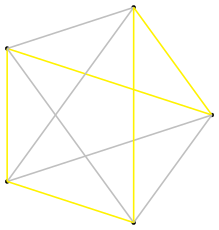
Six points \(A,B,C,D,E\) and \(F\) lie in three dimensional space and are in general positions, that is, no three are collinear and no four lie on a plane. All possible line segments joining pairs of points are drawn and coloured either gold or silver. Prove that there is a triangle whose edges are entirely of one colour. {[}\(Hint\): consider segments radiating from \(A.\){]} Give a sketch showing that the result is false for five points in general positions.
Show Solution