Proof
If we split a set \(S\) of integers into two subsets \(A\) and \(B\) whose intersection is empty and whose union is the whole of \(S\), and such that
- the sum of the elements of \(A\) is equal to the sum of the elements of \(B\)
- and the sum of the squares of the elements of \(A\) is equal to the sum of the squares of the elements of \(B\),
- Find a balanced partition of the set \(\{1, 2, 3, 4, 5, 6, 7, 8\}\) into two subsets \(A\) and \(B\), each of size 4.
- Given that \(a_1, a_2, \ldots, a_m\) and \(b_1, b_2, \ldots, b_m\) are sequences with \[\sum_{k=1}^m a_k = \sum_{k=1}^m b_k \quad \text{and} \quad \sum_{k=1}^m a_k^2 = \sum_{k=1}^m b_k^2,\] show that \[\sum_{k=1}^m a_k^3 + \sum_{k=1}^m (c + b_k)^3 = \sum_{k=1}^m b_k^3 + \sum_{k=1}^m (c + a_k)^3\] for any real number \(c\).
- Find, with justification, a balanced partition of the set \(\{1, 2, 3, \ldots, 16\}\) into two subsets \(A\) and \(B\), each of size 8, which also has the property that
- the sum of the cubes of the elements of \(A\) is equal to the sum of the cubes of the elements of \(B\).
- You are given that the sets \(A = \{1, 3, 4, 5, 9, 11\}\) and \(B = \{2, 6, 7, 8, 10\}\) form a balanced partition of the set \(\{1, 2, 3, \ldots, 11\}\).
Let \(S = \{n^2, (n+1)^2, (n+2)^2, \ldots, (n+11)^2\}\), where \(n\) is any positive integer. Find, with justification, two subsets \(C\) and \(D\) of \(S\) whose intersection is empty and whose union is the whole of \(S\), and such that
- the sum of the elements of \(C\) is equal to the sum of the elements of \(D\).
- \(A = \{1,4,6,7 \}, B = \{2,3,5,8 \}\)
- \begin{align*} && \sum_{k=1}^m a_k^3 + \sum_{k=1}^m (c + b_k)^3 &= \sum_{k=1}^m a_k^3 + mc^3 + 3c^2 \sum_{k=1}^m b_k + 3c \sum_{k=1}^m b_k^2 + \sum_{k=1}^m b_k^3 \\ &&&= \sum_{k=1}^m a_k^3 + mc^3 + 3c^2 \sum_{k=1}^m a_k + 3c \sum_{k=1}^m a_k^2 + \sum_{k=1}^m b_k^3 \\ &&&= \sum_{k=1}^m a_k^3 + 3c \sum_{k=1}^m a_k^2+ 3c^2 \sum_{k=1}^m a_k + mc^3 + \sum_{k=1}^m b_k^3 \\ &&&= \sum_{k=1}^m (a_k+c)^3 + \sum_{k=1}^m b_k^3 \end{align*}
- Note that \begin{align*} && \sum_{k=1}^m a_k^2 + \sum_{k=1}^m (c + b_k)^2 &= \sum_{k=1}^m a_k^2 + mc^2 + 2c \sum_{k=1}^m b_k +\sum_{k=1}^m b_k^2 \\ &&&= \sum_{k=1}^m (a_k+c)^2 + \sum_{k=1}^m b_k^2 \end{align*} Therefore if we take our balanced subsets of \(\{1,2,3,4,5,6,7,8\}\) and take \(A \cup (B+8)\) and \(B \cup (A+8)\) they will be balanced (including the cubes) so: \(A = \{1,4,6,7,10,11,13,16\}, B = \{2,3,5,8,9,12,14,15\}\)
- Notice that: \begin{align*} \sum_{a \in A} (n+a)^2 &= |A|n^2 + 2n \sum_{a \in A} a + \sum_{a \in A} a^2 \\ &= 6 n^2 + 2n \sum_{b \in B}b + \sum_{b \in B} b^2 \\ &= n^2 + \sum_{b \in B}(n+b)^2 \\ \end{align*} Therefore consider the sets \(C = \{(n+i)^2 : i \in A\}, D = \{n^2\} \cup \{(n+i)^2 : i \in B\}\)
In the equality \[ 4 + 5 + 6 + 7 + 8 = 9 + 10 + 11, \] the sum of the five consecutive integers from 4 upwards is equal to the sum of the next three consecutive integers. Throughout this question, the variables \(n\), \(k\) and \(c\) represent positive integers.
- Show that the sum of the \(n + k\) consecutive integers from \(c\) upwards is equal to the sum of the next \(n\) consecutive integers if and only if \[ 2n^2 + k = 2ck + k^2. \]
- Find the set of possible values of \(n\), and the corresponding values of \(c\), in each of the cases
- \(k = 1\)
- \(k = 2\).
- Show that there are no solutions for \(c\) and \(n\) if \(k = 4\).
- Consider now the case where \(c = 1\).
- Find two possible values of \(k\) and the corresponding values of \(n\).
- Show, given a possible value \(N\) of \(n\), and the corresponding value \(K\) of \(k\), that \[ N' = 3N + 2K + 1 \] will also be a possible value of \(n\), with \[ K' = 4N + 3K + 1 \] as the corresponding value of \(k\).
- Find two further possible values of \(k\) and the corresponding values of \(n\).
- Suppose the sum of the \(n + k\) consecutive integers from \(c\) upwards is equal to the sum of the next \(n\) consecutive integers then \begin{align*} && \sum_{i=c}^{i=c+n+k-1} i &= \sum_{i=c+n+k}^{c+2n+k-1} i \\ \Leftrightarrow && \frac{(c+n+k-1)(c+n+k)}{2} - \frac{(c-1)c}{2} &= \frac{(c+2n+k-1)(c+2n+k)}{2} - \frac{(c+n+k-1)(c+n+k)}{2} \\ \Leftrightarrow && 2(c+n+k-1)(c+n+k) &= (c+2n+k-1)(c+2n+k) + c(c-1) \\ \Leftrightarrow && 2c^2+4cn+4ck+2n^2+4kn+2k^2-2c-2n-2k&=2c^2+4cn+2ck+4n^2+4nk+k^2-2c-2n-k \\ \Leftrightarrow && 2ck+k^2&=2n^2+k \\ \end{align*}
- If \(k=1\) then \begin{align*} && 2n^2 + 1 &= 2c + 1 \\ \Rightarrow && c &= n^2 \end{align*} So \(n\) can take any value and \(c = n^2\)
- If \(k=2\) then \begin{align*} && 2n^2+2&= 4c+4 \\ \Rightarrow && n^2-1 &=2c \end{align*} So \(n\) must be odd, and \(c = \frac12(n^2-1)\)
- Suppose \(k=4\) then \(2n^2+4 = 8c+16\) or \(n^2-6 = 4c\) but then the left hand side is \(2, 3 \pmod{4}\) which is a contradiction.
- Suppose \(c =1\)
- Since \(2n^2+k = 2k + k^2\) or \(2n^2 = k^2+k\) we can have \(k = 1, n = 1\) or \(k = 8, n = 6\)
- Suppose \(2N^2 = K^2 + K\) then consider \begin{align*} && 2(N')^2 &= 2(3N+2K+1)^2 \\ &&&= 2(9N^2+4K^2+1+12NK+6N+4K) \\ &&&= 18N^2+8K^2+24NK+12N+8K+2 \\ && (K')^2+K' &= (4N+3K+1)^2 + (4N+3K+1) \\ &&&= 16N^2 + 9K^2+1+24NK+12N+9K+1 \\ &&&= 16N^2+9K^2+24NK+12N+9K+2 \\ \Rightarrow && 2(N')^2-(K')^2-K' &= 2N^2-K^2-K \\ &&&= 0 \end{align*} as required.
- So consider \((k,n) = (1,1), (8,6), (49, 35), (288,204)\)
- Given that \(a\), \(b\) and \(c\) are the lengths of the sides of a triangle, explain why \(c < a + b\), \(a < b + c\) and \(b < a + c\).
- Use a diagram to show that the converse of the result in part (i) also holds: if \(a\), \(b\) and \(c\) are positive numbers such that \(c < a + b\), \(a < b + c\) and \(b < c + a\) then it is possible to construct a triangle with sides of length \(a\), \(b\) and \(c\).
- When \(a\), \(b\) and \(c\) are the lengths of the sides of a triangle, determine in each case whether the following sets of three lengths can
- always
- sometimes but not always
- never
- Let \(\mathrm{f}\) be a function defined on the positive real numbers and such that, whenever \(x > y > 0\), \[\mathrm{f}(x) > \mathrm{f}(y) > 0 \quad \text{but} \quad \frac{\mathrm{f}(x)}{x} < \frac{\mathrm{f}(y)}{y}.\] Show that, whenever \(a\), \(b\) and \(c\) are the lengths of the sides of a triangle, then \(\mathrm{f}(a)\), \(\mathrm{f}(b)\) and \(\mathrm{f}(c)\) can also be the lengths of the sides of a triangle.
- Not that unless a side is the largest side, it is clearly shorter than the sum of the other two sides (since it's greater than or equal to one on its own). Note also that the distance from one vertex to the other (say \(c\)) is shorter than going via the other vertex \(a+b\), therefore \(c < a+b\).
- Draw a line of the length of the largest number, say \(c\), then since \(c < a+b\) we must have circles radius \(a\) and \(b\) at the endpoints cross, and at their intersection we have a vertex of a \(c\)-\(a\)-\(b\) triangle.
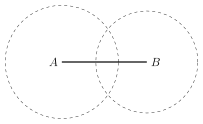
- (A) always. Suppose \(c\) is the longest side, then \(c < a+b \Rightarrow c+1 < a + 1 + b+1\) so \((a+1,b+1,c+1)\) are still sides of a triangle. (B) sometimes, but not always. \((1,1,1) \to (1,1,1)\) is still a triangle, but \((10, 10, 1) \to (1, 10, \frac{1}{10})\) is not a triangle since \(10 > 1 + \frac{1}{10}\) (C) never, suppose \(a \leq b \leq c\) then the sides are \(b-a, c-b, c-a\) but \(c-a = (c-b)+(b-a)\) so the triangle inequality cannot be satisfied. (D) always - without loss of generality let \(c\) be the longest side, and since every term is homogeneous degree \(2\) we can divide through by \(c^2\) to see we have the sides \(a^2+b, b^2+a, 1+ab\) and note that \(1 + ab < a+b +ab < a+b+a^2+b^2\), also \(a^2+b < 1 + b < 1 + (a+b)b = 1 + b^2 + ab < (1+ab)+(b^2+a)\).
- Suppose \(f\) is increasing and \(\f(x)/x\) is decreasing, and suppose \(a,b,c\) are side-lengths of a triangle. Wlog \(c\) is the longest side, then note \(f(c) > f(b), f(a)\), so it suffices to prove that \(f(c) < f(a)+f(b)\) \begin{align*} \frac{f(c)}{c} < \frac{f(a)}{a}: && f(a) &> \frac{a}{c} f(c) \\ \frac{f(c)}{c} < \frac{f(b)}{b}: && f(b) &> \frac{b}{c} f(c) \\ \Rightarrow && f(a)+f(b) &> f(c) \underbrace{\left ( \frac{a+b}{c} \right)}_{>1} \\ &&&> f(c) \end{align*} as required
Consider the following steps in a proof that \(\sqrt{2} + \sqrt{3}\) is irrational.
- If an integer \(a\) is not divisible by 3, then \(a = 3k \pm 1\), for some integer \(k\). In both cases, \(a^2\) is one more than a multiple of 3.
- Suppose that \(\sqrt{2} + \sqrt{3}\) is rational, and equal to \(\frac{a}{b}\), where \(a\) and \(b\) are positive integers with no common factor greater than one.
- Then \(a^4 + b^4 = 10a^2b^2\).
- So if \(a\) is divisible by 3, then \(b\) is divisible by 3.
- Hence \(\sqrt{2} + \sqrt{3}\) is irrational.
- Show clearly that steps 1, 3 and 4 are all valid and that the conclusion 5 follows from the previous steps of the argument.
- Prove, by means of a similar method but using divisibility by 5 instead of 3, that \(\sqrt{6} + \sqrt{7}\) is irrational. Why can divisibility by 3 not be used in this case?
- Step 1: There are only three possibilities for the remainder of \(a\) when divided by \(3\), (\(0\), \(1\), \(2\)). \(a = 3m+r\). If \(r = 0\) we are done, if \(r = 1\) take \(k = m\), and \(r=2\) take \(k=(m+1)\) and we have \(a = 3k-1\) as required. Then \(a^2 = (3k\pm1)^2 =9k^2\pm6k+1 = 3(3k^32\pm2k)+1\) which is clearly \(1\) more than a square. Step 3: \begin{align*} && \frac{a}{b} &= \sqrt{2}+\sqrt{3} \\ \Rightarrow && \frac{a^2}{b^2} &= 5+2\sqrt{6} \\ \Rightarrow && \frac{a^2}{b^2}-5 &= 2\sqrt{6} \\ \Rightarrow && 24 &= \left ( \frac{a^2}{b^2}-5 \right)^2 \\ &&&= 25 + \frac{a^4}{b^4}-10\frac{a^2}{b^2} \\ \Rightarrow && -b^4 &= a^4-10a^2b^2 \\ \Rightarrow && a^4+b^4 &= 10a^2b^2 \end{align*} Step 4: If \(a\) is divisible by \(3\) then \(b^4 = 10a^2b^2-a^4\) is a multiple of \(3\), but if \(b\) was not a multiple of \(3\) then \(b^2\) would be \(1\) more than a multiple of \(3\) (by Step 3) and \(b^4\) would also be \(1\) more than a multiple of \(3\), and we would have a contradiction. Step 5: Follows since either \(a,b\) are both divisible by \(3\) (contradicting Step 2), or neither is, but then \(a^2\) and \(b^2\) are both one more than a multiple of \(3\) and the RHS is one more than a multiple of \(3\) but the LHS is \(2\) more than a multiple of \(3\) which is a contradiction.
- Step 1: If \(a\) is not divisible by \(5\) then \(a^2 \equiv \pm 1 \pmod{5}\) Step 2: Suppose \(\frac{a}{b} = \sqrt{6}+\sqrt{7}\) Step 3: \begin{align*} && \frac{a}{b} &= \sqrt{6}+\sqrt{7} \\ \Rightarrow && \frac{a^2}{b^2} &= 13 + 2\sqrt{42} \\ \Rightarrow && 168 &= \left (\frac{a^2}{b^2} - 13 \right)^2 \\ &&&= 169 - 26 \frac{a^2}{b^2} + \frac{a^4}{b^4} \\ \Rightarrow && a^4+b^4 &= 26a^2b^2 \end{align*} Step 4: If \(a\) is a multiple of \(5\) then so is \(b^4\) and hence so is \(b^2\) and \(b\). Step 5: But the left hand side is always \(2 \pmod{5}\) and the right hand side is never \(2 \pmod{5}\) contradiction. Divisibility by \(3\) doesn't work here since mod \(3\) we can have \(a = 1, b = 1\) and have a valid solution.
The sequence \(u_0, u_1, \ldots\) is said to be a constant sequence if \(u_n = u_{n+1}\) for \(n = 0, 1, 2, \ldots\). The sequence is said to be a sequence of period 2 if \(u_n = u_{n+2}\) for \(n = 0, 1, 2, \ldots\) and the sequence is not constant.
- A sequence of real numbers is defined by \(u_0 = a\) and \(u_{n+1} = f(u_n)\) for \(n = 0, 1, 2, \ldots\), where $$f(x) = p + (x - p)x,$$ and \(p\) is a given real number. Find the values of \(a\) for which the sequence is constant. Show that the sequence has period 2 for some value of \(a\) if and only if \(p > 3\) or \(p < -1\).
- A sequence of real numbers is defined by \(u_0 = a\) and \(u_{n+1} = f(u_n)\) for \(n = 0, 1, 2, \ldots\), where $$f(x) = q + (x - p)x,$$ and \(p\) and \(q\) are given real numbers. Show that there is no value of \(a\) for which the sequence is constant if and only if \(f(x) > x\) for all \(x\). Deduce that, if there is no value of \(a\) for which the sequence is constant, then there is no value of \(a\) for which the sequence has period 2. Is it true that, if there is no value of \(a\) for which the sequence has period 2, then there is no value of \(a\) for which the sequence is constant?
- If \(f(a) = a\) then the sequence is constant, ie \(a = p+a^2-pa \Rightarrow 0 = (a-p)(a-1)\). Therefore \(a = 1, p\) If there sequence has period \(2\) then there must be a solution to \(f(f(x)) = x\), ie \begin{align*} && x &= p+(f(x)-p)f(x) \\ &&&= p+(p+(x-p)x-p)(p+(x-p)x) \\ &&&= p + (x-p)x(p+(x-p)x) \\ &&&= p+(x^2-px)(x^2-px+p) \\ \Rightarrow && 0 &= x^4-2px^3+(p+p^2)x^2-(p^2+1)x+p \\ &&&= (x-1)(x-p)(x^2-(p-1)x+1) \end{align*} The first two roots (\(x = 1, p\)) are constant sequences, so we need the second quadratic to have a root, ie \((p-1)^2-4 \geq 0 \Rightarrow p \geq 3 , p \leq -1\). We also need this root not to be \(1\) or \(p\), ie \(1-(p-1)+1 = 3-p \neq 0\) and \(p^2-(p-1)p + 1 = 1+p \neq 0\) so \(p \neq -1, 3\). Therefore \(p > 3\) or \(p < -1\).
- There exists a constant sequence iff there is a solution to \(f(x) = x\), ie \begin{align*} && x &= f(x) \\ &&&= q + (x-p)x \\ \Leftrightarrow && 0 &= x^2-(p+1)x + q \tag{has a solution} \\ \end{align*} But if it doesn't have a solution, clearly the RHS is always larger, and if it does have a solution then there is some point where the inequality doesn't hold. Suppose \(f(x) > x\) for all \(x\) then \(f(f(x)) > f(x) > x\) therefore there is no value where \(f(f(x)) = x\) which is required for any sequence of period 2. No, consider \(p = q = 0\) so \(f(x) = x^2\) then there cannot be a period \(2\) sequence by the first part, but also clearly \(u_n = 1\) is a valid constant sequence.
- Find all pairs of positive integers \((n,p)\), where \(p\) is a prime number, that satisfy \[ n!+ 5 =p \,. \]
- In this part of the question you may use the following two theorems:
- For \(n\ge 7\), \(1! \times 3! \times \cdots \times (2n-1)! > (4n)!\,\).
- For every positive integer \(n\), there is a prime number between \(2n\) and \(4n\).
- Let \(n! + 5 = p\). If \(n \geq 5\) then \(5\) divides the LHS and so must also divide the RHS. Since \(n!+5 > 5\) this means the RHS cannot be prime. Therefore consider \(n = 1, 2, 3, 4\). \begin{align*} n = 1: && 1! + 5 = 6 &&\text{ nope} \\ n=2: && 2! + 5 = 7 && \checkmark \\ n=3: && 3! + 5 = 11 && \checkmark \\ n=4: && 4! + 5 = 29 && \checkmark \end{align*} Therefore the solutions are \((2,7), (3,11), (4,29)\).
- Suppose \(1! \times 3! \times \cdots \times (2n-1)! = m!\). If \(n \geq 7\) then \(m! > (4n)!\) (by the first theorem) in particular \(m > 4n\). Therefore (by the second theorem) the RHS is divisible by some prime which cannot divide the LHS. Therefore consider \(n = 1,2,3,4,5,6\) \begin{align*} n = 1: && 1! = 1 = 1! && \checkmark \\ n = 2: && 1! \times 3! = 6 = 3! && \checkmark \\ n = 3: && 1! \times 3! \times 5! = 6! && \checkmark \\ n = 4: && 1! \times 3! \times 5! \times 7! = 6! \times 7! = 10! && \checkmark \\ n = 5: && 1! \times 3! \times 5! \times 7! \times 9! = 10! 9! > 11! && \text{would need a factor of } 11\text{ so no} \\ n = 6: && 1! \times 3! \times 5! \times 7! \times 9! \times 11! = 10! 11! 9! > 13! && \text{would need a factor of } 13\text{ so no} \\ \end{align*} Therefore all solutions are \((1,1), (2,3), (3,6), (4,10)\)
The sequence of numbers \(x_0\), \(x_1\), \(x_2\), \(\ldots\) satisfies \[ x_{n+1} = \frac{ax_n-1}{x_n+b} \,. \] (You may assume that \(a\), \(b\) and \(x_0\) are such that \(x_n+b\ne0\,\).) Find an expression for \(x_{n+2}\) in terms of \(a\), \(b\) and \(x_n\).
- Show that \(a+b=0\) is a necessary condition for the sequence to be periodic with period 2. Note: The sequence is said to be periodic with period \(k\) if \(x_{n+k} = x_n\) for all \(n\), and there is no integer \(m\) with \(0 < m < k\) such that \(x_{n+m} = x_n\) for all \(n\).
- Find necessary and sufficient conditions for the sequence to have period 4.
- If \(x_{n+2} = x_n\) then \begin{align*} && x_n &= \frac{(a^2-1)x_n-(a+b)}{(a+b)x_n+b^2-1} \\ \Rightarrow && 0 &=(a+b)x_n^2+(b^2-a^2)x_n+(a+b) \\ &&&= (a+b)(x_n^2+(a-b)x_n + 1) \end{align*} If \(x_{n+1} = x_n\) then \(x_n^2+(a-b)x_n + 1\) and since our sequence has period \(2\) rather than \(1\) it must be the case this is non-zero. Therefore \(a+b =0\).
- \begin{align*} x_{n+4} &= \frac{(a^2-1)x_{n+2}-(a+b)}{(a+b)x_{n+2}+b^2-1} \\ &= \frac{(a^2-1)\frac{(a^2-1)x_{n}-(a+b)}{(a+b)x_{n}+b^2-1} -(a+b)}{(a+b)\frac{(a^2-1)x_{n}-(a+b)}{(a+b)x_{n}+b^2-1} +b^2-1} \\ &= \frac{((a^2-1)^2-(a+b)^2)x_n -(a^2+b^2-2)(a+b)}{(a^2+b^2-2)(a+b)x_n + (b^2-1)^2-(a+b)^2} \end{align*} If \(x_{n+4} = x_n\) then \begin{align*} x_n &=\frac{((a^2-1)^2-(a+b)^2)x_n -(a^2+b^2-2)(a+b)}{(a^2+b^2-2)(a+b)x_n + (b^2-1)^2-(a+b)^2} \\ 0 &= (a^2+b^2-2)(a+b)x_n^2 + \l (b^2-1)^2-(a^2-1)^2 \r x_n+(a^2+b^2-2)(a+b) \\ &= (a^2+b^2-2)(a+b)x_n^2+(b^2-a^2)(a^2+b^2-2)x_n + (a^2+b^2-2)(a+b) \\ &= (a^2+b^2-2)(a+b)(x_n^2+(b-a)x_n + 1) \end{align*} Since we do not want \(x_n\) to be periodic with period \(1\) we must have the quadratic in \(x_n\) \(\neq 0\). If \(a+b = 0\) then \(x_n\) is periodic with period \(2\) since \(x_{n+2} = \frac{(a^2-1)x_n}{((-a)^2-1)} = x_n\). Therefore it is necessary that \(a^2+b^2-2 = 0\). If \(a^2+b^2-2= 0\) then \begin{align*} x_{n+4} &= \frac{((a^2-1)^2-(a+b)^2)x_n}{(b^2-1)^2-(a+b)^2} \\ &=\frac{((a^2-1)^2-(a+b)^2)x_n}{((2-a^2)-1)^2-(a+b)^2} \\ &=\frac{((a^2-1)^2-(a+b)^2)x_n}{((1-a^2)^2-(a+b)^2} \\ &= x_n \end{align*} Therefore it is sufficient too. So our conditions are \(a+b \neq 0, \, \, x_n^2+(a-b)x_n + 1 \neq 0\) and \(a^2+b^2-2 = 0\)
The set \(S\) consists of all the positive integers that leave a remainder of 1 upon division by 4. The set \(T\) consists of all the positive integers that leave a remainder of 3 upon division by 4.
- Describe in words the sets \(S \cup T\) and \(S \cap T\).
- Prove that the product of any two integers in \(S\) is also in \(S\). Determine whether the product of any two integers in \(T\) is also in \(T\).
- Given an integer in \(T\) that is not a prime number, prove that at least one of its prime factors is in \(T\).
- For any set \(X\) of positive integers,
an integer in \(X\) (other than 1) is said to be
\(X\)-prime if it cannot be expressed as the product of
two or more integers all in \(X\) (and all different from 1).
- \(\bf (a)\) Show that every integer in \(T\) is either \(T\)-prime or is the product of an odd number of \(T\)-prime integers.
- \(\bf (b)\) Find an example of an integer in \(S\) that can be expressed as the product of \(S\)-prime integers in two distinct ways. [Note: \(s_1s_2\) and \(s_2s_1\) are not counted as distinct ways of expressing the product of \(s_1\) and \(s_2\).]
- \(S \cup T\) is the set of odd positive integers. \(S \cap T\) is the empty set.
- Suppose we have two integers in \(S\), say \(4n+1\) and \(4m+1\), so \((4n+1)(4m+1) = 16nm + 4(n+m) + 1 = 4(4nm + n+m) + 1\) which clearly is in \(S\). The product of any two integers in \(T\) is in \(S\), since \((4n+3)(4m+3) = 16nm + 12(n+m) + 9 = 4(4nm+3(n+m) + 2) + 1\)
- Suppose \(p \in T\) is not prime, then it must have prime factors. They must all be odd, so they are in \(T\) or \(S\). If they are all in \(S\) then \(p\) must also be in \(S\) (as the product of numbers in \(S\)) but this is a contraction. Therefore \(p\) must have a prime factor in \(T\).
- \(3, 7, 11, 19\) are all primes in \(T\). Notice therefore that any product of two of them must be \(S\)-prime. But then \((3 \times 7) \times (11 \times 19)\) and \((3 \times 11) \times (7 \times 19)\) are distinct factorisations into \(S\)-prime factors.
Show that:
- \(1+2+3+ \cdots + n = \frac12 n(n+1)\);
- if \(N\) is a positive integer, \(m\) is a non-negative integer and \(k\) is a positive odd integer, then \((N-m)^k +m^k\) is divisible by \(N\).
- \(\,\) \begin{align*} && S & = 1 +\quad 2\quad \;\;+ \quad 3 \quad+ \cdots + \quad n \\ && S &= n + (n-1) + (n-2) + \cdots + 1 \\ && 2S &= (n+1) + (n+1) + \cdots + (n+1) \\ \Rightarrow && S &= \frac12n(n+1) \end{align*}
- \(\,\) \begin{align*} && (N-m)^{k} + m^k&= \sum_{i=0}^k \binom{k}{i} N^{k-i} (-m)^{i} + m^k \\ &&&= N\sum_{i=0}^{k-1} \binom{k}{i}N^{k-i-1}(-m)^i -m^k+m^k \\ &&&= N\sum_{i=0}^{k-1} \binom{k}{i}N^{k-i-1}(-m)^i \end{align*} which is clearly divisible by \(N\).
If \(s_1\), \(s_2\), \(s_3\), \(\ldots\) and \(t_1\), \(t_2\), \(t_3\), \(\ldots\) are sequences of positive numbers, we write \[ (s_n)\le (t_n) \] to mean
- \((1000n) \le (n^2)\,\).
- If it is not the case that \((s_n)\le (t_n)\), then it is the case that \((t_n)\le (s_n)\,\).
- If \((s_n)\le (t_n)\) and \((t_n) \le (u_n)\), then \((s_n)\le (u_n)\,\).
- \((n^2)\le (2^n)\,\).
- If \(m = 1000\), then \(n \geq m \Rightarrow n^2 \geq 1000n \Rightarrow (1000n) \leq (n^2)\)
- This is false. Let \(s_i = 1,2,1,2,\cdots\) and \(t_i = 2,1,2,1,\cdots\).
- Suppose that for \(n \geq m_1, s_n \le t_n\) and for \(n \geq m_2, s_t \le u_n\), then for \(n \geq m = \max(m_1, m_2), s_n \leq t_n \leq u_n \Rightarrow s_n \leq u_n \Rightarrow (s_n) \leq (u_n)\)
- Let \(m = 6\), then if \(n \geq m, 2^n \geq 1 + n + \frac{n(n-1)}{2} + \frac{n(n-1)}{2} + n + 1 = n^2 + n + 2 \geq n^2\), so \((2^n) \geq (n^2)\)
- In the following argument to show that \(\sqrt2\) is irrational, give proofs appropriate for steps 3, 5 and 6.
- Assume that \(\sqrt2\) is rational.
- Define the set \(S\) to be the set of positive integers with the following property:
\(n\) is in \(S\) if and only if \(n \sqrt2\) is an integer.
- Show that the set \(S\) contains at least one positive integer.
- Define the integer \(k\) to be the smallest positive integer in \(S\).
- Show that \((\sqrt2-1)k\) is in \(S\).
- Show that steps 4 and 5 are contradictory and hence that \(\sqrt2\) is irrational.
- Prove that \(2^{\frac13} \) is rational if and only if \(2^{\frac23}\) is rational. Use an argument similar to that of part (i) to prove that \(2^{\frac13}\) and \(2^{\frac23}\) are irrational.
- For step 3, since we have assumed \(\sqrt{2}\) is rational we can write it in the form \(p/q\) with \(p, q\) coprime with \(q \geq 1\). Then \(q \in S\) since \(q\sqrt{2} = p\) which is an integer. For step 5, notice that \((\sqrt{2}-1)k\) is an integer (since \(\sqrt{2}k\) is an integer and so is \(-k\). It is also positive since \(\sqrt{2} > 1\). We must check that \((\sqrt{2}-1)k \cdot \sqrt{2} = 2k - \sqrt{2}k\) is also an integer, but clearly it is as both \(2k\) and \(-\sqrt{2}k\) are integers. Therefore \((\sqrt{2}-1)k \in S\). For step 6, notice that \((\sqrt{2}-1) < 1\) and therefore \((\sqrt{2}-1)k < k\), contradicting that \(k\) is the smallest element in our set. (And all non-empty sets of positive integers have a smallest element)
- Claim: \(2^{\frac13}\) is irrational \(\Leftrightarrow 2^{\frac23}\) is irrational.
Proof: Since \(2^{\frac13} \cdot 2^{\frac23} = 2\) if one of them is rational, then the other one must also be rational. Which is the same as them both being irrational at the same time.
- Assume that \(\sqrt[3]{2}\) is rational, ie \(\sqrt[3]{2} = p/q\) for some integers.
- \(S := \{ n \in \mathbb{Z}_{>0} : n \sqrt[3]{2} \text{ and } n \sqrt[3]{4}\in \mathbb{Z}\}\)
- Suppose \(k\) is the smallest element in \(S\) (which must exist, consider \(q^2\)
- Consider \((\sqrt[3]{2}-1)k\) then clearly this is an integer, and \((\sqrt[3]{2}-1)\sqrt[3]{2}k = \sqrt[3]{4}k - \sqrt[3]{2}k \in \mathbb{Z}\) and \((\sqrt[3]{2}-1)\sqrt[3]{4}k = 2 k -\sqrt[3]{4}k \in \mathbb{Z}\).
- But this is a smaller element of \(S\), contradicting that \(k\) is the smallest element. Therefore, we have a contradiction.
An operator \(\rm D\) is defined, for any function \(\f\), by \[ {\rm D}\f(x) = x\frac{\d\f(x)}{\d x} .\] The notation \({\rm D}^n\) means that \(\rm D\) is applied \(n\) times; for example \[ \displaystyle {\rm D}^2\f(x) = x\frac{\d\ }{\d x}\left( x\frac{\d\f(x)}{\d x} \right) \,. \] Show that, for any constant \(a\), \({\rm D}^2 x^a = a^2 x^a\,\).
- Show that if \(\P(x)\) is a polynomial of degree \(r\) (where \(r\ge1\)) then, for any positive integer \(n\), \({\rm D}^n\P(x)\) is also a polynomial of degree \(r\).
- Show that if \(n\) and \(m\) are positive integers with \(n < m\), then \({\rm D}^n(1-x)^m\) is divisible by \((1-x)^{m-n}\).
- Deduce that, if \(m\) and \(n\) are positive integers with \(n < m\), then \[ \sum_{r=0}^m (-1)^r \binom m r r^n =0 \, . \]
- [Not on original paper] Let \(\f_n(x) = D^n(1-x)^n\,\), where \(n\) is a positive integer. Prove that \(\f_n(1)=(-1)^nn!\, \).
- Claim: \({\mathrm D^n}(x^a) =a^n x^a\) Proof: Induct on \(n\). Base cases we have already seen, so consider \(D^{k+1}(x^a) = D(a^k x^a) = a^{k+1}x^a\) as required. Claim: \({\mathrm D}\) is linear, ie \({\mathrm D}(f(x) + g(x)) = {\mathrm D}(f(x)) + {\mathrm D}(g(x))\) Proof: \begin{align*} {\mathrm D}(f(x) + g(x)) &= x\frac{\d\ }{\d x}\left(f(x) + g(x) \right) \\ &= x\frac{\d\ }{\d x}f(x) + x\frac{\d\ }{\d x}g(x) \\ &= {\mathrm D}(f(x)) + {\mathrm D}(g(x)) \end{align*} Claim: If \(p(x)\) is a polynomial degree \(r\) then \({\mathrm D}^n p(x)\) is a polynomial degree \(n\). Proof: Since \({\mathrm D}\) is linear, it suffices to prove this for a monomial of degree \(n\), but this was already proven in the first question.
- Claim: If \(f(x)\) is some polynomial, \({\mathrm D}((1-x)^m f(x))\) is divisible by \((1-x)^{m-1}\) Proof: \({\mathrm D}((1-x)^mf(x)) = -xm(1-x)^{m-1}f(x) + (1-x)^mxf'(x) = x(1-x)^{m-1}((1-x)f'(x)-xf(x))\) as required. Therefore repeated application of \({\mathrm D}\) will reduce the factor of \(1-x\) by at most \(1\) each time as required.
- \begin{align*} {\mathrm D}^n(1-x)^m &= {\mathrm D}^n \left ( \sum_{r=0}^m \binom{m}{r}(-1)^r x^r\right) \\ &= \sum_{r=0}^m {\mathrm D}^n \left ( \binom{m}{r}(-1)^r x^r \right ) \\ &= \sum_{r=0}^m\binom{m}{r}(-1)^r r^n x^r \end{align*} Since the left-hand side is divisible by \(1-x\), if we substitute \(x = 1\), the sum must be \(0\), i.e., we get the desired result.
- On each application of \({\mathrm D}\) to \((1-x)^m f(x)\) we end up with a term in the form \(x(1-x)^{m-1}(x)\) and a term of the form \((1-x)^m\). After the latter term will be annihilated once we evaluate at \(x = 1\) because there will be insufficient applications to remove the factors of \(1-x\). Therefore we only need to focus on the term which does not get annihilated. This term is will be \((-x)^n n \cdot (n-1) \cdots 1\), so \(f_n(1) = (-1)^n n!\) as required. Alternatively: \begin{align*} {\mathrm D}^n((1-x)^n) &= D^{n-1}(-nx(1-x)^{n-1}) \\ &= -n{\mathrm D}^{n-1}(x(1-x)^{n-1}) \\ &= -n{\mathrm D}^{n-1}((x-1+1)(1-x)^{n-1}) \\ &= -n{\mathrm D}^{n-1}(-(1-x)^{n}+(1-x)^{n-1}) \\ &= -n{\mathrm D}^{n-1}(-(1-x)^{n})-n{\mathrm D}^{n-1}((1-x)^{n-1}) \\ \end{align*} Therefore, when this is evaluated at \(x = 1\), recursively, we will have \(f_n(1) = -nf_{n-1}(1)\), in particular, \(f_n(1) = (-1)^n n!\)
All numbers referred to in this question are non-negative integers.
- Express each of the numbers 3, 5, 8, 12 and 16 as the difference of two non-zero squares.
- Prove that any odd number can be written as the difference of two squares.
- Prove that all numbers of the form \(4k\), where \(k\) is a non-negative integer, can be written as the difference of two squares.
- Prove that no number of the form \(4k+2\), where \(k\) is a non-negative integer, can be written as the difference of two squares.
- Prove that any number of the form \(pq\), where \(p\) and \(q\) are prime numbers greater than 2, can be written as the difference of two squares in exactly two distinct ways. Does this result hold if \(p\) is a prime greater than 2 and \(q=2\)?
- Determine the number of distinct ways in which 675 can be written as the difference of two squares.
- \(\,\) \begin{align*} && 3 &= 2^2 - 1^2 \\ && 5 &= 3^2 - 2^2 \\ && 8 &= 3^2 - 1^2 \\ && 16 &= 5^2 - 3^2 \end{align*}
- Suppose \(n = 2k+1\), then \(n = (k+1)^2 - k^2\)
- Suppose \(n = 4k\) then \(n = (2k+1)^2 - (2k-1)^2\)
- All squares leave a remainder of \(0\) or \(1\) on division by \(4\). Therefore the difference can leave a remainder of \(0\), \(1\), \(-1 \equiv 3\), none of which are \(2\).
- Suppose \(n = pq = a^2 - b^2\) with \(a > b\) ie \((a-b)(a+b) = pq\). Since \(p\) is prime, \(p \mid (a-b)\) or \(p \mid (a+b)\). Similarly for \(q\). Suppose also (wlog) that \(p > q\) Since the factors of \(pq\) are \(1, p, q, pq\) then \(a-b = 1, p\) (which are two possibilities) and \(a+b = pq, q\), ie \(a = \frac{1+pq}{2}, \frac{p+q}{2}\) and \(b = \frac{pq-1}{2}, \frac{p-q}{2}\) \begin{align*} && pq &= \left ( \frac{1+pq}{2} \right)^2- \left ( \frac{1-pq}{2} \right)^2 \\ &&&= \left ( \frac{p+q}{2} \right)^2- \left ( \frac{p-q}{2} \right)^2 \\ \end{align*} Where everything is an integer since \(p\) and \(q\) are odd. If we have \(p > 2\) and \(q = 2\) then \(p\) is odd and the number has the form \(4k+2\) which cannot be expressed as the difference of two squares.
- \(675 = 3^3 \cdot 5^2\), each factor pair of \(675\) will lead to a different solution of \(675 = a^2-b^2\), since we will have an equation \(a-b = X, a+b = Y\) where \(X, Y\) are both odd. Therefore there are as many solution as (half) the number of factors, ie \(4 \times 3 = 12\)
- Let \(f(x) = (x+2a)^3 -27 a^2 x\), where \(a\ge 0\). By sketching \(f(x)\), show that \(f(x)\ge 0\) for \(x \ge0\).
- Use part (i) to find the greatest value of \(xy^2\) in the region of the \(x\)-\(y\) plane given by \(x\ge0\), \(y\ge0\) and \(x+2y\le 3\,\). For what values of \(x\) and \(y\) is this greatest value achieved?
- Use part (i) to show that \((p+q+r)^3 \ge 27pqr\) for any non-negative numbers \(p\), \(q\) and \(r\). If \((p+q+r)^3 = 27pqr\), what relationship must \(p\), \(q\) and \(r\) satisfy?
- Note that \(f(x) = (x+2a)^3 - 27a^2x\) so \(f'(x) = 3(x+2a)^2-27a^2 = 3x^2+12ax-15a^2 = (x-a)(3x+15a)\) so the turning points are at \(x = a, x = -5a\). But \(f(a) = 0\), so the curve just touches the \(x\)-axis. Note also that \(f(0) = 8a^3 \geq 0\) so:
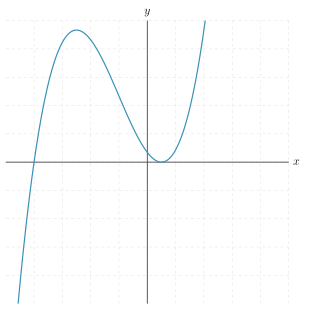
- \(\,\) \begin{align*} && 0 &\leq (x+2y)^3 - 27y^2 x \\ &&& \leq 3^3 - 27 y^2 x \\ &&&= 27(1-y^2x) \\ \Rightarrow && xy^2 &\leq1 \end{align*} with equality when \(x = y = 1\)
- Notice that \begin{align*} && 0 &\leq (p+q+r)^3 - 27\left (\frac{q+r}{2}\right)^2 p \\ \Rightarrow && (p+q+r)^3 &\geq 27\left (\frac{q+r}{2}\right)^2 p \\ &&&\underbrace{\geq}_{AM-GM} 27\left (\sqrt{qr}\right)^2 p \\ &&&= 27pqr \end{align*} Equality can only hold if \(p = \frac{q+r}{2}\), but by symmetry we must also have \(q = \frac{r+p}{2}, r = \frac{p+q}{2}\) ie \(p = q = r\). And indeed equality does hold in this case.
- Write down a solution of the equation \[ x^2-2y^2 =1\,, \tag{\(*\)} \] for which \(x\) and \(y\) are non-negative integers. Show that, if \(x=p\), \(y=q\) is a solution of (\(*\)), then so also is \(x=3p+4q\), \(y=2p+3q\). Hence find two solutions of \((*)\) for which \(x\) is a positive odd integer and \(y\) is a positive even integer.
- Show that, if \(x\) is an odd integer and \(y\) is an even integer, \((*)\) can be written in the form \[ n^2 = \tfrac12 m(m+1)\,, \] where \(m\) and \(n\) are integers.
- The positive integers \(a\), \(b\) and \(c\) satisfy \[ b^3=c^4-a^2\,, \] where \(b\) is a prime number. Express \(a\) and \(c^2\) in terms of \(b\) in the two cases that arise. Find a solution of \(a^2+b^3=c^4\), where \(a\), \(b\) and \(c\) are positive integers but \(b\) is not prime.
- \((x,y) = (1,0)\) we have Suppose \(p^2-2q^2 = 1\), then \begin{align*} && (3p+4q)^2-2\cdot(2p+3q)^2 &= 9p^2+24pq + 16q^2 - 2\cdot(4p^2+12pq+9q^2) \\ &&&= p^2(9-8) + pq(24-24) + q^2(16-18) \\ &&&= p^2 - 2q^2 = 1 \end{align*} So we have: \begin{array}{c|c} x & y \\ \hline 1 & 0 \\ 3 & 2 \\ 17 & 12 \\ \end{array}
- Suppose \(x = 2m+1\) and \(y = 2n\) then \begin{align*} && 1 & = x^2 - 2y^2 \\ &&&= (2m+1)^2 - 2(2n)^2 \\ &&&= 4m^2 + 4m + 1 - 8n^2 \\ \Leftrightarrow && n^2 &= \frac{m(m+1)}{2} \end{align*}
- Suppose \(b^3 = c^4 - a^2 =(c^2-a)(c^2+a)\), since \(b\) is prime and \(c^2 + a > c^2-a\) we must have: \begin{align*} && p = c^2-a && p^2 =c^2 +a \\ \Rightarrow && c^2 = \frac{p+p^2}{2} && a = \frac{p^2-p}2\\ && 1 = c^2-a && p^3 = c^2+a \\ \Rightarrow && c^2 = \frac{p^3+1}{2} && a = \frac{p^3-1}{2} \end{align*} Note that \(c^2 = \frac{p(p+1)}{2}\) is reminicent of our first equation, so suppose \(n = c = 6\) and \(p = m = 8\) then \(6^4 = 8^3 + 28^2\)
In this question, you may assume that, if \(a\), \(b\) and \(c\) are positive integers such that \(a\) and \(b\) are coprime and \(a\) divides \(bc\), then \(a\) divides \(c\). (Two positive integers are said to be coprime if their highest common factor is 1.)
- Suppose that there are positive integers \(p\), \(q\), \(n\) and \(N\) such that \(p\) and \(q\) are coprime and \(q^nN=p^n\). Show that \(N=kp^n\) for some positive integer \(k\) and deduce the value of \(q\). Hence prove that, for any positive integers \(n\) and \(N\), \(\sqrt[n]N\) is either a positive integer or irrational.
- Suppose that there are positive integers \(a\), \(b\), \(c\) and \(d\) such that \(a\) and \(b\) are coprime and \(c\) and \(d\) are coprime, and \(a^ad^b = b^a c^b \,\). Prove that \(d^b = b^a\) and deduce that, if \(p\) is a prime factor of \(d\), then \(p\) is also a prime factor of \(b\). If \(p^m\) and \(p^n\) are the highest powers of the prime number \(p\) that divide \(d\) and \(b\), respectively, express \(b\) in terms of \(a\), \(m\) and \(n\) and hence show that \(p^n\le n\). Deduce the value of \(b\). (You may assume that if \(x > 0\) and \(y\ge2\) then \(y^x > x\).) Hence prove that, if \(r\) is a positive rational number such that \(r^r\) is rational, then \(r\) is a positive integer.
- Suppose \(q^nN = p^n\) then since \((p,q) =1\) we must have \(p \mid N\), and then by dividing both \(p^n\) and \(N\) by \(p\) we can repeat this process \(n\) times to find that \(N = kp^n\) and in particular \(q = 1\). Suppose \(\sqrt[n]{N} = \frac{p}q\) for \(p,q\) coprime positive integers (ie it is not irrational), then \(q^nN = p^n\) and so \(q = 1\) and in fact \(\sqrt[n]{N}\) is an integer so \(N\).
- Suppose \((a,b) = 1, (c,d) = 1\) and \(a^ad^b = b^ac^b\), then since \((a,b) = 1\) we must have \((b^a, a) = 1\) so \(b^a \mid d^b\). Similarly since \((c,d) = 1\) we must have \((d^b, c) = 1\) so \(d^b \mid b^a\). Therefore \(d^b = b^a\). Suppose \(p \mid d\) then \(p \mid d^b = b^a \Rightarrow p \mid b\). Suppose \(\nu_p(d) = m, \nu_p(b) = n\) we must have \(bm = \nu_p(d^b) = \nu_p(b^a) = an\), ie \(b = \frac{an}{m}\). Note that \(p^n \mid b \Rightarrow p^n \mid n \frac{a}{m} \Rightarrow p^n \mid n \Rightarrow p^n \leq n\). Since \((p,a) = 1\).. But since \(p^n > n\) if \(p \geq 2\) we must have that \(b = 1\). Therefore suppose \(r = \frac{a}{b}\) with \((a,b) = 1\) an \(r^r = \frac{c}{d}\) we must ahve \(a^ac^b = b^ad^b\) and so \(b = 1\) implying \(r\) is an integer.
- The numbers \(m\) and \(n\) satisfy
\[
m^3=n^3+n^2+1\,.
\tag{\(*\)}
\]
- Show that \(m > n\). Show also that \(m < n+1\) if and only if \(2n^2+3n > 0\,\). Deduce that \(n < m < n+1\) unless \(-\frac32 \le n \le 0\,\).
- Hence show that the only solutions of \((*)\) for which both \(m\) and \(n\) are integers are \((m,n) = (1,0)\) and \((m,n)= (1,-1)\).
- Find all integer solutions of the equation \[ p^3=q^3+2q^2-1\,. \]
Write down the cubes of the integers \(1, 2, \ldots , 10\). The positive integers \(x\), \(y\) and \(z\), where \(x < y\), satisfy \[ x^3+y^3 = kz^3\,, \tag{\(*\)} \] where \(k\) is a given positive integer.
- In the case \(x+y =k\), show that \[ z^3 = k^2 -3kx+3x^2\,. \] Deduce that \((4z^3 - k^2)/3\) is a perfect square and that \(\frac14 {k^2} \le z^3 < k^2\,\). Use these results to find a solution of \((*)\) when \(k=20\).
- By considering the case \(x+y = z^2\), find two solutions of \((*)\) when \(k=19\).
- \(\,\) \begin{align*} && x^3 + y^3 &= kz^3 \\ \Rightarrow &&k(x^2-xy+y^2)&=kz^3 \\ \Rightarrow && z^3 &= (x+y)^2-3xy \\ &&&= k^2-3x(k-x) \\ &&&= k^2-3xk+3x^2 \\ \\ \Rightarrow && \frac{4z^3-k^2}{3} &= \frac{4(k^2-3xk+3x^2)-k^2}{3} \\ &&&= \frac{3k^2-12xk+12x^2}{3} \\ &&&= k^2-4xk+4x^2 \\ &&&= (k-2x)^2 \end{align*} Therefore \(\frac{4z^3-k^2}{3}\) is a perfect square and so \(4z^3 \geq k^2 \Rightarrow z^3 \geq \frac14k^2\). Clearly \(kz^3 < x^3+3x^2y+3xy^2+y^3 = k^3 \Rightarrow z^3 < k^2\), therefore \(\frac14 k^2 \leq z^3 < k^2\) Therefore if \(k = 20\), \(100 \leq z^3 < 400 \Rightarrow z \in \{ 5, 6,7\}\). Mod \(3\) it is clear that \(4z^3-k^2\) is not divisible by \(3\) for \(z = 5,6\) therefore \(z = 7\) \begin{align*} && 343 &= 3x^2-60x+400 \\ \Rightarrow && 0 &= 3x^2-60x+57 \\ \Rightarrow && 0 &= x^2-20x+19 \\ \Rightarrow && x &= 1,19 \end{align*} Therefore a solution is \(1^3 + 19^3 = 20 \cdot 7^3\)
- When \(x+y = z^2\) we must have \begin{align*} && x^3 + y^3 &= kz^3 \\ \Rightarrow &&(x^2-xy+y^2)&=kz \\ \Rightarrow && kz &= (x+y)^2-3xy \\ &&&= z^4-3x(z^2-x)\\ &&&= z^4-3xz^2+3x^2 \\ \Rightarrow && 0 &= 3x^2-3z^2x+z^4-kz \\ \\ \Rightarrow && 0 &\leq \Delta = 9z^4-12(z^4-kz) \\ &&&=12kz-3z^4 \\ \Rightarrow && z^3 &\leq 4k \end{align*} If \(k = 19\) this means \(z \leq 4\) \begin{array}{c|c|c|c} z & 19z^3 & x & y \\ \hline 1 & 19 & - & - \\ 2 & 152 & 3 & 5 \\ 3 & 513 & 1 & 8 \end{array} So two solutions are \(1^3+8^3 = 19 \cdot 3^3\) and \(3^3+5^3=19 \cdot 2^3\)
- Suppose that \(a\), \(b\) and \(c\) are integers that satisfy the equation \[ a^{3}+3b^{3}=9c^{3}. \] Explain why \(a\) must be divisible by 3, and show further that both \(b\) and \(c\) must also be divisible by 3. Hence show that the only integer solution is \(a=b=c=0\,\).
- Suppose that \(p\), \(q\) and \(r\) are integers that satisfy the equation \[ p^4 +2q^4 = 5r^4 \,.\] By considering the possible final digit of each term, or otherwise, show that \(p\) and \(q\) are divisible by 5. Hence show that the only integer solution is \(p=q=r=0\,\).
- Since \(a^3 = 9c^3 - 3b^3 = 3(3c^3-b^3)\) we must have \(3 \mid a^3\). But since \(3\) is prime, \(3 \mid a\). Since \(3 \mid a\) we can write \(a = 3a'\) for some \(a' \in \mathbb{Z}\). Therefore our equation is \(27(a')^3 + 3b^3 = 9c^3 \Rightarrow 9(a')^3 + b^3 = 3c^3\) which means that \(3 \mid b\) by the same argument from earlier. So \(b = 3b'\) so the equation is \(9(a')^3 + 27(b')^3 = 3c^3 \Rightarrow 3(a')^3 + 9(b')^3 = c^3\) which means that \(3 \mid c\). Suppose \((a,b,c)\) is the smallest measured by \(a^2+b^2+c^2\) with \(a, b, c\neq 0\). Then \((\frac{a}{3}, \frac{b}{3}, \frac{c}{3})\) is also a solution. But this contradicts that we had found the smallest solution. Therefore the only possible solution is \((0,0,0)\) which clearly works.
- Consider \(p, q \pmod{5}\). By \(FLT\) \(p^4, q^4 = 0, 1 \pmod{5}\) so \(p^4+2q^4 \in \{0, 1, 2, 3\}\) and in particular the only way they are divisible by \(5\) is if \(p \equiv q \equiv 0 \pmod{5}\). Therefore \(p = 5p', q = 5q'\) and so \(5^4(p')^4 + 5^4(q')^4 = 5r^4 \Rightarrow r^4 = 5(25(p')^4 + 25(q')^4) \Rightarrow 5\mid r^4 \Rightarrow 5 \mid r\). Therefore we can use the same argument about the smallest solution to show that \(p = q= r = 0\)
The vertices \(A\), \(B\), \(C\) and \(D\) of a square have coordinates \((0,0)\), \((a,0)\), \((a,a)\) and \((0,a)\), respectively. The points \(P\) and \(Q\) have coordinates \((an,0)\) and \((0,am)\) respectively, where \(0 < m < n < 1\). The line \(CP\) produced meets \(DA\) produced at \(R\) and the line \(CQ\) produced meets \(BA\) produced at \(S\). The line \(PQ\) produced meets the line \(RS\) produced at \(T\). Show that \(TA\) is perpendicular to \(AC\). Explain how, given a square of area \(a^2\), a square of area \(2a^2\) may be constructed using only a straight-edge. [Note: a straight-edge is a ruler with no markings on it; no measurements (and no use of compasses) are allowed in the construction.]
Show Solution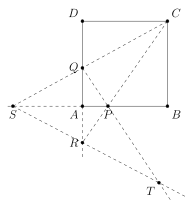
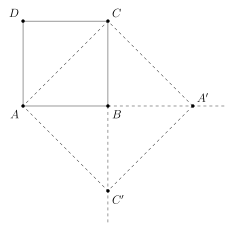
A {\em proper factor} of an integer \(N\) is a positive integer, not \(1\) or \(N\), that divides \(N\).
- Show that \(3^2\times 5^3\) has exactly \(10\) proper factors. Determine how many other integers of the form \(3^m\times5^n\) (where \(m\) and \(n\) are integers) have exactly 10 proper factors.
- Let \(N\) be the smallest positive integer that has exactly \(426\) proper factors. Determine \(N\), giving your answer in terms of its prime factors.
- All factors of \(3^2 \times 5^3\) have factors of the form \(3^k \times 5^l\) where \(0 \leq k \leq 2\) and \(0 \leq l \leq 3\) therefore there are \(3\) possible values for \(k\) and \(4\) possible values for \(l\), which gives \(3 \times 4 = 12\) factors, which includes \(2\) factors we aren't counting, so \(10\) proper factors. By the same argument \(3^m \times 5^n\) has \((m+1) \times (n+1) - 2\) proper factors, so we want \((m+1) \times (n+1) = 12\), so we could have \begin{array}{cccc} \text{factor} & m+1 & n + 1 & m & n \\ 12 = 12 \times 1 & 12 & 1 & 11 & 0 \\ 12 = 6 \times 2 & 6& 2 & 5 & 1 \\ 12 = 4 \times 3 & 4& 3 & 3 & 2 \\ 12 = 3 \times 4 & 3& 4 & 2 & 3 \\ 12 = 2 \times 6 & 2& 6 & 1 & 5 \\ 12 = 1 \times 12 & 1& 12 & 0 & 11 \\ \end{array} So we could have \(3^{11}, 3^{5} \times 5^1 3^3 \times 5^2, 3^2 \times 5^3, 3^1 \times 5^5, 5^{11}\)
- Suppose \(N\) has \(426\) proper factors, then it has \(428 = 2^2 \times 107\) factors, so it will either factor as \(p^{427}\) or \(p_1^{106} p_2^{3}\) or \(p_1^{106} p_2 p_3\). Clearly the first will be very large, and we should have \(p_1 < p_2 < p_3\), so lets consider \(2^{106}\) with either \(3^3 = 27\) or \(3 \times = 15 < 27\). Therefore we should take \(2^{106} \times 3 \times 5\)
What does it mean to say that a number \(x\) is irrational? Prove by contradiction statements A and B below, where \(p\) and \(q\) are real numbers.
- A: If \(pq\) is irrational, then at least one of \(p\) and \(q\) is irrational.
- B: If \(p+q\) is irrational, then at least one of \(p\) and \(q\) is irrational.
- C: If \(p\) and \(q\) are irrational, then \(p+q\) is irrational.
- A: Suppose for sake of contradiction that neither \(p\) nor \(q\) is irrational, then \(pq\) is the product of two rational numbers, ie is also rational. Therefore \(pq\) is rational. Contradiction.
- B: Suppose for the sake of contradiction both \(p\) and \(q\) are rational, but then \(p+q\) is also rational, contradicting \(p+q\) is irrational.
- C: Note that \(\sqrt{2}\) and \(-\sqrt{2}\) are both irrational, but \(\sqrt{2}+(-\sqrt{2}) = 0\) which is rational.
Prove that, if \(c\ge a\) and \(d\ge b\), then \[ ab+cd\ge bc+ad\,. \tag{\(*\)} \]
- If \(x\ge y\), use \((*)\) to show that \(x^2+y^2\ge 2xy\,\). If, further, \(x\ge z\) and \(y\ge z\), use \((*)\) to show that \(z^2+xy\ge xz+yz\) and deduce that \(x^2+y^2+z^2\ge xy+yz+zx\,\). Prove that the inequality \(x^2+y^2+z^2\ge xy+yz+zx\,\) holds for all \(x\), \(y\) and \(z\).
- Show similarly that the inequality \[\frac st +\frac tr +\frac rs +\frac ts +\frac rt +\frac sr \ge 6\] holds for all positive \(r\), \(s\) and \(t\).
- Applying \((*)\) with \(c=d=x\) and \(a=b=y\) we obtain: \(x^2 + y^2 \geq xy + xy = 2xy\) Similarly, applying \((*)\) with \(c=x, d=y, a=b=z\) we obtain: \(z^2 + xy \geq zx+zy\) so \(x^2+y^2+z^2 \geq 2xy + z^2 \geq xy + zx+zy\) There was nothing special about our choice of ordering \(x,y,z\) so it is true for all \(x,y,z\)
- \begin{align*} \frac st +\frac tr +\frac rs +\frac ts +\frac rt +\frac sr &=\left ( \frac st+\frac ts \right)+\left ( \frac tr +\frac rt \right)+\left ( \frac rs +\frac sr \right) \\ & \geq 2 \sqrt{\frac st \frac ts} + 2 \sqrt{\frac tr \frac rt} + 2 \sqrt{\frac rs \frac sr} \\ & = 2 + 2 + 2 \\ &= 6 \end{align*}
The polynomial \(\p(x)\) is given by \[ \ds \p(x)= x^n +\sum\limits_{r=0}^{n-1}a_rx^r\,, \] where \(a_0\), \(a_1\), \(\ldots\) , \(a_{n-1}\) are fixed real numbers and \(n\ge1\). Let \(M\) be the greatest value of \(\big\vert \p(x) \big\vert\) for $\vert x \vert\le 1\(. Then Chebyshev's theorem states that \)M\ge 2^{1-n}$.
- Prove Chebyshev's theorem in the case \(n=1\) and verify that Chebyshev's theorem holds in the following cases:
- \( \p(x) = x^2 - \frac12\,\);
- \(\p(x) = x^3 - x \,\).
- Use Chebyshev's theorem to show that the curve $ \ y= 64x^5+25x^4-66x^3-24x^2+3x+1 \ $ has at least one turning point in the interval \(-1\le x \le 1\).
- If \(n = 1\) the theorem is \(\max_{x \in [-1,1]} \left ( |x + a_0 |\right) \geq 1\), but clearly \(\max(1+a_0, |a_0 - 1|) \geq 1\) (taking according to the sign of \(a_0\))
- \( \p(x) = x^2 - \frac12\,\) - take \(x = 0\) then \(|p(0)| = \frac12 \geq 2^{1-2} = \frac12\)
- \(\p(x) = x^3 - x \,\). take \(x = \frac1{\sqrt{2}}\), then \(|p\left ( \frac1{\sqrt{2}}\right)| = |\frac12 \frac{1}{\sqrt{2}}-\frac{1}{\sqrt{2}}| = \frac{1}{2\sqrt{2}} > \frac14 = 2^{1-3} \)
- Consider \(p(x) = \frac{1}{64} \left ( 64x^5+25x^4-66x^3-24x^2+3x+1\right)\), then \(p\) satisfies the conditions of the theorem, therefore \(\max |p(x)| \geq 2^{1-5} = \frac1{16} = \frac{4}{64}\). However, \(p(-1) = \frac{1}{64}\) and \(p(1) = \frac{3}{64}\), so it cannot be strictly increasing or decreasing and there must be at turning point to achieve \(\frac{4}{64}\)
A sequence of points \((x_1,y_1)\), \((x_2,y_2)\), \(\ldots\) in the cartesian plane is generated by first choosing \((x_1,y_1)\) then applying the rule, for \(n=1\), \(2\), \(\ldots\), \[ (x_{n+1}, y_{n+1}) = (x_n^2-y_n^2 +a, \; 2x_ny_n+b+2)\,, \] where \(a\) and \(b\) are given real constants.
- In the case \(a=1\) and \(b=-1\), find the values of \((x_1,y_1)\) for which the sequence is constant.
- Given that \((x_1,y_1) = (-1,1)\), find the values of \(a\) and \(b\) for which the sequence has period 2.