2020 Paper 2 Q4
Year: 2020
Paper: 2
Question Number: 4
Course: LFM Pure
Section: Proof
Problem
- Given that \(a\), \(b\) and \(c\) are the lengths of the sides of a triangle, explain why \(c < a + b\), \(a < b + c\) and \(b < a + c\).
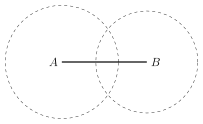
- Use a diagram to show that the converse of the result in part (i) also holds: if \(a\), \(b\) and \(c\) are positive numbers such that \(c < a + b\), \(a < b + c\) and \(b < c + a\) then it is possible to construct a triangle with sides of length \(a\), \(b\) and \(c\).
- When \(a\), \(b\) and \(c\) are the lengths of the sides of a triangle, determine in each case whether the following sets of three lengths can
- always
- sometimes but not always
- never
- Let \(\mathrm{f}\) be a function defined on the positive real numbers and such that, whenever \(x > y > 0\), \[\mathrm{f}(x) > \mathrm{f}(y) > 0 \quad \text{but} \quad \frac{\mathrm{f}(x)}{x} < \frac{\mathrm{f}(y)}{y}.\] Show that, whenever \(a\), \(b\) and \(c\) are the lengths of the sides of a triangle, then \(\mathrm{f}(a)\), \(\mathrm{f}(b)\) and \(\mathrm{f}(c)\) can also be the lengths of the sides of a triangle.
Solution
- Not that unless a side is the largest side, it is clearly shorter than the sum of the other two sides (since it's greater than or equal to one on its own). Note also that the distance from one vertex to the other (say \(c\)) is shorter than going via the other vertex \(a+b\), therefore \(c < a+b\).
- Draw a line of the length of the largest number, say \(c\), then since \(c < a+b\) we must have circles radius \(a\) and \(b\) at the endpoints cross, and at their intersection we have a vertex of a \(c\)-\(a\)-\(b\) triangle.
- (A) always. Suppose \(c\) is the longest side, then \(c < a+b \Rightarrow c+1 < a + 1 + b+1\) so \((a+1,b+1,c+1)\) are still sides of a triangle. (B) sometimes, but not always. \((1,1,1) \to (1,1,1)\) is still a triangle, but \((10, 10, 1) \to (1, 10, \frac{1}{10})\) is not a triangle since \(10 > 1 + \frac{1}{10}\) (C) never, suppose \(a \leq b \leq c\) then the sides are \(b-a, c-b, c-a\) but \(c-a = (c-b)+(b-a)\) so the triangle inequality cannot be satisfied. (D) always - without loss of generality let \(c\) be the longest side, and since every term is homogeneous degree \(2\) we can divide through by \(c^2\) to see we have the sides \(a^2+b, b^2+a, 1+ab\) and note that \(1 + ab < a+b +ab < a+b+a^2+b^2\), also \(a^2+b < 1 + b < 1 + (a+b)b = 1 + b^2 + ab < (1+ab)+(b^2+a)\).
- Suppose \(f\) is increasing and \(\f(x)/x\) is decreasing, and suppose \(a,b,c\) are side-lengths of a triangle. Wlog \(c\) is the longest side, then note \(f(c) > f(b), f(a)\), so it suffices to prove that \(f(c) < f(a)+f(b)\) \begin{align*} \frac{f(c)}{c} < \frac{f(a)}{a}: && f(a) &> \frac{a}{c} f(c) \\ \frac{f(c)}{c} < \frac{f(b)}{b}: && f(b) &> \frac{b}{c} f(c) \\ \Rightarrow && f(a)+f(b) &> f(c) \underbrace{\left ( \frac{a+b}{c} \right)}_{>1} \\ &&&> f(c) \end{align*} as required
Examiner's report
— 2020 STEP 2, Question 4There were just over 800 entries for this paper, and good solutions were seen to all of the questions. Candidates should be aware of the need to provide clear explanations of their reasoning throughout the paper (and particularly in questions where the result to be shown is given in the question). Short explanatory comments at key points in solutions can be very helpful in this regard, as can clearly drawn diagrams of the situation described in the question. The paper included a few questions where a statement of the form "A if and only if B" needed to be proven – candidates should be aware of the meaning of such statements and make sure that both directions of the implication are covered clearly. In general, candidates who performed better on the questions in this paper recognised the relationships between the different parts of each question and were able to adapt methods used in earlier parts when working on the later sections of the question.
Rating Information
Difficulty Rating: 1500.0
Difficulty Comparisons: 0
Banger Rating: 1500.0
Banger Comparisons: 0
Show LaTeX source
Problem source
\begin{questionparts}
\item Given that $a$, $b$ and $c$ are the lengths of the sides of a triangle, explain why $c < a + b$, $a < b + c$ and $b < a + c$.
\item Use a diagram to show that the converse of the result in part \textbf{(i)} also holds: if $a$, $b$ and $c$ are positive numbers such that $c < a + b$, $a < b + c$ and $b < c + a$ then it is possible to construct a triangle with sides of length $a$, $b$ and $c$.
\item When $a$, $b$ and $c$ are the lengths of the sides of a triangle, determine in each case whether the following sets of three lengths can
\begin{itemize}
\item always
\item sometimes but not always
\item never
\end{itemize}
form the sides of a triangle. Prove your claims.
\textbf{(A)} $a+1$, $b+1$, $c+1$.
\textbf{(B)} $\dfrac{a}{b}$, $\dfrac{b}{c}$, $\dfrac{c}{a}$.
\textbf{(C)} $|a-b|$, $|b-c|$, $|c-a|$.
\textbf{(D)} $a^2 + bc$, $b^2 + ca$, $c^2 + ab$.
\item Let $\mathrm{f}$ be a function defined on the positive real numbers and such that, whenever $x > y > 0$,
\[\mathrm{f}(x) > \mathrm{f}(y) > 0 \quad \text{but} \quad \frac{\mathrm{f}(x)}{x} < \frac{\mathrm{f}(y)}{y}.\]
Show that, whenever $a$, $b$ and $c$ are the lengths of the sides of a triangle, then $\mathrm{f}(a)$, $\mathrm{f}(b)$ and $\mathrm{f}(c)$ can also be the lengths of the sides of a triangle.
\end{questionparts}
Solution source
\begin{questionparts}
\item Not that unless a side is the largest side, it is clearly shorter than the sum of the other two sides (since it's greater than or equal to one on its own). Note also that the distance from one vertex to the other (say $c$) is shorter than going via the other vertex $a+b$, therefore $c < a+b$.

\item Draw a line of the length of the largest number, say $c$, then since $c < a+b$ we must have circles radius $a$ and $b$ at the endpoints cross, and at their intersection we have a vertex of a $c$-$a$-$b$ triangle.


\begin{center}
    \begin{tikzpicture}
        \tikzset{
            axis/.style={thick, draw=black!80, -{Stealth[scale=1.2]}},
            grid/.style={thin, dashed, gray!30},
            curveA/.style={very thick, color=cyan!70!black, smooth},
            curveB/.style={very thick, color=orange!90!black, smooth},
            curveC/.style={very thick, color=green!90!black, smooth},
            curveBlack/.style={very thick, color=black, smooth},
            dot/.style={circle, fill=black, inner sep=1.2pt},
            labelbox/.style={fill=white, inner sep=2pt, rounded corners=2pt} % Protects text from lines
        }

        \coordinate (A) at (0, 0);

        \coordinate (B) at (3, 0);

        \draw[curveBlack] (A) -- (B);

        \draw[dashed] (A) circle (2);
        \draw[dashed] (B) circle (1.8);

        \node[left] at (A) {$A$};
        \node[right] at (B) {$B$};

    \end{tikzpicture}
\end{center}


\item \textbf{(A)} always. Suppose $c$ is the longest side, then $c < a+b \Rightarrow c+1 < a + 1 + b+1$ so $(a+1,b+1,c+1)$ are still sides of a triangle.

\textbf{(B)} sometimes, but not always. $(1,1,1) \to (1,1,1)$ is still a triangle, but $(10, 10, 1) \to (1, 10, \frac{1}{10})$ is not a triangle since $10 > 1 + \frac{1}{10}$

\textbf{(C)} never, suppose $a \leq b \leq c$ then the sides are $b-a, c-b, c-a$ but $c-a = (c-b)+(b-a)$ so the triangle inequality cannot be satisfied.

\textbf{(D)} always - without loss of generality let $c$ be the longest side, and since every term is homogeneous degree $2$ we can divide through by $c^2$ to see we have the sides $a^2+b, b^2+a, 1+ab$ and note that $1 + ab < a+b +ab < a+b+a^2+b^2$, also $a^2+b < 1 + b < 1 + (a+b)b = 1 + b^2 + ab < (1+ab)+(b^2+a)$.

\item Suppose $f$ is increasing and $\f(x)/x$ is decreasing, and suppose $a,b,c$ are side-lengths of a triangle. Wlog $c$ is the longest side, then note $f(c) > f(b), f(a)$, so it suffices to prove that $f(c) < f(a)+f(b)$
\begin{align*}
\frac{f(c)}{c} < \frac{f(a)}{a}: && f(a) &> \frac{a}{c} f(c) \\
\frac{f(c)}{c} < \frac{f(b)}{b}: && f(b) &> \frac{b}{c} f(c) \\
\Rightarrow && f(a)+f(b) &> f(c) \underbrace{\left ( \frac{a+b}{c} \right)}_{>1} \\
&&&> f(c)
\end{align*}
as required
\end{questionparts}
Most candidates could justify the triangle inequality in part (i) (as well as arguing that the shortest distance is the straight line, there were successful uses of the cosine rule or c = a cos B + b cos A), but were less confident in proving the converse in part (ii). Successful approaches were to consider two circular loci for the SSS construction, or to fix two sides and vary the angle between them; in both cases care was needed to ensure all three inequalities were actually used, for example checking that neither circle can contain the other, which was often omitted. There was one elegant solution using three pairwise tangent circles. A reasonable number of candidates obtained correct answers of "always", "sometimes" (by examples) and "never" for part (iii) A, B and C respectively, although it was surprisingly common to forget that a, b, c must be the sides of a triangle. However, B caused some confusion as many candidates spent some time trying to prove that the new lengths did satisfy the triangle inequality. Parts (iii) D and (iv) were found much harder and many candidates did not attempt them. A reasonable number of candidates were able to make some progress, but there were few complete solutions to either of these parts. Common errors for (iii) D were showing that the sum of the three inequalities is a true statement, or attempting to prove a positive result by examples. Most substantial attempts at (iv) used a different approach of fixing the order of a, b, c and reducing the problem to proving one of the three inequalities.