Differentiation from first principles
Let \(f(x) = (x-p)g(x)\), where g is a polynomial. Show that the tangent to the curve \(y = f(x)\) at the point with \(x = a\), where \(a \neq p\), passes through the point \((p, 0)\) if and only if \(g'(a) = 0\). The curve \(C\) has equation $$y = A(x - p)(x - q)(x - r),$$ where \(p\), \(q\) and \(r\) are constants with \(p < q < r\), and \(A\) is a non-zero constant.
- The tangent to \(C\) at the point with \(x = a\), where \(a \neq p\), passes through the point \((p, 0)\). Show that \(2a = q + r\) and find an expression for the gradient of this tangent in terms of \(A\), \(q\) and \(r\).
- The tangent to \(C\) at the point with \(x = c\), where \(c \neq r\), passes through the point \((r, 0)\). Show that this tangent is parallel to the tangent in part (i) if and only if the tangent to \(C\) at the point with \(x = q\) does not meet the curve again.
- In this case \(g(x) = A(x-q)(x-r) = A(x^2-(q+r)x+qr)\) and so we must have that \(g'(a) = 0\), ie \(A(2a-(q+r)) = 0 \Rightarrow 2a = q+r\) The gradient is \(g(a) +(a-p)g'(a) = g(a) = A(a-q)(a-r)\)
- By the same reasoning, but with \(g(x) = A(x-p)(x-q)\) we have the gradient is \(A(c-p)(c-r)\). This is parallel iff \begin{align*} && (c-p)(c-r) &= (a-q)(a-r) \end{align*} The tangent at \(x = q\) is \(\frac{y-0}{x-q} = A(q-p)(q-r)\) or \( y = A(q-p)(q-r)(x-q)\)
The definition of the derivative \(f'\) of a (differentiable) function f is $$f'(x) = \lim_{h\to 0} \frac{f(x + h) - f(x)}{h}. \quad (*)$$
- The function f has derivative \(f'\) and satisfies $$f(x + y) = f(x)f(y)$$ for all \(x\) and \(y\), and \(f'(0) = k\) where \(k \neq 0\). Show that \(f(0) = 1\). Using \((*)\), show that \(f'(x) = kf(x)\) and find \(f(x)\) in terms of \(x\) and \(k\).
- The function g has derivative \(g'\) and satisfies $$g(x + y) = \frac{g(x) + g(y)}{1 + g(x)g(y)}$$ for all \(x\) and \(y\), \(|g(x)| < 1\) for all \(x\), and \(g'(0) = k\) where \(k \neq 0\). Find \(g'(x)\) in terms of \(g(x)\) and \(k\), and hence find \(g(x)\) in terms of \(x\) and \(k\).
- \(\,\) \begin{align*} && f(0+x) &= f(0)f(x) \\ \Rightarrow && f(0) &= 0, 1\\ &&\text{since }f'(0) \neq 0 & \text{ there is some non-zero } f(x) \\ \Rightarrow && f(0) &= 1 \end{align*} \begin{align*} && f'(x) &= \lim_{h\to 0} \frac{f(x+h)-f(x)}{h} \\ &&&= \lim_{h\to 0} \frac{f(x)f(h)-f(x)}{h} \\ &&&= f(x) \cdot \lim_{h\to 0} \frac{f(h)-1}{h} \\ &&&= f(x) \cdot \lim_{h\to 0} \frac{f(0+h)-f(0)}{h} \\ &&&= f(x) \cdot f'(0) \\ &&&= kf(x) \end{align*} Since \(f'(x) = kf(x)\) we must have \(\frac{f'(x)}{f(x)} = k \Rightarrow \ln f(x) = kx + c \Rightarrow f(x) = Ae^{kx}\) but \(f(0) = 1\) so \(f(x) = e^{kx}\)
- Consider \begin{align*} && g(0+0) &= \frac{g(0)+g(0)}{1+(g(0))^2} \\ \Rightarrow && g(0)(1+(g(0))^2)&= 2g(0) \\ \Rightarrow && 0 &= g(0)\left (1- (g(0))^2 \right) \\ \Rightarrow && g(0) &= -1, 0, 1 \\ \Rightarrow && g(0) &= 0 \tag{\(|g(0)| < 1\)} \end{align*} \begin{align*} && g'(x) &=\lim_{h\to 0} \frac{g(x+h)-g(x)}{h} \\ &&&= \lim_{h\to 0} \frac{\frac{g(x)+g(h)}{1+g(x)g(h)}-g(x)}{h} \\ &&&= \lim_{h\to 0} \frac{g(x)+g(h)-g(x)(1+g(x)g(h))}{h(1+g(x)g(h))} \\ &&&= \lim_{h\to 0} \frac{g(h)-g(x)(g(x)g(h))}{h(1+g(x)g(h))} \\ &&&= (1-(g(x))^2) \cdot \lim_{h \to 0} \frac{1}{1+g(x)g(h)} \cdot \lim_{h \to 0} \frac{g(h)}{h} \\ &&&= (1-(g(x))^2) \cdot \frac{1}{1+g(x)\cdot 0} \cdot \lim_{h \to 0} \frac{g(h) - g(0)}{h} \\ &&&= (1-(g(x))^2) \cdot g'(0)\\ &&&= k (1-(g(x))^2) \\ \end{align*} Let \(y = g(x)\) so \begin{align*} && y' &= k(1-y^2) \\ \Rightarrow && kx &= \int \frac{1}{1-y^2} \d y \\ \Rightarrow &&&= \int \frac12\left ( \frac{1}{1-y} + \frac{1}{1+y} \right) \d y \\ &&&= \frac12\ln \left ( \frac{1+y}{1-y} \right) + C \\ x = 0, y = 0: && 0 &= \ln 1 + C \\ \Rightarrow && C &= 0 \\ \Rightarrow && \frac{1+y}{1-y} &= e^{2kx} \\ \Rightarrow && 1+y &= e^{2kx} - e^{2kx}y \\ \Rightarrow && y &= \frac{e^{2kx}-1}{e^{2kx}+1} \\ &&&= \tanh kx \end{align*}
The line \(y=a^2 x\) and the curve \(y=x(b-x)^2\), where \(0 < a < b\,\), intersect at the origin \(O\) and at points \(P\) and \(Q \). The \(x\)-coordinate of \(P\) is less than the \(x\)-coordinate of \(Q\). Find the coordinates of \(P\) and \(Q\), and sketch the line and the curve on the same axes. Show that the equation of the tangent to the curve at \(P\) is \[ y = a(3a-2b)x + 2a(b-a)^2 . \] This tangent meets the \(y\)-axis at \(R\). The area of the region between the curve and the line segment \(OP\) is denoted by \(S\). Show that \[ S= \frac1{12}(b-a)^3(3a+b)\,. \] The area of triangle \(OPR\) is denoted by \(T\). Show that \(S>\frac{1}{3}T\,\).
Show Solution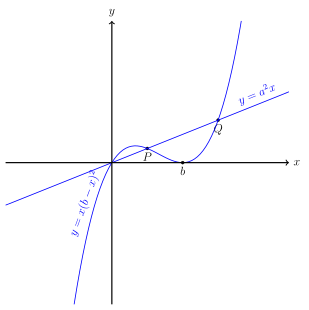
The real numbers \(a_1\), \(a_2\), \(a_3\), \(\ldots\) are all positive. For each positive integer \(n\), \(A_n\) and \(G_n\) are defined by \[ A_n = \frac{a_1+a_2 + \cdots + a_n}n \ \ \ \ \ \text{and } \ \ \ \ \ G_n = \big( a_1a_2\cdots a_n\big) ^{1/n} \,. \]
- Show that, for any given positive integer \(k\), \[ (k+1) ( A_{k+1} - G_{k+1}) \ge k (A_k-G_k) \] if and only if \[\lambda^{k+1}_k -(k+1)\lambda_{{k}} +k \ge 0\,, \] where \( \lambda_{{k}} = \left(\dfrac{a_{k+1}}{G_{k}}\right)^{\frac1 {k+1}}\,\).
- Let \[ \f(x)=x^{k+1} -(k+1)x +k \,, \] where \(x > 0\) and \(k\) is a positive integer. Show that \(\f(x)\ge0\) and that \(\f(x)=0\) if and only if \(x = 1\,\).
- Deduce that:
- \(A_n \ge G_n\) for all \(n\); \\
- if \(A_n=G_n\) for some \(n\), then \(a_1=a_2 = \cdots = a_n\,\).
- \begin{align*} && (k+1) (A_{k+1} - G_{k+1}) & \geq k(A_k - G_k) \\ \Leftrightarrow && \sum_{i=1}^{k+1} a_i - (k+1)G_{k+1} &\geq \sum_{i=1}^k a_i - kG_k \\ \Leftrightarrow && a_{k+1} -(k+1)G_k^{k/(k+1)}a_{k+1}^{1/(k+1)} & \geq - k G_k \\ \Leftrightarrow && a_{k+1} -(k+1)G_k^{k/(k+1)}a_{k+1}^{1/(k+1)} + k G_k& \geq 0\\ \Leftrightarrow && \frac{a_{k+1}}{G_k} -(k+1)G_k^{k/(k+1)-1}a_{k+1}^{1/(k+1)} + k & \geq 0\\ \Leftrightarrow && \lambda_k^{k+1} -(k+1)\lambda_k+ k & \geq 0\\ \end{align*} as required.
- \begin{align*} && f'(x) &= (k+1)x^k - (k+1) \\ &&&= (k+1)(x^k-1) \end{align*} Therefore \(f(x)\) is strictly decreasing on \((0,1)\) and strictly increasing on \((1,\infty)\) and so the minimum will be \(f(1) = 1 - (k+1) + k = 0\), so \(f(x) \geq 0\) with equality only at \(x = 1\).
- We can proceed by induction to show since the inequality holds for \(n=1\) and since if it holds for \(n=k\) it will hold for \(n=k+1\) as \(A_{k+1}-G_{k+1}\) must have the same sign as \(A_k - G_k\).
- The only way for equality to hold is if \(\lambda_k = 1\) for \(k = 1, \cdots n\), ie \(a_{k+1} = G_k\), but this means \(a_2 = a_1, a_3 = a_1\) etc. Therefore all values are equal.
Let \[ \f(x) = 3ax^2 - 6x^3\, \] and, for each real number \(a\), let \({\rm M}(a)\) be the greatest value of \(\f(x)\) in the interval \(-\frac13 \le x \le 1\). Determine \({\rm M} (a)\) for \(a\ge0\). [The formula for \({\rm M} (a)\) is different in different ranges of \(a\); you will need to identify three ranges.]
Show SolutionLet \(L_a\) denote the line joining the points \((a,0)\) and \((0, 1-a)\), where \(0< a < 1\). The line \(L_b\) is defined similarly.
- Determine the point of intersection of \(L_a\) and \(L_b\), where \(a\ne b\).
- Show that this point of intersection, in the limit as \(b\to a\), lies on the curve \(C\) given by \[ y=(1-\sqrt x)^2\, \ \ \ \ (0< x < 1)\,. \]
- Show that every tangent to \(C\) is of the form \(L_a\) for some \(a\).
- \(L_a : \frac{y}{x-a} = \frac{1-a-0}{0-a} = \frac{a-1}{a} \Rightarrow ay+(1-a)x = a(1-a)\) \begin{align*} && ay + (1-a)x &= a(1-a) \\ && by + (1-b)x &= b(1-b) \\ \Rightarrow && aby + b(1-a)x &= ba(1-a) \\ && aby + a(1-b)x &= ab(1-b) \\ \Rightarrow && (b-a)x &= ab(b-a) \\ \Rightarrow && x &= ab \\ && y &= \frac{a-1}{a} \cdot a(b-1) \\ &&&= (1-a)(1-b) \end{align*}
- As \(a \to b\), \(x \to a^2, y \to 1-2a+a^2 =(1-a)^2 = (1-\sqrt{x})^2\)
- \(\frac{\d y}{\d x} = 2(1-\sqrt{x})\cdot \left (-\tfrac12 \frac{1}{\sqrt{x}} \right) = 1 - \frac{1}{\sqrt{x}}\). Therefore the tangent when \(x = c^2, y = (1-c)^2\) is \begin{align*} && \frac{y-(1-c)^2}{x-c^2} &= 1 - \frac{1}{c} \\ \Rightarrow && cy + (1-c)x &= c(c-1)+c(1-c)^2 \\ &&&= c(1-c) \end{align*} Which is an equation of the form \(L_c\)
- A function \(\f(x)\) satisfies \(\f(x) = \f(1-x)\) for all \(x\). Show, by differentiating with respect to \(x\), that \(\f'(\frac12) =0\,\). If, in addition, \(\f(x) = \f(\frac1x)\) for all (non-zero) \(x\), show that \(\f'(-1)=0\) and that \(\f'(2)=0\).
- The function \(\f\) is defined, for \(x\ne0\) and \(x\ne1\), by \[ \f(x) = \frac {(x^2-x+1)^3}{(x^2-x)^2} \,. \] Show that \(\f(x)= \f(\frac 1 x)\) and \(\f(x) = \f(1-x)\). Given that it has exactly three stationary points, sketch the curve \(y=\f(x)\).
- Hence, or otherwise, find all the roots of the equation \(\f(x) = \dfrac {27} 4\,\) and state the ranges of values of \(x\) for which \(\f(x) > \dfrac{27} 4\,\). Find also all the roots of the equation \(\f(x) = \dfrac{343}{36}\,\) and state the ranges of values of \(x\) for which \(\f(x) > \dfrac{343}{36}\).
- \(\,\) \begin{align*} && f(x) &= f(1-x) \\ \Rightarrow && f'(x) &= -f'(1-x) \\ \Rightarrow && f'(\tfrac12) &= -f'(\tfrac12) \\ \Rightarrow && f'(\tfrac12) &= 0 \\ \\ && f(x) &= f(\tfrac1x) \\ \Rightarrow && f'(x) &= f'(\tfrac1x) \cdot \frac{-1}{x^2} \\ \Rightarrow && f'(-1) &= -f'(-1) \\ \Rightarrow && f'(-1) &= 0 \\ \\ && f'(2) &= -\frac{1}{4}f'(\tfrac12) \\ &&&= 0 \end{align*}
- Suppose \begin{align*}
&& f(x) &= \frac{(x^2-x+1)^3}{(x^2-x)^2} \\
&& f(1/x) &= \frac{(x^{-2}-x^{-1}+1)^3}{(x^{-2}-x^{-1})^2} \\
&&&= \frac{(1-x+x^2)^3/x^6}{((x-x^2)^2/x^6} \\
&&&= f(x) \\
\\
&& f(1-x) &= \frac{((1-x)^2-(1-x)+1)^3}{((1-x)^2-(1-x))^2} \\
&&&= \frac{(1-x+x^2)^3}{(x^2-x)^2} = f(x)
\end{align*}
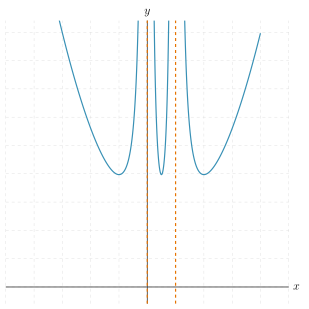
- Clearly \(x = -1\) is a root of \(f(x) = \frac{27}{4}\), so we must also have \(x=2\) and \(x = \frac12\), therefore \(f(x) > \frac{27}{4}\) if \(x \in \mathbb{R} \setminus \{-1, 2, \tfrac12, 0, 1 \}\). Clearly \(x = 3\) and \(x = -2\) are solutions so we also have: \(\frac13, -\frac12, \frac32, \frac23\) and these must be all solutions so we must have: \(f(x) > \frac{343}{36} \Leftrightarrow x \in (-\infty, -2) \cup (-\frac12, 0) \cup (0, \frac13) \cup (\frac23, 1) \cup (1, \frac32) \cup (3, \infty)\)
- Sketch the curve \(y= x^4-6x^2+9\) giving the coordinates of the stationary points. Let \(n\) be the number of distinct real values of \(x\) for which
\[
x^4-6x^2 +b=0.
\]
State the values of \(b\), if any, for which
- \(n=0\,\);
- \(n=1\,\);
- \(n=2\,\);
- \(n=3\,\);
- \(n=4\,\).
- For which values of \(a\) does the curve \(y= x^4-6x^2 +ax +b\) have a point at which both \(\dfrac{\d y}{\d x}=0\) and \(\dfrac{\d^2y}{\d x^2}=0\,\)? For these values of \(a\), find the number of distinct real values of \(x\) for which \(\vphantom{\dfrac{A}{B}}\) \[ x^4-6x^2 +ax +b=0\,, \] in the different cases that arise according to the value of \(b\).
- Sketch the curve \(y= x^4-6x^2 +ax\) in the case \(a>8\,\).
- \(\,\)

- \(n = 0\) if \(b > 9\)
- \(n = 1\) is not possible, since by symmetry if \(x\) is a root, so is \(-x\), and \(0\) can never be the only root.
- \(n = 2\) if \(b < 0\) or \(b = 9\)
- \(n = 3\) if \(b = 0\)
- \(n = 4\) if \(0 < b < 9\)
- \(\,\) \begin{align*}
&& y' &= 4x^3-12x+a \\
&& y'' &= 12x^2-12 \\
\Rightarrow && x &= \pm 1 \\
\Rightarrow && 0 &= 4(\pm 1) - 12 (\pm 1) + a \\
&&&= a \mp 8 \\
\Rightarrow && a &= \pm 8
\end{align*}
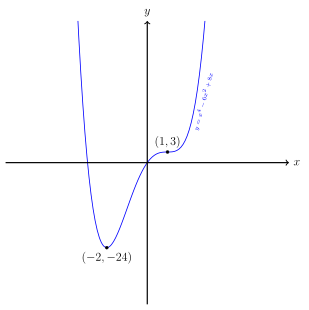
When \(a = 8\), we have \(y = x^4-6x^2+8x\) and
\begin{align*}
&&y' &= 4x^3-12x+8 \\
&&&= 4(x^3-3x+2) \\
&&&= 4(x-1)^2(x+2) \\
\Rightarrow && y(1) &= 3\\
&& y(-2) &= -24
\end{align*}
Therefore there are no solutions if \(b > 24\), one solution if \(b = 24\) and two solutions otherwise. Similarly, if \(a = -8\), we have \(y = x^4 - 6x^2-8x\) \begin{align*} && y' &= 4x^3-12x-8 \\ &&&= 4(x^3-3x-2) \\ &&&= 4(x-2)(x+1)^2 \end{align*} So we have stationary points at \(x = 2\) and \(x = -1\) (which is also a inflection point) and at \(x = 2\) \(y = -24\), so we have the same story: there are no solutions if \(b > 24\), one solution if \(b = 24\) and two solutions otherwise.
- \(\,\)

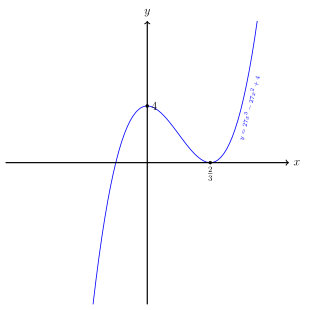
- Find the coordinates of the turning points of the curve \(y=27x^3-27x^2+4\). Sketch the curve and deduce that \(x^2(1-x)\le 4/27\) for all \(x\ge0\,\). Given that each of the numbers \(a\), \(b\) and \(c\) lies between \(0\) and \(1\), prove by contradiction that at least one of the numbers \(bc(1-a)\), \(ca(1-b)\) and \(ab(1-c)\) is less than or equal to \(4/27\).
- Given that each of the numbers \(p\) and \(q\) lies between \(0\) and \(1\), prove that at least one of the numbers \(p(1-q)\) and \(q(1-p)\) is less than or equal to \(1/4\).
- \(\,\)
\begin{align*}
&& y & = 27x^3 - 27x^2 + 4 \\
\Rightarrow && \frac{\d y}{\d x} &= 81x^2 - 54x \\
\Rightarrow && x &= 0, \frac23 \\
\Rightarrow && (x,y) &= (0, 4), \left (\frac23, 0 \right)
\end{align*}
Since \(f(x) \geq 0\) for \(x \geq 0\) we must have \(27x^2(1-x) \leq 4 \Rightarrow x^2(1-x) \leq \frac{4}{27}\) Suppose for contradiction that \(bc(1-a) > \frac{4}{27}, ca(1-b) > \frac{4}{27}, ab(1-c) > \frac{4}{27}\) then taking the product we see \begin{align*} && \left ( \frac{4}{27} \right)^3 &< bc(1-a) \cdot ca(1-b) \cdot ab(1-c) \\ &&&= a^2(1-c) \cdot b^2(1-b) \cdot c^2(1-c) \leq \left ( \frac{4}{27}\right)^3 \end{align*} which is a contradiction.
- Notice that \(f(x) = x(1-x)\) has a turning point at \((\frac12, \frac14)\), and so \(f(x) \leq \frac14\). Suppose for contradiction that both \(p(1-q)\) and \(q(1-p)\) are larger than \(1/4\) \begin{align*} && \left ( \frac14 \right)^2 &< p(1-q) \cdot q(1-p) \\ &&&= p(1-p) \cdot q(1-q) \\ &&&\leq \left ( \frac14 \right)^2 \end{align*} which is a contradiction.
A small goat is tethered by a rope to a point at ground level on a side of a square barn which stands in a large horizontal field of grass. The sides of the barn are of length \(2a\) and the rope is of length \(4a\). Let \(A\) be the area of the grass that the goat can graze. Prove that \(A\le14\pi a^2\) and determine the minimum value of \(A\).
Show Solution
The point \(P\) has coordinates \(\l p^2 , 2p \r\) and the point \(Q\) has coordinates \(\l q^2 , 2q \r\), where \(p\) and~\(q\) are non-zero and \(p \neq q\). The curve \(C\) is given by \(y^2 = 4x\,\). The point \(R\) is the intersection of the tangent to \(C\) at \(P\) and the tangent to \(C\) at \(Q\). Show that \(R\) has coordinates \(\l pq , p+q \r\). The point \(S\) is the intersection of the normal to \(C\) at \(P\) and the normal to \(C\) at \(Q\). If \(p\) and \(q\) are such that \(\l 1 , 0 \r\) lies on the line \(PQ\), show that \(S\) has coordinates \(\l p^2 + q^2 + 1 , \, p+q \r\), and that the quadrilateral \(PSQR\) is a rectangle.
Prove that the rectangle of greatest perimeter which can be inscribed in a given circle is a square. The result changes if, instead of maximising the sum of lengths of sides of the rectangle, we seek to maximise the sum of \(n\)th powers of the lengths of those sides for \(n\geqslant 2\). What happens if \(n=2\)? What happens if \(n=3\)? Justify your answers.
Show Solution- By considering \((1+x+x^{2}+\cdots+x^{n})(1-x)\) show that, if \(x\neq1\), \[ 1+x+x^{2}+\cdots+x^{n}=\frac{1-x^{n+1}}{1-x}. \]
- By differentiating both sides and setting \(x=-1\) show that \[ 1-2+3-4+\cdots+(-1)^{n-1}n \] takes the value \(-n/2\) is \(n\) is even and the value \((n+1)/2\) if \(n\) is odd.
- Show that \[ 1^{2}-2^{2}+3^{2}-4^{2}+\cdots+(-1)^{n-1}n^{2}=(-1)^{n-1}(An^{2}+Bn) \] where the constants \(A\) and \(B\) are to be determined.
- \begin{align*} && (1+x+x^{2}+\cdots+x^{n})(1-x) &= 1-x+x-x^2+\cdots -x^n+x^n-x^{n+1} \\ &&&= 1-x^{n+1} \\ \Rightarrow && 1+x+x^2+\cdots+x^n &= \frac{1-x^{n+1}}{1-x} \tag{dividing by \(1-x\)} \end{align*}
- \begin{align*} \frac{\d}{\d x}: && 0+1+2x+\cdots+nx^{n-1} &= \frac{(n+1)(1-x)x^n+(1-x^{n+1})}{(1-x)^2} \\ \Rightarrow && 1-2x+\cdots+(-1)^n n &= \frac{-(n+1)2(-1)^n+(1-(-1)^{n+1})}{4} \\ &&&= \begin{cases} \frac{-(n+1)\cdot2\cdot1+(1-(-1)}{4} & \text{if }n\text{ is even} \\ \frac{-(n+1)\cdot 2 \cdot(-1)+(1-1)}{4} & \text{if }n\text{ is odd}\end{cases} \\ &&&= \begin{cases} \frac{-n}{2} & \text{if }n\text{ is even}\\ \frac{n+1}{2} & \text{if }n\text{ is odd}\end{cases} \\ \end{align*}
- \begin{align*} x: && x+2x^2+\cdots+nx^{n} &= \frac{(n+1)(1-x)x^{n+1}+x(1-x^{n+1})}{(1-x)^2} \\ &&&= \frac{x+(n+1)x^{n+1}-nx^{n+2}}{(1-x)^2}\\ \frac{\d}{\d x}: && 1^2+2^2x + \cdots + n^2x^{n-1} &= \frac{(1-x)^2(1+(n+1)^2x^{n}-n(n+2)x^{n+1}) +2(1-x)(x+(n+1)x^{n+1}-nx^{n+2})}{(1-x)^4} \\ &&&= \frac{1 + x - (1 + n)^2 x^n + (2 n^2+2n-1) x^{n+1} - n^2 x^{n+2}}{(1-x)^3} \\ \Rightarrow && 1^2-2^2 + \cdots + (-1)^{n-1}n^2 &= \frac{(-1)^n \l - (1 + n)^2- (2 n^2+2n-1) - n^2 \r}{8} \\ &&&= \frac{(-1)^n(-4n^2-4n}{8} \\ &&&= \frac{(-1)^{n-1}(n^2+n)}{2} \end{align*}
\(\lozenge\) is an operation which take polynomials in \(x\) to polynomials in \(x\); that is, given a polynomial \(\mathrm{h}(x)\) there is another polynomial called \(\lozenge\mathrm{h}(x)\). It is given that, if \(\mathrm{f}(x)\) and \(\mathrm{g}(x)\) are any two polynomials in \(x\), the following are always true:
- \(\lozenge(\mathrm{f}(x)\mathrm{g}(x))=\mathrm{g}(x)\lozenge\mathrm{f}(x)+\mathrm{f}(x)\lozenge\mathrm{g}(x),\)
- \(\lozenge(\mathrm{f}(x)+\mathrm{g}(x))=\lozenge\mathrm{f}(x)+\lozenge\mathrm{g}(x),\)
- \(\lozenge x=1\)
- if \(\lambda\) is a constant then \(\lozenge(\lambda\mathrm{f}(x))=\lambda\lozenge\mathrm{f}(x).\)
Given a curve described by \(y=\mathrm{f}(x)\), and such that \(y\geqslant0\), a push-off of the curve is a new curve obtained as follows: for each point \((x,\mathrm{f}(x))\) with position vector \(\mathbf{r}\) on the original curve, there is a point with position vector \(\mathbf{s}\) on the new curve such that \(\mathbf{s-r}=\mathrm{p}(x)\mathbf{n},\) where \(\mathrm{p}\) is a given function and \(\mathbf{n}\) is the downward-pointing unit normal to the original curve at \(\mathbf{r}\).
- For the curve \(y=x^{k},\) where \(x>0\) and \(k\) is a positive integer, obtain the function \(\mathrm{p}\) for which the push-off is the positive \(x\)-axis, and find the value of \(k\) such that, for all points on the original curve, \(\left|\mathbf{r}\right|=\left|\mathbf{r-s}\right|\).
- Suppose that the original curve is \(y=x^{2}\) and \(\mathrm{p}\) is such that the gradient of the curves at the points with position vectors \(\mathbf{r}\) and \(\mathbf{s}\) are equal (for every point on the original curve). By writing \(\mathrm{p}(x)=\mathrm{q}(x)\sqrt{1+4x^{2}},\) where \(\mathrm{q}\) is to be determined, or otherwise, find the form of \(\mathrm{p}\).
- Suppose we have \(y = x^k\), then the tangent at \((t,t^k)\) has gradient \(\frac{\d y}{\d x} = kx^{k-1} = kt^{k-1}\) and the normal has gradient \(-\frac1k x^{1-k}\). For the push-off to be the positive \(x\)-axis, we need \(p(x)\) to be the length of the line. The line will have the equation: \begin{align*} && \frac{y - t^k}{x - t} &= -\frac1k t^{1-k} \\ y = 0: && x-t &= \frac{kt^k}{t^{1-k}} \\ && x& =t + kt^{2k-1} \end{align*} The distance from \((t,t^k)\) to \((t+kt^{2k-1},0)\) is \(\sqrt{t^{2k} + k^2t^{4k-2}} = t^k \sqrt{1+k^2t^{2k-2}} = y \sqrt{1+k^2 \frac{y^2}{x^2}} = \frac{y}{x} \sqrt{x^2 + k^2y^2}\), ie \(p(x) = \frac{y}{x}\sqrt{x^2+k^2y^2}\) If \(\left|\mathbf{r}\right|=\left|\mathbf{r-s}\right|\), then we need \(\sqrt{x^2+y^2} = \frac{y}{x}\sqrt{x^2+ky^2}\), but clearly this is satisfied when \(k = 1\).
- The points are \((t, t^2)\) and the normal has graident \(-\frac{1}{2t}\), the normal vector is \(\frac{1}{\sqrt{1+\frac{1}{4t^2}}}\binom{1}{-\frac1{2t}} = \frac{1}{\sqrt{4t^2+1}} \binom{2t}{-1}\). If we write \(p(x) = q(x)\sqrt{4x^2+1}\) then the the new points are at \(\binom{t+q(t)2t}{t^2-\q(t)}\) an the gradient will be \(\frac{2t-q'(t)}{1+q'(t)2t+2q(t)}\). We need it to be the case that \begin{align*} && 2t &= \frac{2t-q'(t)}{1+2q(t)+2tq'(t)} \\ \Rightarrow && 4tq(t) &= -q'(t)(1+4t^2) \\ \Rightarrow && \frac{q'(t)}{q(t)} &= -\frac{4t}{1+4t^2} \\ \Rightarrow && \ln q(t) &= -\frac12 \ln(1+4t^2)+C \\ \Rightarrow && q(t) &= A(1+4t^2)^{-1/2} \\ \Rightarrow && p(x) &= A \end{align*} So the push-off's are constants.
The function \(\mathrm{f}\) is defined by \[ \mathrm{f}(x)=ax^{2}+bx+c. \] Show that \[ \mathrm{f}'(x)=\mathrm{f}(1)\left(x+\tfrac{1}{2}\right)+\mathrm{f}(-1)\left(x-\tfrac{1}{2}\right)-2\mathrm{f}(0)x. \] If \(a,b\) and \(c\) are real and such that \(\left|\mathrm{f}(x)\right|\leqslant1\) for \(\left|x\right|\leqslant1\), show that \(\left|\mathrm{f}'(x)\right|\leqslant4\) for \(\left|x\right|\leqslant1\). Find particular values of \(a,b\) and \(c\) such that, for the corresponding function \(\mathrm{f}\) of the above form \(\left|\mathrm{f}(x)\right|\leqslant1\) for all \(x\) with \(\left|x\right|\leqslant1\) and \(\mathrm{f}'(x)=4\) for some \(x\) satisfying \(\left|x\right|\leqslant1\).
Show Solution