Complex Numbers (L8th)
Complex numbers up until Argand Diagram and Loci
If \(z=x+\mathrm{i}y\) where \(x\) and \(y\) are real, define \(\left|z\right|\) in terms of \(x\) and \(y\). Show, using your definition, that if \(z_{1},z_{2}\in\mathbb{C}\) then \(\left|z_{1}z_{2}\right|=\left|z_{1}\right|\left|z_{2}\right|.\) Explain, by means of a diagram, or otherwise, why \(\left|z_{1}+z_{2}\right|\leqslant\left|z_{1}\right|+\left|z_{2}\right|.\) Suppose that \(a_{j}\in\mathbb{C}\) and \(\left|a_{j}\right|\leqslant1\) for \(j=1,2,\ldots,n.\) Show that, if \(\left|z\right|\leqslant\frac{1}{2},\) then \[ \left|a_{n}z^{n}+a_{n-1}z^{n-1}+\cdots+a_{1}z\right|<1, \] and deduce that any root \(w\) of the equation \[ a_{n}z^{n}+a_{n-1}z^{n-1}+\cdots+a_{1}z+1=0 \] must satisfy \(\left|x\right|>\frac{1}{2}.\)
\textit{In this question, the argument of a complex number is chosen to satisfy \(0\leqslant\arg z<2\pi.\)} Let \(z\) be a complex number whose imaginary part is positive. What can you say about \(\arg z\)? The complex numbers \(z_{1},z_{2}\) and \(z_{3}\) all have positive imaginary part and \(\arg z_{1}<\arg z_{2}<\arg z_{3}.\) Draw a diagram that shows why \[ \arg z_{1}<\arg(z_{1}+z_{2}+z_{3})<\arg z_{3}. \] Prove that \(\arg(z_{1}z_{2}z_{3})\) is never equal to \(\arg(z_{1}+z_{2}+z_{3}).\)
The point in the Argand diagram representing the complex number \(z\) lies on the circle with centre \(K\) and radius \(r\), where \(K\) represents the complex number \(k\). Show that $$ zz^* -kz^* -k^*z +kk^* -r^2 =0. $$ The points \(P\), \(Q_1\) and \(Q_2\) represent the complex numbers \(z\), \(w_1\) and \(w_2\) respectively. The point \(P\) lies on the circle with \(OA\) as diameter, where \(O\) and \(A\) represent \(0\) and \(2i\) respectively. Given that \(w_1=z/(z-1)\), find the equation of the locus \(L\) of \(Q_1\) in terms of \(w_1\) and describe the geometrical form of \(L\). Given that \(w_2=z^*\), show that the locus of \(Q_2\) is also \(L\). Determine the positions of \(P\) for which \(Q_1\) coincides with \(Q_2\).
Sketch the following subsets of the complex plane using Argand diagrams. Give reasons for your answers.
- \(\{z:\mathrm{Re}((1+\mathrm{i})z)\geqslant0\}.\)
- \(\{z: |z^{2}| \leqslant2,\mathrm{Re}(z^{2})\geqslant0\}.\)
- \(\{z=z_{1}+z_{2}:\left|z_{1}\right|=2,\left|z_{2}\right|=1\}.\)
- Multiplication by \(1+i\) rotates by \(45^{\circ}\) anticlockwise

- \(|z| \leq \sqrt{2}\), \(\textrm{Re}(z^2) \geq 0\) means \(\textrm{Re}{z} \geq \textrm{Im}{z}\)

- These are all points within \(1\) unit from a circle radius \(2\) units.

Let \(\alpha\) be a fixed angle, \(0 < \alpha \leqslant\frac{1}{2}\pi.\) In each of the following cases, sketch the locus of \(z\) in the Argand diagram (the complex plane):
- \({\displaystyle \arg\left(\frac{z-1}{z}\right)=\alpha,}\)
- \({\displaystyle \arg\left(\frac{z-1}{z}\right)=\alpha-\pi,}\)
- \(|\dfrac{z-1}{z}|=1.\)
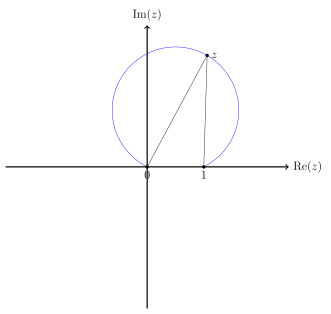
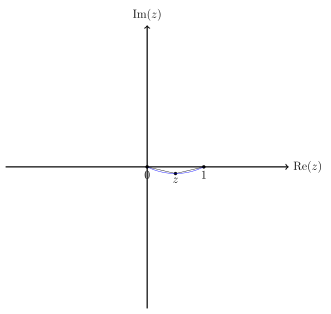
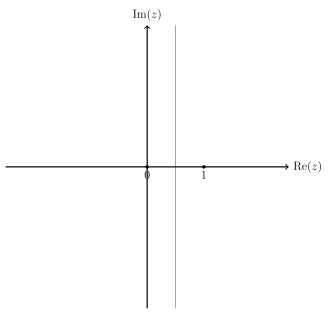
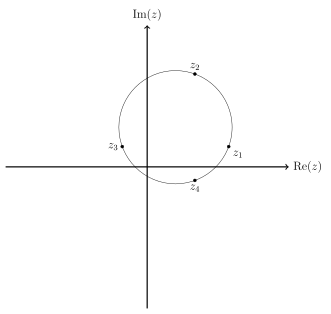
The distinct points \(L,M,P\) and \(Q\) of the Argand diagram lie on a circle \(S\) centred on the origin and the corresponding complex numbers are \(l,m,p\) and \(q\). By considering the perpendicular bisectors of the chords, or otherwise, prove that the chord \(LM\) is perpendicular to the chord \(PQ\) if and only if \(lm+pq=0.\) Let \(A_{1},A_{2}\) and \(A_{3}\) be three distinct points on \(S\). For any given point \(A_{1}'\) on \(S\), the points \(A_{2}',A_{3}'\) and \(A_{1}''\) are chosen on \(S\) such that \(A_{1}'A_{2}',A_{2}'A_{3}'\) and \(A_{3}'A_{1}''\) are perpendicular to \(A_{1}A_{2},A_{2}A_{3}\) and \(A_{3}A_{1},\) respectively. Show that for exactly two positions of \(A_{1}',\) the points \(A_{1}'\) and \(A_{1}''\) coincide. If, instead, \(A_{1},A_{2},A_{3}\) and \(A_{4}\) are four given distinct points on \(S\) and, for any given point \(A_{1}',\) the points \(A_{2}',A_{3}',A_{4}'\) and \(A_{1}''\) are chosen on \(S\) such that \(A_{1}'A_{2}',A_{2}'A_{3}',A_{3}'A_{4}'\) and \(A_{4}'A_{1}''\) are respectively perpendicular to \(A_{1}A_{2},A_{2}A_{3},A_{3}A_{4}\) and \(A_{4}A_{1},\) show that \(A_{1}'\) coincides with \(A_{1}''.\) Give the corresponding result for \(n\) distinct points on \(S\).
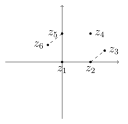
Show SolutionThe complex numbers \(z_{1},z_{2},\ldots,z_{6}\) are represented by six distinct points \(P_{1},P_{2},\ldots,P_{6}\) in the Argand diagram. Express the following statements in terms of complex numbers:
- \(\overrightarrow{P_{1}P_{2}}=\overrightarrow{P_{5}P_{4}}\) and \(\overrightarrow{P_{2}P_{3}}=\overrightarrow{P_{6}P_{5}}\,\);
- \(\overrightarrow{P_{2}P_{4}}\) is perpendicular to \(\overrightarrow{P_{3}P_{6}}\,\).
- \(\overrightarrow{P_{1}P_{2}}=\overrightarrow{P_{5}P_{4}}\) is equivalent to \(z_2 - z_1 = z_4 - z_5\). \(\overrightarrow{P_{2}P_{3}}=\overrightarrow{P_{6}P_{5}}\) is equivalent to \(z_3-z_2 = z_5 - z_6\).
- \(\overrightarrow{P_{2}P_{4}}\) is perpendicular to \(\overrightarrow{P_{3}P_{6}}\,\) is equivalent to \(\frac{z_4 - z_2}{z_6-z_3} \in i\mathbb{R}\)
The quadratic equation \(x^{2}+bx+c=0\), where \(b\) and \(c\) are real, has the properly that if \(k\) is a (possibly complex) root, then \(k^{-1}\) is a root. Determine carefully the restriction that this property places on \(b\) and \(c\). If, in addition to this property, the equation has the further property that if \(k\) is a root, then \(1-k\) is a root, find \(b\) and \(c\). Show that \[ x^{3}-\tfrac{3}{2}x^{2}-\tfrac{3}{2}x+1=0 \] is the only cubic equation of the form \(x^{3}+px^{2}+qx+r=0\), where \(p,q\) and \(r\) are real, which has both the above properties.
Show SolutionThe complex number \(w\) is such that \(w^{2}-2w\) is real.
- Sketch the locus of \(w\) in the Argand diagram.
- If \(w^{2}=x+\mathrm{i}y,\) describe fully and sketch the locus of points \((x,y)\) in the \(x\)-\(y\) plane.
- Suppose \(w = u+ vi\) then \(w^2 - 2w = u^2-v^2-2u+(2uv-2v)i\) so to be purely real we must have \(2uv-2v = 2v(u-1) = 0\) ie either \(v = 0\) or \(u = 1\). Therefore the locus is the real axis and the line \(1 + ti\):

- If \(w^2 = x+yi\) then we must have \(x = u^2-v^2\) and \(y = 2uv\), so either \(v = 0, y = 0, x = u^2-2u \geq -1\) or \(u = 1, x = 1-v^2, y = 2v\) which is a parabola:


Give a parametric form for the curve in the Argand diagram determined by \(\left|z-\mathrm{i}\right|=2.\) Let \(w=(z+\mathrm{i})/(z-\mathrm{i}).\) Find and sketch the locus, in the Argand diagram, of the point which represents the complex number \(w\) when \begin{questionparts} \item \(\left|z-\mathrm{i}\right|=2;\) \item \(z\) is real; \item \(z\) is imaginary. \end{questionpart}
Show Solution- \begin{align*}
w &= \frac{z+i}{z-i} \\
&= \frac{2i + 2e^{it}}{2e^{it}} \\
&= 2 + ie^{-it}
\end{align*}
This is obvious a circle radius \(1\) about the point \(2\).

- If \(z\) is real, then \begin{align*} w &= \frac{z+i}{z-i} \\ &= \frac{(z+i)^2}{z^2+1} \\ &= \frac{z^2-1 + 2zi}{z^2+1} \end{align*} We can quickly notice this describes a circle radius \(1\) about \(0\). Alternatively, \(|z+i| = |z-i| \Rightarrow |\frac{z+i}{z-i}| = 1\) so we must be talking about points on the unit circle. Since this is a Mobius transform we know it maps lines and circles to lines and circles, therefore it must map to the unit circle;
- If \(z\) is purely imaginary, say \(it\) then:
\begin{align*}
w &= \frac{z+i}{z-i} \\
&= \frac{(it+i)(i-it)}{(-1+t)^2} \\
&= \frac{t^2-1}{(t-1)^2}
\end{align*}
Which is purely real, and can take all real values.
