Problems
Filters
39 problems found
2008 Paper 1 Q1
What does it mean to say that a number \(x\) is irrational? Prove by contradiction statements A and B below, where \(p\) and \(q\) are real numbers.
- A: If \(pq\) is irrational, then at least one of \(p\) and \(q\) is irrational.
- B: If \(p+q\) is irrational, then at least one of \(p\) and \(q\) is irrational.
- C: If \(p\) and \(q\) are irrational, then \(p+q\) is irrational.
Solution:
- A: Suppose for sake of contradiction that neither \(p\) nor \(q\) is irrational, then \(pq\) is the product of two rational numbers, ie is also rational. Therefore \(pq\) is rational. Contradiction.
- B: Suppose for the sake of contradiction both \(p\) and \(q\) are rational, but then \(p+q\) is also rational, contradicting \(p+q\) is irrational.
- C: Note that \(\sqrt{2}\) and \(-\sqrt{2}\) are both irrational, but \(\sqrt{2}+(-\sqrt{2}) = 0\) which is rational.
2008 Paper 1 Q2
The variables \(t\) and \(x\) are related by \(t=x+ \sqrt{x^2+2bx+c\;} \,\), where \(b\) and \(c\) are constants and \(b^2 < c\). Show that \[ \frac{\d x}{\d t} = \frac{t-x}{t+b}\;, \] and hence integrate \(\displaystyle \frac1 {\sqrt{x^2+2bx+c}}\,\). Verify by direct integration that your result holds also in the case \(b^2=c\) if \(x+b > 0\) but that your result does not hold in the case \(b^2=c\) if \(x+b < 0\,\).
Solution: \begin{align*} && t &= x+ \sqrt{x^2+2bx+c} \\ && \frac{\d t}{\d x} &= 1 + \frac{x+b}{\sqrt{x^2+2bx+c}} \\ &&&= \frac{x + \sqrt{x^2+2bx+c} + b}{\sqrt{x^2+2bx+c}} \\ &&&= \frac{t+b}{t-x} \\ \Rightarrow && \frac{\d x}{\d t} &= \frac{t-x}{t+b} \\ \\ && \int \frac{1}{\sqrt{x^2+2bx+c}} \d x &= \int \frac{1}{t-x} \frac{t-x}{t+b} \d t \\ &&&= \int \frac{1}{t+b} \d t \\ &&&= \ln (t + b) +C \\ &&&= \ln \left (x + \sqrt{x^2+2bx+c} + b \right) + C \end{align*} If \(b^2 = c\) then we have \(x^2+2bx+b^2 = (x+b)^2\) so \(\sqrt{x^2+2bx+c^2} = x+b\) (if \(x+b>0\)), so \begin{align*} && \int \frac{1}{\sqrt{x^2+2bx+c}} \d x &= \int \frac{1}{x+b} \d x\\ &&&= \ln (x + b) + C \\ &&&= \ln(x+b) + \ln 2 + C' \\ &&&= \ln (2(x+b)) + C' \\ &&&= \ln \left(x + b + \sqrt{(x+b)^2} \right)+C'\\ &&&= \ln \left(x + b + \sqrt{x^2+2bx+c} \right)+C'\\ \end{align*} If \(x+b < 0\) then the antiderivative is \(\ln 0\). \begin{align*} && \int \frac{1}{\sqrt{x^2+2bx+c}} \d x &= -\int \frac{1}{x+b} \d x\\ &&&= -\ln |x + b| + C \\ \end{align*} which are clearly different.
2008 Paper 1 Q3
Prove that, if \(c\ge a\) and \(d\ge b\), then \[ ab+cd\ge bc+ad\,. \tag{\(*\)} \]
- If \(x\ge y\), use \((*)\) to show that \(x^2+y^2\ge 2xy\,\). If, further, \(x\ge z\) and \(y\ge z\), use \((*)\) to show that \(z^2+xy\ge xz+yz\) and deduce that \(x^2+y^2+z^2\ge xy+yz+zx\,\). Prove that the inequality \(x^2+y^2+z^2\ge xy+yz+zx\,\) holds for all \(x\), \(y\) and \(z\).
- Show similarly that the inequality \[\frac st +\frac tr +\frac rs +\frac ts +\frac rt +\frac sr \ge 6\] holds for all positive \(r\), \(s\) and \(t\).
Solution: \begin{align*} && \underbrace{(c-a)}_{\geq 0}\underbrace{(d-b)}_{\geq 0} & \geq 0 \\ \Leftrightarrow && cd -bc -ad + ab &\geq 0 \\ \Leftrightarrow && ab +cd &\geq bc+ad \\ \end{align*}
- Applying \((*)\) with \(c=d=x\) and \(a=b=y\) we obtain: \(x^2 + y^2 \geq xy + xy = 2xy\) Similarly, applying \((*)\) with \(c=x, d=y, a=b=z\) we obtain: \(z^2 + xy \geq zx+zy\) so \(x^2+y^2+z^2 \geq 2xy + z^2 \geq xy + zx+zy\) There was nothing special about our choice of ordering \(x,y,z\) so it is true for all \(x,y,z\)
- \begin{align*} \frac st +\frac tr +\frac rs +\frac ts +\frac rt +\frac sr &=\left ( \frac st+\frac ts \right)+\left ( \frac tr +\frac rt \right)+\left ( \frac rs +\frac sr \right) \\ & \geq 2 \sqrt{\frac st \frac ts} + 2 \sqrt{\frac tr \frac rt} + 2 \sqrt{\frac rs \frac sr} \\ & = 2 + 2 + 2 \\ &= 6 \end{align*}
2008 Paper 1 Q4
A function \(\f(x)\) is said to be convex in the interval \(a < x < b\) if \(\f''(x)\ge0\) for all \(x\) in this interval.
- Sketch on the same axes the graphs of \(y= \frac23 \cos^2 x\) and \(y=\sin x\) in the interval \(0\le x \le 2\pi\). The function \(\f(x)\) is defined for \(0 < x < 2\pi\) by \[\f(x) = \e^{\frac23 \sin x}. \] Determine the intervals in which \(\f(x)\) is convex.
- The function \(\g(x)\) is defined for \(0 < x < \frac12\pi\) by \[\g(x) = \e^{-k \tan x}. \] If \(k=\sin 2 \alpha\) and \(0 < \alpha < \frac{1}{4}\pi\), show that \(\g(x)\) is convex in the interval \(0 < x < \alpha\), and give one other interval in which \(\g(x)\) is convex.
Solution:
- \begin{align*} && f(x) &= \exp\left (\tfrac23\sin x \right) \\ && f'(x) &= \exp\left (\tfrac23\sin x \right) \cdot \tfrac23 \cos x \\ && f''(x) &= \left ( \exp\left (\tfrac23\sin x \right) \cdot \tfrac23\right) \left ( \tfrac23 \cos^2 x - \sin x \right) \end{align*} Therefore \(f(x)\) is convex when \(\frac23 \cos^2 x \geq \sin x\). Note that we can find the equality points when \begin{align*} && \sin x &= \frac23 \cos^2 x \\ &&&= \frac23 (1- \sin^2 x) \\ \Rightarrow && 0 &= 2\sin^2 x + 3 \sin x - 2 \\ &&&= (2 \sin x -1) (\sin x+2) \end{align*} ie \(\sin x = \frac12 \Rightarrow x = \frac{\pi}{6}, \frac{5\pi}{6}\). Therefore \(f\) is convex on \([0, \frac{\pi}{6}] \cup [\frac{5\pi}{6}, 2\pi]\)
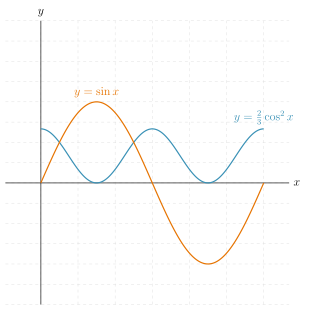
- Suppose \(g(x) = \exp \left ( -k \tan x \right)\) then \begin{align*} && g'(x) &= \exp \left ( -k \tan x \right) \cdot (-k \sec^2 x ) \\ && g''(x) &= \left ( -k \exp \left ( -k \tan x \right) \right) \left ( -k\sec^4 x + 2 \sec x \cdot \sec x \tan x\right) \\ &&&= -k \exp \left ( -k \tan x \right) \sec^4 x \left ( -k + 2\sin x \cos x \right) \\ &&&= -k \exp \left ( -k \tan x \right) \sec^4 x \left ( -k + \sin 2x \right) \\ \end{align*} If \(0 < \alpha < \frac{\pi}{4}\) then \(k > 0\) so \(g\) is convex if \(-k + \sin 2x < 0\), ie \(\sin 2x < \sin 2\alpha\), ie on \((0, \alpha)\) and \((\frac{\pi}{2} - \alpha, \frac{\pi}{2})\)
2008 Paper 1 Q5
The polynomial \(\p(x)\) is given by \[ \ds \p(x)= x^n +\sum\limits_{r=0}^{n-1}a_rx^r\,, \] where \(a_0\), \(a_1\), \(\ldots\) , \(a_{n-1}\) are fixed real numbers and \(n\ge1\). Let \(M\) be the greatest value of \(\big\vert \p(x) \big\vert\) for $\vert x \vert\le 1\(. Then Chebyshev's theorem states that \)M\ge 2^{1-n}$.
- Prove Chebyshev's theorem in the case \(n=1\) and verify that Chebyshev's theorem holds in the following cases:
- \( \p(x) = x^2 - \frac12\,\);
- \(\p(x) = x^3 - x \,\).
- Use Chebyshev's theorem to show that the curve $ \ y= 64x^5+25x^4-66x^3-24x^2+3x+1 \ $ has at least one turning point in the interval \(-1\le x \le 1\).
Solution:
- If \(n = 1\) the theorem is \(\max_{x \in [-1,1]} \left ( |x + a_0 |\right) \geq 1\), but clearly \(\max(1+a_0, |a_0 - 1|) \geq 1\) (taking according to the sign of \(a_0\))
- \( \p(x) = x^2 - \frac12\,\) - take \(x = 0\) then \(|p(0)| = \frac12 \geq 2^{1-2} = \frac12\)
- \(\p(x) = x^3 - x \,\). take \(x = \frac1{\sqrt{2}}\), then \(|p\left ( \frac1{\sqrt{2}}\right)| = |\frac12 \frac{1}{\sqrt{2}}-\frac{1}{\sqrt{2}}| = \frac{1}{2\sqrt{2}} > \frac14 = 2^{1-3} \)
- Consider \(p(x) = \frac{1}{64} \left ( 64x^5+25x^4-66x^3-24x^2+3x+1\right)\), then \(p\) satisfies the conditions of the theorem, therefore \(\max |p(x)| \geq 2^{1-5} = \frac1{16} = \frac{4}{64}\). However, \(p(-1) = \frac{1}{64}\) and \(p(1) = \frac{3}{64}\), so it cannot be strictly increasing or decreasing and there must be at turning point to achieve \(\frac{4}{64}\)
2008 Paper 1 Q6
The function \(\f\) is defined by \[ \f(x) = \frac{\e^x-1}{\e-1}, \ \ \ \ \ x\ge0, \] and the function \(\g\) is the inverse function to \(\f\), so that \(\g(\f(x))=x\). Sketch \(\f(x)\) and \(\g(x)\) on the same axes. Verify, by evaluating each integral, that \[ \int_0^\frac12 \f(x) \,\d x + \int_0^k \g(x) \,\d x = \frac1 {2(\sqrt \e +1)}\,, \] where \(\displaystyle k= \frac 1{\sqrt\e+1}\), and explain this result by means of a diagram.
2008 Paper 1 Q7
The point \(P\) has coordinates \((x,y)\) with respect to the origin \(O\). By writing \(x=r\cos\theta\) and \(y=r\sin\theta\), or otherwise, show that, if the line \(OP\) is rotated by \(60^\circ\) clockwise about \(O\), the new \(y\)-coordinate of \(P\) is \(\frac12(y-\sqrt3\,x)\). What is the new \(y\)-coordinate in the case of an anti-clockwise rotation by \(60^\circ\,\)? An equilateral triangle \(OBC\) has vertices at \(O\), \((1,0)\) and \((\frac12,\frac12 \sqrt3)\), respectively. The point \(P\) has coordinates \((x,y)\). The perpendicular distance from \(P\) to the line through \(C\) and \(O\) is \(h_1\); the perpendicular distance from \(P\) to the line through \(O\) and \(B\) is \(h_2\); and the perpendicular distance from \(P\) to the line through \(B\) and \(C\) is \(h_3\). Show that \(h_1=\frac12 \big\vert y-\sqrt3\,x\big\vert\) and find expressions for \(h_2\) and \(h_3\). Show that \(h_1+h_2+h_3=\frac12 \sqrt3\) if and only if \(P\) lies on or in the triangle \(OBC\).
2008 Paper 1 Q8
- The gradient \(y'\) of a curve at a point \((x,y)\) satisfies \[ (y')^2 -xy'+y=0\,. \tag{\(*\)} \] By differentiating \((*)\) with respect to \(x\), show that either \(y''=0\) or \(2y'=x\,\). Hence show that the curve is either a straight line of the form \(y=mx+c\), where \(c=-m^2\), or the parabola \(4y=x^2\).
- The gradient \(y'\) of a curve at a point \((x,y)\) satisfies \[ (x^2-1)(y')^2 -2xyy'+y^2-1=0\,. \] Show that the curve is either a straight line, the form of which you should specify, or a circle, the equation of which you should determine.
Solution:
- \(\,\) \begin{align*} && 0 &= (y')^2 -xy'+y\\ \Rightarrow && 0 &= 2y' y'' -y' - xy'' + y' \\ &&&= 2y'y'' - xy'' \\ &&&= y'' (2y'-x) \end{align*} Therefore \(y'' = 0 \Rightarrow y = mx + c\) or \(y' = \frac12 x \Rightarrow x = \frac14x^2 + C\). Plugging these into the original equation we have \(m^2 - xm+mx+c = 0 \Rightarrow c = -m^2\) \(\frac14 x^2 - \frac12 x^2 + \frac14x^2 + C = 0 \Rightarrow C = 0\). Therefore \(4y = x^2\)
- \begin{align*} && 0 &= (x^2-1)(y')^2 -2xyy'+y^2-1 \\ \Rightarrow && 0 &= 2x(y')^2 +(x^2-1)2y'y'' - 2yy' - 2x(y')^2-2xyy''+2yy' \\ &&&= (x^2-1)2y'y'' -2xyy'' \\ &&&= 2y'' ((x^2-1)y'-xy) \end{align*} Therefore \(y'' = 0\) so \(y = mx + c\) or \begin{align*} && \frac{\d y}{\d x} &= \frac{xy}{x^2-1} \\ \Rightarrow && \int \frac1y \d y &= \int \frac{x}{x^2-1} \d x \\ \Rightarrow && \ln |y| &= \frac12 \ln |x^2-1| + C \\ \Rightarrow && y^2 &= A(x^2-1) \end{align*} Suppose \(y = mx+c\) then we must have \((x^2-1)m^2-2xm(mx+c)+(mx+c)^2 = -m^2+c^2 \Rightarrow c^2 = m^2\) If \(y^2 = A(x^2-1)\) then \(2yy' = 2xA\) and \begin{align*} && 0 &= \frac{y^2}{A}\left ( \frac{xA}{y} \right)^2 - 2x^2A+A(x^2-1)-1 \\ &&&= x^2A-2x^2A+x^2A-A-1 \\ \Rightarrow && A &= -1 \end{align*} Therefore \(x^2 + y^2 = 1\)
2008 Paper 1 Q9
Two identical particles \(P\) and \(Q\), each of mass \(m\), are attached to the ends of a diameter of a light thin circular hoop of radius \(a\). The hoop rolls without slipping along a straight line on a horizontal table with the plane of the hoop vertical. Initially, \(P\) is in contact with the table. At time \(t\), the hoop has rotated through an angle \(\theta\). Write down the position at time \(t\) of \(P\), relative to its starting point, in cartesian coordinates, and determine its speed in terms of \(a\), \(\theta\) and \(\dot\theta\). Show that the total kinetic energy of the two particles is \(2ma^2\dot\theta^2\). Given that the only external forces on the system are gravity and the vertical reaction of the table on the hoop, show that the hoop rolls with constant speed.
Solution:

2008 Paper 1 Q10
On the (flat) planet Zog, the acceleration due to gravity is \(g\) up to height \(h\) above the surface and \(g'\) at greater heights. A particle is projected from the surface at speed \(V\) and at an angle \(\alpha\) to the surface, where \(V^2 \sin^2\alpha > 2 gh\,\). Sketch, on the same axes, the trajectories in the cases \(g'=g\) and \(g' < g\). Show that the particle lands a distance \(d\) from the point of projection given by \[ d = \left(\frac {V-V'} g + \frac {V'}{ g'} \right) V\sin2\alpha\,, \] where \(V' = \sqrt{V^2-2gh\,\rm{cosec}^2\alpha\,}\,\).
2008 Paper 1 Q11
A straight uniform rod has mass \(m\). Its ends \(P_1\) and \(P_2\) are attached to small light rings that are constrained to move on a rough rigid circular wire with centre \(O\) fixed in a vertical plane, and the angle \(P_1OP_2\) is a right angle. The rod rests with \(P_1\) lower than \(P_2\), and with both ends lower than \(O\). The coefficient of friction between each of the rings and the wire is \(\mu\). Given that the rod is in limiting equilibrium (i.e. \ on the point of slipping at both ends), show that \[ \tan \alpha = \frac{1-2\mu -\mu^2}{1+2\mu -\mu^2}\,, \] where \(\alpha\) is the angle between \(P_1O\) and the vertical (\(0<\alpha<45^\circ\)). Let \(\theta\) be the acute angle between the rod and the horizontal. Show that \(\theta =2\lambda\), where \(\lambda \) is defined by \(\tan \lambda= \mu\) and \(0<\lambda<22.5^\circ\).
2008 Paper 1 Q12
In this question, you may use without proof the results: \[ \sum_{r=1}^n r = \tfrac12 n(n+1) \qquad\text{and}\qquad \sum_{r=1}^n r^2 = \tfrac1 6 n(n+1)(2n+1)\,. \] The independent random variables \(X_1\) and \(X_2\) each take values \(1\), \(2\), \(\ldots\), \(N\), each value being equally likely. The random variable \(X\) is defined by \[ X= \begin{cases} X_1 & \text { if } X_1\ge X_2\\ X_2 & \text { if } X_2\ge X_1\;. \end{cases} \]
- Show that \(\P(X=r) = \dfrac{2r-1}{N^2}\,\) for \(r=1\), \(2\), \(\ldots\), \(N\).
- Find an expression for the expectation, \(\mu\), of \(X\) and show that \(\mu=67.165\) in the case \(N=100\).
- The median, \(m\), of \(X\) is defined to be the integer such that \(\P(X\ge m) \ge \frac 12\) and \(\P(X\le m)\ge \frac12\). Find an expression for \(m\) in terms of \(N\) and give an explicit value for \(m\) in the case \(N=100\).
- Show that when \(N\) is very large, \[ \frac \mu m \approx \frac {2\sqrt2}3\,. \]
Solution: \begin{align*} \P(X = r) &= \P(X_1 = r, X_2 \leq r) + \P(X_2 = r, X_1 < r) \\ &= \P(X_1 = r) \P(X_2 \leq r) + \P(X_2 = r)\P( X_1 < r) \\ &= \frac{1}{N} \frac{r}{N} + \frac{1}{N} \frac{r-1}{N} \\ &= \frac{2r-1}{N^2} \end{align*} \begin{align*} \E(X) &= \sum_{r=1}^N r \P(X = r) \\ &= \sum_{r=1}^N \frac{2r^2 - r}{N^2} \\ &= \frac{1}{N^2} \l \frac{N(N+1)(2N+1)}{3} - \frac{N(N+1)}{2} \r \\ &= \frac{N+1}{N} \l \frac{4N-1}{6} \r \end{align*} When \(N = 100\), this is equal to \(\frac{101 \cdot 399}{6 \cdot 100} = \frac{101 \cdot 133}{200} = 67.165\) \begin{align*} &&\frac12 &\leq \P(X \leq m) \\ &&&=\sum_{r=1}^m \P(X=r) \\ &&&=\sum_{r=1}^m \frac{2r-1}{N^2} \\ &&&= \frac{1}{N^2} \l m(m+1) - m \r \\ &&&= \frac{m^2}{N^2} \\ \Rightarrow && m^2 &\geq \frac{N^2}{2} \\ \Rightarrow && m &\geq \frac{N}{\sqrt{2}} \\ \Rightarrow && m &= \left \lceil \frac{N}{\sqrt{2}} \right \rceil \end{align*} When \(N = 100\), \(100/\sqrt{2} = \sqrt{2}50\). \(\sqrt{2} > 1.4 \Rightarrow 50\sqrt{2} > 70\) \(\sqrt{2} < 1.42 \Rightarrow 50 \sqrt{2} < 71\), therefore \(\displaystyle \left \lceil \frac{100}{\sqrt{2}} \right \rceil = 71\) \begin{align*} \lim_{N \to \infty} \frac{\frac{(N+1)(4N-1)}{6N}}{ \left \lceil\frac{N}{\sqrt{2}} \right \rceil} &= \lim_{N \to \infty} \frac{\sqrt{2}}{3}\l \frac{4N^2 +3N - 1}{2N^2} \r \tag{since the floor will be irrelevant}\\ &= \lim_{N \to \infty} \frac{\sqrt{2}}{3}\l 2 + \frac{3}{2N} - \frac{1}{N^2} \r \\ &= \lim_{N \to \infty} \frac{2\sqrt{2}}{3} \end{align*}
2008 Paper 1 Q13
Three married couples sit down at a round table at which there are six chairs. All of the possible seating arrangements of the six people are equally likely.
- Show that the probability that each husband sits next to his wife is \(\frac{2}{15}\).
- Find the probability that exactly two husbands sit next to their wives.
- Find the probability that no husband sits next to his wife.
2008 Paper 2 Q1
A sequence of points \((x_1,y_1)\), \((x_2,y_2)\), \(\ldots\) in the cartesian plane is generated by first choosing \((x_1,y_1)\) then applying the rule, for \(n=1\), \(2\), \(\ldots\), \[ (x_{n+1}, y_{n+1}) = (x_n^2-y_n^2 +a, \; 2x_ny_n+b+2)\,, \] where \(a\) and \(b\) are given real constants.
- In the case \(a=1\) and \(b=-1\), find the values of \((x_1,y_1)\) for which the sequence is constant.
- Given that \((x_1,y_1) = (-1,1)\), find the values of \(a\) and \(b\) for which the sequence has period 2.
2008 Paper 2 Q2
Let \(a_n\) be the coefficient of \(x^n\) in the series expansion, in ascending powers of \(x\), of \[\displaystyle \frac{1+x}{(1-x)^2(1+x^2)} \,, \] where \(\vert x \vert <1\,\). Show, using partial fractions, that either \(a_n =n+1\) or \(a_n = n+2\) according to the value of \(n\). Hence find a decimal approximation, to nine significant figures, for the fraction \( \displaystyle \frac{11\,000}{8181}\). \newline [You are not required to justify the accuracy of your approximation.]
Solution: \begin{align*} && \frac{1+x}{(1-x)^2(1+x^2)} &= \frac{A}{1-x} + \frac{B}{(1-x)^2} + \frac{Cx+D}{1+x^2} \\ \Rightarrow && 1 + x &= A(1-x)(1+x^2) + B(1+x^2) + Cx(1-x)^2 + D(1-x)^2 \\ \Rightarrow && 2 &= 2B \tag{\(x = 1\)} \\ \Rightarrow && 1 &= B \\ \Rightarrow && 1 &= A+B+D \tag{\(x = 0\)}\\ \Rightarrow && A &= -D \\ \Rightarrow && 0 &= 4A+2B-4C+4D \tag{\(x = -1\)}\\ \Rightarrow && C &= \frac12\\ \Rightarrow && 3 &= -5A+5B+2C+D \tag{\(x=2\)} \\ \Rightarrow && 3 &= -6A+6 \\ \Rightarrow && A,D &=-\frac12,\frac12 \\ \Rightarrow && \frac{1+x}{(1-x)^2(1+x^2)} &= \frac{1}{(1-x)^2} +\frac{1}{2(1-x)}+ \frac{x-1}{2(1+x^2)} \\ &&&=\sum_{k=0}^{\infty}(k+1)x^k + \sum_{k=0}^{\infty}\frac12 x^k + \sum_{k=0}^{\infty}\frac12 (-1)^kx^{2k+1} - \sum_{k=0}^{\infty}\frac12 (-1)^kx^{2k} \end{align*} Therefore the coefficient of \(x^n\) is \(n+1\) or \(n+2\) depending on whether the coefficients from the final series add constructively \(n \equiv 1, 2 \pmod{4}\) or destructively. \begin{align*} \frac{11\, 000}{8181} &= \frac{(10+1) \cdot 1000}{(10-1)^2 \cdot (100+1)} \\ &= \frac{(1+\frac{1}{10})}{(1-\frac{1}{10})^2 \cdot (1+\frac1{10})} \\ &= 1 + \frac3{10} + \frac4{10^2} + \frac{4}{10^3}+\frac{5}{10^4} + \frac{7}{10^5} + \frac{8}{10^6} + \cdots \\ & \quad \quad \cdots + \frac{8}{10^7} + \frac{9}{10^8} + \frac{11}{10^9} + \frac{12}{10^{10}} + \cdots \\ &= 1.34457890 + \frac{12}{10^{10}} + \cdots \end{align*} \begin{align*} && \sum_{k=m}^{\infty} (k+2)x^k &= x^m \sum_{k=0}^{\infty} (k+m+2)x^{k} \\ && &= \frac{x^k}{(1-x)^2} + \frac{(m+2)x^k}{1-x} \\ \Rightarrow && |\sum_{k=m}^{\infty} a_k \left ( \frac1{10} \right )^k | &\leq \frac{1}{10^m}\left ( \frac{1}{(1-\frac1{10})^2} + \frac{m+2}{1-\frac1{10}} \right) \\ &&&= \frac{1}{10^{m-1}} \left ( \frac{9m+28}{81}\right ) \end{align*} Therefore for this will be less than \(10^{-9}\), when \(m = 11\), so our approximation is valid to 9sf