Problems
Filters
8 problems found
2015 Paper 3 Q8
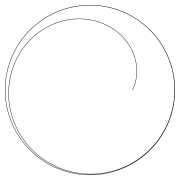
- Show that under the changes of variable \(x= r\cos\theta\) and \(y = r\sin\theta\), where \(r\) is a function of \(\theta\) with \(r>0\), the differential equation \[ (y+x)\frac{\d y}{\d x} = y-x \] becomes \[ \frac{\d r}{\d\theta} + r=0 \,. \] Sketch a solution in the \(x\)-\(y\) plane.
- Show that the solutions of \[ \left( y+x -x(x^2+y^2) \right) \, \frac{\d y }{\d x} = y-x - y(x^2+y^2) \] can be written in the form \\ \[ r^2 = \dfrac 1 {1+A\e^{2\theta}}\, \]\\ and sketch the different forms of solution that arise according to the value of \(A\).
Solution:
- \begin{align*}
&& (y+x)\frac{\d y}{\d x} &= y-x \\
\Rightarrow && (r \sin \theta + r \cos\theta) \frac{\frac{dy}{d\theta}}{\frac{dx}{d\theta}} &= (r \sin\theta - r \cos\theta) \\
\Rightarrow && ( \sin \theta + \cos\theta) \frac{dy}{d\theta} &= (\sin\theta - \cos\theta){\frac{dx}{d\theta}} \\
\Rightarrow && ( \sin \theta + \cos\theta) \left ( \frac{dr}{d\theta} \cos \theta - r \sin \theta\right ) &= (\sin\theta - \cos\theta)\left ( \frac{dr}{d\theta} \sin\theta + r \cos \theta\right) \\
\Rightarrow && \frac{dr}{d\theta} \left (\sin \theta \cos \theta + \cos^2 \theta - \sin^2 \theta + \sin \theta \cos \theta \right)&= r \left (\sin \theta \cos \theta - \cos^2 \theta + \sin^2 \theta + \sin\theta \cos \theta\right) \\
\Rightarrow && \frac{dr}{d\theta}&= -r \\
\end{align*}
Therefore \(r = Ae^{-\theta}\)

- \begin{align*}
&& \left( y+x -x(x^2+y^2) \right) \, \frac{\d y }{\d x} &= y-x - y(x^2+y^2) \\
\Rightarrow && \left( r \sin \theta+r\cos \theta -r^3\cos \theta \right) \, \frac{\d y }{\d \theta} &= \left ( r \sin \theta- r \cos \theta- r^3\sin \theta \right)\frac{\d x }{\d \theta} \\
\Rightarrow && \left( r \sin \theta+r\cos \theta -r^3\cos \theta \right) \, \left (\frac{\d r}{\d \theta} \sin \theta + r \cos \theta \right) &= \\
&& \left ( r \sin \theta- r \cos \theta- r^3\sin \theta \right)&\left (\frac{\d r}{\d \theta} \cos \theta - r \sin \theta \right) \\
\Rightarrow && \frac{\d r}{\d \theta} \left (\sin \theta ( \sin \theta + \cos \theta - r^2 \cos \theta) - \cos \theta (\sin \theta - \cos \theta - r^2 \sin \theta) \right) &= \\
&& r ( -\sin \theta (\sin \theta - \cos \theta - r^2 \sin \theta) - \cos \theta ( \sin \theta + \cos \theta &- r^2 \cos \theta)) \\
\Rightarrow && \frac{\d r}{\d \theta} &= r ( -1 +r^2) \\
\Rightarrow && \int \frac{1}{r(r-1)(r+1)} \d r &= \int \d \theta \\
\Rightarrow && \int \l \frac{-1}{r} + \frac{1}{2(r-1)} + \frac{1}{2(r+1)} \r \d r &= \int \d \theta \\
\Rightarrow && \l -\log r+ \frac12 \log (1+r)+ \frac12 \log (1-r)\r + C &= \theta \\
\Rightarrow && \frac12 \log \left (\frac{1-r^2}{r^2} \right) + C &= \theta \\
\Rightarrow && \log \left (\frac{1}{r^2}-1 \right) + C &= 2\theta \\
\Rightarrow && r &= \frac{1}{1 + Ae^{2\theta}} \\
\end{align*}


2009 Paper 3 Q11
A comet in deep space picks up mass as it travels through a large stationary dust cloud. It is subject to a gravitational force of magnitude \(M\!f\) acting in the direction of its motion. When it entered the cloud, the comet had mass \(M\) and speed \(V\). After a time \(t\), it has travelled a distance \(x\) through the cloud, its mass is \(M(1+bx)\), where~\(b\) is a positive constant, and its speed is \(v\).
- In the case when \(f=0\), write down an equation relating \(V\), \(x\), \(v\) and \(b\). Hence find an expression for \(x\) in terms of \(b\), \(V\) and \(t\).
- In the case when \(f\) is a non-zero constant, use Newton's second law in the form \[ \text{force} = \text{rate of change of momentum} \] to show that \[ v = \frac{ft+V}{1+bx}\,. \] Hence find an expression for \(x\) in terms of \(b\), \(V\), \(f\) and \(t\). Show that it is possible, if \(b\), \(V\) and \(f\) are suitably chosen, for the comet to move with constant speed. Show also that, if the comet does not move with constant speed, its speed tends to a constant as \(t\to\infty\).
2005 Paper 2 Q8
For \(x \ge 0\) the curve \(C\) is defined by $$ {\frac{\d y} {\d x}} = \frac{x^3y^2}{(1 + x^2)^{5/2}} $$ with \(y = 1\) when \(x=0\,\). Show that \[ \frac 1 y = \frac {2+3x^2}{3(1+x^2)^{3/2}} +\frac13 \] and hence that for large positive \(x\) $$ y \approx 3 - \frac 9 x\;. $$ Draw a sketch of \(C\). On a separate diagram, draw a sketch of the two curves defined for \(x \ge 0\) by $$ \frac {\d z} {\d x} = \frac{x^3z^3}{2(1 + x^2)^{5/2}} $$ with \(z = 1\) at \(x=0\) on one curve, and \(z = -1\) at \(x=0\) on the other.
Solution: \begin{align*} && {\frac{\d y} {\d x}} &= \frac{x^3y^2}{(1 + x^2)^{5/2}} \\ \Rightarrow &&\int \frac{1}{y^2} \d y &= \int \frac{x^3}{(1+x^2)^{5/2}} \d x \\ \Rightarrow && -\frac1y &= \int \frac{x^3+x-x}{(1+x^2)^{5/2}} \d x \\ &&&= \int \left ( \frac{x}{(1+x^2)^{3/2}}-\frac{x}{(1+x^2)^{5/2}} \right) \d x \\ &&&= \frac{-1}{(1+x^2)^{1/2}} + \frac{1}{3(1+x^2)^{3/2}} + C \\ &&&= \frac{1-3(1+x^2)}{3(1+x^2)^{3/2}} + C \\ &&&= \frac{-3x^2-2}{3(1+x^2)^{3/2}} + C \\ (x,y) = (0,1): &&-1 &= -\frac23 + C \\ \Rightarrow && C &= -\frac13 \\ \Rightarrow && \frac1y &= \frac{3x^2+2}{3(1+x^2)^{3/2}} + \frac13 \end{align*} \begin{align*} y &= \frac{1}{\frac13 +\frac{3x^2+2}{3(1+x^2)^{3/2}} } \\ &= \frac{3}{1+ \frac{3x^2+2}{3(1+x^2)^{3/2}}} \\ &= \frac{3}{1+ \frac{3}{x} + \cdots} \\ &\approx 3 - \frac{9}{x} \end{align*}


2004 Paper 2 Q11
The maximum power that can be developed by the engine of train \(A\), of mass \(m\), when travelling at speed \(v\) is \(Pv^{3/2}\,\), where \(P\) is a constant. The maximum power that can be developed by the engine of train \(B\), of mass \(2m\), when travelling at speed \(v\) is \(2Pv^{3/2}.\) For both \(A\) and \(B\) resistance to motion is equal to \(kv\), where \(k\) is a constant. For \(t\le0\), the engines are crawling along at very low equal speeds. At \(t = 0\,\), both drivers switch on full power and at time \(t\) the speeds of \(A\) and \(B\) are \(v_{\vphantom{\dot A}\!A}\) and \(v_{\vphantom{\dot B}\hspace{-1pt}B},\) respectively.
- Show that \[ v_{\vphantom{\dot A}\!A} = \frac{P^2 \left(1-\e^{-kt/2m}\right)^2}{k^2} \] and write down the corresponding result for \(v_{\vphantom{\dot B}B}\).
- Find \(v_{\vphantom{\dot B}A}\) and \(v_{\vphantom{\dot B}B}\) when \(9 v_{\vphantom{\dot B}A} =4v_{\vphantom{\dot B}B}\;\). [Not on original paper] Show that \(1 < v_{\vphantom{\dot B}\hspace{-1pt}B} /v_{\vphantom{\dot A}\!A} < 4\) for \(t > 0\,\).
- Both engines are switched off when \(9 v_{\vphantom{\dot B}A} =4v_{\vphantom{\dot B}B}\,\). Show that thereafter \(k^2 v_{\vphantom{\dot B}B}^2 = 4 P^2 v_{\vphantom{\dot B}A}\,\).
Solution:
- \(\,\) \begin{align*} && P &= Fv \\ \text{N2}(\rightarrow): && Pv^{1/2} - kv &= ma \\ \Rightarrow && \dot{v} &= \frac{P}{m} \sqrt{v}-\frac{k}{m}v \\ \Rightarrow && \int \d t & = \int \frac{m}{\sqrt{v}\left (P-k\sqrt{v} \right)} \d v \\ &&t &= -\frac{2m}k\ln\left (P - k\sqrt{v_A}\right) + C \\ t = 0, v_A \approx 0: && 0 & =-\frac{2m}{k} \ln P+ C \\ \Rightarrow && C &= \frac{2m}{k} \ln P \\ \Rightarrow && e^{-kt/2m} &= \frac{P- k \sqrt{v_A}}{P} \\ \Rightarrow && v_A &= \frac{P^2(1-e^{-kt/2m})^2}{k^2} \end{align*} The equation of motion for \(B\) is \(\dot{v_B} = \frac{P}{m}\sqrt{v} - \frac{k}{2m} v\), ie \(k \to \frac{k}{2}\), so \[ v_B = \frac{4P^2(1-e^{-kt/4m})^2}{k^2} \]
- Suppose \(9v_A = 4v_B\), then and let \(e^{-kt/4m} = X\) \begin{align*} && 9 \frac{P^2(1-e^{-kt/2m})^2}{k^2} &= 4 \frac{4P^2(1-e^{-kt/4m})^2}{k^2} \\ \Rightarrow && \frac{3}{4} &= \frac{1-X}{1-X^2} \\ \Rightarrow && 0 &= 3X^2-4X+1 \\ &&&= (3X-1)(X-1) \\ \Rightarrow && X &= 1, \frac13 \\ X = 1: && t &= 0 \\ X = \frac13: && e^{-kt/4m} &= \frac13\\ \Rightarrow && t &= \frac{4m}{k}\ln 3 \\ && v_A &= \frac{P^2(1-\frac19)^2}{k^2} \\ &&&= \frac{64P^2}{81k^2} \\ && v_B &= \frac{P^2(1-\frac13)^2}{k^2} \\ &&&= \frac{4P^2}{9k^2} \end{align*} Notice also that \begin{align*} && \frac{v_B}{v_A} &= 4\left ( \frac{1-X}{1-X^2} \right)^2 \\ &&&= 4 \frac{1}{(1+X)^2} \end{align*} Since \(X \in (0,1)\) \(\frac{v_B}{v_A} \in (1, 4)\)
- Once the engines are switched off, the equation of motion for \(A\) is (where \(t\) is measured from that point) \begin{align*} && \dot{v} &= -\frac{k}{m}v \\ \Rightarrow && v &= Ae^{-kt/m} \\ \Rightarrow && v_A &= \frac{64P^2}{81k^2}e^{-kt/m} \end{align*} Similarly, \(v_B = \frac{4P^2}{9k^2}e^{-kt/2m}\) so \begin{align*} && \frac{v_A}{v_B^2} &= \frac{64P^2}{81k^2} \cdot \frac{81k^4}{16P^4} = \frac{4k^2}{P^2} \end{align*} as required.
2001 Paper 1 Q7
In a cosmological model, the radius \(\rm R\) of the universe is a function of the age \(t\) of the universe. The function \(\rm R\) satisfies the three conditions: $$ \mbox{\({\rm R}(0)=0\)}, \ \ \ \ \ \ \ \ \ \mbox{\({\rm R'}(t)>0\) for \(t>0\)}, \ \ \ \ \ \ \ \ \ \ \mbox{\({\rm R''}(t)<0\) for \(t>0\)}, \tag{*} $$ where \({\rm R''}\) denotes the second derivative of \(\rm R\). The function \({\rm H}\) is defined by \[ {\rm H} (t)= \frac{{\rm R}'(t)}{{\rm R}( t)}\;. \]
- Sketch a graph of \({\rm R} (t)\). By considering a tangent to the graph, show that \(t<1/{\rm H}(t)\).
- Observations reveal that \({\rm H}(t) = a/t\), where \(a\) is constant. Derive an expression for \({\rm R}(t)\). What range of values of \(a\) is consistent with the three conditions \((*)\)?
- Suppose, instead, that observations reveal that \({\rm H}(t)= b t^{-2}\), where \(b\) is constant. Show that this is not consistent with conditions \((*)\) for any value of \(b\).
Solution:
- \(\,\)
Notice the tangent must hit the \(y\)-axis above the origin, ie \begin{align*} && 0 &< R'(t)(0-t) + R(t) \\ \Rightarrow && R'(t) t &< R(t) \\ \Rightarrow && t &< \frac{R(t)}{R'(t)} = \frac{1}{H(t)} \end{align*}

- Suppose \(H(t) = a/t\) then \begin{align*} && \frac{R'}{R} &= \frac{a}{t} \\ \Rightarrow && \int \frac{1}{R} \d R &= \int \frac{a}{t} \d t \\ \Rightarrow && \ln R &= a \ln t + C \tag{t, R > 0} \\ \Rightarrow && R &= Kt^a \end{align*} Since we need \(R(t) > 0\), \(K > 0\), since \(R'(t) > 0\) we need \(a > 0\), since \(R''(t) < 0\) we need \(a(a-1) < 0\) ie \(0 < a < 1\)
- Suppose instead \(H(t) = bt^{-2}\) then \begin{align*} && \frac{R'}{R} &= \frac{b}{t^2} \\ \Rightarrow && \int \frac{1}{R} \d R &= \int \frac{b}{t^2} \d t \\ \Rightarrow && \ln R &= -bt^{-1} + C \tag{R > 0} \\ \Rightarrow && R &= Ke^{-b/t} \end{align*} Since \(R > 0\) we must have \(K > 0\). \begin{align*} R' > 0: && R' &= K(b/t^2)e^{-b/t} > 0 \\ \Rightarrow && b &> 0 \\ R'' < 0: && R'' &= K(b^2/t^4)e^{-b/t} -K2b/t^3 e^{-b/t} \\ &&&= Kb/t^4 (b-2t)e^{-b/t} < 0 \\ \Rightarrow && b &< 2t\\ \Rightarrow && b &< 2t \end{align*} which cannot be true for all \(t\), ie there is no \(b\) which satisfies this.
1995 Paper 2 Q8
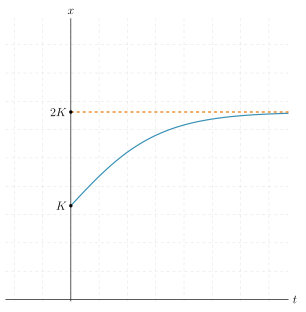
If there are \(x\) micrograms of bacteria in a nutrient medium, the population of bacteria will grow at the rate \((2K-x)x\) micrograms per hour. Show that, if \(x=K\) when \(t=0\), the population at time \(t\) is given by \[ x(t)=K+K\frac{1-\mathrm{e}^{-2Kt}}{1+\mathrm{e}^{-2Kt}}. \] Sketch, for \(t\geqslant0\), the graph of \(x\) against \(t\). What happens to \(x(t)\) as \(t\rightarrow\infty\)? Now suppose that the situation is as described in the first paragraph, except that we remove the bacteria from the nutrient medium at a rate \(L\) micrograms per hour where \(K^{2}>L\). We set \(\alpha=\sqrt{K^{2}-L}.\) Write down the new differential equation for \(x\). By considering a new variable \(y=x-K+\alpha,\) or otherwise, show that, if \(x(0)=K\) then \(x(t)\rightarrow K+\alpha\) as \(t\rightarrow\infty\).
Solution: \begin{align*} && \dot{x} &= (2K-x)x \\ \Rightarrow && \int \d t &= \int \frac{1}{(2K-x)x} \d x \\ &&&= \int \frac1{2K}\left ( \frac{1}{2K-x} + \frac{1}{x} \right) \d x \\ &&&= \frac{1}{2K} \left (\ln x - \ln (2K-x) \right) \\ \Rightarrow && 2Kt+C &= \ln \frac{x}{2K-x} \\ t = 0, x = K: && C &= \ln \frac{K}{2K-K} = 0 \\ \Rightarrow && e^{2Kt} &= \frac{x}{2K-x} \\ \Rightarrow && e^{-2Kt} &= \frac{2K}{x} -1 \\ \Rightarrow && x &= \frac{2K}{1+e^{-2Kt}} \\ &&&= K + K \frac{1-e^{-2Kt}}{1+e^{-2Kt}} \end{align*}
1991 Paper 1 Q7
According to the Institute of Economic Modelling Sciences, the Slakan economy has alternate years of growth and decline, as in the following model. The number \(V\) of vloskan (the unit of currency) in the Slakan Treasury is assumed to behave as a continuous variable, as follows. In a year of growth it increases continuously at an annual rate \(aV_{0}\left(1+(V/V_{0})\right)^{2}.\) During a year of decline, as long as there is still money in the Treasury, the amount decreases continuously at an annual rate \(bV_{0}\left(1+(V/V_{0})\right)^{2};\) but if \(V\) becomes zero, it remains zero until the end of the year. Here \(a,b\) and \(V_{0}\) are positive constants. A year of growth has just begun and there are \(k_{0}V_{0}\) vloskan in the Treasury, where \(0\leqslant k_{0} < a^{-1}-1\). Explain the significance of these inequalities for the model to be remotely sensible. If \(k_{0}\) is as above and at the end of one year there are \(k_{1}V_{0}\) vloskan in the Treasury, where \(k_{1} > 0\), find the condition involving \(b\) which \(k_{1}\) must satisfy so that there will be some vloskan left after a further year. Under what condition (involving \(a,b\) and \(k_{0}\)) does the model predict that unlimited growth will take place in the third year (but not before)?
1991 Paper 2 Q14
The current in a straight river of constant width \(h\) flows at uniform speed \(\alpha v\) parallel to the river banks, where \(0<\alpha<1\). A boat has to cross from a point \(A\) on one bank to a point \(B\) on the other bank directly opposite to \(A\). The boat moves at constant speed \(v\) relative to the water. When the position of the boat is \((x,y)\), where \(x\) is the perpendicular distance from the opposite bank and \(y\) is the distance downstream from \(AB\), the boat is pointing in a direction which makes an angle \(\theta\) with \(AB\). Determine the velocity vector of the boat in terms of \(v,\theta\) and \(\alpha.\) The pilot of the boat steers in such a way that the boat always points exactly towards \(B\). Show that the velocity vector of the boat is \[ \begin{pmatrix}\dfrac{\mathrm{d}x}{\mathrm{d}t}\\ \tan\theta\dfrac{\mathrm{d}x}{\mathrm{d}t}+x\sec^{2}\theta\dfrac{\mathrm{d}\theta}{\mathrm{d}t} \end{pmatrix}. \] By comparing this with your previous expression deduce that \[ \alpha\frac{\mathrm{d}x}{\mathrm{d}\theta}=-x\sec\theta \] and hence show that \[ (x/h)^{\alpha}=(\sec\theta+\tan\theta)^{-1}. \] Let \(s(t)\) be a new variable defined by \(\tan\theta=\sinh(\alpha s).\) Show that \(x=h\mathrm{e}^{-s},\) and that \[ h\mathrm{e}^{-s}\cosh(\alpha s)\frac{\mathrm{d}s}{\mathrm{d}t}=v. \] Hence show that the time of crossing is \(hv^{-1}(1-\alpha^{2})^{-1}.\)