Problems
Filters
5 problems found
2012 Paper 1 Q2
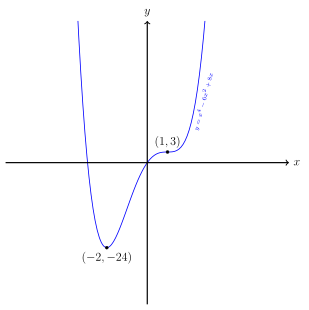
- Sketch the curve \(y= x^4-6x^2+9\) giving the coordinates of the stationary points. Let \(n\) be the number of distinct real values of \(x\) for which
\[
x^4-6x^2 +b=0.
\]
State the values of \(b\), if any, for which
- \(n=0\,\);
- \(n=1\,\);
- \(n=2\,\);
- \(n=3\,\);
- \(n=4\,\).
- For which values of \(a\) does the curve \(y= x^4-6x^2 +ax +b\) have a point at which both \(\dfrac{\d y}{\d x}=0\) and \(\dfrac{\d^2y}{\d x^2}=0\,\)? For these values of \(a\), find the number of distinct real values of \(x\) for which \(\vphantom{\dfrac{A}{B}}\) \[ x^4-6x^2 +ax +b=0\,, \] in the different cases that arise according to the value of \(b\).
- Sketch the curve \(y= x^4-6x^2 +ax\) in the case \(a>8\,\).
Solution:
- \(\,\)

- \(n = 0\) if \(b > 9\)
- \(n = 1\) is not possible, since by symmetry if \(x\) is a root, so is \(-x\), and \(0\) can never be the only root.
- \(n = 2\) if \(b < 0\) or \(b = 9\)
- \(n = 3\) if \(b = 0\)
- \(n = 4\) if \(0 < b < 9\)
- \(\,\) \begin{align*}
&& y' &= 4x^3-12x+a \\
&& y'' &= 12x^2-12 \\
\Rightarrow && x &= \pm 1 \\
\Rightarrow && 0 &= 4(\pm 1) - 12 (\pm 1) + a \\
&&&= a \mp 8 \\
\Rightarrow && a &= \pm 8
\end{align*}
When \(a = 8\), we have \(y = x^4-6x^2+8x\) and
\begin{align*}
&&y' &= 4x^3-12x+8 \\
&&&= 4(x^3-3x+2) \\
&&&= 4(x-1)^2(x+2) \\
\Rightarrow && y(1) &= 3\\
&& y(-2) &= -24
\end{align*}
Therefore there are no solutions if \(b > 24\), one solution if \(b = 24\) and two solutions otherwise. Similarly, if \(a = -8\), we have \(y = x^4 - 6x^2-8x\) \begin{align*} && y' &= 4x^3-12x-8 \\ &&&= 4(x^3-3x-2) \\ &&&= 4(x-2)(x+1)^2 \end{align*} So we have stationary points at \(x = 2\) and \(x = -1\) (which is also a inflection point) and at \(x = 2\) \(y = -24\), so we have the same story: there are no solutions if \(b > 24\), one solution if \(b = 24\) and two solutions otherwise.
- \(\,\)

2005 Paper 3 Q3
Let \(\f(x)=x^2+px+q\) and \(\g(x)=x^2+rx+s\,\). Find an expression for \(\f ( \g (x))\) and hence find a necessary and sufficient condition on \(a\), \(b\) and \(c\) for it to be possible to write the quartic expression \(x^4+ax^3+bx^2+cx+d\) in the form \(\f ( \g (x))\), for some choice of values of \(p\), \(q\), \(r\) and \(s\). Show further that this condition holds if and only if it is possible to write the quartic expression \(x^4+ax^3+bx^2+cx+d\) in the form \((x^2+vx+w)^2-k\), for some choice of values of \(v\), \(w\) and \(k\). Find the roots of the quartic equation \(x^4-4x^3+10x^2-12x+4=0\,\).
Solution: \begin{align*} && f(g(x)) &= (g(x))^2 + p(g(x)) + q \\ &&&= (x^2+rx+s)^2 + p(x^2+rx+s) + q \\ &&&= x^4 + 2rx^3 + (2s+r^2+p)x^2 +(2rs+pr)x + (s^2+ps+q) \end{align*} So we need \(2r=a ,2s+r^2+p = b, r(2s+p) = c\). (We have full control over \(d\) since we can always chance \(q\) only affecting \(d\). \begin{align*} && r &= \frac{a}{2} \\ && b-r^2 & =rc \\ && b - \frac{a^2}{4} & =\frac{ac}{2} \\ \Rightarrow && 4b-a^2&= 2ac \end{align*} Clearly this condition is necessary. It is sufficient since if it is true the equations are solveable. \((x^2+vx+w)^2 = x^4 + 2vx^3 + (2vw+v^2)x^2+2vw x + w^2\). We don't care about the constant term since we can control this with \(k\), so we just need to check \(4(2vw+v^2) - (2v)^2 = 8wv\) so this does satisfy the condition. The reverse is also clear. \begin{align*} && 0 &= x^4-4x^3+10x^2-12x+4 \\ &&&= (x^2-2x+3)^2-5 \\ \Rightarrow && 0 &= x^2 - 2x+3 \pm \sqrt{5} \\ && x &= \frac{2 \pm \sqrt{4 - 4(3 \pm \sqrt{5})}}{2} \\ &&&= 1 \pm \sqrt{\mp \sqrt{5} -2} \\ &&& = 1 \pm \sqrt{\sqrt{5}-2}, 1 \pm i\sqrt{\sqrt{5}+2} \end{align*}
1993 Paper 3 Q7
The real numbers \(x\) and \(y\) satisfy the simultaneous equations $$ \sinh (2x) = \cosh y \qquad\hbox{and}\qquad \sinh(2y) = 2 \cosh x. $$ Show that \(\sinh^2 y\) is a root of the equation $$ 4t^3 + 4t^2 -4t -1=0 $$ and demonstrate that this gives at most one valid solution for \(y\). Show that the relevant value of \(t\) lies between \(0.7\) and \(0.8\), and use an iterative process to find \(t\) to 6 decimal places. Find \(y\) and hence find \(x\), checking your answers and stating the final answers to four decimal places.
Solution: Let \(t = \sinh^2 y\), then \begin{align*} && \sinh(2x) &= \cosh y \tag{1}\\ && \sinh(2y) &= 2 \cosh x \tag{2} \\ \\ && \cosh(2x) &= 2 \cosh^2 x -1 \\ (2): &&&= \frac12 \sinh^2(2y) -1 \\ && 1 &= \left (\frac12 \sinh^2(2y) -1 \right)^2 - \cosh^2 y \\ &&&= \frac14 \sinh^4(2y)-\sinh^2(2y)+1-\cosh^2 y \\ \Rightarrow && 0 &= \frac14 (\cosh^2 (2y)-1)^2- (\cosh^2 (2y)-1) - \cosh^2 y \\ &&&= \frac14 \left ( \left (1+2\sinh^2 y \right)^2-1 \right)^2 -\left ( \left (1+2\sinh^2 y \right)^2 -1\right) - (1 + \sinh^2 y ) \\ &&&= \frac14 \left ( 1 + 4t+4t^2 -1\right)^2 - \left ( 1+4t+4t^2-1\right) - (1 + t) \\ &&&= \frac14 (4t + 4t^2)^2 - (4t+4t^2)-1-t \\ &&&= 4(t+t^2)^2 - 4t^2-5t-1 \\ &&&= 4t^4+8t^3+4t^2-4t^2-5t-1 \\ &&& = 4t^4+8t^3-5t-1 \\ &&&= (t+1)(4t^3+4t^2-4t-1) \end{align*} Since \(\sinh^2 y\) is positive, we must be a root of the second cubic. Let \(f(t) = 4t^3+4t^2-4t-1\), then \(f(0) = -1\) and \(f'(t) = 12t^2+8t-4 = 4(t+1)(3t-1)\), so we have turning points at \(-1\) and \(\frac13\). Since \(f(-1) = 3 > 0\) and \(f(0) < 0\) we must have exactly one root larger than zero. Therefore there is a unique root. \(f(0.7) = -0.468 < 0\) \(f(0.8) = 0.408 > 0\) since \(f\) is continuous and changes sign, the root must fall in the interval \((0.7, 0.8)\). Let \(t_{n+1} = t_n - \frac{f(t_n)}{f'(t_n)}\), and \(t_0 = 0.75\), then \begin{align*} t_0 &= 0.75 \\ t_1 &= 0.7571428571 \\ t_2 &= 0.7570684728 \\ t_3 &= 0.7570684647 \end{align*} So \(t \approx 0.757068\), \(\sinh y \approx 0.870097\), \(y \approx 0.786474\), \(x \approx 0.546965\)
1992 Paper 3 Q3
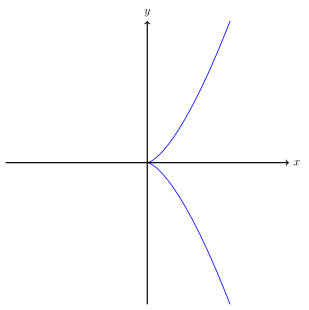
Sketch the curve \(C_{1}\) whose parametric equations are \(x=t^{2},\) \(y=t^{3}.\) The circle \(C_{2}\) passes through the origin \(O\). The points \(R\) and \(S\) with real non-zero parameters \(r\) and \(s\) respectively are other intersections of \(C_{1}\) and \(C_{2}.\) Show that \(r\) and \(s\) are roots of an equation of the form \[ t^{4}+t^{2}+at+b=0, \] where \(a\) and \(b\) are real constants. By obtaining a quadratic equation, with coefficients expressed in terms of \(r\) and \(s\), whose roots would be the parameters of any further intersections of \(C_{1}\) and \(C_{2},\) or otherwise, show that \(O\), \(R\) and \(S\) are the only real intersections of \(C_{1}\) and \(C_{2}.\)
Solution:
1988 Paper 2 Q5
By considering the imaginary part of the equation \(z^{7}=1,\) or otherwise, find all the roots of the equation \[ t^{6}-21t^{4}+35t^{2}-7=0. \] You should justify each step carefully. Hence, or otherwise, prove that \[ \tan\frac{2\pi}{7}\tan\frac{4\pi}{7}\tan\frac{6\pi}{7}=\sqrt{7}. \] Find the corresponding result for \[ \tan\frac{2\pi}{n}\tan\frac{4\pi}{n}\cdots\tan\frac{(n-1)\pi}{n} \] in the two cases \(n=9\) and \(n=11.\)
Solution: Suppose \(z^7 = 1\), then we can write \(z = \cos \theta + i \sin \theta\) and we must have that: \begin{align*} 0 &= \textrm{Im}((\cos \theta + i \sin \theta)^7) \\ &= \binom{7}{6}\cos^6 \theta \sin \theta - \binom{7}{4} \cos^4 \theta \sin^3 \theta + \binom{7}{2} \cos^2 \theta \sin^5 \theta - \sin^7 \theta \\ &= 7 \cos^6 \sin \theta - 35 \cos^4 \theta \sin ^3 \theta + 21 \cos^2 \theta \sin^5 \theta - \sin^7 \theta \\ &= -\cos^7 \theta \l \tan^7 \theta - 21 \tan^5 \theta + 35 \tan^3 \theta - 7 \tan \theta\r \\ &= \cos^7 \theta \cdot t (t^7-21t^4+35t^2-7) \end{align*} Where \(t = \tan \theta\). So if \(z\) is a root of \(z^7 = 1\) and \(\cos \theta \neq 0, \tan \theta \neq 0\) then \(t\) is a root of the equation. Thererefore the roots are: \(\tan \frac{2\pi k}{7}\) where \(k = 1, 2, \ldots 6\). Noting that \(\tan \frac{\pi}7 = -\tan \frac{6\pi}{7}, \tan \frac{3\pi}{7} = -\tan \frac{4 \pi}{7}, \tan \frac{5\pi}{7} = -\tan \frac{2 \pi}{7}\) we can conclude that: \begin{align*} && 7 &= \prod_{k=1}^k \tan \frac{k \pi}{6} \\ &&&= \l \tan\frac{2\pi}{7}\tan\frac{4\pi}{7}\tan\frac{6\pi}{7} \r^2 \\ \Rightarrow&& \pm \sqrt{7} &= \tan\frac{2\pi}{7}\tan\frac{4\pi}{7}\tan\frac{6\pi}{7} \end{align*} However, we know that \(\tan \frac{2\pi}{7}\) is positive, \(\tan \frac{4\pi}{7},\tan \frac{6\pi}{7}\) are negative, therefore the result must be positive, ie \(+\sqrt{7}\) Using a similar method, we notice that: \begin{align*} 0 &= \textrm{Im} \l (\cos \theta + i \sin \theta)^n \r \\ &= \cos^n \theta \cdot t (t^{n-1} + \cdots - \binom{n}{n-1}) \end{align*} Therefore \(\prod_{k=0}^{n-1} \tan \frac{k \pi}{n} = n\) and since \(\tan \frac{(2k+1) \pi}{n} = \tan \frac{(n-2k-1)\pi}{n}\) is a map of all the odd numbers to the even numbers (and vice versa) when \(n\) is odd. We also know that the terms less where \(\tan \theta\) has \(\theta < \frac{\pi}{2}\) are positive, and the others even, we can determine the signs: \begin{align*} \tan \frac{2 \pi}{9} \tan \frac{4 \pi}{9} \tan \frac{6 \pi}{9} \tan \frac{8 \pi}{9} & = 3 \\ \tan \frac{2 \pi}{11} \tan \frac{4 \pi}{11} \tan \frac{6 \pi}{11} \tan \frac{8 \pi}{11} \tan \frac{10 \pi}{11} &= -\sqrt{11} \end{align*}