Problems
Filters
13 problems found
2010 Paper 3 Q1
Let \(x_{\low1}\), \(x_{\low2}\), \ldots, \(x_n\) and \(x_{\vphantom {\dot A} n+1}\) be any fixed real numbers. The numbers \(A\) and \(B\) are defined by \[ A = \frac 1 n \sum_{k=1}^n x_{ \low k} \,, \ \ \ B= \frac 1 n \sum_{k=1}^n (x_{\low k}-A)^2 \,, \ \ \ \] and the numbers \(C\) and \(D\) are defined by \[ C = \frac 1 {n+1} \sum\limits_{k=1}^{n+1} x_{\low k} \,, \ \ \ D = \frac1{n+1} \sum_{k=1}^{n+1} (x_{\low k}-C)^2 \,. \]
- Express \( C\) in terms of \(A\), \(x_{\low n+1}\) and \(n\).
- Show that $ \displaystyle B= \frac 1 n \sum_{k=1}^n x_{\low k}^2 - A^2\,\(.
- Express \)D \( in terms of \)B\(, \)A\(, \)x_{\low n+1}\( and \)n$. Hence show that \((n + 1)D \ge nB\) for all values of \(x_{\low n+1}\), but that \(D < B\) if and only if \[ A-\sqrt{\frac{(n+1)B}{n}} < x_{\low n+1} < A+\sqrt{\frac{(n+1)B}{n}}\,. \]
2010 Paper 3 Q2
In this question, \(a\) is a positive constant.
- Express \(\cosh a\) in terms of exponentials. By using partial fractions, prove that \[ \int_0^1 \frac 1{ x^2 +2x\cosh a +1} \, \d x = \frac a {2\sinh a}\,. \]
- Find, expressing your answers in terms of hyperbolic functions, \[ \int_1^\infty \frac 1 {x^2 +2x \sinh a -1} \,\d x \, \] and \[ \int_0^\infty \frac 1 {x^4 +2x^2\cosh a +1} \,\d x \,.\]
Solution:
- \(\cosh a = \frac12 (e^a + e^{-a})\) \begin{align*} \int_0^1 \frac 1{ x^2 +2x\cosh a +1} \, \d x &= \int_0^1 \frac{1}{x^2+(e^a+e^{-a})x+e^ae^{-a}} \d x \\ &= \int_0^1 \frac{1}{e^a-e^{-a}}\left (\frac{1}{x+e^{-a}}-\frac{1}{x+e^a} \right)\d x \\ &= \frac{1}{2 \sinh a} \int_0^1 \left (\frac{1}{x+e^{-a}}-\frac{1}{x+e^a} \right)\d x \\ &= \frac{1}{2 \sinh a}\left [\ln(x+e^{-a})-\ln(x+e^a) \right]_0^1 \\ &= \frac{1}{2 \sinh a} \left (\ln(1+e^a)-\ln(1+e^{-a}) - (\ln e^{-a}-\ln e^a) \right) \\ &= \frac{1}{2\sinh a}\left (2a + \ln \frac{1+e^a}{1+e^{-a}}\right) \\ &= \frac1{2\sinh a} \left ( 2a -a \right) \\ &= \frac{a}{2 \sinh a} \end{align*}
- \begin{align*} \int_1^\infty \frac 1 {x^2 +2x \sinh a -1} \,\d x &= \int_1^{\infty} \frac{1}{(x+e^a)(x-e^{-a})} \d x \\ &= \int_1^{\infty} \frac{1}{e^a+e^{-a}} \left ( \frac{1}{x-e^{-a}} - \frac{1}{x+e^{a}} \right)\d x \\ &= \frac{1}{2\cosh a} \int_1^{\infty} \left ( \frac{1}{x-e^{-a}} - \frac{1}{x+e^{a}} \right)\d x \\ &= \frac{1}{2\cosh a} \left [\ln(x-e^{-a}) - \ln (x + e^{a} ) \right]_1^{\infty} \\ &= \frac1{2\cosh a} \left [ \ln \frac{x-e^{-a}}{x+e^{a}} \right]_1^{\infty} \\ &= \frac{1}{2\cosh a} \left ( 0 - \ln \frac{1-e^{-a}}{1+e^a}{}\right) \\ &= \frac{1}{2\cosh a} \ln \frac{1+e^a}{1-e^{-a}}\\ &= \frac{1}{2\cosh a} \left ( a + \ln \coth \frac{a}{2} \right) \end{align*} and \begin{align*} \int_0^\infty \frac 1 {x^4 +2x^2\cosh a +1} \,\d x &= \int_0^\infty\frac{1}{(x^2+e^a)(x^2+e^{-a})} \d x \\ &= \int_0^\infty \frac{1}{e^a-e^{-a}} \left ( \frac{1}{x^2+e^{-a}} - \frac{1}{x^2+e^{a}} \right) \d x \\ &= \frac{1}{2\sinh a} \left [ \frac{1}{e^{-a/2}} \tan^{-1} \frac{x}{e^{-a/2}} - \frac{1}{e^{a/2}}\tan^{-1} \frac{x}{e^{a/2}} \right]_0^{\infty} \\ &= \frac{1}{2\sinh a} \left (e^{a/2}\frac{\pi}{2}-e^{-a/2}\frac{\pi}{2} - 0 \right) \\ &= \frac{1}{2\sinh a} \pi \sinh \frac{a}{2} \\ &= \frac{\pi \sinh \tfrac{a}{2}}{2\sinh a} \\ &= \frac{\pi \sinh \tfrac{a}{2}}{4\sinh \tfrac{a}{2} \cosh \tfrac{a}{2}} \\ &= \frac{\pi}{4\cosh \tfrac{a}{2}} \end{align*}
2010 Paper 3 Q3
For any given positive integer \(n\), a number \(a\) (which may be complex) is said to be a primitive \(n\)th root of unity if \(a^n=1\) and there is no integer \(m\) such that \(0 < m < n\) and \(a^m = 1\). Write down the two primitive 4th roots of unity. Let \({\rm C}_n(x)\) be the polynomial such that the roots of the equation \({\rm C}_n(x)=0\) are the primitive \(n\)th roots of unity, the coefficient of the highest power of \(x\) is one and the equation has no repeated roots. Show that \({\rm C}_4(x) = x^2+1\,\).
- Find \({\rm C}_1(x)\), \({\rm C}_2(x)\), \({\rm C}_3(x)\), \({\rm C}_5(x)\) and \({\rm C}_6(x)\), giving your answers as unfactorised polynomials.
- Find the value of \(n\) for which \({\rm C}_n(x) = x^4 + 1\).
- Given that \(p\) is prime, find an expression for \({\rm C}_p(x)\), giving your answer as an unfactorised polynomial.
- Prove that there are no positive integers \(q\), \(r\) and \(s\) such that \({\rm C}_q(x) \equiv {\rm C}_r(x) {\rm C}_s(x)\,\).
Solution: The primitive 4th roots of unity are \(i\) and \(-i\). (Since the other two roots of \(x^4-1\) are also roots of \(x^2-1\) \({\rm C}_4(x) = (x-i)(x+i) = x^2+1\) as required.
- \(\,\) \begin{align*} && {\rm C}_1 (x) &= x-1 \\ && {\rm C}_2 (x) &= x+1 \\ && {\rm C}_3 (x) &= x^2+x+1 \\ && {\rm C}_5 (x) &= x^4+x^3+x^2+x+1 \\ && {\rm C}_6 (x) &= x^2-x+1 \\ \end{align*}
- Since \((x^4+1)(x^4-1) = x^8-1\) we must have \(n \mid 8\). But \(n \neq 1,2,4\) so \(n = 8\).
- \({\rm C}_p(x) = x^{p-1} +x^{p-2}+\cdots+x+1\)
- Suppose \({\rm C_q}(x) \equiv {\rm C}_r(x){\rm C}_s(x)\), then if \(\omega\) is a primitive \(q\)th root of unity we must \({\rm C}_q(\omega) = 0\), but that means that one of \({\rm C}_r(\omega)\), \({\rm C}_s(\omega)\) is \(0\). But that's only possible if \(r\) or \(s\) \(=q\). If this were the case, then what would the other value be? There are no possible values, hence it's not possible.
2010 Paper 3 Q4
- The number \(\alpha\) is a common root of the equations \(x^2 +ax +b=0\) and \(x^2+cx+d=0\) (that is, \(\alpha\) satisfies both equations). Given that \(a\ne c\), show that \[ \alpha =- \frac{b-d}{a-c}\,. \] Hence, or otherwise, show that the equations have at least one common root if and only if \[ (b-d)^2 -a(b-d)(a-c) + b(a-c)^2 =0\,. \] Does this result still hold if the condition \(a\ne c\) is not imposed?
- Show that the equations \(x^2+ax+b=0\) and \(x^3+(a+1)x^2+qx+r=0\) have at least one common root if and only if \[ (b-r)^2-a(b-r)(a+b-q) +b(a+b-q)^2=0\,. \] Hence, or otherwise, find the values of \(b\) for which the equations \(2x^2+5 x+2 b=0\) and \(2x^3+7x^2+5x+1=0\) have at least one common root.
Solution:
- \begin{align*} && 0 &= \alpha^2 + a \alpha + b \tag{1} \\ && 0 &= \alpha^2 + c \alpha + d \tag{2} \\ \\ (1) - (2): && 0 & =\alpha ( a-c) + (b-d) \\ \Rightarrow && \alpha &= - \frac{b-d}{a-c} \tag{\(a\neq c\)} \end{align*} (\(\Rightarrow\)) Suppose they have a common root, then given we know it's form, we must have: \begin{align*} && 0 &= \left ( - \frac{b-d}{a-c} \right)^2 +a\left ( - \frac{b-d}{a-c} \right) + b \\ \Rightarrow && 0 &= (b-d)^2 - a(b-d)(a-c) + b(a-c)^2 \end{align*} (\(\Leftarrow\)) Suppose the equation holds, then \begin{align*} && 0 &= (b-d)^2 - a(b-d)(a-c) + b(a-c)^2 \\ \Rightarrow && 0 &= \left ( - \frac{b-d}{a-c} \right)^2 +a\left ( - \frac{b-d}{a-c} \right) + b \\ \end{align*} So \(\alpha\) is a root of the first equation. Considering \((1) - (2)\) we must have that \(\alpha(a-c) +(b-d) = t\) (whatever the second equation is), but that value is clearly \(0\), therefore \(\alpha\) is a root of both equations. If \(a = c\) then the equation becomes \(0 = (b-d)^2\), ie the two equations are the same, therefore they must have common roots!
- \begin{align*} && 0 &= x^2+ax+b \tag{1} \\ && 0 &= x^3+(a+1)x^2+qx+r \tag{2} \\ \\ (2) - x(1) && 0 &= x^2 + (q-b)x + r \tag{3} \end{align*} Therefore if the equations have a common root, \((1)\) and \((3)\) have a common root, ie \((b-r)^2-a(b-r)(a-(q-b))+b(a-(q-b))^2 = 0\) which is exactly our condition. \(a = \frac52, q = \frac52, r = \frac12\) \begin{align*} && 0 &= \left (b-\frac12 \right)^2 - \frac52\left (b-\frac12\right) b + b^3 \\ &&&= b^2 -b + \frac14 - \frac52 b^2+\frac54b + b^3 \\ &&&= b^3 -\frac32 b^2 +\frac14 b + \frac14 \\\Rightarrow && 0 &= 4b^3 - 6b^2+b + 1 \\ &&&= (b-1)(4b^2-2b-1) \\ \Rightarrow && b &= 1, \frac{1 \pm \sqrt{5}}{4}\end{align*}
2010 Paper 3 Q5
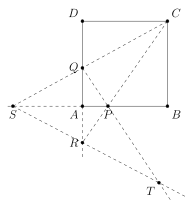
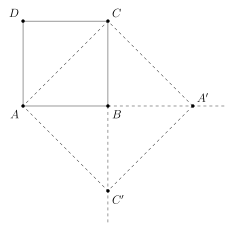
The vertices \(A\), \(B\), \(C\) and \(D\) of a square have coordinates \((0,0)\), \((a,0)\), \((a,a)\) and \((0,a)\), respectively. The points \(P\) and \(Q\) have coordinates \((an,0)\) and \((0,am)\) respectively, where \(0 < m < n < 1\). The line \(CP\) produced meets \(DA\) produced at \(R\) and the line \(CQ\) produced meets \(BA\) produced at \(S\). The line \(PQ\) produced meets the line \(RS\) produced at \(T\). Show that \(TA\) is perpendicular to \(AC\). Explain how, given a square of area \(a^2\), a square of area \(2a^2\) may be constructed using only a straight-edge. [Note: a straight-edge is a ruler with no markings on it; no measurements (and no use of compasses) are allowed in the construction.]
Solution:
2010 Paper 3 Q6
The points \(P\), \(Q\) and \(R\) lie on a sphere of unit radius centred at the origin, \(O\), which is fixed. Initially, \(P\) is at \(P_0(1, 0, 0)\), \(Q\) is at \(Q_0(0, 1, 0)\) and \(R\) is at \(R_0(0, 0, 1)\).
- The sphere is then rotated about the \(z\)-axis, so that the line \(OP\) turns directly towards the positive \(y\)-axis through an angle \(\phi\). The position of \(P\) after this rotation is denoted by \(P_1\). Write down the coordinates of \(P_1\).
- The sphere is now rotated about the line in the \(x\)-\(y\) plane perpendicular to \(OP_1\), so that the line \(OP\) turns directly towards the positive \(z\)-axis through an angle \(\lambda\). The position of \(P\) after this rotation is denoted by \(P_2\). Find the coordinates of \(P_2\). Find also the coordinates of the points \(Q_2\) and \(R_2\), which are the positions of \(Q\) and \(R\) after the two rotations.
- The sphere is now rotated for a third time, so that \(P\) returns from \(P_2\) to its original position~\(P_0\). During the rotation, \(P\) remains in the plane containing \(P_0\), \(P_2\) and \(O\). Show that the angle of this rotation, \(\theta\), satisfies \[ \cos\theta = \cos\phi \cos\lambda\,, \] and find a vector in the direction of the axis about which this rotation takes place.
2010 Paper 3 Q7
Given that \(y = \cos(m \arcsin x)\), for \(\vert x \vert <1\), prove that \[ (1-x^2) \frac {\d^2 y}{\d x^2} -x \frac {\d y}{\d x} +m^2y=0\,. \] Obtain a similar equation relating \(\dfrac{\d^3y}{\d x^3}\,\), \(\dfrac{\d^2y}{\d x^2}\, \) and \(\, \dfrac{\d y}{\d x}\,\), and a similar equation relating \(\dfrac{\d^4y}{\d x^4}\,\), \(\dfrac{\d^3y}{\d x^3}\,\) and \(\,\dfrac{\d^2 y}{\d x^2}\,\). Conjecture and prove a relation between \(\dfrac{\d^{n+2}y}{\d x^{n+2}}\,\), \(\dfrac{\d^{n+1}y}{\d x^{n+1}}\;\) and \(\;\dfrac{\d^n y}{\d x^n}\,\). Obtain the first three non-zero terms of the Maclaurin series for \(y\). Show that, if \(m\) is an even integer, \(\cos m\theta\) may be written as a polynomial in \(\sin\theta\) beginning \[ 1 - \frac{m^2\sin^2\theta}{2!}+ \frac{m^2(m^2-2^2)\sin^4\theta}{4!} -\cdots \,. \, \tag{\(\vert\theta\vert < \tfrac12 \pi\)} \] State the degree of the polynomial.
Solution: \begin{align*} && y &= \cos(m \arcsin x) \\ && y' &= -m \sin (m \arcsin x) \cdot (1-x^2)^{-\frac12} \\ && y'' &= -m^2 \cos(m \arcsin x) \cdot (1-x^2)^{-1} -m \sin(m \arcsin x) \cdot (1-x^2)^{-\frac32} \cdot (-x) \\ &&&= -m^2 y (1-x^2)^{-1} + x(1-x^2)^{-1} y' \\ \Rightarrow && 0 &= (1-x^2)y'' - x y' + m^2y \\ \\ && 0 &= (1-x^2)y^{(3)} -2xy'' - xy''-y' + m^2y' \\ &&&= (1-x^2)y^{(3)} - 3xy'' + (m^2-1)y' \\ \\ && 0 &= (1-x^2)y^{(4)} - 2xy^{(3)} - 3xy^{(3)} - 3y^{(2)} + (m^2-1)y^{(2)} \\ &&&= (1-x^2)y^{(4)}- 5xy^{(3)} - (m^2-4)y^{(2)} \end{align*} Claim: \(0 = (1-x^2)y^{(n+2)} - (2n+1)y^{(n+1)} + (m^2-n^2)y^{(n)}\) Proof: (By induction) Clearly the first few base cases are true. Suppose it is true for some \(n\), then \begin{align*} && 0 &= (1-x^2)y^{(n+2)} - (2n+1)xy^{(n+1)} + (m^2-n^2)y^{(n)} \\ \Rightarrow && 0 &= (1-x^2)y^{(n+3)} - 2xy^{(n+2)} - (2n+1)xy^{(n+2)} - (2n+1)y^{(n+1)} + (m^2-n^2)y^{(n+1)} \\ &&&= (1-x^2)y^{(n+3)} - (2n+3)xy^{(n+2)} + (m^2-n^2-2n-1)y^{(n+1)} \\ &&&= (1-x^2)y^{(n+1+2)} - (2(n+1)+1)xy^{(n+1+1)} +(m^2-(n+1)^2)y^{(n)} \end{align*} And so we can conclude the result by induction. Notice that \begin{align*} && y(0) &= \cos(m 0) = 1 \\ && y'(0) &= -m\sin(m 0) = 0 \\ && y''(0) &= -m^2 y(0) = -m^2\\ \end{align*} Notice that \(y^{(n+2)}(0) + (m^2-n^2)y^{(n)} = 0\) so in particular all the odd terms will be \(0\) and the even terms will be \(1, -m^2, m^2(m^2-2^2), \cdots\), therefore \begin{align*} && \cos (m \arcsin x) &= 1 -\frac{m^2}{2!} x^2 + \frac{m^2(m^2-2^2)}{4!}x^4 - \cdots \\ \Rightarrow && \cos(m \theta) &= 1 - \frac{m^2}{2!} \sin^2 \theta + \frac{m^2(m^2-2^2)}{4!} \sin^4 \theta \end{align*} Notice that if \(m\) is even, then at some point we will have \(m^2-m^2\) appearing in our expansion and all remaining terms will be zero. Therefore we will end up with a polynomial series, of degree \(m\) in \(\sin \theta\)
2010 Paper 3 Q8
Given that \({\rm P} (x) = {\rm Q} (x){\rm R}'(x) - {\rm Q}'(x){\rm R}(x)\), write down an expression for \[ \int \frac{{\rm P} ( x)}{ \big( {\rm Q} ( x)\big )^ 2}\, \d x\, . \]
- By choosing the function \({\rm R}(x)\) to be of the form \(a +bx+c x^2\), find \[ \int \frac{5x^2 - 4x - 3} {(1 + 2x + 3x^2 )^2 } \, \d x \,.\] Show that the choice of \({\rm R}(x)\) is not unique and, by comparing the two functions \({\rm R}(x)\) corresponding to two different values of \(a\), explain how the different choices are related.
- Find the general solution of \[ (1+\cos x +2 \sin x) \frac {\d y}{\d x} +(\sin x -2 \cos x)y = 5 - 3 \cos x + 4 \sin x\,. \]
Solution: \begin{align*} && \int \frac{{\rm P} ( x)}{ \big( {\rm Q} ( x)\big )^ 2}\, \d x &= \int \frac{{\rm Q} (x){\rm R}'(x) - {\rm Q}'(x){\rm R}(x)}{ \big( {\rm Q} ( x)\big )^ 2}\, \d x \\ &&&= \int \frac{\d}{\d x} \left ( \frac{R(x)}{Q(x)} \right) \d x \\ &&&= \frac{R(x)}{Q(x)} + C \end{align*}
- Suppose \(Q(x) = 1 + 2x + 3x^2, P(x) = 5x^2-4x-3\), and \(R(x) = a +bx + cx^2\), then \begin{align*} && 5x^2-4x-3 &= (1 + 2x + 3x^2)(2cx+b) - (6x+2)(a+bx+cx^2) \\ &&&= (6c-6c)x^3 + (3b+4c-6b-2c)x^2 + \\ &&&\quad+(2c+2b-6a-2b)x + (b-2a) \\ \Rightarrow && 2c-3b &= 5 \\ && 2c-6a &= -4 \\ && b - 2a &= -3 \\ \Rightarrow && b &= 2a - 3\\ && c &= 3a-2 \end{align*} So say \(a = 0, b = -3, c = -2\) we will have \begin{align*} \int \frac{5x^2 - 4x - 3} {(1 + 2x + 3x^2 )^2 } \, \d x &= \frac{-3x-2x^2}{1+2x+3x^2} + C \end{align*} Suppose we have a different value of \(a\), then we end up with: \begin{align*} \frac{a+(2a-3)x+(3a-2)x^2}{1+2x+3x^2} = a +\frac{-3x-2x^2}{1+2x+3x^2} \end{align*} So the different antiderivatives differ by a constant.
- \(\,\) \begin{align*} && \frac{\d }{\d x} \left ( \frac{1}{1+\cos x + 2 \sin x } y\right) &= \frac{5-3\cos x + 4 \sin x }{(1+\cos x + 2 \sin x)^2} \\ \end{align*} We want to find \(R(x) = A \cos x + B\sin x + C\) such that \begin{align*} &&5-3\cos x + 4 \sin x &= (1+\cos x + 2 \sin x)R'(x) - R(x)(-\sin x + 2 \cos x) \\ &&&= (1+\cos x + 2 \sin x)(-A\sin x + B \cos x) \\ &&&\quad- (A\cos x + B \sin x + C)(-\sin x + 2 \cos x) \\ &&&=(-A+C) \sin x + (B-2C)\cos x +\\ &&&\quad\quad (2B-A+A-2B)\sin x \cos x \\ &&&\quad\quad (-2A+B)\sin^2x+(B-2A)\cos^2x \\ &&&= (-A+C)\sin x + (B-2C)\cos x +(B-2A) \\ \Rightarrow && B-2A &= 5\\ && C-A &= 4 \\ && B-2C &= -3 \\ \end{align*} There are many solutions so WLOG \(C=4, A = 0, B = 5\) and so \begin{align*} && \int \frac{5-3\cos x + 4 \sin x }{(1+\cos x + 2 \sin x)^2} \d x &= \frac{5\sin x +4}{1+\cos x + 2 \sin x} + K \\ \Rightarrow && y &= 5\sin x + 4 + K(1 + \cos x + 2 \sin x) \end{align*}
2010 Paper 3 Q9
\(\,\)
2010 Paper 3 Q10
A small bead \(B\), of mass \(m\), slides without friction on a fixed horizontal ring of radius \(a\). The centre of the ring is at \(O\). The bead is attached by a light elastic string to a fixed point \(P\) in the plane of the ring such that \(OP = b\), where \(b > a\). The natural length of the elastic string is \(c\), where \(c < b - a\), and its modulus of elasticity is \(\lambda\). Show that the equation of motion of the bead is \[ ma\ddot \phi = -\lambda\left( \frac{a\sin\phi}{c\sin\theta}-1\right)\sin(\theta+\phi) \,, \] where \(\theta=\angle BPO\) and \(\phi=\angle BOP\). Given that \(\theta\) and \(\phi\) are small, show that $a(\theta+\phi)\approx b\theta$. Hence find the period of small oscillations about the equilibrium position \(\theta=\phi =0\).
2010 Paper 3 Q11
A bullet of mass \(m\) is fired horizontally with speed \(u\) into a wooden block of mass \(M\) at rest on a horizontal surface. The coefficient of friction between the block and the surface is \(\mu\). While the bullet is moving through the block, it experiences a constant force of resistance to its motion of magnitude \(R\), where \(R>(M+m)\mu g\). The bullet moves horizontally in the block and does not emerge from the other side of the block.
- Show that the magnitude, \(a\), of the deceleration of the bullet relative to the block while the bullet is moving through the block is given by \[ a= \frac R m + \frac {R-(M+m)\mu g}{M}\, . \]
- Show that the common speed, \(v\), of the block and bullet when the bullet stops moving through the block satisfies \[ av = \frac{Ru-(M+m)\mu gu}M\,. \]
- Obtain an expression, in terms of \(u\), \(v\) and \(a\), for the distance moved by the block while the bullet is moving through the block.
- Show that the total distance moved by the block is \[ \frac{muv}{2(M+m)\mu g}\,. \]
2010 Paper 3 Q12
The infinite series \(S\) is given by \[ S = 1 + (1 + d)r + (1 + 2d)r^2 + \cdots + (1+nd)r^n +\cdots\; ,\] for \(\vert r \vert <1\,\). By considering \(S - rS\), or otherwise, prove that \[ S = \frac 1{1-r} + \frac {rd}{(1-r)^2} \,.\] Arthur and Boadicea shoot arrows at a target. The probability that an arrow shot by Arthur hits the target is \(a\); the probability that an arrow shot by Boadicea hits the target is \(b\). Each shot is independent of all others. Prove that the expected number of shots it takes Arthur to hit the target is \(1/a\). Arthur and Boadicea now have a contest. They take alternate shots, with Arthur going first. The winner is the one who hits the target first. The probability that Arthur wins the contest is \(\alpha\) and the probability that Boadicea wins is \(\beta\). Show that \[ \alpha = \frac a {1-a'b'}\,, \] where \(a' = 1-a\) and \(b'=1-b\), and find \(\beta\). Show that the expected number of shots in the contest is \(\displaystyle \frac \alpha a + \frac \beta b\,.\)
Solution: Notice that \begin{align*} && S - rS &= 1 + dr + dr^2 + \cdots \\ &&&= 1 + dr(1 + r+r^2+ \cdots) \\ &&&= 1 + \frac{rd}{1-r} \\ \Rightarrow && S &= \frac{1}{1-r} + \frac{rd}{(1-r)^2} \end{align*} The number of shots Arthur takes is \(\textrm{Geo}(a)\), so it's expectation is \(1/a\). The probability Arthur wins is: \begin{align*} \alpha &= a + a'b'a + (a'b')^2a + \cdots \\ &= a(1+a'b' + \cdots) \\ &= \frac{a}{1-a'b'} \\ \\ \beta &= a'b + a'b'a'b + \cdots \\ &= a'b(1+b'a' + (b'a')^2 + \cdots ) \\ &= \frac{a'b}{1-a'b'} \end{align*} The expected number of shots in the contest is: \begin{align*} E &= a + 2a'b + 3a'b'a + 4a'b'a'b + \cdots \\ &= a(1 + 3a'b' + 5(a'b')^2 + \cdots) + 2a'b(1 + 2(a'b') + 3(a'b')^2 + \cdots) \\ &= a \left ( \frac{1}{1-a'b'} + \frac{2a'b'}{(1-a'b')^2} \right) + 2a'b \left ( \frac{1}{1-a'b'} + \frac{a'b'}{(1-a'b')^2}\right) \\ &= \frac{a}{1-a'b'} \left (1 + \frac{2a'b'}{(1-a'b')} \right) + 2\frac{a'b}{1-a'b'} \left ( 1 + \frac{a'b'}{(1-a'b')}\right) \\ &= \alpha \frac{1+a'b'}{1-a'b'} + \beta \frac{2}{1-a'b'} \\ &= \alpha \frac{1+1-a-b+ab}{1-a'b'} + \beta \frac{2}{1-a'b'} \\ \end{align*}
2010 Paper 3 Q13
In this question, \({\rm Corr}(U,V)\) denotes the product moment correlation coefficient between the random variables \(U\) and \(V\), defined by \[ \mathrm{Corr}(U,V) \equiv \frac{\mathrm{Cov}(U,V)}{\sqrt{\var(U)\var(V)}}\,. \] The independent random variables \(Z_1\), \(Z_2\) and \(Z_3\) each have expectation 0 and variance 1. What is the value of \(\mathrm{Corr} (Z_1,Z_2)\)? Let \(Y_1 = Z_1\) and let \[ Y_2 = \rho _{12} Z_1 + (1 - {\rho_{12}^2})^{ \frac12} Z_ 2\,, \] where \(\rho_{12}\) is a given constant with $-1<\rho _{12}<1$. Find \(\E(Y_2)\), \(\var(Y_2)\) and \(\mathrm{Corr}(Y_1, Y_2)\). Now let \(Y_3 = aZ_1 + bZ_2 + cZ_3\), where \(a\), \(b\) and \(c\) are real constants and \(c\ge0\). Given that \(\E(Y_3) = 0\), \(\var(Y_3) = 1\), \( \mathrm{Corr}(Y_1, Y_3) =\rho^{{2}}_{13} \) and \( \mathrm{Corr}(Y_2, Y_3)= \rho^{{2}} _{23}\), express \(a\), \(b\) and \(c\) in terms of \(\rho^{2} _{23}\), \(\rho^{2}_{13}\) and \(\rho^{2} _{12}\). Given constants \(\mu_i\) and \(\sigma_i\), for \(i=1\), \(2\) and \(3\), give expressions in terms of the \(Y_i\) for random variables \(X_i\) such that \(\E(X_i) = \mu_i\), \(\var(X_i) = \sigma_ i^2\) and \(\mathrm{Corr}(X_i,X_j) = \rho_{ij}\).
Solution: \begin{align*} \mathrm{Corr} (Z_1,Z_2) &= \frac{\mathrm{Cov}(Z_1,Z_2)}{\sqrt{\var(Z_1)\var(Z_2)}} \\ &= \frac{\mathbb{E}(Z_1 Z_2)}{\sqrt{1 \cdot 1}} \\ &= \frac{\mathbb{E}(Z_1)\mathbb{E}(Z_2)}{\sqrt{1 \cdot 1}} \\ &= \frac{0}{1} \\ &= 0 \end{align*} \begin{align*} && \mathbb{E}(Y_2) &= \mathbb{E}(\rho_{12} Z_1 + (1 - {\rho_{12}^2})^{ \frac12} Z_ 2) \\ &&&= \mathbb{E}(\rho_{12} Z_1) + \mathbb{E}( (1 - {\rho_{12}^2})^{ \frac12} Z_ 2) \\ &&&= \rho_{12}\mathbb{E}( Z_1) + (1 - {\rho_{12}^2})^{ \frac12}\mathbb{E}( Z_ 2) \\ &&&= 0\\ \\ && \textrm{Var}(Y_2) &= \textrm{Var}(\rho _{12} Z_1 + (1 - {\rho_{12}^2})^{ \frac12} Z_ 2) \\ &&&= \textrm{Var}(\rho_{12} Z_1)+\textrm{Cov}(\rho_{12} Z_1,(1 - {\rho_{12}^2})^{ \frac12} Z_ 2 ) + \textrm{Var}((1 - {\rho_{12}^2})^{ \frac12} Z_ 2) \\ &&&= \rho_{12}^2\textrm{Var}( Z_1)+\rho_{12} (1 - {\rho_{12}^2})^{ \frac12} \textrm{Cov}(Z_1, Z_ 2 ) + (1 - {\rho_{12}^2})\textrm{Var}(Z_ 2) \\ &&&= \rho_{12}^2 + (1-\rho_{12}^2) = 1 \\ \\ && \textrm{Cov}(Y_1, Y_2) &= \mathbb{E}((Y_1-0)(Y_2-0)) \\ &&&= \mathbb{E}(Z_1 \cdot (\rho _{12} Z_1 + (1 - {\rho_{12}^2})^{ \frac12} Z_ 2)) \\ &&&= \rho_{12} \mathbb{E}(Z_1^2) + (1-\rho_{12}^2)^{\frac12}\mathbb{E}(Z_1, Z_2) \\ &&&= \rho_{12} \\ \Rightarrow && \textrm{Corr}(Y_1, Y_2) &= \frac{\textrm{Cov}(Y_1, Y_2)}{\sqrt{\textrm{Var}(Y_1)\textrm{Var}(Y_2)}} \\ &&&= \frac{\rho_{12}}{1 \cdot 1} = \rho_{12} \end{align*} Suppose \(Y_3 =aZ_1 +bZ_2+cZ_3\) with \(\mathbb{E}(Y_3) = 0\) (must be true), \(\textrm{Var}(Y_3) = 1 = a^2+b^2+c^2\) and \(\textrm{Corr}(Y_1, Y_3) = \rho_{13}, \textrm{Corr}(Y_2, Y_3) = \rho_{23}\). \begin{align*} && \textrm{Corr}(Y_1,Y_3) &= \textrm{Cov}(Y_1, Y_3) \\ &&&= \textrm{Cov}(Z_1, aZ_1 +bZ_2+cZ_3) \\ &&&= a \\ \Rightarrow && a &= \rho_{13} \\ \\ && \textrm{Corr}(Y_2,Y_3) &= \textrm{Cov}(Y_2, Y_3) \\ &&&= \textrm{Cov}(\rho_{12}Z_1+(1-\rho_{12}^2)^\frac12Z_2, \rho_{13}Z_1 +bZ_2+cZ_3) \\ &&&= \rho_{12}\rho_{13}+(1-\rho_{12}^2)^\frac12b \\ \Rightarrow && \rho_{23} &= \rho_{12}\rho_{13}+(1-\rho_{12}^2)^\frac12b \\ \Rightarrow && b &= \frac{\rho_{23}-\rho_{12}\rho_{13}}{(1-\rho_{12}^2)^\frac12} \\ && c &= \sqrt{1-\rho_{13}^2-\frac{(\rho_{23}-\rho_{12}\rho_{13})^2}{(1-\rho_{12}^2)}} \end{align*} Finally, let \(X_i = \mu_i + \sigma_i Y_i\)