Problems
Filters
14 problems found
1994 Paper 2 Q1
In this question we consider only positive, non-zero integers written out in the usual (decimal) way. We say, for example, that 207 ends in 7 and that 5310 ends in 1 followed by 0. Show that, if \(n\) does not end in 5 or an even number, then there exists \(m\) such that \(n\times m\) ends in 1. Show that, given any \(n\), we can find \(m\) such that \(n\times m\) ends either in 1 or in 1 followed by one or more zeros. Show that, given any \(n\) which ends in 1 or in 1 followed by one or more zeros, we can find \(m\) such that \(n\times m\) contains all the digits \(0,1,2,\ldots,9\).
Solution: \begin{array}{c|c} \text{ends in} & \text{multiply by} \\ \hline 1 & 1 \\ 3 & 7 \\ 7 & 3 \\ 9 & 9 \end{array} If if \(n = 2^a \cdot 5^b \cdot c\) where \(c\) has no factors of \(2\) and \(5\) then we can multiply by \(2^b \cdot 5^a\) to obtain \(c\) followed by \(0\)s. Since \(c\) is neither even, nor a multiple of \(5\), by the earlier part of the question we can find a multiple such that it ends in \(1\). Suppose it is a \(k\) digit number, the consider Now consider \(1\underbrace{00\cdots0}_{k\text{ digits}}2\underbrace{00\cdots0}_{k\text{ digits}}\cdots 8\underbrace{00\cdots0}_{k\text{ digits}}9\cdot 0\), then clearly each section will end in the leading digit (ie all digits from \(1\) to \(9\)) and also end with a \(0\)
1994 Paper 2 Q2
If \(\mathrm{Q}\) is a polynomial, \(m\) is an integer, \(m\geqslant1\) and \(\mathrm{P}(x)=(x-a)^{m}\mathrm{Q}(x),\) show that \[ \mathrm{P}'(x)=(x-a)^{m-1}\mathrm{R}(x) \] where \(\mathrm{R}\) is a polynomial. Explain why \(\mathrm{P}^{(r)}(a)=0\) whenever \(1\leqslant r\leqslant m-1\). (\(\mathrm{P}^{(r)}\) is the \(r\)th derivative of \(\mathrm{P}.\)) If \[ \mathrm{P}_{n}(x)=\frac{\mathrm{d}^{n}}{\mathrm{d}x^{n}}(x^{2}-1)^{n} \] for \(n\geqslant1\) show that \(\mathrm{P}_{n}\) is a polynomial of degree \(n\). By repeated integration by parts, or otherwise, show that, if \(n-1\geqslant m\geqslant0,\) \[ \int_{-1}^{1}x^{m}\mathrm{P}_{n}(x)\,\mathrm{d}x=0 \] and find the value of \[ \int_{-1}^{1}x^{n}\mathrm{P}_{n}(x)\,\mathrm{d}x. \] {[}Hint. \textit{You may use the formula \[ \int_{0}^{\frac{\pi}{2}}\cos^{2n+1}t\,\mathrm{d}t=\frac{(2^{2n})(n!)^{2}}{(2n+1)!} \] without proof if you need it. However some ways of doing this question do not use this formula.}{]}
Solution: \begin{align*} && P(x) &= (x-a)^mQ(x) \\ \Rightarrow && P'(x) &= m(x-a)^{m-1}Q(x) + (x-a)^mQ'(x) \\ &&&= (x-a)^{m-1}(\underbrace{mQ(x) + (x-a)Q'(x)}_{\text{a polynomial}}) \\ &&&= (x-a)^{m-1}R(x) \end{align*} Therefore \(P^{(r)}(a) = 0\) for \(1 \leq r \leq m-1\) since each time we differentiate we will have a factor of \((x-a)^{m-r}\) which is zero when we evaluate at \(x = a\). If \(P_n(x) = \frac{\d^n}{\d x^n}(x^2-1)^n\) then we are differentiating a degree \(2n\) polynomial \(n\) times. Each time we differentiate we reduce the degree by \(1\), therefore the degree of \(P_n\) is \(n\). \begin{align*} && \int_{-1}^1 x^mP_n(x) \d x &= \left [x^m \underbrace{\frac{\d^{n-1}}{\d x^{n-1}}\left ( (x-1)^{n} (x+1)^{n} \right)}_{\text{has a factor of }x-1\text{ and }x+1}\right]_{-1}^1 - \int_{-1}^1 mx^{m-1}\frac{\d^{n-1}}{\d x^{n-1}}\left ( (x-1)^{n} (x+1)^{n} \right) \d x\\ &&&= 0 - \int_{-1}^1 mx^{m-1}\frac{\d^{n-1}}{\d x^{n-1}}\left ( (x-1)^{n} (x+1)^{n} \right) \d x\\ &&&= -\left [mx^{m-1} \underbrace{\frac{\d^{n-2}}{\d x^{n-2}}\left ( (x-1)^{n} (x+1)^{n} \right)}_{\text{has a factor of }x-1\text{ and }x+1}\right]_{-1}^1+ \int_{-1}^1 m(m-1)x^{m-2}\frac{\d^{n-2}}{\d x^{n-2}}\left ( (x-1)^{n} (x+1)^{n} \right) \d x\\ &&&= m(m-1)\int_{-1}^1 x^{m-2}\frac{\d^{n-2}}{\d x^{n-2}}\left ( (x-1)^{n} (x+1)^{n} \right) \d x\\ &&& \cdots \\ &&&= (-1)^m m!\int_{-1}^1 \frac{\d^{n-m}}{\d x^{n-m}} \left ( (x-1)^{n} (x+1)^{n} \right) \d x\\ &&&= 0 \end{align*} If \(n = m\), we have \begin{align*} && \int_{-1}^1 x^n P_n(x) \d x&= (-1)^nn! \int_{-1}^1 (x^2-1)^n \d x \\ && &= (-1)^{2n}n! \cdot 2\int_{0}^1 (1-x^2)^n \d x \\ x = \sin \theta, \d x = \cos \theta \d \theta: &&&= 2 \cdot n!\int_{0}^{\pi/2} \cos^{2n} \theta \cdot \cos \theta \d \theta \\ &&&= 2 \cdot n!\int_{0}^{\pi/2} \cos^{2n+1} \theta \d \theta \\ &&&= 2 \cdot n!\frac{(2^{2n})(n!)^{2}}{(2n+1)!} \\ &&&= \frac{(2^{2n+1})(n!)^{3}}{(2n+1)!} \\ \end{align*}
1994 Paper 2 Q3
The function \(\mathrm{f}\) satisfies \(\mathrm{f}(0)=1\) and \[ \mathrm{f}(x-y)=\mathrm{f}(x)\mathrm{f}(y)-\mathrm{f}(a-x)\mathrm{f}(a+y) \] for some fixed number \(a\) and all \(x\) and \(y\). Without making any further assumptions about the nature of the function show that \(\mathrm{f}(a)=0\). Show that, for all \(t\),
- \(\mathrm{f}(t)=\mathrm{f}(-t)\),
- \(\mathrm{f}(2a)=-1\),
- \(\mathrm{f}(2a-t)=-\mathrm{f}(t)\),
- \(\mathrm{f}(4a+t)=\mathrm{f}(t)\).
Solution: Let \(P(x,y)\) be the statement that the functional equation holds, then: \begin{align*} P(0,0): && f(0) &= f(0)f(0)-f(a)f(a) \\ \Rightarrow && 1 &= 1 - f(a)^2 \\ \Rightarrow && f(a)^2 &= 0 \\ \Rightarrow && f(a) &= 0 \end{align*}
- \begin{align*} P(0,t): && f(-t) &= f(0)f(t) - f(a)f(a-t) \\ \Rightarrow && f(-t) &= f(t) - 0 \\ \Rightarrow && f(t) &= f(-t) \end{align*}
- \begin{align*} P(a,a): && f(0) &= f(a)f(a)-f(0)f(2a) \\ \Rightarrow && 1 &= 0 - f(2a) \\ \Rightarrow && f(2a) &= -1 \end{align*}
- \begin{align*} P(2a,t): && f(2a-t) &= f(2a)f(t) - f(-a)f(a+t) \\ \Rightarrow && f(2a-t) &= -f(t)-f(a)f(a+t) \\ &&&= -f(t)-0 \\ \Rightarrow && f(2a-t) &= -f(t) \end{align*}
- \begin{align*} && f(4a+t) &= f(2a-(-2a-t)) \\ &&&=-f(2a+t) \\ &&&=-f(2a-(-t)) \\ &&&=f(-t) \\ &&&=f(t) \end{align*}
1994 Paper 2 Q4
By considering the area of the region defined in terms of Cartesian coordinates \((x,y)\) by \[ \{(x,y):\ x^{2}+y^{2}=1,\ 0\leqslant y,\ 0\leqslant x\leqslant c\}, \] show that \[ \int_{0}^{c}(1-x^{2})^{\frac{1}{2}}\,\mathrm{d}x=\tfrac{1}{2}[c(1-c^{2})^{\frac{1}{2}}+\sin^{-1}c], \] if \(0 < c\leqslant1.\) Show that the area of the region defined by \[ \left\{ (x,y):\ \frac{x^{2}}{a^{2}}+\frac{y^{2}}{b^{2}}=1,\ 0\leqslant y,\ 0\leqslant x\leqslant c\right\} , \] is \[ \frac{ab}{2}\left[\frac{c}{a}\left(1-\frac{c^{2}}{a^{2}}\right)^{\frac{1}{2}}+\sin^{-1}\left(\frac{c}{a}\right)\right], \] if \(0 < c\leqslant a\) and \(0 < b.\) Suppose that \(0 < b\leqslant a.\) Show that the area of intersection \(E\cap F\) of the two regions defined by \[ E=\left\{ (x,y):\ \frac{x^{2}}{a^{2}}+\frac{y^{2}}{b^{2}}\leqslant1\right\} \qquad\mbox{ and }\qquad F=\left\{ (x,y):\ \frac{x^{2}}{b^{2}}+\frac{y^{2}}{a^{2}}\leqslant1\right\} \] is \[ 4ab\sin^{-1}\left(\frac{b}{\sqrt{a^{2}+b^{2}}}\right). \]
1994 Paper 2 Q5
- Show that the equation \[ (x-1)^{4}+(x+1)^{4}=c \] has exactly two real roots if \(c>2,\) one root if \(c=2\) and no roots if \(c<2\).
- How many real roots does the equation \(\left(x-3\right)^{4}+\left(x-1\right)^{4}=c\) have?
- How many real roots does the equation \(\left|x-3\right|+\left|x-1\right|=c\) have?
- How many real roots does the equation \(\left(x-3\right)^{3}+\left(x-1\right)^{3}=c\) have?
Solution:
- \(\,\) \begin{align*} && c &= (x-1)^4+(x+1)^4 \\ &&&= 2x^4+12x^2+2 \\ \Rightarrow && 0 &= (x^2+6)^2-\frac{c}{2} - 35 \\ \Rightarrow && \underbrace{x^2+6}_{\geq 6} &= \pm \sqrt{35 + \frac{c}{2}}\\ \end{align*} Therefore there are two solutions if \(c > 2\), one solution if \(c = 2\) and no solutions otherwise.
- \(\,\) This equation is the same equation if \(y = x-2\), ie there are two solutions if \(c > 2\), one solution if \(c = 2\) and no solutions otherwise.
- Rewriting as \(|x-1|+|x+1| = c\) we have For \(x < -1\): \(1-x-1-x = -2x\) For \(-1 \leq x \leq 1\): \(1-x+x+1 = 2\) For \(x > 1\): \(x-1+x+1 = 2x\) Therefore there are infinitely many solutions if \(c = 2\) (the interval \([-3,-1]\)), two solutions if \(c > 2\) and none otherwise.
- Rewriting as \((x-1)^3+(x+1)^3\) we have \(x^3+6x = c\). Notice that \(3x^2+6 > 0\) so the function is increasing, ie there is one solution for all \(c\)
1994 Paper 2 Q6
Prove by induction, or otherwise, that, if \(0<\theta<\pi\), \[ \frac{1}{2}\tan\frac{\theta}{2}+\frac{1}{2^{2}}\tan\frac{\theta}{2^{2}}+\cdots+\frac{1}{2^{n}}\tan\frac{\theta}{2^{n}}=\frac{1}{2^{n}}\cot\frac{\theta}{2^{n}}-\cot\theta. \] Deduce that \[ \sum_{r=1}^{\infty}\frac{1}{2^{r}}\tan\frac{\theta}{2^{r}}=\frac{1}{\theta}-\cot\theta. \]
Solution: Claim: \(\displaystyle \sum_{r=1}^n \frac1{2^r} \tan \tfrac{\theta}{2^r} = \frac1{2^n}\cot \tfrac{\theta}{2^n} - \cot \theta\) Proof: (By Induction) Base case: \(n = 1\) \begin{align*} && LHS &= \sum_{r=1}^1 \frac1{2^r} \tan \frac{\theta}{2^r} \\ &&&= \frac1{2} \tan \frac{\theta}{2}\\ \\ && RHS &= \frac12 \cot \frac{\theta}{2} - \cot \theta \\ &&&= \frac12 \frac{1}{\tan \frac{\theta}{2}} - \frac{1-\tan^2 \frac{\theta}{2}}{2 \tan \frac{\theta}{2}} \\ &&&= \frac{1}{2} \tan \frac{\theta}{2} = LHS \end{align*} Therefore our base case is true. Assume our statement is true for some \(n=k\), then consider \(n = k+1\), ie \begin{align*} \sum_{r=1}^{k+1} \frac1{2^r} \tan \tfrac{\theta}{2^r} &= \sum_{r=1}^{k} \frac1{2^r} \tan \tfrac{\theta}{2^r} + \frac1{2^{k+1}} \tan \frac{\theta}{2^{k+1}} \\ &= \frac{1}{2^k} \cot \frac{\theta}{2^k} - \cot \theta + \frac{1}{2^{k+1}}\tan \frac{\theta}{2^{k+1}} \\ &= \frac{1}{2^{k+1}} \left (2 \cot \frac{\theta}{2^k} +\tan \frac{\theta}{2^{k+1}} \right) - \cot \theta \\ &= \frac{1}{2^{k+1}} \left (2\frac{1-\tan^2 \frac{\theta}{2^{k+1}}}{2 \tan \frac{\theta}{2^{k+1}}} + \tan \frac{\theta}{2^{k+1}} \right) - \cot \theta \\ &= \frac{1}{2^{k+1}} \cot \frac{\theta}{2^{k+1}} - \cot \theta \\ \end{align*} Therefore, since as \(x \to 0, x\cot x \to 1\) or \(x \cot \theta x \to \frac{1}{\theta}\) \begin{align*} \sum_{r=1}^{\infty}\frac{1}{2^{r}}\tan\frac{\theta}{2^{r}} &= \lim_{k\to \infty} \sum_{r=1}^{k}\frac{1}{2^{r}}\tan\frac{\theta}{2^{r}} \\ &= \lim_{k\to \infty} \left ( \frac{1}{2^{k+1}} \cot \frac{\theta}{2^{k+1}} - \cot \theta \right) \\ &= \lim_{k\to \infty}\frac{1}{2^{k+1}} \cot \frac{\theta}{2^{k+1}} - \cot \theta \\ &= \lim_{k\to \infty}\frac{1}{2^{k+1}} \cot \frac{\theta}{2^{k+1}} - \cot \theta \\ &= \lim_{k\to \infty}\frac{1}{2^{k+1}} \cot \frac{\theta}{2^{k+1}} - \cot \theta \\ &= \frac{1}{\theta} - \cot \theta \end{align*}
1994 Paper 2 Q7
Show that the equation \[ ax^{2}+ay^{2}+2gx+2fy+c=0 \] where \(a>0\) and \(f^{2}+g^{2}>ac\) represents a circle in Cartesian coordinates and find its centre. The smooth and level parade ground of the First Ruritanian Infantry Division is ornamented by two tall vertical flagpoles of heights \(h_{1}\) and \(h_{2}\) a distance \(d\) apart. As part of an initiative test a soldier has to march in such a way that he keeps the angles of elevation of the tops of the two flagpoles equal to one another. Show that if the two flagpoles are of different heights he will march in a circle. What happens if the two flagpoles have the same height? To celebrate the King's birthday a third flagpole is added. Soldiers are then assigned to each of the three different pairs of flagpoles and are told to march in such a way that they always keep the tops of their two assigned flagpoles at equal angles of elevation to one another. Show that, if the three flagpoles have different heights \(h_{1},h_{2}\) and \(h_{3}\) and the circles in which the soldiers march have centres of \((x_{ij},y_{ij})\) (for the flagpoles of height \(h_{i}\) and \(h_{j}\)) relative to Cartesian coordinates fixed in the parade ground, then the \(x_{ij}\) satisfy \[ h_{3}^{2}\left(h_{1}^{2}-h_{2}^{2}\right)x_{12}+h_{1}^{2}\left(h_{2}^{2}-h_{3}^{2}\right)x_{23}+h_{2}^{2}\left(h_{3}^{2}-h_{1}^{2}\right)x_{31}=0, \] and the same equation connects the \(y_{ij}\). Deduce that the three centres lie in a straight line.
1994 Paper 2 Q8
`24 Hour Spares' stocks a small, widely used and cheap component. Every \(T\) hours \(X\) units arrive by lorry from the wholesaler, for which the owner pays a total \(\pounds (a+qX)\). It costs the owner \(\pounds b\) per hour to store one unit. If she has the units in stock she expects to sell \(r\) units per hour at \(\pounds(p+q)\) per unit. The other running costs of her business remain at \(\pounds c\) pounds an hour irrespective of whether she has stock or not. (All of the quantities \(T,X,a,b,r,q,p\) and \(c\) are greater than 0.) Explain why she should take \(X\leqslant rT\). Given that the process may be assumed continuous (the items are very small and she sells many each hour), sketch \(S(t)\) the amount of stock remaining as a function of \(t\) the time from the last delivery. Compute the total profit over each period of \(T\) hours. Show that, if \(T\) is fixed with \(T\geqslant p/b\), the business can be made profitable if \[ p^{2}>2\frac{(a+cT)b}{r}. \]
1994 Paper 2 Q9
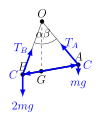
A light rod of length \(2a\) is hung from a point \(O\) by two light inextensible strings \(OA\) and \(OB\) each of length \(b\) and each fixed at \(O\). A particle of mass \(m\) is attached to the end \(A\) and a particle of mass \(2m\) is attached to the end \(B.\) Show that, in equilibrium, the angle \(\theta\) that the rod makes the horizontal satisfies the equation \[ \tan\theta=\frac{a}{3\sqrt{b^{2}-a^{2}}}. \] Express the tension in the string \(AO\) in terms of \(m,g,a\) and \(b\).
Solution:

1994 Paper 2 Q10
A truck is towing a trailer of mass \(m\) across level ground by means of an elastic rope of natural length \(l\) whose modulus of elasticity is \(\lambda.\) At first the rope is slack and the trailer stationary. The truck then accelerates until the rope becomes taut and thereafter the truck travels in a straight line at a constant speed \(u\). Assuming that the effect of friction on the trailer is negligible, show that the trailer will collide with the truck at a time \[ \pi\left(\frac{lm}{\lambda}\right)^{\frac{1}{2}}+\frac{l}{u} \] after the rope first becomes taut.
1994 Paper 2 Q11
As part of a firework display a shell is fired vertically upwards with velocity \(v\) from a point on a level stretch of ground. When it reaches the top of its trajectory an explosion it splits into two equal fragments each travelling at speed \(u\) but (since momentum is conserved) in exactly opposite (not necessarily horizontal) directions. Show, neglecting air resistance, that the greatest possible distance between the points where the two fragments hit the ground is \(2uv/g\) if \(u\leqslant v\) and \((u^{2}+v^{2})/g\) if \(v\leqslant u.\)
Solution: Since \(v^2 - u^2 = 2as\) we have the initial height reached is \(\frac{v^2}{2g}\). At the point of explosion, the velocities are \(\pm \binom{u \cos \theta}{u \sin \theta}\) where \(0 \leq \theta < \frac{\pi}{2}\). Looking vertically: \begin{align*} && -\frac{v^2}{2g} &= \pm u \sin \theta t - \frac12gt^2 \\ \Rightarrow && t &= \frac{\mp u \sin \theta \pm \sqrt{u^2 \sin^2 \theta - 4 \cdot \left (-\frac12 g \right) \cdot (\frac{v^2}{2g})}}{2(-\frac12g)} \\ &&&= \frac{\pm u \sin \theta \mp \sqrt{u^2 \sin^2 \theta+v^2}}{g}\\ &&&= \frac{\pm u \sin \theta +\sqrt{u^2 \sin^2 \theta+v^2}}{g} \end{align*} Since we always want the positive \(t\). Then the horizontal distance travelled will be \begin{align*} && s &= u \cos \theta (t_1 + t_2) \\ &&&= u \cos \theta \frac{2\sqrt{u^2 \sin^2 \theta+v^2}}{g} \\ &&&= \frac{2u \cos \theta \sqrt{u^2 \sin^2 \theta + v^2}}{g} \\ &&s^2 &= \frac{4u^2}{g^2} \cos^2 \theta ({u^2 \sin^2 \theta + v^2}) \\ &&&= \frac{4u^2}{g^2} \left (-u^2\cos^4 \theta + (v^2+u^2)\cos^2 \theta \right) \\ &&&= \frac{4u^2}{g^2} \left (-u^2\left ( \cos^2 \theta - \frac{v^2+u^2}{2u^2}\right)^2 + \frac{(v^2+u^2)^2}{4u^2} \right) \\ &&&= \frac{(v^2+u^2)^2}{g^2} - \frac{4u^4}{g^2}\left ( \cos^2 \theta - \frac{v^2+u^2}{2u^2}\right)^2 \end{align*} If \(u \geq v\) then such a \(\theta\) exists such that we can achieve the maximum, ie \(s = \frac{v^2+u^2}{g}\). If not, then we will achieve our maximum when \(\cos \theta = 1\), ie \(\sin \theta = 0\) and \(s = \frac{2uv}{g}\)
1994 Paper 2 Q12
Calamity Jane sits down to play the game of craps with Buffalo Bill. In this game she rolls two fair dice. If, on the first throw, the sum of the dice is \(2,3\) or \(12\) she loses, while if it is \(7\) or \(11\) she wins. Otherwise Calamity continues to roll the dice until either the first sum is repeated, in which case she wins, or the sum is \(7\), in which case she loses. Find the probability that she wins on the first throw. Given that she throws more than once, show that the probability that she wins on the \(n\)th throw is \[ \frac{1}{48}\left(\frac{3}{4}\right)^{n-2}+\frac{1}{27}\left(\frac{13}{18}\right)^{n-2}+\frac{25}{432}\left(\frac{25}{36}\right)^{n-2}. \] Given that she throws more than \(m\) times, where \(m>1,\) what is the probability that she wins on the \(n\)th throw?
1994 Paper 2 Q13
The makers of Cruncho (`The Cereal Which Cares') are giving away a series of cards depicting \(n\) great mathematicians. Each packet of Cruncho contains one picture chosen at random. Show that when I have collected \(r\) different cards the expected number of packets I must open to find a new card is \(n/(n-r)\) where \(0\leqslant r\leqslant n-1.\) Show by means of a diagram, or otherwise, that \[ \frac{1}{r+1}\leqslant\int_{r}^{r+1}\frac{1}{x}\,\mathrm{d}x\leqslant\frac{1}{r} \] and deduce that \[ \sum_{r=2}^{n}\frac{1}{r}\leqslant\ln n\leqslant\sum_{r=1}^{n-1}\frac{1}{r} \] for all \(n\geqslant2.\) My children will give me no peace until we have the complete set of cards, but I am the only person in our household prepared to eat Cruncho and my spouse will only buy the stuff if I eat it. If \(n\) is large, roughly how many packets must I expect to consume before we have the set?
1994 Paper 2 Q14
When Septimus Moneybags throws darts at a dart board they are certain to end on the board (a disc of radius \(a\)) but, it must be admitted, otherwise are uniformly randomly distributed over the board.
- Show that the distance \(R\) that his shot lands from the centre of the board is a random variable with variance \(a^{2}/18.\)
- At a charity fete he can buy \(m\) throws for \(\pounds(12+m)\), but he must choose \(m\) before he starts to throw. If at least one of his throws lands with \(a/\sqrt{10}\) of the centre he wins back \(\pounds 12\). In order to show that a good sport he is, he is determined to play but, being a careful man, he wishes to choose \(m\) so as to minimise his expected loss. What values of \(m\) should he choose?
Solution:
- \(\,\) \begin{align*} && \mathbb{P}(R < d) &= \frac{\pi d^2}{\pi a^2} \\ &&&= \frac{d^2}{a^2} \\ \Rightarrow && f_R(d) &= \frac{2d}{a^2}\\ \\ && \E[R] &= \int_0^a x \cdot f_R(x) \d x \\ &&&= \int_0^a \frac{2x^2}{a^2} \d x \\ &&&= \frac{2a}{3} \\ \\ && \E[R^2] &= \int_0^a x^2 \cdot f_R(x) \d x \\ &&&= \int_0^a \frac{2x^3}{a^2} \d x \\ &&&= \frac{a^2}{2} \\ \Rightarrow && \var[R] &= \frac{a^2}2 - \frac{4a^2}{9} \\ &&7= \frac{a^2}{18} \end{align*}
- Let \(p = \mathbb{P}(R < \frac{a}{\sqrt{10}}) = \frac{a^2}{10a^2} = \frac{1}{10}\) be the probability of hitting the target on each throw. His expected loss is \((12+m)p^m + m(1-p^m) = 12p^m + m\). \begin{array}{c|c} m & \text{expected loss} \\ \hline 0 & 12 \\ 1 & \frac{12}{10} + 1 \approx 2.2 \\ 2 & \frac{12}{100} + 2 \approx 2.12 \\ \end{array} If he takes more than \(2\) throws it will definitely cost more than \(3\), therefore he should take exactly \(2\) throws.