Problems
Filters
1531 problems found
1989 Paper 3 Q7
The linear transformation \(\mathrm{T}\) is a shear which transforms a point \(P\) to the point \(P'\) defined by
- \(\overrightarrow{PP'}\) makes an acute angle \(\alpha\) (anticlockwise) with the \(x\)-axis,
- \(\angle POP'\) is clockwise (i.e. the rotation from \(OP\) to \(OP'\) clockwise is less than \(\pi),\)
- \(PP'=k\times PN,\) where \(PN\) is the perpendicular onto the line \(y=x\tan\alpha,\) where \(k\) is a given non-zero constant.
Solution:

1989 Paper 3 Q8
Given that \[ \frac{\mathrm{d}x}{\mathrm{d}t}=4(x-y)\qquad\mbox{ and }\qquad\frac{\mathrm{d}y}{\mathrm{d}t}=x-12(\mathrm{e}^{2t}+\mathrm{e}^{-2t}), \] obtain a differential equation for \(x\) which does not contain \(y\). Hence, or otherwise, find \(x\) and \(y\) in terms of \(t\) given that \(x=y=0\) when \(t=0\).
Solution: \begin{align*} && \frac{\d x}{\d t} &= 4(x-y) \\ && \frac{\d y}{\d t} &= x - 12(e^{2t}+e^{-2t}) \\ \Rightarrow && \frac{\d^2 x}{\d t^2} &= 4 \frac{\d x}{\d t}-4\frac{\d y}{\d t} \\ &&&= 4 \frac{\d x}{\d t}-4 \left ( x - 12(e^{2t}+e^{-2t}) \right) \\ \Rightarrow && \frac{\d^2 x}{\d t^2} - 4 \frac{\d x}{\d t}+4x &= 48 (e^{2t}+e^{-2t}) \end{align*} This differential equation has characteristic polynomial \(\lambda^2 - 4\lambda + 4 = (\lambda-2)^2\). Therefore we should expect a general solution of \((At+B)e^{2t}\). For particular integrals we should try \(ke^{-2t}\) and \(Ct^2 e^{2t}\). For the former, we have: \begin{align*} && 48 &= 4k+8k+k \\ \Rightarrow && k &= \frac{48}{13} \end{align*} For the latter we have: \begin{align*} &&4Ct^2e^{2t} -4C(2te^{2t}+2t^2e^{2t})+2C((1+2t)e^{2t}+2t^2e^{2t}) &= 48e^{2t} \\ \Rightarrow && 2C &= 48 \\ \Rightarrow && C &= 24 \end{align*} Therefore the solution should be: \begin{align*} x = (At+B)e^{2t} + \frac{48}{13}e^{-2t} + 24t^2 e^{2t} \\ x(0) = B + \frac{48}{13} \\ x'(0) = 2B+A-\frac{96}{13} \\ x =\frac{48}{13}((4t-1)e^{2t}+e^{-2t})+24t^2e^{2t} \\ y = x - \frac{1}{4} \frac{\d x}{\d t} \end{align*}
1989 Paper 3 Q9
Obtain the sum to infinity of each of the following series.
- \(1{\displaystyle +\frac{2}{2}+\frac{3}{2^{2}}+\frac{4}{2^{3}}+\cdots+\frac{r}{2^{r-1}}+\cdots;}\)
- \(1{\displaystyle +\frac{1}{2}\times\frac{1}{2}+\frac{1}{3}\times\frac{1}{2^{2}}+\cdots+\frac{1}{r}\times\frac{1}{2^{r-1}}+\cdots;}\)
- \({\displaystyle \dfrac{1\times3}{2!}\times\frac{1}{3}+\frac{1\times3\times5}{3!}\frac{1}{3^{2}}+\cdots+\frac{1\times3\times\cdots\times(2k-1)}{k!}\times\frac{1}{3^{k-1}}+\cdots.}\)
Solution:
- \begin{align*} && \frac1{1-x} &= \sum_{r=0}^{\infty} x^r \\ \underbrace{\Rightarrow}_{\frac{\d}{\d x}} && \frac{1}{(1-x)^2} &= \sum_{r=0}^\infty rx^{r-1} \\ \underbrace{\Rightarrow}_{x = \frac12} && 4 &= \sum_{r=0}^{\infty} \frac{r}{2^{r-1}} \end{align*}
- \begin{align*} && \frac1{1-x} &= \sum_{r=1}^{\infty} x^{r-1} \\ \underbrace{\Rightarrow}_{\int} && -\ln (1-x) &= \sum_{r=1}^{\infty} \frac1{r} x^r \\ \underbrace{\Rightarrow}_{x = \frac12} && \ln 2 &= \sum_{r=1}^{\infty} \frac1{r } \times \frac{1}{ 2^{r}} \\ \Rightarrow && 2 \ln 2 &= \sum_{r=1}^{\infty} \frac1{r } \times \frac{1}{ 2^{r-1}} \\ \end{align*}
- \begin{align*} && (1-x)^{-1/2} &= 1 + \frac{(-\tfrac12)}{1!} (-x) +\frac{(-\tfrac12)(-\tfrac32)}{2!}(-x)^2 + \cdots \\ &&&= \sum_{r=0}^{\infty} \frac{1 \cdot 3 \cdot 5 \cdots \cdot (2r-1)}{2^rr!} x^r \\ \underbrace{\Rightarrow}_{x = \frac23} && \sqrt{3} &= \sum_{r=0}^{\infty} \frac{1 \cdot 3 \cdot 5 \cdots \cdot (2r-1)}{r!} \frac1{3^r} \\ &&&= 1 + \frac{1}{1!} \frac23 + \frac13 \sum_{r=2}^{\infty} \frac{1 \cdot 3 \cdot 5 \cdots \cdot (2r-1)}{r!} \frac1{3^{r-1}} \\ \Rightarrow && 3\sqrt{3}-5 &= \sum_{r=2}^{\infty} \frac{1 \cdot 3 \cdot 5 \cdots \cdot (2r-1)}{r!} \frac1{3^{r-1}} \\ \end{align*}
1989 Paper 3 Q10
- Prove that \[ \sum_{r=1}^{n}r(r+1)(r+2)(r+3)(r+4)=\tfrac{1}{6}n(n+1)(n+2)(n+3)(n+4)(n+5) \] and deduce that \[ \sum_{r=1}^{n}r^{5}<\tfrac{1}{6}n(n+1)(n+2)(n+3)(n+4)(n+5). \]
- Prove that, if \(n>1,\) \[ \sum_{r=0}^{n-1}r^{5}>\tfrac{1}{6}(n-5)(n-4)(n-3)(n-2)(n-1)n. \]
- Let \(\mathrm{f}\) be an increasing function. If the limits \[ \lim_{n\rightarrow\infty}\sum_{r=0}^{n-1}\frac{a}{n}\mathrm{f}\left(\frac{ra}{n}\right)\qquad\mbox{ and }\qquad\lim_{n\rightarrow\infty}\sum_{r=1}^{n}\frac{a}{n}\mathrm{f}\left(\frac{ra}{n}\right) \] both exist and are equal, the definite integral \({\displaystyle \int_{0}^{a}\mathrm{f}(x)\,\mathrm{d}x}\) is defined to be their common value. Using this definition, prove that \[ \int_{0}^{a}x^{5}\,\mathrm{d}x=\tfrac{1}{6}a^6. \]
Solution:
- Claim: \[ \sum_{r=1}^{n}r(r+1)(r+2)(r+3)(r+4)=\tfrac{1}{6}n(n+1)(n+2)(n+3)(n+4)(n+5) \] Proof: (By Induction) Base case: (n=1) \begin{align*} LHS &= 1 \cdot 2 \cdot 3 \cdot 4 \cdot 5 = 5! \\ RHS &= \frac16 1 \cdot 2 \cdot 3 \cdot 4 \cdot 5 \cdot 6 = 5! \end{align*} Therefore the base case is true. Inductive step: Suppose our statement is true for some \(n=k\), then consider \(n = k+1\) \begin{align*} \sum_{r=1}^{k+1} r(r+1)(r+2)(r+3)(r+4) &= \sum_{r=1}^{k} r(r+1)(r+2)(r+3)(r+4) + (k+1)(k+2)(k+3)(k+4)(k+5) \\ &\underbrace{=}_{\text{assumption}} \frac16 k(k+1)(k+2)(k+3)(k+4)(k+5) + (k+1)(k+2)(k+3)(k+4)(k+5) \\ &= (k+1)(k+2)(k+3)(k+4)(k+5) \l \frac{k}{6} +1\r \\ &= \frac16 (k+1)(k+2)(k+3)(k+4)(k+5)(k+6) \end{align*} Therefore our statement is true for \(n = k+1\). Therefore since our statement is true for \(n=1\) and if it is true for \(n=k\) then it is true for \(n = k+1\) by the principle of mathematical induction it is true for all \(n \geq 1\) Since \begin{align*} \sum_{r=1}^{n}r^5 &< \sum_{r=1}^{n}r(r+1)(r+2)(r+3)(r+4) \\ &= \frac16 n(n+1)(n+2)(n+3)(n+4)(n+5) \end{align*}
- \begin{align*}\sum_{r=0}^{n-1} r^5 &> \sum_{r=0}^{n-1} (r-4)(r-3)(r-2)(r-1)r \\ &= \sum_{r=0}^{n-5} r(r+1)(r+2)(r+3)(r+4) \\ &= \frac16 (n-5)(n-4)(n-3)(n-2)(n-1)n \end{align*}
- Let \(f(x) = x^5\) \begin{align*} S_{1,n} &= \sum_{r=0}^{n-1}\frac{a}{n}f\left(\frac{ra}{n}\right) \\ &= \sum_{r=0}^{n-1}\frac{a}{n}\left(\frac{ra}{n}\right)^5 \\ &=\frac{a^6}{n^6} \sum_{r=0}^{n-1}r^5\\ \end{align*} Therefore \(\frac{a^6}6 \frac{(n-5)(n-4)(n-3)(n-2)(n-1)n}{n^6} < S_{1,n} < \frac{a^6}6 \frac{(n-1)n(n+1)(n+2)(n+3)(n+4)}{n^6}\) and so \(\lim_{n\to\infty} S_{1,n} = \frac{a^6}{6}\). Similarly, \begin{align*} S_{2,n} &= \sum_{r=1}^{n}\frac{a}{n}f\left(\frac{ra}{n}\right) \\ &= \sum_{r=1}^{n}\frac{a}{n}\left(\frac{ra}{n}\right)^5 \\ &= \frac{a^6}{n^6} \sum_{r=1}^{n} r^5 \end{align*} Therefore \(\frac{a^6}6 \frac{(n-4)(n-3)(n-2)(n-1)n(n+1)}{n^6} < S_{2,n} < \frac{a^6}6 \frac{n(n+1)(n+2)(n+3)(n+4)(n+5)}{n^6}\) and so \(\lim_{n\to\infty} S_{2,n} = \frac{a^6}{6}\). Since both limits exist are are equal, we have \[ \int_{0}^{a}x^{5}\,\mathrm{d}x=\tfrac{1}{6}a^6. \]
1989 Paper 3 Q11
A smooth uniform sphere, with centre \(A\), radius \(2a\) and mass \(3m,\) is suspended from a fixed point \(O\) by means of a light inextensible string, of length \(3a,\) attached to its surface at \(C\). A second smooth unifom sphere, with centre \(B,\) radius \(3a\) and mass \(25m,\) is held with its surface touching \(O\) and with \(OB\) horizontal. The second sphere is released from rest, falls and strikes the first sphere. The coefficient of restitution between the spheres is \(3/4.\) Find the speed \(U\) of \(A\) immediately after the impact in terms of the speed \(V\) of \(B\) immediately before impact. The same system is now set up with a light rigid rod replacing the string and rigidly attached to the sphere so that \(OCA\) is a straight line. The rod can turn freely about \(O\). The sphere with centre \(B\) is dropped as before. Show that the speed of \(A\) immediately after impact is \(125U/127.\)
1989 Paper 3 Q12
A smooth horizontal plane rotates with constant angular velocity \(\Omega\) about a fixed vertical axis through a fixed point \(O\) of the plane. The point \(A\) is fixed in the plane and \(OA=a.\) A particle \(P\) lies on the plane and is joined to \(A\) by a light rod of length \(b(>a)\) freely pivoted at \(A\). Initially \(OAP\) is a straight line and \(P\) is moving with speed \((a+2\sqrt{ab})\Omega\) perpendicular to \(OP\) in the same sense as \(\Omega.\) At time \(t,\) \(AP\) makes an angle \(\phi\) with \(OA\) produced. Obtain an expression for the component of the acceleration of \(P\) perpendicular to \(AP\) in terms of \(\dfrac{\mathrm{d}^{2}\phi}{\mathrm{d}t^{2}},\phi,a,b\) and \(\Omega.\) Hence find \(\dfrac{\mathrm{d}\phi}{\mathrm{d}t}\), in terms of \(\phi,a,b\) and \(\Omega,\) and show that \(P\) never crosses \(OA.\)
Solution: Set up coordinate axes so that at time \(t\) \(OA\) is the \(x\)-axis, and all rotations are counter-clockwise. Then if \(OA = \mathbf{a}\), \(AP = \mathbf{x}\) and \(OP = \mathbf{p}\) we have: \begin{align*} \mathbf{a} &= \binom{a}{0} \\ \dot{\mathbf{a}} &= \binom{0}{-a \Omega} \\ \ddot{\mathbf{a}} &= \binom{-a \Omega^2}{0} \\ \\ \mathbf{x} &= \binom{b \cos \phi }{b \sin \phi } \\ \dot{\mathbf{x}} &= b \dot{\phi} \binom{-\sin \phi}{\cos \phi} \\ \ddot{\mathbf{x}} &= \binom{-b \ddot{\phi} \sin \phi-b \dot{\phi}^2 \cos \phi }{b \ddot{\phi} \cos \phi-b \dot{\phi}^2 \sin \phi} \\ \\ \ddot{\mathbf{p}} &= \binom{-a \Omega^2 +-b \ddot{\phi} \sin \phi-b \dot{\phi}^2 \cos \phi }{b \ddot{\phi} \cos \phi-b \dot{\phi}^2 \sin \phi} \end{align*} We can take a dot product with \(\mathbf{n} = \binom{-\sin \phi}{\cos \phi}\) to obtain the component perpendicular to \(AP\), which is: \begin{align*} && \binom{-\sin \phi}{\cos \phi} \cdot \ddot{x} &= a \Omega^2 \sin \phi + b \ddot{\phi} \end{align*} Noticing that this component must be \(0\) (since the only force acting on \(P\) is the rod), this must be equal to zero. \begin{align*} && 0 &= a \Omega^2 \sin \phi + b \ddot{\phi} \\ \Rightarrow && 0 &= a \Omega^2 \dot{\phi} \sin \phi + b\dot{\phi} \ddot{\phi} \\ \Rightarrow && C &= -a \Omega^2 \cos \phi + \tfrac12 b \dot{\phi}^2 \end{align*} Noticing that the initial conditions are \(\phi = 0\) and \(\dot{\phi} = 2\sqrt{\frac{a}{b}} \Omega\), so \begin{align*} && C &= -a \Omega^2+ \tfrac12 b \left ( 2\sqrt{\frac{a}{b}} \Omega \right)^2 \\ &&&= -a \Omega^2 + 2a \Omega^2 \\ &&&= a \Omega^2\\ \Rightarrow && \dot{\phi} &=\sqrt{\frac{2}{b} \left ( a \Omega^2 + a \Omega^2 \cos \phi \right)} \\ &&&= \Omega \sqrt{\frac{2a}{b}} \sqrt{1+ \cos \phi} \\ &&& = \Omega \sqrt{\frac{2a}{b}}\sqrt{2} \cos \tfrac{\phi}{2} \\ \Rightarrow && \int \sec \tfrac{\phi}{2} \d \phi &= 2 \Omega \sqrt{\frac{a}{b}}t \\ \Rightarrow && \tfrac12 \ln | \sec \tfrac{\phi}{2}+\tan \tfrac{\phi}{2} | &= 2 \Omega \sqrt{\frac{a}{b}}t + C \\ t = 0, \phi = 0: && C = 0 \\ \Rightarrow && \sec \tfrac{\phi}{2}+\tan \tfrac{\phi}{2} &= e^{4 \Omega \sqrt{\frac{a}{b}}t} \end{align*} Since when \(t > 0\) this is positive and larger than \(1\) we cannot have \(\phi = 0\) and since it remains below infinite \(\phi\) cannot reach \(\pi\). Therefore it cannot cross \(OA\)
1989 Paper 3 Q13
The points \(A,B,C,D\) and \(E\) lie on a thin smooth horizontal table and are equally spaced on a circle with centre \(O\) and radius \(a\). At each of these points there is a small smooth hole in the table. Five elastic strings are threaded through the holes, one end of each beging attached at \(O\) under the table and the other end of each being attached to a particle \(P\) of mass \(m\) on top of the table. Each of the string has natural length \(a\) and modulus of elasticity \(\lambda.\) If \(P\) is displaced from \(O\) to any point \(F\) on the table and released from rest, show that \(P\) moves with simple harmonic motion of period \(T\), where \[ T=2\pi\sqrt{\frac{am}{5\lambda}}. \] The string \(PAO\) is replaced by one of natural length \(a\) and modulus \(k\lambda.\) \(P\) is displaced along \(OA\) from its equilibrium position and released. Show that \(P\) still moves in a straight line with simple harmonic motion, and, given that the period is \(T/2,\) find \(k\).
Solution:

1989 Paper 3 Q14
- A solid circular disc has radius \(a\) and mass \(m.\) The density is proportional to the distance from the centre \(O\). Show that the moment of inertia about an axis through \(C\) perpendicular to the plane of the disc is \(\frac{3}{5}ma^{2}.\)
- A light inelastic string has one end fixed at \(A\). It passes under and supports a smooth pulley \(B\) of mass \(m.\) It then passes over a rough pulley \(C\) which is a disc of the type described in (i), free to turn about its axis which is fixed and horizontal. The string carries a particle \(D\) of mass \(M\) at its other end. The sections of the string which are not in contact with the pulleys are vertical. The system is released from rest and moves under gravity for \(t\) seconds. At the end of this interval the pulley \(B\) is suddenly stopped. Given that \(m<2M\), find the resulting impulse on \(D\) in terms of \(m,M,g\) and \(t\). {[}You may assume that the string is long enough for there to be no collisions between the elements of the system, and that the pulley \(C\) is rough enough to prevent slipping throughout.{]}
Solution:
- \begin{align*} m &= \int_0^a \underbrace{(\rho r)}_{\text{mass per area}} \underbrace{\pi r^2}_{\text{area}} \d r \\ &= \rho \pi \frac{a^3}{3} \\ \\ I &= \sum m r^2 \\ &= \sum (\rho r) \pi r^2 \cdot r^2 \\ &\to \int_0^a \rho \pi r^4 \\ &= \frac15 \rho \pi a^5 \\ &= \frac35 m a^2 \end{align*}
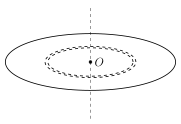
- \begin{align*} \text{N2}(\downarrow, D): && Mg -T_C &= Mf \\ \overset{\curvearrowright}{C} && (T_C - T_B)a &= I \frac{f}{a} \\ &&&= \frac35 m a f \\ \text{N2}(\uparrow, B): && 2T_B-mg &= \frac12 m f \\ \\ \Rightarrow && Mg-T_B &= \left (M + \frac35 m \right)f \\ \Rightarrow && Mg - \frac12 mg &= \left (M + \frac35 m + \frac14 m \right)f \\ \Rightarrow && f &= \frac{(M-\frac12 m)g}{M + \frac{17}{20} m} \\ &&&= \frac{(2M-m)g}{2M +\frac{17}{10}m} \end{align*} Therefore the speed after a time \(t\) is \(\displaystyle \frac{(2M-m)g}{2M +\frac{17}{10}m} t\) and the impulse will be the change in momentum, ie \(\displaystyle \frac{(2M-m)g}{2M +\frac{17}{10}m} Mt\)

1989 Paper 3 Q15
The continuous random variable \(X\) is uniformly distributed over the interval \([-c,c].\) Write down expressions for the probabilities that:
- \(n\) independently selected values of \(X\) are all greater than \(k\),
- \(n\) independently selected values of \(X\) are all less than \(k\),
Solution:
- \begin{align*} \mathbb{P}(n\text{ independent values of }X > k) &= \prod_{i=1}^n \mathbb{P}(X > k) \\ &= \left ( \frac{c-k}{2c}\right)^n \end{align*}
- \begin{align*} \mathbb{P}(n\text{ independent values of }X < k) &= \prod_{i=1}^n \mathbb{P}(X < k) \\ &= \left ( \frac{k+c}{2c}\right)^n \end{align*}
1989 Paper 3 Q16
It is believed that the population of Ruritania can be described as follows:
- \(25\%\) are fair-haired and the rest are dark-haired;
- \(20\%\) are green-eyed and the rest hazel-eyed;
- the population can also be divided into narrow-headed and broad-headed;
- no narrow-headed person has green eyes and fair hair;
- those who are green-eyed are as likely to be narrow-headed as broad-headed;
- those who are green-eyed and broad-headed are as likely to be fair-headed as dark-haired;
- half of the population is broad-headed and dark-haired;
- a hazel-eyed person is as likely to be fair-haired and broad-headed as dark-haired and narrow-headed.
Solution:


1988 Paper 1 Q1
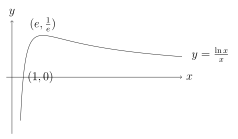
Sketch the graph of the function \(\mathrm{h}\), where \[ \mathrm{h}(x)=\frac{\ln x}{x},\qquad(x>0). \] Hence, or otherwise, find all pairs of distinct positive integers \(m\) and \(n\) which satisfy the equation \[ n^{m}=m^{n}. \]
Solution:
1988 Paper 1 Q2
The function \(\mathrm{f}\) and \(\mathrm{g}\) are related (for all real \(x\)) by \[ \mathrm{g}(x)=\mathrm{f}(x)+\frac{1}{\mathrm{f}(x)}\,. \] Express \(\mathrm{g}'(x)\) and \(\mathrm{g}''(x)\) in terms of \(\mathrm{f}(x)\) and its derivatives. If \(\mathrm{f}(x)=4+\cos2x+2\sin x\), find the stationary points of \(\mathrm{g}\) for \(0\leqslant x\leqslant2\pi,\) and determine which are maxima and which are minima.
Solution: \(g'(x) = f'(x) - \frac{f'(x)}{(f(x))^2} = f'(x) \l 1 - \frac{1}{(f(x))^2} \r\) \(g''(x) = f''(x) - \frac{f''(x)f(x)^2-f'(x)\cdot 2f(x) f'(x)}{(f(x))^4} = f''(x) + \frac{f''(x)f(x)-2(f'(x))^2}{(f(x))^3}\) \begin{align*} f(x) &=4+\cos2x+2\sin x \\ f'(x) &=-2\sin2x+2\cos x \\ f''(x) &= -4\cos2x-2\sin x \end{align*} Therefore, since the stationary points of \(g\), ie points where \(g'(x) = 0\) are where \(f'(x) = 0\) or \(f(x) = \pm 1\) we should look at \begin{align*} && 0 &= f'(x) \\ && 0 &= 2 \cos x - 2 \sin 2x \\ &&&= 2 \cos x - 4 \sin x \cos x \\ &&&= 2\cos x (1 - 2 \sin x) \\ \Rightarrow && x &= \frac{\pi}2, \frac{3\pi}{2}, \frac{\pi}{6}, \frac{5\pi}{6} \end{align*} \begin{align*} && 1 &= f(x) \\ && 1 &= 4 + \cos 2x + 2 \sin x \\ \Rightarrow && \cos 2x = -1,& \sin x = -1 \\ \Rightarrow && x &= \frac{3\pi}{2} \end{align*} which we were already checking. For each of these points we have: \begin{array}{c|c|c|c||c} x & f(x) & f'(x) & f''(x) & g''(x) \\ \hline \frac{\pi}{2} & 5 & 0 & 2 & > 0\\ \frac{3\pi}{2} & 1 & 0 & 6 &> 0\\ \frac{\pi}{6} & 5.5 & 0 & -3 & < 0 \\ \frac{5\pi}{6} & 5.5 & 0 & -3 & < 0\\ \end{array} Therefore \(\frac{\pi}{2}, \frac{3\pi}{2}\) are minimums and \(\frac{\pi}{6}\) and \(\frac{5\pi}{6}\) are maxima.
1988 Paper 1 Q3
Two points \(P\) and \(Q\) lie within, or on the boundary of, a square of side 1cm, one corner of which is the point \(O\). Show that the length of at least one of the lines \(OP,PQ\) and \(QO\) must be less than or equal to \((\sqrt{6}-\sqrt{2})\) cm.
Solution: First note that \((\sqrt{6} - \sqrt{2})^2 = 8 - 2\sqrt{12} = 8 - 4\sqrt{3}\) and since \(49 > 16 \times 3\) \(\sqrt{6}-\sqrt{2} > 1\). Therefore we can assume without loss of generality that \(P\) and \(Q\) both do not lie on the same side as each other, a side containing \(O\), otherwise one of those lengths would be \(1 \text{ cm} < (\sqrt{6}-\sqrt{2}) \text{ cm} \). Let \(O = (0,0)\), \(P = (1,x)\), \(Q = (y,1)\), then our lengths squared are: \(1 + x^2, 1 + y^2, (1-x)^2+(1-y)^2\). To maximise the length of the smallest side, each side should be equal in length (otherwise we could increase the length of the smallest side by moving the point between the shortest side and the longest side (without affecting the other side). Therefore \(x = y\) and \(1+x^2 = 2(1-x)^2 \Rightarrow x^2-4x+1 = 0 \Rightarrow x = 2 - \sqrt{3} \). Therefore the distances are all \(\sqrt{1+7-4\sqrt{3}} = \sqrt{8-4\sqrt{3}} = (\sqrt{6}-\sqrt{2}) \text{ cm}\)
1988 Paper 1 Q4
Each of \(m\) distinct points on the positive \(y\)-axis is joined by a line segment to each of \(n\) distinct points on the positive \(x\)-axis. Except at the endpoints, no three of these segments meet in a single point. Derive formulae for \begin{questionparts} \item the number of such line segments; \item the number of points of intersections of the segments, ignoring intersections at the endpoints of the segments. \end{questionpart} If \(m=n\geqslant3,\) and the two segments with the greatest number of points of intersection, and the two segments with the least number of points of intersection, are excluded, prove that the average number of points of intersection per segment on the remaining segments is \[ \frac{n^{3}-7n+2}{4(n+2)}\,. \]
Solution:
- There are \(m \cdot n\) line segments, since each of the \(m\) points on the \(y\)-axis correspond to \(n\) points of the \(x\)-axis.
- Every pair of points on the \(x\)-axis and pair of points on the \(y\) axis will generate \(4\) lines, but only \(1\) of those points will meet in the middle, therefore there will be \(\binom{m}{2} \binom{n}{2}\) intersections.
1988 Paper 1 Q5
Given that \(b>a>0\), find, by using the binomial theorem, coefficients \(c_{m}\) (\(m=0,1,2,\ldots\)) such that \[ \frac{1}{\left(1-ax\right)\left(1-bx\right)}=c_{0}+c_{1}x+c_{2}x^{2}+\ldots+c_{m}x^{m}+\cdots \] for \(b\left|x\right|<1\). Show that \[ c_{m}^{2}=\frac{a^{2m+2}-2(ab)^{m+1}+b^{2m+2}}{(a-b)^{2}}\,. \] Hence, or otherwise, show that \[ c_{0}^{2}+c_{1}^{2}x+c_{2}^{2}x^{2}+\cdots+c_{m}^{2}x^{m}+\cdots=\frac{1+abx}{\left(1-abx\right)\left(1-a^{2}x\right)\left(1-b^{2}x\right)}\,, \] for \(x\) in a suitable interval which you should determine.
Solution: \begin{align*} \frac{1}{(1-ax)(1-bx)} &=\frac{1}{b-a} \l \frac{b}{1-bx}-\frac{a}{1-ax}\r \\ &= \frac{1}{b-a} \l \sum_{k=0}^{\infty} b(bx)^k-\sum_{k=0}^{\infty} a(ax)^k \r \\ &= \frac{1}{b-a} \sum_{k=0}^{\infty} \l b^{k+1} - a^{k+1} \r x^k \end{align*} Therefore \(\displaystyle c_m = \frac{b^{k+1}-a^{k+1}}{b-a}\). \begin{align*} c_m^2 &= \frac{(b^{m+1}-a^{m+1})^2}{(b-a)^2} \\ &= \frac{a^{2m+2} - 2(ab)^{m+1} + b^{2m+2}}{(b-a)^2} \end{align*} \begin{align*} \sum_{m=0}^{\infty} c_m x^m &= \sum_{m=0}^{\infty} \l \frac{a^{2m+2} - 2(ab)^{m+1} + b^{2m+2}}{(b-a)^2} \r x^m \\ &= \frac{1}{(b-a)^2} \l \sum_{m=0}^{\infty} a^{2m+2} x^m-2\sum_{m=0}^{\infty} (ab)^{m+1} x^m+\sum_{m=0}^{\infty} b^{2m+2} x^m \r \\ &= \frac{1}{(b-a)^2} \l a^2\sum_{m=0}^{\infty} a^{2m} x^m-2ab\sum_{m=0}^{\infty} (ab)^{m} x^m+b^2\sum_{m=0}^{\infty} b^{2m} x^m \r \\ &= \frac{1}{(b-a)^2} \l \frac{a^2}{1-a^2x^2} - \frac{2ab}{1-abx} + \frac{b^2}{1-b^2x^2}\r \\ &= \frac{1+ab}{(1-a^2x)(1-abx)(1-b^2x)} \end{align*} Where geometric series will converge if \(|a^2x| < 1, |b^2x| < 1, |abx| < 1\), ie \(|x| < \min (\frac{1}{a^2}, \frac{1}{b^2} )\)