Problems
Filters
1531 problems found
1989 Paper 2 Q8
Let \(\Omega=\exp(\mathrm{i}\pi/3).\) Prove that \(\Omega^{2}-\Omega+1=0.\) Two transformations, \(R\) and \(T\), of the complex plane are defined by \[ R:z\longmapsto\Omega^{2}z\qquad\mbox{ and }\qquad T:z\longmapsto\dfrac{\Omega z+\Omega^{2}}{2\Omega^{2}z+1}. \] Verify that each of \(R\) and \(T\) permute the four point \(z_{0}=0,\) \(z_{1}=1,\) \(z_{2}=\Omega^{2}\) and \(z_{3}=-\Omega.\) Explain, without explicitly producing a group multiplication table, why the smallest group of transformations which contains elements \(R\) and \(T\) has order at least 12. Are there any permutations of these points which cannot be produced by repeated combinations of \(R\) and \(T\)?
Solution: \(R(0) = 0\), \(R(1) = \Omega^2 1 = \Omega^2\), \(R(\Omega^2) = \Omega^4 = -\Omega\), \(R(-\Omega) = -\Omega^3 = 1\) \(T(0) = \frac{\Omega^2}1 = \Omega^2\), \(T(1) = \frac{\Omega + \Omega^2}{2\Omega^2+1} = \frac{2\Omega - 1}{2\Omega-1} = 1\) \(T(\Omega^2) = \frac{\Omega^3 + \Omega^2}{2\Omega^4+1} = \Omega \frac{\Omega^2+\Omega}{-2\Omega+1} = \Omega \frac{2\Omega-1}{-2\Omega+1} = - \Omega\) \(T(-\Omega) = \frac{-\Omega^2 + \Omega^2}{-2\Omega^3+1} = \frac{0}{3} = 0\) Thinking of \(R\) and \(S\) as elements of \(S_4\), we have that \(R = (234), S = (134)\), we can also construct \(RS = (14)(23), R^2S = (12)(34), RSR^2S = (13)(24)\). Therefore we have the subgroups \(\{e, (234), (243)\}\) of order \(3\) and the subgroup \(\{e, (12)(34), (13)(24), (14)(23) \}\) of order \(4\). By Lagrange's theorem this means that both \(3\) and \(4\) divide the order of the group, therefore the group has order divisible by \(12\) (and therefore is at least \(12\)). Yes, we cannot produce any odd permutation, for example \((12)\) cannot be produced. (Since all our generators are even permutations).
1989 Paper 2 Q9
The matrix \(\mathbf{F}\) is defined by \[ \mathbf{F}=\mathbf{I}+\sum_{n=1}^{\infty}\frac{1}{n!}t^{n}\mathbf{A}^{n}, \] where $\mathbf{A}=\begin{pmatrix}-3 & -1\\ 8 & 3 \end{pmatrix} \( and \) t \( is a variable scalar. Evaluate \)\mathbf{A}^{2}$, and show that \[ \mathbf{F}=\mathbf{I}\cosh t+\mathbf{A}\sinh t. \] Show also that \(\mathbf{F}^{-1}=\mathbf{I}\cosh t-\mathbf{A}\sinh t\), and that \(\dfrac{\mathrm{d}\mathbf{F}}{\mathrm{d}t}=\mathbf{FA}\). The vector $\mathbf{r}=\begin{pmatrix}x(t)\\ y(t) \end{pmatrix}$ satisfies the differential equation \[ \frac{\mathrm{d}\mathbf{r}}{\mathrm{d}t}+\mathbf{A}\mathbf{r}=\mathbf{0}, \] with \(x=\alpha\) and \(y=\beta\) at \(t=0.\) Solve this equation by means of a suitable matrix integrating factor, and hence show that \begin{alignat*}{1} x(t) & =\alpha\cosh t+(3\alpha+\beta)\sinh t\\ y(t) & =\beta\cosh t-(8\alpha+3\beta)\sinh t. \end{alignat*}
Solution: \begin{align*} \begin{pmatrix} -3 & -1 \\ 8 & 3 \end{pmatrix}^2 &= \begin{pmatrix} 9-8 & 3-3 \\ -24+24 & -8+9 \end{pmatrix} \\ &= \begin{pmatrix} 1 & 0 \\ 0 & 1 \end{pmatrix} \\ &= \mathbf{I} \end{align*} Therefore: \begin{align*} \mathbf{F} &= \mathbf{I}+\sum_{n=1}^{\infty}\frac{1}{n!}t^{n}\mathbf{A}^{n} \\ &= \mathbf{I} + \sum_{n=1}^{\infty} \frac{1}{(2n)!}t^{2n} \mathbf{I} + \sum_{n=0}^{\infty} \frac{1}{(2n+1)!}t^{2n+1} \mathbf{A} \\ &= \cosh t \mathbf{I} + \sinh t \mathbf{A} \end{align*} Notice that \begin{align*} \mathbf{F} (\mathbf{I}\cosh t-\mathbf{A}\sinh t) &= (\mathbf{I}\cosh t+\mathbf{A}\sinh t)(\mathbf{I}\cosh t-\mathbf{A}\sinh t) \\ &= \mathbf{I}^2 \cosh^2 t+\mathbf{A}(\sinh t \cosh t - \cosh t \sinh t) - \mathbf{A}^2\sinh^2 t \\ &= \mathbf{I} \cosh^2 t - \mathbf{I} \sinh^2 t \\ &= \mathbf{I} \end{align*} Therefore \(\mathbf{F}^{-1} = \mathbf{I}\cosh t-\mathbf{A}\sinh t\) \begin{align*} \frac{\d \mathbf{F}}{\d t} &= \frac{\d }{\d t} \left [ \mathbf{I}+\sum_{n=1}^{\infty}\frac{1}{n!}t^{n}\mathbf{A}^{n}\right] \\ &= \sum_{n=1}^{\infty} \frac{1}{(n-1)!}t^{n-1} \mathbf{A}^n \\ &= \left ( \sum_{n=1}^{\infty} \frac{1}{(n-1)!}t^{n-1} \mathbf{A}^{n-1} \right) \mathbf{A} \\ &= \mathbf{F}\mathbf{A} \end{align*} \begin{align*} && \frac{\mathrm{d}\mathbf{r}}{\mathrm{d}t}+\mathbf{A}\mathbf{r}&=\mathbf{0} \\ \Rightarrow && \mathbf{F} \frac{\d \mathbf{r}}{\d t} + \mathbf{FAr} &= \mathbf{0} \\ && \frac{\d }{\d t} \left ( \mathbf{F} \mathbf{r}\right) &= 0 \\ \Rightarrow && \mathbf{Fr} &= \mathbf{c} \\ \Rightarrow && \mathbf{r} &= \mathbf{F}^{-1}\mathbf{c} \\ &&&= ( \mathbf{I}\cosh t-\mathbf{A}\sinh t)\mathbf{c} \\ t = 0: && \binom{\alpha}{\beta} &= \mathbf{c} \\ \Rightarrow && \mathbf{r} &= ( \mathbf{I}\cosh t-\mathbf{A}\sinh t)\binom{\alpha}{\beta} \\ &&&= \binom{\alpha \cosh t}{\beta \cosh t} - \binom{-3\alpha-\beta}{8\alpha + 3\beta}\sinh t \\ &&&= \binom{\alpha \cosh t + (3\alpha + \beta) \sinh t}{\beta \cosh t -(8\alpha + 3\beta)\sinh t} \end{align*} as required
1989 Paper 2 Q10
State carefully the conditions which the fixed vectors \(\mathbf{a,b,u}\) and \(\mathbf{v}\) must satisfy in order to ensure that the line \(\mathbf{r=a+}\lambda\mathbf{u}\) intersects the line \(\mathbf{r=b+\mu}\mathbf{v}\) in exactly one point. Find the two values of the fixed scalar \(b\) for which the planes with equations \[ \left.\begin{array}{c} x+y+bz=b+2\\ bx+by+z=2b+1 \end{array}\right\} \tag{*} \] do not intersect in a line. For other values of \(b\), express the line of intersection of the two planes in the form \(\mathbf{r=a}+\lambda\mathbf{u},\) where \(\mathbf{a\cdot u}=0\). Find the conditions which \(b\) and the fixed scalars \(c\) and \(d\) must satisfy to ensure that there is exactly one point on the line \[ \mathbf{r=}\left(\begin{array}{c} 0\\ 0\\ c \end{array}\right)+\mu\left(\begin{array}{c} 1\\ d\\ 0 \end{array}\right) \] whose coordinates satisfy both equations \((*)\).
Solution: There are two requirements (assuming they are lines not fixed points): 1. They cannot be parallel, ie \(\mathbf{u} \neq \lambda \mathbf{v}\) for any \(\lambda\) 2. They must lie in the same plane, ie \((\mathbf{b}-\mathbf{a})\cdot (\mathbf{u} \times \mathbf{v}) = 0\) The planes will not intersect in a line if they are either parallel and separate or parallel and the same. If \(b = 1\) or \(b=-1\) the planes are parallel. \begin{align*} && (x+y) + b z &= b+ 2\\ &&b(x+y) + z &= 2b + 1 \\ \Rightarrow && (1-b^2)z &= 2b+1 - b^2 -2b \\ &&&= 1-b^2 \\ \Rightarrow && z &= 1 \\ && x+ y &= 2 \\ \end{align*} Therefore our line is \(\mathbf{r} = \begin{pmatrix} 1+t \\ 1-t \\ 1 \end{pmatrix} = \begin{pmatrix} 1 \\ 1 \\ 1 \end{pmatrix} + t \begin{pmatrix} 1 \\ -1 \\ 0 \end{pmatrix} \) We must have: \(d \neq -1\) to ensure that the lines aren't parallel. We must also have: \begin{align*} 0 &= \left ( \begin{pmatrix} 1 \\ 1 \\ 1 \end{pmatrix} -\begin{pmatrix} 0 \\ 0 \\ c \end{pmatrix}\right) \cdot \left ( \begin{pmatrix} 1 \\ -1 \\ 0 \end{pmatrix} \times \begin{pmatrix} 1 \\ d \\ 0 \end{pmatrix} \right) \\ &= \begin{pmatrix} 1 \\ 1 \\ 1-c \end{pmatrix} \cdot \begin{pmatrix} 0 \\ 0 \\ d+1 \end{pmatrix} \\ &= (1-c)(d+1) \end{align*} So \(c =1\)
1989 Paper 2 Q11
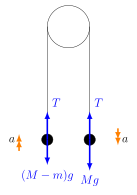
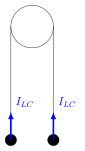
A lift of mass \(M\) and its counterweight of mass \(M\) are connected by a light inextensible cable which passes over a light frictionless pulley. The lift is constrained to move vertically between smooth guides. The distance between the floor and the ceiling of the lift is \(h\). Initially, the lift is at rest, and the distance between the top of the lift and the pulley is greater than \(h\). A small tile of mass \(m\) becomes detached from the ceiling of the lift. Show that the time taken for it to fall to the floor is \[ t=\sqrt{\frac{\left(2M-m\right)h}{Mg}}. \] The collision between the tile and the lift floor is perfectly inelastic. Show that the lift is reduced to rest by the collision, and that the loss of energy of the system is \(mgh\). Note: the question on the STEP database is \[ t=\sqrt{\frac{2\left(M-m\right)h}{Mg}}. \]
Solution:
1989 Paper 2 Q12
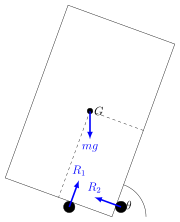
A uniform rectangular lamina of sides \(2a\) and \(2b\) rests in a vertical plane. It is supported in equilibrium by two smooth pegs fixed in the same horizontal plane, a distance \(d\) apart, so that one corner of the lamina is below the level of the pegs. Show that if the distance between this (lowest) corner and the peg upon which the side of length \(2a\) rests is less than \(a\), then the distance between this corner and the other peg is less than \(b\). Show also that \[ b\cos\theta-a\sin\theta=d\cos2\theta, \] where \(\theta\) is the acute angle which the sides of length \(2b\) make with the horizontal.
Solution:
1989 Paper 2 Q13
A body of mass \(m\) and centre of mass \(O\) is said to be dynamically equivalent to a system of particles of total mass \(m\) and centre of mass \(O\) if the moment of inertia of the system of particles is the same as the moment of inertia of the body, about any axis through \(O\). Show that this implies that the moment of inertia of the system of particles is the same as that of the body about any axis. Show that a uniform rod of length \(2a\) and mass \(m\) is dynamically equivalent to a suitable system of three particles, one at each end of the rod, and one at the midpoint. Use this result to deduce that a uniform rectangular lamina of mass \(M\) is dynamically equivalent to a system consisting of particles each of mass \(\frac{1}{36}M\) at the corners, particles each of mass \(\frac{1}{9}M\) at the midpoint of each side, and a particle of mass \(\frac{4}{9}M\) at the centre. Hence find the moment of inertia of a square lamina, of side \(2a\) and mass \(M,\) about one of its diagonals. The mass per unit length of a thin rod of mass \(m\) is proportional to the distance from one end of the rod, and a dynamically equivalent system consists of one particle at each end of the rod and one at the midpoint. Write down a set of equations which determines these masses, and show that, in fact, only two particles are required.
Solution: This follows from the parallel axis theorem. The moment of inertia of both the system and the body will be equal to the moment of inertia about the axis through the centre of mass plus the distance from the axis. Suppose we have an axis through the centre of the rod, then consider the coordinate frame with the axis and as the \(y\) axis and the intersection between rod and axis at the origin. Suppose the angle between the rod and the \(x\) axis is \(\theta\) Then the moment of inertia for the rod will be: \begin{align*} \int_{-a}^a\frac{M}{2a} x^2 \cos^2 \theta \d x &= \frac{M}{2a}\frac23 a^3 \cos^2 \theta \\ &= \frac13 M \cos^2 \theta a^2 \end{align*} Suppose we put a weights of mass \(\frac16\) at where the end of the rod would be, and a weight of mass \(\frac23\) at the centre, then the moment of inertial would be: \begin{align*} I &= \frac23M \cdot 0^2 + \frac16M (a \cos \theta)^2+\frac16 (a \cos \theta)^2 \\ &= \frac13 M \cos^2 \theta a^2 \end{align*} Therefore it has the same mass (\(M\)), centre of mass (\(O\)) and moment of inertia for any axis through the COM so the two systems are dynamically equivalent. A uniform lamina can be broken down into a system with a rod of mass \(\frac23 M\) through the middle parallel to one side and rods of mass \(\frac16 M\) on each of those parallel sides. Those rods are then equivalent to a particle at the centre mass \(\frac23 \cdot \frac23 M = \frac49 M\) a mass at the centre of those sides of mass \(\frac23 \cdot \frac 16 M = \frac19 M\), a mass at the centre of the parallel sides of mass \(\frac16 \cdot \frac23 M = \frac 19 M\) and masses at the corners of mass \(\frac16 \cdot \frac16 M = \frac1{36} M\) The moment of inertia of a square lamina side length \(2a\) mass \(M\) about a diagonal through the centre will be: \begin{align*} I &= \sum_{\text{points}} md^2 \\ &= 2 \cdot \frac1{36}M \cdot \frac12 (2a)^2 \\ &= \frac19 Ma^2 \end{align*} Suppose the rod is on \([0, 1]\), then we must have: \(\displaystyle \int_0^1 \rho x \d x = m \Rightarrow \rho = 2m\). The centre of mass will be at: \begin{align*} \overline{x} &= \frac1m \int_0^1 2m x^2 \d x \\ &= \frac23 \end{align*} The moment of inertial for a line through \((\frac23, 0)\) with angle \(\theta\) will be: \begin{align*} I &= \int_0^12mx \l\frac23 - x \r^2\cos^2 \theta \d x \\ &= 2m\cos^2 \theta \cdot \frac1{36} \\ &= \frac1{18}m \cos^2 \theta \end{align*} Therefore if the particles have mass \(m_0, m_{1/2}, m_1\) we must have: \begin{align*} &&m &= m_0 + m_{1/2} + m_1 \\ &&\frac23m &= \frac12 m_{1/2} + m_1 \\ &&\frac1{18}m \cos^2 \theta &= m_0\frac49 \cos^2 \theta + m_{1/2}\frac1{36} \cos^2 \theta + m_1 \frac1{9} \cos^2 \theta \\ \Rightarrow && m &= 8 m_0 +\frac12 m_{1/2}+2m_1 \\ \Rightarrow && m_0 &= 0 \\ && m_{1/2} &= \frac23 \\ && m_1 &= \frac13 \end{align*} Since \(m_0 = 0\) the particle at the "thin" end of the rod could be ignored.
1989 Paper 2 Q14
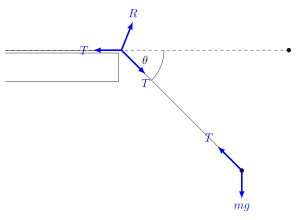
One end of a light inextrnsible string of length \(l\) is fixed to a point on the upper surface of a thin, smooth, horizontal table-top, at a distance \((l-a)\) from one edge of the table-top. A particle of mass \(m\) is fixed to the other end of the string, and held a distance \(a\) away from this edge of the table-top, so that the string is horizontal and taut. The particle is then released. Find the tension in the string after the string has rotated through an angle \(\theta,\) and show that the largest magnitude of the force on the edge of the table top is \(8mg/\sqrt{3}.\)
Solution:
1989 Paper 2 Q15
Two points are chosen independently at random on the perimeter (including the diameter) of a semicircle of unit radius. What is the probability that exactly one of them lies on the diameter? Let the area of the triangle formed by the two points and the midpoint of the diameter be denoted by the random variable \(A\).
- Given that exactly one point lies on the diameter, show that the expected value of \(A\) is \(\left(2\pi\right)^{-1}\).
- Given that neither point lies on the diameter, show that the expected value of \(A\) is \(\pi^{-1}\). [You may assume that if two points are chosen at random on a line of length \(\pi\) units, the probability density function for the distance \(X\) between the two points is \(2\left(\pi-x\right)/\pi^{2}\) for \(0\leqslant x\leqslant\pi.\)]
Solution:
- \begin{align*} \mathbb{E}(A \mid \text{exactly one point on diameter}) &= \int_{-1}^1\int_0^\pi \frac12 (x-0)\cdot 1 \cdot \sin(\pi - \theta) \frac{1}{\pi} \d \theta \frac{1}{2} \d x \\ &= \int_{-1}^1\frac1{2\pi} x \d x \cdot \left [ -\cos \theta \right]_0^\pi \\ &= \frac{1}{2\pi} \end{align*}

- \begin{align*} \mathbb{E}(A \mid \text{no point on diameter}) &= \int_0^{\pi} \frac12 \cdot 1 \cdot 1 \cdot \sin x \cdot 2(\pi - x)/\pi^2 \d x \\ &= \frac1{\pi^2} \int_0^\pi \sin x (\pi - x) \d x \\ &= \frac1{\pi^2} \int_0^\pi x\sin x \d x \\ &= \frac1{\pi^2} \left [ \sin x - x \cos x \right]_0^{\pi} \\ &= \frac{1}{\pi} \end{align*}

1989 Paper 2 Q16
Widgets are manufactured in batches of size \((n+N)\). Any widget has a probability \(p\) of being faulty, independent of faults in other widgets. The batches go through a quality control procedure in which a sample of size \(n\), where \(n\geqslant2\), is taken from each batch and tested. If two or more widgets in the sample are found to be faulty, all widgets in the batch are tested and all faults corrected. If fewer than two widgets in the sample are found to be faulty, the sample is replaced in the batch and no faults are corrected. Show that the probability that the batch contains exactly \(k\), where \(k\leqslant N\), faulty widgets after quality control is \[ \frac{\left[N+1+k\left(n-1\right)\right]N!}{\left(N-k+1\right)!k!}p^{k}\left(1-p\right)^{N+n-k}, \] and verify that this formula also gives the correct answer for \(k=N+1\). Show that the expected number of faulty widgets in a batch after quality control is \[ \left[N+n+pN(n-1)\right]p(1-p)^{n-1}. \]
Solution: \begin{align*} \mathbb{P}(\text{exactly }k\text{ faults after test}) &= \mathbb{P}(k\text{ faults in non-tested, 0 in batch})+\mathbb{P}(k-1\text{ faults in non-tested, 1 in batch}) \\ &=\binom{N}{k}(1-p)^{N-k}p^k\binom{n}{0}(1-p)^n+\binom{N}{k-1}(1-p)^{N-k+1}p^{k-1}\binom{n}{1}(1-p)^{n-1}p \\ &= (1-p)^{N-k+n}p^k \cdot \left ( \binom{N}{k}+n\binom{N}{k-1} \right) \\ &= (1-p)^{N-k+n}p^k \cdot \left (\frac{N!}{k!(N-k)!}+\frac{N!n}{(k-1)!(N-k+1)!}\right) \\ &= (1-p)^{N-k+n}p^k \frac{N!}{k!(N-k+1)!} \cdot \left ((N-k+1)+nk \right) \\ &= \frac{\left[N+1+k\left(n-1\right)\right]N!}{\left(N-k+1\right)!k!}p^{k}\left(1-p\right)^{N+n-k} \end{align*} When \(k = N+1\) we get: \begin{align*} \frac{(N+1)n N!}{(N+1)!} p^{N+1}(1-p)^{N+n-k} &= np^{N+1}(1-p)^{N+n-k} \end{align*} and the probability is: \begin{align*} \mathbb{P}(\text{exactly }N+1\text{ faults after test}) &= \mathbb{P}(N\text{ faults in non-tested, 1 in batch}) \\ &= \binom{N}{N}p^N \cdot \binom{n}{1}p(1-p)^{N-1} \\ &= np^{N+1}(1-p)^{N+n-k} \end{align*} So the formula does work for \(k = N+1\). \begin{align*} \mathbb{E}(faults) &= \sum_{k=0}^{N+1} k \cdot \mathbb{P}(\text{exactly }k\text{ faults after test}) \\ &= \sum_{k=0}^{N+1} k \cdot \frac{\left[N+1+k\left(n-1\right)\right]N!}{\left(N-k+1\right)!k!}p^{k}\left(1-p\right)^{N+n-k} \\ &= \sum_{k=1}^{N+1} \frac{\left[N+1+k\left(n-1\right)\right]N!}{\left(N-k+1\right)!(k-1)!}p^{k}\left(1-p\right)^{N+n-k} \\ &= \sum_{k=1}^{N+1} \left[N+1+k\left(n-1\right)\right] p(1-p)^{n-1}\binom{N}{k-1}p^{k-1}\left(1-p\right)^{N-k+1} \\ &= p(1-p)^{n-1} \cdot \left ( (N+1+n-1)\sum_{k=1}^{N+1} \binom{N}{k-1}p^{k-1}\left(1-p\right)^{N-k+1}+ (n-1)\sum_{k=1}^{N+1} (k-1)\binom{N}{k-1}p^{k-1}\left(1-p\right)^{N-k+1} \right) \\ &= p(1-p)^{n-1} \left ((N+1+n-1) + (n-1)pN \right) \\ &= \left[N+n+pN(n-1)\right]p(1-p)^{n-1} \end{align*}
1989 Paper 3 Q1
Prove that the area of the zone of the surface of a sphere between two parallel planes cutting the sphere is given by \[ 2\pi\times(\mbox{radius of sphere})\times(\mbox{perpendicular distance between the planes}). \] A tangent from the origin \(O\) to the curve with cartesian equation \[ (x-c)^{2}+y^{2}=a^{2}, \] where \(a\) and \(c\) are positive constants with \(c>a,\) touches the curve at \(P\). The \(x\)-axis cuts the curve at \(Q\) and \(R\), the points lying in the order \(OQR\) on the axis. The line \(OP\) and the arc \(PR\) are rotated through \(2\pi\) radians about the line \(OQR\) to form a surface. Find the area of this surface.
Solution:


1989 Paper 3 Q2
The points \(A,B\) and \(C\) lie on the surface of the ground, which is an inclined plane. The point \(B\) is 100m due north of \(A,\) and \(C\) is 60m due east of \(B\). The vertical displacements from \(A\) to \(B,\) and from \(B\) to \(C\), are each 5m downwards. A plane coal seam lies below the surface and is to be located by making vertical bore-holes at \(A,B\) and \(C\). The bore-holes strike the coal seam at 95m, 45m and 76m below \(A,B\) and \(C\) respectively. Show that the coal seam is inclined at \(\cos^{-1}(\frac{4}{5})\) to the horizontal. The coal seam comes to the surface along a line. Find the bearing of this line.
Solution: Set up a coordinate system so that \(x\) is E-W, \(y\) is N-S and \(z\) is the vertical direction. Also assume \(B\) is the origin, then, \(A = \begin{pmatrix} 0 \\ -100 \\ 5\end{pmatrix}, B = \begin{pmatrix} 0 \\ 0 \\ 0\end{pmatrix}, C= \begin{pmatrix} 60 \\ 0\\ -5\end{pmatrix},\). The coal seam has points: \(\begin{pmatrix} 0 \\ -100 \\ -90\end{pmatrix}, \begin{pmatrix} 0 \\ 0 \\ -45\end{pmatrix}, \begin{pmatrix} 60 \\ 0\\ -81\end{pmatrix},\) Therefore we can find the normal to the coal seam: \begin{align*} \mathbf{n} &= \left (\begin{pmatrix} 0 \\ -100 \\ -90\end{pmatrix} - \begin{pmatrix} 0 \\ 0 \\ -45\end{pmatrix}\right ) \times \left ( \begin{pmatrix} 60 \\ 0\\ -81\end{pmatrix} - \begin{pmatrix} 0 \\ 0 \\ -45\end{pmatrix}\right ) \\ &= \begin{pmatrix} 0 \\ - 100 \\ -45\end{pmatrix} \times \begin{pmatrix} 60 \\ 0 \\ -36\end{pmatrix} \\ &= \begin{pmatrix} 3600 \\ -60 \cdot 45 \\ 60 \cdot 100 \end{pmatrix} \\ &= 300\begin{pmatrix} 12 \\ -9 \\ 20\end{pmatrix} \end{align*} To measure the incline \(\theta\) to the horizontal we can take a dot with \(\hat{\mathbf{k}}\), to see: \begin{align*} \cos \theta &= \frac{20}{\sqrt{12^2+(-9)^2+20^2} \sqrt{1^2+0^2+0^2}} \\ &= \frac{20}{25} \\ &= \frac{4}{5} \end{align*} Therefore the angle is \(\cos^{-1} \tfrac 45\) The equation of the seam is \(12x - 9y + 20z = -900\). The equation of the surface is \(5x + 3y + 60z = 0\) We can compute the direction of the overlap again with a cross product: \begin{align*} \mathbf{d} &= \begin{pmatrix} 12 \\ -9 \\ 20\end{pmatrix} \times \begin{pmatrix} 5 \\ 3 \\ 60\end{pmatrix} \\ &= \begin{pmatrix} -600 \\ -620 \\ 81 \end{pmatrix} \end{align*} To get the bearing of this vector we just need to look at the \(x\) and \(y\) components, so it will be \(\tan^{-1} \frac{600}{620} = \tan^{-1} \frac{30}{31}\)
1989 Paper 3 Q3
The matrix \(\mathbf{M}\) is given by \[ \mathbf{M}=\begin{pmatrix}\cos(2\pi/m) & -\sin(2\pi/m)\\ \sin(2\pi/m) & \cos(2\pi/m) \end{pmatrix}, \] where \(m\) is an integer greater than \(1.\) Prove that \[ \mathbf{M}^{m-1}+\mathbf{M}^{m-2}+\cdots+\mathbf{M}^{2}+\mathbf{M}+\mathbf{I}=\mathbf{O}, \] where $\mathbf{I}=\begin{pmatrix}1 & 0\\ 0 & 1 \end{pmatrix}\( and \)\mathbf{O}=\begin{pmatrix}0 & 0\\ 0 & 0 \end{pmatrix}.$ The sequence \(\mathbf{X}_{0},\mathbf{X}_{1},\mathbf{X}_{2},\ldots\) is defined by \[ \mathbf{X}_{k+1}=\mathbf{PX}_{k}+\mathbf{Q}, \] where \(\mathbf{P,Q}\) and \(\mathbf{X}_{0}\) are given \(2\times2\) matrices. Suggest a suitable expression for \(\mathbf{X}_{k}\) in terms of \(\mathbf{P},\) \(\mathbf{Q}\) and \(\mathbf{X}_{0},\) and justify it by induction. The binary operation \(*\) is defined as follows: \[ \mathbf{X}_{i}*\mathbf{X}_{j}\mbox{ is the result of substituting \ensuremath{\mathbf{X}_{j}}for \ensuremath{\mathbf{X}_{0}}in the expression for \ensuremath{\mathbf{X}_{i}}. } \] Show that if \(\mathbf{P=M},\) the set \(\{\mathbf{X}_{1},\mathbf{X}_{2},\mathbf{X}_{3},\ldots\}\) forms a finite group under the operation \(*\).
Solution: \(\mathbf{M}^m = \mathbf{I}\), we also have \(\mathrm{det}(\mathbf{M - I}) = \cos^2(2\pi/m) - 2\cos(2\pi/m) + 1 + \sin^2(2\pi/m) = 2(1-\cos(2\pi/m))\) therefore \(\mathbf{M-I}\) is invertible. Therefore since \(\mathbf{(M-I)(M^{m-1} + M^{m-1} + \cdots + M^2 + M + I)= M^m-I = 0}\) we can cancel the \(\mathbf{M-I}\) to obtain the desired result. \(\mathbf{X_0 = X_0}\) \(\mathbf{X_1 = PX_0+Q}\) \(\mathbf{X_2 = P(PX_0+Q)+Q = P^2X_0 + PQ + Q}\) Claim: \(\mathbf{X_k = P^k X_0 + (P^{k-1} + P^{k-2} + \cdots + I)Q}\) Proof: (By induction on \(k\)). Base case \(k = 0\) is true. Assume it's true for some \(k = l\), then consider \(k = l+1\) \(\mathbf{X_{l+1} = PX_l + Q = P( P^l X_0 + (P^{l-1} + P^{l-2} + \cdots + I)Q) + Q = P^{l+1}X_0 + (P^l + P^{l-1} + \cdots + P)Q + Q = P^{l+1}X_0 + (P^l + P^{l-1} + \cdots + P + I)Q}\) Suppose \(\mathbf{P} = \mathbf{M}\), then consider the set \(\{\mathbf{X_1, X_2}, \ldots\}\) with the operation \(*\) as defined. \(\mathbf{X_i * X_j} = M^{i}(X_j) + (M^{i-1} + M^{i-2} + \cdots + M + I)Q = M^{i}(M^jX_0 + (M^{j-1} + M^{j-2} + \cdots + M + I)Q) + (M^{i-1} + M^{i-2} + \cdots + M + I)Q = M^{i+j}X_0 + (M^{i+j-1}+\cdots + M + I)Q = X_{i+j}\) Since \(X_m = X_0\) we can check all the requirements of the group, but this is going to be isomorphic to the cyclic group with \(m\) elements.
1989 Paper 3 Q4
Sketch the curve whose cartesian equation is \[ y=\frac{2x(x^{2}-5)}{x^{2}-4}, \] and give the equations of the asymptotes and of the tangent to the curve at the origin. Hence, or otherwise, determine (giving reasons) the number of real roots of the following equations:
- \(4x^{2}(x^{2}-5)=(5x-2)(x^{2}-4)\);
- \(4x^{2}(x^{2}-5)^{2}=(x^{2}-4)^{2}(x^{2}+1)\);
- \(4z^{2}(z-5)^{2}=(z-4)^{2}(z+1)\).
Solution:

- \begin{align*} && 4x^{2}(x^{2}-5)&=(5x-2)(x^{2}-4) \\ && \frac{2x(x^2-5)}{x^2-4} &= \frac{5x-2}{2x} = \frac52 -\frac1x \end{align*} Therefore it will have two roots as the hyperbola will intersect our graph in two places. (In the upper left and lower right quadrants).
- \begin{align*}
&& 4x^{2}(x^{2}-5)^{2}&=(x^{2}-4)^{2}(x^{2}+1) \\
&& \frac{2x(x^2-5)}{x^2-4} &= \frac{(x^2-4)(x^2+1)}{2x}
\end{align*}
No solutions \begin{align*} && 4z^{2}(z-5)^{2}&=(z-4)^{2}(z+1) \\ && \frac{2z(z^2-5)}{z^2-4} &= \frac{(z+5)(z-4)(z+1)}{(z-5)(z+4)} \end{align*}
 5 solutions
1989 Paper 3 Q5
Given that \(y=\cosh(n\cosh^{-1}x),\) for \(x\geqslant1,\) prove that \[ y=\frac{(x+\sqrt{x^{2}-1})^{n}+(x-\sqrt{x^{2}-1})^{n}}{2}. \] Explain why, when \(n=2k+1\) and \(k\in\mathbb{Z}^{+},\) \(y\) can also be expressed as the polynomial \[ a_{0}x+a_{1}x^{3}+a_{2}x^{5}+\cdots+a_{k}x^{2k+1}. \] Find \(a_{0},\) and show that
- \(a_{1}=(-1)^{k-1}2k(k+1)(2k+1)/3\);
- \(a_{2}=(-1)^{k}2(k-1)k(k+2)(2k+1)/15.\)
Solution: Recall, \(\cosh^{-1} x = \ln (x + \sqrt{x^2-1})\) \begin{align*} \cosh(n \cosh^{-1} x) &= \frac12 \left ( \exp(n \cosh^{-1} x) + \exp(-n\cosh^{-1}x) \right) \\ &= \frac12 \left ((x + \sqrt{x^2-1})^n + (x + \sqrt{x^2-1})^{-n} \right) \\ &= \frac12 \left ((x + \sqrt{x^2-1})^n + (x - \sqrt{x^2-1})^{n} \right) \\ \end{align*} When \(n = 2k+1\) \begin{align*} \cosh(n \cosh^{-1} x)&= \frac12 \left ((x + \sqrt{x^2-1})^n + (x - \sqrt{x^2-1})^{n} \right) \\ &= \frac12 \left (\sum_{i=0}^{2k+1}\binom{2k+1}{i}x^{2k+1-i}\left ( (\sqrt{x^2-1}^{i} + (-\sqrt{x^2-1})^{i} \right) \right) \\ &=\sum_{i=0}^{k} \binom{2k+1}{2i}x^{2k+1-2i}(x^2-1)^i \\ &=\sum_{i=0}^{k} \binom{2k+1}{2i}x^{2(k-i)+1}(x^2-1)^i \\ \end{align*} Which is clearly a polynomial with only odd degree terms. \begin{align*} a_0 &= \frac{\d y}{\d x} \vert_{x=0} \\ &= \sum_{i=0}^k\binom{2k+1}{2i} \left ( (2(k-i)+1)x^{2(k-i)}(x^2-1)^i + 2i\cdot x^{2(k-i)+2}(x^2-1) \right) \\ &= \binom{2k+1}{2k} (-1)^{k} \\ &= (-1)^k(2k+1) \end{align*}
- \begin{align*} a_1 &= \binom{2k+1}{2k}\binom{k}{1}(-1)^{k-1}+\binom{2k+1}{2(k-1)}(-1)^{k-1} \\ &=(-1)^{k-1}\cdot ( (2k+1)k + \frac{(2k+1)\cdot 2k \cdot (2k-1)}{3!}) \\ &= (-1)^{k-1}(2k+1)k\frac{3 + 2k-1}{3} \\ &= (-1)^{k-1}2(2k+1)k (k+1) \end{align*}
- \begin{align*} a_2 &= \binom{2k+1}{2k} \binom{k}{2}(-1)^{k-2} + \binom{2k+1}{2(k-1)} \binom{k-1}{1} (-1)^{k-2}+\binom{2k+1}{2(k-2)} (-1)^{k-2} \\ &= \binom{2k+1}{1} \binom{k}{2}(-1)^{k-2} + \binom{2k+1}{3} \binom{k-1}{1} (-1)^{k-2}+\binom{2k+1}{5} (-1)^{k-2} \\ &= (-1)^{k} \left (\binom{2k+1}{1} \frac{k(k-1)}{2} + \binom{2k+1}{3}(k-1)+\binom{2k+1}{5} \right) \\ &= (-1)^{k} \left ( \frac{(2k+1)k(k-1)}{2} + \frac{(2k+1)k(2k-1)}{3} + \frac{(2k+1)k(2k-1)(k-1)(2k-3)}{5\cdot2\cdot3} \right) \\ &= (-1)^k (2k+1)k\frac{1}{30} \left ( 15(k-1) + 10(2k-1)+(2k-1)(k-1)(2k-3) \right) \end{align*}
1989 Paper 3 Q6
Show that, for a given constant \(\gamma\) \((\sin\gamma\neq0)\) and with suitable choice of the constants \(A\) and \(B\), the line with cartesian equation \(lx+my=1\) has polar equations \[ \frac{1}{r}=A\cos\theta+B\cos(\theta-\gamma). \] The distinct points \(P\) and \(Q\) on the conic with polar equations \[ \frac{a}{r}=1+e\cos\theta \] correspond to \(\theta=\gamma-\delta\) and \(\theta=\gamma+\delta\) respectively, and \(\cos\delta\neq0.\) Obtain the polar equation of the chord \(PQ.\) Hence, or otherwise, obtain the equation of the tangent at the point where \(\theta=\gamma.\) The tangents at \(L\) and \(M\) to a conic with focus \(S\) meet at \(T.\) Show that \(ST\) bisects the angle \(LSM\) and find the position of the intersection of \(ST\) and \(LM\) in terms of your chosen parameters for \(L\) and \(M.\)
Solution: \begin{align*} && \frac1{r} &= A \cos \theta + B \cos (\theta - \gamma) \\ &&&= A \cos \theta + B \cos \theta \cos \gamma + B \sin \theta \sin \gamma \\ &&&= (A+B \cos \gamma) \cos \theta + B \sin \gamma \sin \theta \\ \Longleftrightarrow && 1 &= (A+B \cos \gamma) x + B \sin \gamma y \end{align*} So if we choose \(B = \frac{m}{\sin \gamma}\) and \(A = l-m \cot \gamma\) we have the desired result. \begin{align*} && \frac{1 + e \cos (\gamma -\delta)}a &= A \cos (\gamma - \delta) + B \cos (\gamma - \delta - \gamma) \\ &&&= A \cos(\gamma-\delta) +B \cos \delta\\ && \frac{1 + e \cos (\gamma +\delta)}{a} &= A \cos (\gamma + \delta) + B \cos (\gamma + \delta - \gamma) \\ &&&= A \cos(\gamma + \delta) + B \cos \delta\\ \Rightarrow && \frac1{r} &= \frac{e}{a} \cos \theta + \frac{1}{a \cos \delta} \cos (\theta - \gamma) \\ \lim{\delta \to 0} &&\frac1{r} &= \frac{e}{a} \cos \theta+ \frac{1}{a} \cos (\theta - \gamma) \end{align*} Suppose we have have points \(L\) and \(M\) with \(\theta = \gamma_L, \gamma_M\) then our tangents are: \begin{align*} && \frac{a}{r} &= \cos \theta + \cos (\theta - \gamma_L) \\ && \frac{a}{r} &= \cos \theta + \cos (\theta - \gamma_M) \\ \Rightarrow && 0 &= \cos (\theta - \gamma_L) -\cos(\theta - \gamma_M) \\ &&&= - 2 \sin \frac{(\theta - \gamma_L)+(\theta - \gamma_M)}{2} \sin \frac{(\theta - \gamma_L)-(\theta - \gamma_M)}{2} \\ &&&= -2 \sin \left ( \theta - \frac{\gamma_L+\gamma_M}2 \right) \sin \left ( \frac{\gamma_M - \gamma_L}{2}\right) \\ \Rightarrow && \theta &= \frac{\gamma_L+\gamma_M}{2} \end{align*} Therefore clearly \(ST\) bisects \(LSM\). The line \(LM\) can be seen as the chord from the points \(\frac{\gamma_L+\gamma_M}{2} \pm \frac{\gamma_L-\gamma_M}{2}\), so the line is: \begin{align*} && \frac{a}{r} &= e \cos \theta + \frac{1}{\cos \left ( \frac{\gamma_L-\gamma_M}{2}\right)} \cos \left (\theta - \frac{\gamma_L+\gamma_M}{2} \right) \end{align*} and we want the point on the line where \(\theta =\frac{\gamma_L+\gamma_M}{2}\) so \begin{align*} && \frac{a}{r} &= e \cos \left ( \frac{\gamma_L+\gamma_M}{2} \right) + \frac{1}{\cos \left ( \frac{\gamma_L-\gamma_M}{2}\right)} \\ \Rightarrow && r &= \frac{a}{e \cos \left ( \frac{\gamma_L+\gamma_M}{2} \right) + \frac{1}{\cos \left ( \frac{\gamma_L-\gamma_M}{2}\right)}} \end{align*}