1989 Paper 2 Q11
Year: 1989
Paper: 2
Question Number: 11
Course: UFM Mechanics
Section: Work, energy and Power 2
Difficulty: 1600.0
Banger: 1484.0
work-energy-power
lift and counterweight
pulley
perfectly inelastic collision
energy loss
Newton's second law
relative acceleration
connected particles
conservation of momentum
Problem
A lift of mass \(M\) and its counterweight of mass \(M\) are connected by a light inextensible cable which passes over a light frictionless pulley. The lift is constrained to move vertically between smooth guides. The distance between the floor and the ceiling of the lift is \(h\). Initially, the lift is at rest, and the distance between the top of the lift and the pulley is greater than \(h\). A small tile of mass \(m\) becomes detached from the ceiling of the lift. Show that the time taken for it to fall to the floor is
\[
t=\sqrt{\frac{\left(2M-m\right)h}{Mg}}.
\]
The collision between the tile and the lift floor is perfectly inelastic. Show that the lift is reduced to rest by the collision, and that the loss of energy of the system is \(mgh\).
Note: the question on the STEP database is \[
t=\sqrt{\frac{2\left(M-m\right)h}{Mg}}.
\]
Solution
Rating Information
Difficulty Rating: 1600.0
Difficulty Comparisons: 0
Banger Rating: 1484.0
Banger Comparisons: 1
Show LaTeX source
Problem source
A lift of mass $M$ and its counterweight of mass $M$ are connected by a light inextensible cable which passes over a light frictionless pulley. The lift is constrained to move vertically between smooth guides. The distance between the floor and the ceiling of the lift is $h$. Initially, the lift is at rest, and the distance between the top of the lift and the pulley is greater than $h$. A small tile of mass $m$ becomes detached from the ceiling of the lift. Show that the time taken for it to fall to the floor is
	\[
	t=\sqrt{\frac{\left(2M-m\right)h}{Mg}}.
	\]
	The collision between the tile and the lift floor is perfectly inelastic. Show that the lift is reduced to rest by the collision, and that the loss of energy of the system is $mgh$.
Note: the question on the STEP database is \[
	t=\sqrt{\frac{2\left(M-m\right)h}{Mg}}.
	\]
Solution source
\begin{center}
    \begin{tikzpicture}
        \def\r{0.75};
        \draw (0,0) circle (\r);
        \draw (\r,0) -- (\r, -4);
        \draw ({-\r},0) -- ({-\r}, -4);
        \filldraw (\r,-4) circle (0.2);
        \filldraw ({-\r},-4) circle (0.2);

        \draw[-latex, blue, ultra thick] (\r,-4) -- ++ (0,1) node[above right] {$T$};
        \draw[-latex, blue, ultra thick] (\r,-4) -- ++ (0,-1.1) node[below] {$Mg$};
        \draw[-latex, blue, ultra thick] ({-\r},-4) -- ++ (0,1) node[above right] {$T$};
        \draw[-latex, blue, ultra thick] ({-\r},-4) -- ++ (0,-0.9) node[below] {$(M-m)g$};

        \draw[-latex, orange, ultra thick] ({-\r-1},-4-0.4) -- ({-\r-1},-4);
        \draw[-latex, orange, ultra thick] ({-\r-1},-4) -- ({-\r-1},-4+0.2);

        \draw[-latex, orange, ultra thick] ({\r+1},-4) -- ({\r+1},-4-0.2);
        \draw[-latex, orange, ultra thick] ({\r+1},-4+0.4) -- ({\r+1},-4);

        \node[right] at ({\r +1},-4) {$a$};
        \node[left] at ({-\r-1},-4) {$a$};

    \end{tikzpicture}
\end{center}

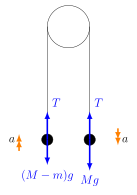
Considering the pulley system with the lift (now of mass $M-m$) and the counterweight of mass $M$.

Once they start moving, since they are connected by a light inextensible string they must move with the same speed (and by extension the same acceleration). (Up to sign)

\begin{align*}
\text{N2(lift,}\uparrow):&&(M-m)a &= T-(M-m)g \\
\text{N2(couterweight,}\downarrow):&&Ma &= Mg - T \\
\Rightarrow && (2M-m)a &= mg \\
\Rightarrow && a &= \frac{mg}{2M-m}
\end{align*}

We could treat the situation as the tile travelling a distance of $h$ with acceleration $\displaystyle g \left ( 1 + \frac{m}{2M-m} \right) = g \frac{2M}{2M-m}$.

\begin{align*}
t &= \sqrt{\frac{2h}{g \frac{2M}{2M-m}}} \\
&= \sqrt{\frac{(2M-m)h}{Mg}} \\
\end{align*}

\begin{center}
    \begin{tikzpicture}
        \def\r{0.75};
        \draw (0,0) circle (\r);
        \draw (\r,0) -- (\r, -4);
        \draw ({-\r},0) -- ({-\r}, -4);
        \filldraw (\r,-4) circle (0.2);
        \filldraw ({-\r},-4) circle (0.2);

        \draw[-latex, blue, ultra thick] (\r,-4) -- ++ (0,1) node[above right] {$I_{LC}$};
        \draw[-latex, blue, ultra thick] ({-\r},-4) -- ++ (0,1) node[above right] {$I_{LC}$};


    \end{tikzpicture}
\end{center}

Since the collision between the lift and tile is perfectly inelastic, they immediately coalesce.

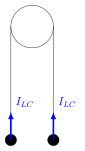
There is also an impulse in the pulley system, which goes over the pulley, which means there is an impulse acting vertically on the lift and the counterweight. Assume afterwards the lift (and tile) is travelling upwards with speed $V$ and the counterweight is travelling downwards with speed $V$ (ie velocity $-V$).


\begin{align*}
\text{for the lift/tile}: &&  I_{LC} &= (\text{momentum after}) - (\text{momentum before})\\
&&&= MV - ((M-m)at +m(-g)t) \\
&&&= MV - Mat + m(a-g)t \\
\text{for the counterweight}: &&  I_{LC} &= (\text{momentum after}) - (\text{momentum before})\\
&&&= M(-V) - (M(-a)t) \\
&&&= -MV +Mat \\
\Rightarrow && 2MV &= m(g-a)t + 2Mat \\
&&&= t (2Ma -ma+mg) \\
&&&= 0 \\
\Rightarrow && V &= 0
\end{align*}

Therefore, the lift ends up stationary.

The energy lost in the collision is:

\begin{align*}
&& E &= KE_{before} - KE_{after} \\
&&&= \underbrace{\frac12 (M-m)a^2 t^2}_{lift} + \underbrace{\frac12 mg^2 t^2}_{tile} + \underbrace{\frac12 Ma^2 t^2}_{counterweight} - \underbrace{0}_{\text{everything is at rest after}} \\
&&&= \frac12 \l (M-m)a^2 + mg^2 + Ma^2 \r t^2 \\
&&&= \frac12 \l 2Ma^2-ma^2 + mg^2 \r t^2 \\
&&&= \frac12 \l (2M-m)a^2 + mg^2 \r t^2 \\
&&&= \frac12 \l mga + mg^2 \r t^2 \\
&&&= \frac12 mg (a + g)t^2 \\
&&&= \frac12 mg \left ( \frac{mg}{2M-m} + g\right ) \frac{(2M-m)h}{Mg} \\
&&&= \frac12 mg \left ( \frac{mg +2Mg - mg}{2M-m} \right) \frac{(2M-m)h}{Mg} \\
&&&= mgh
\end{align*}

as required.