Problems
Filters
298 problems found
2010 Paper 1 Q2
The curve \(\displaystyle y=\Bigl(\frac{x-a}{x-b}\Bigr)\e^{x}\), where \(a\) and \(b\) are constants, has two stationary points. Show that \[ a-b<0 \ \ \ \text{or} \ \ \ a-b>4 \,. \]
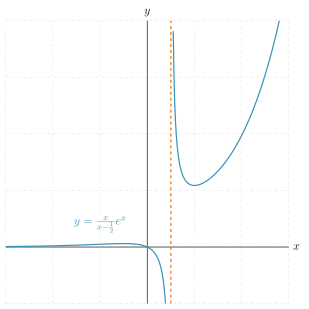
- Show that, in the case \(a=0\) and \(b= \frac12\), there is one stationary point on either side of the curve's vertical asymptote, and sketch the curve.
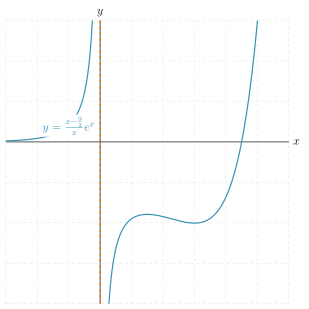
- Sketch the curve in the case \( a=\tfrac{9}{2}\) and \(b=0\,\).
Solution: \begin{align*} && y &= \left ( \frac{x-a}{x-b} \right )e^x \\ &&y'& = \left ( \frac{x-a}{x-b} \right )e^x + \left ( \frac{(x-b)-(x-a)}{(x-b)^2}\right )e^x \\ &&&= \left ( \frac{(x-b)(x-a) +a-b}{(x-b)^2} \right)e^x \\ &&&= \left ( \frac{x^2-(a+b)x+a-b+ab}{(x-b)^2} \right)e^x \\ && 0 &< \Delta = (a+b)^2 - 4 \cdot 1 \cdot (a-b+ab) \\ &&&= a^2+2ab+b^2-4a+4b-4ab \\ &&&= a^2-2ab+b^2-4a+4b\\ &&&= (a-b)^2-4(a-b) \\ &&&= (a-b)(a-b-4) \\ \end{align*} Considered as a quadratic in \(a-b\) we can see \(a-b < 0\) or \(a-b > 4\)
- If \(a = 0, b = \frac12\), we have \(x^2-\frac12x -\frac12 = 0 \Rightarrow (2x+1)(x-1) = 0 \Rightarrow x = -\frac12, x=1\). The asymptote is at \(x = \frac12\) so they are on either side.
- \(\,\)
2010 Paper 1 Q12
A discrete random variable \(X\) takes only positive integer values. Define \(\E(X)\) for this case, and show that \[\E(X) =\sum^{\infty}_{n=1}\P\left(X\ge n \right).\] I am collecting toy penguins from cereal boxes. Each box contains either one daddy penguin or one mummy penguin. The probability that a given box contains a daddy penguin is \(p\) and the probability that a given box contains a mummy penguin is \(q\), where \(p\ne0\), \(q\ne0\) and \(p+q=1\,\). Let \(X\) be the number of boxes that I need to open to get at least one of each kind of penguin. Show that \(\P(X\ge 4)= p^{3}+q^{3}\), and that \[ \E(X)=\frac{1}{pq}-1.\, \] Hence show that \(\E(X)\ge 3\,\).
Solution: \[ \E[X] := \sum_{n=1}^{\infty} n \mathbb{P}(X=n) \] \begin{align*} && \sum^{\infty}_{n=1}\mathbb{P}\left(X\ge n \right) &= \sum^{\infty}_{n=1}\sum_{k=n}^\infty \mathbb{P}(X=k) \\ &&&= \sum_{k=1}^\infty k \cdot \mathbb{P}(X=k) \\ &&&= \E[X] \end{align*} \begin{align*} &&\mathbb{P}(X \geq 4) &= \mathbb{P}(\text{first 3 are daddies}) +\mathbb{P}(\text{first 3 are mummies}) \\ &&&= p^3 + q^3 \\ \Rightarrow && \E[X] &= \sum_{n=1}^{\infty} \mathbb{P}\left(X\ge n \right) \\ &&&= 1+\sum_{n=2}^{\infty} \left ( p^{n-1} + q^{n-1}\right) \\ &&&= 1+\frac{p}{1-p} + \frac{q}{1-q} \\ &&&= 1+\frac{p}q + \frac{q}p \\ &&&= 1+\frac{p^2+q^2}{pq} \\ &&&= 1+\frac{(p+q)^2-2pq}{pq} \\ &&&= \frac{1}{pq} -1 \\ &&& \underbrace{\geq}_{AM-GM} \frac{1}{4}-1 = 3 \end{align*}
2010 Paper 1 Q13
The number of texts that George receives on his mobile phone can be modelled by a Poisson random variable with mean \(\lambda\) texts per hour. Given that the probability George waits between 1 and 2 hours in the morning before he receives his first text is \(p\), show that \[ p\e^{2\lambda}-\e^{\lambda}+1=0. \] Given that \(4p<1\), show that there are two positive values of \(\lambda\) that satisfy this equation. The number of texts that Mildred receives on each of her two mobile phones can be modelled by independent Poisson random variables with different means \(\lambda_{1}\) and \(\lambda_{2}\) texts per hour. Given that, for each phone, the probability that Mildred waits between 1 and 2 hours in the morning before she receives her first text is also \(p\), find an expression for \(\lambda_{1}+\lambda_{2}\) in terms of \(p\). Find the probability, in terms of \(p\), that she waits between 1 and 2 hours in the morning to receive her first text.
Solution: Let \(X_t\) be the number of texts he recieves before \(t\) hours. So \(X_t \sim P(t\lambda)\) \begin{align*} &&\mathbb{P}(X_1 = 0 \, \cap \, X_2 > 0) &= e^{-\lambda} \cdot \left ( 1-e^{-\lambda}\right) = p \\ \Rightarrow && e^{2\lambda}p &= e^{\lambda} - 1 \\ \Rightarrow && 0 &= pe^{2\lambda}-e^{\lambda} + 1 \\ \Rightarrow && e^{\lambda} &= \frac{1 \pm \sqrt{1-4p}}{2p} \end{align*} Which clearly has two positive roots if \(4p < 1\). We need to show both roots are \(>1\). So considering the smaller one we are looking at: \begin{align*} && \frac{1-\sqrt{1-4p}}{2p} & > 1 \\ \Leftrightarrow && 1-\sqrt{1-4p} &> 2p \\ \Leftrightarrow && 1-2p&> \sqrt{1-4p} \\ \Leftrightarrow && (1-2p)^2&> 1-4p \\ \Leftrightarrow && 1-4p+4p^2&> 1-4p \\ \end{align*} which is clearly true. We must have \(e^{\lambda_1}\cdot e^{\lambda_2} = \frac{1}{p}\), so \(\lambda_1 + \lambda_2 = -\ln p\) by considering the product of the roots in our quadratic. (Vieta). Therefore the probability she waits between 1 and 2 hours in the morning is \(e^{-(\lambda_1 + \lambda_2)} \cdot ( 1- e^{-(\lambda_1+\lambda_2)}) = p \cdot (1-p)\)
2010 Paper 2 Q9
Two points \(A\) and \(B\) lie on horizontal ground. A particle \(P_1\) is projected from \(A\) towards \(B\) at an acute angle of elevation \(\alpha\) and simultaneously a particle \(P_2\) is projected from \(B\) towards \(A\) at an acute angle of elevation \(\beta\). Given that the two particles collide in the air a horizontal distance \(b\) from \(B\), and that the collision occurs after \(P_1\) has attained its maximum height \(h\), show that \[ 2h \cot\beta < b < 4h \cot\beta \hphantom{\,,} \] and \[ 2h \cot\alpha < a < 4h \cot\alpha \,, \] where \(a\) is the horizontal distance from \(A\) to the point of collision.
2010 Paper 2 Q10
- In an experiment, a particle \(A\) of mass \(m\) is at rest on a smooth horizontal table. A particle \(B\) of mass \(bm\), where \(b >1\), is projected along the table directly towards \(A\) with speed \(u\). The collision is perfectly elastic. Find an expression for the speed of \(A\) after the collision in terms of \(b\) and \(u\), and show that, irrespective of the relative masses of the particles, \(A\) cannot be made to move at twice the initial speed of \(B\).
- In a second experiment, a particle \(B_1\) is projected along the table directly towards \(A\) with speed \(u\). This time, particles \(B_2\), \(B_3\), \(\ldots\,\), \(B_n\) are at rest in order on the line between \(B_1\) and \(A\). The mass of \(B_i\) (\(i=1\), \(2\), \(\ldots\,\), \(n\)) is \(\lambda^{n+1-i}m\), where \(\lambda>1\). All collisions are perfectly elastic. Show that, by choosing \(n\) sufficiently large, there is no upper limit on the speed at which \(A\) can be made to move. In the case \(\lambda=4\), determine the least value of \(n\) for which \(A\) moves at more than \(20u\). You may use the approximation \(\log_{10}2 \approx 0.30103\).
Solution:
- Since the collision is perfectly elastic, the speed of approach and separation are equal, ie \(v_B = v_A - u\) \begin{align*} \text{COM}: && bmu &= bm(v_A - u) + mv_A \\ \Rightarrow && (b+1)v_A &= 2bu \\ \Rightarrow && v_A &= \frac{2b}{b+1} u \end{align*} Since \(0 < \frac{b}{b+1} < 1\), the largest \(0 < v_A < 2u\)

- After the first collision with each \(B_i\) we will have \(\displaystyle v_{i+1} = \frac{2\lambda}{\lambda + 1}v_i\), ie \(\displaystyle v_{i+1} = \left (\frac{2\lambda}{\lambda + 1} \right)^i u\) and so \(\displaystyle v_A = \left (\frac{2\lambda}{\lambda + 1} \right)^n u\) which can be arbitrarily large. Suppose \(\lambda = 4\), then \begin{align*} && 20u &< v_A \\ &&&= \left (\frac{8}{5} \right)^n u \\ \Rightarrow && \log_{10} 20 < n \log_{10}(16/10) \\ && \log_{10} 2 + 1 < n 4\log_{10} 2 - n \\ \Rightarrow && n &> \frac{ \log_{10} 2 + 1}{ 4\log_{10} 2 - 1} \\ &&&\approx \frac{0.30103+1}{4 \times 0.30103 -1}\\ &&&= \frac{1.30103}{0.20412} \\ &&&>6 \end{align*} So \(n =7\) is the smallest possible
2010 Paper 2 Q12
The continuous random variable \(X\) has probability density function \(\f(x)\), where \[ \f(x) = \begin{cases} a & \text {for } 0\le x < k \\ b & \text{for } k \le x \le 1\\ 0 & \text{otherwise}, \end{cases} \] where \(a > b > 0\) and \(0 < k < 1\). Show that \(a > 1\) and \(b < 1\).
- Show that \[ \E(X) = \frac{1-2b+ab}{2(a-b)}\,. \]
- Show that the median, \(M\), of \(X\) is given by \(\displaystyle M=\frac 1 {2a}\) if \(a+b\ge 2ab\) and obtain an expression for the median if \(a+b\le 2ab\).
- Show that \(M < \E(X)\,\).
Solution: \begin{align*} && 1 &= \int_0^1 f(x) \d x \\ &&&= ak + b(1-k) \\ &&&= b + (a-b)k \\ \Rightarrow && k &= \frac{1-b}{a-b} \\ \Rightarrow && b & < 1 \tag{\(0 < k, \,a > b\)} \\ && k &> 1 \\ \Rightarrow && a-b & > 1-b \\ \Rightarrow && a > 1 \end{align*}
- \(\,\) \begin{align*} && \E[X] &= \int_0^1 x \cdot f(x) \d x \\ &&&= \int_0^k ax \d x + \int_k^1 b x \d x \\ &&&= a \frac{k^2}{2} + b \frac{1-k^2}{2} \\ &&&= \frac12b + (a-b) \frac{(1-b)^2}{2(a-b)^2} \\ &&&= \frac{(1-b)^2+b(a-b)}{2(a-b)} \\ &&&= \frac{1-2b+ab}{2(a-b)} \end{align*}
- \(\,\) The median \(M\) satisfies \[\frac12 = \int_0^M f(x) \d x \] If \(ka = \frac{a-ab}{a-b} \leq \frac12 \Leftrightarrow 2a-2ab \leq a-b \Leftrightarrow a+b \leq 2ab\) then \(M > k\) otherwise \(M < k\). In the latter case: \begin{align*} && \frac12 &= Ma \\ \Rightarrow && M &= \frac{1}{2M} \end{align*} In the former case \begin{align*} && \frac12 &= ka + (M-k)b \\ &&&= k(a-b) + Mb \\ &&&= 1-b + M b \\ \Rightarrow && M &= 1-\frac1{2b} \end{align*}
2010 Paper 2 Q13
Rosalind wants to join the Stepney Chess Club. In order to be accepted, she must play a challenge match consisting of several games against Pardeep (the Club champion) and Quentin (the Club secretary), in which she must win at least one game against each of Pardeep and Quentin. From past experience, she knows that the probability of her winning a single game against Pardeep is \(p\) and the probability of her winning a single game against Quentin is \(q\), where \(0 < p < q < 1\).
- The challenge match consists of three games. Before the match begins, Rosalind must choose either to play Pardeep twice and Quentin once or to play Quentin twice and Pardeep once. Show that she should choose to play Pardeep twice.
- In order to ease the entry requirements, it is decided instead that the challenge match will consist of four games. Now, before the match begins, Rosalind must choose whether to play Pardeep three times and Quentin once (strategy 1), or to play Pardeep twice and Quentin twice (strategy 2) or to play Pardeep once and Quentin three times (strategy 3). Show that, if \(q-p > \frac 12\), Rosalind should choose strategy 1. If \(q-p<\frac12\), give examples of values of \(p\) and \(q\) to show that strategy 2 can be better or worse than strategy 1.
Solution:
- If she plays \(P\) twice her probability is \(q(p^2+2p(1-p)) = qp(2-p)\). If she plays \(Q\) twice her probability is \(pq(2-q)\). Since \(p < q\) she should play \(P\) twice.
- Under strategy 1, her probability is \(q(p^3+3p^2(1-p)+3p(1-p)^2) = qp(p^2+3p-3p^2+3-6p+3p^2) = qp(3-3p+p^2)\) Under strategy 2 her probability is \((p^2+2p(1-p))(q^2+2q(1-q)) = pq(2-p)(2-q)\). Under strategy 3 her probability is \(qp(3-3q+q^2)\) \begin{align*} && q - p &> \frac12 \\ \Rightarrow && (2-p)(2-q) & < (2-p)(\frac32 - p) \\ &&&= 3 - \frac72p + p^2 \\ &&&< 3- 3p + p^2 \end{align*} Therefore Strategy 1 dominates if \(q-p > \frac12\). If \(p = \frac14, q = \frac12\) then \((2-p)(2-q) =\frac74 \cdot \frac32 = \frac{21}{8}\) and \(3-3p + p^2 = 3 - \frac34 + \frac1{16} = \frac{48-12+1}{16} = \frac{37}{16} < \frac{42}{16}\) so strategy 2 dominates. Notice that strategy 1 always dominates strategy 3 since \(f(x) = 3-3x+x^2\) is decreasing for \(x < 1.5\). If \(p = \frac14, q = \frac12\) then \((2-p)(2-q) =\frac74 \cdot \frac32 = \frac{21}{8}\) and \(3-3p + p^2 = 3 - \frac34 + \frac1{16} = \frac{48-12+1}{16} = \frac{37}{16} < \frac{42}{16}\) so strategy 2 dominates. For strategy 1 to dominate, we need \(3-3p+p^2 > (2-q)(2-p)\) or \(\frac{3-3p+p^2}{2-p} > 2-q\). When \(p = \frac12\) this is \(\frac{3-\frac32 + \frac14}{2 - \frac12} = \frac{\frac{7}{4}}{\frac{3}{2}} = \frac76 = 2-\frac{5}{6}\) so take any value of \(q\) larger than \(\frac56\).
2010 Paper 3 Q1
Let \(x_{\low1}\), \(x_{\low2}\), \ldots, \(x_n\) and \(x_{\vphantom {\dot A} n+1}\) be any fixed real numbers. The numbers \(A\) and \(B\) are defined by \[ A = \frac 1 n \sum_{k=1}^n x_{ \low k} \,, \ \ \ B= \frac 1 n \sum_{k=1}^n (x_{\low k}-A)^2 \,, \ \ \ \] and the numbers \(C\) and \(D\) are defined by \[ C = \frac 1 {n+1} \sum\limits_{k=1}^{n+1} x_{\low k} \,, \ \ \ D = \frac1{n+1} \sum_{k=1}^{n+1} (x_{\low k}-C)^2 \,. \]
- Express \( C\) in terms of \(A\), \(x_{\low n+1}\) and \(n\).
- Show that $ \displaystyle B= \frac 1 n \sum_{k=1}^n x_{\low k}^2 - A^2\,\(.
- Express \)D \( in terms of \)B\(, \)A\(, \)x_{\low n+1}\( and \)n$. Hence show that \((n + 1)D \ge nB\) for all values of \(x_{\low n+1}\), but that \(D < B\) if and only if \[ A-\sqrt{\frac{(n+1)B}{n}} < x_{\low n+1} < A+\sqrt{\frac{(n+1)B}{n}}\,. \]
2010 Paper 3 Q9
\(\,\)
2009 Paper 1 Q9
Two particles \(P\) and \(Q\) are projected simultaneously from points \(O\) and \(D\), respectively, where~\(D\) is a distance \(d\) directly above \(O\). The initial speed of \(P\) is \(V\) and its angle of projection {\em above} the horizontal is \(\alpha\). The initial speed of \(Q\) is \(kV\), where \(k>1\), and its angle of projection {\em below} the horizontal is \(\beta\). The particles collide at time \(T\) after projection. Show that \(\cos\alpha = k\cos\beta\) and that \(T\) satisfies the equation \[ (k^2-1)V^2T^2 +2dVT\sin\alpha -d^2 =0\,. \] Given that the particles collide when \(P\) reaches its maximum height, find an expression for~\(\sin^2\alpha\) in terms of \(g\), \(d\), \(k\) and \(V\), and deduce that \[ gd\le (1+k)V^2\,. \]
2009 Paper 1 Q12
Prove that, for any real numbers \(x\) and \(y\), \(x^2+y^2\ge2xy\,\).
- Carol has two bags of sweets. The first bag contains \(a\) red sweets and \(b\) blue sweets, whereas the second bag contains \(b\) red sweets and \(a\) blue sweets, where \(a\) and \(b\) are positive integers. Carol shakes the bags and picks one sweet from each bag without looking. Prove that the probability that the sweets are of the same colour cannot exceed the probability that they are of different colours.
- Simon has three bags of sweets. The first bag contains \(a\) red sweets, \(b\) white sweets and \(c\) yellow sweets, where \(a\), \(b\) and \(c\) are positive integers. The second bag contains \(b\) red sweets, \(c\) white sweets and \(a\) yellow sweets. The third bag contains \(c\) red sweets, \(a\) white sweets and \(b\) yellow sweets. Simon shakes the bags and picks one sweet from each bag without looking. Show that the probability that exactly two of the sweets are of the same colour is \[ \frac {3(a^2b+b^2c+c^2a+ab^2 + bc^2 +ca^2)}{(a+b+c)^3}\,, \] and find the probability that the sweets are all of the same colour. Deduce that the probability that exactly two of the sweets are of the same colour is at least 6 times the probability that the sweets are all of the same colour.
2009 Paper 2 Q6
The Fibonacci sequence \(F_1\), \(F_2\), \(F_3\), \(\ldots\) is defined by \(F_1=1\), \(F_2= 1\) and \[ F_{n+1} = F_n+F_{n-1} \qquad\qquad (n\ge 2). \] Write down the values of \(F_3\), \(F_4\), \(\ldots\), \(F_{10}\). Let \(\displaystyle S=\sum_{i=1}^\infty \dfrac1 {F_i}\,\).
- Show that \(\displaystyle \frac 1{F_i} > \frac1{2F_{i-1}}\,\) for \(i\ge4\) and deduce that \(S > 3\,\). Show also that \(S < 3\frac23\,\).
- Show further that \(3.2 < S < 3.5\,\).
Solution: \begin{array}{c|r} n & F_n \\ \hline 1 & 1 \\ 2 & 1 \\ 3 & 2 \\ 4 & 3 \\ 5 & 5 \\ 6 & 8 \\ 7 & 13 \\ 8 & 21 \\ 9 & 34 \\ 10 & 55 \end{array} \begin{questionparts} \item Claim: \(\frac1{F_i} > \frac1{2F_{i-1}}\) for \(i \geq 4\). Proof: Since \(F_i = F_{i-1}+F_{i-2}\) and \(F_i > 1\) for \(i \geq 1\) we have \(F_i > F_{i-1}\) for \(i \geq 3\). In particular we have \(F_i = F_{i-1}+F_{i-2} < 2F_{i-1}\) for \(i -1 \geq 3\) or \(i \geq 4\). Therefore \(\frac{1}{F_i} > \frac1{2F_{i-1}}\)
2009 Paper 3 Q3
The function \(\f(t)\) is defined, for \(t\ne0\), by \[ \f(t) = \frac t {\e^t-1}\,. \] \begin{questionparts} \item By expanding \(\e^t\), show that \(\displaystyle \lim _{t\to0} \f(t) = 1\,\). Find \(\f'(t)\) and evaluate \(\displaystyle \lim _{t\to0} \f'(t)\,\). \item Show that \(\f(t) +\frac12 t\) is an even function. [{\bf Note:} A function \(\g(t)\) is said to be {\em even} if \(\g(t) \equiv \g(-t)\).] \item Show with the aid of a sketch that \( \e^t( 1-t)\le 1\,\) and deduce that \(\f'(t)\ne 0\) for \(t\ne0\). \end{questionpart} Sketch the graph of \(\f(t)\).
Solution:
- Claim \(f(t) + \frac12 t\) is an even function. Proof: Consider \(f(-t) - \frac12t\), then \begin{align*} f(-t) - \frac12t &= \frac{-t}{e^{-t}-1} - \frac12t \\ &= \frac{-te^t}{1-e^t} - \frac12 t \\ &= \frac{t(1-e^t) -t}{1-e^t} - \frac12 t \\ &= t - \frac{t}{1-e^t} - \frac12 t \\ &= \frac{t}{e^t-1} + \frac12 t \end{align*} So it is even.
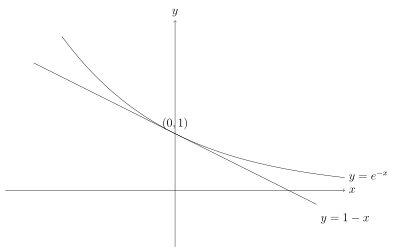
- Drawing the tangent to \(y = e^{-x}\) at \((0,1)\) we find that \(e^{-t} \geq (1-t)\) for all \(t\), in particular, \(e^t(1-t) \leq 1\) \(f'(t) = \frac{(e^t(1-t) -1}{(e^t-1)^2} \leq 0\) and \(f'(t) = -\frac12\) when \(t = 0\)

2008 Paper 1 Q3
Prove that, if \(c\ge a\) and \(d\ge b\), then \[ ab+cd\ge bc+ad\,. \tag{\(*\)} \]
- If \(x\ge y\), use \((*)\) to show that \(x^2+y^2\ge 2xy\,\). If, further, \(x\ge z\) and \(y\ge z\), use \((*)\) to show that \(z^2+xy\ge xz+yz\) and deduce that \(x^2+y^2+z^2\ge xy+yz+zx\,\). Prove that the inequality \(x^2+y^2+z^2\ge xy+yz+zx\,\) holds for all \(x\), \(y\) and \(z\).
- Show similarly that the inequality \[\frac st +\frac tr +\frac rs +\frac ts +\frac rt +\frac sr \ge 6\] holds for all positive \(r\), \(s\) and \(t\).
Solution: \begin{align*} && \underbrace{(c-a)}_{\geq 0}\underbrace{(d-b)}_{\geq 0} & \geq 0 \\ \Leftrightarrow && cd -bc -ad + ab &\geq 0 \\ \Leftrightarrow && ab +cd &\geq bc+ad \\ \end{align*}
- Applying \((*)\) with \(c=d=x\) and \(a=b=y\) we obtain: \(x^2 + y^2 \geq xy + xy = 2xy\) Similarly, applying \((*)\) with \(c=x, d=y, a=b=z\) we obtain: \(z^2 + xy \geq zx+zy\) so \(x^2+y^2+z^2 \geq 2xy + z^2 \geq xy + zx+zy\) There was nothing special about our choice of ordering \(x,y,z\) so it is true for all \(x,y,z\)
- \begin{align*} \frac st +\frac tr +\frac rs +\frac ts +\frac rt +\frac sr &=\left ( \frac st+\frac ts \right)+\left ( \frac tr +\frac rt \right)+\left ( \frac rs +\frac sr \right) \\ & \geq 2 \sqrt{\frac st \frac ts} + 2 \sqrt{\frac tr \frac rt} + 2 \sqrt{\frac rs \frac sr} \\ & = 2 + 2 + 2 \\ &= 6 \end{align*}
2008 Paper 1 Q4
A function \(\f(x)\) is said to be convex in the interval \(a < x < b\) if \(\f''(x)\ge0\) for all \(x\) in this interval.
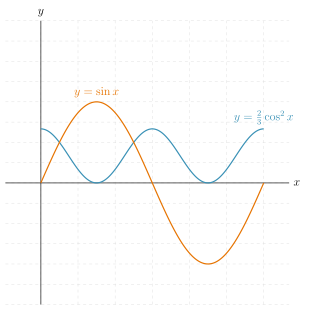
- Sketch on the same axes the graphs of \(y= \frac23 \cos^2 x\) and \(y=\sin x\) in the interval \(0\le x \le 2\pi\). The function \(\f(x)\) is defined for \(0 < x < 2\pi\) by \[\f(x) = \e^{\frac23 \sin x}. \] Determine the intervals in which \(\f(x)\) is convex.
- The function \(\g(x)\) is defined for \(0 < x < \frac12\pi\) by \[\g(x) = \e^{-k \tan x}. \] If \(k=\sin 2 \alpha\) and \(0 < \alpha < \frac{1}{4}\pi\), show that \(\g(x)\) is convex in the interval \(0 < x < \alpha\), and give one other interval in which \(\g(x)\) is convex.
Solution:
- \begin{align*} && f(x) &= \exp\left (\tfrac23\sin x \right) \\ && f'(x) &= \exp\left (\tfrac23\sin x \right) \cdot \tfrac23 \cos x \\ && f''(x) &= \left ( \exp\left (\tfrac23\sin x \right) \cdot \tfrac23\right) \left ( \tfrac23 \cos^2 x - \sin x \right) \end{align*} Therefore \(f(x)\) is convex when \(\frac23 \cos^2 x \geq \sin x\). Note that we can find the equality points when \begin{align*} && \sin x &= \frac23 \cos^2 x \\ &&&= \frac23 (1- \sin^2 x) \\ \Rightarrow && 0 &= 2\sin^2 x + 3 \sin x - 2 \\ &&&= (2 \sin x -1) (\sin x+2) \end{align*} ie \(\sin x = \frac12 \Rightarrow x = \frac{\pi}{6}, \frac{5\pi}{6}\). Therefore \(f\) is convex on \([0, \frac{\pi}{6}] \cup [\frac{5\pi}{6}, 2\pi]\)
- Suppose \(g(x) = \exp \left ( -k \tan x \right)\) then \begin{align*} && g'(x) &= \exp \left ( -k \tan x \right) \cdot (-k \sec^2 x ) \\ && g''(x) &= \left ( -k \exp \left ( -k \tan x \right) \right) \left ( -k\sec^4 x + 2 \sec x \cdot \sec x \tan x\right) \\ &&&= -k \exp \left ( -k \tan x \right) \sec^4 x \left ( -k + 2\sin x \cos x \right) \\ &&&= -k \exp \left ( -k \tan x \right) \sec^4 x \left ( -k + \sin 2x \right) \\ \end{align*} If \(0 < \alpha < \frac{\pi}{4}\) then \(k > 0\) so \(g\) is convex if \(-k + \sin 2x < 0\), ie \(\sin 2x < \sin 2\alpha\), ie on \((0, \alpha)\) and \((\frac{\pi}{2} - \alpha, \frac{\pi}{2})\)