Problems
Filters
1531 problems found
1992 Paper 3 Q16
The probability that there are exactly \(n\) misprints in an issue of a newspaper is \(\mathrm{e}^{-\lambda}\lambda^{n}/n!\) where \(\lambda\) is a positive constant. The probability that I spot a particular misprint is \(p\), independent of what happens for other misprints, and \(0 < p < 1.\)
- If there are exactly \(m+n\) misprints, what is the probability that I spot exactly \(m\) of them?
- Show that, if I spot exactly \(m\) misprints, the probability that I have failed to spot exactly \(n\) misprints is \[ \frac{(1-p)^{n}\lambda^{n}}{n!}\mathrm{e}^{-(1-p)\lambda}. \]
Solution:
- \(\binom{m+n}{m} p^m (1-p)^n\)
- \(\,\) \begin{align*} \mathbb{P}(\text{failed to spot }n\text{ misprints}|\text{spotted }m\text{ misprints}) &= \frac{\mathbb{P}(\text{failed to spot }n\text{ misprints and spotted }m\text{ misprints}) }{\mathbb{P}(\text{spotted }m\text{ misprints})} \\ &= \frac{\binom{m+n}{n}p^m(1-p)^n e^{-\lambda} \lambda^{m+n}/(n+m)!}{\sum_{k=0}^{\infty} \binom{m+k}{k}p^m(1-p)^k e^{-\lambda} \lambda^{m+k}/(n+k)!} \\ &= \frac{\binom{m+n}{n}(1-p)^n \lambda^{n}/(n+m)!}{\sum_{k=0}^{\infty} \binom{m+k}{k}(1-p)^k \lambda^{k}/(n+k)!} \\ &= \frac{(1-p)^n \lambda^{n}/n!}{\sum_{k=0}^{\infty} (1-p)^k \lambda^{k}/k!} \\ &= \frac{(1-p)^n\lambda^n}{n!} e^{-(1-p)\lambda} \end{align*} Alternatively, given the missed misprints and spotted misprints are independent, we can view them as both following \(Po(p\lambda)\) and \(Po((1-p)\lambda)\) and so we obtain exactly this result, without calculation.
1991 Paper 1 Q1
If \(\theta+\phi+\psi=\tfrac{1}{2}\pi,\) show that \[ \sin^{2}\theta+\sin^{2}\phi+\sin^{2}\psi+2\sin\theta\sin\phi\sin\psi=1. \] By taking \(\theta=\phi=\tfrac{1}{5}\pi\) in this equation, or otherwise, show that \(\sin\tfrac{1}{10}\pi\) satisfies the equation \[ 8x^{3}+8x^{2}-1=0. \]
Solution: \begin{align*} S &= \sin^{2}\theta+\sin^{2}\phi+\sin^{2}\psi+2\sin\theta\sin\phi\sin\psi \\ &= \sin^{2}\theta+\sin^{2}\phi+\sin^{2}(\tfrac\pi2-\theta-\phi)+2\sin\theta\sin\phi\sin(\tfrac\pi2-\theta-\phi) \\ &= \sin^{2}\theta+\sin^{2}\phi+\cos^{2}(\theta+\phi)+2\sin\theta\sin\phi\cos(\theta+\phi) \\ &= \sin^{2}\theta+\sin^{2}\phi+\left ( \cos(\theta)\cos(\phi)-\sin(\theta)\sin(\phi)\right)^2+2\sin\theta\sin\phi\left ( \cos(\theta)\cos(\phi)-\sin(\theta)\sin(\phi)\right) \\ &= \sin^{2}\theta+\sin^{2}\phi+\cos^2 \theta\cos^2 \phi-\sin^2 \theta \sin^2 \phi \\ &= \sin^{2}\theta(1-\sin^2 \phi)+\sin^{2}\phi+\cos^2 \theta\cos^2 \phi \\ &= \sin^{2}\theta\cos^2 \phi+\sin^{2}\phi+\cos^2 \theta\cos^2 \phi \\ &= \sin^{2}\phi+\cos^2 \phi \\ &= 1 \end{align*} Suppose \(\theta = \phi = \tfrac15 \pi, \psi = \tfrac1{10}\pi\). Also let \(s = \sin \tfrac1{10}\) \begin{align*} 1 &= 2\sin^2 \tfrac15 \pi + \sin^2 \tfrac1{10} \pi + 2 \sin^2\tfrac15 \pi \sin \tfrac1{10} \pi \\ &= 8\sin^2 \tfrac1{10} \pi \cos^2 \tfrac1{10} \pi + \sin^2 \tfrac1{10} \pi + 8 \sin^2 \tfrac1{10} \pi \cos^2 \tfrac1{10} \pi \sin \tfrac1{10} \pi \\ &= 8\sin^2 \tfrac1{10} \pi(1- \sin^2 \tfrac1{10} \pi) + \sin^2 \tfrac1{10} \pi + 8 \sin^2 \tfrac1{10} \pi (1-\sin^2 \tfrac1{10} \pi) \sin \tfrac1{10} \pi \\ &= 8s^2(1-s^2)+s^2 + 8s^2(1-s^2)s \\ &= -8 s^5 - 8 s^4 + 8 s^3 + 9 s^2 \end{align*} Therefore \(s\) is a root of \(8s^5+8s^4-8s^3-9s^2+1 = 0\), but notice that \begin{align*} 8s^5+8s^4-8s^3-9s^2+1 &= (s-1)(8 s^4 + 16 s^3 + 8 s^2 - s - 1 ) \\ &= (s-1)(s+1)(8s^3+8s^2-1) \end{align*} Therefore since \(\sin \tfrac{1}{10} \pi \neq \pm 1\) it must be a root of \(8x^3+8x^2-1=0\)
1991 Paper 1 Q2
Frosty the snowman is made from two uniform spherical snowballs, of initial radii \(2R\) and \(3R.\) The smaller (which is his head) stands on top of the larger. As each snowball melts, its volume decreases at a rate which is directly proportional to its surface area, the constant of proportionality being the same for both snowballs. During melting each snowball remains spherical and uniform. When Frosty is half his initial height, find the ratio of his volume to his initial volume. If \(V\) and \(S\) denote his total volume and surface area respectively, find the maximum value of \(\dfrac{\mathrm{d}V}{\mathrm{d}S}\) up to the moment when his head disappears.
Solution: \(V_h = \frac43 \pi r_h^3, S_h = 4 \pi r_h^2\) \(\frac{\d V_h}{\d t} = -k4\pi r_h^2 \Rightarrow 4\pi r_h^2 \frac{\d r_h}{\d t} = -k 4\pi r_h^2 \Rightarrow \frac{\d r_h}{\d t} = -k\) Therefore \(r_h = 2R - kt, r_b = 3R - kt\). The height will halve when \(2kt = \frac{5}{2}R \Rightarrow kt = \frac{5}{4}R\) and the two sections will have radii \(\frac{3}{4}R\) and \(\frac{7}{4}R\) and the ratio of the volumes will be: \begin{align*} \frac{\frac{3^3}{4^3}+\frac{7^3}{4^3}}{2^3+3^3} = \frac{37}{224} \end{align*} \begin{align*} && \frac{\d V}{\d t} &= -4\pi k(r_h^2+r_b^2) \\ && \frac{\d S}{\d t} &= -8\pi k (r_h+r_b) \\ \Rightarrow && \frac{\d V}{\d S} &= \frac{r_h^2 + r_b^2}{2(r_h+r_b)} \\ &&&= \frac{(2R-kt)^2+(3R-kt)^2}{2(5R-2kt)} \\ &&&= \frac{13R^2-10Rkt+2k^2t^2}{2(5R-2kt)} \\ &&&= \frac{13R^2-10Rs + 2s^2}{2(5R-2s)} \end{align*} Where \(s = kt\) and \(0 \leq s \leq 2R\). We can maximise this but differentiating wrt to \(s\). \begin{align*} \Rightarrow && &= \frac{(-10R+4s)(10R-4s)+4(13R^2-10Rs+2s^2)}{4(5R-2s)^2} \\ &&&= \frac{-48R^2+40Rs-8s^2}{4(5R-2s)^2} \\ &&&= \frac{-8(s-2R)(s-3R)}{4(5R-2s)^2} \\ &&&<0 \end{align*} Therefore it is largest when \(s = 0\), ie \(\frac{13R^2}{10R} = \frac{13}{10}R\)
1991 Paper 1 Q3
A path is made up in the Argand diagram of a series of straight line segments \(P_{1}P_{2},\) \(P_{2}P_{3},\) \(P_{3}P_{4},\ldots\) such that each segment is \(d\) times as long as the previous one, \((d\neq1)\), and the angle between one segment and the next is always \(\theta\) (where the segments are directed from \(P_{j}\) towards \(P_{j+1}\), and all angles are measured in the anticlockwise direction). If \(P_{j}\) represents the complex number \(z_{j},\) express \[ \frac{z_{n+1}-z_{n}}{z_{n}-z_{n-1}} \] as a complex number (for each \(n\geqslant2\)), briefly justifying your answer. If \(z_{1}=0\) and \(z_{2}=1\), obtain an expression for \(z_{n+1}\) when \(n\geqslant2\). By considering its imaginary part, or otherwise, show that if \(\theta=\frac{1}{3}\pi\) and \(d=2\), then the path crosses the real axis infinitely often.
Solution: \begin{align*} && | \frac{z_{n+1}-z_{n}}{z_{n}-z_{n-1}} | &= d \\ && \arg \left ( \frac{z_{n+1}-z_{n}}{z_{n}-z_{n-1}} \right) &= \arg (z_{n+1}-z_{n}) - \arg(z_{n}-z_{n-1}) \\ &&&= \theta \\ \Rightarrow && \frac{z_{n+1}-z_{n}}{z_{n}-z_{n-1}} &= d e^{i \theta} \end{align*} \begin{align*} && z_1 &= 0 \\ && z_2 &= 1 \\ && \frac{z_3-z_2}{z_2-z_1} &= de^{i \theta} \\ \Rightarrow && z_3 &= de^{i \theta} + 1 \\ && \frac{z_4-z_3}{z_3-z_2} &= de^{i \theta} \\ \Rightarrow && z_4 &= (d e^{i \theta})^2 + d e^{i \theta} + 1\\ \Rightarrow && z_{n+1} &= \frac{(de^{i \theta})^{n}-1}{de^{i \theta}-1} \end{align*} If \(d = 2, \theta = \tfrac13 \pi\), then, \(2e^{i \tfrac13 \pi} = 1 + \sqrt{3}i\) \begin{align*} \textrm{Im}(z_{n+1})) &= \textrm{Im} \left ( \frac{(2e^{i \tfrac13 \pi})^{n}-1}{2e^{i \tfrac13 \pi}-1}\right) \\ &= \textrm{Im} \left ( \frac{(2e^{i \tfrac13 \pi})^{n}-1}{\sqrt{3}i}\right) \\ &= -\frac{1}{\sqrt{3}}\textrm{Re} \left (2^n e^{i \frac{n}{3} \pi} \right) + \frac{1}{\sqrt{3}} \end{align*} Which clearly changes sign infinitely many times, ie crosses the origin infinitely many times.
1991 Paper 1 Q4
\(\ \)
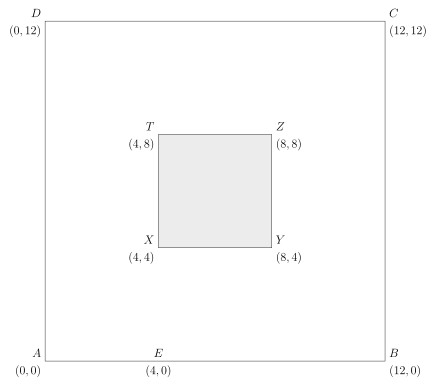
- as small as possible,
- as large as possible.
Solution:
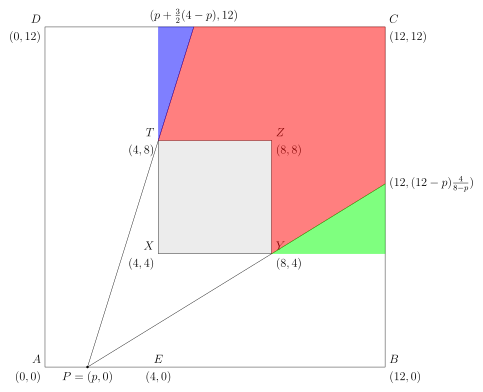
- Since the area not visible is increasing as \(p\) increases, we would like \(p\) to be as large as possible, ie \(p = 4\).
- Similarly, he can see the most when \(p =0\)
1991 Paper 1 Q5
A set of \(n\) distinct vectors \(\mathbf{a}_{1},\mathbf{a}_{2},\ldots,\mathbf{a}_{n},\) where \(n\geqslant2\), is called regular if it satisfies the following two conditions:
- there are constants \(\alpha\) and \(\beta\), with \(\alpha>0\), such that for any \(i\) and \(j\), \[ \mathbf{a}_{i}\cdot\mathbf{a}_{j}=\begin{cases} \alpha^{2} & \mbox{ when }i=j\\ \beta & \mbox{ when }i\neq j, \end{cases} \]
- the centroid of \(\mathbf{a}_{1},\mathbf{a}_{2},\ldots,\mathbf{a}_{n}\) is the origin \(\mathbf{0}.\) {[}The centroid of vectors \(\mathbf{b}_{1},\mathbf{b}_{2},\ldots,\mathbf{b}_{m}\) is the vector \(\frac{1}{m}(\mathbf{b}_{1}+\mathbf{b}_{2}+\cdots+\mathbf{b}_{m}).\){]}
Solution: \begin{align*} && \mathbf{0} &= \sum_i \mathbf{a}_i \tag{ii} \\ \Rightarrow && 0 &= \mathbf{a}_i \cdot \mathbf{0} \\ &&&= \sum_j \mathbf{a}_i \cdot \mathbf{a}_j \\ &&&= (n-1)\beta + \alpha^2 \tag{i} \\ \Rightarrow && (n-1)\beta &= -\alpha^2 \end{align*} Suppose we have \(\mathbf{a}_j = \binom{x}{y}\), \(j \neq 1\) then \(x = \beta\). We also must have \(\beta^2 + y^2 = 1\), so there are at most two values for \(y\), ie two extra vectors. ie \(n = 2, 3\). If \(n = 2 \Rightarrow \mathbf{a}_2 = - \mathbf{a}_1\). If \(n = 3\) \begin{align*} && \mathbf{0} &= \binom{1}{0} + \binom{\beta}{y} + \binom{\beta}{-y} \\ \Rightarrow && \beta = -1/2 \\ \Rightarrow && y &= \pm \frac{\sqrt{3}}{2} \end{align*} Suppose $\mathbf{a}_{1}=\begin{pmatrix}1\\ 0\\ 0 \end{pmatrix}\(, \)\mathbf{a}_{2}=\begin{pmatrix}\cos \theta \\ \sin \theta \\ 0 \end{pmatrix}$ (since we need \(\mathbf{a}_2 \cdot \mathbf{a}_2 = 1\)). \(\beta = \cos \theta\)). We can have \(\cos \theta = - 1\). Suppose we have \(\mathbf{a}_j =\begin{pmatrix}x\\ y \\ z \end{pmatrix}\), so \(x = \cos \theta\), and \(y^2 + z^2 = \sin^2 \theta\), so we can write it as: \(\mathbf{a}_j =\begin{pmatrix} \cos \theta \\ \sin \theta \cos \phi \\ \sin \theta \sin \phi \end{pmatrix}\). We must also have \(\beta = \begin{pmatrix} \cos \theta \\ \sin \theta \cos \phi \\ \sin \theta \sin \phi \end{pmatrix} \cdot \begin{pmatrix} \cos \theta \\ \sin \theta\\ 0 \end{pmatrix} = \cos^2 \theta + \sin^2 \theta \cos \phi = \cos \theta\), so \(\cos \phi = \frac{\cos \theta - \cos^2\theta}{1-\cos^2 \theta} = \frac{\cos \theta}{1+\cos \theta}\). Therefore there is one value for \(\cos \phi\), so at most two values for \(\sin \phi\), Therefore we can have either \(2, 3,4\) or \(5\) different values in the set. \(n = 2\), we've already handled. If \(n = 3\), then \(\beta = -\frac12\), \(\cos \phi = -1\), so we can only have two different values for \(\sin \theta\), ie: \(\displaystyle \left \{\begin{pmatrix} 1\\ 0 \\ 0 \end{pmatrix}, \begin{pmatrix} -1/2\\ \frac{\sqrt{3}}{2} \\ 0 \end{pmatrix}, \begin{pmatrix} -1/2\\ -\frac{\sqrt{3}}{2} \\ 0 \end{pmatrix} \right \}\) Finally, if \(n = 4\), we have \(\beta = -\frac13\), \(\cos \phi = \frac{-1/3}{2/3} = -\frac12\). \(\sin \theta = \pm \frac{\sqrt{3}}{2}\) \(\displaystyle \left \{\begin{pmatrix} 1\\ 0 \\ 0 \end{pmatrix}, \begin{pmatrix} -\frac13\\ \frac{2\sqrt{2}}{3} \\ 0 \end{pmatrix}, \begin{pmatrix} -\frac13\\ -\frac{\sqrt{2}}{3} \\ \frac{\sqrt{6}}{3} \end{pmatrix},\begin{pmatrix} -\frac13\\ -\frac{\sqrt{2}}{3} \\ -\frac{\sqrt{6}}{3} \end{pmatrix} \right \}\) \(\displaystyle \left \{\begin{pmatrix} 1\\ 0 \\ 0 \end{pmatrix}, \begin{pmatrix} -\frac13\\ -\frac{2\sqrt{2}}{3} \\ 0 \end{pmatrix}, \begin{pmatrix} -\frac13\\ \frac{\sqrt{2}}{3} \\ \frac{\sqrt{6}}{3} \end{pmatrix},\begin{pmatrix} -\frac13\\ \frac{\sqrt{2}}{3} \\ -\frac{\sqrt{6}}{3} \end{pmatrix} \right \}\) If \(n = 5\), then \(\beta = -\frac14\), \(\cos \phi = \frac{-1/4}{3/4} = -\frac13\). \(\sin \theta = \frac{\sqrt{15}}{4}\), \(\sin \phi = \frac{2\sqrt{2}}{3}\) \(\displaystyle \left \{\begin{pmatrix} 1\\ 0 \\ 0 \end{pmatrix}, \begin{pmatrix} -\frac14\\ \frac{\sqrt{15}}{4} \\ 0 \end{pmatrix}, \begin{pmatrix} -\frac14\\ -\frac{\sqrt{15}}{4} \\ 0 \end{pmatrix}, \begin{pmatrix} -\frac14\\ \frac{\sqrt{15}}{12} \\ \frac{\sqrt{30}}{6} \end{pmatrix}, \begin{pmatrix} -\frac14\\ -\frac{\sqrt{15}}{12} \\ -\frac{\sqrt{30}}{6} \end{pmatrix}, \right \}\)
1991 Paper 1 Q6
Criticise each step of the following arguments. You should correct the arguments where necessary and possible, and say (with justification) whether you think the conclusion are true even though the argument is incorrect.
- The function \(g\) defined by \[ \mathrm{g}(x)=\frac{2x^{3}+3}{x^{4}+4} \] satisfies \(\mathrm{g}'(x)=0\) only for \(x=0\) or \(x=\pm1.\) Hence the stationary values are given by \(x=0\), \(\mathrm{g}(x)=\frac{3}{4}\) and \(x=\pm1,\) \(\mathrm{g}(x)=1.\) Since \(\frac{3}{4}<1,\) there is a minimum at \(x=0\) and maxima at \(x=\pm1.\) Thus we must have \(\frac{3}{4}\leqslant\mathrm{g}(x)\leqslant1\) for all \(x\).
- \({\displaystyle \int(1-x)^{-3}\,\mathrm{d}x=-3(1-x)^{-4}}\quad\) and so \(\quad{\displaystyle \int_{-1}^{3}(1-x)^{-3}\,\mathrm{d}x=0.}\)
Solution:
- \begin{align*} && g(x) &= \frac{2x^3+3}{x^4+4} \\ \Rightarrow && g'(x) &= \frac{6x^2(x^4+4) - (2x^3+3)(4x^3)}{(x^4+4)^2} \\ &&&= \frac{-2x^6-12x^3+24x^2}{(x^4+4)} \\ &&&= \frac{-2x^2(x^4+6x-12)}{(x^4+4)} \end{align*} So \(g'(x)\) is not \(0\) for \(x = \pm 1\). We can also note that \(g(-1) = \frac1{5} \neq 1\) Even if the other turning point was \(1\), we would also need to check the behaviour as \(x \to \pm \infty\). We can also note that \(g(-1) = \frac{1}{5} < \frac34\) so the conclusion is also not true.
- There are several errors. \[ \int (1-x)^{-3} \d x = \underbrace{\frac{1}{4}}_{\text{correct constant}}(1-x)^{-4} + \underbrace{C}_{\text{constant of integration}} \] We cannot integrate through the asymptote at \(1\). There is a sense in which we could argue \(\displaystyle \int_{-1}^3 (1-x)^{-3} \d x = 0\), specifically using Cauchy principal value \begin{align*} \mathrm {p.v.} \int_{-1}^3 (1-x)^{-3} &=\lim_{\epsilon \to 0} \left [ \int_{-1}^{1-\epsilon} (1-x)^{-3} \d x+ \int_{1+\epsilon}^{3} (1-x)^{-3} \d x\right] \\ &=\lim_{\epsilon \to 0} \left [ \left[ \frac14 (1-x)^{-4}\right]_{-1}^{1-\epsilon}+ \left[ \frac14 (1-x)^{-4}\right]_{1+\epsilon}^3\right] \\ &=\lim_{\epsilon \to 0} \left [ \frac14 \epsilon^{-4}-\frac14 \frac1{2^4} + \frac14 \frac1{2^4} - \frac14 \epsilon^{-4} \right] \\ &= \lim_{\epsilon \to 0} 0 \\ &= 0 \end{align*} However, in many normal ways of treating this integral it would be undefined.
1991 Paper 1 Q7
According to the Institute of Economic Modelling Sciences, the Slakan economy has alternate years of growth and decline, as in the following model. The number \(V\) of vloskan (the unit of currency) in the Slakan Treasury is assumed to behave as a continuous variable, as follows. In a year of growth it increases continuously at an annual rate \(aV_{0}\left(1+(V/V_{0})\right)^{2}.\) During a year of decline, as long as there is still money in the Treasury, the amount decreases continuously at an annual rate \(bV_{0}\left(1+(V/V_{0})\right)^{2};\) but if \(V\) becomes zero, it remains zero until the end of the year. Here \(a,b\) and \(V_{0}\) are positive constants. A year of growth has just begun and there are \(k_{0}V_{0}\) vloskan in the Treasury, where \(0\leqslant k_{0} < a^{-1}-1\). Explain the significance of these inequalities for the model to be remotely sensible. If \(k_{0}\) is as above and at the end of one year there are \(k_{1}V_{0}\) vloskan in the Treasury, where \(k_{1} > 0\), find the condition involving \(b\) which \(k_{1}\) must satisfy so that there will be some vloskan left after a further year. Under what condition (involving \(a,b\) and \(k_{0}\)) does the model predict that unlimited growth will take place in the third year (but not before)?
1991 Paper 1 Q8
- By a substitution of the form \(y=k-x\) for suitable \(k\), prove that, for any function \(\mathrm{f}\), \[ \int_{0}^{\pi}x\mathrm{f}(\sin x)\,\mathrm{d}x=\pi\int_{0}^{\frac{1}{2}\pi}\mathrm{f}(\sin x)\,\mathrm{d}x. \] Hence or otherwise evaluate \[ \int_{0}^{\pi}\frac{x}{2+\sin x}\,\mathrm{d}x. \]
- Evaluate \[ \int_{0}^{1}\frac{(\sin^{-1}t)\cos\left[(\sin^{-1}t)^{2}\right]}{\sqrt{1-t^{2}}}\,\mathrm{d}t. \] {[}No credit will be given for numerical answers obtained by use of a calculator.{]}
Solution:
- \begin{align*} y = \pi - x, \d y = -\d x: && \int_0^{\pi} x f(\sin x) &= \int_{y = \pi}^{y = 0}(\pi - y) f(\sin(\pi-y))- \d y \\ &&&= \int_0^{\pi} (\pi -y) f(\sin y) \d y \\ \Rightarrow && 2 \int_0^{\pi} x f(\sin x)\d x &= \pi \int_0^{\pi} f(\sin x) \d x \\ &&&= \pi \int_0^{\pi/2} f(\sin x ) \d x + \pi \int_{\pi/2}^{\pi} f(\sin x ) \d x \\ &&&= \pi \int_0^{\pi/2} f(\sin x ) \d x +\pi \int_{y=\pi/2}^{y=0} f(\sin (\pi-y) ) (-\d y) \\ &&&= 2 \pi \int_0^{\pi/2} f(\sin x) \d x \\ \Rightarrow && \int_0^{\pi} x f(\sin x)\d x &= \pi \int_0^{\pi/2} f(\sin x) \d x \end{align*} Therefore if \(f(x) = \frac1{2+\sin x}\), letting \(t = \tan \frac{x}{2}\) we have \(\sin x = \frac{2 t}{1+t^2}, \frac{dt}{\d x} = \frac12 (1+t^2)\) \begin{align*} && \int_0^{\pi} \frac{x}{2 + \sin x } \d x &= \pi \int_0^{\pi/2} \frac{1}{2 + \sin x} \d x \\ &&&= \pi \int_{t = 0}^{t = 1} \frac{1}{2+\frac{2t}{1+t^2}} \frac{2}{1+t^2} \d t \\ &&&=\pi \int_0^1 \frac{2}{2t^2+2t+2} \d t\\ &&&=\pi \int_0^1 \frac{1}{(t+\tfrac12)^2 + \tfrac34} \d t\\ &&&= \pi \left [\frac{1}{\sqrt{3/4}} \tan^{-1} \frac{u}{\sqrt{3/4}} \right ]_{u=1/2}^{3/2} \\ &&&= \frac{2 \pi}{\sqrt{3}} \left ( \tan^{-1} \sqrt{3} - \tan^{-1} \frac1{\sqrt{3}} \right) \\ &&&= \frac{2 \pi}{\sqrt{3}} \left ( \frac{\pi}{3} - \frac{\pi}{6} \right) \\ &&&= \frac{\pi^2}{3\sqrt{3}} \end{align*}
- Let \(u = (\sin^{-1} t)^2, \frac{\d u}{\d t} = 2(\sin^{-1} t) \frac{1}{\sqrt{1-t^2}}\) \begin{align*} \int_{0}^{1}\frac{(\sin^{-1}t)\cos\left[(\sin^{-1}t)^{2}\right]}{\sqrt{1-t^{2}}}\,\mathrm{d}t &= \int_{u=0}^{\pi^2/4} \frac12 \cos u \d u \\ &= \frac12 \sin \frac{\pi^2}{4} \end{align*}
1991 Paper 1 Q9
- Suppose that the real number \(x\) satisfies the \(n\) inequalities \begin{alignat*}{2} 1<\ & x & & < 2\\ 2<\ & x^{2} & & < 3\\ 3<\ & x^{3} & & < 4\\ & \vdots\\ n<\ & x^{n} & & < n+1 \end{alignat*} Prove without the use of a calculator that \(n\leqslant4\).
- If \(n\) is an integer strictly greater than 1, by considering how many terms there are in \[ \frac{1}{n+1}+\frac{1}{n+2}+\cdots+\frac{1}{n^{2}}, \] or otherwise, show that \[ \frac{1}{n}+\frac{1}{n+1}+\cdots+\frac{1}{n^{2}}>1. \] Hence or otherwise find, with justification, an integer \(N\) such that \({\displaystyle {\displaystyle \sum_{n=1}^{N}\frac{1}{n}>10.}}\)
Solution:
- Suppose \(n > 4\) then the following inequalities are both true \begin{align*} 3 < x^3 < 4 & \Rightarrow 3^5 < x^{15} < 4^{5}\\ 5 < x^5 < 6 & \Rightarrow 5^{3} < x^{15} < 6^3 \end{align*} But \(3^5 = 243\) and \(6^3 = 216\) so \(243 < x^{15} < 216\) whichis a contradiction.
- This question is wrong. Consider \(n = 2\), then \(\frac{1}{2+1} + \frac{1}{2+2} = \frac13+\frac14 = \frac{7}{12} < 1\). The question should be about \(n \geq 4\). \begin{align*} \frac{1}{n+1}+\frac1{n+2}+\cdots + \frac{1}{2n} > \frac{n}{2n} &= \frac12 \\ \frac{1}{2n+1}+\frac1{2n+2}+\cdots + \frac{1}{3n} > \frac{n}{3n} &= \frac13 \\ \frac{1}{4n+1}+\frac1{4n+2}+\cdots + \frac{1}{4n} > \frac{n}{4n} &= \frac14 \\ \sum_{k=1}^{n^2-n} \frac{1}{n+k} > \frac{13}{12} &> 1 \end{align*} We have a stronger result, \(\frac1{n+1} + \cdots + \frac1{4n} > 1\) for \(n > 4\) so we can take \(N = 4^{10}\) since, since there will be \(9\) sequences from \(\frac{1}{4^{i}+1} \to \frac{1}{4^{i+1}}\) and we will have \(\frac1{1}\) at the start to give use the extra \(1\).
1991 Paper 1 Q10
\(\ \)\vspace{-1cm} \noindent
1991 Paper 1 Q11
A piledriver consists of a weight of mass \(M\) connected to a lighter counterweight of mass \(m\) by a light inextensible string passing over a smooth light fixed pulley. By considerations of energy or otherwise, show that if the weights are released from rest, and move vertically, then as long as the string remains taut and no collisions occur, the weights experience a constant acceleration of magnitude \[ g\left(\frac{M-m}{M+m}\right). \] Initially the weight is held vertically above the pile, and is released from rest. During the subsequent motion both weights move vertically and the only collisions are between the weight and the pile. Treating the pile as fixed and the collisions as completely inelastic, show that, if just before a collision the counterweight is moving with speed \(v\), then just before the next collision it will be moving with speed \(mv/\left(M+m\right)\). {[}You may assume that when the string becomes taut, the momentum lost by one weight equals that gained by the other.{]} Further show that the times between successive collisions with the pile form a geometric progression. Show that the total time before the weight finally comes to rest is three times the time from the start to the first impact.
1991 Paper 1 Q12
\(\ \)\vspace{-1.5cm} \noindent
1991 Paper 1 Q13
\(\ \)\vspace{-1.5cm} \noindent
1991 Paper 1 Q14
A set of \(2N+1\) rods consists of one of each length \(1,2,\ldots,2N,2N+1\), where \(N\) is an integer greater than 1. Three different rods are selected from the set. Suppose their lengths are \(a,b\) and \(c\), where \(a > b > c\). Given that \(a\) is even and fixed, show, by considering the possible values of \(b\), that the number of selections in which a triangle can then be formed from the three rods is \[ 1+3+5+\cdots+(a-3), \] where we allow only non-degenerate triangles (i.e. triangles with non-zero area). Similarly obtain the number of selections in which a triangle may be formed when \(a\) takes some fixed odd value. Write down a formula for the number of ways of forming a non-degenerate triangle and verify it for \(N=3\). Hence show that, if three rods are drawn at random without replacement, then the probability that they can form a non-degenerate triangle is \[ \frac{(N-1)(4N+1)}{2(4N^{2}-1)}. \]
Solution: Suppose we have \(a = 2k\), it is necessary (by the triangle inequality) that \(b + c > a\). So the smallest \(b\) can be is \(k+1\), and then \(c\) must be \(k\) (1 choice). Then \(b\) could be \(k+2\) and \(c\) can be \(k+1\), \(k\), \(k-1\) (3 choices). Suppose \(b = k+i\) then \(c\) can be \(k+i-1, \ldots, k-i+1\) which is \(2i-1\) choices. This works until \(b = 2k-1\) and there are \(2(k-1)-1 = 2k-3 = a-3\) choices. Therefore there are \(1 + 3 + 5 + \cdots + (a-3)\) total choices. If \(a = 2k+1\) then, \(b = k+1\) is not possible \(b = k+2\) we have \(a = k+1, k\) (2 choices) \(b = k+3\) we have \(a = k+2, k+1, k, k-1\) (4 choices) \(b = k + i\) we have \(a = k+i-1, \cdots, k-i+2\) (\(2i-2\) choices) This works until \(b = k+k\) with \(2k-2 = a-3\) choices. So \(2 + 4 + \cdots + (a-3)\) If \(a\) is even, we have \(\left ( \frac{a-2}{2} \right)^2\) If \(a\) is odd we have \(\frac{(a-3)(a-1)}{4}\) Therefore the total number is: \begin{align*} C &= \sum_{k=2}^N \left ( \frac{(2k-2)^2}{4} + \frac{(2k+1-3)(2k+1-1)}{4} \right) \\ &= \sum_{k=2}^N \left ( (k-1)^2 + (k-1)k\right) \\ &= \sum_{k=2}^N (2k^2-3k+1) \\ &= \sum_{k=1}^N (2k^2-3k+1) \\ &= \frac{N(N+1)(2N+1)}{3} - \frac{3N(N+1)}{2} + N \\ &= \frac{N((N+1)(4N+2-9)+6)}{6} \\ &= \frac{N(4N+1)(N-1)}{6} \\ \end{align*} When \(N = 3\) we have \(1, 2, \cdots, 7\) sticks, and so \(a = 4\), \(1\) option \(a = 5\), \(2\) options \(a = 6\) \(4\) options \(a = 7\) \(6\) options for a total of \(13\). \(\frac{3 \cdot 13 \cdot 2}{6} = 13\) so this is promising, There are \(\binom{2N+1}{3}\) ways to choose three sticks (in order) and of those our formula tells us how many are valid, therefore \begin{align*} && P &= \frac{ \frac{N(4N+1)(N-1)}{6} }{\frac{(2N+1)2N(2N-1)}{6}} \\ &&&= \frac{(4N+1)(N-1)}{2(4N^2-1)} \end{align*}