Problems
Filters
233 problems found
2006 Paper 2 Q5
The notation \({\lfloor } x \rfloor\) denotes the greatest integer less than or equal to the real number \(x\). Thus, for example, \(\lfloor \pi\rfloor =3\,\), \(\lfloor 18\rfloor =18\,\) and \(\lfloor-4.2\rfloor = -5\,\).
- Two curves are given by \(y= x^2+3x-1\) and \(y=x^2 +3\lfloor x\rfloor -1\,\). Sketch the curves, for \(1\le x \le 3\,\), on the same axes. Find the area between the two curves for \(1\le x \le n\), where \(n\) is a positive integer.
- Two curves are given by \(y= x^2+3x-1\) and \(y=\lfloor x\rfloor ^2+3\lfloor x\rfloor -1\,\). Sketch the curves, for \(1\le x \le 3\,\), on the same axes. Show that the area between the two curves for \(1\le x \le n\), where \(n\) is a positive integer, is \[ \tfrac 16 (n-1)(3n+11)\,. \]
Solution:
- \(\,\)
The difference between the curves is \(3x - 3\lfloor x \rfloor\), which has area \(\frac32\) for each step. Therefore the area between the curves from \(1 \leq x \leq n\) is \(\frac32 (n-1)\)

- \(\,\)
The area between the curves is \(x^2 - \lfloor x \rfloor ^2 + 3(x - \lfloor x \rfloor)\). Looking at \begin{align*} && A &= \int_1^n \left ( x^2 - \lfloor x \rfloor ^2 \right )\d x \\ &&&= \frac{n^3-1^3}{3} - \sum_{k=1}^{n-1} k^2 \\ &&&= \frac{(n-1)(n^2+n+1)}{3} - \frac{(n-1)n(2n-1)}{6} \\ &&&= \frac{(n-1) \left (2n^2+2n+2-2n^2+n \right)}{6} \\ &&&= \frac{(n-1)(3n+2)}{6} \end{align*} Therefore the total area is \(\frac{(n-1)(3n+2)}{6}+\frac32(n-1) = \frac{(n-1)}{6}\left ( 3n+2+9\right) =\frac{(n-1)(3n+11)}{6}\)

2006 Paper 2 Q14
Sketch the graph of \[ y= \dfrac1 { x \ln x} \text{ for \(x>0\), \(x\ne1\)}.\] You may assume that \(x\ln x \to 0\) as \(x\to 0\). The continuous random variable \(X\) has probability density function \[ \f(x) = \begin{cases} \dfrac \lambda {x\ln x}& \text{for \(a\le x \le b\)}\;, \\[3mm] \ \ \ 0 & \text{otherwise }, \end{cases} \] where \(a\), \(b\) and \(\lambda\) are suitably chosen constants.
- In the case \(a=1/4\) and \(b=1/2\), find \(\lambda\,\).
- In the case \(\lambda=1\) and \(a>1\), show that \(b=a^\e\).
- In the case \(\lambda =1\) and \(a=\e\), show that \(\P(\e^{3/2}\le X \le \e^2)\approx \frac {31}{108}\,\).
- In the case \(\lambda =1\) and \(a=\e^{1/2}\), find \(\P(\e^{3/2}\le X \le \e^2)\;\).
Solution:
- \begin{align*} 1 &= \int_{1/4}^{1/2} \frac{\lambda}{x\ln x} \, dx \\ &= \lambda\left [ \ln |\ln x| \right ]_{1/4}^{1/2} \\ &= \lambda \l \ln |-\ln 2| - \ln |-2 \ln 2| \r \\ &= \lambda (-\ln 2) \end{align*} So \(\lambda = -\frac{1}{\ln 2} = \frac{1}{\ln \frac12}\)
- \begin{align*} 1 &= \int_{a}^{b} \frac{1}{x\ln x} \, dx \\ &= \left [ \ln |\ln x| \right ]_{a}^{b} \\ &= \l \ln \ln b - \ln \ln a \r \\ &= \ln \l \frac{\ln b}{\ln a} \r \\ \end{align*} So \(b = e^{a}\)
- If \(\lambda = 1, a = e, b = e^e\), then \begin{align*} \P(\e^{3/2}\le X \le \e^2) &= \int_{e^{3/2}}^{e^2} \frac{1}{x \ln x} \, dx \\ &= \left [ \ln \ln x \right]_{e^{3/2}}^{e^2} \\ &= \ln 2 - \ln \frac{3}{2} \\ &= \ln \frac{4}{3} \\ &= \ln \l 1 + \frac{1}{3} \r \\ &\approx \frac{1}{3} - \frac{1}{2 \cdot 3^2} + \frac{1}{3 \cdot 3^3} - \frac{1}{4 \cdot 3^4} \\ &= \frac{31}{108} \end{align*}
- Note that \(2 > e^{\frac12} > 1\) so \(a = e^{\frac12}, b = e^{\frac{e}2}\). Since \(3 > e \Rightarrow e^{3/2} > e^{\frac{e}{2}}\) this probability is out of range, therefore \(\P(\e^{3/2}\le X \le \e^2) = 0\)
2006 Paper 3 Q2
Let \[ I = \int_{-\frac12 \pi}^{\frac12\pi} \frac {\cos^2\theta}{1-\sin\theta\sin2\alpha} \, \d\theta \text{ and } J = \int_{-\frac12 \pi}^{\frac12\pi} \frac {\sec^2\theta}{1+\tan^2\theta\cos^22\alpha} \, \d\theta \] where \(0 < \alpha < \frac14\pi\,\).
- Show that \[ I = \int_{-\frac12 \pi}^{\frac12\pi} \frac {\cos^2\theta}{1+\sin\theta\sin2\alpha} \d\theta \] and hence that \[ \displaystyle 2I = \int_{-\frac12 \pi}^{\frac12\pi} \frac {2}{1+\tan^2\theta\cos^22\alpha} \, \d\theta \]
- Find \(J\).
- By considering \(I\sin^2 2\alpha +J\cos^2 2\alpha \), or otherwise, show that \(I =\frac12 \pi \sec^2\alpha\).
- Evaluate \(I\) in the case \(\frac14\pi < \alpha < \frac12\pi\).
Solution:
- \(\,\) \begin{align*} && I &= \int_{-\frac12 \pi}^{\frac12\pi} \frac {\cos^2\theta}{1-\sin\theta\sin2\alpha} \, \d\theta \\ \phi = -\theta, \d \phi = - \d \theta: &&&= \int_{\phi=\frac12\pi}^{\phi=-\frac12\pi} \frac{\cos^2(-\phi)}{1-\sin(-\phi)\sin 2 \alpha} (-1) \d \phi \\ &&&= \int_{-\frac12 \pi}^{\frac12\pi} \frac {\cos^2\phi}{1+\sin\phi\sin2\alpha} \d\phi \\ \\ && 2I &= \int_{-\frac12 \pi}^{\frac12\pi} \frac {\cos^2\theta}{1-\sin\theta\sin2\alpha} \, \d\theta +\int_{-\frac12 \pi}^{\frac12\pi} \frac {\cos^2\theta}{1+\sin\theta\sin2\alpha} \, \d\theta \\ &&&= \int_{-\frac12 \pi}^{\frac12\pi} \left ( \frac {\cos^2\theta}{1-\sin\theta\sin2\alpha} +\frac {\cos^2\theta}{1+\sin\theta\sin2\alpha} \right) \, \d\theta \\ &&&= \int_{-\frac12 \pi}^{\frac12\pi} \left ( \frac {2\cos^2\theta}{1-\sin^2\theta\sin^22\alpha} \right) \, \d\theta \\ &&&= \int_{-\frac12 \pi}^{\frac12\pi} \left ( \frac {2\cos^2\theta}{1-(1-\cos^2\theta)(1-\cos^22\alpha)} \right) \, \d\theta \\ &&&= \int_{-\frac12 \pi}^{\frac12\pi} \left ( \frac {2\cos^2\theta}{\cos^2\theta+\cos^22\alpha-\cos^2 \theta \cos^2 2 \alpha)} \right) \, \d\theta \\ &&&= \int_{-\frac12 \pi}^{\frac12\pi} \left ( \frac {2}{1+\cos^22\alpha(\sec^2 \theta - 1))} \right) \, \d\theta \\ &&&= \int_{-\frac12 \pi}^{\frac12\pi} \left ( \frac {2}{1+\tan^2 \theta \cos^22\alpha} \right) \, \d\theta \\ \end{align*}
- \(\,\) \begin{align*} && J &= \int_{-\frac12 \pi}^{\frac12\pi} \frac {\sec^2\theta}{1+\tan^2\theta\cos^22\alpha} \, \d\theta \\ &&&= \left [\sec 2 \alpha \tan^{-1} \left ( \cos 2 \alpha \tan \theta \right) \right]_{-\frac12 \pi}^{\frac12\pi} \\ &&&= \sec(2\alpha)\pi = \frac{\pi}{\cos 2 \alpha} \end{align*}
- \(\,\) \begin{align*} && I\sin^2 2\alpha +J\cos^2 2\alpha &= \int_{-\frac12\pi}^{\frac12 \pi} \frac{\sin^2 2 \alpha+\cos^2 2 \alpha \sec^2 \theta}{1+\tan^2 \theta \cos^2 2\alpha} \d \theta \\ &&&= \int_{-\frac12\pi}^{\frac12 \pi} \frac{\sin^2 2 \alpha+\cos^2 2 \alpha (1 + \tan^2 \theta)}{1+\tan^2 \theta \cos^2 2\alpha} \d \theta \\ &&&= \pi \\ \\ \Rightarrow && I &= \frac{\pi - \pi \cos 2 \alpha}{\sin^2 2 \alpha} \\ &&&= \pi \frac{2\sin^2 \alpha}{4 \sin^2 \alpha \cos^2 \alpha} \\ &&&= \frac12 \pi \sec^2 \alpha \end{align*}
- If \(\frac14 \pi < \alpha < \frac12 \pi\) then our calculation for \(J\) is not correct. \begin{align*} && J &= \int_{-\frac12 \pi}^{\frac12\pi} \frac {\sec^2\theta}{1+\tan^2\theta\cos^22\alpha} \, \d\theta \\ &&&= \left [\sec 2 \alpha \tan^{-1} \left ( \cos 2 \alpha \tan \theta \right) \right]_{-\frac12 \pi}^{\frac12\pi} \\ &&&= \sec(2\alpha) \left ( \lim_{\theta \to \frac{\pi}{2}} \tan^{-1} \left ( \cos 2 \alpha \tan \theta \right) - \lim_{\theta \to -\frac{\pi}{2}} \tan^{-1} \left ( \cos 2 \alpha \tan \theta \right) \right) \\ &&&= \sec(2\alpha) \left ( \tan^{-1} \left ( \lim_{x\to -\infty} x \right) - \tan^{-1} \left ( \lim_{x\to \infty} x \right) \right) \\ &&&= -\pi \sec 2 \alpha \end{align*} Still using the same logic, we can say \begin{align*} && I &= \frac{\pi+\pi\cos 2 \alpha}{\sin^2 2 \alpha} \\ &&&= \pi \frac{2 \cos^2 \alpha}{4 \sin^2 \alpha \cos^2 \alpha}\\ &&&= \frac12 \pi \cosec^2 \alpha \end{align*}
2006 Paper 3 Q7
- Solve the equation \(u^2+2u\sinh x -1=0\) giving \(u\) in terms of \(x\). Find the solution of the differential equation \[ \left( \frac{\d y}{\d x}\right)^{\!2} +2 \frac{\d y}{\d x} \sinh x -1 = 0 \] that satisfies \(y=0\) and \(\dfrac {\d y}{\d x} >0\) at \(x=0\).
- Find the solution, not identically zero, of the differential equation \[ \sinh y \left( \frac{\d y}{\d x}\right)^{\!2} +2 \frac{\d y}{\d x} -\sinh y = 0 \] that satisfies \(y=0\) at \(x=0\), expressing your solution in the form \(\cosh y=\f(x)\). Show that the asymptotes to the solution curve are \(y=\pm(-x+\ln 4)\).
2006 Paper 3 Q12
Fifty times a year, 1024 tourists disembark from a cruise liner at a port. From there they must travel to the city centre either by bus or by taxi. Tourists are equally likely to be directed to the bus station or to the taxi rank. Each bus of the bus company holds 32 passengers, and the company currently runs 15 buses. The company makes a profit of \(\pounds\)1 for each passenger carried. It carries as many passengers as it can, with any excess being (eventually) transported by taxi. Show that the largest annual licence fee, in pounds, that the company should consider paying to be allowed to run an extra bus is approximately \[ 1600 \Phi(2) - \frac{800}{\sqrt{2\pi}}\big(1- \e^{-2}\big)\,, \] where \(\displaystyle \Phi(x) =\dfrac1{\sqrt{2\pi}} \int_{-\infty}^x \e^{-\frac12t^2}\d t\,\). You should not consider continuity corrections.
Solution: The the number of people being directed towards the buses (each cruise) is \(X \sim B(1024, \tfrac12) \approx N(512, 256) \approx 16Z + 512\). Therefore without an extra bus, the expected profit is \(\mathbb{E}[\min(X, 15 \times 32)]\). With the extra bus, the extra profit is \(\mathbb{E}[\min(X, 16 \times 32)]\), therefore the expected extra profit is: \(\mathbb{E}[\min(X, 16 \times 32)]-\mathbb{E}[\min(X, 15 \times 32)] = \mathbb{E}[\min(X, 16 \times 32)-\min(X, 15 \times 32)] \) \begin{align*} \text{Expected extra profit} &= \mathbb{E}[\min(X, 16 \times 32)-\min(X, 15 \times 32)] \\ &= \mathbb{E}[\min(16Z+512, 16 \times 32)-\min(16Z+512, 15 \times 32)] \\ &= 16\mathbb{E}[\min(Z+32, 32)-\min(Z+32, 30)] \\ &=16\int_{-\infty}^{\infty} \left (\min(Z+32, 32)-\min(Z+32, 30) \right)p_Z(z) \d z \\ &= 16 \left ( \int_{-2}^{0} (z+32-30) p_Z(z) \d z + \int_0^\infty (32-30)p_Z(z) \d z \right) \\ &= 16 \left ( \int_{-2}^{0} (z+2) p_Z(z) \d z + \int_0^\infty 2p_Z(z) \d z \right) \\ &= 16 \left ( \int_{-2}^{0} zp_Z(z) \d z + 2\int_{-2}^\infty p_Z(z) \d z \right) \\ &= 16 \left ( \int_{-2}^{0} z \frac{1}{\sqrt{2\pi}} e^{-\frac12 z^2} \d z + 2(1-\Phi(2)) \right) \\ &= 32(1-\Phi(2)) + \frac{16}{\sqrt{2\pi}} \left [ -e^{-\frac12z^2} \right]_{-2}^0 \\ &= 32(1-\Phi(2)) - \frac{16}{\sqrt{2\pi}} \left ( 1-e^{-2}\right) \end{align*} Across \(50\) different runs, this profit is \[ 1600(1-\Phi(2)) - \frac{800}{\sqrt{2\pi}} \left ( 1-e^{-2}\right) \]
2006 Paper 3 Q13
Two points are chosen independently at random on the perimeter (including the diameter) of a semicircle of unit radius. The area of the triangle whose vertices are these two points and the midpoint of the diameter is denoted by the random variable \(A\). Show that the expected value of \(A\) is \((2+\pi)^{-1}\).
Solution: There are \(3\) possible numbers of points on the curved part of the perimeter. \(0\): The area is \(0\) \(1\):


2005 Paper 1 Q5
- Evaluate the integral \[ \int_0^1 \l x + 1 \r ^{k-1} \; \mathrm{d}x \] in the cases \(k\ne0\) and \(k = 0\,\). Deduce that \(\displaystyle \frac{2^k - 1}{k} \approx \ln 2\) when \(k \approx 0\,\).
- Evaluate the integral \[ \int_0^1 x \l x + 1 \r ^m \; \mathrm{d}x \; \] in the different cases that arise according to the value of \(m\).
Solution:
- Case \(k \neq 0\): \begin{align*} && \int_0^1 (x+1)^{k-1} \d x &= \left [\frac{1}{k}(x+1)^k \right]_0^1 \\ &&&= \frac{2^k-1}{k} \\ \end{align*} Case \(k = 0\): \begin{align*} && \int_0^1 (x+1)^{k-1} \d x &= \int_0^1 (x+1)^{-1} \d x \\ &&&= \left [\ln(x+1) \right]_0^1 \\ &&&= \ln 2 \end{align*} Therefore for \(k \approx 0\), we must have both integrals being close to each other, since the function is nice on this interval, ie \(\frac{2^k-1}{k} \approx \ln 2\)
- Case \(m = 0\). \(I = \frac12\) Case \(m \neq 0, -1, -2\) \begin{align*} u = x+1, \d u = \d x && \int_0^1 x(x+1)^m \d x &= \int_{u=1}^{u=2} (u-1)u^m \d u \\ &&&=\left[ \frac{u^{m+2}}{m+2} - \frac{u^{m+1}}{m+1} \right]_1^2 \\ &&&= 2^{m+1}\left ( \frac{2}{m+2} - \frac1{m+1} \right) - \frac{1}{m+2} + \frac{1}{m+1} \\ &&&= 2^{m+1} \frac{m}{(m+1)(m+2)} + \frac{1}{(m+1)(m+2)} \\ &&&= \frac{m2^{m+1}+1}{(m+1)(m+2)} \\ \end{align*} Case \(m = -1\). \begin{align*} && \int_0^1 \frac{x}{x+1} \d x &= \int_0^1 1 - \frac{1}{x+1} \d x \\ &&&= 1 - \ln2 \\ \end{align*} Case \(m = -2\): \begin{align*} && \int_0^1 \frac{x}{(x+1)^2} \d x &= \int_0^1\frac{x+1-1}{(x+1)^2} \d x \\ &&&= \left [ \ln (x+1) +(1+x)^{-1} \right]_0^1 \\ &&&= \ln 2 + \frac12 - 1 \\ &&&= \ln 2 - \frac12 \end{align*}
2005 Paper 2 Q3
Give a sketch, for \(0 \le x \le \frac{1}{2}\pi\), of the curve $$ y = (\sin x - x\cos x)\;, $$ and show that \(0\le y \le 1\,\). Show that:
- \(\displaystyle \int_0^{\frac{1}{2}\pi}\,y\;\d x = 2 -\frac \pi 2 \)
- \(\displaystyle \int_0^{\frac{1}{2}\pi}\,y^2\,\d x = \frac{\pi^3}{48}-\frac \pi 8 \)
Solution:
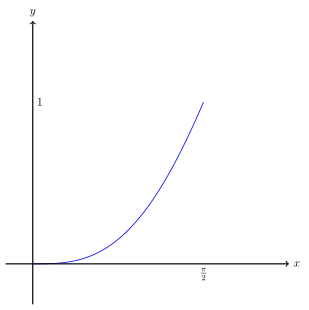
- \(\,\) \begin{align*} \int_0^{\frac{1}{2}\pi}\,y\;\d x &= \int_0^{\frac{1}{2}\pi} (\sin x - x \cos x) \d x \\ &= \left [-\cos x \right]_0^{\frac{1}{2}\pi} +\left [ -x \sin x \right]_0^{\frac{1}{2}\pi} + \int_0^{\frac{1}{2}\pi} \sin x \d x \\ &= 1-\frac{\pi}{2} + 1 = 2 - \frac{\pi}{2} \end{align*}
- \(\,\) \begin{align*} \int_0^{\frac{1}{2}\pi}y^2\d x &= \int_0^{\frac{1}{2}\pi} (\sin x - x \cos x)^2 \d x \\ &= \int_0^{\frac{1}{2}\pi} (\sin^2x - 2x\sin x \cos x+x^2\cos^2 x) \d x\\ &= \int_0^{\frac{1}{2}\pi} (\sin^2x -x \sin 2x+\tfrac12x^2(\cos 2 x + 1)) \d x\\ &= \frac{\pi}{4} + \frac{\pi^3}{48} + \int_0^{\frac{1}{2}\pi} (-x \sin 2x+\tfrac12x^2\cos 2 x) \d x \\ &= \frac{\pi}{4} + \frac{\pi^3}{48} + \left [\frac12 x \cos 2x +\frac14 x^2 \sin2x\right]_0^{\frac{1}{2}\pi}-\int_0^{\frac{1}{2}\pi}(\tfrac12 \cos 2x +\tfrac12 x \sin 2x) \d x\\ &= \frac{\pi}{4} + \frac{\pi^3}{48} - \frac{\pi}{4} - \left [ \frac14 \sin 2x \right]_0^{\frac{1}{2}\pi} - \int_0^{\frac{1}{2}\pi} \tfrac12 x \sin 2x \d x\\ &= \frac{\pi^3}{48} - \left( \left[ -\frac14 x \cos 2x \right]_0^{\frac{1}{2}\pi} - \int_0^{\frac{1}{2}\pi} -\frac14 \cos 2x \d x \right)\\ &= \frac{\pi^3}{48} - \left( \frac{\pi}{8} + \left[ \frac18 \sin 2x \right]_0^{\frac{1}{2}\pi} \right)\\ &= \frac{\pi^3}{48} - \frac{\pi}{8} \end{align*}
2005 Paper 2 Q8
For \(x \ge 0\) the curve \(C\) is defined by $$ {\frac{\d y} {\d x}} = \frac{x^3y^2}{(1 + x^2)^{5/2}} $$ with \(y = 1\) when \(x=0\,\). Show that \[ \frac 1 y = \frac {2+3x^2}{3(1+x^2)^{3/2}} +\frac13 \] and hence that for large positive \(x\) $$ y \approx 3 - \frac 9 x\;. $$ Draw a sketch of \(C\). On a separate diagram, draw a sketch of the two curves defined for \(x \ge 0\) by $$ \frac {\d z} {\d x} = \frac{x^3z^3}{2(1 + x^2)^{5/2}} $$ with \(z = 1\) at \(x=0\) on one curve, and \(z = -1\) at \(x=0\) on the other.
Solution: \begin{align*} && {\frac{\d y} {\d x}} &= \frac{x^3y^2}{(1 + x^2)^{5/2}} \\ \Rightarrow &&\int \frac{1}{y^2} \d y &= \int \frac{x^3}{(1+x^2)^{5/2}} \d x \\ \Rightarrow && -\frac1y &= \int \frac{x^3+x-x}{(1+x^2)^{5/2}} \d x \\ &&&= \int \left ( \frac{x}{(1+x^2)^{3/2}}-\frac{x}{(1+x^2)^{5/2}} \right) \d x \\ &&&= \frac{-1}{(1+x^2)^{1/2}} + \frac{1}{3(1+x^2)^{3/2}} + C \\ &&&= \frac{1-3(1+x^2)}{3(1+x^2)^{3/2}} + C \\ &&&= \frac{-3x^2-2}{3(1+x^2)^{3/2}} + C \\ (x,y) = (0,1): &&-1 &= -\frac23 + C \\ \Rightarrow && C &= -\frac13 \\ \Rightarrow && \frac1y &= \frac{3x^2+2}{3(1+x^2)^{3/2}} + \frac13 \end{align*} \begin{align*} y &= \frac{1}{\frac13 +\frac{3x^2+2}{3(1+x^2)^{3/2}} } \\ &= \frac{3}{1+ \frac{3x^2+2}{3(1+x^2)^{3/2}}} \\ &= \frac{3}{1+ \frac{3}{x} + \cdots} \\ &\approx 3 - \frac{9}{x} \end{align*}


2005 Paper 3 Q7
Show that if \(\displaystyle \int\frac1{u \, \f(u)}\; \d u = \F(u) + c\;\), then \(\displaystyle \int\frac{m}{x \, \f(x^m)} \;\d x = \F(x^m) + c\;\), where \(m\ne0\). Find:
- \(\displaystyle\int\frac1{x^n-x} \, \d x\,\);
- \(\displaystyle\int\frac1 {\sqrt{x^n+x^2}}\, \d x\,\).
Solution: \begin{align*} u = x^m, \d u = m x^{m-1} && \int \frac{m}{x f(x^m)} \d x &= \int \frac{m x^{m-1}}{uf(u)} \d x \\ &&&= \int \frac{1}{u f(u)} \d u \\ &&&= F(u) + c \\ &&&= F(x^m) + c \end{align*}
- \begin{align*} && \int \frac{1}{u(u-1)} \d u &= \int \left ( \frac{1}{u-1}-\frac{1}{u} \right ) \d u \\ &&&= \ln \left ( \frac{u-1}{u} \right) + c \\ &&&= \ln \left ( 1 - \frac{1}{u} \right) + c \\ && \int \frac{1}{x^n - x} \d x &= \int \frac{1}{x (x^{n-1}-1)} \d x \\ f(u) = u - 1: && &= \frac{1}{n-1} \ln \left ( 1 - \frac{1}{x^{n-1}} \right) + c \end{align*}
- \begin{align*} v = \sqrt{u+1}, \d v = \tfrac12 (u+1)^{-1/2} \d u && \int \frac{1}{u\sqrt{u+1}} \d u &= \int \frac{1}{(v^2-1)} (u+1)^{-1/2} \d u \\ &&&= \int \frac{2}{v^2-1} \d v \\ &&&=\ln \frac{1-v}{1+v} + c \\ &&&= \ln \left (\frac{1-\sqrt{u+1}}{1+\sqrt{u+1}} \right)+ c \\ f(u) = \sqrt{x+1}:&& \int \frac{1}{\sqrt{x^n + x^2}} \d x &= \int \frac{1}{x\sqrt{x^{n-2}+1}} \d x \\ &&&= \frac{1}{n-2} \ln \left ( \frac{1-\sqrt{x^{n-2}+1}}{1+\sqrt{x^{n-2}+1}} \right)+c \end{align*}
2005 Paper 3 Q14
In this question, you may use the result \[ \displaystyle \int_0^\infty \frac{t^m}{(t+k)^{n+2}} \; \mathrm{d}t =\frac{m!\, (n-m)!}{(n+1)! \, k^{n-m+1}}\;, \] where \(m\) and \(n\) are positive integers with \(n\ge m\,\), and where \(k>0\,\). The random variable \(V\) has density function \[ \f(x) = \frac{C \, k^{a+1} \, x^a}{(x+k)^{2a+2}} \quad \quad (0 \le x < \infty) \;, \] where \(a\) is a positive integer. Show that \(\displaystyle C = \frac{(2a+1)!}{a! \, a!}\;\). Show, by means of a suitable substitution, that \[ \int_0^v \frac{x^a}{(x+k)^{2a+2}} \; \mathrm{d}x = \int_{\frac{k^2}{v}}^\infty \frac{u^a}{(u+k)^{2a+2}} \; \mathrm{d}u \] and deduce that the median value of \(V\) is \(k\). Find the expected value of \(V\). The random variable \(V\) represents the speed of a randomly chosen gas molecule. The time taken for such a particle to travel a fixed distance \(s\) is given by the random variable \(\ds T=\frac{s}{V}\). Show that \begin{equation} \mathbb{P}( T < t) = \ds \int_{\frac{s}{t}}^\infty \frac{C \, k^{a+1} \, x^a}{(x+k)^{2a+2}}\; \mathrm{d}x \tag{\( *\)} \end{equation} and hence find the density function of \(T\). You may find it helpful to make the substitution \(\ds u = \frac{s}{x}\) in the integral \((*)\). Hence show that the product of the median time and the median speed is equal to the distance \(s\), but that the product of the expected time and the expected speed is greater than \(s\).
Solution: \begin{align*} && f(x) &= \frac{C \, k^{a+1} \, x^a}{(x+k)^{2a+2}} \\ \Rightarrow && 1 &= \int_0^{\infty} f(x) \d x \\ &&&= \int_0^{\infty} \frac{C \, k^{a+1} \, x^a}{(x+k)^{2a+2}} \d x \\ &&&= Ck^{a+1} \int_0^{\infty} \frac{x^a}{(x+k)^{2a+2} }\d x \\ &&&= Ck^{a+1} \frac{a!(2a-a)!}{(2a+1)!k^{2a-a+1}} \\ &&&= C \frac{a!a!}{(2a+1)!} \\ \Rightarrow && C &= \frac{(2a+1)!}{a!a!} \end{align*} \begin{align*} && I &= \int_0^v \frac{x^a}{(x+k)^{2a+2}} \d x\\ u = k^2/x, \d x = -k^2u^{-2} \d u: &&&= \int_{u = +\infty}^{u = k^2/v} \frac{k^{2a}u^{-a}}{(k^2u^{-1} +k)^{2a+2}}(-k^2u^{-2}) \d u \\ &&&= \int_{u = +\infty}^{u = k^2/v} \frac{k^{2a-2a-2}u^{2a+2-a}}{(k +u)^{2a+2}}(-k^2u^{-2}) \d u \\ &&&= \int_{ k^2/v}^{\infty} \frac{u^{a}}{(k +u)^{2a+2}} \d u \\ \end{align*} At the median we want a value \(M\) such that \(M = k^2/M\) ie \(M = k\) \begin{align*} && \mathbb{E}(V) &= \int_0^{\infty} x f(x) \d x \\ &&&= \frac{(2a+1)!k^{a+1}}{a!a!} \int_0^{\infty} \frac{x^{a+1}}{(x+k)^{2a+2}} \d x \\ &&&= \frac{(2a+1)!k^{a+1}}{a!a!} \frac{(a+1)!(2a-(a+1))!}{(2a+1)!k^{2a-(a+1)+1}}\\ &&&= \frac{k^{a+1}}{a!} \frac{(a+1)(a-1)!}{k^{a}} \\ &&&= \frac{k(a+1)}{a} = \frac{a+1}a k \end{align*} \begin{align*} && \mathbb{P}(T < t) &= \mathbb{P}(\frac{s}{V} < t) \\ &&&= \mathbb{P}(V > \frac{s}{t}) \\ &&&= \int_{s/t}^{\infty} f(x) \d x \\ &&&= \int_{s/t}^{\infty} \frac{C \, k^{a+1} \, x^a}{(x+k)^{2a+2}} \d x \\ \\ \Rightarrow && f_T(t) &= \frac{\d}{\d t} \left ( \mathbb{P}(T < t)\right) \\ &&&= \frac{\d}{\d t} \left ( \int_{s/t}^{\infty} \frac{C \, k^{a+1} \, x^a}{(x+k)^{2a+2}} \d x \right) \\ &&&= - \frac{C \, k^{a+1} \, \left ( \frac{s}{t} \right)^a}{(\frac{s}{t}+k)^{2a+2}} \cdot \left (-\frac{s}{t^2} \right) \\ &&&= \frac{Ck^{a+1}s^{a+1}t^{2a+2}}{t^{a+2}(s+kt)^{2a+2}} \\ &&&= \frac{C(ks)^{a+1}t^a}{(s+kt)^{2a+2}} \\ &&&= \frac{C(\frac{s}{k})^{a+1}t^a}{(\frac{s}{k}+t)^{2a+2}} \end{align*} Therefore \(T\) follows the same distribution, but with parameter \(s/k\) rather than \(k\). In particular it has median \(s/k\) (and the product of the medians is \(s\)). However, the product of the expected time and expected speed is \(\frac{a+1}{a} k \frac{a+1}{a} \frac{s}{k} = \left ( \frac{a+1}{a} \right)^2s > s\)
2004 Paper 1 Q2
The square bracket notation \(\boldsymbol{[} x\boldsymbol{]}\) means the greatest integer less than or equal to \(x\,\). For example, \(\boldsymbol{[}\pi\boldsymbol{]} = 3\,\), \(\boldsymbol{[}\sqrt{24}\,\boldsymbol{]} = 4\,\) and \(\boldsymbol{[}5\boldsymbol{]}=5\,\).
- Sketch the graph of \(y = \sqrt{\boldsymbol{[}x\boldsymbol{]}}\) and show that \[ \displaystyle \int^a_0 \sqrt{\boldsymbol{[}x\boldsymbol{]}} \; \mathrm{d}x = \sum^{a-1}_{r=0} \sqrt{r} \] when \(a\) is a positive integer.
- Show that $\displaystyle \int^{a}_0 2_{\vphantom{A}}^{\pmb{\boldsymbol {[} } x \pmb{ \boldsymbol{]}} }\; \mathrm{d}x = 2^{a}-1\( when \)a\( is a positive integer.
- Determine an expression for \)\displaystyle \int^{a}_0 2_{\vphantom{\dot A}}^{\pmb{\boldsymbol{[} }x \pmb{ \boldsymbol{]}} } \; \mathrm{d}x\( when \)a$ is positive but not an integer.
Solution:
- \(\,\) \begin{align*} && \int_0^a \sqrt{\boldsymbol{[}x\boldsymbol{]}} \d x &= \sum_{r=0}^{a-1} \int_{x=r}^{x=r+1} \sqrt{\boldsymbol{[}x\boldsymbol{]}} \d x \\ &&&= \sum_{r=0}^{a-1} \int_r^{r+1} \sqrt{r} \d x \\ &&&= \sum_{r=0}^{a-1} \sqrt{r} \\ \end{align*}
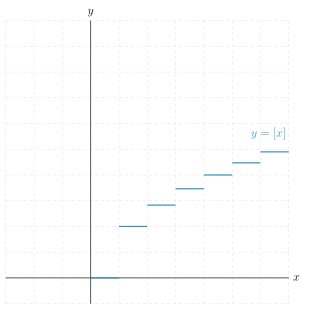
- \(\,\) \begin{align*} && \int^{a}_0 2^{\boldsymbol {[} x \boldsymbol{]}} \d x &= \sum_{r=0}^{a-1} \int_{x=r}^{x=r+1} 2^{\boldsymbol {[} x \boldsymbol{]}} \d x \\ &&&= \sum_{r=0}^{a-1} \int_{x=r}^{x=r+1} 2^{r} \d x \\ &&&= \sum_{r=0}^{a-1} 2^{r}\\ &&&= 2^{a}-1 \end{align*}
- \(\,\) \begin{align*} && \int^{a}_0 2^{\boldsymbol {[} x \boldsymbol{]}} \d x &= \int_0^{\boldsymbol {[} a \boldsymbol{]}} 2^{\boldsymbol {[} x \boldsymbol{]}} \d x + \int_{\boldsymbol {[} a \boldsymbol{]}}^a 2^{\boldsymbol {[} x \boldsymbol{]}} \d x \\ &&&= 2^{ \boldsymbol {[} a \boldsymbol{]}}-1 + (a-\boldsymbol {[} a \boldsymbol{]})2^{\boldsymbol {[} a \boldsymbol{]}} \\ &&&= (a-\boldsymbol {[} a \boldsymbol{]}+1)2^{\boldsymbol {[} a \boldsymbol{]}} -1 \end{align*}
2004 Paper 1 Q4
Differentiate \(\sec {t}\) with respect to \(t\).
- Use the substitution \(x=\sec t\) to show that $\displaystyle \int^2_{\sqrt 2} \frac{1}{ x^3\sqrt {x^2-1} } \; \mathrm{d}x =\frac{\sqrt 3 - 2}{8} + \frac {\pi}{24} \;.$
- Determine $\displaystyle \int \frac{1} {( x+2) \sqrt {(x+1)(x+3)} } \; \mathrm{d}x \;$.
- Determine $\displaystyle \int \frac {1} {(x+2) \sqrt {x^2+4x-5} } \; \mathrm{d}x \;$.
Solution: \[\frac{\d}{\d t} \left ( \sec t \right) = \frac{\sin t }{\cos^2 t} = \sec t \tan t \]
- \(\,\) \begin{align*} && I_1 &= \int_{\sqrt{2}}^2 \frac{1}{x^3 \sqrt{x^2-1}} \\ x = \sec t, \d x = \sec t \tan t:&&&= \int_{t=\pi/4}^{t=\pi/3} \frac{1}{\sec^3 t \tan t} \sec t \tan t \d t \\ &&&= \int_{t=\pi/4}^{t=\pi/3} \cos^2 t \d t \\ &&&= \int_{t=\pi/4}^{t=\pi/3} \frac{1+\cos 2t}{2} \d t \\ &&&= \frac12 \frac{\pi}{12} + \frac12 \left (\sin \frac{\pi}{3} - \sin \frac{\pi}{4} \right) \\ &&&= \frac{\pi}{24} + \frac{\sqrt{3}-2}{8} \\ \end{align*}
- \(\,\) \begin{align*} && I_2 &= \int \frac{1}{(x+2)\sqrt{(x+1)(x+3)}} \d x \\ &&&= \int \frac{1}{(x+2)\sqrt{(x+2)^2-1}} \d x \\ &&&= \int \frac{1}{u\sqrt{u^2-1}} \d u \\ &&&= \sec^{-1} u + C \\ &&&= \sec^{1} (x+2) + C \end{align*}
- \(\,\) \begin{align*} && I_3 &= \int \frac{1}{(x+2)\sqrt{(x+2)^2 - 9}} \d x \\ &&&= \int\frac{1}{9(\frac{x+2}{3})\sqrt{(\frac{x+2}3)^2 - 1}} \d x \\ u = \frac{x+2}{3}, 3\d u =\d x &&&= \frac19 \int \frac{1}{u\sqrt{u^2-1}} 3 \d u \\ &&&= \frac13 \sec^{-1} u + C \\ &&&= \frac13 \sec^{-1} \frac{x+2}{3} + C \end{align*}
2004 Paper 2 Q5
Evaluate \(\int_0^{{\pi}} x \sin x\,\d x\) and \(\int_0^{{\pi}} x \cos x\,\d x\;\). The function \(\f\) satisfies the equation \begin{equation} \f(t)=t + \int_0^{{\pi}} \f(x)\sin(x+t)\,\d x\;. \tag{\(*\)} \end{equation} Show that \[ \f(t)=t + A\sin t + B\cos t\;, \] where \(A= \int_0^{{\pi}}\,\f(x)\cos x\,\d x\;\) and \(B= \int_0^{{\pi}}\,\f(x)\sin x\,\d x\;\). Find \(A\) and \(B\) by substituting for \(\f(t)\) and \(\f(x)\) in \((*)\) and equating coefficients of \(\sin t\) and \(\cos t\,\).
Solution: \begin{align*} && I &= \int_0^\pi x \sin x \d x \\ &&&= \left [ -x \cos x \right]_0^\pi + \int_0^{\pi} \cos x \d x \\ &&&= \pi \\ \\ && J &= \int_0^\pi x \cos x \d x \\ &&&= \left [ x \sin x \right]_0^\pi - \int_0^\pi \sin x \d x \\ &&&= -2 \end{align*} \begin{align*} && f(t) &= t + \int_0^\pi f(x) \sin (x+t) \d x \\ &&&= t + \int_0^\pi f(x) \left ( \sin t \cos x + \cos t \sin x \right) \d x \\ &&&= t + \sin t \int_0^{\pi} f(x) \cos x \d x + \cos t \int_0^{\pi} f(x) \sin x \d x \\ \\ && A &= \int_0^\pi (x + A \sin x + B \cos x) \cos x \d x \\ &&&= -2+ \frac{\pi}{2} B \\ && B &= \int_0^{\pi} (x + A \sin x + B \cos x ) \sin x \d x \\ &&&= \pi + \frac{\pi}{2} A \\ \Rightarrow && (A,B) &= (-2,0) \end{align*}
2004 Paper 2 Q12
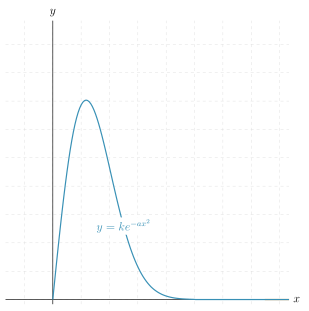
Sketch the graph, for \(x \ge 0\,\), of $$ y = kx\e^{-ax^2} \;, $$ where \(a\) and \(k\) are positive constants. The random variable \(X\) has probability density function \(\f(x)\) given by \begin{equation*} \f(x)= \begin{cases} kx\e^{-ax^2} & \text{for \(0 \le x \le 1\)}\\[3pt] 0 & \text{otherwise}. \end{cases} \end{equation*} Show that \(\displaystyle k=\frac{2a}{1-\e^{-a}}\) and find the mode \(m\) in terms of \(a\,\), distinguishing between the cases \(a < \frac12\) and \(a > \frac12\,\). Find the median \(h\) in terms of \(a\), and show that \(h > m\) if \(a > -\ln\left(2\e^{-1/2} - 1\right).\) Show that, \(-\ln\left(2\e^{-1/2}-1\right)> \frac12 \,\). Show also that, if \(a > -\ln\left(2\e^{-1/2} - 1\right) \,\), then $$ P(X > m \;\vert\; X < h) = {{2\e^{-1/2}-\e^{-a}-1} \over 1-\e^{-a}}\;. $$
Solution: