Problems
Filters
112 problems found
1995 Paper 1 Q2
- Suppose that \[ S=\int\frac{\cos x}{\cos x+\sin x}\,\mathrm{d}x\quad\mbox{ and }\quad T=\int\frac{\sin x}{\cos x+\sin x}\,\mathrm{d}x. \] By considering \(S+T\) and \(S-T\) determine \(S\) and \(T\).
- Evaluate \({\displaystyle \int_{\frac{1}{4}}^{\frac{1}{2}}(1-4x)\sqrt{\frac{1}{x}-1}\,\mathrm{d}x}\) by using the substitution \(x=\sin^{2}t.\)
Solution:
- \begin{align*} && S + T &= \int \frac{\cos x + \sin x }{\cos x + \sin x} \d x \\ &&&= \int \d x \\ &&&= x + C \\ && S - T &= \int \frac{\cos x - \sin x}{\cos x + \sin x} \d x \\ &&&= \ln( \cos x + \sin x) + C \\ \Rightarrow && 2S &= x + \ln(\cos x + \sin x) + C \\ \Rightarrow && S &= \frac12 \left ( x + \ln(\cos x + \sin x) \right) + C \\ \Rightarrow && 2T &= x - \ln(\cos x + \sin x) + C \\ \Rightarrow && T &= \frac12 \left ( x - \ln(\cos x + \sin x) \right) + C \end{align*}
- \begin{align*} && I &= \int_{1/4}^{1/2} (1-4x)\sqrt{\frac1x-1} \d x \\ x = \sin^2 t, \d x = 2 \sin t \cos t \d t: &&&= \int_{\pi/6}^{\pi/4} (1-4\sin^2 t) \sqrt{\frac{1-\sin^2 t}{\sin^2 t}} 2 \sin t \cos t \d t\\ &&&=\int_{\pi/6}^{\pi/4} (1-4\sin^2 t)\frac{\cos t}{\sin t} 2 \sin t \cos t \d t \\ &&&= \int_{\pi/6}^{\pi/4} (1-4\sin^2 t) 2 \cos^2 t \d t \\ &&&= \int_{\pi/6}^{\pi/4} \left ( 2\cos^2t - 8 \sin^2t \cos^2 t \right) \d t \\ &&&= \int_{\pi/6}^{\pi/4} \left ( 1+\cos2t - 2 \sin^2 2t \right) \d t \\ &&&= \int_{\pi/6}^{\pi/4} \left ( 1+\cos2t +(\cos 4t-1)\right) \d t \\ &&&= \left[\frac12 \sin 2t + \frac14 \sin 4t \right]_{\pi/6}^{\pi/4} \\ &&&= \left ( \frac12 \right) - \left (\frac12 \frac{\sqrt{3}}{2} + \frac14 \frac{\sqrt{3}}{2} \right) \\ &&&= \frac{4-3\sqrt{3}}{8} \end{align*}
1995 Paper 1 Q5
If \[ \mathrm{f}(x)=nx-\binom{n}{2}\frac{x^{2}}{2}+\binom{n}{3}\frac{x^{3}}{3}-\cdots+(-1)^{r+1}\binom{n}{r}\frac{x^{r}}{r}+\cdots+(-1)^{n+1}\frac{x^{n}}{n}\,, \] show that \[ \mathrm{f}'(x)=\frac{1-(1-x)^{n}}{x}\,. \] Deduce that \[ \mathrm{f}(x)=\int_{1-x}^{1}\frac{1-y^{n}}{1-y}\,\mathrm{d}y. \] Hence show that \[ \mathrm{f}(1)=1+\frac{1}{2}+\frac{1}{3}+\cdots+\frac{1}{n}\,. \]
Solution: \begin{align*} f(x) & =nx-\binom{n}{2}\frac{x^{2}}{2}+\binom{n}{3}\frac{x^{3}}{3}-\cdots+(-1)^{r+1}\binom{n}{r}\frac{x^{r}}{r}+\cdots+(-1)^{n+1}\frac{x^{n}}{n} \\ f'(x) &= n - \binom{n}{2} x + \binom{n}{3}x^2 - \cdots (-1)^{r+1} \binom{n}{r} + \cdots + (-1)^{n+1} x^{n-1} \\ &= \frac{1-(1-x)^n}{x} \end{align*} Therefore, since \(\displaystyle f(x) = \int_0^xf'(t)\,dt\) \begin{align*} f(x) &= \int_0^x \frac{1 - (1-t)^n}{t} \, dt \\ &= \int_{1}^{1-x} \frac{1-y^n}{1-y} (-1)\, dy \tag{Let \(y = 1-t, \frac{dy}{dt} = -1\)} \\ &= \boxed{\int_{1-x}^1 \frac{1-y^n}{1-y} dy} \\ &= \int_{1-x}^1 \l 1 + y + y^2 + \cdots + y^{n-1} \r \, dy \\ &= \left [ y + \frac{y^2}{2} + \frac{y^3}{3} + \cdots + \frac{y^n}{n} \right]_{1-x}^1 \\ \end{align*} So when \(x = 1, 1-x = 0\) so we exactly have the sum required.
1995 Paper 1 Q6
- In the differential equation \[ \frac{1}{y^{2}}\frac{\mathrm{d}y}{\mathrm{d}x}+\frac{1}{y}=\mathrm{e}^{2x} \] make the substitution \(u=1/y,\) and hence show that the general solution of the original equation is \[ y=\frac{1}{A\mathrm{e}^{x}-\mathrm{e}^{2x}}\,. \]
- Use a similar method to solve the equation \[ \frac{1}{y^{3}}\frac{\mathrm{d}y}{\mathrm{d}x}+\frac{1}{y^{2}}=\mathrm{e}^{2x}. \]
Solution:
- \(,\) \begin{align*} u = 1/y, \frac{\d u}{\d x} = -1/y^2 y': && -\frac{\d u}{\d x} + u &= e^{2x} \\ \Rightarrow && \frac{\d}{\d x} \left (e^{-x}u \right) = -e^{x} \\ \Rightarrow && e^{-x}u &= -e^x+C \\ \Rightarrow && u &= Ce^x-e^{2x} \\ \Rightarrow && y &= \frac{1}{Ce^x-e^{2x}} \end{align*}
- \(\,\) \begin{align*} u = 1/y^2, u' = -2/y^3 y': && -2u'+u &= e^{2x} \\ \Rightarrow && \frac{\d}{\d x} \left (e^{-1/2x}u\right) &= -\frac12e^{\frac32x} \\ \Rightarrow && e^{-\frac12x}u &= -\frac13e^{\frac32x}+C \\ \Rightarrow && u &= -\frac13e^{2x}+Ce^{\frac12x} \\ \Rightarrow && y &= \left ( \frac{1}{Ce^{\frac12x}-\frac13e^{2x}}\right)^{\frac12} \end{align*}
1995 Paper 2 Q8
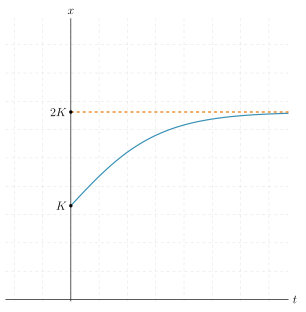
If there are \(x\) micrograms of bacteria in a nutrient medium, the population of bacteria will grow at the rate \((2K-x)x\) micrograms per hour. Show that, if \(x=K\) when \(t=0\), the population at time \(t\) is given by \[ x(t)=K+K\frac{1-\mathrm{e}^{-2Kt}}{1+\mathrm{e}^{-2Kt}}. \] Sketch, for \(t\geqslant0\), the graph of \(x\) against \(t\). What happens to \(x(t)\) as \(t\rightarrow\infty\)? Now suppose that the situation is as described in the first paragraph, except that we remove the bacteria from the nutrient medium at a rate \(L\) micrograms per hour where \(K^{2}>L\). We set \(\alpha=\sqrt{K^{2}-L}.\) Write down the new differential equation for \(x\). By considering a new variable \(y=x-K+\alpha,\) or otherwise, show that, if \(x(0)=K\) then \(x(t)\rightarrow K+\alpha\) as \(t\rightarrow\infty\).
Solution: \begin{align*} && \dot{x} &= (2K-x)x \\ \Rightarrow && \int \d t &= \int \frac{1}{(2K-x)x} \d x \\ &&&= \int \frac1{2K}\left ( \frac{1}{2K-x} + \frac{1}{x} \right) \d x \\ &&&= \frac{1}{2K} \left (\ln x - \ln (2K-x) \right) \\ \Rightarrow && 2Kt+C &= \ln \frac{x}{2K-x} \\ t = 0, x = K: && C &= \ln \frac{K}{2K-K} = 0 \\ \Rightarrow && e^{2Kt} &= \frac{x}{2K-x} \\ \Rightarrow && e^{-2Kt} &= \frac{2K}{x} -1 \\ \Rightarrow && x &= \frac{2K}{1+e^{-2Kt}} \\ &&&= K + K \frac{1-e^{-2Kt}}{1+e^{-2Kt}} \end{align*}
1994 Paper 1 Q8
By means of the change of variable \(\theta=\frac{1}{4}\pi-\phi,\) or otherwise, show that \[ \int_{0}^{\frac{1}{4}\pi}\ln(1+\tan\theta)\,\mathrm{d}\theta=\tfrac{1}{8}\pi\ln2. \] Evaluate \[ {\displaystyle \int_{0}^{1}\frac{\ln(1+x)}{1+x^{2}}\,\mathrm{d}x}\qquad\mbox{ and }\qquad{\displaystyle \int_{0}^{\frac{1}{2}\pi}\ln\left(\frac{1+\sin x}{1+\cos x}\right)\,\mathrm{d}x}. \]
Solution: \begin{align*} && I &= \int_0^{\frac14\pi} \ln (1 + \tan \theta) \d \theta \\ \theta = \tfrac14\pi - \phi, \d \theta = -\d\phi: &&&= \int_0^{\frac14 \pi} \ln ( 1 + \tan (\tfrac14\pi - \phi)) \d \phi \\ &&&= \int_0^{\frac14 \pi} \ln \left ( 1 + \frac{1 - \tan \phi}{1+\tan \phi} \right) \d \phi \\ &&&= \int_0^{\frac14 \pi} \ln \left ( \frac{2}{1+\tan \phi} \right) \d \phi \\ &&&= \tfrac14 \pi \ln 2 - I \\ \Rightarrow && I &= \tfrac18\pi \ln 2 \end{align*} \begin{align*} && J &= \int_0^1 \frac{\ln(1+x)}{1+x^2} \d x \\ x= \tan \theta \d \theta, \d \theta = \frac{\d x}{1+x^2} &&&= \int_0^{\frac14 \pi} \ln(1 + \tan \theta) \d \theta \\ &&&= \tfrac18 \pi \ln 2 \end{align*} \begin{align*} && K &= \int_0^{\frac12 \pi} \ln \left ( \frac{1 + \sin x}{1 + \cos x} \right) \d x \\ y = \tfrac12\pi - x, \d y = -\d x: &&&= \int_0^{\frac12\pi} \ln \left ( \frac{1+\cos y}{1+\sin y}\right) \d y \\ &&&= -K \\ \Rightarrow && K &= 0 \end{align*}
1994 Paper 3 Q2
- By setting \(y=x+x^{-1},\) find the solutions of \[ x^{4}+10x^{3}+26x^{2}+10x+1=0. \]
- Solve \[ x^{4}+x^{3}-10x^{2}-4x+16=0. \]
Solution:
- \begin{align*} && x^{4}+10x^{3}+26x^{2}+10x+1 &= 0 \\ \Leftrightarrow && x^2 + 10x + 26 + 10x^{-1} + x^{-2} &= 0 \\ \Leftrightarrow && (x^2 + x^{-2} + 2) + 10(x+x^{-1}) + 24 &= 0 \\ \Leftrightarrow && y^2 + 10y + 24 &= 0 \tag{\(y = x + x^{-1}\)} \\ \Leftrightarrow && (y+6)(y+4) &= 0 \\ \Leftrightarrow && \begin{cases} x+x^{-1} = -4 \\ x+x^{-1} = -6 \\ \end{cases} \\ \Leftrightarrow && \begin{cases} x^2+4x+1 = 0 \\ x^2+6x+1 = 0 \\ \end{cases} \\ \Leftrightarrow && \boxed{\begin{cases} x = -2 \pm \sqrt{3} \\ x = -3 \pm 2\sqrt{2} \\ \end{cases}} \\ \end{align*}
- \begin{align*} && x^{4}+x^{3}-10x^{2}-4x+16=0 &= 0 \\ \Leftrightarrow && x^2 + x - 10 - 4x^{-1} + 4x^{-2} &= 0 \\ \Leftrightarrow && (x^2+4x^{-2} - 4) + (x - 4x^{-1}) - 6 &= 0 \\ \Leftrightarrow && (x^2+4x^{-2} - 4) + (x - 4x^{-1}) - 6 &= 0 \\ \Leftrightarrow && z^2 + z - 6 &= 0 \tag{\(z = x -2x^{-1}\)} \\ \Leftrightarrow && (z+3)(z-2) &= 0 \\ \Leftrightarrow && \begin{cases} x-2x^{-1} = -3 \\ x-2x^{-1} = 2 \\ \end{cases} \\ \Leftrightarrow && \begin{cases} x^2+3x-2 = 0 \\ x^2-2x-2 = 0 \\ \end{cases} \\ \Leftrightarrow && \boxed{\begin{cases} x = \frac{-3 \pm \sqrt{17}}{2} \\ x = 1 \pm \sqrt{3} \\ \end{cases}} \\ \end{align*}
1993 Paper 1 Q4
By making the change of variable \(t=\pi-x\) in the integral \[ \int_{0}^{\pi}x\mathrm{f}(\sin x)\,\mathrm{d}x, \] or otherwise, show that, for any function \(\mathrm{f},\) \[ \int_{0}^{\pi}x\mathrm{f}(\sin x)\,\mathrm{d}x=\frac{\pi}{2}\int_{0}^{\pi}\mathrm{f}(\sin x)\,\mathrm{d}x\,. \] Evaluate \[ \int_{0}^{\pi}\frac{x\sin x}{1+\cos^{2}x}\,\mathrm{d}x\quad\mbox{ and }\quad\int_{0}^{2\pi}\frac{x\sin x}{1+\cos^{2}x}\,\mathrm{d}x\,. \]
Solution: \begin{align*} && I &= \int_0^{\pi} x f(\sin x) \d x \\ t = \pi - x, \d t = -\d t : &&&= \int_{t = \pi}^{t = 0} (\pi - t) f(\sin (\pi - t)) -\d t \\ &&&= \int_0^{\pi} (\pi - t) f(\sin t) \d t \\ \Rightarrow && 2 I &= \pi \int_0^\pi f(\sin t) \d t \\ \Rightarrow && I &= \frac{\pi}{2} \int_0^{\pi} f(\sin x) \d x \end{align*} \begin{align*} && I &= \int_{0}^{\pi}\frac{x\sin x}{1+\cos^{2}x}\,\mathrm{d}x \\ &&&= \frac{\pi}{2}\int_0^\pi \frac{\sin x}{1 + \cos^2 x} \d x \\ &&&= \frac{\pi}{2}\left [ -\tan^{-1} \cos x\right]_0^{\pi} \\ &&&= \tan 1 - \tan (-1) = \frac{\pi^2}{4} \\ \\ && I &= \int_{0}^{2\pi}\frac{x\sin x}{1+\cos^{2}x}\,\mathrm{d}x \\ &&&= \int_{0}^{\pi}\frac{x\sin x}{1+\cos^{2}x}\,\mathrm{d}x + \int_{\pi}^{2\pi} \frac{x\sin x}{1+\cos^{2}x}\,\mathrm{d}x \\ u = x - \pi, \d u = \d x: &&&= \frac{\pi^2}{4} + \int_{0}^{\pi} \frac{(u+\pi)(-\sin u)}{1 + \cos^2 u}\d u \\ &&&= \frac{\pi^2}{4} -\frac{3\pi}{2} \int_0^{\pi} \frac{\sin u}{1+\cos^2 u} \d u \\ &&&= - \frac{\pi^2}2 \end{align*}
1993 Paper 1 Q16
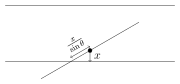
By making the substitution \(y=\cos^{-1}t,\) or otherwise, show that \[ \int_{0}^{1}\cos^{-1}t\,\mathrm{d}t=1. \] A pin of length \(2a\) is thrown onto a floor ruled with parallel lines equally spaced at a distance \(2b\) apart. The distance \(X\) of its centre from the nearest line is a uniformly distributed random variable taking values between \(0\) and \(b\) and the acute angle \(Y\) the pin makes with a direction perpendicular to the line is a uniformly distributed random variable taking values between \(0\) and \(\pi/2\). \(X\) and \(Y\) are independent. If \(X=x\) what is the probability that the pin crosses the line? If \(a < b\) show that the probability that the pin crosses a line for a general throw is \(\dfrac{2a}{\pi b}.\)
Solution: \begin{align*} && I &= \int_0^1 \cos^{-1} t \d t \\ \cos y = t: -\sin y \d y = \d t: &&&= \int_{\frac{\pi}{2}}^0 -y \sin y \d y \\ &&&= \int_0^{\pi/2} y \sin y \d y \\ &&&= \left [-y \cos y \right]_0^{\pi/2} + \int_0^{\pi/2} \cos y \d y \\ &&&= \left [ \sin y \right]_0^{\pi/2} = 1 \end{align*}
1993 Paper 2 Q2
- Evaluate \[ \int_{0}^{2\pi}\cos(mx)\cos(nx)\,\mathrm{d}x, \] where \(m,n\) are integers, taking into account any special cases that arise.
- Find \({\displaystyle \int\sqrt{1+\frac{1}{x}}\,\mathrm{d}x}.\)
1993 Paper 2 Q3
- Solve the differential equation \[ \frac{\mathrm{d}y}{\mathrm{d}x}-y-3y^{2}=-2 \] by making the substitution \(y=-\dfrac{1}{3u}\dfrac{\mathrm{d}u}{\mathrm{d}x}.\)
- Solve the differential equation \[ x^{2}\frac{\mathrm{d}y}{\mathrm{d}x}+xy+x^{2}y^{2}=1 \] by making the substitution \[ y=\frac{1}{x}+\frac{1}{v}, \] where \(v\) is a function of \(x\).
1991 Paper 1 Q8
- By a substitution of the form \(y=k-x\) for suitable \(k\), prove that, for any function \(\mathrm{f}\), \[ \int_{0}^{\pi}x\mathrm{f}(\sin x)\,\mathrm{d}x=\pi\int_{0}^{\frac{1}{2}\pi}\mathrm{f}(\sin x)\,\mathrm{d}x. \] Hence or otherwise evaluate \[ \int_{0}^{\pi}\frac{x}{2+\sin x}\,\mathrm{d}x. \]
- Evaluate \[ \int_{0}^{1}\frac{(\sin^{-1}t)\cos\left[(\sin^{-1}t)^{2}\right]}{\sqrt{1-t^{2}}}\,\mathrm{d}t. \] {[}No credit will be given for numerical answers obtained by use of a calculator.{]}
Solution:
- \begin{align*} y = \pi - x, \d y = -\d x: && \int_0^{\pi} x f(\sin x) &= \int_{y = \pi}^{y = 0}(\pi - y) f(\sin(\pi-y))- \d y \\ &&&= \int_0^{\pi} (\pi -y) f(\sin y) \d y \\ \Rightarrow && 2 \int_0^{\pi} x f(\sin x)\d x &= \pi \int_0^{\pi} f(\sin x) \d x \\ &&&= \pi \int_0^{\pi/2} f(\sin x ) \d x + \pi \int_{\pi/2}^{\pi} f(\sin x ) \d x \\ &&&= \pi \int_0^{\pi/2} f(\sin x ) \d x +\pi \int_{y=\pi/2}^{y=0} f(\sin (\pi-y) ) (-\d y) \\ &&&= 2 \pi \int_0^{\pi/2} f(\sin x) \d x \\ \Rightarrow && \int_0^{\pi} x f(\sin x)\d x &= \pi \int_0^{\pi/2} f(\sin x) \d x \end{align*} Therefore if \(f(x) = \frac1{2+\sin x}\), letting \(t = \tan \frac{x}{2}\) we have \(\sin x = \frac{2 t}{1+t^2}, \frac{dt}{\d x} = \frac12 (1+t^2)\) \begin{align*} && \int_0^{\pi} \frac{x}{2 + \sin x } \d x &= \pi \int_0^{\pi/2} \frac{1}{2 + \sin x} \d x \\ &&&= \pi \int_{t = 0}^{t = 1} \frac{1}{2+\frac{2t}{1+t^2}} \frac{2}{1+t^2} \d t \\ &&&=\pi \int_0^1 \frac{2}{2t^2+2t+2} \d t\\ &&&=\pi \int_0^1 \frac{1}{(t+\tfrac12)^2 + \tfrac34} \d t\\ &&&= \pi \left [\frac{1}{\sqrt{3/4}} \tan^{-1} \frac{u}{\sqrt{3/4}} \right ]_{u=1/2}^{3/2} \\ &&&= \frac{2 \pi}{\sqrt{3}} \left ( \tan^{-1} \sqrt{3} - \tan^{-1} \frac1{\sqrt{3}} \right) \\ &&&= \frac{2 \pi}{\sqrt{3}} \left ( \frac{\pi}{3} - \frac{\pi}{6} \right) \\ &&&= \frac{\pi^2}{3\sqrt{3}} \end{align*}
- Let \(u = (\sin^{-1} t)^2, \frac{\d u}{\d t} = 2(\sin^{-1} t) \frac{1}{\sqrt{1-t^2}}\) \begin{align*} \int_{0}^{1}\frac{(\sin^{-1}t)\cos\left[(\sin^{-1}t)^{2}\right]}{\sqrt{1-t^{2}}}\,\mathrm{d}t &= \int_{u=0}^{\pi^2/4} \frac12 \cos u \d u \\ &= \frac12 \sin \frac{\pi^2}{4} \end{align*}
1991 Paper 2 Q7
The function \(\mathrm{g}\) satisfies, for all positive \(x\) and \(y\), \[ \mathrm{g}(x)+\mathrm{g}(y)=\mathrm{g}(z),\tag{*} \] where \(z=xy/(x+y+1).\) By treating \(y\) as a constant, show that \[ \mathrm{g}'(x)=\frac{y^{2}+y}{(x+y+1)^{2}}\mathrm{g}'(z)=\frac{z(z+1)}{x(x+1)}\mathrm{g}'(z), \] and deduce that \(2\mathrm{g}'(1)=(u^{2}+u)\mathrm{g}'(u)\) for all \(u\) satisfying \(0 < u < 1.\) Now by treating \(u\) as a variable, show that \[ \mathrm{g}(u)=A\ln\left(\frac{u}{u+1}\right)+B, \] where \(A\) and \(B\) are constants. Verify that \(\mathrm{g}\) satisfies \((*)\) for a suitable value of \(B\). Can \(A\) be determined from \((*)\)? The function \(\mathrm{f}\) satisfies, for all positive \(x\) and \(y\), \[ \mathrm{f}(x)+\mathrm{f}(y)=\mathrm{f}(z) \] where \(z=xy.\) Show that \(\mathrm{f}(x)=C\ln x\) where \(C\) is a constant.
Solution: Note that \(z = xy/(x+y+1) \Rightarrow y(x-z) = z(x+1)\) \begin{align*} && g(x) + g(y) &= g(z) \\ \Rightarrow && g'(x) &= g'(z) \cdot \frac{y(x+y+1) - xy \cdot 1} {(x+y+1)^2} \\ &&&= g'(z) \frac{y^2+y}{(x+y+1)^2} \\ &&&= g'(z) \frac{z^2(y^2+y)}{x^2y^2} \\ &&&= g'(z) \frac{z^2(y+1)}{x^2y} \\ &&&= g'(z) \frac{z^2}{x^2} \left (1 + \frac{x-z}{z(x+1)} \right) \\ &&&= g'(z) \frac{z}{x^2} \frac{zx+x}{x+1} \\ &&&= g'(z) \frac{z(z+1)}{x(x+1)} \end{align*} If \(x = 1\) then as \(y\) ranges from \(0\) to \(\infty\), \(z\) ranges from \(0\) to \(1\), so \(g'(1) = \frac{z(z+1)}{1(1+1)}g'(z)\), ie \(2g'(1) = (u^2+u)g'(u)\). \begin{align*} && g'(u) &= \frac{A}{u(u+1)} \\ \Rightarrow && g(u) &= A\int \left ( \frac{1}{u} - \frac{1}{u+1} \right) \d u \\ &&&= A \left ( \ln u - \ln(u+1) \right) + B \\ &&&= A \ln \left ( \frac{u}{u+1} \right) + B \\ \\ && A \ln \left ( \frac{x}{x+1} \right) + B+A \ln \left ( \frac{y}{y+1} \right) + B &=A \ln \left ( \frac{z}{z+1} \right) + B \\ \Rightarrow && B &= A \ln \left ( \frac{z}{z+1} \frac{y+1}{y} \frac{x+1}{x} \right) \\ &&&= A \ln \left ( \frac{1}{1+\frac{x+y+1}{xy}} \frac{(y+1)(x+1)}{xy} \right) \\ &&&= A \ln 1 \\ &&& = 0 \end{align*} Therefore \(B = 0\). \(A\) cannot be determined from \((*)\). Suppose \(f(x) + f(y) = f(z)\), then \(f'(x) = yf'(z)\). Letting \(x = 1\) we find \(f'(1) = uf'(u) \Rightarrow f(u) = C \ln u + D\), but \(D = 0\) so \(f(x) = C \ln x\)
1991 Paper 2 Q8
Solve the quadratic equation \(u^{2}+2u\sinh x-1=0\), giving \(u\) in terms of \(x\). Find the solution of the differential equation \[ \left(\frac{\mathrm{d}y}{\mathrm{d}x}\right)^{2}+2\frac{\mathrm{d}y}{\mathrm{d}x}\sinh x-1=0 \] which satisfies \(y=0\) and \(y'>0\) at \(x=0\). Find the solution of the differential equation \[ \sinh x\left(\frac{\mathrm{d}y}{\mathrm{d}x}\right)^{2}+2\frac{\mathrm{d}y}{\mathrm{d}x}-\sinh x=0 \] which satisfies \(y=0\) at \(x=0\).
Solution: \begin{align*} && 0 &= u^2 + 2u \sinh x -1 \\ &&&= u^2 + u(e^x-e^{-x})-e^{x}e^{-x} \\ &&&= (u-e^{-x})(u+e^x) \\ \Rightarrow && u &= e^{-x}, -e^x \end{align*} \begin{align*} && 0 &= \left(\frac{\mathrm{d}y}{\mathrm{d}x}\right)^{2}+2\frac{\mathrm{d}y}{\mathrm{d}x}\sinh x-1 \\ \Rightarrow && \frac{\d y}{\d x} &= e^{-x}, -e^x \\ \Rightarrow && y &= -e^{-x}+C, -e^x+C \\ y(0) = 0: && C &= 1\text{ both cases } \\ y'(0) > 0: && y &= 1-e^{-x} \end{align*} \begin{align*} && 0 &= \sinh x u^2 + 2u -\sinh x \\ \Rightarrow && u &= \frac{-2 \pm \sqrt{4+4\sinh^2 x}}{2\sinh x} \\ &&&= \frac{-1 \pm \cosh x}{\sinh x} = - \textrm{cosech }x \pm \textrm{coth}x \\ \\ && 0 &= \sinh x\left(\frac{\mathrm{d}y}{\mathrm{d}x}\right)^{2}+2\frac{\mathrm{d}y}{\mathrm{d}x}-\sinh x \\ \Rightarrow && \frac{\d y}{\d x} &= - \textrm{cosech }x \pm \textrm{coth}x \\ \Rightarrow && y &= -\ln \left ( \tanh \frac{x}{2} \right) \pm \ln \sinh x+C \end{align*} For \(x \to 0\) to be defined, we need \(+\), so \begin{align*} && y &= \ln \left (\frac{\sinh x}{\tanh \frac{x}{2}} \right) + C \\ && y &= \ln \left (\frac{2\sinh \frac{x}{2} \cosh \frac{x}{2}}{\tanh \frac{x}{2}} \right)+C \\ &&&= \ln \left (2 \cosh^2 x \right) + C \\ y(0) = 0: && 0 &= \ln 2+C \\ \Rightarrow && y &= \ln(2 \cosh^2 x) -\ln 2 \\ && y &= 2 \ln (\cosh x) \end{align*}
1991 Paper 3 Q7
- Prove that \[ \int_{0}^{\frac{1}{2}\pi}\ln(\sin x)\,\mathrm{d}x=\int_{0}^{\frac{1}{2}\pi}\ln(\cos x)\,\mathrm{d}x=\tfrac{1}{2}\int_{0}^{\frac{1}{2}\pi}\ln(\sin2x)\,\mathrm{d}x-\tfrac{1}{4}\pi\ln2 \] and \[ \int_{0}^{\frac{1}{2}\pi}\ln(\sin2x)\,\mathrm{d}x=\tfrac{1}{2}\int_{0}^{\pi}\ln(\sin x)\,\mathrm{d}x=\int_{0}^{\frac{1}{2}\pi}\ln(\sin x)\,\mathrm{d}x. \] Hence, or otherwise, evaluate \({\displaystyle \int_{0}^{\frac{1}{2}\pi}\ln(\sin x)\,\mathrm{d}x.}\) You may assume that all the integrals converge.
- Given that \(\ln u< u\) for \(u\geqslant1\) deduce that \[ \tfrac{1}{2}\ln x < \sqrt{x}\qquad\mbox{ for }\quad x\geqslant1. \] Deduce that \(\dfrac{\ln x}{x}\rightarrow0\) as \(x\rightarrow\infty\) and that \(x\ln x\rightarrow0\) as \(x\rightarrow0\) through positive values.
- Using the results of parts (i) and (ii), or otherwise, evaluate \({\displaystyle \int_{0}^{\frac{1}{2}\pi}x\cot x\,\mathrm{d}x.}\)
Solution:
- \begin{align*} u = \frac{\pi}{2} - x :&& \int_0^{\tfrac12 \pi} \ln (\sin x) \d x &= \int_{\frac12\pi}^0 \ln (\cos u) (- 1)\d u \\ &&&= \int_0^{\frac12 \pi} \ln (\cos x) \d x \\ \Rightarrow && 2 \int_0^{\tfrac12 \pi} \ln (\sin x) \d x &= \int_0^{\tfrac12 \pi} \ln (\sin x) \d x +\int_0^{\tfrac12 \pi} \ln (\cos x) \d x \\ &&&= \int_0^{\tfrac12 \pi}\left (\ln (\sin x)+ \ln (\cos x) \right) \d x \\ &&&= \int_0^{\frac12 \pi} \ln \left (\frac12 \sin 2x \right) \d x \\ &&&= \int_0^{\frac12 \pi} \left ( \ln \left (\sin 2x \right) - \ln 2 \right)\d x \\ &&&= \int_0^{\frac12 \pi} \ln \left (\sin 2x \right)\d x - \frac{\pi}{2} \ln 2\\ \Rightarrow && \int_0^{\tfrac12 \pi} \ln (\sin x) \d x &= \frac12 \int_0^{\frac12 \pi} \ln \left (\sin 2x \right)\d x - \frac{\pi}{4} \ln 2 \end{align*} \begin{align*} u = 2x, \d u = 2 \d x && \int_0^{\frac12 \pi} \ln \left (\sin 2x \right)\d x &= \int_0^{\pi} \ln (\sin u) \frac12 \d u \\ &&&= \frac12 \int_0^{\pi} \ln (\sin u) \d u \\ &&&=\frac12 \left ( \int_0^{\pi/2} \ln (\sin u) \d u + \int_{\pi/2}^{\pi} \ln (\sin u) \d u \right)\\ &&&= \int_0^{\pi/2} \ln (\sin u) \d u \\ \Rightarrow && I &= \frac12 I - \frac14 \pi \ln 2 \\ \Rightarrow && I &= -\frac12 \pi \ln 2 \end{align*}
- \begin{align*} && \ln u &< u & \quad (u \geq 1)\\ \underbrace{\Rightarrow}_{u = \sqrt{x}} && \ln \sqrt{x} &< \sqrt{x} \\ \Rightarrow && \frac12 \ln x &< \sqrt{x} \\ \Rightarrow && \frac{\ln x}{x} &< \frac{2\sqrt{x}}{x} \\ &&&= \frac{2}{\sqrt{x}} \\ &&&\to 0 & (x \to \infty) \\ && x \ln x &= \frac{\ln 1/y}{y} \\ &&&= -\frac{\ln y}{y} \\ &&&\to 0 & (y \to \infty, x \to 0) \end{align*}
- \begin{align*} \int_{0}^{\frac{1}{2}\pi}x\cot x\,\mathrm{d}x &= \left [ x \ln(\sin x) \right]_0^{\pi/2} - \int_0^{\pi/2} \ln (\sin x) \d x \\ &= \left ( \frac{\pi}{2} \ln 1 - \lim_{x \to 0} x \ln (\sin x) \right) - \left ( -\frac12 \pi \ln 2 \right) \\ &= \frac12 \pi \ln 2 \end{align*}
1989 Paper 1 Q5
Write down the binomial expansion of \((1+x)^{n}\), where \(n\) is a positive integer.
- By substituting particular values of \(x\) in the above expression, or otherwise, show that, if \(n\) is an even positive integer, \[ \binom{n}{0}+\binom{n}{2}+\binom{n}{4}+\cdots+\binom{n}{n}=\binom{n}{1}+\binom{n}{3}+\binom{n}{5}+\cdots+\binom{n}{n-1}=2^{n-1}. \]
- Show that, if \(n\) is any positive integer, then \[ \binom{n}{1}+2\binom{n}{2}+3\binom{n}{3}+\cdots+n\binom{n}{n}=n2^{n-1}. \]
Solution: \[ (1+x)^n = \sum_{k=0}^n \binom{n}{k} x^k \]
- \begin{align*} (1+1)^n &= \sum_{k=0}^n \binom{n}{k} \\ (1-1)^n &= \sum_{k=0}^n (-1)^n\binom{n}{k} \\ &= \sum_{\text{even }k, 0 \leq k \leq n} \binom{n}{k} -\sum_{\text{odd }k, 0 \leq k \leq n} \binom{n}{k} \end{align*} Therefore \(\displaystyle \sum_{\text{even }k, 0 \leq k \leq n} \binom{n}{k} = \sum_{\text{odd }k, 0 \leq k \leq n} \binom{n}{k} = \frac{2^n}{2} = 2^{n-1}\)
- \begin{align*} && (1+x)^n &= \sum_{k=0}^n \binom{n}{k}x^k \\ \frac{\d}{\d x}: && n(1+x)^{n-1} &= \sum_{k=0}^n k\binom{n}{k} x^{k-1} \\ x = 1: && n2^{n-1} &= \sum_{k=1}^n k\binom{n}{k} \end{align*} as required