Problems
Filters
233 problems found
2008 Paper 1 Q2
The variables \(t\) and \(x\) are related by \(t=x+ \sqrt{x^2+2bx+c\;} \,\), where \(b\) and \(c\) are constants and \(b^2 < c\). Show that \[ \frac{\d x}{\d t} = \frac{t-x}{t+b}\;, \] and hence integrate \(\displaystyle \frac1 {\sqrt{x^2+2bx+c}}\,\). Verify by direct integration that your result holds also in the case \(b^2=c\) if \(x+b > 0\) but that your result does not hold in the case \(b^2=c\) if \(x+b < 0\,\).
Solution: \begin{align*} && t &= x+ \sqrt{x^2+2bx+c} \\ && \frac{\d t}{\d x} &= 1 + \frac{x+b}{\sqrt{x^2+2bx+c}} \\ &&&= \frac{x + \sqrt{x^2+2bx+c} + b}{\sqrt{x^2+2bx+c}} \\ &&&= \frac{t+b}{t-x} \\ \Rightarrow && \frac{\d x}{\d t} &= \frac{t-x}{t+b} \\ \\ && \int \frac{1}{\sqrt{x^2+2bx+c}} \d x &= \int \frac{1}{t-x} \frac{t-x}{t+b} \d t \\ &&&= \int \frac{1}{t+b} \d t \\ &&&= \ln (t + b) +C \\ &&&= \ln \left (x + \sqrt{x^2+2bx+c} + b \right) + C \end{align*} If \(b^2 = c\) then we have \(x^2+2bx+b^2 = (x+b)^2\) so \(\sqrt{x^2+2bx+c^2} = x+b\) (if \(x+b>0\)), so \begin{align*} && \int \frac{1}{\sqrt{x^2+2bx+c}} \d x &= \int \frac{1}{x+b} \d x\\ &&&= \ln (x + b) + C \\ &&&= \ln(x+b) + \ln 2 + C' \\ &&&= \ln (2(x+b)) + C' \\ &&&= \ln \left(x + b + \sqrt{(x+b)^2} \right)+C'\\ &&&= \ln \left(x + b + \sqrt{x^2+2bx+c} \right)+C'\\ \end{align*} If \(x+b < 0\) then the antiderivative is \(\ln 0\). \begin{align*} && \int \frac{1}{\sqrt{x^2+2bx+c}} \d x &= -\int \frac{1}{x+b} \d x\\ &&&= -\ln |x + b| + C \\ \end{align*} which are clearly different.
2008 Paper 1 Q6
The function \(\f\) is defined by \[ \f(x) = \frac{\e^x-1}{\e-1}, \ \ \ \ \ x\ge0, \] and the function \(\g\) is the inverse function to \(\f\), so that \(\g(\f(x))=x\). Sketch \(\f(x)\) and \(\g(x)\) on the same axes. Verify, by evaluating each integral, that \[ \int_0^\frac12 \f(x) \,\d x + \int_0^k \g(x) \,\d x = \frac1 {2(\sqrt \e +1)}\,, \] where \(\displaystyle k= \frac 1{\sqrt\e+1}\), and explain this result by means of a diagram.
2008 Paper 2 Q5
Evaluate the integrals \[\int_0^{\frac{1}{2}\pi} \frac{\sin 2x}{1+\sin^2x} \d x \text{ and } \int_0^{\frac{1}{2}\pi} \frac{\sin x}{1+\sin^2x} \d x\] Show, using the binomial expansion, that \((1+\sqrt2\,)^5<99\). Show also that \(\sqrt 2 > 1.4\). Deduce that \(2^{\sqrt2} > 1+ \sqrt2\,\). Use this result to determine which of the above integrals is greater.
Solution: \begin{align*} && I &= \int_0^{\frac{1}{2}\pi} \frac{\sin 2x}{1+\sin^2x} \d x \\ &&&= \int_0^{\frac{1}{2}\pi} \frac{2 \sin x \cos x}{1+\sin^2x} \d x \\ &&&= \left [\ln (1 + \sin^2 x) \right]_0^{\pi/2} \\ &&&= \ln 2 \\ \\ && J &= \int_0^{\frac{1}{2}\pi} \frac{\sin x}{1+\sin^2x} \d x \\ &&&= \int_0^{\frac{1}{2}\pi} \frac{\sin x}{2-\cos^2x} \d x \\ &&&= \frac{1}{2\sqrt{2}}\int_0^{\frac{1}{2}\pi} \left ( \frac{\sin x}{\sqrt{2}-\cos x}+ \frac{\sin x}{\sqrt{2}+\cos x} \right) \d x \\ &&&= \frac{1}{2\sqrt{2}} \left [\ln (\sqrt{2}-\cos x) - \ln (\sqrt{2}+\cos x) \right]_0^{\pi/2} \\ &&&= \frac{1}{2\sqrt{2}} \left (-\ln(\sqrt{2}-1)+\ln(\sqrt{2}+1) \right) \\ &&&= \frac1{2\sqrt{2}} \ln \left (\frac{\sqrt{2}+1}{\sqrt{2}-1} \right)\\ &&&= \frac1{\sqrt{2}} \ln (\sqrt{2}+1) \end{align*} \begin{align*} && (1+\sqrt{2})^5 + (1-\sqrt{2})^5 &= 2(1+10\cdot2+5\cdot2^2) \\ &&&= 82 \\ && |(1-\sqrt{2})^5| & < 1 \\ && (1+\sqrt{2})^5 &< 83 < 99 \\ \\ && 1.4^2 &= 1.96 \\ &&&< 2 \\ \Rightarrow && 1.4 &<\sqrt{2} \\ \\ \Rightarrow && 2^{\sqrt{2}} &> 2^{1.4} \\ &&&=2^{7/5} \\ &&&= {128}^{1/5} \\ &&&>99^{1/5} \\ &&&>1+\sqrt{2} \end{align*} \begin{align*} && \ln 2 & > \frac{1}{\sqrt{2}} \ln(\sqrt{2}+1) \\ \Leftrightarrow && \sqrt{2} \ln 2 &> \ln(\sqrt{2}+1) \\ \Leftrightarrow && 2^{\sqrt{2}} &> 1+\sqrt{2} \end{align*} which we have already shown, so the first integral is larger.
2008 Paper 3 Q4
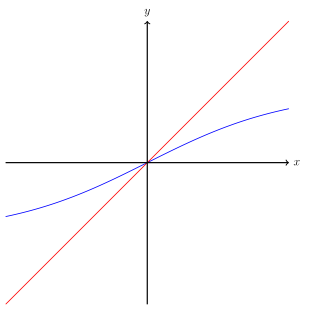
- Show, with the aid of a sketch, that \(y> \tanh (y/2)\) for \(y>0\) and deduce that \begin{equation} \textrm{arcosh} x > \dfrac{x-1}{\sqrt{x^2-1}} \text{ for } x>1. \tag{\(*\)} \end{equation}
- By integrating \((*)\), show that $\textrm{arcosh} x > 2 \dfrac{{x-1}}{\sqrt{x^2-1}} \( for \)x>1$.
- Show that $\textrm{arcosh} x >3 \dfrac{\sqrt{x^2-1}}{{x+2}} \( for \)x>1$.
Solution:
- If \(y = \textrm{arcosh} x \), then \(\tanh\textrm{arcosh} x/2 = \sqrt{\frac{\cosh \textrm{arcosh} x-1}{\cosh \textrm{arcosh} x+1}} = \sqrt{\frac{x-1}{x+1}} = \frac{x-1}{\sqrt{x^2-1}}\)
- \begin{align*} \int \textrm{arcosh} x \d x &= \left [x \textrm{arcosh} x \right] - \int \frac{x}{\sqrt{x^2-1}} \d x \\ &= x \textrm{arcosh} x - \sqrt{x^2-1}+C \\ \int \frac{x-1}{\sqrt{x^2-1}} &= \sqrt{x^2-1} - \textrm{arcosh} x +C \end{align*} Therefore \begin{align*} && \int_1^x \textrm{arcosh} t \d t &> \int_1^x \frac{t-1}{\sqrt{t^2-1}} \d t \\ \Rightarrow && x \textrm{arcosh} x - \sqrt{x^2-1} - 0 &> \sqrt{x^2-1} - \textrm{arcosh} x - 0 \\ \Rightarrow && (x+1) \textrm{arcosh} x &> 2\sqrt{x^2-1} \\ \Rightarrow && \textrm{arcosh} x & > 2\frac{\sqrt{x^2-1}}{x+1} \\ &&&= 2 \frac{\sqrt{x-1}}{\sqrt{x+1}} \\ &&&= 2 \frac{x-1}{\sqrt{x^2-1}} \end{align*}
- Integrating both sides again, \begin{align*} && \int_1^x \textrm{arcosh} t \d t &> 2 \int_1^x \frac{t-1}{\sqrt{t^2-1}} \d t \\ \Rightarrow && x \textrm{arcosh} x - \sqrt{x^2-1} &> 2\left (\sqrt{x^2-1} - \textrm{arcosh}x \right) \\ \Rightarrow && (x+2)\textrm{arcosh} x &> 3 \sqrt{x^2-1} \\ \Rightarrow && \textrm{arcosh} x &> 3 \frac{\sqrt{x^2-1}}{x+2} \end{align*}
2008 Paper 3 Q9
A particle of mass \(m\) is initially at rest on a rough horizontal surface. The particle experiences a force \(mg\sin \pi t\), where \(t\) is time, acting in a fixed horizontal direction. The coefficient of friction between the particle and the surface is \(\mu\). Given that the particle starts to move first at \(t=T_0\), state the relation between \(T_0\) and \(\mu\).
- For \(\mu = \mu_0\), the particle comes to rest for the first time at \(t=1\). Sketch the acceleration-time graph for \(0\le t \le 1\). Show that \[ 1+\left(1-\mu_0^2\right)^{\frac12} -\mu_0\pi +\mu_0 \arcsin \mu_0 =0\,. \]
- For \(\mu=\mu_0\) sketch the acceleration-time graph for \(0\le t\le 3\). Describe the motion of the particle in this case and in the case \(\mu=0\).
2007 Paper 1 Q3
Prove the identities \(\cos^4\theta -\sin^4\theta \equiv \cos 2\theta\) and $\cos^4 \theta + \sin^4 \theta \equiv 1 - {\frac12} \sin^2 2 \theta$. Hence or otherwise evaluate \[ \int_0^{\frac{1}{2}\pi} \cos^4 \theta \; \d \theta \;\;\;\; \mbox{and}\;\;\;\; \int_0^{\frac{1}{2}\pi} \sin^4 \theta \; \d \theta \,. \] Evaluate also \[ \int_0^{\frac{1}{2}\pi} \cos^6 \theta \; \d \theta \;\;\;\; \mbox{and}\;\;\;\; \int_0^{\frac{1}{2}\pi} \sin^6 \theta \; \d \theta \,. \]
Solution: \begin{align*} && \cos^4 \theta - \sin^4 \theta &= (\cos^2 \theta - \sin^2 \theta)(\cos^2 \theta + \sin^2 \theta) \\ &&&= \cos^2 \theta - \sin^2 \theta \\ &&&= \cos 2 \theta \\ \\ && 1&= (\cos^2 \theta + \sin^2 \theta)^2 \\ &&&= \cos^4 \theta + \sin^4 \theta + 2 \sin^2 \theta \cos^2 \theta \\ &&&= \cos^4 \theta + \sin^4 \theta + \frac12 ( \sin^2 2 \theta) \\ \Rightarrow && \cos^4 \theta + \sin^4 \theta &= 1 - \tfrac12 \sin^2 2 \theta \end{align*} \begin{align*} && I &= \int_{0}^{\pi/2} \cos^4 \theta \d \theta \\ && J &= \int_0^{\pi/2} \sin^4 \theta \d \theta \\ && I-J &= \int_0^{\pi/2} \cos 2 \theta \d \theta = 0 \\ && I+J &= \int_0^{\pi/2} (1- \frac12 \sin^2 2 \theta) \d \theta \\ &&&= \frac{\pi}{2} - \frac14 \int_0^{\pi} \sin^2 \theta \d \theta \\ &&&= \frac{\pi}{2} - \frac{\pi}{8} \\ &&&= \frac{3\pi}{8} \\ \Rightarrow && I=J &= \frac{3\pi}{16} \end{align*} \begin{align*} && \cos^6 \theta + \sin^6 \theta &= (\cos^2 \theta + \sin^2 \theta)(\cos^4 \theta - \cos^2 \theta \sin^2 \theta + \sin^4 \theta) \\ &&&= 1-\tfrac12 \sin^2 2\theta - \tfrac14 \sin^2 2 \theta \\ &&&= 1 - \tfrac34 \sin^2 2 \theta \\ %&& \cos^6 \theta - \sin^6 \theta &= (\cos^2 \theta - \sin^2 \theta)(\cos^4 \theta + \cos^2 \theta \sin^2 \theta + \sin^4 \theta) \\ %&&&= \cos 2 \theta (1 - \tfrac12 \sin^2 2 \theta + \tfrac14 \sin^2 2 \theta) \\ %&&&= \cos 2 \theta (1 - \tfrac14 \sin^2 2 \theta) \\ \end{align*} \begin{align*} && I &= \int_{0}^{\pi/2} \cos^6 \theta \d \theta \\ && J &= \int_0^{\pi/2} \sin^6 \theta \d \theta \\ && I-J &= 0 \\ && I+J &= \int_0^{\pi/2} (1 - \tfrac34 \sin^2 2 \theta) \d \theta \\ &&&= \frac{\pi}{2} - \frac{3\pi}{16} = \frac{5\pi}{16} \\ \Rightarrow && I = J &= \frac{5\pi}{32} \end{align*}
2007 Paper 2 Q2
A curve has equation \(y=2x^3-bx^2+cx\). It has a maximum point at \((p,m)\) and a minimum point at \((q,n)\) where \(p>0\) and \(n>0\). Let \(R\) be the region enclosed by the curve, the line \(x=p\) and the line \(y=n\).
- Express \(b\) and \(c\) in terms of \(p\) and \(q\).
- Sketch the curve. Mark on your sketch the point of inflection and shade the region \(R\). Describe the symmetry of the curve.
- Show that \(m-n=(q-p)^3\).
- Show that the area of \(R\) is \(\frac12 (q-p)^4\).
Solution:
- \(\,\) \begin{align*} && y &= 2x^3-bx^2+cx \\ \Rightarrow && y' &= 6x^2-2bx+c \end{align*} We must have \(p, q\) are the roots of this equation, ie \(\frac13b = p+q, \frac16c = pq\)
- The point of inflection will be at \(\frac{b}6\)
The graph will have rotational symmetry of \(180^{\circ}\) about the point of inflection.

- \begin{align*} && m-n &= 2(p^3-q^3)-b(p^2-q^2)+c(p-q) \\ &&&= (p-q)(2(p^2+qp+q^2)-b(p+q)+c) \\ &&&= (p-q)(2(p^2+qp+q^2)-3(p+q)^2+6pq) \\ &&&= (p-q)(-p^2-q^2+2pq) \\ &&&= (q-p)^3 \end{align*}
- The area of \(R\) is \begin{align*} A &= \frac12 bh \\ &= \frac12 (q-p)(m-n) = \frac12(q-p)^4 \end{align*} as required.
2007 Paper 2 Q3
By writing \(x=a\tan\theta\), show that, for \(a\ne0\), $\displaystyle \int \frac 1 {a^2+x^2}\, \d x =\frac 1 a \arctan \frac x a + \text{constant}\,$.
- Let $\displaystyle I=\int_0^{\frac{1}{2}\pi}
\frac {\cos x}{1+\sin^2 x} \, \d x\,$.
- Evaluate \(I\).
- Use the substitution \(t=\tan \frac12 x\) to show that \(\displaystyle \int_0^1 \frac {1-t^2}{1+6t^2+t^4} \, \d t = \tfrac12 I\,\).
- Evaluate \(\displaystyle \int_0^1 \frac {1-t^2}{1+14t^2+t^4} \, \d t \,\).
Solution: \begin{align*} && I &= \int \frac{1}{a^2+x^2} \d x\\ x = a \tan \theta, \d x =a \sec^2 \theta \d \theta &&&= \int \frac{1}{a^2+a^2\tan^2 x} a \sec^2 \theta \d \theta \\ &&&=\int \frac{\sec^2 \theta}{a \sec^2 \theta} \d \theta \\ &&&= \frac1a \theta + C \\ &&&= \frac1a \arctan \frac{x}{a} + C \end{align*}
- \(\,\) \begin{align*} && I &= \int_0^{\frac{1}{2}\pi} \frac {\cos x}{1+\sin^2 x} \d x \\ &&&= \left [ \arctan (\sin x) \right]_0^{\pi/2} \\ &&&= \arctan(1) - \arctan(0) = \frac{\pi}{4} \end{align*}
- \(\,\) \begin{align*} && t &= \tan \frac{x}{2} \\ \Rightarrow && \sin x &= \frac{2t}{1+t^2} \\ && \cos x &= \frac{1-t^2}{1+t^2} \\ && \d x &= \frac{2}{1+t^2} \d t \\ \Rightarrow && I &= \int_0^{\pi/2} \frac{\cos x}{1 + \sin^2 x } \d x \\ &&&= \int_{t=0}^{t = 1} \frac{\frac{1-t^2}{1+t^2}}{1 + \left (\frac{2t}{1+t^2} \right)^2} \frac{2}{1+t^2} \d t \\ &&&= 2 \int_0^1 \frac{1-t^2}{(1+t^2)^2+(2t)^2} \d t\\ &&&= 2 \int_0^1 \frac{1-t^2}{1+6t^2+t^4} \d t\\ \end{align*} From which the conclusion follows
- \(\,\) \begin{align*} && J &= \int_0^1 \frac {1-t^2}{1+14t^2+t^4} \, \d t \\ &&&= \int_0^1 \frac {\frac{1-t^2}{1+t^2}}{\frac{1+14t^2+t^4}{(1+t^2)^2}} \frac{1}{1+t^2} \, \d t \\ &&&= \int_0^1 \frac {\frac{1-t^2}{1+t^2}}{\frac{(t^2+1)^2+3(2t)^2}{(1+t^2)^2}} \frac{1}{1+t^2} \, \d t \\ &&&= \frac12\int_{x=0}^{x=\pi/2} \frac {\cos x}{1+3 \sin^2 x} \d x \\ &&&= \frac{1}{6}\left[ \sqrt{3} \arctan(\sin \sqrt{3}x)\right]_0^{\pi/2} \\ &&&= \frac16 \sqrt{3} \frac{\pi}{3} \\ &&&= \frac{\sqrt{3}\pi}{18} \end{align*}
2007 Paper 2 Q6
- Differentiate \(\ln\big (x+\sqrt{3+x^2}\,\big)\) and \(x\sqrt{3+x^2}\) and simplify your answers. Hence find \(\int \! \sqrt{3+x^2}\, \d x\).
- Find the two solutions of the differential equation \[ 3\left(\frac{\d y}{\d x}\right)^{\!2} + 2 x \frac {\d y}{\d x} =1 \] that satisfy \(y=0\) when \(x=1\).
Solution:
- \(\,\) \begin{align*} && y &= \ln (x + \sqrt{3+x^2}) \\ \Rightarrow && y' &= \frac{1}{x + \sqrt{3+x^2}} \cdot \left (1 + \frac{x}{\sqrt{3+x^2}} \right) \\ &&&= \frac{1}{\sqrt{3+x^2}} \\ \\ && y &= x\sqrt{3+x^2} \\ && y' &= \sqrt{3+x^2} + \frac{x^2}{\sqrt{3+x^2}} \\ &&&= 2\sqrt{3+x^2} - \frac{3}{\sqrt{3+x^2}} \\ \\ \Rightarrow && \sqrt{3+x^2} &= \frac12(x \sqrt{3+x^2})' + \frac32(\ln(x+\sqrt{3+x^2})' \\ \Rightarrow && \int \sqrt{3+x^2}\, \d x &= \frac12x\sqrt{3+x^2} + \frac32 \ln (x+\sqrt{3+x^2}) + C \end{align*}
- \(\,\) \begin{align*} && 3 \left ( \frac{\d y}{\d x} \right)^2 + 2x \frac{\d y}{\d x} &= 1 \\ && \frac{\d y}{\d x} &= \frac{-x \pm \sqrt{x^2+3} }3 \\ \Rightarrow && y &= -\frac{x^2}{6} \pm \frac16x\sqrt{3+x^2} \pm \frac12 \ln (x+\sqrt{3+x^2}) + C \\ y = 0, x = 1: && 0 &= -\frac16 \pm \frac13 \pm \frac12 \ln 3 \\ \Rightarrow && y &= -\frac{x^2}{6} \pm \frac12x\sqrt{3+x^2} \pm \frac32 \ln (x+\sqrt{3+x^2}) + \frac16 \mp \frac13 \mp \frac12 \ln 3 \end{align*}
2007 Paper 2 Q14
The random variable \(X\) has a continuous probability density function \(\f(x)\) given by \begin{equation*} \f(x) = \begin{cases} 0 & \text{for } x \le 1 \\ \ln x & \text{for } 1\le x \le k\\ \ln k & \text{for } k\le x \le 2k\\ a-bx & \text{for } 2k \le x \le 4k \\ 0 & \text{for } x\ge 4k \end{cases} \end{equation*} where \(k\), \(a\) and \(b\) are constants.
- Sketch the graph of \(y=\f(x)\).
- Determine \(a\) and \(b\) in terms of \(k\) and find the numerical values of \(k\), \(a\) and \(b\).
- Find the median value of \(X\).
Solution:

- Since \(f(x)\) is continuous, \(a -bx\) joins \((2k, \ln k)\) and \((4k ,0)\). ie it has a gradient of \(\frac{-\ln k}{2k}\) and is zero at \(4k\), hence \(\displaystyle b = -\frac{\ln k}{2k}, a = 2\ln k\). The \(3\) sections have areas \(\int_1^k \ln x \d x = k \ln k -k +1\), \(k \ln k, k \ln k\). Therefore \begin{align*} &&1&= 3k\ln k - k +1 \\ \Rightarrow &&0 &= k(3\ln k - 1) \\ \Rightarrow &&\ln k &= \frac13 \\ \Rightarrow &&k &= e^{1/3} \\ && a &= \frac23 \\ && b&= -\frac16e^{-1/3} \end{align*}
- Clearly \(1 > k \ln k > \frac{1}{3}\), therefore the median must lie between \(k\) and \(2k\). So we need, \(\frac12\) to be the area of the rectangle + the triangle, ie: \begin{align*} && \frac12 &= k \ln k + (2k-M) \ln k \\ &&&= \frac13 k + \frac13 (2k - M) \\ \Rightarrow && M &= 3k - \frac32 \\ \Rightarrow && M &= 3e^{1/3} - \frac32 \end{align*}
2007 Paper 3 Q7
The functions \(\s(x)\) (\(0\le x<1\)) and \(t(x)\) (\(x\ge0\)), and the real number \(p\), are defined by \[ \s(x) = \int_0^x \frac 1 {\sqrt{1-u^2}}\, \d u\;, \ \ \ \ t(x) = \int_0^x \frac 1 {1+u^2}\, \d u\;, \ \ \ \ p= 2 \int_0^\infty \frac 1 {1+u^2}\, \d u \;. \] For this question, do not evaluate any of the above integrals explicitly in terms of inverse trigonometric functions or the number \(\pi\).
- Use the substitution \(u=v^{-1}\) to show that \(\displaystyle t(x) =\int_{1/x}^\infty\frac 1 {1+v^2}\, \d v \, \). Hence evaluate \(t(1/x) + t(x)\) in terms of \(p\) and deduce that \(2t(1)= \frac12 p\,\).
- Let \(y=\dfrac{u}{\sqrt{1+u^2}}\). Express \(u\) in terms of \(y\), and show that \(\displaystyle \frac{\d u}{\d y} = \frac 1 {\sqrt{(1-y^2)^3}}\). By making a substitution in the integral for \(t(x)\), show that \[ t(x) = \s\left(\frac{x}{\sqrt{1+x^2}}\right)\!. \] Deduce that \(\s\big(\frac1{\sqrt2}\big) =\frac1 4 p\,\).
- Let \(z= \dfrac{u+ \frac1{\sqrt3}}{1-\frac 1{\sqrt3}u}\,\). Show that \(\displaystyle t(\tfrac1{\sqrt3}) = \int_{\frac1{\sqrt3}}^{\sqrt3} \frac1 {1+z^2} \,\d z\;, \) and hence that \(3t(\frac1{\sqrt3}) = \frac12 p\,\).
Solution:
- \begin{align*} && t(x) &= \int_0^x \frac{1}{1+u^2} \d u \\ u = v^{-1}, \d u = -v^{-2} \d v&&&= \int_{v = \infty}^{v = 1/x} \frac{1}{1+v^{-2}} \frac{-1}{v^2} \d v \\ &&&= \int_{1/x}^\infty \frac{1}{1+v^2} \d v \\ \\ \Rightarrow && t(x) + t(1/x) &= \int_0^x \frac{1}{1+u^2} \d u + \int_0^{1/x} \frac{1}{1+u^2} \d u \\ &&&= \int_{1/x}^{\infty} \frac{1}{1+u^2} \d u + \int_0^{1/x} \frac{1}{1+u^2} \d u \\ &&&= \int_0^{\infty} \frac{1}{1+u^2} \d u \\ &&&= \frac12 p \\ \\ \Rightarrow && t(1) +t(1/1) = 2t(1) &= \frac12 p \end{align*}
- \(\,\) \begin{align*} && y &= \frac{u}{\sqrt{1+u^2}} \\ \Rightarrow && y^2 &= \frac{u^2}{1+u^2} \\ &&&= 1-\frac{1}{1+u^2} \\ \Rightarrow && 1+u^2 &= \frac{1}{1-y^2} \\ \Rightarrow && u &= \frac{y}{\sqrt{1-y^2}} \\ \\ && \frac{\d u}{\d y} &= \frac{\sqrt{1-y^2} + y^2(1-y^2)^{-1/2}}{1-y^2} \\ &&&= \frac{1}{(1-y^2)^{3/2}} \\ \\ && t(x) &= \int_0^x \frac{1}{1+u^2} \d u \\ &&&= \int_0^{y = x/\sqrt{1+x^2}} \frac{1}{1 + \frac{y^2}{1-y^2}} \frac{1}{(1-y^2)^{3/2}} \d y \\ &&&= \int_0^{x/\sqrt{1+x^2}} \frac{1-y^2}{(1-y^2)^{3/2}} \d y \\ &&&= \int_0^{x/\sqrt{1+x^2}} \frac{1}{(1-y^2)^{1/2}} \d y \\ &&&= s\left ( \frac{x}{\sqrt{1+x^2}} \right) \\ \\ \Rightarrow && s\left ( \frac{1}{\sqrt{2}} \right) &= t(1) = \frac14p \end{align*}
- \(\,\) \begin{align*} && z &= \frac{u + \frac1{\sqrt{3}}}{1- \frac{1}{\sqrt{3}} u}\\ \Rightarrow && z - \frac{z}{\sqrt{3}}u &= u + \frac{1}{\sqrt{3}} \\ \Rightarrow && u &= \frac{z-\frac{1}{\sqrt{3}}}{1 + \frac{z}{\sqrt{3}}} \\ \\ \Rightarrow && \frac{\d u}{\d z} &= \frac{\sqrt{3}(\sqrt{3}+z ) -(\sqrt{3}z-1)}{\left (\sqrt{3}+z \right)^2} \\ &&&= \frac{4}{(\sqrt{3}+z)^2} \\ \\ \Rightarrow && t \left ( \frac{1}{\sqrt{3}} \right) &= \int_0^{1/\sqrt{3}} \frac{1}{1+u^2} \d u \\ &&&= \int_{z=1/\sqrt{3}}^{z=\sqrt{3}} \frac{1}{1 + \left ( \frac{\sqrt{3}z-1}{\sqrt{3}+z}\right)^2} \frac{4}{(\sqrt{3}+z)^2} \d z\\ &&&= \int_{1/\sqrt{3}}^{\sqrt{3}} \frac{4}{(\sqrt{3}+z)^2+(\sqrt{3}z-1)^2} \d z \\ &&&= \int_{1/\sqrt{3}}^{\sqrt{3}} \frac{4}{4+4z^2} \d z \\ &&&= \int_{1/\sqrt{3}}^{\sqrt{3}} \frac{1}{1+z^2} \d z \end{align*} Notice that \(t(1/\sqrt{3})+t(\sqrt{3}) = \frac12p\) and also notice that \(t(1/\sqrt{3}) + t(1/\sqrt{3}) =t(\sqrt{3})\) so \(3t(1/\sqrt{3}) = \frac12p\)
2007 Paper 3 Q14
- My favourite dartboard is a disc of unit radius and centre \(O\). I never miss the board, and the probability of my hitting any given area of the dartboard is proportional to the area. Each throw is independent of any other throw. I throw a dart \(n\) times (where \(n>1\)). Find the expected area of the smallest circle, with centre \(O\), that encloses all the \(n\) holes made by my dart. Find also the expected area of the smallest circle, with centre \(O\), that encloses all the \((n-1)\) holes nearest to \(O\).
- My other dartboard is a square of side 2 units, with centre \(Q\). I never miss the board, and the probability of my hitting any given area of the dartboard is proportional to the area. Each throw is independent of any other throw. I throw a dart \(n\) times (where \(n>1\)). Find the expected area of the smallest square, with centre \(Q\), that encloses all the \(n\) holes made by my dart.
- Determine, without detailed calculations, whether the expected area of the smallest circle, with centre \(Q\), on my square dartboard that encloses all the \(n\) holes made by my darts is larger or smaller than that for my circular dartboard.
Solution:
- Firstly, we consider the probability that all darts lie within a distance \(s\) from the centre, ie \begin{align*} \mathbb{P}(\text{all darts within }s) &= \prod_{k=1}^s \mathbb{P}(\text{dart within }s) \\ &= \left ( \frac{\pi s^2}{\pi} \right)^n \\ &= s^{2n} \end{align*} Therefore the pdf is \(2ns^{2n-1}\), and the expected area is \(\int_{s=0}^1 \pi s^2 \cdot 2n s^{2n-1} \d s = 2n \pi \frac{1}{2n+2} = \frac{n}{n+1} \pi\). \begin{align*} \mathbb{P}(\text{n-1 within }s) &= \underbrace{s^{2n}}_{\text{all within }s} + \underbrace{ns^{2n-2}(1-s^2)}_{\text{all but 1 within }s}\\ &= ns^{2n-2}-(n-1)s^{2n} \end{align*} Therefore the pdf is \(n(2n-2)s^{2n-3} - 2n(n-1)s^{2n-1} = 2n(n-1)(s^{2n-3}-s^{2n-1})\) and the expected area is: \begin{align*} \int \pi s^2 \cdot2n(n-1)(s^{2n-3}-s^{2n-1})\d s &= 2n(n-1) \pi \left ( \frac{1}{2n} - \frac{1}{2n+2} \right) \\ &= n(n-1)\pi \frac{2}{n(n+1)} \\ &= \frac{n-1}{n+1} \pi \end{align*}
- Now consider a square of side-length \(s\), we must have \(\mathbb{P}(\text{all darts within square}) = \left ( \frac{s^2}{4} \right)^n\) and therefore the pdf is \(n \frac{s^{n-1}}{4^n}\). Therefore the expected area is \(\displaystyle \int_0^2 s^2 \cdot n \frac{s^{n-1}}{4^n} \d s = \frac{n}{n+1} \frac{2^{2n+1}}{2^{2n}} = \frac{4n}{n+1}\)
- It is clearly larger as the square dartboard contains all of the circular dartboard, and there will be some probability that the darts land outside the circular dartboard, making the circle much larger.
2006 Paper 1 Q5
- Use the substitution \(u^2=2x+1\) to show that, for \(x>4\), \[ \int \frac{3} { ( x-4 ) \sqrt {2x+1}} \; \d x = \ln \l \frac{\sqrt{2x+1}-3} {\sqrt{2x+1}+3} \r + K\,, \] where \(K\) is a constant.
- Show that $ \displaystyle \int_{\ln 3}^{\ln 8} \frac{2} { \e^x \sqrt{ \e^x + 1}}\; \mathrm{d}x\, = \frac 7{12} + \ln \frac23 $ .
Solution:
- \begin{align*} && I &= \int \frac{3}{(x-4)\sqrt{2x+1}}\, \d x \\ u^2 =2x+1, 2u \frac{\d u}{\d x}=2: && &= \int \frac{3}{\left(\frac{u^2-1}{2}-4\right)u} u \d u \\ &&&= \int \frac{6}{u^2-9} \d u \\ &&&= \int \frac{6}{(u-3)(u+3)} \d u\\ &&&= \int \left ( \frac{1}{u-3} - \frac{1}{u+3} \right )\d u \\ &&&= \ln (u-3) - \ln (u+3) + C \\ &&&= \ln \frac{u-3}{u+3} + C \\ &&&= \ln \left (\frac{\sqrt{2x+1}-3}{\sqrt{2x+1}+3} \right) + C \end{align*}
- \begin{align*} && I &= \int_{\ln 3}^{\ln 8} \frac{2}{e^x\sqrt{e^x+1}} \d x \\ u = e^x, \frac{\d u}{\d x} = e^x: &&&= \int_{u=3}^{u=8} \frac{2}{u\sqrt{u+1}} \frac{1}{u} \d u \\ v^2=u+1, 2v \frac{\d v}{\d u} = 1: &&&= \int_{v=2}^{v=3} \frac{2}{v(v^2-1)^2} \d v \\ &&&= \int_2^3 \left ( \frac{2}{v} - \frac{}{v-1} - \frac{1}{2(v-1)^2} - \frac{1}{v+1} - \frac{1}{2(v+1)^2}\right) \d v \\ &&&= \left [2\ln v - \ln(v^2-1)+\frac12(v-1)^{-1}+\frac12(v+1)^{-1} \right]_2^3 \\ &&&= \left ( 2\ln3-\ln 8+\frac14+\frac18\right)-\left ( 2\ln2-\ln 3+\frac12+\frac16\right) \\ &&&= \end{align*}
2006 Paper 1 Q7
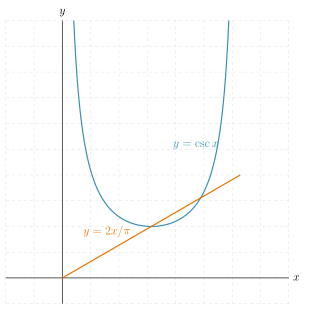
- Sketch on the same axes the functions \({\rm cosec}\, x\) and \(2x/ \pi\), for \(0 < x < \pi\,\). Deduce that the equation \(x\sin x = \pi/2 \) has exactly two roots in the interval \(0 < x < \pi\,\). Show that \[ \displaystyle \int_{\pi/2}^{\pi} \left \vert x\sin x - \frac{\pi} { 2} \right \vert \; \mathrm{d}x = 2\sin\alpha +\frac{3\pi^2} 4 - \alpha \pi -\pi -2\alpha \cos\alpha -1 \] where \(\alpha\) is the larger of the roots referred to above.
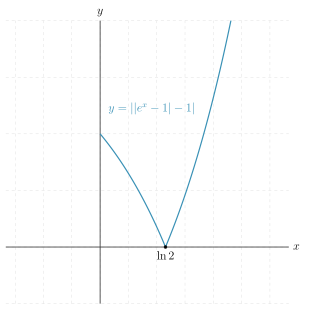
- Show that the region bounded by the positive \(x\)-axis, the \(y\)-axis and the curve \[y = \Bigl| \vert \e^x - 1 \vert - 1 \Bigr|\] has area \(\ln 4-1\).
Solution:
- \(\,\)
Notice that they are equal at \(1\) when \(x = \pi/2\), but this is a local minimum for \(\csc x\) whereas \(2x/\pi\) is increasing so there is a second intersection. Notice that \(\csc x = \frac{2x}{\pi} \Leftrightarrow x \sin x = \frac{\pi}{2}\) therefore our intersections are also the roots of \(x \sin x = \frac{\pi}{2}\) and the larger one is greater than \(\pi/2\) \begin{align*} && I &= \int_{\pi/2}^{\pi} \Bigl| x \sin x - \frac{\pi}{2} \Bigr| \d x \\ &&&= \int_{\pi/2}^{\alpha} \left ( x \sin x - \frac{\pi}{2} \right )\d x +\int_{\alpha}^{\pi} \left ( \frac{\pi}{2} -x \sin x \right) \d x \\ &&&= \left ( \pi - 2\alpha + \frac{\pi}{2}\right) \frac{\pi}{2} + \int_{\pi/2}^{\alpha} x \sin x\d x -\int_{\alpha}^{\pi} x \sin x \d x \\ &&&= \frac{3\pi^2}{4} - \alpha \pi + \left [-x \cos x \right]_{\pi/2}^{\alpha}+\left[x \cos x \right]_{\alpha}^{\pi} + \int_{\pi/2}^{\alpha} \cos x \d x - \int_{\alpha}^{\pi} \cos x \d x \\ &&&= \frac{3\pi^2}{4} - \alpha \pi -\alpha \cos \alpha -\pi -\alpha \cos \alpha+ \sin \alpha - 1+\sin \alpha \\ &&&= 2\sin \alpha + \frac{3\pi^2}{4} - \alpha \pi - 2\alpha \cos \alpha - 1 \end{align*}
- \(\,\)
\begin{align*} && A &= \int_0^{\ln 2} ||e^x-1|-1| \d x \\ &&&= \int_0^{\ln 2} |e^x-2| \d x \\ &&&=\int_0^{\ln 2} (2-e^x) \d x \\ &&&= 2 \ln 2 - \left [e^x \right]_0^{\ln 2} \\ &&&= \ln 4 - (2-1) = \ln 4 - 1 \end{align*}
2006 Paper 2 Q4
By making the substitution \(x=\pi-t\,\), show that \[ \! \int_0^\pi x\f(\sin x) \d x = \tfrac12 \pi \! \int_0^\pi \f(\sin x) \d x\,, \] where \(\f(\sin x)\) is a given function of \(\sin x\). Evaluate the following integrals:
- \(\displaystyle \int_0^\pi \frac {x \sin x}{3+\sin^2 x}\,\d x\,\);
- $\displaystyle \int_0^{2\pi} \frac {x \sin x}{3+\sin^2 x}\,\d x\,\(;
- \)\displaystyle \int_{0}^{\pi} \frac {x \big\vert\sin 2x\big\vert}{3+\sin^2 x}\,\d x\,$.