Problems
Filters
1531 problems found
1999 Paper 2 Q4
By considering the expansions in powers of \(x\) of both sides of the identity $$ {(1+x)^n}{(1+x)^n}\equiv{(1+x)^{2n}}, $$ show that $$ \sum_{s=0}^n {n\choose s}^2 = {2n\choose n}, $$ where \(\displaystyle {n\choose s}= \frac{n!}{s!\,(n-s)!}\). By considering similar identities, or otherwise, show also that:
- if \(n\) is an even integer, then \(\displaystyle \sum_{s=0}^n {{(-1)}^s}{n \choose s}^2= (-1)^{n/2}{n \choose n/2};\)
- \(\displaystyle \sum\limits_{t=1}^ n 2t { n \choose t}^2 = n {2n\choose n} .\)
Solution: To obtain the coefficient of \(x^n\) on the RHS we clearly have \(\displaystyle \binom{2n}n\). To obtain the coefficient of \(x^n\) on the LHS we can obtain \(x^s\) from the first bracket and \(x^{n-s}\) from the second bracket, ie \(\displaystyle \sum_{s=0}^n \binom{n}{s}\binom{n}{n-s} = \sum_{s=0}^n \binom{n}{s}\binom{n}{s} = \sum_{s=0}^n \binom{n}{s}^2\)
- Consider \((1-x)^n(1+x)^n = (1-x^2)^n\), then the coefficient of \(x^n\) (if \(n\) is even) is for the RHS \(\displaystyle (-1)^{n/2} \binom{n}{n/2}\). For the LHS, we can obtain \(x^n\) via \(x^s\) and \(x^{n-s}\) which is \(\displaystyle \sum_{s=0}^n (-1)^s\binom{n}{s}\binom{n}{n-s} = \sum_{s=0}^n (-1)^s\binom{n}{s}^2\)
- Notice that \begin{align*} && \sum_{t=1}^ n 2t { n \choose t}^2 &= n {2n\choose n} \\ \Leftrightarrow && \sum_{t=1}^ n 2t \frac{n}{t} { n-1 \choose t-1}\binom{n}{t} &= n \frac{2n}{n}{2n-1\choose n-1} \\ \Leftrightarrow && \sum_{t=1}^ n { n-1 \choose t-1}\binom{n}{t} &= {2n-1\choose n-1} \\ \Leftrightarrow && \sum_{t=1}^ n { n-1 \choose t-1}\binom{n}{n-t} &= {2n-1\choose n-1} \\ \end{align*} but this is exactly what we would obtain by considering the coefficient of \(x^{n-1}\) in \((1+x)^{n-1}(1+x)^n \equiv (1+x)^{2n-1}\)
1999 Paper 2 Q5
Show that if \(\alpha\) is a solution of the equation $$ 5{\cos x} + 12{\sin x} = 7, $$ then either $$ {\cos }{\alpha} = \frac{35 -12\sqrt{120}}{169} $$ or \(\cos \alpha\) has one other value which you should find. Prove carefully that if \(\frac{1}{2}\pi< \alpha < \pi\), then \(\alpha < \frac{3}{4}\pi\).
Solution: \begin{align*} && 5 \cos x + 12\sin x &= 7 \\ \Rightarrow && 5 \cos x - 7 &= -12 \sin x \\ \Rightarrow && 25 \cos^2 x - 70\cos x + 49 &= 144 \sin^2 x \\ \Rightarrow && 25 \cos^2 x - 70\cos x + 49 &= 144 (1-\cos^2 x) \\ \Rightarrow && 169 \cos^2 x - 70 \cos x -95 &= 0 \\ \Rightarrow && \cos \alpha &= \frac{70 \pm \sqrt{70^2 - 4 \cdot 169 \cdot (-95)}}{2 \cdot 169} \\ &&&= \frac{35 \pm \sqrt{35^2 + 169 \cdot 95} }{169} \\ &&&= \frac{35 \pm 12\sqrt{120}}{169} \end{align*} If \(\frac12 \pi < \alpha < \pi\) then \(\cos \alpha\) is negative, in particular \(\cos \alpha = \frac{35 -12\sqrt{120}}{169}\). Since \(\cos\) is decreasing over this range, if \(\cos \alpha > \cos \frac34 \pi = -\frac{\sqrt{2}}2\), then we will have shown \(\alpha < \frac34 \pi\) \begin{align*} && \cos \alpha &= \frac{35 - 12 \sqrt{120}}{169} \\ &&&> \frac{35 - 12 \cdot \sqrt{121}}{169} \\ &&&= \frac{35 - 12 \cdot 11}{169} \\ &&&= \frac{35 - 132}{169} \\ &&&= -\frac{97}{169} \\ &&&> -\frac{8}{13} \end{align*} but \(\left ( \frac{8}{13} \right)^2 = \frac{64}{169} < \frac12\), so we are done.
1999 Paper 2 Q6
Find \(\displaystyle \ \frac{\d y}{\d x} \ \) if $$ y = \frac{ax+b}{cx+d}. \tag{*} $$ By using changes of variable of the form \((*)\), or otherwise, show that \[ \int_0^1 \frac{1}{(x+3)^2} \; \ln \left(\frac{x+1}{x+3}\right)\d x = {\frac16} \ln3 - {\frac14}\ln 2 - \frac 1{12}, \] and evaluate the integrals \[ \int_0^1 \frac{1}{(x+3)^2} \; \ln \left(\frac{x^2+3x+2}{(x+3)^2}\right)\d x \mbox{ and } \int_0^1 \frac{1}{(x+3)^2} \; \ln\left(\frac{x+1}{x+2}\right)\d x . \] [Not on original paper:] By changing to the variable \(y\) defined by $$ y=\frac{2x-3}{x+1},$$ evaluate the integral $$ \int_2^4 \frac{2x-3}{(x+1)^3}\; \ln\!\left(\frac{2x-3}{x+1}\right)\d x.$$ Evaluate the integral $$ \int_9^{25} {\big({2z^{-3/2} -5z^{-2}}\big)}\ln{\big(2-5z^{-1/2}\big)}\; \d z.$$
Solution: \begin{align*} && y &= \frac{ax+b}{cx+d} \\ &&&= \frac{\frac{a}{c}(cx+d) - \frac{da}{c} + b}{cx+d} \\ \Rightarrow && y' &= \left (b - \frac{da}{c} \right)(-1)(cx+d)^{-2} \cdot c \\ &&&= (ad-bc)(cx+d)^{-2} \end{align*} \begin{align*} && y &= \frac{x+1}{x+3} \\ && \frac{\d y}{\d x} &= \frac{2}{(x+3)^2} \\ \Rightarrow && I &= \int_0^1 \frac{1}{(x+3)^2} \; \ln \left(\frac{x+1}{x+3}\right)\d x \\ &&&= \int_{y=1/3}^{y=1/2} \frac12 \ln y \, \d y \\ &&&= \frac12 \left [ y \ln y - y \right]_{1/3}^{1/2} \\ &&&= \frac12 \left ( \frac12\ln \frac12 - \frac12 - \frac13 \ln\frac13 + \frac13 \right) \\ &&&= \frac16 \ln 3 -\frac14 \ln 2 -\frac1{12} \end{align*} \begin{align*} && J &= \int_0^1 \frac1{(x+3)^2} \ln \left ( \frac{x^2+3x+2}{(x+3)^2} \right) \d x \\ &&&= \int_0^1 \frac1{(x+3)^2} \left ( \ln \frac{x+1}{x+3} + \ln \frac{x+2}{x+3} \right) \d x \\ &&&= I + \int_0^1 \frac1{(x+3)^2} \ln \left ( \frac{x+2}{x+3} \right) \d x \\ &&&= I + \int_{y=2/3}^{y=3/4} \ln y\, \d y \\ &&&= I + \left [ y \ln y- y\right]_{2/3}^{3/4} \\ &&&= I + \left ( \frac34 \ln \frac34 - \frac34 - \frac23 \ln \frac23 + \frac23 \right) \\ &&&= I + \left ( \frac34 \ln 3 - \frac32 \ln 2- \frac1{12} - \frac23 \ln 2 + \frac23 \ln 3\right) \\ &&&= I + \left ( \frac{17}{12} \ln 3 - \frac{13}6 \ln 2- \frac1{12} \right) \\ &&&= \frac16 \ln 3 -\frac14 \ln 2 -\frac1{12} + \left ( \frac{17}{12} \ln 3 - \frac{13}6 \ln 2- \frac1{12} \right) \\ &&&= \frac{19}{12} \ln 3 -\frac{29}{12}\ln 2 - \frac16 \end{align*} \begin{align*} && K &= \int_0^1 \frac{1}{(x+3)^2} \; \ln\left(\frac{x+1}{x+2}\right)\d x \\ &&&= \int_0^1 \frac{1}{(x+3)^2} \; \left ( \ln\left(\frac{x+1}{x+3}\right) - \ln \left ( \frac{x+3}{x+2} \right) \right)\d x \\ &&&= \frac16 \ln 3 -\frac14 \ln 2 -\frac1{12} - \left ( \frac{17}{12} \ln 3 - \frac{13}6 \ln 2- \frac1{12} \right) \\ &&&= -\frac54 \ln 3 +\frac{23}{12} \ln 2 \end{align*}
1999 Paper 2 Q7
The curve \(C\) has equation $$ y = \frac x {\sqrt{x^2-2x+a}}\; , $$ where the square root is positive. Show that, if \(a>1\), then \(C\) has exactly one stationary point. Sketch \(C\) when (i) \(a=2\) and (ii) \(a=1\).
Solution: \begin{align*} && y &= \frac x {\sqrt{x^2-2x+a}} \\ && y' &= \frac{\sqrt{x^2-2x+a} - \frac{x(x-1)}{\sqrt{x^2-2x+a}}}{x^2-2x+a} \\ &&&= \frac{-x+a}{(x^2-2x+a)^{3/2}} \end{align*} Since the denominator is always positive, the only stationary point is when \(x = a\)


1999 Paper 2 Q8
Prove that $$ \sum_{k=0}^n \sin k\theta = \frac { \cos \tfrac12\theta - \cos (n+ \tfrac12) \theta} {2\sin \tfrac12\theta}\;. \tag{*}$$
- Deduce that, when \(n\) is large, \[ \sum_{k=0}^n \sin \left(\frac{k\pi}{n}\right) \approx \frac{2n}\pi\;. \]
- By differentiating \((*)\) with respect to \(\theta\), or otherwise, show that, when \(n\) is large, \[ \sum_{k=0}^n k \sin^2 \left(\frac{k\pi}{2n}\right) \approx \left(\frac{1}4 +\frac{1}{\pi^2} \right)n^2\;. \]
Solution: \begin{align*} && \sum_{k=0}^n \sin k\theta &= \textrm{Im} \left ( \sum_{k=0}^n e^{i k \theta}\right)\\ &&&= \textrm{Im} \left ( \frac{e^{i(n+1)\theta}-1}{e^{i \theta}-1} \right)\\ &&&= \textrm{Im} \left ( \frac{e^{i(n+\tfrac12)\theta}-e^{-i\theta/2}}{e^{i \theta/2}-e^{-i \theta/2}} \right)\\ &&&= \textrm{Im} \left ( \frac{(e^{i(n+\tfrac12)\theta}-e^{-i\theta/2})/2i}{(e^{i \theta/2}-e^{-i \theta/2})/2i} \right)\\ &&&= \textrm{Im} \left ( \frac{(e^{i(n+\tfrac12)\theta}-e^{-i\theta/2})/i}{2\sin \tfrac12 \theta} \right)\\ &&&= \frac{\cos \tfrac12 \theta - \cos(n+ \tfrac12)\theta}{2\sin \tfrac12 \theta} \end{align*}
- When \(n\) is large we have \begin{align*} &&\sum_{k=0}^n \sin \left(\frac{k\pi}{n}\right) &= \frac{\cos \frac{\pi}{2n} - \cos \frac{(2n + 1)\pi}{2n}}{2 \sin \frac{\pi}{2n}} \\ &&&= \frac{\cos \frac{\pi}{2n} +\cos \frac{\pi}{2n}}{2 \sin \frac{\pi}{2n}} \\ &&&\approx \frac{1- \frac{\pi^2}{4n^2}}{\frac{\pi}{2n}} \\ &&&= \frac{2n}{\pi} - \frac{\pi}{2n} \\ &&&\approx \frac{2n}{\pi} \end{align*}
- \(\,\) \begin{align*} && \sum_{k=0}^n \sin k\theta &= \frac { \cos \tfrac12\theta - \cos (n+ \tfrac12) \theta} {2\sin \tfrac12\theta} \\ \frac{\d }{\d \theta}: && \sum_{k=0}^n k\cos k\theta &= \frac { (-\tfrac12\sin\tfrac12\theta +(n+\tfrac12) \sin (n+ \tfrac12) \theta)2 \sin \tfrac12 \theta - (\cos \tfrac12\theta - \cos (n+ \tfrac12) \theta) \cos \tfrac12 \theta} {4\sin^2 \tfrac12\theta} \\ &&&= \frac{-\sin^2 \tfrac12 \theta+(2n+1)\sin(n+\tfrac12)\theta \sin \tfrac12 \theta-\cos^2\tfrac12 \theta+\cos(n+\frac12)\theta \cos\tfrac12 \theta}{4 \sin^2 \tfrac12 \theta} \\ &&&= \frac{(2n+1)\sin(n+\tfrac12)\theta \sin \tfrac12 \theta+\cos(n+\frac12)\theta \cos\tfrac12 \theta-1}{4 \sin^2 \tfrac12 \theta} \\ &&&= \frac{2n\sin(n+\tfrac12)\theta \sin \tfrac12 \theta+\cos n \theta-1}{4 \sin^2 \tfrac12 \theta} \\ \\ \Rightarrow && \sum_{k=0}^n k\left ( 1-2\sin^2 \left ( \frac{k\theta}{2} \right) \right) &= \frac{2n\sin(n+\tfrac12)\theta \sin \tfrac12 \theta+\cos n \theta-1}{4 \sin^2 \tfrac12 \theta} \\ \Rightarrow && \sum_{k=0}^n k\sin^2 \left ( \frac{k\theta}{2} \right) &= \frac{n(n+1)}{4} - \frac{2n\sin(n+\tfrac12)\theta \sin \tfrac12 \theta+\cos n \theta-1}{8 \sin^2 \tfrac12 \theta} \\ \theta = \frac{\pi}{n}: && \sum_{k=0}^n k\sin^2 \left ( \frac{k\pi}{2n} \right) &= \frac{n(n+1)}{4} - \frac{2n\sin(n+\tfrac12)\frac{\pi}{n}\sin \tfrac12 \frac{\pi}{n}+\cos n \frac{\pi}{n}-1}{8 \sin^2 \tfrac12 \frac{\pi}{n}} \\ &&&= \frac{n(n+1)}{4} - \frac{-2n \sin^2 \frac{\pi}{2n}-2}{8 \sin^2 \tfrac12 \frac{\pi}{n}} \\ &&&= \frac{n^2+n}{4} + \frac{n}{4} + \frac{1}{4\sin^2\frac{\pi}{2n}} \\ &&&\approx \frac{n^2}4 + \frac{n}{2}+ \frac{n^2}{\pi^2} \\ &&&= \left ( \frac14 + \frac{1}{\pi^2} \right)n^2 + \frac{n}{4} \\ &&&\approx \left ( \frac14 + \frac{1}{\pi^2} \right)n^2 \end{align*}
1999 Paper 2 Q9
In the \(Z\)--universe, a star of mass \(M\) suddenly blows up, and the fragments, with various initial speeds, start to move away from the centre of mass \(G\) which may be regarded as a fixed point. In the subsequent motion the acceleration of each fragment is directed towards \(G\). Moreover, in accordance with the laws of physics of the \(Z\)--universe, there are positive constants \(k_1\), \(k_2\) and \(R\) such that when a fragment is at a distance \(x\) from \(G\), the magnitude of its acceleration is \(k_1x^3\) if \(x < R\) and is \(k_2x^{-4}\) if \(x \ge R\). The initial speed of a fragment is denoted by \(u\).
- For \(x < R\), write down a differential equation for the speed \(v\), and hence determine \(v\) in terms of \(u\), \(k_1\) and \(x\) for \( x < R\).
- Show that if \(u < a\), where \(2a^2=k_1 R^4\), then the fragment does not reach a distance \(R\) from \(G\).
- Show that if \(u \ge b\), where $ 6b^2= 3k_1R^4 + 4k_2 /R^3, $ then from the moment of the explosion the fragment is always moving away from \(G\).
- If \(a < u < b\), determine in terms of \(k_2\), \(b\) and \(u\) the maximum distance from \(G\) attained by the fragment.
1999 Paper 2 Q10
\(N\) particles \(P_1\), \(P_2\), \(P_3\), \(\ldots\), \(P_N\) with masses \(m\), \(qm\), \(q^2m\), \(\ldots\) , \({q^{N-1}}m\), respectively, are at rest at distinct points along a straight line in gravity-free space. The particle \(P_1\) is set in motion towards \(P_2\) with velocity \(V\) and in every subsequent impact the coefficient of restitution is \(e\), where \(0 < e < 1\). Show that after the first impact the velocities of \(P_1\) and \(P_2\) are $$ {\left({{1-eq}\over{1+q}}\right)}V \mbox{ \ \ \ and \ \ \ } {\left({{1+e}\over{1+q}}\right)}V, $$ respectively. Show that if \(q \le e\), then there are exactly \(N-1\) impacts and that if \(q=e\), then the total loss of kinetic energy after all impacts have occurred is equal to $$ {1\over 2}{me}{\left(1-e^{N-1}\right)}{V^2}. $$
1999 Paper 2 Q11
An automated mobile dummy target for gunnery practice is moving anti-clockwise around the circumference of a large circle of radius \(R\) in a horizontal plane at a constant angular speed \(\omega\). A shell is fired from \(O\), the centre of this circle, with initial speed \(V\) and angle of elevation \(\alpha\). Show that if \(V^2 < gR\), then no matter what the value of \(\alpha\), or what vertical plane the shell is fired in, the shell cannot hit the target. Assume now that \(V^2 > gR\) and that the shell hits the target, and let \(\beta\) be the angle through which the target rotates between the time at which the shell is fired and the time of impact. Show that \(\beta\) satisfies the equation $$ g^2{{\beta}^4} - 4{{\omega}^2}{V^2}{{\beta}^2} +4{R^2}{{\omega}^4}=0. $$ Deduce that there are exactly two possible values of \(\beta\). Let \(\beta_1\) and \(\beta_2\) be the possible values of \(\beta\) and let \(P_1\) and \(P_2\) be the corresponding points of impact. By considering the quantities \((\beta_1^2 +\beta_2^2) \) and \(\beta_1^2\beta_2^2\,\), or otherwise, show that the linear distance between \(P_1\) and \(P_2\) is \[ 2R \sin\Big( \frac\omega g \sqrt{V^2-Rg}\Big) \;. \]
Solution: \begin{align*} && 0 &= V\sin \alpha t-\frac12 gt^2 \\ \Rightarrow && t &= \frac{2V \sin \alpha}{g} \\ && R &= V \cos \alpha \, t \\ &&&= \frac{2V^2 \sin \alpha \cos \alpha}{g} \\ &&&= \frac{V^2 \sin 2 \alpha}{g} \end{align*} Therefore the max distance is \(\frac{V^2}{g}\), therefore we cannot hit the target if \(R > \frac{V^2}{g} \Rightarrow gR > V^2\). We have \(\beta = \omega t \Rightarrow t = \frac{\beta}{\omega}\) \begin{align*} && \sin \alpha &= \frac{gt}{2V} \\ && \cos \alpha &= \frac{R}{Vt} \\ \Rightarrow && 1 &= \left (\frac{gt}{2V} \right)^2 + \left ( \frac{R}{Vt} \right)^2 \\ &&&= \left (\frac{g\beta}{2V \omega} \right)^2 + \left ( \frac{R\omega}{V\beta} \right)^2 \\ &&&= \frac{g^2 \beta^2}{4 V^2 \omega^2} + \frac{R^2 \omega^2}{V^2 \beta ^2} \\ \Rightarrow && 4V^2 \omega^2 \beta^2 &= g^2 \beta^4 + 4R^2 \omega^4 \\ \Rightarrow && 0 &= g^2 \beta^4 - 4\omega^2 V^2 \beta^2+4R^2\omega^4 \end{align*} This (quadratic) equation in terms of \(\beta^2\) has two solution if \(\Delta = 16\omega^4V^4-16g^2R^2\omega^4 =16\omega^4(V^4-g^2R^2) > 0\) since \(V^2 > gR\). Since \(\beta > 0\) there are exactly two solutions, once we have values for \(\beta\). First notice, \begin{align*} && \beta_1^2 + \beta_2^2 &= \frac{4\omega^2V^2}{g^2} \\ && \beta_1^2\beta_2^2 &= \frac{4R^2\omega^4}{g^2} \end{align*} Then notice the positions of \(P_1\) and \(P_2\) are \((R\cos \beta_1 , R\sin \beta_1)\) and \((R\cos \beta_2, R\sin \beta_2)\). \begin{align*} && d^2 &= R^2\left ( \cos \beta_1 - \cos \beta_2 \right)^2 + R^2 \left ( \sin \beta_1 - \sin \beta_2 \right)^2 \\ &&&= 2R^2 - 2R^2(\cos \beta_1 \cos \beta_2 + \sin \beta_1 \sin \beta_2) \\ &&&= 2R^2-2R^2\cos(\beta_1 - \beta_2) \\ &&&= 2R^2 \left (1-\cos(\sqrt{(\beta_1-\beta_2)^2} \right ) \\ &&&= 2R^2 \left (1 - \cos\left ( \sqrt{\frac{4\omega^2 V^2}{g^2} - \frac{4R\omega^2}{g}} \right) \right) \\ &&&= 2R^2 \left (1 - \cos\left (\frac{2\omega}{g} \sqrt{V^2 - Rg} \right) \right) \\ &&&= 4 R^2 \sin^2 \left (\frac{\omega}{g} \sqrt{V^2 - Rg} \right) \end{align*} which gives us the required result.
1999 Paper 2 Q12
It is known that there are three manufacturers \(A, B, C,\) who can produce micro chip MB666. The probability that a randomly selected MB666 is produced by \(A\) is \(2p\), and the corresponding probabilities for \(B\) and \(C\) are \(p\) and \(1 - 3p\), respectively, where \({{0} \le p \le {1 \over 3}}.\) It is also known that \(70\%\) of MB666 micro chips from \(A\) are sound and that the corresponding percentages for \(B\) and \(C\) are \(80\%\) and \(90\%\), respectively. Find in terms of \(p\), the conditional probability, \(\P(A {\vert} S)\), that if a randomly selected MB666 chip is found to be sound then it came from \(A\), and also the conditional probability, \(\P(C {\vert} S)\), that if it is sound then it came from \(C\). A quality inspector took a random sample of one MB666 micro chip and found it to be sound. She then traced its place of manufacture to be \(A\), and so estimated \(p\) by calculating the value of \(p\) that corresponds to the greatest value of \(\P(A {\vert} S)\). A second quality inspector also a took random sample of one MB666 chip and found it to be sound. Later he traced its place of manufacture to be \(C\) and so estimated \(p\) by applying the procedure of his colleague to \(\P(C {\vert} S)\). Determine the values of the two estimates and comment briefly on the results obtained.
1999 Paper 2 Q13
A stick is broken at a point, chosen at random, along its length. Find the probability that the ratio, \(R\), of the length of the shorter piece to the length of the longer piece is less than \(r\). Find the probability density function for \(R\), and calculate the mean and variance of \(R\).
Solution: Let \(X \sim U[0, \tfrac12]\) be the shorter piece, so \(R = \frac{X}{1-X}\), and \begin{align*} && \mathbb{P}(R \leq r) &= \mathbb{P}(\tfrac{X}{1-X} \leq r) \\ &&&= \mathbb{P}(X \leq r - rX) \\ &&&= \mathbb{P}((1+r)X \leq r) \\ &&&= \mathbb{P}(X \leq \tfrac{r}{1+r} ) \\ &&&= \begin{cases} 0 & r < 0 \\ \frac{2r}{1+r} & 0 \leq r \leq 1 \\ 1 & r > 1 \end{cases} \\ \\ && f_R(r) &= \begin{cases} \frac{2}{(1+r)^2} & 0 \leq r \leq 1 \\ 0 & \text{otherwise} \end{cases} \end{align*} Let \(Y \sim U[\tfrac12, 1]\) be the longer piece, then \(R = \frac{1-Y}{Y} = Y^{-1} - 1\) and \begin{align*} \E[R] &= \int_{\frac12}^1 (y^{-1}-1) 2 \d y \\ &= 2\left [\ln y - y \right]_{\frac12}^1 \\ &= -2 + 2\ln2 +2\frac12 \\ &= 2\ln2 -1 \\ \\ \E[R^2] &= \int_{\frac12}^1 (y^{-1}-1)^2 2 \d y\\ &= 2\left [-y^{-1} -2\ln y + 1 \right]_{\frac12}^1 \\ &= 2 \left ( 2 - 2\ln 2+\frac12\right) \\ &= 3-4\ln 2 \\ \var[R] &= 3 - 4 \ln 2 -(2\ln 2-1)^2 \\ &= 2 - 4(\ln 2)^2 \end{align*}
1999 Paper 2 Q14
You play the following game. You throw a six-sided fair die repeatedly. You may choose to stop after any throw, except that you must stop if you throw a 1. Your score is the number obtained on your last throw. Determine the strategy that you should adopt in order to maximize your expected score, explaining your reasoning carefully.
Solution: Once you have thrown, all previous throws are irrelevant so the only thing which can affect your decision is the current throw. Therefore the strategy must consist of a list of states we re-throw from, and a list of states we stick on. It must also be the case that if we stick on \(k\) we stick on \(k+1\) (otherwise we can improve our strategy by switching those two values around). Therefore we can form a table of our expected score: \begin{array}{c|c|c} \text{stop on} & \text{possible outcomes} & \E[\text{score}] \\ \hline \geq 2 & \{1,2,3,4,5,6\} & \frac{21}{6} = 3.5 \\ \geq 3 & \{1,3,4,5,6\} & \frac{19}{5} = 3.8 \\ \geq 4 & \{1,4,5,6\} & \frac{16}{4} = 4 \\ \geq 5 & \{1,5,6\} & \frac{12}{3} = 4 \\ =6 & \{1,6\} & \frac{7}{2} = 3.5 \end{array} Therefore the optimal strategy is to stop on \(4\) or higher. If we cared about variance we might look at the variance of the two best strategies, \(4\) or higher has a variance of \(\frac{1+16+25+36}{4} - 16 = 3.5\) and \(5\) or higher has a variance of \(\frac{1+25+36}3 - 16 = \frac{14}3 > 3.5\) so \(4\) or higher is probably better in most scenarios.
1999 Paper 3 Q1
Consider the cubic equation \[ x^3-px^2+qx-r=0\;, \] where \(p\ne0\) and \(r\ne 0\).
- If the three roots can be written in the form \(ak^{-1}\), \(a\) and \(ak\) for some constants \(a\) and \(k\), show that one root is \(q/p\) and that \(q^3 -rp^3=0\;.\)
- If \(r=q^3/p^3\;\), show that \(q/p\) is a root and that the product of the other two roots is \((q/p)^2\). Deduce that the roots are in geometric progression.
- Find a necessary and sufficient condition involving \(p\), \(q\) and \(r\) for the roots to be in arithmetic progression.
Solution:
- If the roots are \(ak^{-1}, a, ak\) then we must have that \(p = a(k^{-1}+1+k)\), \(q = a^2(k^{-1}+k+1)\) and \(r = a^3\), therefore \(a = \frac{q}{p}\) (ie one of the roots is \(\frac q p\) and \(r = \left ( \frac{q}{p} \right)^3 \Rightarrow q^3 =rp^3 \Rightarrow q^3-rp^3 = 0\)
- Suppose \(r = q^3/p^3\) then \(\left (\frac{q}{p} \right)^3 - p\left (\frac{q}{p} \right)^2+q\left (\frac{q}{p} \right) - r = \frac{--pq^2+pq^2}{p^2} =0 \), therefore \(q/p\) is a root by the factor theorem. We must also have the product of the three roots is \(q^3/p^3\) but one of the roots is \(q/p\) therefore the product of the other two roots is \(q^2/p^2\), but the condition \(ac = b^2\) is precisely the condition that \(a,b,c\) is a geometric progression.
- If the three roots are \(a-d, a, a+d\) then \(p = 3a\), \(q = a^2-da+a^2+da+a^2-d^2 = 3a^2-d^2\), \(r = a(a^2-q^2)\), therefore \(\frac{p}{3}\left (q-\frac{2p^2}9 \right) = r\) Similarly, suppose \(\frac{p}{3}\) is a root, then the other two roots must sum to twice this and therefore they are in arithmetic progression. The condition \(\frac{p}{3}\) is a root is equivalent to: \(\frac{p^3}{27} - \frac{p^3}{9} + \frac{qp}{3} - r = 0\), ie exactly \(\frac{p}{3}\left (q-\frac{2p^2}9 \right) = r\), therefore this condition is both necessary and sufficient.
1999 Paper 3 Q2
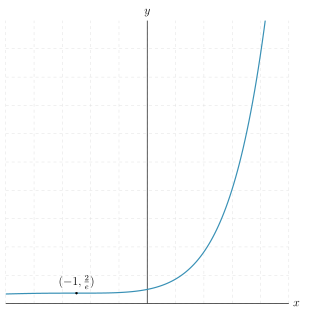
- Let \(\f(x)=(1+x^2)\e^x\). Show that \(\f'(x)\ge 0\) and sketch the graph of \(\f(x)\). Hence, or otherwise, show that the equation \[ (1+x^2)\e^x = k, \] where \(k\) is a constant, has exactly one real root if \(k>0\) and no real roots if \(k\le 0\).
- Determine the number of real roots of the equation $$ (\e^x-1) - k \tan^{-1} x=0 $$ in the cases (a) \(0< k\le 2/\pi\) and (b) \(2/\pi < k < 1\).
Solution:
- \(\,\) \begin{align*}
&& f(x) &= (1+x^2)e^x \\
&& f'(x) &= 2xe^x + (1+x^2)e^x \\
&&&= (1+x)^2e^x \geq 0
\end{align*}
As \(x \to -\infty\), \(f(x) \to 0\) and as \(x \to \infty\), \(f(x) \to +\infty\) and since \(f\) is strictly increasing we have exactly one solution to \(f(x) = k\) on \((0,\infty)\). Since \(f(x) > 0\) there are no solutions if \(k \leq 0\).
- Considering the function \(g(x) = (e^x-1)-k\tan^{-1} x \) then \(g'(x) = e^x - \frac{k}{1+x^2}\) therefore \(g'(x)\) has exactly one turning point when \(k > 0\) and \(0\) otherwise at the root of \(f(x) = k\) Notice also that \(g(0) = 0\) so we already have one solution, and \(g'(0) = 1 - k > 0\). Notice from our sketch that if \(0 < k < 1\) the root for \(f(x) = k\) has \(x \leq 0\), so our turning point is to the left of the origin and we are interested in the behaviour of \(g(x)\) as \(x \to -\infty\). (ie do we cross the axis again). \(\lim_{x \to -\infty} \left [ e^x - 1 - k \tan^{-1} x \right] = 0 - 1 +k \frac{\pi}{2} = k \frac{\pi}{2} - 1\). if this is positive, ie if \(k > \frac{2}{\pi}\) there are two solutions, otherwise there is only one real root.
1999 Paper 3 Q3
Justify, by means of a sketch, the formula $$ \lim_{n\rightarrow\infty}\left\{{1\over n}\sum_{m=1}^n \f(1+m/n)\right\} = \int_1^2 \f(x)\,\d x \,. $$ Show that $$ \lim_{n\rightarrow\infty}\left\{{1\over n+1} + {1\over n+2} + \cdots + {1\over n+n}\right\} = \ln 2 \,. $$ Evaluate $$ \lim_{n\rightarrow\infty}\left\{{n\over n^2+1} + {n\over n^2+4} + \cdots + {n\over n^2+n^2}\right\}\,. $$
Solution:

1999 Paper 3 Q4
A polyhedron is a solid bounded by \(F\) plane faces, which meet in \(E\) edges and \(V\) vertices. You may assume \textit{Euler's formula}, that \(V-E+F=2\). In a regular polyhedron the faces are equal regular \(m\)-sided polygons, \(n\) of which meet at each vertex. Show that $$ F={4n\over h} \,, $$ where \(h=4-(n-2)(m-2)\). By considering the possible values of \(h\), or otherwise, prove that there are only five regular polyhedra, and find \(V\), \(E\) and \(F\) for each.
Solution: Note that each of the \(F\) faces have \(m\) edges. If we count edges from each face we will get \(mF\) edges, but this counts each edge twice, so \(E = \frac{m}{2}F\). Similarly each edge goes into \(2\) vertices, but this counts each vertex \(n\) times, therefore \(V = \frac{2E}{n} = \frac{m}{n}F\) Therefore \begin{align*} && 2 &= V - E + F \\ &&&= \frac{m}{n}F - \frac{m}{2}F + F \\ &&&= F \left ( \frac{2m-nm+2n}{2n} \right) \\ &&&= F \left ( \frac{4-(n-2)(m-2)}{2n} \right) \\ \Rightarrow && F &= \frac{4n}{4-(n-2)(m-2)} = \frac{4n}{h} \end{align*} Notice that \(1 \leq h \leq 4\), so If \(h = 4\), then \(n = 2\) or \(m = 2\) but we can't have two-sided polygons or polyhedra with two faces making a vertex so this is not possible. If \(h = 3\) then \((n-2)(m-2) = 1\) and \(3 \mid n\), so we have \(n = 3, m = 3\). ie we have triangular faces meeting at \(3\) per point. We also have \(F = \frac{4 \cdot 3 }3\) which is \(4\) faces so this is a tetrahedron and \((V,E, F) = (4, 6, 4)\) If \(h = 2\) then \((n-2)(m-2) = 2\): Case 1: \(n = 4, m = 3\) which is four triangles meeting at each vertex with \((V,E,F) = (6, 12, 8)\), ie an octohedron. Case 2: \(n = 3, m = 4\) so we have three squares meeting at each vertex, with \((V,E,F) = (8,12,6)\) which is a cube. If \(h = 1\) then \((n-2)(m-2) = 3\) Case 1: \(n = 5, m = 3\) which is five triangles meeting at each vertex, with \((V,E,F) = ( 12,30, 20)\) ie an icosahedron. Case 2: \(n = 3, m = 5\) which is three pentagons meeting at each vertex, with \((V,E,F) = (20, 30,12)\) which is a dodecahedron. These are all the possible cases and hence we have found the five platonic solids.