Problems
Filters
142 problems found
2003 Paper 3 Q10
A particle moves along the \(x\)-axis in such a way that its acceleration is \(kx \dot{x}\,\) where \(k\) is a positive constant. When \(t = 0\), \(x = d\) (where \(d>0\)) and \(\dot{x} =U\,\).
- Find \(x\) as a function of \(t\) in the case \(U = kd^2\) and show that \(x\) tends to infinity as \(t\) tends to \(\displaystyle \frac{\pi }{2 dk}\,\).
- If \(U < 0\), find \(x\) as a function of \(t\) and show that it tends to a limit, which you should state in terms of \(d\) and \(U\,\), as \(t\) tends to infinity.
Solution:
- \(\,\) \begin{align*} && \ddot{x} &= kx \dot{x} \\ \Rightarrow && \frac{\d v}{\d x} \dot{x} &= k x \dot{x} \\ \Rightarrow && \int \d v &= \int k x \d x \\ \Rightarrow && v &= \frac12kx^2 + C \\ t=0, x = d, \dot{x} = kd^2: && kd^2 &= \frac12kd^2 + C \\ \Rightarrow && \dot{x} &= \frac12k(x^2+d^2) \\ \Rightarrow && \frac{\d x}{\d t} &= \frac12k(x^2+d^2) \\ \Rightarrow && \int \d t &= \int \frac{1}{\frac12k(x^2+d^2)} \d x \\ &&&= \frac{2}{kd}\tan^{-1} \frac{x}{d} \\ \Rightarrow && t &= \frac{2}{kd}\tan^{-1} \frac{x}{d} + C' \\ t = 0, x = d: && 0 &= \frac{\pi}{2kd} + C' \\ \Rightarrow && t &= \frac{2}{kd}\tan^{-1} \frac{x}{d}-\frac{\pi}{2kd} \end{align*} As \(x \to \infty\), \(t \to \frac{2}{kd} \frac{\pi}{2} - \frac{\pi}{2kd} = \frac{\pi}{2kd} \)
- \(\,\) \begin{align*} && v &= \frac12kx^2 + C \\ t=0, x = d, \dot{x} = U && U &= \frac12kd^2 + C \\ \Rightarrow && \dot{x} &= \frac12k(x^2-d^2)+U \\ \Rightarrow && \frac{\d x}{\d t} &=\frac12k(x^2-d^2)+U \\ \Rightarrow && \int \d t &= \int \frac{1}{\frac12k(x^2-d^2)+U} \d x \\ && &=\frac{2}{k} \int \frac{1}{x^2-d^2+\frac{2U}k} \d x \\ &&&= \frac2{k} \frac{1}{2\sqrt{d^2-\frac{2U}k}} \ln \frac{ \sqrt{d^2-\frac{2U}k}-x}{x+\sqrt{d^2-\frac{2U}k}} \\ \Rightarrow && t &= \frac2{k} \frac{1}{2\sqrt{d^2-\frac{2U}k}} \ln \frac{ \sqrt{d^2-\frac{2U}k}-x}{x+\sqrt{d^2-\frac{2U}k}} + C'' \\ t = 0, \dot{x} = d: && 0 &= \frac2{k} \frac{1}{2\sqrt{d^2-\frac{2U}k}} \ln \frac{ \sqrt{d^2-\frac{2U}k}-d}{d+\sqrt{d^2-\frac{2U}k}} + C'' \\ \Rightarrow && t &= \frac2{k} \frac{1}{2\sqrt{d^2-\frac{2U}k}} \ln \left ( \frac{ \sqrt{d^2-\frac{2U}k}-x}{x+\sqrt{d^2-\frac{2U}k}} \frac{d+\sqrt{d^2-\frac{2U}k}}{ \sqrt{d^2-\frac{2U}k}-d} \right ) \end{align*} as \(t \to \infty\) the denominator needs to head to \(0\), ie \(x \to -\sqrt{d^2-\frac{2U}k}\)
2002 Paper 1 Q3
Show that \((a+b)^2\le 2a^2+2b^2\,\). Find the stationary points on the curve $y=\big(a^2\cos^2\theta +b^2\sin^2\theta\big)^{\frac12} + \big(a^2\sin^2\theta +b^2\cos^2\theta\big)^{\frac12}\,$, where \(a\) and \(b\) are constants. State, with brief reasons, which points are maxima and which are minima. Hence prove that \[ \vert a\vert +\vert b \vert \le \big(a^2\cos^2\theta +b^2\sin^2\theta\big)^{\frac12} + \big(a^2\sin^2\theta +b^2\cos^2\theta\big)^{\frac12} \le \big(2a^2+2b^2\big)^{\frac12} \;. \]
Solution: \begin{align*} && 2a^2+2b^2 &= a^2 + b^2 + (a^2+b^2) \\ &&&\underbrace{\geq}_{AM-GM} a^2+b^2+2\sqrt{a^2b^2} \\ &&&= a^2+b^2 + 2|a||b| \\ &&&\geq a^2+b^2 + 2ab \\ &&&= (a+b)^2 \end{align*} Assume \(a^2 \neq b^2\), otherwise the curve is a constant. \begin{align*} && y & = \big(a^2\cos^2\theta +b^2\sin^2\theta\big)^{\frac12} + \big(a^2\sin^2\theta +b^2\cos^2\theta\big)^{\frac12}\\ && \frac{\d y}{\d \theta} &= \tfrac12 \left (a^2\cos^2\theta +b^2\sin^2\theta \right)^{-\frac12} \cdot (2 \sin \theta \cos \theta (b^2 - a^2)) + \tfrac12 (a^2\sin^2\theta +b^2\cos^2\theta)^{-\frac12} \cdot (2 \sin \theta \cos \theta (a^2 - b^2) \\ &&&= \tfrac12\sin2 \theta (b^2 - a^2) \left ( \left (a^2\cos^2\theta +b^2\sin^2\theta \right)^{-\frac12} - (a^2\sin^2\theta +b^2\cos^2\theta)^{-\frac12}\right) \\ \therefore \frac{\d y}{\d x} = 0 \Rightarrow && \sin 2\theta = 0 & \text{ or } a^2\cos^2\theta +b^2\sin^2\theta = a^2\sin^2\theta +b^2\cos^2\theta \\ \Rightarrow && \theta &= 0, \frac{\pi}{2}, \pi, \frac{3\pi}{2}, 2\pi \\ && (a^2-b^2) \cos ^2\theta &= (a^2-b^2) \sin^2 \theta \\ \Rightarrow && \theta &= \frac{\pi}{4}, \frac{3\pi}{4}, \frac{5\pi}{4}, \frac{7\pi}{4} \end{align*} WLOG \(b^2 - a^2 > 0\), then the two parts of the derivative look like:

2002 Paper 1 Q7
Let \[ I= \int_0^a \frac {\cos x}{\sin x + \cos x} \; \d x \, \quad \mbox{ and } \quad J= \int_0^a \frac {\sin x}{\sin x + \cos x} \; \d x \;, \] where \(0\le a < \frac{3}{4}\pi\,\). By considering \(I+J\) and \(I-J\), show that $ 2I= a + \ln (\sin a +\cos a)\;. $ Find also:
- \(\displaystyle \int_0^{\frac{1}{2}\pi} \frac {\cos x}{p\sin x + q\cos x} \; \d x \,\), where \(p\) and \(q\) are positive numbers; %
- [(ii)] %\(\displaystyle \int_0^{\frac{1}{2}\pi/2} \frac {\cos x}{\sin (x+k)} \; \d x \,\), where \(0 < k < \pi/2\,\);
- \(\displaystyle \int_0^{\frac{1}{2}\pi} \frac {\cos x+4}{3\sin x + 4\cos x+ 25} \; \d x \,\).
Solution: \begin{align*} && I + J &= \int_0^a \frac{\sin x + \cos x}{\sin x + \cos x } \d x = a \\ && I - J &= \int_0^a \frac{\cos x - \sin x}{\sin x + \cos x} \d x \\ &&&= \left [\ln ( \sin x + \cos x) \right]_0^a = \ln (\sin a + \cos a) - \ln 1 = \ln(\sin a + \cos a) \\ \\ \Rightarrow && 2I &= a + \ln(\sin a + \cos a) \end{align*}
- Let \(\displaystyle I = \int_0^{\frac12 \pi} \frac{\cos x}{p \sin x + q \cos x} \d x, J = \int_0^{\frac12 \pi} \frac{\sin x}{p \sin x + q \cos x} \d x\) so \begin{align*} && qI + pJ &= \frac{\pi}{2} \\ && pI - qJ &= \int_0^{\frac12 \pi} \frac{p \cos x - q \sin x}{p \sin x + q \cos x } \d x \\ &&&= \left [\ln (p \sin x + q \cos x) \right]_0^{\pi/2} \\ &&&= \ln(p) - \ln(q) = \ln \frac{p}{q} \end{align*}
- \(\,\) \begin{align*} && \int_0^{\frac{\pi}{2}} \frac{\cos x}{\sin(x + k)} \d x &= \int_0^{\frac{\pi}{2}} \frac{\cos x}{\sin(x) \cos(k) + \cos(x) \sin (k)} \d x \\ &&&= \ln \tan k \end{align*}
- Let \(\displaystyle I = \int_0^{\pi/2} \frac{\cos x + 4}{3 \sin x + 4 \cos x + 25} \d x, J = \int_0^{\pi/2} \frac{\sin x + 3}{3 \sin x + 4 \cos x + 25} \d x\), so \begin{align*} && 4I + 3J &= \int_0^{\pi/2} \frac{3 \sin x + 4 \cos x + 25}{3 \sin x + 4 \cos x + 25} \d x \\ &&&= \frac{\pi}{2} \\ && 3I - 4J &= \int_0^{\pi/2} \frac{3\cos x - 4 \sin x}{3 \sin x + 4 \cos x + 25} \d x \\ &&&= \left [\ln(3 \sin x + 4 \cos x + 25) \right]_0^{\pi/2} \\ &&&= \ln (28) - \ln (29) = \ln \frac{28}{29} \\ \Rightarrow && 25I &= 2\pi + 3 \ln \frac{28}{29} \\ \Rightarrow && I &= \frac{2}{25} \pi + \frac{3}{25} \ln \frac{28}{29} \end{align*}
2002 Paper 2 Q1
Show that \[ \int_{\frac{1}{6}\pi}^{\frac{1}{4}\pi} \frac 1{1-\cos2\theta} \;\d\theta = \frac{\sqrt3}2 - \frac12\;. \] By using the substitution \(x=\sin2\theta\), or otherwise, show that \[ \int_{\sqrt3/2}^1 \frac 1 {1-\sqrt{1-x^2}} \, \d x = \sqrt 3 -1 -\frac\pi 6 \;. \] Hence evaluate the integral \[ \int_1^{2/\sqrt3} \frac 1{y ( y - \sqrt{y^2-1^2})} \, \d y \;. \]
Solution: \begin{align*} && I &= \int_{\frac{1}{6}\pi}^{\frac{1}{4}\pi} \frac 1{1-\cos2\theta} \;\d\theta \\ &&&= \int_{\frac{1}{6}\pi}^{\frac{1}{4}\pi} \frac 1{2\sin^2 \theta} \;\d\theta \\ &&&= \frac12\int_{\frac{1}{6}\pi}^{\frac{1}{4}\pi} \cosec^2 \theta \;\d\theta \\ &&&= \frac12\left [-\cot \theta \right]_{\frac{1}{6}\pi}^{\frac{1}{4}\pi} \\ &&&= \frac12 \left (\cot \frac{\pi}{6} - \cot \frac{\pi}{4} \right)\\ &&&= \frac{\sqrt{3} - 1}{2} \end{align*} \begin{align*} && J &= \int_{\sqrt3/2}^1 \frac 1 {1-\sqrt{1-x^2}} \, \d x \\ x = \sin 2 \theta, \d x = 2\cos 2\theta \d \theta &&&=\int_{\pi/6}^{\pi/4} \frac{2 \cos 2 \theta }{1-\cos 2 \theta} \d \theta \\ &&&=\int_{\pi/6}^{\pi/4} \frac{2 \cos 2 \theta -2+2}{1-\cos 2 \theta} \d \theta \\ &&&= -2\left (\frac{\pi}{4} - \frac{\pi}6 \right) + 2I \\ &&&= \sqrt{3}-1-\frac{\pi}{6} \end{align*} \begin{align*} && K &= \int_1^{2/\sqrt{3}} \frac{1}{y(y-\sqrt{y^2-1})} \d y \\ y = 1/x, \d x = -1/y^2 \d y &&&= \int_{x=1}^{x=\sqrt{3}/2} \frac{1}{1-\sqrt{1-x^2}} \d x\\ &&&= \sqrt{3}-1 -\frac{\pi}6 \end{align*}
2002 Paper 2 Q4
Give a sketch to show that, if \(\f(x) > 0\) for \(p < x < q\,\), then \(\displaystyle \int_p^{q} \f(x) \d x > 0\,\).
- By considering \(\f(x) = ax^2-bx+c\,\) show that, if \(a > 0\) and \(b^2 < 4ac\), then \(3b < 2a+6c\,\).
- By considering \(\f(x)= a\sin^2x - b\sin x + c\,\) show that, if \(a > 0\) and \(b^2< 4ac\), then \(4b < (a+2c)\pi\)
- Show that, if \(a > 0\), \(b^2 < 4ac\) and \(q > p > 0\,\), then $$ b\ln(q/p) < a\left(\frac1p -\frac1q\right) +c(q-p)\;. $$
Solution:
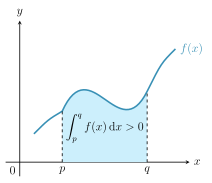
- If \(a > 0\) and \(b^2 < 4ac \Rightarrow \Delta < 0\) then \(f(x) = ax^2-bx+c > 0\) for all \(x\). Therefore \begin{align*} && 0 & < \int_0^1 (ax^2-bx+c) \d x\\ &&&= \frac13 a-\frac12b+c \\ \Rightarrow && 3b &< 2a+6c \end{align*}
- Similar logic tells us this must also be always positive, therefore \begin{align*} && 0 &< \int_0^{\pi} (a \sin^2 x - b \sin x +c ) \d x\\ &&&= \frac{\pi}{2}a - 2b+\pi c \\ \Rightarrow && 4b &< (a+2c)\pi \end{align*}
- Similar logic shows that \(f(x) = \frac{a}{x^2}-\frac{b}{x} +c>0\), therefore \begin{align*} && 0 &< \int_p^q \left (\frac{a}{x^2} - \frac{b}{x} + c\right) \d x \\ &&&=a\left (\frac{1}{p} - \frac{1}{q} \right) - b(\ln q - \ln p)+c(q-p) \\ \Rightarrow && b \ln (q/p) &,< a\left (\frac{1}{p} - \frac{1}{q} \right) +c(q-p) \end{align*}
2001 Paper 1 Q8
Given that \(y=x\) and \(y=1-x^2\) satisfy the differential equation $$ \frac{\d^2 {y}}{\d x^2} + \p(x) \frac{\d {y}}{\d x} + \q(x) {y}=0\;, \tag{*} $$ show that \(\p(x)= -2x(1+x^2)^{-1}\) and \(\q(x) = 2(1+x^2)^{-1}\). Show also that \(ax+b(1-x^2)\) satisfies the differential equation for any constants \(a\) and \(b\). Given instead that \(y=\cos^2(\frac{1}{2}x^2)\) and \(y=\sin^2(\frac{1}{2}x^2)\) satisfy the equation \((*)\), find \(\p(x)\) and \(\q(x)\).
Solution: \begin{align*} && y &= x \\ && y' &= 1 \\ && y'' &= 0 \\ \Rightarrow && 0 &= 0 + p(x) + xq(x) \tag{1} \\ \\ && y &= 1-x^2 \\ && y' &= -2x \\ && y'' &= -2 \\ \Rightarrow && 0 &= -2 -2x p(x)+(1-x^2)q(x) \tag{2}\\ \\ 2x*(1) +(2): && 2 &= (2x^2+1-x^2) q(x) \\ \Rightarrow && q(x) &= 2(1+x^2)^{-1} \\ \Rightarrow && p(x) &= -2x(1+x^2)^{-1} \tag{by (1)} \end{align*} \begin{align*} && \frac{\d^2}{\d x^2} \left (a x + b(1-x^2) \right) + p(x) \frac{\d}{\d x} \left (a x + b(1-x^2) \right)+q(x) \left (a x + b(1-x^2) \right) \\ &&= a \frac{\d^2 x}{\d x^2} + b \frac{\d^2}{\d x^2} \left ( 1- x^2 \right) + ap(x) \frac{\d x}{ \d x} + bp(x) \frac{\d }{\d x} \left ( 1- x^2 \right) + aq(x) x + bq(x)(1-x^2) \\ &&= a \left (\frac{\d^2 x}{\d x^2}+ p(x) \frac{\d x}{ \d x} +q(x)x\right)+b \left ( \frac{\d^2}{\d x^2} \left ( 1- x^2 \right)+ p(x) \frac{\d }{\d x} \left ( 1- x^2 \right)+q(x)(1-x^2)\right) &= 0 \end{align*} \begin{align*} && y &= \cos^2(\tfrac12 x^2) = \frac12 \left (1 + \cos(x^2) \right) \\ && y' &= -x \sin(x^2) \\ && y'' &= -2x^2 \cos(x^2)-\sin(x^2) \\ \Rightarrow && 0 &= -2x^2 \cos(x^2)-\sin(x^2)+p(x)(-x \sin(x^2)) +\frac12 \left (1 + \cos(x^2) \right)q(x) \\ \Rightarrow && 2x^2\cos(x^2)+\sin(x^2) &= -x \sin(x^2) p(x) + \frac12(1 + \cos(x^2)) q(x) \tag{3}\\ \\ && y &= \sin^2(\tfrac12 x^2) = \frac12 \left ( 1 - \cos (x^2) \right) \\ && y' &= x\sin(x^2) \\ && y'' &= 2x^2 \cos(x^2)+\sin(x^2) \\ \Rightarrow && 0 &= 2x^2 \cos(x^2)+\sin(x^2) +p(x) x \sin(x^2) + \frac12 \left ( 1 - \cos (x^2) \right)q(x)\\ \Rightarrow && -2x^2 \cos(x^2)-\sin(x^2) &= p(x) x \sin(x^2) + \frac12 \left ( 1 - \cos (x^2) \right)q(x) \tag{4}\\ (3)+(4): && 0 &= q(x) \\ \Rightarrow && p(x) &= -\frac{2x^2 \cos(x^2)+\sin(x^2)}{x \sin(x^2)} \end{align*}
2001 Paper 1 Q10
A gun is sited on a horizontal plain and can fire shells in any direction and at any elevation at speed \(v\). The gun is a distance \(d\) from a straight railway line which crosses the plain, where \(v^2>gd\). The gunner aims to hit the line, choosing the direction and elevation so as to maximize the time of flight of the shell. Show that the time of flight, \(T\), of the shell satisfies \[ %\frac{2v}{g} \sin \left( \frac12 \arccos \frac{gd}{v^2}\right)\,. g^2 T^2 = 2 v^2 +2 \left(v^4 -g^2d^2\right)^{\frac12}\,. \] Extension: (Not in original paper) Find the time of flight if the gun is constrained so that the angle of elevation \(\alpha \) is not greater than \( 45^\circ\).
Solution: If we fire the gun at an angle to the track, as long as we can travel a horizontal distance \(\geq d\) we can hit the track. Suppose we am at an elevatation \(\alpha\), then \begin{align*} (\uparrow): && s &= ut + \frac12 at^2 \\ && 0 &= v\sin \alpha T - \frac12 g T^2 \\ \Rightarrow &&T &= \frac{2v\sin \alpha}{g}\\ \\ (\rightarrow): && s &= ut \\ && s &= v \cos \alpha T \\ &&&= v\sqrt{1-\sin^2 \alpha} T \\ &&&= vT\sqrt{1 - \frac{g^2T^2}{4v^2}}\\ &&&= \frac{T}{2}\sqrt{4v^2-g^2T^2}\\ \Rightarrow && d & \leq \frac{T}{2}\sqrt{4v^2-g^2T^2} \\ \Rightarrow && 4g^2d^2&\leq g^2T^2(4v^2-g^2T^2) \\ \Rightarrow && 0 &\leq -(g^2T^2)^2 + 4v^2 (g^2T^2)-4g^2d^2 \\ &&&=4v^4-4g^2d^2 -\left (g^2T^2-2v^2 \right)^2 \\ \Rightarrow && \left (g^2T^2-2v^2 \right)^2 & \leq 4v^4-4g^2d^2 \\ \Rightarrow && g^2T^2 &\leq 2v^2+2\sqrt{v^4-g^2d^2} \end{align*} Therefore the maximum value for \(g^2T^2\) is \(2v^2+2\sqrt{v^4-g^2d^2}\) Notice that we are hitting the track directly at \(d\). This is because to maximise the time of flight (for a fixed speed) we want to maximise the angle of elevation. Therefore we want the highest angle where we still hit the track (which is clearly the shortest distance). If we are constraint to \(\alpha \leq 45^\circ\) we know that \(T\) is maximised when \(\alpha = 45^\circ\) (and we will reach the track since the range \(\frac{v^2 \sin 2 \alpha}{g}\) is increasing). Therefore the maximum time is \(T = \frac{\sqrt{2}v}{g}\)
2001 Paper 3 Q9
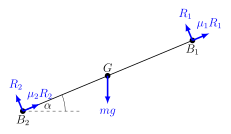
\(B_1\) and \(B_2\) are parallel, thin, horizontal fixed beams. \(B_1\) is a vertical distance \(d \sin \alpha \) above \(B_2\), and a horizontal distance \(d\cos\alpha \) from \(B_2\,\), where \(0<\alpha<\pi/2\,\). A long heavy plank is held so that it rests on the two beams, perpendicular to each, with its centre of gravity at \(B_1\,\). The coefficients of friction between the plank and \(B_1\) and \(B_2\) are \(\mu_1\) and \(\mu_2\,\), respectively, where \(\mu_1<\mu_2\) and \(\mu_1+\mu_2=2\tan\alpha\,\). The plank is released and slips over the beams experiencing a force of resistance from each beam equal to the limiting frictional force (i.e. the product of the appropriate coefficient of friction and the normal reaction). Show that it will come to rest with its centre of gravity over \(B_2\) in a time \[ \pi \left(\frac{d}{g(\mu_2-\mu_1)\cos\alpha }\right)^{\!\frac12}\;. \]
Solution:
2000 Paper 1 Q8
Show that \[ \int_{-1}^1 \vert \, x\e^x \,\vert \d x =- \int_{-1}^0 x\e^x \d x + \int_0^1 x\e^x \d x \] and hence evaluate the integral. Evaluate the following integrals:
- \(\displaystyle \int_0^4 \vert\, x^3-2x^2-x+2 \,\vert \, \d x\,;\)
- \(\displaystyle \int_{-\pi}^\pi \vert\, \sin x +\cos x \,\vert \; \d x\,.\)
Solution: \begin{align*} && \int_{-1}^1 |x e^x |\d x &= \int_{-1}^0 |xe^x| \d x + \int_0^1 |xe^x| \d x \\ &&&= \int_{-1}^0 -xe^x \d x + \int_0^1 x \e^x \d x \\ &&&= -\int_{-1}^0 xe^x \d x + \int_0^1 x \e^x \d x \\ \\ && \int xe^x \d x &= xe^x - \int e^x \d x \\ &&&= xe^x - e^x \\ \\ \Rightarrow && \int_{-1}^1 |x e^x |\d x &= \left [ xe^x - e^x \right]_0^{-1}+ \left [ xe^x - e^x \right]_0^{1} \\ &&&= -e^{-1}-e^{-1} +e^{0} + e^1 - e^1 +e^0 \\ &&&= 2-2e^{-1} \end{align*}
- \(\,\) \begin{align*} && I &= \int_0^4 | x^3-2x^2-x+2| \d x \\ &&&= \int_0^4 |(x-2)(x-1)(x+1)| \d x\\ &&&= \int_0^1( x^3-2x^2-x+2) \d x- \int_1^2 ( x^3-2x^2-x+2) \d x + \int_2^4 ( x^3-2x^2-x+2) \d x \\ &&&= \left [\frac14 x^4-\frac23 x^3- \frac12 x^2 +2x \right]_0^1 - \left [\frac14 x^4-\frac23 x^3- \frac12 x^2 +2x \right]_1^2 + \left [\frac14 x^4-\frac23 x^3- \frac12 x^2 +2x \right]_2^4 \\ &&&= 2 \left ( \frac14 - \frac23 -\frac12 + 2\right) - 2 \left ( \frac14 2^4 - \frac23 2^3 -\frac12 2^2 + 2 \cdot 2\right)+ \left ( \frac14 4^4 - \frac23 4^3 -\frac12 4^2 + 2 \cdot 4\right) \\ &&&= \frac{133}{6} \end{align*}
- \(\,\) \begin{align*} && J &= \int_{-\pi}^\pi | \sin x + \cos x | \d x \\ &&&= \int_{-\pi}^{\pi} | \sqrt{2} \sin(x + \tfrac{\pi}{4})| \d x \\ &&&= 2\sqrt{2}\int_0^\pi \sin x \d x \\ &&&= 4\sqrt{2} \end{align*}
2000 Paper 2 Q5
It is required to approximate a given function \(\f(x)\), over the interval \(0 \le x \le 1\), by the linear function \(\lambda x\), where \(\lambda\) is chosen to minimise \[ \int_0^1 \big(\f(x)-\lambda x \big)^{\!2} \,\d x . \] Show that \[ \lambda = 3 \int_0^1 x\f(x)\,\d x. \] The residual error, \(R\), of this approximation process is such that \[ R^2 = \int_0^1 \big(\f(x)-\lambda x \big)^{\!2}\,\d x. \] Show that \[ R^2 = \int_0^1 \big(\f(x)\big)^{\!2}\,\d x -\tfrac{1}{3} \lambda ^2. \] Given now that \(\f(x)= \sin (\pi x/n)\), show that (i) for large \(n\), \(\lambda \approx \pi/n\) and (ii) \(\lim_{n \to \infty}R = 0.\) Explain why, prior to any calculation, these results are to be expected. [You may assume that, when \(\theta\) is small, $\sin \theta \approx \theta-\frac{1}{6}\theta^3$ and \(\cos \theta \approx 1 - \frac{1}{2}\theta^2.\)]
Solution: \begin{align*} && g(\lambda) &= \int_0^1 \big(\f(x)-\lambda x \big)^{\!2} \,\d x \\ &&&= \int_0^1 \left ( f(x)^2 -2\lambda xf(x) + \lambda^2 x^2\right) \d x \\ &&&= \frac13\lambda^2 - 2\lambda \int_0^1 x f(x) \d x + \int_0^1 f(x)^2 \d x \\ \end{align*} Differentiating (or completing the square) it is clear the minimum occurs when \(\displaystyle \lambda = 3 \int_0^1 xf(x) \d x\) \begin{align*} && R^2 &= \int_0^1 (f(x) - \lambda x )^2 \d x \\ &&&= \frac13\lambda^2 - 2\lambda \int_0^1 x f(x) \d x + \int_0^1 f(x)^2 \d x \\ &&&= \frac13 \left (\lambda -3\int_0^1 xf(x) \d x \right)^2 -\frac13 \left ( 3\int_0^1 xf(x) \d x \right)^2+\int_0^1 f(x)^2 \d x \\ \end{align*} When \(\lambda = 3\int_0^1 xf(x) \d x \) clearly this is the desired result. \begin{align*} && \lambda &= 3\int_0^1 xf(x) \d x \\ &&&= 3\int_0^1 x \sin(\pi x /n) \d x \\ &&&= 3 \left [-x \frac{n}{\pi} \cos (\pi x /n) \right]_0^1 + \frac{3n}{\pi} \int_0^1 \cos(\pi x /n) \d x \\ &&&= -\frac{3n}{\pi}\cos(\pi/n) + \frac{3n}{\pi} \left [ \frac{n}{\pi} \sin(\pi x /n)\right]_0^1 \\ &&&= -\frac{3n}{\pi} \cos(\pi/n) + \frac{3n^2}{\pi^2} \sin(\pi /n) \\ \text{for large }n: &&&\approx -\frac{3n}{\pi}\left ( 1 - \frac12\frac{\pi^2}{n^2} + o(1/n^4)\right) + \frac{3n^2}{\pi^2} \left (\frac{\pi}{n} - \frac16 \frac{\pi^3}{n^3} +o(1/n^5) \right) \\ &&&= \left (\frac32 -\frac12\right)\frac{\pi}{n} + o(1/n^3) \\ &&&= \frac{\pi}{n} + o(1/n^2) \end{align*} Therefore for large \(n\), \(\lambda \approx \frac{\pi}n\) \begin{align*} && \int_0^1 \sin^2(\pi x/n) \d x &= \frac12\int_0^1(1- \cos(2\pi x/n)) \d x\\ &&&= \frac12\left ( 1 - \frac{n}{2\pi}\left[\sin(2\pi x/n) \right]_0^1 \right) \\ &&&= \frac12 -\frac{n}{4\pi}\sin(2\pi /n) \\ \\ && R^2 &= \frac12 -\frac{n}{4\pi}\sin(2\pi /n) - \frac13 \left ( \frac{\pi}{n}+o(1/n^2)\right)^2 \\ &&&= \frac12 - \left ( \frac{1}{2} -\frac16\frac{\pi}{n}+o(1/n^3) \right) - o(1/n^2) \\ &&& = \frac16 \frac{\pi}{n} + o(1/n^2) \\ &&&\to 0 \text{ as } n \to \infty \end{align*} We should expect these results as for \(n\) very large \(\sin(\pi x/n) \approx \frac{\pi }{n}x\) so the best linear approximation is likely to be \(\lambda = \frac{\pi}{n}\) and we should expect it to improve to the point that we cannot tell the difference, ie \(R^2 \to 0\)
2000 Paper 2 Q6
Show that \[ \sin\theta = \frac {2t}{1+t^2}, \ \ \ \cos\theta = \frac{1-t^2}{1+t^2}, \ \ \ \frac{1+\cos\theta}{\sin\theta} = \tan (\tfrac{1}{2}\pi-\tfrac{1}{2}\theta), \] where \(t =\tan\frac{1}{2}\theta\). Use the substitution \(t =\tan\frac{1}{2}\theta\) to show that, for \(0<\alpha<\frac{1}{2}\pi\), \[ \int_0^{\frac{1}{2}\pi} {1 \over {1 + \cos\alpha \sin \theta}} \,\d\theta =\frac{\alpha}{\sin\alpha}\,, \] and deduce a similar result for \[ \int_0^{\frac{1}{2}\pi} {1 \over {1 + \sin\alpha \cos \theta}} \,\d\theta \,. \]
Solution: \begin{align*} && \frac{2t}{1+t^2} &= \frac{2 \sin \tfrac12 \theta \cos\tfrac12 \theta }{\cos^2 \tfrac12 \theta + \sin^2 \tfrac12 \theta} \\ &&&= \frac{\sin \theta}{1} = \sin \theta \\ \\ && \frac{1-t^2}{1+t^2} &= \frac{\cos^2 \tfrac12 \theta - \sin^2 \tfrac12 \theta}{\cos^2 \tfrac12 \theta + \sin^2 \tfrac12 \theta} \\ &&&= \frac{\cos \theta }{1} = \cos \theta \\ \\ && \tan(\tfrac12 \pi - \tfrac12 \theta) &= \frac{1}{t} \\ && \frac{1+\cos \theta}{\sin \theta} &= \frac{1 + \frac{1-t^2}{1+t^2}}{\frac{2t}{1+t^2}} \\ &&&= \frac{2}{2t} = \frac1t = \tan(\tfrac12\pi - \tfrac12 \theta) \end{align*} Notice also that \(\frac{\d t}{\d \theta} = \tfrac12 \sec^2 \tfrac12 \theta = \tfrac12(1 + t^2)\) so \begin{align*} && I &= \int_0^{\frac12 \pi} \frac{1}{1 + \cos \alpha \sin \theta} \d \theta \\ t = \tan \tfrac12 \theta, \d \theta = \frac{2}{1+t^2} \d t: &&&= \int_{0}^{1} \frac{1}{1 + \cos \alpha \frac{2t}{1+t^2}}\frac{2}{1+t^2} \d t \\ &&&= \int_0^1 \frac{2}{1+t^2 + 2\cos \alpha t} \d t \\ &&&= \int_0^1 \frac{2}{(t + \cos \alpha)^2+\sin^2 \alpha} \d t \\ &&&= \left [ \frac{2}{\sin \alpha} \tan^{-1} \left ( \frac{t+ \cos \alpha}{\sin \alpha} \right) \right]_0^1 \\ &&&= \frac{2}{\sin \alpha} \left ( \tan^{-1} \left ( \frac{1+ \cos \alpha}{\sin \alpha} \right) - \tan^{-1} \left ( \frac{ \cos \alpha}{\sin \alpha} \right) \right) \\ &&&= \frac{2}{\sin \alpha} \left ( \tan^{-1} \left (\tan (\tfrac12 \pi - \tfrac12 \alpha \right) - \tan^{-1} \left (\tan(\tfrac12\pi - \alpha )\right) \right) \\ &&&= \frac{2}{\sin \alpha} \left ( \tfrac12 \pi - \tfrac12 \alpha - \tfrac12 \pi + \alpha \right) \\ &&&= \frac{\alpha}{\sin \alpha} \end{align*} \begin{align*} && J &= \int_0^{\tfrac12 \pi} \frac{1}{1 + \sin \alpha \cos \theta} \d \theta \\ &&&= \int_0^{\tfrac12 \pi} \frac{1}{1 + \cos (\tfrac12 \pi - \alpha) \sin \theta} \d \theta \\ &&&= \frac{\tfrac12 \pi - \alpha}{\cos \alpha} \end{align*}
2000 Paper 2 Q7
The line \(l\) has vector equation \({\bf r} = \lambda {\bf s}\), where \[ {\bf s} = (\cos\theta+\sqrt3\,) \; {\bf i} +(\surd2\;\sin\theta)\;{\bf j} +(\cos\theta-\sqrt3\,)\;{\bf k} \] and \(\lambda\) is a scalar parameter. Find an expression for the angle between \(l\) and the line \mbox{\({\bf r} = \mu(a\, {\bf i} + b\,{\bf j} +c\, {\bf k})\)}. Show that there is a line \(m\) through the origin such that, whatever the value of \(\theta\), the acute angle between \(l\) and \(m\) is \(\pi/6\). A plane has equation \(x-z=4\sqrt3\). The line \(l\) meets this plane at \(P\). Show that, as \(\theta\) varies, \(P\) describes a circle, with its centre on \(m\). Find the radius of this circle.
1999 Paper 1 Q7
Show that \(\sin(k\sin^{-1} x)\), where \(k\) is a constant, satisfies the differential equation $$(1-x^{2})\frac {\d^2 y}{\d x^2} -x\frac{\d y}{\d x} +k^{2}y=0. \tag{*}$$ In the particular case when \(k=3\), find the solution of equation \((*)\) of the form \[ y=Ax^{3}+Bx^{2}+Cx+D, \] that satisfies \(y=0\) and \(\displaystyle \frac{\d y}{\d x}=3\) at \(x=0\). Use this result to express \(\sin 3\theta\) in terms of powers of \(\sin\theta\).
Solution: \begin{align*} && y &= \sin(k \sin^{-1} x ) \\ &&y' &= \cos (k \sin^{-1} x) \cdot k \frac{1}{\sqrt{1-x^2}} \\ && y'' &= -\sin (k \sin^{-1} x) \cdot k^2 \frac{1}{(1-x^2)} - \cos(k \sin^{-1} x) \cdot k \frac{x}{(1-x^2)\sqrt{1-x^2}} \\ && (1-x^2)y'' &= -k^2y -xy' \\ \Rightarrow && 0 &= (1-x^2)y''+xy' + k^2y \end{align*} \begin{align*} && y &= Ax^3 + Bx^2 + Cx + D \\ && y' &= 3Ax^2 + 2Bx + C \\ && y'' &= 6Ax+2B \\ && 0 &= (1-x^2)(6Ax+2B) - x( 3Ax^2 + 2Bx + C) + 9(Ax^3 + Bx^2 + Cx + D ) \\ &&&= x^3(-6A-3A+9A) + x^2(-2B-2B+9B) + x(6A-C+9C) + (2B +9D) \\ \Rightarrow && B &= 0 \\ \Rightarrow && D &= 0 \\ \Rightarrow && C &= -\frac34 A \\ \\ x = 0, y = 0, y' = 0: && y &= 3x-4x^3 \\ \end{align*} And so \(\sin 3 x = 3 \sin x - 4\sin^3 x\)
1999 Paper 2 Q11
An automated mobile dummy target for gunnery practice is moving anti-clockwise around the circumference of a large circle of radius \(R\) in a horizontal plane at a constant angular speed \(\omega\). A shell is fired from \(O\), the centre of this circle, with initial speed \(V\) and angle of elevation \(\alpha\). Show that if \(V^2 < gR\), then no matter what the value of \(\alpha\), or what vertical plane the shell is fired in, the shell cannot hit the target. Assume now that \(V^2 > gR\) and that the shell hits the target, and let \(\beta\) be the angle through which the target rotates between the time at which the shell is fired and the time of impact. Show that \(\beta\) satisfies the equation $$ g^2{{\beta}^4} - 4{{\omega}^2}{V^2}{{\beta}^2} +4{R^2}{{\omega}^4}=0. $$ Deduce that there are exactly two possible values of \(\beta\). Let \(\beta_1\) and \(\beta_2\) be the possible values of \(\beta\) and let \(P_1\) and \(P_2\) be the corresponding points of impact. By considering the quantities \((\beta_1^2 +\beta_2^2) \) and \(\beta_1^2\beta_2^2\,\), or otherwise, show that the linear distance between \(P_1\) and \(P_2\) is \[ 2R \sin\Big( \frac\omega g \sqrt{V^2-Rg}\Big) \;. \]
Solution: \begin{align*} && 0 &= V\sin \alpha t-\frac12 gt^2 \\ \Rightarrow && t &= \frac{2V \sin \alpha}{g} \\ && R &= V \cos \alpha \, t \\ &&&= \frac{2V^2 \sin \alpha \cos \alpha}{g} \\ &&&= \frac{V^2 \sin 2 \alpha}{g} \end{align*} Therefore the max distance is \(\frac{V^2}{g}\), therefore we cannot hit the target if \(R > \frac{V^2}{g} \Rightarrow gR > V^2\). We have \(\beta = \omega t \Rightarrow t = \frac{\beta}{\omega}\) \begin{align*} && \sin \alpha &= \frac{gt}{2V} \\ && \cos \alpha &= \frac{R}{Vt} \\ \Rightarrow && 1 &= \left (\frac{gt}{2V} \right)^2 + \left ( \frac{R}{Vt} \right)^2 \\ &&&= \left (\frac{g\beta}{2V \omega} \right)^2 + \left ( \frac{R\omega}{V\beta} \right)^2 \\ &&&= \frac{g^2 \beta^2}{4 V^2 \omega^2} + \frac{R^2 \omega^2}{V^2 \beta ^2} \\ \Rightarrow && 4V^2 \omega^2 \beta^2 &= g^2 \beta^4 + 4R^2 \omega^4 \\ \Rightarrow && 0 &= g^2 \beta^4 - 4\omega^2 V^2 \beta^2+4R^2\omega^4 \end{align*} This (quadratic) equation in terms of \(\beta^2\) has two solution if \(\Delta = 16\omega^4V^4-16g^2R^2\omega^4 =16\omega^4(V^4-g^2R^2) > 0\) since \(V^2 > gR\). Since \(\beta > 0\) there are exactly two solutions, once we have values for \(\beta\). First notice, \begin{align*} && \beta_1^2 + \beta_2^2 &= \frac{4\omega^2V^2}{g^2} \\ && \beta_1^2\beta_2^2 &= \frac{4R^2\omega^4}{g^2} \end{align*} Then notice the positions of \(P_1\) and \(P_2\) are \((R\cos \beta_1 , R\sin \beta_1)\) and \((R\cos \beta_2, R\sin \beta_2)\). \begin{align*} && d^2 &= R^2\left ( \cos \beta_1 - \cos \beta_2 \right)^2 + R^2 \left ( \sin \beta_1 - \sin \beta_2 \right)^2 \\ &&&= 2R^2 - 2R^2(\cos \beta_1 \cos \beta_2 + \sin \beta_1 \sin \beta_2) \\ &&&= 2R^2-2R^2\cos(\beta_1 - \beta_2) \\ &&&= 2R^2 \left (1-\cos(\sqrt{(\beta_1-\beta_2)^2} \right ) \\ &&&= 2R^2 \left (1 - \cos\left ( \sqrt{\frac{4\omega^2 V^2}{g^2} - \frac{4R\omega^2}{g}} \right) \right) \\ &&&= 2R^2 \left (1 - \cos\left (\frac{2\omega}{g} \sqrt{V^2 - Rg} \right) \right) \\ &&&= 4 R^2 \sin^2 \left (\frac{\omega}{g} \sqrt{V^2 - Rg} \right) \end{align*} which gives us the required result.
1999 Paper 3 Q8
The function \(y(x)\) is defined for \(x\ge0\) and satisfies the conditions \[ y=0 \mbox{ \ \ and \ \ } \frac{\d y}{\d x}=1 \mbox{ \ \ at \(x=0\)}. \] When \(x\) is in the range \(2(n-1)\pi< x <2n\pi\), where \(n\) is a positive integer, \(y(t)\) satisfies the differential equation $$ {\d^2y \over \d x^2} + n^2 y=0. $$ Both \(y\) and \(\displaystyle \frac{\d y}{\d x} \) are continuous at \(x=2n\pi\) for \(n=0,\; 1,\;2,\; \ldots\;\).
- Find \(y(x)\) for \(0\le x \le 2\pi\).
- Show that \(y(x) = \frac12 \sin 2x \) for \(2\pi\le x\le 4\pi\), and find \(y(x)\) for all \(x\ge0\).
- Show that $$ \int_0^\infty y^2 \,\d x = \pi \sum_{n=1}^\infty {1\over n^2} \,. $$