Problems
Filters
233 problems found
2010 Paper 1 Q4
Use the substitution \(x=\dfrac{1}{t^{2}-1}\; \), where \(t>1\), to show that, for \( x>0\), \[ \int \frac{1}{\sqrt{x\left(x+1\right) \; } \ }\; \d x =2 \ln \left(\sqrt x+ \sqrt{x +1} \; \right)+c \,. \] Note: You may use without proof the result \(\displaystyle \int \! \frac{1}{t^2-a^2} \, \d t = \frac{1}{2a} \ln \left| \frac{t-a}{t+a}\right| + \rm {constant}\). The section of the curve \[ y=\dfrac{1}{\sqrt{x}\; }-\dfrac{1}{\sqrt{x+1}\; } \] between \(x=\frac{1}{8}\) and \(x=\frac{9}{16}\) is rotated through \(360^{o}\) about the \(x\)-axis. Show that the volume enclosed is \(2\pi \ln \tfrac{5}{4}\,\). \(\phantom{\dfrac AB}\)
Solution: \begin{align*} && x &= \frac{1}{t^2-1} \\ && t &= \sqrt{\frac{x+1}{x}}\\ \Rightarrow && \frac{\d x}{\d t} &= \frac{-2t}{(t^2-1)^2} \\ \Rightarrow && I &= \int \frac{1}{\sqrt{x(x+1)}} \d x \\ &&&= \int \frac{1}{\sqrt{\frac1{t^2-1} \frac{t^2}{t^2-1}}} \cdot \frac{-2 t}{(t^2-1)^2} \d t \\ &&&= \int \frac{t^2-1}{t} \frac{-2t}{(t^2-1)^2} \d t \\ &&&= -\int \frac{2}{t^2-1} \d t \\ &&&= - \frac{2}{2 \cdot 1} \ln \left | \frac{t-1}{t+1} \right| +C \\ &&&= \ln \left | \frac{t+1}{t-1} \right| + C \\ &&&= \ln \left | \frac{\sqrt{\frac{x+1}{x}}+1}{\sqrt{\frac{x+1}{x}}-1} \right| + C \\ &&&= \ln \left | \frac{\sqrt{x+1}+\sqrt{x}}{\sqrt{x+1}-\sqrt{x}} \right| + C \\ &&&= 2\ln \left | \sqrt{x+1}+\sqrt{x}\right| + C \\ &&&= 2\ln \left ( \sqrt{x+1}+\sqrt{x}\right) + C \\ \end{align*} \begin{align*} && V&= \pi \int_{1/8}^{9/16} y^2 \d x \\ &&&= \pi \int_{1/8}^{9/16} \left ( \frac1x + \frac{1}{x+1} - \frac{2}{\sqrt{x(x+1)}}\right) \d x \\ &&&= \pi \left [ \ln x + \ln (x+1) - 4 \ln(\sqrt{x+1} + \sqrt{x}) \right]_{1/8}^{9/16} \\ &&&= \pi \left ( \ln \frac{9}{16} + \ln \frac{25}{16} - 4 \ln \left ( \frac54 + \frac34\right) \right) +\\ &&&\quad -\pi \left ( \ln \frac{1}{8} + \ln \frac{9}{8} - 4 \ln \left ( \frac1{2\sqrt{2}} + \frac3{2\sqrt{2}}\right) \right) \\ &&&= \pi \left ( 2 \ln 3 - 8 \ln 2 + 2 \ln 5 - 4\ln2 \right) - \pi \left ( -6 \ln 2 + 2\ln 3 - 2\ln 2\right) \\ &&&= \pi (2 \ln 5 - 4 \ln 2 ) \\ &&&= 2 \pi \ln \tfrac54 \end{align*}
2010 Paper 1 Q5
By considering the expansion of \(\left(1+x\right)^{n}\) where \(n\) is a positive integer, or otherwise, show that:
- \[\binom{n}{0}+\binom{n}1+\binom{n}2 +\cdots +\binom{n}n=2^{n} \]
- \[\binom{n}{1}+2\binom{n}2+3\binom{n}3 +\cdots +n\binom{n}n=n2^{n-1} \]
- \[\binom{n}{0}+\frac12\binom{n}1+\frac13\binom{n}2 +\cdots +\frac1{n+1}\binom{n}n=\frac1{n+1}(2^{n+1}-1) \]
- \[\binom{n}{1}+2^2\binom{n}2+3^2\binom{n}3 +\cdots +n^2\binom{n}n=n(n+1)2^{n-2} \]
Solution:
- Notice that \begin{align*} && (1+x)^n &= \sum_{i=0}^n \binom{n}{i} x^i \\ \text{Evaluate at }x = 1: && 2^n &= \sum_{i=0}^n \binom{n}{i} \end{align*}
- \(\,\) \begin{align*} && (1+x)^n &= \sum_{i=0}^n \binom{n}{i} x^i \\ \frac{\d}{\d x}: && n(1+x)^{n-1} &= \sum_{i=1}^n i\binom{n}{i} x^{i-1} \\ \text{Evaluate at }x = 1: && n2^{n-1} &= \sum_{i=1}^n i\binom{n}{i} \end{align*}
- \(\,\) \begin{align*} && (1+x)^n &= \sum_{i=0}^n \binom{n}{i} x^i \\ \Rightarrow && \int_0^1(1+x)^n \d x &= \int_0^1 \sum_{i=0}^n \binom{n}{i} x^i \d x \\ \Rightarrow && \frac{1}{n+1}(2^{n+1}-1) &= \sum_{i=0}^n \binom{n}{i}\int_0^1 x^i \d x\\ &&& = \sum_{i=0}^n \frac{1}{i+1}\binom{n}{i} \\ \end{align*}
- \(\,\) \begin{align*} && (1+x)^n &= \sum_{i=0}^n \binom{n}{i} x^i \\ \frac{\d}{\d x}: && n(1+x)^{n-1} &= \sum_{i=1}^n i\binom{n}{i} x^{i-1} \\ \times x: && nx(1+x)^{n-1} &= \sum_{i=1}^n i\binom{n}{i} x^{i} \\ \frac{\d}{\d x}: && n(1+x)^{n-1}+n(n-1)x(1+x)^{n-2} &= \sum_{i=1}^n i^2\binom{n}{i} x^{i-1} \\ \text{Evaluate at }x = 1: && \sum_{i=1}^n i^2\binom{n}{i} &= n(1+1)^{n-1}+n(n-1)x(1+1)^{n-2} \\ &&&= 2^{n-2} \left (n(n-1) + 2n \right) \\ &&&= n(n+1)2^{n-2} \end{align*}
2010 Paper 2 Q2
Prove that \[ \cos 3x = 4 \cos^3 x - 3 \cos x \,. \] Find and prove a similar result for \(\sin 3x\) in terms of \(\sin x\).
- Let \[ {\rm I}(\alpha) = \int_0^\alpha \big(7\sin x - 8 \sin^3 x\big) \d x\,. \] Show that \[ {\rm I}(\alpha) = -\tfrac 8 3 c^3 + c +\tfrac5 3\,, \] where \(c = \cos \alpha\). Write down one value of \(c\) for which \({\rm I}(\alpha) =0\).
- Useless Eustace believes that \[ \int \sin^n x \, \d x =\dfrac {\sin^{n+1}x}{n+1}\, \] for \(n=1, \ 2, \ 3, \ldots\, \). Show that Eustace would obtain the correct value of \({\rm I}(\beta)\,\), where \(\cos \beta= -\frac16\). Find all values of \(\alpha\) for which he would obtain the correct value of \({\rm I}(\alpha)\).
Solution: \begin{align*} \cos 3x &\equiv \cos (2x + x) \\ &\equiv \cos 2x \cos x - \sin 2x \sin x \\ &\equiv (2\cos^2 x - 1) \cos x - 2 \sin x \cos x \sin x \\ &\equiv 2 \cos^3 x - \cos x - 2\cos x (\sin^2 x) \\ &\equiv 2 \cos^3 x - \cos x - 2\cos x (1- \cos^2 x) \\ &\equiv 4\cos^3 x - 3\cos x \end{align*} Similarly, \begin{align*} \sin 3x &\equiv \sin (2x + x) \\ &\equiv \sin 2x \cos x + \cos 2x \sin x \\ &\equiv 2 \sin x \cos x \cos x + (1-2\sin^2 x) \sin x \\ &\equiv 2 \sin x (1-\sin^2 x) + \sin x - 2 \sin^3 x \\ &\equiv 3 \sin x -4 \sin ^3 x \end{align*}
- \begin{align*} I(\alpha) &= \int_0^{\alpha} (7 \sin x - 8 \sin^3 x) \d x \\ &= \int_0^{\alpha} (7 \sin x - (6\sin x-2 \sin 3x) ) \d x \\ &= \int_0^{\alpha} (\sin x +2 \sin 3x ) \d x \\ &= -\cos \alpha - \frac23 \cos 3\alpha +1+\frac23 \\ &= -c - \frac23 (4c^3-3c) + \frac53 \\ &= -\frac83 c^3 +c + \frac53 \end{align*} as required. When \(c = -1\) this value is \(0\). Eustace will obtain the value \(\frac{7}{2} \sin^2 \beta - 2 \sin^4 \beta = \frac72 (1-\cos^2 \beta) - 2(1-\cos^2 \beta)^2 = \frac32 + \frac12\cos^2 \beta -2\cos^4 \beta\) So if \(\cos \beta = -\frac16\) he will obtain \(\frac32 + \frac{1}{2\cdot36} - \frac{2}{6^4}\) and he should obtain \(\frac{8}{3} \frac{1}{6^3} - \frac{1}{6} + \frac{5}{3}\) which are equal. We want to find all roots of: \begin{align*} && \frac32 + \frac12 c^2 - 2c^4 &= -\frac83 c^3+ c + \frac53 \\ \Rightarrow && 0 &=2c^4-\frac83c^3-\frac12 c^2+c +\frac{1}{6} \\ &&&= 12c^4-16c^3-3c^2+6c+1\\ &&&= (6c+1)(2c^3-3c^2+1) \\ &&&= (6c+1)(2c+1)(c-1)^2 \end{align*} Therefore \(\cos \alpha = - \frac16, -\frac12, 1\) will give the correct answers.
2010 Paper 2 Q4
- Let \[ I=\int_0^a \frac {\f(x)}{\f(x)+\f(a-x)} \, \d x\,. \] Use a substitution to show that \[ I = \int_0^a \frac {\f(a-x)}{\f(x)+\f(a-x)} \, \d x\, \] and hence evaluate \(I\) in terms of \(a\). Use this result to evaluate the integrals \[ \int_0^1 \frac{\ln (x+1)}{\ln (2+x-x^2)}\, \d x \ \ \ \ \ \ \text{ and }\ \ \ \ \ \int_0^{\frac\pi 2} \frac{\sin x } {\sin(x+\frac \pi 4 )} \, \d x \,. \]
- Evaluate \[ \int_{\frac12}^2 \frac {\sin x}{x \big(\sin x + \sin \frac 1 x\big)} \, \d x\,. \]
Solution:
- \(\,\) \begin{align*} && I &= \int_0^a \frac{f(x)}{f(x)+f(a-x)} \d x \\ u =a-x, \d u = - \d x: &&& \int_{u=a}^{u=0} \frac{f(a-u)}{f(a-u)+f(u)} (-1) \d u \\ &&&= \int_0^a \frac{f(a-u)}{f(u)+f(a-u)} \d u \\ &&&= \int_0^a \frac{f(a-x)}{f(x)+f(a-x)} \d x \\ \Rightarrow && 2 I &= \int_0^a \left ( \frac{f(x)}{f(x)+f(a-x)} + \frac{f(a-x)}{f(x)+f(a-x)} \right) \d x \\ &&&= \int_0^a 1 \d x \\ &&&= a \\ \Rightarrow && I &= \frac{a}{2} \end{align*} \begin{align*} && J &= \int_0^1 \frac{\ln (x+1)}{\ln (2+x-x^2)}\, \d x \\ &&&= \int_0^1 \frac{\ln (x+1)}{\ln((x+1)(2-x))} \d x \\ &&&= \int_0^1 \frac{\ln (x+1)}{\ln(x+1) + \ln ((1-x)+1)} \d x \\ &&&= \frac{1}{2} \tag{\(f(x) = \ln (x+1)\)} \\ \\ && K &= \int_0^{\frac\pi 2} \frac{\sin x } {\sin(x+\frac \pi 4 )} \, \d x \\ &&&= \int_0^{\frac{\pi}{2}} \frac{\sin x }{\sin x \cos \frac{\pi}{4} + \cos x \sin \frac{\pi}{4}} \\ &&&= \sqrt{2} \int_0^{\frac{\pi}{2}} \frac{\sin x }{\sin x + \sin (\frac{\pi}{2}-x)} \d x\\ &&&= \frac{\pi}{2\sqrt{2}} \end{align*}
- \(\,\) \begin{align*} &&I &= \int_{\frac12}^2 \frac{\sin x }{x(\sin x + \sin \frac1x)} \d x \\ u = 1/x, \d u = -1/x^2 \d x : &&&= \int_{u = 2}^{u=\frac12} \frac{\sin \frac1u}{\frac{1}{u}(\sin \frac1u + \sin u)} (-\frac{1}{u^2} ) \d u \\ &&&= \int_{\frac12}^2 \frac{\sin \frac1u}{u (\sin u + \sin \frac1u)} \d u \\ \Rightarrow && 2I &= \int_{\frac12}^2 \left ( \frac{\sin x }{x(\sin x + \sin \frac1x)} + \frac{\sin \frac1x }{x(\sin x + \sin \frac1x)}\right) \d x \\ &&&= \int_{\frac12}^2 \frac{1}{x} \d x\\ &&&= 2\ln2 \\ \Rightarrow && I &= \ln 2 \end{align*}
2010 Paper 2 Q8
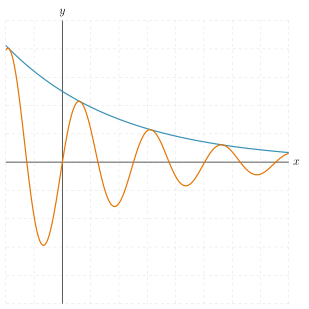
The curves \(C_1\) and \(C_2\) are defined by \[ y= \e^{-x} \quad (x>0) \quad \text{ and } \quad y= \e^{-x}\sin x \quad (x>0), \] respectively. Sketch roughly \(C_1\) and \(C_2\) on the same diagram. Let \(x_n\) denote the \(x\)-coordinate of the \(n\)th point of contact between the two curves, where \(0 < x_1 < x_2 < \cdots\), and let \(A_n\) denote the area of the region enclosed by the two curves between \(x_n\) and \(x_{n+1}\). Show that \[ A_n = \tfrac12(\e^{2\pi}-1) \e^{-(4n+1)\pi/2} \] and hence find \(\displaystyle \sum_{n=1}^\infty A_n\).
Solution:
2010 Paper 3 Q2
In this question, \(a\) is a positive constant.
- Express \(\cosh a\) in terms of exponentials. By using partial fractions, prove that \[ \int_0^1 \frac 1{ x^2 +2x\cosh a +1} \, \d x = \frac a {2\sinh a}\,. \]
- Find, expressing your answers in terms of hyperbolic functions, \[ \int_1^\infty \frac 1 {x^2 +2x \sinh a -1} \,\d x \, \] and \[ \int_0^\infty \frac 1 {x^4 +2x^2\cosh a +1} \,\d x \,.\]
Solution:
- \(\cosh a = \frac12 (e^a + e^{-a})\) \begin{align*} \int_0^1 \frac 1{ x^2 +2x\cosh a +1} \, \d x &= \int_0^1 \frac{1}{x^2+(e^a+e^{-a})x+e^ae^{-a}} \d x \\ &= \int_0^1 \frac{1}{e^a-e^{-a}}\left (\frac{1}{x+e^{-a}}-\frac{1}{x+e^a} \right)\d x \\ &= \frac{1}{2 \sinh a} \int_0^1 \left (\frac{1}{x+e^{-a}}-\frac{1}{x+e^a} \right)\d x \\ &= \frac{1}{2 \sinh a}\left [\ln(x+e^{-a})-\ln(x+e^a) \right]_0^1 \\ &= \frac{1}{2 \sinh a} \left (\ln(1+e^a)-\ln(1+e^{-a}) - (\ln e^{-a}-\ln e^a) \right) \\ &= \frac{1}{2\sinh a}\left (2a + \ln \frac{1+e^a}{1+e^{-a}}\right) \\ &= \frac1{2\sinh a} \left ( 2a -a \right) \\ &= \frac{a}{2 \sinh a} \end{align*}
- \begin{align*} \int_1^\infty \frac 1 {x^2 +2x \sinh a -1} \,\d x &= \int_1^{\infty} \frac{1}{(x+e^a)(x-e^{-a})} \d x \\ &= \int_1^{\infty} \frac{1}{e^a+e^{-a}} \left ( \frac{1}{x-e^{-a}} - \frac{1}{x+e^{a}} \right)\d x \\ &= \frac{1}{2\cosh a} \int_1^{\infty} \left ( \frac{1}{x-e^{-a}} - \frac{1}{x+e^{a}} \right)\d x \\ &= \frac{1}{2\cosh a} \left [\ln(x-e^{-a}) - \ln (x + e^{a} ) \right]_1^{\infty} \\ &= \frac1{2\cosh a} \left [ \ln \frac{x-e^{-a}}{x+e^{a}} \right]_1^{\infty} \\ &= \frac{1}{2\cosh a} \left ( 0 - \ln \frac{1-e^{-a}}{1+e^a}{}\right) \\ &= \frac{1}{2\cosh a} \ln \frac{1+e^a}{1-e^{-a}}\\ &= \frac{1}{2\cosh a} \left ( a + \ln \coth \frac{a}{2} \right) \end{align*} and \begin{align*} \int_0^\infty \frac 1 {x^4 +2x^2\cosh a +1} \,\d x &= \int_0^\infty\frac{1}{(x^2+e^a)(x^2+e^{-a})} \d x \\ &= \int_0^\infty \frac{1}{e^a-e^{-a}} \left ( \frac{1}{x^2+e^{-a}} - \frac{1}{x^2+e^{a}} \right) \d x \\ &= \frac{1}{2\sinh a} \left [ \frac{1}{e^{-a/2}} \tan^{-1} \frac{x}{e^{-a/2}} - \frac{1}{e^{a/2}}\tan^{-1} \frac{x}{e^{a/2}} \right]_0^{\infty} \\ &= \frac{1}{2\sinh a} \left (e^{a/2}\frac{\pi}{2}-e^{-a/2}\frac{\pi}{2} - 0 \right) \\ &= \frac{1}{2\sinh a} \pi \sinh \frac{a}{2} \\ &= \frac{\pi \sinh \tfrac{a}{2}}{2\sinh a} \\ &= \frac{\pi \sinh \tfrac{a}{2}}{4\sinh \tfrac{a}{2} \cosh \tfrac{a}{2}} \\ &= \frac{\pi}{4\cosh \tfrac{a}{2}} \end{align*}
2010 Paper 3 Q8
Given that \({\rm P} (x) = {\rm Q} (x){\rm R}'(x) - {\rm Q}'(x){\rm R}(x)\), write down an expression for \[ \int \frac{{\rm P} ( x)}{ \big( {\rm Q} ( x)\big )^ 2}\, \d x\, . \]
- By choosing the function \({\rm R}(x)\) to be of the form \(a +bx+c x^2\), find \[ \int \frac{5x^2 - 4x - 3} {(1 + 2x + 3x^2 )^2 } \, \d x \,.\] Show that the choice of \({\rm R}(x)\) is not unique and, by comparing the two functions \({\rm R}(x)\) corresponding to two different values of \(a\), explain how the different choices are related.
- Find the general solution of \[ (1+\cos x +2 \sin x) \frac {\d y}{\d x} +(\sin x -2 \cos x)y = 5 - 3 \cos x + 4 \sin x\,. \]
Solution: \begin{align*} && \int \frac{{\rm P} ( x)}{ \big( {\rm Q} ( x)\big )^ 2}\, \d x &= \int \frac{{\rm Q} (x){\rm R}'(x) - {\rm Q}'(x){\rm R}(x)}{ \big( {\rm Q} ( x)\big )^ 2}\, \d x \\ &&&= \int \frac{\d}{\d x} \left ( \frac{R(x)}{Q(x)} \right) \d x \\ &&&= \frac{R(x)}{Q(x)} + C \end{align*}
- Suppose \(Q(x) = 1 + 2x + 3x^2, P(x) = 5x^2-4x-3\), and \(R(x) = a +bx + cx^2\), then \begin{align*} && 5x^2-4x-3 &= (1 + 2x + 3x^2)(2cx+b) - (6x+2)(a+bx+cx^2) \\ &&&= (6c-6c)x^3 + (3b+4c-6b-2c)x^2 + \\ &&&\quad+(2c+2b-6a-2b)x + (b-2a) \\ \Rightarrow && 2c-3b &= 5 \\ && 2c-6a &= -4 \\ && b - 2a &= -3 \\ \Rightarrow && b &= 2a - 3\\ && c &= 3a-2 \end{align*} So say \(a = 0, b = -3, c = -2\) we will have \begin{align*} \int \frac{5x^2 - 4x - 3} {(1 + 2x + 3x^2 )^2 } \, \d x &= \frac{-3x-2x^2}{1+2x+3x^2} + C \end{align*} Suppose we have a different value of \(a\), then we end up with: \begin{align*} \frac{a+(2a-3)x+(3a-2)x^2}{1+2x+3x^2} = a +\frac{-3x-2x^2}{1+2x+3x^2} \end{align*} So the different antiderivatives differ by a constant.
- \(\,\) \begin{align*} && \frac{\d }{\d x} \left ( \frac{1}{1+\cos x + 2 \sin x } y\right) &= \frac{5-3\cos x + 4 \sin x }{(1+\cos x + 2 \sin x)^2} \\ \end{align*} We want to find \(R(x) = A \cos x + B\sin x + C\) such that \begin{align*} &&5-3\cos x + 4 \sin x &= (1+\cos x + 2 \sin x)R'(x) - R(x)(-\sin x + 2 \cos x) \\ &&&= (1+\cos x + 2 \sin x)(-A\sin x + B \cos x) \\ &&&\quad- (A\cos x + B \sin x + C)(-\sin x + 2 \cos x) \\ &&&=(-A+C) \sin x + (B-2C)\cos x +\\ &&&\quad\quad (2B-A+A-2B)\sin x \cos x \\ &&&\quad\quad (-2A+B)\sin^2x+(B-2A)\cos^2x \\ &&&= (-A+C)\sin x + (B-2C)\cos x +(B-2A) \\ \Rightarrow && B-2A &= 5\\ && C-A &= 4 \\ && B-2C &= -3 \\ \end{align*} There are many solutions so WLOG \(C=4, A = 0, B = 5\) and so \begin{align*} && \int \frac{5-3\cos x + 4 \sin x }{(1+\cos x + 2 \sin x)^2} \d x &= \frac{5\sin x +4}{1+\cos x + 2 \sin x} + K \\ \Rightarrow && y &= 5\sin x + 4 + K(1 + \cos x + 2 \sin x) \end{align*}
2009 Paper 1 Q6
- Show that, for \(m>0\,\), \[ \int_{1/m}^m \frac{x^2}{x+1} \, \d x = \frac{(m-1)^3(m+1)}{2m^2}+ \ln m\,. \]
- Show by means of a substitution that \[ \int_{1/m}^m \frac1 {x^n(x+1)}\,\d x = \int_{1/m}^m \frac {u^{n-1}}{u+1}\,\d u \,. \]
- Evaluate:
- \(\bf (a)\) \(\displaystyle \int_{1/2}^2 \frac {x^5+3}{x^3(x+1)}\,\d x \;;\)
- \(\bf (b)\) \(\displaystyle \int_1^2 \frac{x^5+x^3 +1}{x^3(x+1)}\, \d x\;. \)
Solution:
- \(\,\) \begin{align*} && \int_{1/m}^m \frac{x^2}{x+1} \d x &= \int_{1/m}^m \left ( x- 1 + \frac{1}{x+1} \right) \d x \\ &&&= \left [ \frac{x^2}{2} - x + \ln (x+1) \right]_{1/m}^m \\ &&&= \left ( m^2/2 - m + \ln(m+1) \right)- \left ( \frac{1}{2m^2} - \frac{1}{m} + \ln\left(\frac1m+1\right) \right) \\ &&&= \frac{m^4-2m^3-1+2m}{2m^2} + \ln (m+1) - \ln(m+1) + \ln m \\ &&&= \frac{(m-1)^3(m+1)}{2m^2} + \ln m \end{align*}
- \(\,\) \begin{align*} u = \frac{1}x, \d x = -\frac{1}{u^2} \d u:&& \int_{1/m}^m \frac1 {x^n(x+1)}\,\d x &= \int_{u=m}^{u=1/m} \frac{1}{u^{-n}(u^{-1}+1)} \frac{-1}{u^2} \d u \\ &&&= \int_{1/m}^m \frac{u^{n-1}}{u+1} \d u \end{align*}
- \(\bf (a)\) \(\,\) \begin{align*} && I &= \int_{1/2}^2 \frac {x^5+3}{x^3(x+1)}\,\d x \\ &&&= \int_{1/2}^2 \left ( \frac{x^2}{x+1} + \frac{3}{x^3(x+1)} \right) \d x \\ &&&= \int_{1/2}^2 \frac{x^2}{x+1} \d x + 3 \int_{1/2}^2 \frac{x^2}{x+1} \d x \\ &&&= 4 \left ( \frac{(2-1)^3(2+1)}{2 \cdot 2^2} + \ln 2 \right) \\ &&&= \frac32+4 \ln 2 \end{align*}
- \(\bf (b)\) \(\,\) \begin{align*} && J &= \int_1^2 \frac{x^5+x^3 +1}{x^3(x+1)}\, \d x \\ && K &= \int_1^2 \frac{x^5 +1}{x^3(x+1)}\, \d x\\ u = 1/x, \d x = -1/u^2 \d u: &&&= \int_{u=1}^{u=1/2} \frac{u^{-5}+1}{u^{-3}(u^{-1}+1)} \frac{-1}{u^2} \d u \\ &&&= \int_{1/2}^1 \frac{1 + u^5}{u^3(u+1)} \d u \\ \Rightarrow && K &= \frac12 \int_{1/2}^2 \frac{x^5+1}{x^3(x+1)} \d x \\ &&&= \frac{(2-1)^3(2+1)}{2 \cdot 2^2} + \ln 2 \\ &&&= \frac38 + \ln 2 \\ && L &= \int_1^2 \frac{x^3}{x^3(x+1)} \d x \\ &&&= \ln (3) - \ln 2 \\ \Rightarrow && J &= \frac38 + \ln 3 \end{align*}
2009 Paper 1 Q7
Show that, for any integer \(m\), \[ \int_0^{2\pi} \e^x \cos mx \, \d x = \frac {1}{m^2+1}\big(\e^{2\pi}-1\big)\,. \]
- Expand \(\cos(A+B) +\cos(A-B)\). Hence show that \[\displaystyle \int_0^{2\pi} \e^x \cos x \cos 6x \, \d x\, = \tfrac{19}{650}\big( \e^{2\pi}-1\big)\,. \]
- Evaluate $\displaystyle \int_0^{2\pi} \e^x \sin 2x \sin 4x \cos x \, \d x\,$.
Solution: \begin{align*} && I &= \int_0^{2 \pi} e^{x} \cos m x \d x \\ &&&= \left [e^x \cos m x \right]_0^{2 \pi}-\int_0^{2 \pi} e^x m (-\sin mx) \d x\\ &&&= e^{2\pi}-1 + m\int_0^{2\pi}e^x \sin m x \d x \\ &&&= e^{2\pi}-1 + m\left [e^x \sin m x \right]_0^{2\pi} - m \int_0^{2\pi} e^x m \cos x \d x \\ &&&= e^{2\pi}-1+0 - m^2 I\\ \Rightarrow && (m^2+1)I &= e^{2\pi}-1 \\ \Rightarrow && I &= \frac{1}{m^2+1} (e^{2\pi}-1) \end{align*}
- \(\,\) \begin{align*} && \cos(A+B) + \cos(A-B) &= \cos A\cos B - \sin A \sin B + \cos A \cos B + \sin A \sin B \\ &&&= 2 \cos A \cos B \end{align*} Therefore \begin{align*} && I &= \int_0^{2\pi} e^x \cos x \cos 6x \d x \\ &&&= \int_0^{2\pi} e^x \frac12\left (\cos 7x + \cos 5x \right) \d x\\ &&&= \left ( \frac{1}{2(1+7^2)} + \frac1{2(1+5^2)}\right)(e^{2\pi}-1) \\ &&&= \left (\frac{1}{100}+\frac{1}{52} \right) (e^{2\pi}-1) \\ &&&= \frac{19}{650}(e^{2\pi}-1) \end{align*}
- \(\,\) \begin{align*} && I &= \int_0^{2\pi} e^x \sin 2x \sin 4x \cos x \d x\\ &&&= \int_0^{2\pi} e^x \tfrac12(\cos2x-\cos 6x) \cos x \d x\\ &&&= \frac12 \int_0^{2\pi} e^x \left (\cos 2x \cos x -\cos 6x \cos x \right) \d x \\ &&&= \frac14 \int_0^{2\pi} e^x \left (\cos 3x + \cos x-\cos 7x-\cos 5x \right) \d x \\ &&&= \frac14 \left (\frac{1}{1+3^2}+\frac{1}{1+1^2}-\frac{1}{1+7^2} - \frac{1}{1+5^2} \right)(e^{2\pi}-1) \\ &&&= \frac14 \left (\frac{1}{10}+\frac{1}{2}-\frac{1}{50} - \frac{1}{26} \right)(e^{2\pi}-1) \\ &&&= \frac{44}{325}(e^{2\pi}-1) \end{align*}
2009 Paper 2 Q5
Expand and simplify \((\sqrt{x-1}+1)^2\,\).
- Evaluate \[ \int_{5}^{10} \frac{ \sqrt{x+2\sqrt{x-1} \;} + \sqrt{x-2\sqrt{x-1} \;} } {\sqrt{x-1}} \,\d x\;. \]
- Find the total area between the curve \[ y= \frac{\sqrt{x-2\sqrt{x-1}\;}}{\sqrt{x-1}\;} \] and the \(x\)-axis between the points \(x=\frac54\) and \(x=10\).
- Evaluate \[ \int_{\frac54}^{10} \frac{ \sqrt{x+2\sqrt{x-1}\;} + \sqrt{x-2\sqrt{x+1}+2 \;} } {\sqrt{x^2-1} } \;\d x\;. \]
2009 Paper 2 Q7
Let \(y= (x-a)^n \e^{bx} \sqrt{1+x^2}\,\), where \(n\) and \(a\) are constants and \(b\) is a non-zero constant. Show that \[ \frac{\d y}{\d x} = \frac{(x-a)^{n-1} \e^{bx} \q(x)}{\sqrt{1+x^2}}\,, \] where \(\q(x)\) is a cubic polynomial. Using this result, determine:
- $\displaystyle \int \frac {(x-4)^{14} \e^{4x}(4x^3-1)} {\sqrt{1+x^2\;}} \, \d x\,;\(
- \)\displaystyle \int \frac{(x-1)^{21}\e^{12x}(12x^4-x^2-11)} {\sqrt{1+x^2\;}}\,\d x\,;\(
- \)\displaystyle \int \frac{(x-2)^{6}\e^{4x}(4x^4+x^3-2)} {\sqrt{1+x^2\;}}\,\d x\,.$
2009 Paper 2 Q11
A train consists of an engine and \(n\) trucks. It is travelling along a straight horizontal section of track. The mass of the engine and of each truck is \(M\). The resistance to motion of the engine and of each truck is \(R\), which is constant. The maximum power at which the engine can work is \(P\). Obtain an expression for the acceleration of the train when its speed is \(v\) and the engine is working at maximum power. The train starts from rest with the engine working at maximum power. Obtain an expression for the time \(T\) taken to reach a given speed \(V\), and show that this speed is only achievable if \[ P>(n+1)RV\,. \]
- In the case when \((n+1) RV/P\) is small, use the approximation \(\ln (1-x) \approx -x -\frac12 x^2\) (valid for small \( x \)) to obtain the approximation \[ PT\approx \tfrac 12 (n+1) MV^2\, \] and interpret this result.
- In the general case, the distance moved from rest in time \(T\) is \(X\). {\em Write down}, with explanation, an equation relating \(P\), \(T\), \(X\), \(M\), \(V\), \(R\) and \(n\) and hence show that \[ X= \frac{2PT - (n+1)MV^2}{2(n+1)R} \,. \]
2009 Paper 2 Q12
A continuous random variable \(X\) has probability density function given by \[ \f(x) = \begin{cases} 0 & \mbox{for } x<0 \\ k\e^{-2 x^2} & \mbox{for } 0\le x< \infty \;,\\ \end{cases} \] where \(k\) is a constant.
- Sketch the graph of \(\f(x)\).
- Find the value of \(k\).
- Determine \(\E(X)\) and \(\var(X)\).
- Use statistical tables to find, to three significant figures, the median value of \(X\).
Solution:
- \par

- Let \(Y \sim N(0,\frac14)\), then: \begin{align*} &&\int_0^\infty \frac{1}{\sqrt{2 \pi \cdot \frac14}} e^{-2x^2} \, dx &= \frac12\\ \Rightarrow && \int_0^\infty e^{-2x^2} &= \frac{\sqrt{\pi}}{2 \sqrt{2}} \\ \Rightarrow && k &= \boxed{\frac{2\sqrt{2}}{\sqrt{\pi}}} \end{align*}
- \begin{align*} \mathbb{E}[X] &= \int_0^\infty x f(x) \, dx \\ &= \frac{2\sqrt{2}}{\sqrt{\pi}}\int_0^\infty x e^{-2x^2}\, dx \\ &= \frac{2\sqrt{2}}{\sqrt{\pi}} \left [-\frac{1}{4}e^{-2x^2} \right]_0^\infty \\ &= \frac{1}{\sqrt{2\pi}} \\ \end{align*} In order to calculate \(\mathbb{E}(X^2)\) it is useful to consider the related computation \(\mathbb{E}(Y^2)\). In fact, by symmetry, these will be the same values. Therefore \(\mathbb{E}(X^2) = \mathbb{E}(Y^2) = \mathrm{Var}(Y) = \frac{1}{4}\) (since \(\mathbb{E}(Y) = 0\)). Therefore \(\mathrm{Var}(Y) = \mathbb{E}(Y^2) - \mathbb{E}(Y)^2 = \frac14 - \frac{1}{2\pi}\)
- \begin{align*} && \mathbb{P}(X < x) &= \frac12 \\ \Leftrightarrow && 2\mathbb{P}(0 \leq Y < x) &= \frac12 \\ \Leftrightarrow && 2\l \mathbb{P}(Y < x) - \frac12 \r &= \frac12 \\ \Leftrightarrow && \mathbb{P}(Y < x)&= \frac34 \\ \Leftrightarrow && \mathbb{P}(\frac{Y-0}{1/2} < \frac{x}{1/2})&= \frac34 \\ \Leftrightarrow && \mathbb{P}(Z < \frac{x}{1/2})&= \frac34 \\ \Leftrightarrow && \Phi(2x)&= \frac34 \\ \Leftrightarrow && 2x &= 0.6744895\cdots \\ \Leftrightarrow && x &= 0.3372\cdots \\ \Leftrightarrow && &= 0.337 \, (3 \text{sf}) \\ \end{align*}
2009 Paper 3 Q4
For any given (suitable) function \(\f\), the Laplace transform of \(\f\) is the function \(\F\) defined by \[ \F(s) = \int_0^\infty \e^{-st}\f(t)\d t \quad \quad \, (s>0) \,. \]
- Show that the Laplace transform of \(\e^{-bt}\f(t)\), where \(b>0\), is \(\F(s+b)\).
- Show that the Laplace transform of \(\f(at)\), where \(a>0\), is \(a^{-1}\F(\frac s a)\,\).
- Show that the Laplace transform of \(\f'(t)\) is \(s\F(s) -\f(0)\,\).
- In the case \(\f(t)=\sin t\), show that \(\F(s)= \dfrac 1 {s^2+1}\,\).
Solution:
- \begin{align*} \mathcal{L}\{e^{-bt}f(t)\}(s) &= \int_0^{\infty}e^{-st}\{ e^{-bt}f(t) \} \d t \\ &= \int_0^{\infty} e^{-(s+b)t}f(t) \d t \\ &= F(s+b) \end{align*}
- \begin{align*} \mathcal{L}\{f(at)\}(s) &= \int_0^{\infty} e^{-st}f(at) \d t \\ &= \int_{u=0}^{\infty}e^{-s \frac{u}{a}} f\left(a \tfrac{u}{a}\right)\frac{1}{a} \d u \\ &= \int_0^{\infty}e^{-su/a}f(u) a^{-1} \d u \\ &= a^{-1} \int_0^{\infty} e^{-(s/a)u}f(u) \d u \\ &= a^{-1} F\left (\frac{s}{a} \right) \end{align*}
- \begin{align*} \mathcal{L}\{f'(t)\}(s) &= \int_0^{\infty} e^{-st}f'(t) \d t \\ &= \left [e^{-st} f(t) \right]_0^{\infty} - \int_0^{\infty} -s e^{-st} f(t) \d t\\ &= -f(0)+sF(s) \\ &= sF(s) - f(0) \end{align*}
- Since \(f''(t) = -f(t)\) we must have: \begin{align*} && -\mathcal{L}(f)&= \mathcal{L}(f'') \\ &&&= s\mathcal{L}(f') -f'(0) \\ &&&= s(s\mathcal{L}(f)-f(0)) - f'(0) \\ &&&= s^2\mathcal{L}(f) - 1 \\ \Rightarrow && (1+s^2) \mathcal{L}(f) &= 1 \\ \Rightarrow && F(s) &= \frac{1}{1+s^2} \end{align*}
2009 Paper 3 Q8
Let \(m\) be a positive integer and let \(n\) be a non-negative integer.
- Use the result \(\displaystyle \lim_{t\to\infty}\e^{-mt} t^n=0\) to show that \[ \lim_{x\to0} x^m (\ln x)^n =0\,. \] By writing \(x^x\) as \(\e^{x\ln x}\) show that \[ \lim _{x\to0} x^x=1\,. \]
- Let \(\displaystyle I_{n} = \int_0^1 x^m (\ln x)^n \d x\,\). Show that \[ I_{n+1} = - \frac {n+1}{m+1} I_{n} \] and hence evaluate \(I_{n}\).
- Show that \[ \int_0^1 x^x \d x = 1 -\left(\tfrac12\right)^2 +\left(\tfrac13\right)^3 -\left(\tfrac14\right)^4 + \cdots \,. \]
Solution:
- \(\,\) \begin{align*} && \lim_{x \to 0} x^m(\ln x)^n &= \lim_{t \to \infty} (e^{-t})^m (\ln e^{-t})^n \\ &&&= \lim_{t \to \infty} e^{-mt} (-t)^n \\ &&&= (-1)^n \lim_{t \to \infty} e^{-mt} t^n = 0 \\ \\ && \lim_{x \to 0} x^x &= \lim_{x \to 0} e^{x \ln x} \\ &&&= \exp \left (\lim_{x \to 0} x \ln x \right) \\ &&&= \exp \left (0 \right) = 1 \end{align*}
- \(\,\) \begin{align*} && I_{n} &= \int_0^1 x^m (\ln x)^n \d x \\ && I_{n+1} &= \int_0^1 x^m (\ln x)^{n+1} \d x \\ &&&= \left [\frac{x^{m+1}}{m+1} (\ln x)^{n+1} \right]_0^1 - \frac{1}{m+1} \int_0^1 x^{m+1} (n+1) (\ln x)^n \cdot x^{-1} \d x \\ &&&= 0 - \frac{1}{m+1} \lim_{x \to 0} \left (x^{m+1} (\ln x)^{n+1} \right) - \frac{n+1}{m+1} \int_0^1 x^m (\ln x)^n \d x \\ &&&= - \frac{n+1}{m+1} I_n \\ \\ && I_0 &= \int_0^1 x^m \d x = \frac{1}{m+1} \\ && I_1 &= -\frac{1}{(m+1)^2} \\ && I_2 &= \frac{2}{(m+1)^3} \\ && I_n &= (-1)^n \frac{n!}{(m+1)^{n+1}} \end{align*}
- \(\,\) \begin{align*} && \int_0^1 x^x \d x &= \int_0^1 e^{x \ln x} \d x \\ &&&= \int_0^1 \sum_{k=0}^{\infty} \frac{x^k(\ln x)^k}{k!} \d x \\ &&&= \sum_{k=0}^{\infty} \int_0^1 \frac{x^k(\ln x)^k}{k!} \d x\\ &&&= \sum_{k=0}^{\infty} (-1)^k \frac{k!}{k!(k+1)^{k+1}}\\ &&&= \sum_{k=0}^{\infty} \frac{(-1)^k}{(k+1)^{k+1}}\\ &&&= 1 - \frac{1}{2^2} + \frac{1}{3^3} - \frac{1}{4^4} + \cdots \end{align*}