Problems
Filters
83 problems found
1989 Paper 2 Q12
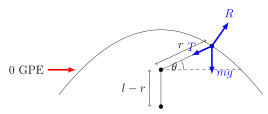
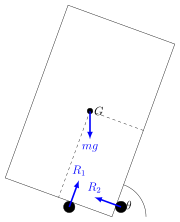
A uniform rectangular lamina of sides \(2a\) and \(2b\) rests in a vertical plane. It is supported in equilibrium by two smooth pegs fixed in the same horizontal plane, a distance \(d\) apart, so that one corner of the lamina is below the level of the pegs. Show that if the distance between this (lowest) corner and the peg upon which the side of length \(2a\) rests is less than \(a\), then the distance between this corner and the other peg is less than \(b\). Show also that \[ b\cos\theta-a\sin\theta=d\cos2\theta, \] where \(\theta\) is the acute angle which the sides of length \(2b\) make with the horizontal.
Solution:
1989 Paper 3 Q13
The points \(A,B,C,D\) and \(E\) lie on a thin smooth horizontal table and are equally spaced on a circle with centre \(O\) and radius \(a\). At each of these points there is a small smooth hole in the table. Five elastic strings are threaded through the holes, one end of each beging attached at \(O\) under the table and the other end of each being attached to a particle \(P\) of mass \(m\) on top of the table. Each of the string has natural length \(a\) and modulus of elasticity \(\lambda.\) If \(P\) is displaced from \(O\) to any point \(F\) on the table and released from rest, show that \(P\) moves with simple harmonic motion of period \(T\), where \[ T=2\pi\sqrt{\frac{am}{5\lambda}}. \] The string \(PAO\) is replaced by one of natural length \(a\) and modulus \(k\lambda.\) \(P\) is displaced along \(OA\) from its equilibrium position and released. Show that \(P\) still moves in a straight line with simple harmonic motion, and, given that the period is \(T/2,\) find \(k\).
Solution:

1988 Paper 1 Q11
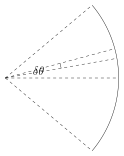
Derive a formula for the position of the centre of mass of a uniform circular arc of radius \(r\) which subtends an angle \(2\theta\) at the centre.

Solution:

1988 Paper 1 Q13
A piece of circus apparatus consists of a rigid uniform plank of mass 1000\(\,\)kg, suspended in a horizontal position by two equal light vertical ropes attached to the ends. The ropes each have natural length 10\(\,\)m and modulus of elasticity 490\(\,\)000 N. Initially the plank is hanging in equilibrium. Nellie, an elephant of mass 4000\(\,\)kg, lands in the middle of the plank while travelling vertically downwards at speed 5\(\,\)ms\(^{-1}.\) While carrying Nellie, the plank comes instantaneously to rest at a negligible height above the floor, and at this instant Nellie steps nimbly and gently off the plank onto the floor. Assuming that the plank remains horizontal, and the rope remain vertical, throughout the motion, find to three significant figures its initial height above the floor. During the motion after Nellie alights, do the ropes ever become slack? {[}Take \(g\) to be \(9.8\mbox{\,\ ms}^{-1}.\){]}
Solution: In the initial position, since the system is in equilibrium the tension in the two ropes must be \(500g\). Therefore since \(T = \frac{\lambda x}{l} \Rightarrow x = \frac{10 \cdot 500 g}{490\, 000} = \frac1{10}\) so the initial extension is \(\frac1{10}\) By conservation of momentum, if the initial speed of the plank + Nellie is \(V\), we must have \(4000 \cdot 5 = 5000 V \Rightarrow V = 4\) \begin{array}{ccc} & \text{GPE} & \text{EPE} & \text{KE} \\ \hline \text{Initially} & 5000gh & 2 \cdot \frac12 \frac{\lambda}{l} \frac{1}{100} & \frac12 \cdot 5000 \cdot 4^2 \\ & 49\,000h & 490 & 40\,000 \\ \text{Finally} & 0 & 2 \cdot \frac12 \frac{\lambda}{l} (h + \frac1{10})^2 & 0 \\ & 0 & 49\,000 (h+\frac1{10})^2 & 0 \end{array} By conservation of energy, we can set up a quadratic: \begin{align*} && 49\,000 (h+\frac1{10})^2 &= 49\,000h + 40\,490 \\ \Rightarrow && 49\,000(h + \frac1{10})^2 &= 49\,000(h + \frac1{10})+35\, 590 \\ \Rightarrow&& h + \frac1{10} &= 1.488092\cdots \\ \Rightarrow && h &= 1.49 \,\, (3\text{ s.f.}) \end{align*} When she gets off the plank, it will move according to: \begin{align*} \text{N2}(\uparrow): && \frac{\lambda x}{l} -1000g &= -1000 \ddot{x} \\ && 49 x-g &= -\ddot{x} \\ \Rightarrow && x &= A \sin 7t + B \cos 7t + 0.2 \\ && x(0) = 1.49, &x'(0) = 0 \\ \Rightarrow && B = -1.69, & A=0 \end{align*} If we continued under this motion the string would definitely reach a point \(0.1\) above \(0\), and therefore the ropes would go slack.
1988 Paper 2 Q13
A librarian wishes to pick up a row of identical books from a shelf, by pressing her hands on the outer covers of the two outermost books and lifting the whole row together. The covers of the books are all in parallel vertical planes, and the weight of each book is \(W\). With each arm, the librarian can exert a maximum force of \(P\) in the vertical direction, and, independently, a maximum force of \(Q\) in the horizontal direction. The coefficient of friction between each pair of books and also between each hand and a book is \(\mu.\) Derive an expression for the maximum number of books that can be picked up without slipping, using this method. {[}You may assume that the books are thin enough for the rotational effect of the couple on each book to be ignored.{]}
Solution:

1988 Paper 3 Q11
A uniform ladder of length \(l\) and mass \(m\) rests with one end in contact with a smooth ramp inclined at an angle of \(\pi/6\) to the vertical. The foot of the ladder rests, on horizontal ground, at a distance \(l/\sqrt{3}\) from the foot of the ramp, and the coefficient of friction between the ladder and the ground is \(\mu.\) The ladder is inclined at an angle \(\pi/6\) to the horizontal, in the vertical plane containing a line of greatest slope of the ramp. A labourer of mass \(m\) intends to climb slowly to the top of the ladder.
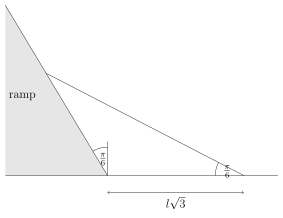
- Find the value of \(\mu\) if the ladder slips as soon as the labourer reaches the midpoint.
- Find the minimum value of \(\mu\) which will ensure that the labourer can reach the top of the ladder.
Solution:
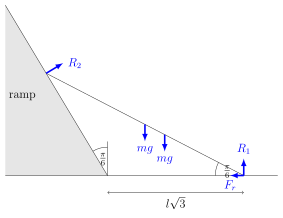
- \begin{align*} \text{N2}(\uparrow): && R_1 + R_2\sin(\frac{\pi}{6})-2mg &= 0 \\ \text{N2}(\rightarrow): && R_2 \cos (\frac{\pi}{6})-F_r &= 0 \\ \overset{\curvearrowleft}{X}: && lmg \cos \tfrac{\pi}{6} - l R_2 \cos \tfrac{\pi}{6} &= 0 \\ \\ \Rightarrow && R_2 &= mg \\ \Rightarrow && R_1 &= 2mg - \frac12mg \\ &&&=\frac32mg \\ \Rightarrow && \frac{\sqrt{3}}2mg - \mu\frac32mg &= 0 \\ \Rightarrow && \mu &= \frac{1}{\sqrt{3}} \end{align*}
- \begin{align*} \text{N2}(\uparrow): && R_1 + R_2\sin(\frac{\pi}{6})-2mg &= 0 \\ \overset{\curvearrowleft}{X}: && \frac12 lmg \cos \tfrac{\pi}{6}+xmg \cos \tfrac{\pi}{6} - l R_2 \cos \tfrac{\pi}{6} &= 0 \\ \\ \Rightarrow && R_2 &= mg(\frac{1}2+\frac{x}{l}) \\ \Rightarrow && R_1 &= 2mg - \frac12mg(\frac{1}2+\frac{x}{l}) \\ &&&=(\frac74 - \frac{x}{2l})mg \\ &&&\geq \frac{5}{4}mg\\ \text{N2}(\rightarrow): && R_2 \cos (\frac{\pi}{6})-\mu R_1& \leq 0 \\ \Rightarrow && \frac{\sqrt{3}}2mg - \mu\frac54mg &\leq 0 \\ \Rightarrow && \mu &\geq \frac{2\sqrt{3}}{5} \end{align*}
1987 Paper 1 Q10
A rubber band band of length \(2\pi\) and modulus of elasticity \(\lambda\) encircles a smooth cylinder of unit radius, whose axis is horizontal. A particle of mass \(m\) is attached to the lowest point of the band, and hangs in equilibrium at a distance \(x\) below the axis of the cylinder. Obtain an expression in terms of \(x\) for the stretched length of the band in equilibrium. What is the value of \(\lambda\) if \(x=2\)?
Solution:

1987 Paper 2 Q12
A long, inextensible string passes through a small fixed ring. One end of the string is attached to a particle of mass \(m,\) which hangs freely. The other end is attached to a bead also of mass \(m\) which is threaded on a smooth rigid wire fixed in the same vertical plane as the ring. The curve of the wire is such that the system can be in static equilibrium for all positions of the bead. The shortest distance between the wire and the ring is \(d(>0).\) Using plane polar coordinates centred on the ring, find the equation of the curve. The bead is set in motion. Assuming that the string remains taut, show that the speed of the bead when it is a distance \(r\) from the ring is \[ \left(\frac{r}{2r-d}\right)^{\frac{1}{2}}v, \] where \(v\) is the speed of the bead when \(r=d.\)
Solution: