Problems
Filters
91 problems found
1992 Paper 1 Q9
The diagram shows a coffee filter consisting of an inverted hollow right circular cone of height \(H\) cm and base radius \(a\) cm. \noindent
1992 Paper 3 Q1
- Given that \[ \mathrm{f}(x)=\ln(1+\mathrm{e}^{x}), \] prove that \(\ln[\mathrm{f}'(x)]=x-\mathrm{f}(x)\) and that \(\mathrm{f}''(x)=\mathrm{f}'(x)-[\mathrm{f}'(x)]^{2}.\) Hence, or otherwise, expand \(\mathrm{f}(x)\) as a series in powers of \(x\) up to the term in \(x^{4}.\)
- Given that \[ \mathrm{g}(x)=\frac{1}{\sinh x\cosh2x}, \] explain why \(\mathrm{g}(x)\) can not be expanded as a series of non-negative powers of \(x\) but that \(x\mathrm{g}(x)\) can be so expanded. Explain also why this latter expansion will consist of even powers of \(x\) only. Expand \(x\mathrm{g}(x)\) as a series as far as the term in \(x^{4}.\)
Solution:
- \begin{align*} && f(x) &= \ln (1+e^x) \\ && f'(x) &= \frac{1}{1+e^x} \cdot e^x \\ &&&= \frac{e^x}{1+e^x} \\ \Rightarrow && \ln [f'(x)] &= x - \ln (1+e^x) \\ &&&= x - f(x) \\ \\ \Rightarrow && \frac{f''(x)}{f'(x)} &= 1 - f'(x) \\ \Rightarrow && f''(x) &= f'(x) - [f'(x)]^2 \\ && f'''(x) &= f''(x) - 2f'(x) f''(x) \\ && f^{(4)}(x) &= f'''(x) - 2[f''(x)]^2-2f'(x)f'''(x) \end{align*} \begin{align*} f(0) &= \ln 2 \\ f'(0) &= \tfrac12 \\ f''(0) &= \tfrac12 -\tfrac14 \\ &= \tfrac 14 \\ f'''(0) &= \tfrac14 - 2 \tfrac12 \tfrac 14 \\ &= 0 \\ f^{(4)}(0) &= -2 \cdot \tfrac1{16} \\ &= -\frac18 \end{align*} Therefore \(f(x) = \ln 2 + \tfrac12 x + \tfrac18 x^2 - \frac1{8 \cdot 4!} x^4 + O(x^5)\)
- As \(x \to 0\), \(g(x) \to \infty\) therefore there can be no power series about \(0\). But as \(x \to 0, x g(x) \not \to \infty\) as \(\frac{x}{\sinh x}\) is well behaved. We can also notice that \(x g(x)\) is an even function, since \(\cosh x\) is even and \(\frac{x}{\sinh x}\) is even, therefore the power series will consist of even powers of \(x\) \begin{align*} \lim_{x \to 0} \frac{x}{\sinh x \cosh 2 x} &= \lim_{x \to 0} \frac{x}{\sinh x} \cdot \lim_{x \to 0} \frac{1}{\cosh2 x} \\ &= 1 \end{align*} Notice that \begin{align*} \frac{x}{\sinh x \cosh 2 x} &= \frac{4x}{(e^x - e^{-x})(e^{2x}+e^{-2x})} \\ &= \frac{4x}{(2x + \frac{x^3}{3} + \cdots)(2 + 4x^2 + \frac43 x^4 + \cdots )} \\ &= \frac{1}{1+\frac{x^2}{6}+\frac{x^4}{5!} + \cdots } \frac{1}{1 + 2x^2 + \frac23 x^4 + \cdots } \\ &= \left (1-(\frac{x^2}{6} + \frac{x^4}{5!})+ (\frac{x^2}{6} )^2 + O(x^6)\right) \left (1-(2x^2+\frac23 x^4)+ (2x^2)^2 + O(x^6)\right) \\ &= \left (1 - \frac16 x^2 + \frac{7}{360} x^4 + O(x^6) \right) \left (1 - 2x^2+ \frac{10}3x^4 + O(x^6) \right) \\ &= 1 - \frac{13}{6} x^2 + \frac{1327}{360}x^4 + O(x^6) \end{align*}
1991 Paper 1 Q2
Frosty the snowman is made from two uniform spherical snowballs, of initial radii \(2R\) and \(3R.\) The smaller (which is his head) stands on top of the larger. As each snowball melts, its volume decreases at a rate which is directly proportional to its surface area, the constant of proportionality being the same for both snowballs. During melting each snowball remains spherical and uniform. When Frosty is half his initial height, find the ratio of his volume to his initial volume. If \(V\) and \(S\) denote his total volume and surface area respectively, find the maximum value of \(\dfrac{\mathrm{d}V}{\mathrm{d}S}\) up to the moment when his head disappears.
Solution: \(V_h = \frac43 \pi r_h^3, S_h = 4 \pi r_h^2\) \(\frac{\d V_h}{\d t} = -k4\pi r_h^2 \Rightarrow 4\pi r_h^2 \frac{\d r_h}{\d t} = -k 4\pi r_h^2 \Rightarrow \frac{\d r_h}{\d t} = -k\) Therefore \(r_h = 2R - kt, r_b = 3R - kt\). The height will halve when \(2kt = \frac{5}{2}R \Rightarrow kt = \frac{5}{4}R\) and the two sections will have radii \(\frac{3}{4}R\) and \(\frac{7}{4}R\) and the ratio of the volumes will be: \begin{align*} \frac{\frac{3^3}{4^3}+\frac{7^3}{4^3}}{2^3+3^3} = \frac{37}{224} \end{align*} \begin{align*} && \frac{\d V}{\d t} &= -4\pi k(r_h^2+r_b^2) \\ && \frac{\d S}{\d t} &= -8\pi k (r_h+r_b) \\ \Rightarrow && \frac{\d V}{\d S} &= \frac{r_h^2 + r_b^2}{2(r_h+r_b)} \\ &&&= \frac{(2R-kt)^2+(3R-kt)^2}{2(5R-2kt)} \\ &&&= \frac{13R^2-10Rkt+2k^2t^2}{2(5R-2kt)} \\ &&&= \frac{13R^2-10Rs + 2s^2}{2(5R-2s)} \end{align*} Where \(s = kt\) and \(0 \leq s \leq 2R\). We can maximise this but differentiating wrt to \(s\). \begin{align*} \Rightarrow && &= \frac{(-10R+4s)(10R-4s)+4(13R^2-10Rs+2s^2)}{4(5R-2s)^2} \\ &&&= \frac{-48R^2+40Rs-8s^2}{4(5R-2s)^2} \\ &&&= \frac{-8(s-2R)(s-3R)}{4(5R-2s)^2} \\ &&&<0 \end{align*} Therefore it is largest when \(s = 0\), ie \(\frac{13R^2}{10R} = \frac{13}{10}R\)
1991 Paper 1 Q4
\(\ \)
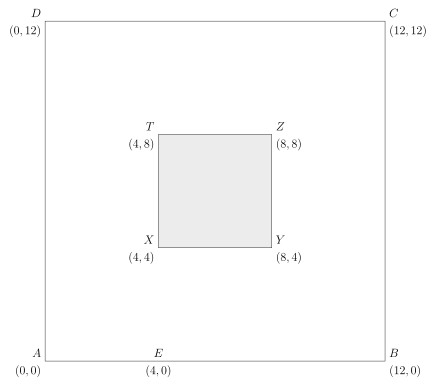
- as small as possible,
- as large as possible.
Solution:
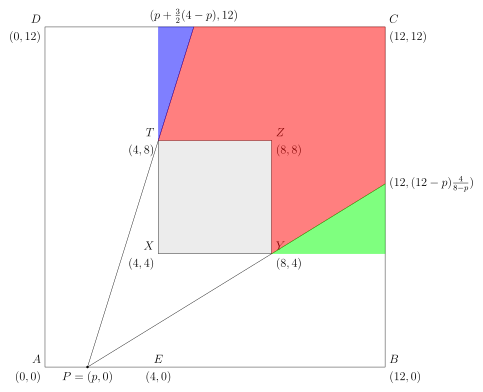
- Since the area not visible is increasing as \(p\) increases, we would like \(p\) to be as large as possible, ie \(p = 4\).
- Similarly, he can see the most when \(p =0\)
1991 Paper 1 Q7
According to the Institute of Economic Modelling Sciences, the Slakan economy has alternate years of growth and decline, as in the following model. The number \(V\) of vloskan (the unit of currency) in the Slakan Treasury is assumed to behave as a continuous variable, as follows. In a year of growth it increases continuously at an annual rate \(aV_{0}\left(1+(V/V_{0})\right)^{2}.\) During a year of decline, as long as there is still money in the Treasury, the amount decreases continuously at an annual rate \(bV_{0}\left(1+(V/V_{0})\right)^{2};\) but if \(V\) becomes zero, it remains zero until the end of the year. Here \(a,b\) and \(V_{0}\) are positive constants. A year of growth has just begun and there are \(k_{0}V_{0}\) vloskan in the Treasury, where \(0\leqslant k_{0} < a^{-1}-1\). Explain the significance of these inequalities for the model to be remotely sensible. If \(k_{0}\) is as above and at the end of one year there are \(k_{1}V_{0}\) vloskan in the Treasury, where \(k_{1} > 0\), find the condition involving \(b\) which \(k_{1}\) must satisfy so that there will be some vloskan left after a further year. Under what condition (involving \(a,b\) and \(k_{0}\)) does the model predict that unlimited growth will take place in the third year (but not before)?
1990 Paper 3 Q5
Prove that, for any integers \(n\) and \(r\), with \(1\leqslant r\leqslant n,\) \[ \binom{n}{r}+\binom{n}{r-1}=\binom{n+1}{r}. \] Hence or otherwise, prove that \[ (uv)^{(n)}=u^{(n)}v+\binom{n}{1}u^{(n-1)}v^{(1)}+\binom{n}{2}u^{(n-2)}v^{(2)}+\cdots+uv^{(n)}, \] where \(u\) and \(v\) are functions of \(x\) and \(z^{(r)}\) means \(\dfrac{\mathrm{d}^{r}z}{\mathrm{d}x^{r}}\). Prove that, if \(y=\sin^{-1}x,\) then \((1-x^{2})y^{(n+2)}-(2n+1)xy^{(n+1)}-n^{2}y^{(n)}=0.\)
Solution: \begin{align*} \binom{n}{r} + \binom{n}{r-1} &= \frac{n!}{r!(n-r)!} + \frac{n!}{(r-1)!(n-r+1)!} \\ &= \frac{n!}{(r-1)!(n-r)!} \left ( \frac{1}{r} + \frac{1}{n-r+1} \right) \\ &= \frac{n!}{(r-1)!(n-r)!} \frac{(n-r+1)+r}{r(n-r+1)} \\ &= \frac{n! (n+1)}{r! (n-r+1)!} \\ &= \frac{(n+1)!}{r!(n+1-r)!} \\ &= \binom{n+1}{r} \end{align*} Claim: \(\displaystyle (uv)^{(n)} = \sum_{r=0}^n \binom{n}{r} u^{(n-r)} v^{(r)}\) Proof: (By induction on \(n\)). Base case: \(n = 0\) is clear. Inductive step: Suppose it is true for \(n = k\), then consider \begin{align*} (uv)^{(k+1)} &= \left ( (uv)^{(k)} \right)' \\ &= \left ( \sum_{r=0}^k \binom{k}{r} u^{(k-r)} v^{(r)} \right)' \tag{by assumption} \\ &=\sum_{r=0}^k \binom{k}{r} \left ( u^{(k-r)} v^{(r)}\right)' \tag{linearity} \\ &=\sum_{r=0}^k \binom{k}{r} \left ( u^{(k-r+1)} v^{(r)} + u^{(k-r)}v^{(r+1)}\right) \\ &= \sum_{r=0}^{k} \binom{k}{r} u^{(k-r+1)} v^{(r)} + \sum_{r=0}^{k} \binom{k}{r} u^{(k-r)}v^{(r+1)} \\ &= \sum_{r=0}^{k} \binom{k}{r} u^{(k-r+1)} v^{(r)} + \sum_{r=1}^{k+1} \binom{k}{r-1} u^{(k-r+1)}v^{(r)} \\ &= u^{(k+1)}v + \sum_{r=1}^k \left (\binom{k}{r} + \binom{k}{r-1} \right)u^{(k-r+1)}v^{(r)} + u v^{(k+1)}\\ &= u^{(k+1)}v + \sum_{r=1}^k \binom{k+1}{r} u^{(k-r+1)}v^{(r)} + u v^{(k+1)}\\ &= \sum_{r=0}^{k+1} \binom{k+1}{r} u^{(k-r+1)}v^{(r)}\\ \end{align*} Therefore if our statement is true for \(n = k\) it is true for \(n = k+1\). Since it is true for \(n = 0\) by the principle of mathematical induction it is true for all integer \(n \geq 0\) Suppose \( y = \sin^{-1} x\), then \(y' = \frac{1}{\sqrt{1-x^2}}\), \(y'' = \frac{x}{(1-x^2)^{3/2}}\). Not that this means that \((1-x^2)y'' - xy' = 0\) (which is our formula when \(n = 0\)). Now apply Leibniz's formula to this. \begin{align*} 0 &= \left ( (1-x^2)y'' - xy' \right)^{(n)} \\ &= \left ( (1-x^2)y'' \right)^{(n)} -\left ( xy' \right)^{(n)} \\ &= \left ( (1-x^2)y^{(n+2)} - n\cdot 2x \cdot y^{(n+1)}-\binom{n}{2} \cdot 2 \cdot y^{(n)} \right )- \left (xy^{(n+1)}+ny^{(n)} \right) \\ &= (1-x^2)y^{(n+2)} - (2n+1)y^{(n+1)} - \left ( n(n-1)+n \right)y^{(n)} \\ &= (1-x^2)y^{(n+2)} - (2n+1)y^{(n+1)} - n^2y^{(n)} \\ \end{align*} as required
1989 Paper 1 Q5
Write down the binomial expansion of \((1+x)^{n}\), where \(n\) is a positive integer.
- By substituting particular values of \(x\) in the above expression, or otherwise, show that, if \(n\) is an even positive integer, \[ \binom{n}{0}+\binom{n}{2}+\binom{n}{4}+\cdots+\binom{n}{n}=\binom{n}{1}+\binom{n}{3}+\binom{n}{5}+\cdots+\binom{n}{n-1}=2^{n-1}. \]
- Show that, if \(n\) is any positive integer, then \[ \binom{n}{1}+2\binom{n}{2}+3\binom{n}{3}+\cdots+n\binom{n}{n}=n2^{n-1}. \]
Solution: \[ (1+x)^n = \sum_{k=0}^n \binom{n}{k} x^k \]
- \begin{align*} (1+1)^n &= \sum_{k=0}^n \binom{n}{k} \\ (1-1)^n &= \sum_{k=0}^n (-1)^n\binom{n}{k} \\ &= \sum_{\text{even }k, 0 \leq k \leq n} \binom{n}{k} -\sum_{\text{odd }k, 0 \leq k \leq n} \binom{n}{k} \end{align*} Therefore \(\displaystyle \sum_{\text{even }k, 0 \leq k \leq n} \binom{n}{k} = \sum_{\text{odd }k, 0 \leq k \leq n} \binom{n}{k} = \frac{2^n}{2} = 2^{n-1}\)
- \begin{align*} && (1+x)^n &= \sum_{k=0}^n \binom{n}{k}x^k \\ \frac{\d}{\d x}: && n(1+x)^{n-1} &= \sum_{k=0}^n k\binom{n}{k} x^{k-1} \\ x = 1: && n2^{n-1} &= \sum_{k=1}^n k\binom{n}{k} \end{align*} as required
1989 Paper 1 Q7
Sketch the curve \(y^{2}=1-\left|x\right|\). A rectangle, with sides parallel to the axes, is inscribed within this curve. Show that the largest possible area of the rectangle is \(8/\sqrt{27}\). Find the maximum area of a rectangle similarly inscribed within the curve given by \(y^{2m}=\left(1-\left|x\right|\right)^{n}\), where \(m\) and \(n\) are positive integers, with \(n\) odd.
Solution:

1989 Paper 1 Q11
A shot-putter projects a shot at an angle \(\theta\) above the horizontal, releasing it at height \(h\) above the level ground, with speed \(v\). Show that the distance \(R\) travelled horizontally by the shot from its point of release until it strikes the ground is given by \[ R=\frac{v^{2}}{2g}\sin2\theta\left(1+\sqrt{1+\frac{2hg}{v^{2}\sin^{2}\theta}}\right). \] The shot-putter's style is such that currently \(\theta=45^{\circ}\). Determine (with justification) whether a small decrease in \(\theta\) will increase \(R\). [Air resistance may be neglected.]
Solution: Notice that \(u_x = v \cos \theta, u_y = v \sin \theta\). We are interested in the time taken for the shot to hit the ground. \(-h = u_y t -\frac12 g t^2\) since our distance will be \(v \cos \theta \cdot t\). Solving this quadratic for \(t\) we obtain: \begin{align*} && 0 &= h + v \sin \theta \cdot t - \frac12 g \cdot t^2 \\ \Rightarrow && t_\pm &= \frac{-v \sin \theta \pm \sqrt{v^2 \sin^2 \theta+2hg}}{-g} \\ \Rightarrow && t_- &= \frac{v \sin \theta+v\sin \theta \sqrt{1 + \frac{2hg}{v^2 \sin^2 \theta}}}{g} \\ \Rightarrow && v \cos \theta t_{-} &= \frac{v^2}{g} \cos \theta \sin \theta \left( 1 + \sqrt{1 + \frac{2hg}{v^2 \sin^2 \theta}} \right) \\ &&&= \frac{v^2}{2g} \sin 2 \theta \left( 1 + \sqrt{1 + \frac{2hg}{v^2 \sin^2 \theta}} \right) \end{align*} Differentiating \(R\) wrt to \(\theta\) at \(\frac{\pi}{4}\) we obtain: \begin{align*} \frac{\d R}{\d \theta} &= \frac{v^2}{2g} \left (2 \cos 2 \theta + 2 \cos 2 \theta \sqrt{1 + \frac{2hg}{v^2 \sin^2 \theta}} + \sin 2\theta \left ( 1 + \frac{2hg}{v^2 \sin^2 \theta}\right)^{-\frac12} \frac12 \frac{2hg} {v^2}(-2) \frac{\cos \theta}{\sin^3 \theta}\right) \\ \frac{\d R}{\d \theta} \biggr \rvert_{\theta = \frac{\pi}{4}} &=\frac{v^2}{2g}\left(0+0- 4\left ( 1 + \frac{4hg}{v^2 }\right)^{-\frac12} \frac{hg} {v^2} \right) \\ &< 0 \end{align*} Therefore, since \(R\) is locally decreasing in \(\theta\) he should reduce his angle of projection slightly.
1988 Paper 1 Q2
The function \(\mathrm{f}\) and \(\mathrm{g}\) are related (for all real \(x\)) by \[ \mathrm{g}(x)=\mathrm{f}(x)+\frac{1}{\mathrm{f}(x)}\,. \] Express \(\mathrm{g}'(x)\) and \(\mathrm{g}''(x)\) in terms of \(\mathrm{f}(x)\) and its derivatives. If \(\mathrm{f}(x)=4+\cos2x+2\sin x\), find the stationary points of \(\mathrm{g}\) for \(0\leqslant x\leqslant2\pi,\) and determine which are maxima and which are minima.
Solution: \(g'(x) = f'(x) - \frac{f'(x)}{(f(x))^2} = f'(x) \l 1 - \frac{1}{(f(x))^2} \r\) \(g''(x) = f''(x) - \frac{f''(x)f(x)^2-f'(x)\cdot 2f(x) f'(x)}{(f(x))^4} = f''(x) + \frac{f''(x)f(x)-2(f'(x))^2}{(f(x))^3}\) \begin{align*} f(x) &=4+\cos2x+2\sin x \\ f'(x) &=-2\sin2x+2\cos x \\ f''(x) &= -4\cos2x-2\sin x \end{align*} Therefore, since the stationary points of \(g\), ie points where \(g'(x) = 0\) are where \(f'(x) = 0\) or \(f(x) = \pm 1\) we should look at \begin{align*} && 0 &= f'(x) \\ && 0 &= 2 \cos x - 2 \sin 2x \\ &&&= 2 \cos x - 4 \sin x \cos x \\ &&&= 2\cos x (1 - 2 \sin x) \\ \Rightarrow && x &= \frac{\pi}2, \frac{3\pi}{2}, \frac{\pi}{6}, \frac{5\pi}{6} \end{align*} \begin{align*} && 1 &= f(x) \\ && 1 &= 4 + \cos 2x + 2 \sin x \\ \Rightarrow && \cos 2x = -1,& \sin x = -1 \\ \Rightarrow && x &= \frac{3\pi}{2} \end{align*} which we were already checking. For each of these points we have: \begin{array}{c|c|c|c||c} x & f(x) & f'(x) & f''(x) & g''(x) \\ \hline \frac{\pi}{2} & 5 & 0 & 2 & > 0\\ \frac{3\pi}{2} & 1 & 0 & 6 &> 0\\ \frac{\pi}{6} & 5.5 & 0 & -3 & < 0 \\ \frac{5\pi}{6} & 5.5 & 0 & -3 & < 0\\ \end{array} Therefore \(\frac{\pi}{2}, \frac{3\pi}{2}\) are minimums and \(\frac{\pi}{6}\) and \(\frac{5\pi}{6}\) are maxima.
1988 Paper 2 Q6
Show that the following functions are positive when \(x\) is positive:
- [ \(x-\tanh x\)
- \(x\sinh x-2\cosh x+2\)
- \(2x\cosh2x-3\sinh2x+4x\).
Solution:
- Notice that \(f(x) = x - \tanh x\) has \(f'(x) = 1-\textrm{sech}^2 x = \tanh^2 x > 0\) so \(f(x)\) is strictly increasing on \((0, \infty)\) and \(f(0) = 0\) therefore \(f(x)\) is positive for all \(x\) positive
- Let \(f(x) = x\sinh x-2\cosh x+2\) then \(f'(x) = \sinh x +x \cosh x - 2 \sinh x = x \cosh x -\sinh x = \cosh x ( x - \tanh x) > 0\) by the first part. \(f(0) = 0\) so \(f(x)\) is positive for all \(x\) positive.
- Let \(f(x) = 2x\cosh2x-3\sinh2x+4x\) then \begin{align*} f'(x) &= 2\cosh 2x +4x\sinh 2x - 6 \cosh 2x + 4 \\ &= 4( x\sinh 2x-\cosh 2x +1) \\ &= 4(x2\cosh x \sinh x -2\cosh^2x ) \\ &= 8 \cosh^2 x (x - \tanh x) \end{align*} Which is always positive when \(x\) > 0, \(f(0) = 0\) so \(f(x) > 0\) for all positive \(x\).
1988 Paper 3 Q6
Let \(\mathrm{f}(x)=\sin2x\cos x.\) Find the 1988th derivative of \(\mathrm{f}(x).\) Show that the smallest positive value of \(x\) for which this derivative is zero is \(\frac{1}{3}\pi+\epsilon,\) where \(\epsilon\) is approximately equal to \[ \frac{3^{-1988}\sqrt{3}}{2}. \]
Solution: \begin{align*} && f(x) &= \sin 2x \cos x \\ &&&= \frac12 \l \sin 3x + \sin x \r \\ \Rightarrow && f^{(1988)}(x) &= \frac12 \l 3^{1988} (-1)^{994} \sin 3x+ (-1)^{994} \sin x \r \\ &&&= \boxed{\frac12 \left (3^{1998} \sin 3x + \sin x \right)} \\ \\ f^{(1988)}(x) = 0: && 0 &= 3^{1988} \sin 3x + \sin x \\ \Rightarrow && 0 &= 3^{1988} ( 3\sin x-4\sin^3 x) + \sin x \\ \Rightarrow && 0 &= \sin x \left (1+3^{1989}-4\cdot 3^{1988}\sin^{2} x \right) \end{align*} Since \(\sin x\) will first contribute a zero when \(x = \frac{\pi}{2}\) we focus on the second bracket, in particular, we need: \begin{align*} && \sin^2 x &= \frac{3}{4} \left ( 1 + \frac{1}{3^{1988}} \right) \\ \Rightarrow && \sin x &= \frac{\sqrt{3}}2 \left (1 + \frac{1}{2 \cdot 3^{1988}} + \cdots \right ) \end{align*} Since near \(\frac{\pi}{3}\), \begin{align*} \sin (\frac{\pi}{3} + \epsilon) &= \sin \frac{\pi}{3} \cos \epsilon + \cos \frac{\pi}{3} \sin \epsilon \\ &\approx \frac{\sqrt{3}}{2} (1-\epsilon^2 + \cdots ) + \frac{1}{2}(\epsilon + \cdots) \\ &= \frac{\sqrt{3}}2 + \frac12 \epsilon + \cdots \end{align*} Therefore by comparison we can see that \(x = \frac{\pi}{3} + \frac{\sqrt{3}}{2} 3^{-1988}\) will be a very good approximation for the root.
1987 Paper 1 Q1
Find the stationary points of the function \(\mathrm{f}\) given by \[ \mathrm{f}(x)=\mathrm{e}^{ax}\cos bx,\mbox{ }(a>0,b>0). \] Show that the values of \(\mathrm{f}\) at the stationary points with \(x>0\) form a geometric progression with common ratio \(-\mathrm{e}^{a\pi/b}\). Give a rough sketch of the graph of \(\mathrm{f}\).
Solution: Let \(f(x) = e^{ax} \cos bx\) then, \(f'(x) = ae^{ax} \cos bx - be^{ax} \sin bx = e^{ax} \l a\cos bx - b \sin bx \r\). Therefore the stationary points are where \(f'(x) = 0 \Leftrightarrow \tan bx = \frac{b}a\), ie \(x = \tan^{-1} \frac{a}{b} + \frac{n}{b} \pi, n \in \mathbb{Z}\). \begin{align*} f(\tan^{-1} \frac{a}{b} + \frac{n}{b} \pi) &= e^{a \tan^{-1} \frac{a}{b} + \frac{an}{b} \pi} \cos \l b \tan^{-1} \frac{a}{b} +n \pi\r \\ &= e^{a \tan^{-1} \frac{a}{b}} \cos \l b \tan^{-1} \frac{a}{b}\r \cdot e^{\frac{an}{b} \pi}(-1)^n \\ &= e^{a \tan^{-1} \frac{a}{b}} \cos \l b \tan^{-1} \frac{a}{b}\r \cdot (-e^{\frac{a}{b} \pi})^n \\ \end{align*} showing the form the desired geometric progression.

1987 Paper 1 Q6
Let \(y=\mathrm{f}(x)\), \((0\leqslant x\leqslant a)\), be a continuous curve lying in the first quadrant and passing through the origin. Suppose that, for each non-negative value of \(y\) with \(0\leqslant y\leqslant\mathrm{f}(a)\), there is exactly one value of \(x\) such that \(\mathrm{f}(x)=y\); thus we may write \(x=\mathrm{g}(y)\), for a suitable function \(\mathrm{g}.\) For \(0\leqslant s\leqslant a,\) \(0\leqslant t\leqslant \mathrm{f}(a)\), define \[ \mathrm{F}(s)=\int_{0}^{s}\mathrm{f}(x)\,\mathrm{d}x,\qquad\mathrm{G}(t)=\int_{0}^{t}\mathrm{g}(y)\,\mathrm{d}y. \] By a geometrical argument, show that \[ \mathrm{F}(s)+\mathrm{G}(t)\geqslant st.\tag{*} \] When does equality occur in \((*)\)? Suppose that \(y=\sin x\) and that the ranges of \(x,y,s,t\) are restricted to \(0\leqslant x\leqslant s\leqslant\frac{1}{2}\pi,\) \(0\leqslant y\leqslant t\leqslant1\). By considering \(s\) such that the equality holds in \((*)\), show that \[ \int_{0}^{t}\sin^{-1}y\,\mathrm{d}y=t\sin^{-1}t-\left(1-\cos(\sin^{-1}t)\right). \] Check this result by differentiating both sides with respect to \(t\).
Solution:

1987 Paper 3 Q10
The Bernoulli polynomials \(P_{n}(x)\), where \(n\) is a non-negative integer, are defined by \(P_{0}(x)=1\) and, for \(n\geqslant1\), \[ \frac{\mathrm{d}P_{n}}{\mathrm{d}x}=nP_{n-1}(x),\qquad\int_{0}^{1}P_{n}(x)\,\mathrm{d}x=0 \] Show by induction or otherwise, that \[ P_{n}(x+1)-P_{n}(x)=nx^{n-1},\quad\mbox{ for }n\geqslant1. \] Deduce that \[ n\sum_{m=0}^{k}m^{n-1}=P_{n}(k+1)-P_{n}(0) \] Hence show that \({\displaystyle \sum_{m=0}^{1000}m^{3}=(500500)^{2}}\)
Solution: \(\displaystyle \int_x^{x+1} nP_{n-1}(x) \, dx = P_n(x+1) - P_n(x)\) Claim: \(P_{n}(x+1)-P_{n}(x)=nx^{n-1},\) for \(n \geq 1\) Proof: (By induction). (Base case, \(n=1\)). \(P_1(x) = x - \frac12\), \(P_1(x+1) - P_1(x) = 1 x^{0}\) as required. Assume the equation is true for \(n = k\). So \(P_k(x+1) - P_k(x) = kx^{k-1}\) now consider \begin{align*} P_{k+1}(x+1) - P_{k+1}(x) &= \int_0^{x+1} (k+1) P_k(t) \d t + P_{k+1}(0)- \int_0^{x} (k+1) P_k(t) \d t - P_{k+1}(0) \\ &= \int_0^x (k+1)(P_k(t+1)-P_k(t)) \d t + \int_0^1 (k+1)P_k(t) \d t \\ &= (k+1)x^{k} + 0 \end{align*} So by induction we are done. \begin{align*} n\sum_{m=0}^{k}m^{n-1} &= \sum_{m=0}^{k}n \cdot m^{n-1} \\ &= \sum_{m=0}^{k}\l P_n(m+1)-P_n(m) \r \\ &= P_n(k+1) - P_n(0) \end{align*} We need to find \(P_4\) \begin{align*} P_0(x) &= 1 \\ P_1(x) &= x - \frac12 \\ P_2(x) &= x^2 -x - \int_0^1 \l x^2 - x \r \d x \\ &= x^2 - x + \frac16 \\ P_3(x) &= x^3 -\frac{3}{2}x^2 + \frac12x - \int_0^1 \l x^3 -\frac{3}{2}x^2 + \frac12x \r \d x \\ &= x^3 -\frac{3}{2}x^2 + \frac12x \\ P_4(x) &= x^4 - 2x^3 + x^2 + c \end{align*} Therefore the sum we are interested in is \(\frac14 \l P_4(1001) - P_4(0) \r = \frac14 (1001)^2 (1001-1)^2 = (1001 \cdot 500)^2 = (500500)^2\)