Problems
Filters
1531 problems found
2001 Paper 1 Q12
Four students, Arthur, Bertha, Chandra and Delilah, exchange gossip. When Arthur hears a rumour, he tells it to one of the other three without saying who told it to him. He decides whom to tell by choosing at random amongst the other three, omitting the ones that he knows have already heard the rumour. When Bertha, Chandra or Delilah hear a rumour, they behave in exactly the same way (even if they have already heard it themselves). The rumour stops being passed round when it is heard by a student who knows that the other three have already heard it. Arthur starts a rumour and tells it to Chandra. By means of a tree diagram, or otherwise, show that the probability that Arthur rehears it is \(3/4\). Find also the probability that Bertha hears it twice and the probability that Chandra hears it twice.
Solution: Without loss of generality, \(C\) will tell \(B\) about the rumour. If \(B\) tells \(D\) then \(D\) can either tell \(A\) or \(C\) at which point either \(A\) is told or the rumour stops spreading.


2001 Paper 1 Q13
Four students, one of whom is a mathematician, take turns at washing up over a long period of time. The number of plates broken by any student in this time obeys a Poisson distribution, the probability of any given student breaking \(n\) plates being \(\e^{-\lambda} \lambda^n/n!\) for some fixed constant \(\lambda\), independent of the number of breakages by other students. Given that five plates are broken, find the probability that three or more were broken by the mathematician.
Solution: Let \(X\) be the number of plates broken by the mathematician and \(Y\) by the other student. Then \(X \sim Po(\lambda), Y \sim Po(3\lambda)\) and \(X+Y \sim Po(4\lambda)\) \begin{align*} && \mathbb{P}(X = k | X+Y = n) &= \frac{\mathbb{P}(X = k, Y = n-k)}{\mathbb{P}(X+Y=n)} \\ &&&= \frac{e^{-\lambda} \lambda^k/k! \cdot e^{-3\lambda} (4\lambda)^{n-k}/(n-k)!}{e^{-4\lambda}(4\lambda)^n/n!} \\ &&&= \binom{n}{k} \left ( \frac{1}{4} \right)^k \left ( \frac{3}{5} \right)^{n-k} \end{align*} Therefore \(X | X+Y = n \sim Binomial(n, \tfrac14)\) \begin{align*} \mathbb{P}(X \geq 3 | X + Y = n) &= \binom{5}{3} \frac{3^2}{4^5} + \binom{5}{4} \frac{3}{4^5} + \binom{5}{5} \frac{1}{4^5} \\ &= \frac{1}{4^5} \left ( 90+ 15 + 1 \right) \\ &= \frac{106}{4^5} = \frac{53}{512} \approx \frac1{10} \end{align*}
2001 Paper 1 Q14
On the basis of an interview, the \(N\) candidates for admission to a college are ranked in order according to their mathematical potential. The candidates are interviewed in random order (that is, each possible order is equally likely).
- Find the probability that the best amongst the first \(n\) candidates interviewed is the best overall.
- Find the probability that the best amongst the first \(n\) candidates interviewed is the best or second best overall.
Solution:
- The probability the best person falls in the first \(n\) is \(\frac{n}{N}\)
- The probability the best two people do not fall in the first \(n\) candidates is \begin{align*} && 1-P &= \frac{\binom{N-2}{n}}{\binom{N}{n}} \\ &&&= \frac{(N-2)(N-3)\cdots(N-2-n+1)}{n!} \frac{n!}{N(N-1)(N-2) \cdots (N-n+1)} \\ &&&= \frac{(N-n)(N-n-1)}{N(N-1)} \\ \Rightarrow && P &= 1- \frac{(N-n)(N-n-1)}{N(N-1)} \\ &&&= \frac{N(N-1) - N(N-1)+n(N-n-1)+Nn}{N(N-1)} \\ &&&= \frac{n(2N-n-1)}{N(N-1)} \end{align*}
2001 Paper 2 Q1
Use the binomial expansion to obtain a polynomial of degree \(2\) which is a good approximation to \(\sqrt{1-x}\) when \(x\) is small.
- By taking \(x=1/100\), show that \(\sqrt{11}\approx79599/24000\), and estimate, correct to 1 significant figure, the error in this approximation. (You may assume that the error is given approximately by the first neglected term in the binomial expansion.)
- Find a rational number which approximates \(\sqrt{1111}\) with an error of about \(2 \times {10}^{-12}\).
Solution: \begin{align*} && \sqrt{1-x} &= (1-x)^{\frac12} \\ &&&= 1 -\frac12x+\frac{\frac12 \cdot \left (-\frac12 \right)}{2!}x^2 + \frac{\frac12 \cdot \left (-\frac12 \right) \cdot \left (-\frac32 \right)}{3!} x^3\cdots \\ &&&\approx 1-\frac12x - \frac18x^2 \end{align*}
- \(\,\) \begin{align*} && \frac{3\sqrt{11}}{10} &= \sqrt{1-1/100} \\ &&&\approx 1 - \frac{1}2 \frac{1}{100} - \frac{1}{8} \frac{1}{100^2} \\ &&&= \frac{80000-400-1}{80000} \\ &&&= \frac{79599}{80000}\\ \Rightarrow && \sqrt{11} &\approx \frac{79599}{24000} \\ \\ &&\text{error} &\approx \frac{1}{16} \frac{10}3 \frac{1}{100^3} \\ &&&= \frac{1}{48} 10^{-5} \\ &&&\approx 2 \times 10^{-7} \end{align*}
- Taking \(x = 1/10^4\) we have \begin{align*} && \frac{3 \sqrt{1111}}{100} &= \sqrt{1-1/10^4} \\ &&&\approx 1 - \frac12 \frac1{10^4} - \frac18 \frac{1}{10^8} \\ &&&= \frac{799959999}{800000000} \\ \Rightarrow && \sqrt{1111} & \approx \frac{266653333}{8000000} \\ \\ && \text{error} &\approx \frac{100}{3} \frac{1}{16} \frac{1}{10^{12}} \\ &&&= \frac{1}{48} \frac{1}{10^{10}} \\ &&&\approx 2 \times 10^{-12} \end{align*}
2001 Paper 2 Q2
Sketch the graph of the function \([x/N]\), for \(0 < x < 2N\), where the notation \([y]\) means the integer part of \(y\). (Thus \([2.9] = 2\), \ \([4]=4\).)
- Prove that \[ \sum_{k=1}^{2N} (-1)^{[k/N]} k = 2N-N^2. \]
- Let \[ S_N = \sum_{k=1}^{2N} (-1)^{[k/N]} 2^{-k}. \] Find \(S_N\) in terms of \(N\) and determine the limit of \(S_N\) as \(N\to\infty\).
2001 Paper 2 Q3
The cuboid \(ABCDEFGH\) is such \(AE\), \(BF\), \(CG\), \(DH\) are perpendicular to the opposite faces \(ABCD\) and \(EFGH\), and \(AB =2, BC=1, AE={\lambda}\). Show that if \(\alpha\) is the acute angle between the diagonals \(AG\) and \(BH\) then $$\cos {\alpha} = |\frac {3-{\lambda}^2} {5+{\lambda}^2} |$$ Let \(R\) be the ratio of the volume of the cuboid to its surface area. Show that \(R<\frac{1}{3}\) for all possible values of \(\lambda\). Prove that, if \(R\ge \frac{1}{4}\), then \(\alpha \le \arccos \frac{1}{9}\).
Solution:

2001 Paper 2 Q4
Let $$ \f(x) = P \, {\sin x} + Q\, {\sin 2x} + R\, {\sin 3x} \;. $$ Show that if \(Q^2 < 4R(P-R)\), then the only values of \(x\) for which \(\f(x) = 0\) are given by \(x=m\pi\), where \(m\) is an integer. \newline [You may assume that \(\sin 3x = \sin x(4\cos^2 x -1)\).] Now let $$ \g(x) = {\sin 2nx} + {\sin 4nx} - {\sin 6nx}, $$ where \(n\) is a positive integer and \(0 < x < \frac{1}{2}\pi \). Find an expression for the largest root of the equation \(\g(x)=0\), distinguishing between the cases where \(n\) is even and \(n\) is odd.
2001 Paper 2 Q5
The curve \(C_1\) passes through the origin in the \(x\)--\(y\) plane and its gradient is given by $$ \frac{\d y}{\d x} =x(1-x^2)\e^{-x^2}. $$ Show that \(C_1\) has a minimum point at the origin and a maximum point at \(\left(1,{\frac12\, \e^{-1}} \right)\). Find the coordinates of the other stationary point. Give a rough sketch of \(C_1\). The curve \(C_2\) passes through the origin and its gradient is given by $$ \frac{\d y}{\d x}= x(1-x^2)\e^{-x^3}. $$ Show that \(C_2\) has a minimum point at the origin and a maximum point at \((1,k)\), where \phantom{} \(k > \frac12 \,\e^{-1}.\) (You need not find \(k\).)
2001 Paper 2 Q6
Show that \[ \int_0^1 \frac{x^4}{1+x^2} \, \d x = \frac \pi {4} - \frac 23 \;. \] Determine the values of
- \(\displaystyle \int_0^1 x^3 \; \tan ^{-1} \left(\frac {1-x} {1+x} \right) \,\d x \)
- \(\displaystyle \int_0^1 \frac {(1-y)^3} {(1+y)^5} \; {{\tan}^{-1} y}\, \d y\)
Solution: \begin{align*} && \int_0^1 \frac{x^4}{1+x^2} \d x &= \int_0^1 \frac{(x^2-1)(1+x^2)+1}{x^2+1} \d x\\ &&&= \int_0^1 \frac{1}{1+x^2} \d x -\int_0^1 (1-x^2) \d x \\ &&&= \left [\tan^{-1}x \right]_0^1 - \left [x - \tfrac13x^3 \right]_0^1 \\ &&&= \frac{\pi}{4} - \frac23 \end{align*}
- \(\,\) \begin{align*} && I &= \int_0^1 x^3 \; \tan ^{-1} \left(\frac {1-x} {1+x} \right) \,\d x \\ &&&= \left [ \frac{x^4}{4}\tan ^{-1} \left(\frac {1-x} {1+x} \right) \right]_0^1 -\int_0^1 \frac{x^4}{4} \frac{1}{1 +\left(\frac {1-x} {1+x} \right) ^2 } \cdot \frac{-2}{(1+x)^2} \d x \\ &&&= \frac{1}{2} \int_0^1 \frac{x^4}{(1+x)^2+(1-x)^2} \d x \\ &&&= \frac{1}{4} \int_0^1 \frac{x^4}{1+x^2} \d x \\ &&&= \frac{\pi}{16} - \frac{1}{6} \end{align*}
- \(\,\) \begin{align*} && J &= \int_0^1 \frac {(1-y)^3} {(1+y)^5} \; {{\tan}^{-1} y}\, \d y \\ &&&= \left [ \frac {(y(1+y^2)} {(1+y)^4} \tan^{-1}y \right]_0^1 - \int_0^1 \frac {(y(1+y^2)} {(1+y)^4} \frac{1}{1+y^2} \d y \\ &&&= \frac{\pi}{32} - \int_0^1 \frac{y}{(1+y)^4} \d y \\ &&&= \frac{\pi}{32} - \left[ - \frac{3y+1}{6(1+y)^3} \right]_0^1 \\ &&&= \frac{\pi}{32} +\frac{4}{6 \cdot 8} - \frac{1}{6} \\ &&&= \frac{\pi}{32} - \frac{1}{12} \end{align*}
2001 Paper 2 Q7
In an Argand diagram, \(O\) is the origin and \(P\) is the point \(2+0\mathrm{i}\). The points \(Q\), \(R\) and \(S\) are such that the lengths \(OP\), \(PQ\), \(QR\) and \(RS\) are all equal, and the angles \(OPQ\), \(PQR\) and \(QRS\) are all equal to \({5{\pi}}/6\), so that the points \(O\), \(P\), \(Q\), \(R\) and \(S\) are five vertices of a regular 12-sided polygon lying in the upper half of the Argand diagram. Show that \(Q\) is the point \(2 + \sqrt 3 + \mathrm{i}\) and find \(S\). The point \(C\) is the centre of the circle that passes through the points \(O\), \(P\) and \(Q\). Show that, if the polygon is rotated anticlockwise about \(O\) until \(C\) first lies on the real axis, the new position of \(S\) is $$ - \tfrac{1}{2} (3\sqrt 2+ \sqrt6)(\sqrt3-\mathrm{i})\;. $$
2001 Paper 2 Q8
The function \(\f\) satisfies \(\f(x+1)= \f(x)\) and \(\f(x)>0\) for all \(x\).
- Give an example of such a function.
- The function \(\F\) satisfies \[ \frac{\d \F}{\d x} =\f(x) \] and \(\F(0)=0\). Show that \(\F(n) = n\F(1)\), for any positive integer \(n\).
- Let \(y\) be the solution of the differential equation \[ \frac{\d y}{\d x} +\f(x) y=0 \] that satisfies \(y=1\) when \(x=0\). Show that \(y(n) \to 0\) as \(n\to\infty\), where \(n= 1,\,2,\, 3,\, \ldots\)
Solution:
- \(f(x) = \lfloor x \rfloor+1\)
- Clearly \(\displaystyle F(x) = \int_0^x f(t) \d t\), in particular: \begin{align*} && F(n) &= \int_0^n f(t) \d t \\ &&&= \sum_{i=1}^n \int_{i-1}^i f(t) \d t \\ &&&= \sum_{i=1}^n \int_{0}^1 f(t-i+1) \d t \\ &&&= \sum_{i=1}^n \int_{0}^1 f(t) \d t \\ &&&= n \int_{0}^1 f(t) \d t\\ &&&= n F(1) \end{align*}
- \(\,\) \begin{align*} && 0 &= \frac{\d y}{\d x} +f(x) y \\ \Rightarrow && \int -f(x) \d x &= \int \frac1y \d y\\ \Rightarrow && -F(x) & = \ln y + C \\ x=0,y=1: && C &= -F(0) \\ \Rightarrow && y &= \exp(F(0)-F(x)) \end{align*} Well this \(F(0)-F(x)\) is equivalent to \(-F(x)\) where \(F(0) = 0\), in particular \(F(n) = nF(1)\), so \(y(n) = e^{-nF(1)}\) which tends to zero as long as \(F(1) > 0\), but since \(f(x) > 0\) for all \(x\) this must be true.
2001 Paper 2 Q9
A particle of unit mass is projected vertically upwards with speed \(u\). At height \(x\), while the particle is moving upwards, it is found to experience a total force \(F\), due to gravity and air resistance, given by \(F=\alpha \e^{-\beta x}\), where \(\alpha\) and \(\beta\) are positive constants. Calculate the energy expended in reaching this height. Show that \[ F= {\textstyle \frac12} \beta v^2+ \alpha - {\textstyle \frac12} \beta u^2 \;, \] where \(v\) is the speed of the particle, and explain why \( \alpha = \frac12 \beta u^2 +g\), where \(g\) is the acceleration due to gravity. Determine an expression, in terms of \(y\), \(g\) and \(\beta\), for the air resistance experienced by the particle on its downward journey when it is at a distance \(y\) below its highest point.
Solution: Considering the energy of the particle, we have initial kinetic energy of \(\frac12 u^2\) and final energy is \(\frac12 v^2\), the change in energy is the work done by the force, \begin{align*} &&\text{Work done against resistance} &= \text{loss in kinetic energy} \\ &&\int F \, \d x &= \int \alpha e^{-\beta x} \, \d x \\ &&&= \frac{\alpha}{\beta} \l 1 - e^{-\beta x} \r \\ &&&= \frac{1}{\beta} \l \alpha - F\r \\ &&&= \frac12 u^2 - \frac12 v^2 \\ \Rightarrow && F &= \frac12 \beta v^2 + \alpha - \frac12 \beta u^2 \end{align*} When \(v = 0\) there is no air resistance, ie \(F = g\), but \(g = 0 + \alpha - \frac12 \beta u^2 \Rightarrow \alpha = g + \frac12 \beta u^2\) \(F = \frac12 \beta v^2 + g\), ie air resistance is \(\frac12 \beta v^2\) Looking at forces acting on the particle when it's descending, \begin{align*} && v \frac{dv}{dx} &= g - \frac12 \beta v^2 \\ \Rightarrow && \frac{v}{g - \frac12 \beta v^2} \frac{dv}{dx} &= 1 \\ \Rightarrow && \int \frac{v}{g - \frac12 \beta v^2} \, dv &= \int dx \\ \Rightarrow && \frac1{\beta}\l\ln(g - \frac12\beta v^2) - \ln(g)\r &= y\\ \Rightarrow && \ln \l 1 - \frac12 \frac{\beta}{g}v^2 \r &= \beta y \\ \Rightarrow && \frac{g}{\beta} \l 1-e^{-\beta y} \r = \frac12 v^2 \end{align*} Since force is the rate of change of work, we can say that the force is \(ge^{-\beta y}\) and the air resistance is \(g \l 1-e^{-\beta y} \r\)
2001 Paper 2 Q10
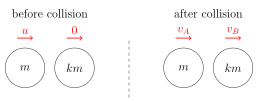
Two particles \(A\) and \(B\) of masses \(m\) and \(km\), respectively, are at rest on a smooth horizontal surface. The direction of the line passing through \(A\) and \(B\) is perpendicular to a vertical wall which is on the other side of \(B\) from \(A\). The particle \(A\) is now set in motion towards \(B\) with speed \(u\). The coefficient of restitution between \(A\) and \(B\) is \(e_1\) and between \(B\) and the wall is \(e_2\). Show that there will be a second collision between \(A\) and \(B\) provided $$ k< \frac {1+e_2(1+e_1)} {e_1}\;. $$ Show that, if \(e_1=\frac13\), \(e_2=\frac12\) and \(k<5\), then the kinetic energy of \(A\) and \(B\) immediately after \(B\) rebounds from the wall is greater than \(mu^2/27\).
Solution: First collision:
2001 Paper 2 Q11
A two-stage missile is projected from a point \(A\) on the ground with horizontal and vertical velocity components \(u\) and \(v\), respectively. When it reaches the highest point of its trajectory an internal explosion causes it to break up into two fragments. Immediately after this explosion one of these fragments, \(P\), begins to move vertically upwards with speed \(v_e\), but retains the previous horizontal velocity. Show that \(P\) will hit the ground at a distance \(R\) from \(A\) given by $$ \frac{gR}u = v+v_e + \sqrt{v_e^2 +v^2}\, . $$ It is required that the range \(R\) should be greater than a certain distance \(D\) (where \(D> 2uv/g\)). Show that this requirement is satisfied if \[ v_e> \frac{gD}{2u}\left( \frac{gD-2uv}{gD-uv}\right). \] \noindent[{\sl The effect of air resistance is to be neglected.}]
2001 Paper 2 Q12
The national lottery of Ruritania is based on the positive integers from \(1\) to \(N\), where \(N\) is very large and fixed. Tickets cost \(\pounds1\) each. For each ticket purchased, the punter (i.e. the purchaser) chooses a number from \(1\) to \(N\). The winning number is chosen at random, and the jackpot is shared equally amongst those punters who chose the winning number. A syndicate decides to buy \(N\) tickets, choosing every number once to be sure of winning a share of the jackpot. The total number of tickets purchased in this draw is \(3.8N\) and the jackpot is \(\pounds W\). Assuming that the non-syndicate punters choose their numbers independently and at random, find the most probable number of winning tickets and show that the expected net loss of the syndicate is approximately \[ N\; - \; %\textstyle{ \frac{5 \big(1- e^{-2.8}\big)}{14} \;W\;. \]