Problems
Filters
1531 problems found
2003 Paper 3 Q8
- Show that the gradient at a point \(\l x\,, \, y \r\) on the curve \[ \l y + 2x \r^3 \l y - 4x \r = c\;, \] where \(c\) is a constant, is given by \[ \frac{\d y}{\d x} = \frac{16 x -y}{2y-5x} \;. \]
- By considering the derivative with respect to \(x\) of \(\l y + ax \r^n \l y + bx \r\,\), or otherwise, find the general solution of the differential equation \[ \frac{\mathrm{d}y}{ \mathrm{d}x} = \frac{10x - 4y}{ 3x - y}\;. \]
Solution:
- \begin{align*} && c &= \left (y+2x \right)^3\left (y-4x \right) \\ \Rightarrow && 0 &= 3\left (y+2x \right)^2\left (y-4x \right)\left ( \frac{\d y}{\d x} + 2 \right) + \left (y+2x \right)^3 \left ( \frac{\d y}{\d x} - 4 \right) \\ \Rightarrow && 0 &= 3(y-4x)\left ( \frac{\d y}{\d x} + 2 \right) + \left (y+2x \right) \left ( \frac{\d y}{\d x} - 4 \right) \\ \Rightarrow &&&= \frac{\d y}{\d x} \left (3(y-4x) + (y+2x) \right) + 6(y-4x)-4(y+2x) \\ &&&= \frac{\d y}{\d x} \left ( 4y-10x\right) + 2y-32x \\ \Rightarrow && \frac{\d y}{\d x} &= \frac{16x-y}{2y-5x} \end{align*}
- \begin{align*} && c &= \left ( y + ax \right)^n \left ( y + bx \right) \\ \Rightarrow && 0 &= n\left ( y + ax \right)^{n-1} \left ( y + bx \right)\left ( \frac{\d y}{ \d x}+a \right) + \left ( y + ax \right)^{n} \left ( \frac{\d y}{ \d x}+b \right) \\ \Rightarrow && 0 &= n \left ( y + bx \right)\left ( \frac{\d y}{ \d x}+a \right) + \left ( y + ax \right) \left ( \frac{\d y}{ \d x}+b \right) \\ &&&= \frac{\d y}{\d x} \left ( (n+1)y + (nb+a)x \right) + an(y+bx) + by+bax \\ &&&= \frac{\d y}{\d x} \left ( (n+1)y + (nb+a)x \right) + (an+b)y+ab(n+1)x \\ \Rightarrow && \frac{\d y}{\d x} &= -\frac{(an+b)y+ab(n+1)x}{(n+1)y+(nb+a)x} \end{align*} We must have \(ab = 10, a+b = -7\) so say \(a=-5,b=-2,n=2\) and we have \((y-5x)^2(y-2) = c\) is our general solution to the differential equation
2003 Paper 3 Q9
A particle \(P\) of mass \(m\) is constrained to move on a vertical circle of smooth wire with centre~\(O\) and of radius \(a\). \(L\) is the lowest point of the circle and \(H\) the highest and \(\angle LOP = \theta\,\). The particle is attached to \(H\) by an elastic string of natural length \(a\) and modulus of elasticity~\(\alpha mg\,\), where \(\alpha > 1\,\). Show that, if \(\alpha>2\,\), there is an equilibrium position with \(0<\theta<\pi\,\). Given that \(\alpha =2+\sqrt 2\,\), and that \(\displaystyle \theta = \tfrac{1}{2}\pi + \phi\,\), show that \[ \ddot{\phi} \approx -\frac{g (\sqrt2+1)}{2a }\, \phi \] when \(\phi\) is small. For this value of \(\alpha\), explain briefly what happens to the particle if it is given a small displacement when \( \theta = \frac{1}{2}\pi\).
2003 Paper 3 Q10
A particle moves along the \(x\)-axis in such a way that its acceleration is \(kx \dot{x}\,\) where \(k\) is a positive constant. When \(t = 0\), \(x = d\) (where \(d>0\)) and \(\dot{x} =U\,\).
- Find \(x\) as a function of \(t\) in the case \(U = kd^2\) and show that \(x\) tends to infinity as \(t\) tends to \(\displaystyle \frac{\pi }{2 dk}\,\).
- If \(U < 0\), find \(x\) as a function of \(t\) and show that it tends to a limit, which you should state in terms of \(d\) and \(U\,\), as \(t\) tends to infinity.
Solution:
- \(\,\) \begin{align*} && \ddot{x} &= kx \dot{x} \\ \Rightarrow && \frac{\d v}{\d x} \dot{x} &= k x \dot{x} \\ \Rightarrow && \int \d v &= \int k x \d x \\ \Rightarrow && v &= \frac12kx^2 + C \\ t=0, x = d, \dot{x} = kd^2: && kd^2 &= \frac12kd^2 + C \\ \Rightarrow && \dot{x} &= \frac12k(x^2+d^2) \\ \Rightarrow && \frac{\d x}{\d t} &= \frac12k(x^2+d^2) \\ \Rightarrow && \int \d t &= \int \frac{1}{\frac12k(x^2+d^2)} \d x \\ &&&= \frac{2}{kd}\tan^{-1} \frac{x}{d} \\ \Rightarrow && t &= \frac{2}{kd}\tan^{-1} \frac{x}{d} + C' \\ t = 0, x = d: && 0 &= \frac{\pi}{2kd} + C' \\ \Rightarrow && t &= \frac{2}{kd}\tan^{-1} \frac{x}{d}-\frac{\pi}{2kd} \end{align*} As \(x \to \infty\), \(t \to \frac{2}{kd} \frac{\pi}{2} - \frac{\pi}{2kd} = \frac{\pi}{2kd} \)
- \(\,\) \begin{align*} && v &= \frac12kx^2 + C \\ t=0, x = d, \dot{x} = U && U &= \frac12kd^2 + C \\ \Rightarrow && \dot{x} &= \frac12k(x^2-d^2)+U \\ \Rightarrow && \frac{\d x}{\d t} &=\frac12k(x^2-d^2)+U \\ \Rightarrow && \int \d t &= \int \frac{1}{\frac12k(x^2-d^2)+U} \d x \\ && &=\frac{2}{k} \int \frac{1}{x^2-d^2+\frac{2U}k} \d x \\ &&&= \frac2{k} \frac{1}{2\sqrt{d^2-\frac{2U}k}} \ln \frac{ \sqrt{d^2-\frac{2U}k}-x}{x+\sqrt{d^2-\frac{2U}k}} \\ \Rightarrow && t &= \frac2{k} \frac{1}{2\sqrt{d^2-\frac{2U}k}} \ln \frac{ \sqrt{d^2-\frac{2U}k}-x}{x+\sqrt{d^2-\frac{2U}k}} + C'' \\ t = 0, \dot{x} = d: && 0 &= \frac2{k} \frac{1}{2\sqrt{d^2-\frac{2U}k}} \ln \frac{ \sqrt{d^2-\frac{2U}k}-d}{d+\sqrt{d^2-\frac{2U}k}} + C'' \\ \Rightarrow && t &= \frac2{k} \frac{1}{2\sqrt{d^2-\frac{2U}k}} \ln \left ( \frac{ \sqrt{d^2-\frac{2U}k}-x}{x+\sqrt{d^2-\frac{2U}k}} \frac{d+\sqrt{d^2-\frac{2U}k}}{ \sqrt{d^2-\frac{2U}k}-d} \right ) \end{align*} as \(t \to \infty\) the denominator needs to head to \(0\), ie \(x \to -\sqrt{d^2-\frac{2U}k}\)
2003 Paper 3 Q11
Point \(B\) is a distance \(d\) due south of point \(A\) on a horizontal plane. Particle \(P\) is at rest at \(B\) at \(t=0\), when it begins to move with constant acceleration \(a\) in a straight line with fixed bearing~\(\beta\,\). Particle \(Q\) is projected from point \(A\) at \(t=0\) and moves in a straight line with constant speed \(v\,\). Show that if the direction of projection of \(Q\) can be chosen so that \(Q\) strikes \(P\), then \[ v^2 \ge ad \l 1 - \cos \beta \r\;. \] Show further that if \(v^2 >ad(1-\cos\beta)\) then the direction of projection of \(Q\) can be chosen so that \(Q\) strikes \(P\) before \(P\) has moved a distance \(d\,\).
2003 Paper 3 Q12
Brief interruptions to my work occur on average every ten minutes and the number of interruptions in any given time period has a Poisson distribution. Given that an interruption has just occurred, find the probability that I will have less than \(t\) minutes to work before the next interruption. If the random variable \(T\) is the time I have to work before the next interruption, find the probability density function of \(T\,\). I need an uninterrupted half hour to finish an important paper. Show that the expected number of interruptions before my first uninterrupted period of half an hour or more is \(\e^3-1\). Find also the expected length of time between interruptions that are less than half an hour apart. Hence write down the expected wait before my first uninterrupted period of half an hour or more.
2003 Paper 3 Q13
In a rabbit warren, underground chambers \(A, B, C\) and \(D\) are at the vertices of a square, and burrows join \(A\) to \(B\), \ \(B\) to \(C\), \ \(C\) to \(D\) and \(D\) to \(A\). Each of the chambers also has a tunnel to the surface. A rabbit finding itself in any chamber runs along one of the two burrows to a neighbouring chamber, or leaves the burrow through the tunnel to the surface. Each of these three possibilities is equally likely. Let \(p_A\,\), \(p_B\,\), \(p_C\) and \(p_D\) be the probabilities of a rabbit leaving the burrow through the tunnel from chamber \(A\), given that it is currently in chamber \(A, B, C\) or \(D\), respectively.
- Explain why \(p_A = \frac13 + \frac13p_B + \frac13 p_D\).
- Determine \(p_A\,\).
- Find the probability that a rabbit which starts in chamber \(A\) does not visit chamber~\(C\), given that it eventually leaves the burrow through the tunnel in chamber \(A\).
2003 Paper 3 Q14
Write down the probability generating function for the score on a standard, fair six-faced die whose faces are labelled \(1, 2, 3, 4, 5, 6\). Hence show that the probability generating function for the sum of the scores on two standard, fair six-faced dice, rolled independently, can be written as \[ \frac1{36} t^2 \l 1 + t \r^2 \l 1 - t + t^2 \r^2 \l 1 + t + t^2 \r^2 \;. \] Write down, in factorised form, the probability generating functions for the scores on two fair six-faced dice whose faces are labelled with the numbers \(1, 2, 2, 3, 3, 4\) and \(1, 3, 4, 5, 6, 8,\) and hence show that when these dice are rolled independently, the probability of any given sum of the scores is the same as for the two standard fair six-faced dice. Standard, fair four-faced dice are tetrahedra whose faces are labelled \(1, 2, 3, 4,\) the score being taken from the face which is not visible after throwing, and each score being equally likely. Find all the ways in which two fair four-faced dice can have their faces labelled with positive integers if the probability of any given sum of the scores is to be the same as for the two standard fair four-faced dice.
2002 Paper 1 Q1
Show that the equation of any circle passing through the points of intersection of the ellipse \((x+2)^2 +2y^2 =18\) and the ellipse \(9(x-1)^2 +16y^2 = 25\) can be written in the form \[ x^2-2ax +y^2 =5-4a\;. \]
Solution: \begin{align*} && (x+2)^2 +2y^2 &=18 \\ && 9(x-1)^2 +16y^2 &= 25 \\ \Rightarrow && 2y^2 &= 18 - (x+2)^2 \\ && 16y^2 &= 25 - 9(x-1)^2 \\ \Rightarrow && 25-9(x-1)^2 &= 8 \cdot 18 - 8(x+2)^2 \\ \Rightarrow && 25 -9+18x-9x^2 &= 144 -32- 32x +8x^2 \\ \Rightarrow && 0 &= 96 - 50x+x^2 \\ &&&= (x-48)(x-2) \\ \Rightarrow && x &= 2,48 \\ \Rightarrow && 2y^2 &= 2, 18-50^2 \\ \Rightarrow && (x,y) &= (2,\pm1) \end{align*} Therefore any circle must have it's centre on there perpendicular bisector of \((2, \pm 1)\), ie on the \(x\)-axis. Therefore it will have equation \((x-a)^2+y^2 = r^2\) and also contain the point \((2,1)\), therefore: \begin{align*} r^2 &= (2-a)^2 + 1^2 \\ &= 4 -2a+a^2 + 1 \\ &= 5-2a+a^2 \end{align*} and the equation is: \begin{align*} && (x-a)^2 + y^2 &= 5-4a+a^2 \\ \Rightarrow && x^2-2ax+a^2 +y^2 &= 5-4a+a^2 \\ \Rightarrow && x^2-2ax+y^2 &= 5-4a \end{align*} as required.
2002 Paper 1 Q2
Let \(f(x) = x^m(x-1)^n\), where \(m\) and \(n\) are both integers greater than \(1\). Show that the curve \(y=f(x)\) has a stationary point with \(0 < x < 1\). By considering \(f''(x)\), show that this stationary point is a maximum if \(n\) is even and a minimum if \(n\) is odd. Sketch the graphs of \(f(x)\) in the four cases that arise according to the values of \(m\) and \(n\).
Solution: \begin{align*} && f'(x) &= mx^{m-1}(x-1)^n + nx^m(x-1)^{n-1} \\ &&&= (m(x-1)+nx)x^{m-1}(x-1)^{n-1} \\ &&&= (x(m+n) - m)x^{m-1}(x-1)^{n-1} \\ \end{align*} Therefore when \(x = \frac{m}{m+n}\) there is a stationary point with \(0 < x < 1\). \begin{align*} && f''(x) &= m(m-1)x^{m-2}(x-1)^n + 2mnx^{m-1}(x-1)^{n-1} + n(n-1)x^{m}(x-1)^{n-2} \\ &&&= (m(m-1)(x-1)^2 +2mnx(x-1)+n(n-1)x^2)x^{m-2}(1-x)^{n-2} \\ \Rightarrow && f'' \left ( \frac{m}{m+n} \right) &= \left ( m(m-1) \frac{n^2}{(m+n)^2} - 2mn\frac{mn}{(m+n)^2} + n(n-1) \frac{m^2}{(m+n)^2} \right) \frac{m^{m-2}}{(m+n)^{m-2}} \frac{(-1)^{n-2}n^{n-2}}{(m+n)^{n-2}} \\ &&&= (-1)^{n-2}\frac{m^{m-1}n^{n-1}}{(m+n)^{m+n-2}} \left ( (m-1)n-2mn+(n-1)m\right) \\ &&&= (-1)^{n-2}\frac{m^{m-1}n^{n-1}}{(m+n)^{m+n-2}} \left ( -m-n\right) \\ &&&= (-1)^{n-1} \frac{m^{m-1}n^{n-1}}{(m+n)^{m+n-3}} \end{align*} Therefore this is positive (and a minimum) when \(n\) is odd and negative (and a maximum) when \(n\) is even.


2002 Paper 1 Q3
Show that \((a+b)^2\le 2a^2+2b^2\,\). Find the stationary points on the curve $y=\big(a^2\cos^2\theta +b^2\sin^2\theta\big)^{\frac12} + \big(a^2\sin^2\theta +b^2\cos^2\theta\big)^{\frac12}\,$, where \(a\) and \(b\) are constants. State, with brief reasons, which points are maxima and which are minima. Hence prove that \[ \vert a\vert +\vert b \vert \le \big(a^2\cos^2\theta +b^2\sin^2\theta\big)^{\frac12} + \big(a^2\sin^2\theta +b^2\cos^2\theta\big)^{\frac12} \le \big(2a^2+2b^2\big)^{\frac12} \;. \]
Solution: \begin{align*} && 2a^2+2b^2 &= a^2 + b^2 + (a^2+b^2) \\ &&&\underbrace{\geq}_{AM-GM} a^2+b^2+2\sqrt{a^2b^2} \\ &&&= a^2+b^2 + 2|a||b| \\ &&&\geq a^2+b^2 + 2ab \\ &&&= (a+b)^2 \end{align*} Assume \(a^2 \neq b^2\), otherwise the curve is a constant. \begin{align*} && y & = \big(a^2\cos^2\theta +b^2\sin^2\theta\big)^{\frac12} + \big(a^2\sin^2\theta +b^2\cos^2\theta\big)^{\frac12}\\ && \frac{\d y}{\d \theta} &= \tfrac12 \left (a^2\cos^2\theta +b^2\sin^2\theta \right)^{-\frac12} \cdot (2 \sin \theta \cos \theta (b^2 - a^2)) + \tfrac12 (a^2\sin^2\theta +b^2\cos^2\theta)^{-\frac12} \cdot (2 \sin \theta \cos \theta (a^2 - b^2) \\ &&&= \tfrac12\sin2 \theta (b^2 - a^2) \left ( \left (a^2\cos^2\theta +b^2\sin^2\theta \right)^{-\frac12} - (a^2\sin^2\theta +b^2\cos^2\theta)^{-\frac12}\right) \\ \therefore \frac{\d y}{\d x} = 0 \Rightarrow && \sin 2\theta = 0 & \text{ or } a^2\cos^2\theta +b^2\sin^2\theta = a^2\sin^2\theta +b^2\cos^2\theta \\ \Rightarrow && \theta &= 0, \frac{\pi}{2}, \pi, \frac{3\pi}{2}, 2\pi \\ && (a^2-b^2) \cos ^2\theta &= (a^2-b^2) \sin^2 \theta \\ \Rightarrow && \theta &= \frac{\pi}{4}, \frac{3\pi}{4}, \frac{5\pi}{4}, \frac{7\pi}{4} \end{align*} WLOG \(b^2 - a^2 > 0\), then the two parts of the derivative look like:

2002 Paper 1 Q4
Give a sketch of the curve \( \;\displaystyle y= \frac1 {1+x^2}\;\), for \(x\ge0\). Find the equation of the line that intersects the curve at \(x=0\) and is tangent to the curve at some point with \(x>0\,\). Prove that there are no further intersections between the line and the curve. Draw the line on your sketch. By considering the area under the curve for \(0\le x\le1\), show that \(\pi>3\,\). Show also, by considering the volume formed by rotating the curve about the \(y\) axis, that \(\ln 2 >2/3\,\). [Note: \(\displaystyle \int_0^ 1 \frac1 {1+x^2}\, \d x = \frac\pi 4\,.\;\)]
Solution:

2002 Paper 1 Q5
Let \[ \f(x) = x^n + a_1 x^{n-1} + \cdots + a_n\;, \] where \(a_1\), \(a_2\), \(\ldots\), \(a_n\) are given numbers. It is given that \(\f(x)\) can be written in the form \[ \f(x) = (x+k_1)(x+k_2)\cdots(x+k_n)\;. \] By considering \(\f(0)\), or otherwise, show that \(k_1k_2 \ldots k_n =a_n\). Show also that $$(k_1+1)(k_2+1)\cdots(k_n+1)= 1+a_1+a_2+\cdots+a_n$$ and give a corresponding result for \((k_1-1)(k_2-1)\cdots(k_n-1)\). Find the roots of the equation \[ x^4 +22x^3 +172x^2 +552x+576=0\;, \] given that they are all integers.
Solution: \begin{align*} && f(0) &= 0^n + a_1\cdot 0^{n-1} + \cdots + a_n \\ &&&= a_n \\ && f(0) &= (0+k_1)(0+k_2) \cdots (0+k_n) \\ &&&= k_1 k_2 \cdots k_n \\ \Rightarrow && a_n &= k_1 k_2 \cdots k_n \\ \\ &&f(1) &= 1^n + a_1 \cdot 1^{n-1} + \cdots + a_n \\ &&&= 1 + a_1 + a_2 + \cdots + a_n \\ && f(1) &= (1 + k_1) (1 + k_2) \cdots (1+k_n) \\ \Rightarrow && (k_1+1)\cdots (k_n+1) &= 1 + a_1 + \cdots + a_n \\ \\ && f(-1) &= (-1)^{n} + a_1 \cdot (-1)^{n-1} + \cdots + a_n \\ &&&= a_n - a_{n-1} + \cdots + (-1)^{n-1} a_1 + (-1)^{n} \\ && f(-1) &= (-1+k_1)(-1+k_2) \cdots (-1+k_n) \\ &&&= (k_1-1)(k_2-1)\cdots(k_n-1) \\ \Rightarrow && (k_1-1)\cdots(k_n-1) &= a_n - a_{n-1} + \cdots + (-1)^{n-1} a_1 + (-1)^{n} \end{align*} \(576 = 2^6 \cdot 3^2\). Notice that \(1 - 22 + 172 -552 + 576 = 175 = 5^2 \cdot 7\) and \(1+22 + 172+552+576 = 1323 = 3^3 \cdot 7^2\). \(k_i = 2, 6, 6, 8\) therefore the roots are \(-2, -6, -6, -8\)
2002 Paper 1 Q6
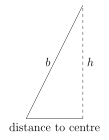
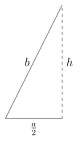
A pyramid stands on horizontal ground. Its base is an equilateral triangle with sides of length~\(a\), the other three sides of the pyramid are of length \(b\) and its volume is \(V\). Given that the formula for the volume of any pyramid is $ \textstyle \frac13 \times \mbox{area of base} \times \mbox {height} \,, $ show that \[ V= \frac1{12} {a^2(3b^2-a^2)}^{\frac12}\;. \] The pyramid is then placed so that a non-equilateral face lies on the ground. Show that the new height, \(h\), of the pyramid is given by \[ h^2 = \frac{a^2(3b^2-a^2)}{4b^2-a^2}\;. \] Find, in terms of \(a\) and \(b\,\), the angle between the equilateral triangle and the horizontal.
Solution: First let's consider the area of the base. It is an equilateral triangle with side length \(a\), so \(\frac12 a^2 \sin 60^\circ = \frac{\sqrt{3}}4a^2\).
2002 Paper 1 Q7
Let \[ I= \int_0^a \frac {\cos x}{\sin x + \cos x} \; \d x \, \quad \mbox{ and } \quad J= \int_0^a \frac {\sin x}{\sin x + \cos x} \; \d x \;, \] where \(0\le a < \frac{3}{4}\pi\,\). By considering \(I+J\) and \(I-J\), show that $ 2I= a + \ln (\sin a +\cos a)\;. $ Find also:
- \(\displaystyle \int_0^{\frac{1}{2}\pi} \frac {\cos x}{p\sin x + q\cos x} \; \d x \,\), where \(p\) and \(q\) are positive numbers; %
- [(ii)] %\(\displaystyle \int_0^{\frac{1}{2}\pi/2} \frac {\cos x}{\sin (x+k)} \; \d x \,\), where \(0 < k < \pi/2\,\);
- \(\displaystyle \int_0^{\frac{1}{2}\pi} \frac {\cos x+4}{3\sin x + 4\cos x+ 25} \; \d x \,\).
Solution: \begin{align*} && I + J &= \int_0^a \frac{\sin x + \cos x}{\sin x + \cos x } \d x = a \\ && I - J &= \int_0^a \frac{\cos x - \sin x}{\sin x + \cos x} \d x \\ &&&= \left [\ln ( \sin x + \cos x) \right]_0^a = \ln (\sin a + \cos a) - \ln 1 = \ln(\sin a + \cos a) \\ \\ \Rightarrow && 2I &= a + \ln(\sin a + \cos a) \end{align*}
- Let \(\displaystyle I = \int_0^{\frac12 \pi} \frac{\cos x}{p \sin x + q \cos x} \d x, J = \int_0^{\frac12 \pi} \frac{\sin x}{p \sin x + q \cos x} \d x\) so \begin{align*} && qI + pJ &= \frac{\pi}{2} \\ && pI - qJ &= \int_0^{\frac12 \pi} \frac{p \cos x - q \sin x}{p \sin x + q \cos x } \d x \\ &&&= \left [\ln (p \sin x + q \cos x) \right]_0^{\pi/2} \\ &&&= \ln(p) - \ln(q) = \ln \frac{p}{q} \end{align*}
- \(\,\) \begin{align*} && \int_0^{\frac{\pi}{2}} \frac{\cos x}{\sin(x + k)} \d x &= \int_0^{\frac{\pi}{2}} \frac{\cos x}{\sin(x) \cos(k) + \cos(x) \sin (k)} \d x \\ &&&= \ln \tan k \end{align*}
- Let \(\displaystyle I = \int_0^{\pi/2} \frac{\cos x + 4}{3 \sin x + 4 \cos x + 25} \d x, J = \int_0^{\pi/2} \frac{\sin x + 3}{3 \sin x + 4 \cos x + 25} \d x\), so \begin{align*} && 4I + 3J &= \int_0^{\pi/2} \frac{3 \sin x + 4 \cos x + 25}{3 \sin x + 4 \cos x + 25} \d x \\ &&&= \frac{\pi}{2} \\ && 3I - 4J &= \int_0^{\pi/2} \frac{3\cos x - 4 \sin x}{3 \sin x + 4 \cos x + 25} \d x \\ &&&= \left [\ln(3 \sin x + 4 \cos x + 25) \right]_0^{\pi/2} \\ &&&= \ln (28) - \ln (29) = \ln \frac{28}{29} \\ \Rightarrow && 25I &= 2\pi + 3 \ln \frac{28}{29} \\ \Rightarrow && I &= \frac{2}{25} \pi + \frac{3}{25} \ln \frac{28}{29} \end{align*}
2002 Paper 1 Q8
I borrow \(C\) pounds at interest rate \(100\alpha \,\%\) per year. The interest is added at the end of each year. Immediately after the interest is added, I make a repayment. The amount I repay at the end of the \(k\)th year is \(R_k\) pounds and the amount I owe at the beginning of \(k\)th year is \(C_k\) pounds (with \(C_1=C\)). Express \(C_{n+1}\) in terms of \(R_k\) (\(k= 1\), \(2\), \(\ldots\), \(n\)), \(\alpha\) and \(C\) and show that, if I pay off the loan in \(N\) years with repayments given by \(R_k= (1+\alpha)^kr\,\), where \(r\) is constant, then \(r=C/N\,\). If instead I pay off the loan in \(N\) years with \(N\) equal repayments of \(R\) pounds, show that \[ \frac R C = \frac{\alpha (1+\alpha)^{N} }{(1+\alpha)^N-1} \;, \] and that \(R/C\approx 27/103\) in the case \(\alpha =1/50\), \(N=4\,\).