Problems
Filters
1531 problems found
2003 Paper 1 Q6
Evaluate the following integrals, in the different cases that arise according to the value of the positive constant \(a\,\):
- \[ \displaystyle \int_0^1 \frac 1 {x^2 + (a+2)x +2a} \; \d x \]
- \[\displaystyle \int _{1}^2\frac 1 {u^2 +au +a-1} \; \d u\]
Solution:
- \(\,\) \begin{align*} && I &= \int_0^1 \frac 1 {x^2 + (a+2)x +2a} \; \d x \\ &&&= \int_0^1 \frac{1}{(x+a)(x+2)} \d x\\ \end{align*} Case 1: \(a = 2\) \begin{align*} && I &= \int_0^1 \frac{1}{(x+2)^2} \d x \\ &&&= \left [ -(x+2)^{-1}\right]_0^1 = \frac12 - \frac13 = \frac16 \end{align*} Case 2: \(a \neq 2, a \not \in [0,1]\) \begin{align*} && I &=\frac{1}{a-2} \int_0^1 \left ( \frac{1}{x+2} - \frac{1}{x+a} \right) \d x \\ &&&= \frac{1}{a-2} \left [ \ln |x+2| - \ln |x + a|\right]_0^1 \\ &&&= \frac{1}{a-2} \left ( \ln \frac{3}{|1+a|} - \ln \frac{2}{|a|} \right) \\ &&&= \frac{1}{a-2} \ln \frac{3|a|}{2|a+1|} \end{align*} Case 3: \(a \in [0, 1]\), \(I\) does not converge
- \(\,\) \begin{align*} && J &= \int _{1}^2\frac 1 {u^2 +au +a-1} \; \d u \\ &&&= \int_1^2 \frac{1}{(u+a-1)(u+1)} \d u \\ x = u-1:&&&= \int_0^1 \frac{1}{(x+a)(x+2)} \d x \end{align*} So it's the same as the previous integral
2003 Paper 1 Q7
Let \(k\) be an integer satisfying \(0\le k \le 9\,\). Show that \(0\le 10k-k^2\le 25\) and that \(k(k-1)(k+1)\) is divisible by \(3\,\). For each \(3\)-digit number \(N\), where \(N\ge100\), let \(S\) be the sum of the hundreds digit, the square of the tens digit and the cube of the units digit. Find the numbers \(N\) such that \(S=N\). [Hint: write \(N=100a+10b+c\,\) where \(a\,\), \(b\,\) and \(c\) are the digits of \(N\,\).]
Solution: First note that \(10k - k^2 = 25 - (5-k)^2\) which is clearly bounded above by \(25\). The smallest it can be is when \(|5-k|\) is as large as possible, ie when \(k =0\) and we get a lower bound of \(0\). For \((k-1)k(k+1)\) notice this is the product of \(3\) consecutive integers, and therefore must be divisible by \(3\). (In fact, it's divisible by six, since \(\binom{k+1}{3}\) is the number of ways to choose \(3\) objects from \(k+1\). Let \(N = 100a + 10b + c\) where \(0 \leq a,b,c < 10\) and \(1 \leq a\). \(S = a + b^2 + c^3\) we want to find \begin{align*} && 100a +10b + c &= a + b^2 + c^3 \\ \Rightarrow && 0 &= \underbrace{99a}_{3 \mid 99 } + 10b - b^2 -\underbrace{c(c+1)(c-1)}_{3 \mid c(c+1)(c-1)} \\ \end{align*} Therefore \(3 \mid 10b - b^2 = b(10-b)\). Therefore \(3 \mid b\) or \(3 \mid 10-b\) so \(b = 0, 3, 6, 1, 4, 7\) We also have \(99a \geq 99\) and \(10b-b^2 \in [0, 25]\) so we need \(c^3-c \geq 99\), so \(c \geq 5\) Case \(c = 5\), Then \(c^3-c = 120\) so \(a = 1\) and \(10b-b^2 = 21\) so \(b= 3, 7\) \(N = 135, 175\) Case \(c = 6\), so \(c^3 - c = 210\) so \(a = 2\) and \(25-(5-k)^2 = 12\) so no solutions. Case \(c = 7\), so \(7^3 - 7 = 336\) so \(a = 3\) and \(25-(5-k)^2 = 39\) so no solutions. Case \(c = 8\) so \(8^3-8 = 504\) so \(a = 5\) and \(25-(5-k)^2 = 9\), so \(b = 1, 9\) and \(N = 518, 598\) Case \(c = 9\) so \(9^3 - 9 = 720\), so \(a = 7\) and \(25-(5-k)^2 = 27\) so no solutions. Therefore all the solutions are \(N = 135, 175, 518, 598\)
2003 Paper 1 Q8
A liquid of fixed volume \(V\) is made up of two chemicals \(A\) and \(B\,\). A reaction takes place in which \(A\) converts to \(B\,\). The volume of \(A\) at time \(t\) is \(xV\) and the volume of \(B\) at time \(t\) is \(yV\) where \(x\) and \(y\) depend on \(t\) and \(x+y=1\,\). The rate at which \(A\) converts into \(B\) is given by \(kVxy\,\), where \(k\) is a positive constant. Show that if both \(x\) and \(y\) are strictly positive at the start, then at time \(t\) \[ y= \frac {D\e^{kt}}{1+D \e^{kt}} \;, \] where \(D\) is a constant. Does \(A\) ever completely convert to \(B\,\)? Justify your answer.
Solution: We have \(\dot{A} = -kVxy\) or \(\dot{x}V = -kVxy\), ie \(\dot{x} = -kxy\) and similarly \(\dot{y} = kxy = k(1-y)y\). \begin{align*} && \frac{\d y}{\d t} &= ky(1-y) \\ \Rightarrow && \int k \d t &= \int \frac{1}{y(1-y)} \d y \\ \Rightarrow && kt &= \int \left ( \frac{1}{y} + \frac{1}{1-y} \right) \d y \\ &&&= \ln y - \ln (1-y) + C\\ \Rightarrow && kt &= \ln \frac{y}{D(1-y)} \\ \Rightarrow && De^{kt} &= \frac{y}{1-y} \\ \Rightarrow && y(1+De^{kt}) &= De^{kt} \\ \Rightarrow && y &= \frac{De^{kt}}{1+De^{kt}} \end{align*} As \(t \to \infty\) \(y \to \frac{D}{D} = 1\) so depending on how fine grained we want to go we might say that 'yes it completely converts' when there is an immeasurably small amount of \(A\) left, or we might say it doesn't since it only tends to \(1\) and never actually reaches it.
2003 Paper 1 Q9
A particle is projected with speed \(V\) at an angle \(\theta\) above the horizontal. The particle passes through the point \(P\) which is a horizontal distance \(d\) and a vertical distance \(h\) from the point of projection. Show that \[ T^2 -2kT + \frac{2kh}{d}+1=0\;, \] where \(T=\tan\theta\) and \(\ds k= \frac{V^2}{gd}\,\). %Derive an equation relating \(\tan \theta\), \(V\), \(g\), \(d\) and \(h\). Show that, if \(\displaystyle {kd > h + \sqrt {h^2 + d^2}}\;\), there are two distinct possible angles of projection. Let these two angles be \(\alpha\) and \(\beta\). Show that \(\displaystyle \alpha + \beta = \pi - \arctan ( {d/ h}) \,\).
2003 Paper 1 Q10
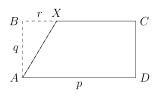
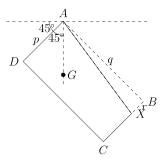
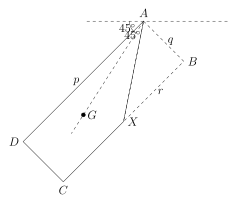
\(ABCD\) is a uniform rectangular lamina and \(X\) is a point on \(BC\,\). The lengths of \(AD\), \(AB\) and \(BX\) are \(p\,\), \(q\) and \(r\) respectively. The triangle \(ABX\) is cut off the lamina. Let \((a,b)\) be the position of the centre of gravity of the lamina, where the axes are such that the coordinates of \(A\,\), \(D\) and \(C\) are \((0,0)\,\), \((p,0)\) and \((p,q)\) respectively. Derive equations for \(a\) and \(b\) in terms of \(p\,\), \(q\) and \(r\,\). When the resulting trapezium is freely suspended from the point \(A\,\), the side \(AD\) is inclined at \(45^\circ\) below the horizontal. Show that \(\displaystyle r = q - \sqrt{q^2 - 3pq + 3p^2}\,\). You should justify carefully the choice of sign in front of the square root.
Solution:
2003 Paper 1 Q11
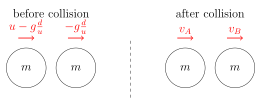
A smooth plane is inclined at an angle \(\alpha\) to the horizontal. \(A\) and \(B\) are two points a distance \(d\) apart on a line of greatest slope of the plane, with \(B\) higher than \(A\). A particle is projected up the plane from \(A\) towards \(B\) with initial speed \(u\), and simultaneously another particle is released from rest at \(B\,\). Show that they collide after a time \(\displaystyle {d /u}\,\). The coefficient of restitution between the two particles is \(e\) and both particles have mass \(m\,\). Show that the loss of kinetic energy in the collision is \(\frac14 {m u^2 \big( 1 - e^2 \big) }\,\).
Solution: We can `ignore' the fact that they are both accelerating, because the acceleration is the same for both object so it will "cancel" out. Therefore the time taken is the same as if the object has to travel distance \(d\) at speed \(u\), ie \(d/u\). \begin{align*} && u_A &= u - g \frac{d}{u} \\ && u_B &= -g\frac{d}{u} \end{align*}
2003 Paper 1 Q12
In a bag are \(n\) balls numbered 1, 2, \(\ldots\,\), \(n\,\). When a ball is taken out of the bag, each ball is equally likely to be taken.
- A ball is taken out of the bag. The number on the ball is noted and the ball is replaced in the bag. The process is repeated once. Explain why the expected value of the product of the numbers on the two balls is \[ \frac 1 {n^2} \sum_{r=1}^n\sum_{s=1}^n rs \] and simplify this expression.
- A ball is taken out of the bag. The number on the ball is noted and the ball is not replaced in the bag. Another ball is taken out of the bag and the number on this ball is noted. Show that the expected value of the product of the two numbers is \[ \frac{(n+1)(3n+2)}{12}\;. \]
Solution:
- Since the second draw is independently of the first draw \(\mathbb{P}(F=r, S=s) = \mathbb{P}(F=r)\mathbb{P}(S=s) = \frac{1}{n^2}\) and so \begin{align*} && \E[FS] &= \sum_{r=1}^n \sum_{s=1}^n rs \mathbb{P}(F=r, S = s) \\ &&&= \frac{1}{n^2} \sum_{r=1}^n \sum_{s=1}^n rs \\ &&&= \frac{1}{n^2} \left ( \sum_{r=1}^n r \right)\left ( \sum_{s=1}^n s \right) \\ &&&= \frac{1}{n^2} \left ( \frac{n(n+1)}{2} \right)^2 \\ &&&= \frac{(n+1)^2}{4} \end{align*}
- Under this methodology, \(\mathbb{P}(F=r, S=s) = \frac{1}{n(n-1)}\) as long as \(r \neq s\), therefore \begin{align*} && \E[FS] &= \sum_{r=1}^n \sum_{s\neq r} rs \mathbb{P}(F = r, S = s) \\ &&&= \frac{1}{n(n-1)} \sum_{r=1}^n \left ( \sum_{s=1}^n rs - r^2 \right) \\ &&&= \frac{1}{n(n-1)} \left ( \frac{n^2(n+1)^2}{4} - \frac{n(n+1)(2n+1)}{6} \right) \\ &&&= \frac{n+1}{12(n-1)} \left ( 3n(n+1)-2(2n+1) \right) \\ &&&= \frac{n+1}{12(n-1)} \left ( 3n^2 -n -2 \right) \\ &&&= \frac{n+1}{12(n-1)} (3n+2)(n-1)\\ &&&= \frac{(n+1)(3n+2)}{12} \end{align*}
2003 Paper 1 Q13
If a football match ends in a draw, there may be a "penalty shoot-out". Initially the teams each take 5 shots at goal. If one team scores more times than the other, then that team wins. If the scores are level, the teams take shots alternately until one team scores and the other team does not score, both teams having taken the same number of shots. The team that scores wins. Two teams, Team A and Team B, take part in a penalty shoot-out. Their probabilities of scoring when they take a single shot are \(p_A\) and \(p_B\) respectively. Explain why the probability \(\alpha\) of neither side having won at the end of the initial \(10\)-shot period is given by $$\alpha =\sum_{i=0}^5\binom{5}{i}^2(1-p_A)^i(1-p_B)^i\,p_A^{5-i}p_B^{5-i}.$$ Show that the expected number of shots taken is \(\displaystyle 10+ \frac{2\alpha}\beta\;,\) where \(\beta=p_A+p_B-2p_Ap_B\,.\)
Solution: Note that in the first \(10\)-short period the number of goals scored by each team is \(B(5, \p_i)\). For them to be equal they must both have scored the same number of goals, ie \begin{align*} && \alpha &= \sum_{i=0}^5 \mathbb{P}(\text{both teams score }5-i) \\ &&&= \sum_{i=0}^5 \binom{5}{i} (1-p_A)^ip_A^{5-i} \binom{5}{i} (1-p_B)^i p_B^{5-i} \\ &&&= \sum_{i=0}^5 \binom{5}{i} ^2(1-p_A)^i (1-p_B)^i p_A^{5-i} p_B^{5-i} \\ \end{align*} Suppose we make it to the end of the shoot out with scores tied. The probability that we finish each round is \(p_A(1-p_B) + p_B(1-p_A)\) (the probability \(A\) wins or \(B\) wins). This is \(p_A + p_B - 2p_Ap_B = \beta\)). Therefore the number of additional rounds is geometric with parameter \(\beta\) and the expected number of rounds is \(\frac{1}{\beta}\). Each round has two shots, and there is a probability \(\alpha\) of this occuring, ie \(\frac{2\alpha}{\beta}\). Added to the \(10\) guaranteed shots we get the desired result
2003 Paper 1 Q14
Jane goes out with any of her friends who call, except that she never goes out with more than two friends in a day. The number of her friends who call on a given day follows a Poisson distribution with parameter \(2\). Show that the average number of friends she sees in a day is~\(2-4\e^{-2}\,\). Now Jane has a new friend who calls on any given day with probability \(p\). Her old friends call as before, independently of the new friend. She never goes out with more than two friends in a day. Find the average number of friends she now sees in a day.
2003 Paper 2 Q1
Consider the equations \begin{alignat*}{2} ax-&y- \ z && =3 \;,\\ 2ax -&y -3z && = 7 \;,\\ 3ax-&y-5z && =b \;, \end{alignat*} where \(a\) and \(b\) are given constants.
- In the case \(a=0\,\), show that the equations have a solution if and only if \(b=11\,\).
- In the case \(a\ne0\) and \(b=11\,\) show that the equations have a solution with \(z=\lambda\) for any given number \(\lambda\,\).
- In the case \(a=2\) and \(b=11\,\) find the solution for which \(x^2+y^2+z^2\) is least.
- Find a value for \(a\) for which there is a solution such that \(x>10^6\) and \(y^2+z^2<1\,\).
Solution:
- If \(a = 0\), then then the LHS second equation is the average of the first and last equations, ie \(7 = \frac{b+3}{2}\) so \(b = 11\). This clearly has solutions, say \(x = 0, y = -1, z = -2\).
- If \(a \neq 0\) and \(b = 11\), it is still the case that the third equation a linear combination of the first two. Therefore we can consider the linear system: \begin{cases} ax - y &= 3 + \lambda \\ 2ax - y &= 7 + 3\lambda \end{cases} and since \(-a+2a = a \neq 0\) the solution has a unique solution for \(x\) and \(y\).
- \begin{align*} \begin{cases} 2x - y &= 3 + \lambda \\ 4x - y &= 7 + 3\lambda \end{cases} \Rightarrow x = 2 +\lambda, y = 1 + \lambda \\ x^2 + y^2 + z^2 &= (2 + \lambda)^2 + (1+\lambda)^2 + \lambda^2 \\ &= (4 + 1) + (4+2)\lambda + 3\lambda^2 \\ &= 5 + 3((\lambda+1)^2 - 1) \\ &= 3(\lambda + 1)^2 + 2 \end{align*} Therefore the solution is minimized when \(\lambda = -1, x = 1, y = 0, z = -1\)
- \begin{align*} \begin{cases} ax - y &= 3 + \lambda \\ 2ax - y &= 7 + 3\lambda \end{cases} \Rightarrow x = \frac{4 +2\lambda}{a}, y = 1 + \lambda \end{align*} We want say \(\lambda = -\frac12\) then we have \(y^2 + z^2 = \frac12\) and \(x = \frac{3}{a}\), so choose \(a < \frac{3}{10^6}\)
2003 Paper 2 Q2
Write down a value of \(\theta\,\) in the interval \(\frac{1}{4}\pi< \theta <\frac{1}{2}\pi\) that satisfies the equation \[ 4\cos\theta+ 2\sqrt3\, \sin\theta = 5 \;. \] Hence, or otherwise, show that \[ \pi=3\arccos(5/\sqrt{28}) + 3\arctan(\sqrt3/2)\;. \] Show that \[ \pi=4\arcsin(7\sqrt2/10) - 4\arctan(3/4)\;. \]
Solution: If \(\theta = \frac{\pi}{3}\) then \(\cos \theta = \frac12, \sin \theta = \frac{\sqrt{3}}{2}\) and clearly the equation is satisfied. We can also solve this equation using the harmonic formulae, namely: \begin{align*} && 5 &= 4 \cos \theta + 2\sqrt{3} \sin \theta \\ &&&= \sqrt{4^2+2^2 \cdot 3} \cos \left (\theta -\tan^{-1} \left (\frac{2\sqrt{3}}{4}\right) \right) \\ \Rightarrow && \frac{5}{\sqrt{28}} &= \cos \left ( \frac{\pi}{3} - \tan^{-1} \left (\frac{\sqrt{3}}{2}\right) \right) \\ \Rightarrow && \frac{\pi}{3} &= \arccos\left( \frac{5}{\sqrt{28}}\right) + \arctan \left (\frac{\sqrt{3}}{2}\right) \end{align*} From which the result follows. Similarly, notice that \(3 \cos \theta + 4 \sin \theta = \frac{7}{\sqrt{2}}\) is clearly solved by \(\frac{\pi}{4}\), but also writing it in harmonic form, we have \begin{align*} &&\frac{7}{\sqrt{2}} &= 5 \sin \left (\theta + \tan^{-1} \left ( \frac{3}{4} \right) \right) \\ \Rightarrow && \frac{7\sqrt{2}}{10} &= \sin \left ( \frac{\pi}{4} + \tan^{-1} \left ( \frac{3}{4} \right) \right) \\ \Rightarrow && \frac{\pi}{4} &= \arcsin \left ( \frac{7\sqrt{2}}{10} \right) - \arctan \left ( \frac{3}{4} \right) \end{align*} as required.
2003 Paper 2 Q3
Prove that the cube root of any irrational number is an irrational number. Let \(\displaystyle u_n = {5\vphantom{\dot A}}^{1/{(3^n)}}\,\). Given that \(\sqrt[3]5\) is an irrational number, prove by induction that \(u_n\) is an irrational number for every positive integer \(n\). Hence, or otherwise, give an example of an infinite sequence of irrational numbers which converges to a given integer \(m\,\). [An irrational number is a number that cannot be expressed as the ratio of two integers.]
Solution: Claim: \(x \in \mathbb{R}\setminus \mathbb{Q} \Rightarrow x^{1/3} \in \mathbb{R} \setminus\mathbb{Q}\) Proof: We will prove the contrapositive, since \(x^{1/3} = p/q\) but then \(x = p^3/q^3 \in \mathbb{Q}\), therefore we're done. Claim: \(u_n = 5^{1/(3^n)}\) is irrational for \(n \geq 1\) Proof: We are assuming the base case, but then \(u_{n+1} = \sqrt[3]{u_n}\) which is clearly irrational by our first lemma, so we're done. Note that \(u_n \to 1\) and so \((m-1)+u_n \to m\) for any integer \(m\).
2003 Paper 2 Q4
The line \(y=d\,\), where \(d>0\,\), intersects the circle \(x^2+y^2=R^2\) at \(G\) and \(H\). Show that the area of the minor segment \(GH\) is equal to \begin{equation} R^2\arccos \left({d \over R}\right) -d\sqrt{R^2 - d^2}\;. \tag {\(*\)} \end{equation} In the following cases, the given line intersects the given circle. Determine how, in each case, the expression \((*)\) should be modified to give the area of the minor segment.
- Line: \(y=c\,\); \ \ \ circle: \((x-a)^2+(y-b)^2=R^2\,\).
- Line: \(y=mx+c\, \); \ \ \ circle: \(x^2+y^2=R^2\,\).
- Line: \(y=mx+c\,\); \ \ \ circle: \((x-a)^2+(y-b)^2=R^2\,\).
2003 Paper 2 Q5
The position vectors of the points \(A\,\), \(B\,\) and \(P\) with respect to an origin \(O\) are \(a{\bf i}\,\), \(b{\bf j}\,\) and \(l{\bf i}+m{\bf j}+n{\bf k}\,\), respectively, where \(a\), \(b\), and \(n\) are all non-zero. The points \(E\), \(F\), \(G\) and \(H\) are the midpoints of \(OA\), \(BP\), \(OB\) and \(AP\), respectively. Show that the lines \(EF\) and \(GH\) intersect. Let \(D\) be the point with position vector \(d{\bf k}\), where \(d\) is non-zero, and let \(S\) be the point of intersection of \(EF\) and \(GH.\) The point \(T\) is such that the mid-point of \(DT\) is \(S\). Find the position vector of \(T\) and hence find \(d\) in terms of \(n\) if \(T\) lies in the plane \(OAB\).
Solution: \(E = \langle \frac{a}{2}, 0,0 \rangle, F = \langle \frac{l}{2}, \frac{m+b}{2}, \frac{n}{2} \rangle, G = \langle 0, \frac{b}{2}, 0 \rangle, H = \langle \frac{a+l}{2}, \frac{m}{2}, \frac{n}{2} \rangle\) Note that the midpoint of \(EF\) and \(GH\) are both $\langle \frac{a+l}{4}, \frac{m+b}{4}, \frac{n}{4} \rangle$, so clearly they must intersect at this point. The vector we just found is \(S\), and \(\mathbf{t} = \mathbf{d} + 2(\mathbf{s}-\mathbf{d}) = 2\mathbf{s} - \mathbf{d}\). Therefore \(T = \langle \frac{a+l}{2}, \frac{m+b}{2}, \frac{n-2d}{2} \rangle\). If \(T\) lies in the plane \(OAB\) then \(n - 2d = 0\) ie \(d = \frac{n}{2}\)
2003 Paper 2 Q6
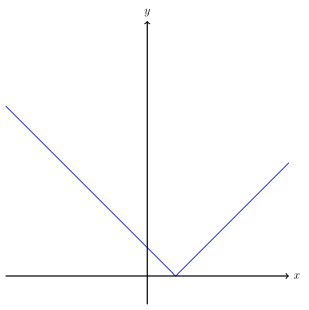
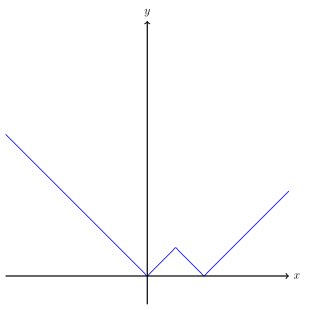
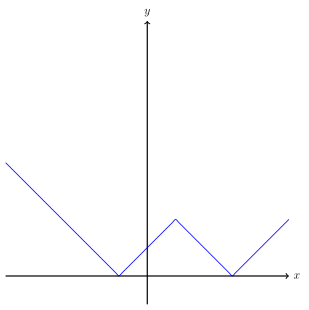
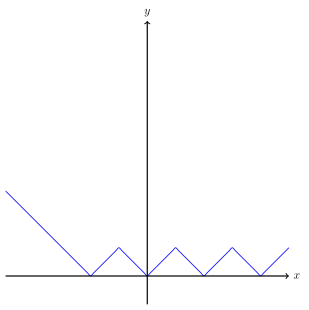
The function \(\f\) is defined by $$ \f(x)= \vert x-1 \vert\;, $$ where the domain is \({\bf R}\,\), the set of all real numbers. The function \(\g_n =\f^n\), with domain \({\bf R}\,\), so for example \(\g_3(x) = \f(\f(\f(x)))\,\). In separate diagrams, sketch graphs of \(\g_1\,\), \(\g_2\,\), \(\g_3\,\) and \(\g_4\,\). The function \(\h\) is defined by \[ \h(x) = |\sin {{{\pi}x} \over 2}|, \] where the domain is \({\bf R}\,\). Show that if \(n\) is even, \[ \int_0^n\,\big( \h(x)-\g_n(x)\big)\,\d x = \frac{2n}{\pi} -\frac{n}2\;. \]
Solution: