Problems
Filters
219 problems found
2011 Paper 2 Q8
The end \(A\) of an inextensible string \(AB\) of length \(\pi\) is attached to a point on the circumference of a fixed circle of unit radius and centre \(O\). Initially the string is straight and tangent to the circle. The string is then wrapped round the circle until the end \(B\) comes into contact with the circle. The string remains taut during the motion, so that a section of the string is in contact with the circumference and the remaining section is straight. Taking \(O\) to be the origin of cartesian coordinates with \(A\) at \((-1,0)\) and \(B\) initially at \((-1, \pi)\), show that the curve described by \(B\) is given parametrically by \[ x= \cos t + t\sin t\,, \ \ \ \ \ \ y= \sin t - t\cos t\,, \] where \(t\) is the angle shown in the diagram.
2011 Paper 2 Q10
A particle is projected from a point on a horizontal plane, at speed \(u\) and at an angle~\(\theta\) above the horizontal. Let \(H\) be the maximum height of the particle above the plane. Derive an expression for \(H\) in terms of \(u\), \(g\) and \(\theta\). A particle \(P\) is projected from a point \(O\) on a smooth horizontal plane, at speed \(u\) and at an angle~\(\theta\) above the horizontal. At the same instant, a second particle \(R\) is projected horizontally from \(O\) in such a way that \(R\) is vertically below \(P\) in the ensuing motion. A light inextensible string of length \(\frac12 H\) connects \(P\) and \(R\). Show that the time that elapses before the string becomes taut is \[ (\sqrt2 -1)\sqrt{H/g\,}\,. \] When the string becomes taut, \(R\) leaves the plane, the string remaining taut. Given that \(P\) and \(R\) have equal masses, determine the total horizontal distance, \(D\), travelled by \(R\) from the moment its motion begins to the moment it lands on the plane again, giving your answer in terms of \(u\), \(g\) and \(\theta\). Given that \(D=H\), find the value of \(\tan\theta\).
2010 Paper 1 Q12
A discrete random variable \(X\) takes only positive integer values. Define \(\E(X)\) for this case, and show that \[\E(X) =\sum^{\infty}_{n=1}\P\left(X\ge n \right).\] I am collecting toy penguins from cereal boxes. Each box contains either one daddy penguin or one mummy penguin. The probability that a given box contains a daddy penguin is \(p\) and the probability that a given box contains a mummy penguin is \(q\), where \(p\ne0\), \(q\ne0\) and \(p+q=1\,\). Let \(X\) be the number of boxes that I need to open to get at least one of each kind of penguin. Show that \(\P(X\ge 4)= p^{3}+q^{3}\), and that \[ \E(X)=\frac{1}{pq}-1.\, \] Hence show that \(\E(X)\ge 3\,\).
Solution: \[ \E[X] := \sum_{n=1}^{\infty} n \mathbb{P}(X=n) \] \begin{align*} && \sum^{\infty}_{n=1}\mathbb{P}\left(X\ge n \right) &= \sum^{\infty}_{n=1}\sum_{k=n}^\infty \mathbb{P}(X=k) \\ &&&= \sum_{k=1}^\infty k \cdot \mathbb{P}(X=k) \\ &&&= \E[X] \end{align*} \begin{align*} &&\mathbb{P}(X \geq 4) &= \mathbb{P}(\text{first 3 are daddies}) +\mathbb{P}(\text{first 3 are mummies}) \\ &&&= p^3 + q^3 \\ \Rightarrow && \E[X] &= \sum_{n=1}^{\infty} \mathbb{P}\left(X\ge n \right) \\ &&&= 1+\sum_{n=2}^{\infty} \left ( p^{n-1} + q^{n-1}\right) \\ &&&= 1+\frac{p}{1-p} + \frac{q}{1-q} \\ &&&= 1+\frac{p}q + \frac{q}p \\ &&&= 1+\frac{p^2+q^2}{pq} \\ &&&= 1+\frac{(p+q)^2-2pq}{pq} \\ &&&= \frac{1}{pq} -1 \\ &&& \underbrace{\geq}_{AM-GM} \frac{1}{4}-1 = 3 \end{align*}
2010 Paper 2 Q10
- In an experiment, a particle \(A\) of mass \(m\) is at rest on a smooth horizontal table. A particle \(B\) of mass \(bm\), where \(b >1\), is projected along the table directly towards \(A\) with speed \(u\). The collision is perfectly elastic. Find an expression for the speed of \(A\) after the collision in terms of \(b\) and \(u\), and show that, irrespective of the relative masses of the particles, \(A\) cannot be made to move at twice the initial speed of \(B\).
- In a second experiment, a particle \(B_1\) is projected along the table directly towards \(A\) with speed \(u\). This time, particles \(B_2\), \(B_3\), \(\ldots\,\), \(B_n\) are at rest in order on the line between \(B_1\) and \(A\). The mass of \(B_i\) (\(i=1\), \(2\), \(\ldots\,\), \(n\)) is \(\lambda^{n+1-i}m\), where \(\lambda>1\). All collisions are perfectly elastic. Show that, by choosing \(n\) sufficiently large, there is no upper limit on the speed at which \(A\) can be made to move. In the case \(\lambda=4\), determine the least value of \(n\) for which \(A\) moves at more than \(20u\). You may use the approximation \(\log_{10}2 \approx 0.30103\).
Solution:
- Since the collision is perfectly elastic, the speed of approach and separation are equal, ie \(v_B = v_A - u\) \begin{align*} \text{COM}: && bmu &= bm(v_A - u) + mv_A \\ \Rightarrow && (b+1)v_A &= 2bu \\ \Rightarrow && v_A &= \frac{2b}{b+1} u \end{align*} Since \(0 < \frac{b}{b+1} < 1\), the largest \(0 < v_A < 2u\)

- After the first collision with each \(B_i\) we will have \(\displaystyle v_{i+1} = \frac{2\lambda}{\lambda + 1}v_i\), ie \(\displaystyle v_{i+1} = \left (\frac{2\lambda}{\lambda + 1} \right)^i u\) and so \(\displaystyle v_A = \left (\frac{2\lambda}{\lambda + 1} \right)^n u\) which can be arbitrarily large. Suppose \(\lambda = 4\), then \begin{align*} && 20u &< v_A \\ &&&= \left (\frac{8}{5} \right)^n u \\ \Rightarrow && \log_{10} 20 < n \log_{10}(16/10) \\ && \log_{10} 2 + 1 < n 4\log_{10} 2 - n \\ \Rightarrow && n &> \frac{ \log_{10} 2 + 1}{ 4\log_{10} 2 - 1} \\ &&&\approx \frac{0.30103+1}{4 \times 0.30103 -1}\\ &&&= \frac{1.30103}{0.20412} \\ &&&>6 \end{align*} So \(n =7\) is the smallest possible
2010 Paper 2 Q13
Rosalind wants to join the Stepney Chess Club. In order to be accepted, she must play a challenge match consisting of several games against Pardeep (the Club champion) and Quentin (the Club secretary), in which she must win at least one game against each of Pardeep and Quentin. From past experience, she knows that the probability of her winning a single game against Pardeep is \(p\) and the probability of her winning a single game against Quentin is \(q\), where \(0 < p < q < 1\).
- The challenge match consists of three games. Before the match begins, Rosalind must choose either to play Pardeep twice and Quentin once or to play Quentin twice and Pardeep once. Show that she should choose to play Pardeep twice.
- In order to ease the entry requirements, it is decided instead that the challenge match will consist of four games. Now, before the match begins, Rosalind must choose whether to play Pardeep three times and Quentin once (strategy 1), or to play Pardeep twice and Quentin twice (strategy 2) or to play Pardeep once and Quentin three times (strategy 3). Show that, if \(q-p > \frac 12\), Rosalind should choose strategy 1. If \(q-p<\frac12\), give examples of values of \(p\) and \(q\) to show that strategy 2 can be better or worse than strategy 1.
Solution:
- If she plays \(P\) twice her probability is \(q(p^2+2p(1-p)) = qp(2-p)\). If she plays \(Q\) twice her probability is \(pq(2-q)\). Since \(p < q\) she should play \(P\) twice.
- Under strategy 1, her probability is \(q(p^3+3p^2(1-p)+3p(1-p)^2) = qp(p^2+3p-3p^2+3-6p+3p^2) = qp(3-3p+p^2)\) Under strategy 2 her probability is \((p^2+2p(1-p))(q^2+2q(1-q)) = pq(2-p)(2-q)\). Under strategy 3 her probability is \(qp(3-3q+q^2)\) \begin{align*} && q - p &> \frac12 \\ \Rightarrow && (2-p)(2-q) & < (2-p)(\frac32 - p) \\ &&&= 3 - \frac72p + p^2 \\ &&&< 3- 3p + p^2 \end{align*} Therefore Strategy 1 dominates if \(q-p > \frac12\). If \(p = \frac14, q = \frac12\) then \((2-p)(2-q) =\frac74 \cdot \frac32 = \frac{21}{8}\) and \(3-3p + p^2 = 3 - \frac34 + \frac1{16} = \frac{48-12+1}{16} = \frac{37}{16} < \frac{42}{16}\) so strategy 2 dominates. Notice that strategy 1 always dominates strategy 3 since \(f(x) = 3-3x+x^2\) is decreasing for \(x < 1.5\). If \(p = \frac14, q = \frac12\) then \((2-p)(2-q) =\frac74 \cdot \frac32 = \frac{21}{8}\) and \(3-3p + p^2 = 3 - \frac34 + \frac1{16} = \frac{48-12+1}{16} = \frac{37}{16} < \frac{42}{16}\) so strategy 2 dominates. For strategy 1 to dominate, we need \(3-3p+p^2 > (2-q)(2-p)\) or \(\frac{3-3p+p^2}{2-p} > 2-q\). When \(p = \frac12\) this is \(\frac{3-\frac32 + \frac14}{2 - \frac12} = \frac{\frac{7}{4}}{\frac{3}{2}} = \frac76 = 2-\frac{5}{6}\) so take any value of \(q\) larger than \(\frac56\).
2009 Paper 1 Q1
A {\em proper factor} of an integer \(N\) is a positive integer, not \(1\) or \(N\), that divides \(N\).
- Show that \(3^2\times 5^3\) has exactly \(10\) proper factors. Determine how many other integers of the form \(3^m\times5^n\) (where \(m\) and \(n\) are integers) have exactly 10 proper factors.
- Let \(N\) be the smallest positive integer that has exactly \(426\) proper factors. Determine \(N\), giving your answer in terms of its prime factors.
Solution:
- All factors of \(3^2 \times 5^3\) have factors of the form \(3^k \times 5^l\) where \(0 \leq k \leq 2\) and \(0 \leq l \leq 3\) therefore there are \(3\) possible values for \(k\) and \(4\) possible values for \(l\), which gives \(3 \times 4 = 12\) factors, which includes \(2\) factors we aren't counting, so \(10\) proper factors. By the same argument \(3^m \times 5^n\) has \((m+1) \times (n+1) - 2\) proper factors, so we want \((m+1) \times (n+1) = 12\), so we could have \begin{array}{cccc} \text{factor} & m+1 & n + 1 & m & n \\ 12 = 12 \times 1 & 12 & 1 & 11 & 0 \\ 12 = 6 \times 2 & 6& 2 & 5 & 1 \\ 12 = 4 \times 3 & 4& 3 & 3 & 2 \\ 12 = 3 \times 4 & 3& 4 & 2 & 3 \\ 12 = 2 \times 6 & 2& 6 & 1 & 5 \\ 12 = 1 \times 12 & 1& 12 & 0 & 11 \\ \end{array} So we could have \(3^{11}, 3^{5} \times 5^1 3^3 \times 5^2, 3^2 \times 5^3, 3^1 \times 5^5, 5^{11}\)
- Suppose \(N\) has \(426\) proper factors, then it has \(428 = 2^2 \times 107\) factors, so it will either factor as \(p^{427}\) or \(p_1^{106} p_2^{3}\) or \(p_1^{106} p_2 p_3\). Clearly the first will be very large, and we should have \(p_1 < p_2 < p_3\), so lets consider \(2^{106}\) with either \(3^3 = 27\) or \(3 \times = 15 < 27\). Therefore we should take \(2^{106} \times 3 \times 5\)
2009 Paper 1 Q5
A right circular cone has base radius \(r\), height \(h\) and slant length \(\ell\). Its volume \(V\), and the area \(A\) of its curved surface, are given by \[ V= \tfrac13 \pi r^2 h \,, \ \ \ \ \ \ \ A = \pi r\ell\,. \]
- Given that \(A\) is fixed and \(r\) is chosen so that \(V\) is at its stationary value, show that \(A^2 = 3\pi^2r^4\) and that \(\ell =\sqrt3\,r\).
- Given, instead, that \(V\) is fixed and \(r\) is chosen so that \(A\) is at its stationary value, find \(h\) in terms of \(r\).
Solution:
- Given \(A\) is fixed, and \(h^2 + r^2 = \ell^2\), we can look at \begin{align*} && V^2 &= \frac19 \pi^2 r^4 h^2 \\ &&&= \frac19\pi^2r^4(\ell^2 - r^2) \\ &&&= \frac19\pi^2 r^4\left (\frac{A^2}{\pi^2r^2} - r^2 \right) \\ &&&= \frac{A^2r^2 - \pi^2r^6}{9} \end{align*} Differentiating wrt to \(r\) we find that \(2rA^2-6\pi^2 r^5 = 0\) or hence \(A^2 = 3\pi^2 r^4 \Rightarrow A = \sqrt{3}\pi r^2\). Therefore \(\sqrt{3}\pi r^2 = \pi r \ell \Rightarrow \ell = \sqrt{3}r\).
- Supposing \(V\) is fixed, then \begin{align*} && A^2 &= \pi^2 r^2\ell^2 \\ &&&= \pi^2 r^2 (h^2+r^2) \\ &&&= \pi^2 r^2 \left ( \frac{9V^2}{\pi^2r^4} + r^2 \right) \\ &&&= 9V^2r^{-2} + \pi^2r^4 \\ \end{align*} Differentiating wrt to \(r\) we find \(-18V^2r^{-3} + 4\pi^2 r^3 = 0\) so \(V^2 = \frac{2\pi^2}{9}r^6\) or \(V = \frac{\sqrt{2}\pi}{3}r^3\), from which it follows: \(\frac{\sqrt{2}\pi}{3}r^3 = \frac13\pi r^2 h \Rightarrow h = \sqrt{2}r\)
2009 Paper 1 Q10
A triangular wedge is fixed to a horizontal surface. The base angles of the wedge are \(\alpha\) and \(\frac\pi 2-\alpha\). Two particles, of masses \(M\) and \(m\), lie on different faces of the wedge, and are connected by a light inextensible string which passes over a smooth pulley at the apex of the wedge, as shown in the diagram. The contacts between the particles and the wedge are smooth.
- Show that if \(\tan \alpha> \dfrac m M \) the particle of mass \(M\) will slide down the face of the wedge.
- Given that \(\tan \alpha = \dfrac{2m}M\), show that the magnitude of the acceleration of the particles is \[ \frac{g\sin\alpha}{\tan\alpha +2} \] and that this is maximised at \(4m^3=M^3\,\).
2009 Paper 2 Q11
A train consists of an engine and \(n\) trucks. It is travelling along a straight horizontal section of track. The mass of the engine and of each truck is \(M\). The resistance to motion of the engine and of each truck is \(R\), which is constant. The maximum power at which the engine can work is \(P\). Obtain an expression for the acceleration of the train when its speed is \(v\) and the engine is working at maximum power. The train starts from rest with the engine working at maximum power. Obtain an expression for the time \(T\) taken to reach a given speed \(V\), and show that this speed is only achievable if \[ P>(n+1)RV\,. \]
- In the case when \((n+1) RV/P\) is small, use the approximation \(\ln (1-x) \approx -x -\frac12 x^2\) (valid for small \( x \)) to obtain the approximation \[ PT\approx \tfrac 12 (n+1) MV^2\, \] and interpret this result.
- In the general case, the distance moved from rest in time \(T\) is \(X\). {\em Write down}, with explanation, an equation relating \(P\), \(T\), \(X\), \(M\), \(V\), \(R\) and \(n\) and hence show that \[ X= \frac{2PT - (n+1)MV^2}{2(n+1)R} \,. \]
2008 Paper 2 Q3
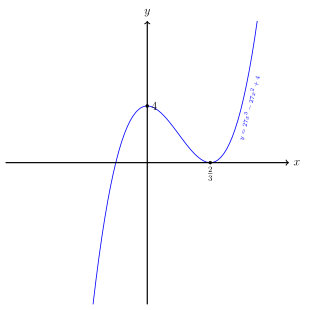
- Find the coordinates of the turning points of the curve \(y=27x^3-27x^2+4\). Sketch the curve and deduce that \(x^2(1-x)\le 4/27\) for all \(x\ge0\,\). Given that each of the numbers \(a\), \(b\) and \(c\) lies between \(0\) and \(1\), prove by contradiction that at least one of the numbers \(bc(1-a)\), \(ca(1-b)\) and \(ab(1-c)\) is less than or equal to \(4/27\).
- Given that each of the numbers \(p\) and \(q\) lies between \(0\) and \(1\), prove that at least one of the numbers \(p(1-q)\) and \(q(1-p)\) is less than or equal to \(1/4\).
Solution:
- \(\,\)
\begin{align*}
&& y & = 27x^3 - 27x^2 + 4 \\
\Rightarrow && \frac{\d y}{\d x} &= 81x^2 - 54x \\
\Rightarrow && x &= 0, \frac23 \\
\Rightarrow && (x,y) &= (0, 4), \left (\frac23, 0 \right)
\end{align*}
Since \(f(x) \geq 0\) for \(x \geq 0\) we must have \(27x^2(1-x) \leq 4 \Rightarrow x^2(1-x) \leq \frac{4}{27}\) Suppose for contradiction that \(bc(1-a) > \frac{4}{27}, ca(1-b) > \frac{4}{27}, ab(1-c) > \frac{4}{27}\) then taking the product we see \begin{align*} && \left ( \frac{4}{27} \right)^3 &< bc(1-a) \cdot ca(1-b) \cdot ab(1-c) \\ &&&= a^2(1-c) \cdot b^2(1-b) \cdot c^2(1-c) \leq \left ( \frac{4}{27}\right)^3 \end{align*} which is a contradiction.
- Notice that \(f(x) = x(1-x)\) has a turning point at \((\frac12, \frac14)\), and so \(f(x) \leq \frac14\). Suppose for contradiction that both \(p(1-q)\) and \(q(1-p)\) are larger than \(1/4\) \begin{align*} && \left ( \frac14 \right)^2 &< p(1-q) \cdot q(1-p) \\ &&&= p(1-p) \cdot q(1-q) \\ &&&\leq \left ( \frac14 \right)^2 \end{align*} which is a contradiction.
2008 Paper 2 Q4
A curve is given by \[x^2+y^2 +2axy = 1,\] where \(a\) is a constant satisfying \(0 < a < 1\). Show that the gradient of the curve at the point \(P\) with coordinates \((x,y)\) is \[\displaystyle - \frac {x+ay}{ax+y}\,,\] provided \(ax+y \ne0\). Show that \(\theta\), the acute angle between \(OP\) and the normal to the curve at \(P\), satisfies \[ \tan\theta = a\vert y^2-x^2\vert\;. \] Show further that, if \(\ \displaystyle \frac{\d \theta}{\d x}=0\) at \(P\), then:
- \(a(x^2+y^2)+2xy=0\,\);
- \((1+a)(x^2+y^2+2xy)=1\,\);
- \(\displaystyle \tan\theta = \frac a{\sqrt{1-a^2}}\,\).
Solution: \begin{align*} && 1 &= x^2 + y^2 + 2axy \\ \frac{\d}{\d x}: && 0 &= 2x + 2y \frac{\d y}{\d x} + 2ay + 2ax \frac{\d y}{\d x} \\ &&&= (2x+2ay) + \frac{\d y}{\d x} \left (2ax + 2y \right) \\ \Rightarrow && \frac{\d y}{\d x} &= -\frac{x+ay}{ax+y} \end{align*}
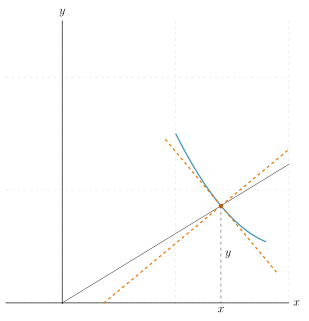
- \(\,\) \begin{align*} && \sec^2 \theta \frac{\d \theta}{\d x} &= \pm a \left (2y \frac{\d y}{\d x} - 2 x\right) \\ \Rightarrow && 0 &= a \left (y \cdot \frac{x+ay}{ax+y} + x \right) \\ &&&=a \left ( \frac{xy+ay^2+ax^2+xy}{ax+y} \right) \\ \Rightarrow && 0 &= a(x^2+y^2)+2xy \end{align*}
- \(\,\) \begin{align*} && 0 &=a(x^2+y^2)+2xy \\ && 1 &= x^2+y^2 + 2axy \\ \Rightarrow && 1 &= (a+1)(x^2+y^2) + (a+1)(2xy) \\ &&&= (a+1)(x^2+y^2+2xy) \end{align*}
- \(\,\) \begin{align*} && 1 &= (a+1)(x+y)^2 \\ \Rightarrow && x +y &= \pm \frac{1}{\sqrt{1+a}} \\ && 0 &=a(x^2+y^2)+2xy \\ && 1 &= x^2+y^2 + 2axy \\ \Rightarrow && 1 &= (1-a)(x^2+y^2) + (a-1)(2xy) \\ &&&= (1-a)(x^2+y^2-2xy)\\ \Rightarrow && x-y &= \pm \frac{1}{\sqrt{1-a}} \\ \Rightarrow && \frac{\d \theta}{\d x} &= a|y^2-x^2| \\ &&&= a|(y-x)(x+y)| \\ &&&= \frac{a}{\sqrt{1-a^2}} \end{align*}
2008 Paper 2 Q9
In this question, use \(g=10\,\)m\,s\(^{-2}\). In cricket, a fast bowler projects a ball at \(40\,\)m\,s\(^{-1}\) from a point \(h\,\)m above the ground, which is horizontal, and at an angle \(\alpha\) above the horizontal. The trajectory is such that the ball will strike the stumps at ground level a horizontal distance of \(20\,\)m from the point of projection.
- Determine, in terms of \(h\), the two possible values of \(\tan\alpha\). Explain which of these two values is the more appropriate one, and deduce that the ball hits the stumps after approximately half a second.
- State the range of values of \(h\) for which the bowler projects the ball below the horizontal.
- In the case \(h=2.5\), give an approximate value in degrees, correct to two significant figures, for \(\alpha\). You need not justify the accuracy of your approximation.
2008 Paper 2 Q13
Bag \(P\) and bag \(Q\) each contain \(n\) counters, where \(n\ge2\). The counters are identical in shape and size, but coloured either black or white. First, \(k\) counters (\(0\le k\le n\)) are drawn at random from bag \(P\) and placed in bag \(Q\). Then, \(k\) counters are drawn at random from bag \(Q\) and placed in bag \(P\).
- If initially \(n-1\) counters in bag \(P\) are white and one is black, and all \(n\) counters in bag \(Q\) are white, find the probability in terms of \(n\) and \(k\) that the black counter ends up in bag \(P\). Find the value or values of \(k\) for which this probability is maximised.
- If initially \(n-1\) counters in bag \(P\) are white and one is black, and \(n-1\) counters in bag \(Q\) are white and one is black, find the probability in terms of \(n\) and \(k\) that the black counters end up in the same bag. Find the value or values of \(k\) for which this probability is maximised.
Solution:
- \(\,\) \begin{align*} \mathbb{P}(\text{black counter in }P) &= \mathbb{P}(\text{black counter moves twice})+\mathbb{P}(\text{black counter doesn't move}) \\ &= \mathbb{P}(\text{black counter moves out})\mathbb{P}(\text{black counter moves back}) + (1-\mathbb{P}(\text{black counter moves out})) \\ &= \frac{k}n\cdot \frac{k}{n+k}+\frac{n-k}{n} \\ &= \frac{k^2+n^2-k^2}{n(n+k)} \\ &= \frac{n^2}{n(n+k)} = \frac{n}{n+k} \end{align*} This is maximised if \(k\) is as small as possibe, ie \(k = 0\) (ie it doesn't leave it's bag)
- \(\,\) \begin{align*} && \mathbb{P}(\text{both counters in same bag}) &= \mathbb{P}(\text{both in }P)+ \mathbb{P}(\text{both in }Q) \\ &&&= \mathbb{P}(B_P \to Q \to P, B_Q \to P)+\mathbb{P}(B_P \text{ stays}, B_Q \to P)+\mathbb{P}(B_P \to Q, \text{both stay}) \\ &&&= \frac{k}{n} \cdot \frac{k(k-1)}{(n+k)(n+k-1)} + \frac{n-k}{n} \frac{k}{n+k} + \frac{k}{n} \frac{n(n-1)}{(n+k)(n+k-1)} \\ &&&= \frac{(k^3-k^2)+(n-k)k(n+k-1)+kn(n-1)}{n(n+k)(n+k-1)}\\ &&&= \frac{2kn(n-1)}{n(n+k)(n+k-1)}\\ &&&= \frac{2k(n-1)}{(n+k)(n+k-1)} \end{align*} \begin{align*} && \frac{P_{k+1}}{P_k} &= \frac{2(k+1)(n-1)}{(n+k+1)(n+k)} \frac{(n+k)(n+k-1)}{2k(n-1)} \\ &&&= \frac{(k+1)(n+k-1)}{k(n+k+1)} \\ &&& \geq 1 \\ \Leftrightarrow && (k+1)(n+k-1) &\geq k(n+k+1) \\ \Leftrightarrow && n-1 &\geq k \\ \end{align*} Therefore this probability is increasing while \(k \leq n-1\), ie it's maximised \(k = n-1\) or \(k=n\)
2007 Paper 1 Q7
- The line \(L_1\) has vector equation $\displaystyle {\bf r} = \begin{pmatrix} 1 \\ 0 \\ 2 \end{pmatrix} + \lambda \begin{pmatrix} \hphantom{-} 2 \\ \hphantom{-} 2 \\ -3 \end{pmatrix} $. The line \(L_2\) has vector equation $\displaystyle {\bf r} = \begin{pmatrix} \hphantom{-} 4 \\ -2 \\ \hphantom{-} 9 \end{pmatrix} + \mu \begin{pmatrix} \hphantom{-} 1 \\ \hphantom{-} 2 \\ -2 \end{pmatrix} . $ Show that the distance \(D\) between a point on \(L_1\) and a point on \(L_2\) can be expressed in the form \[ D^2 = \left(3\mu -4 \lambda-5 \right)^2 + \left( \lambda -1 \right)^2 + 36\,. \] Hence determine the minimum distance between these two lines and find the coordinates of the points on the two lines that are the minimum distance apart.
- The line \(L_3\) has vector equation ${\bf r} = \begin{pmatrix} 2 \\ 3 \\ 5 \end{pmatrix} + \alpha \begin{pmatrix} 0 \\ 1 \\ 0 \end{pmatrix} . $ The line \(L_4\) has vector equation $ {\bf r} = \begin{pmatrix} \hphantom{-} 3 \\ \hphantom{-} 3 \\ -2 \end{pmatrix} + \beta \begin{pmatrix} \, 4k\\ 1-k \\ \!\!\! -3k \end{pmatrix} . $ Determine the minimum distance between these two lines, explaining geometrically the two different cases that arise according to the value of \(k\).
2007 Paper 1 Q11
A smooth, straight, narrow tube of length \(L\) is fixed at an angle of \(30^\circ\) to the horizontal. A~particle is fired up the tube, from the lower end, with initial velocity \(u\). When the particle reaches the upper end of the tube, it continues its motion until it returns to the same level as the lower end of the tube, having travelled a horizontal distance \(D\) after leaving the tube. Show that \(D\) satisfies the equation \[ 4gD^2 - 2 \sqrt{3} \left( u^2 - Lg \right)D - 3L \left( u^2 - gL \right) = 0 \] and hence that \[ \frac{{\rm d}D}{ {\rm d}L} = - \frac{ 2\sqrt{3}gD - 3(u^2-2gL)} { 8gD - 2 \sqrt{3} \left(u^2 - gL \right)}. \] The final horizontal displacement of the particle from the lower end of the tube is \(R\). Show that \(\dfrac{\d R}{\d L} = 0\) when \(2D = L \sqrt 3\), and determine, in terms of \(u\) and \(g\), the corresponding value of \(R\).