Problems
Filters
124 problems found
2003 Paper 2 Q5
The position vectors of the points \(A\,\), \(B\,\) and \(P\) with respect to an origin \(O\) are \(a{\bf i}\,\), \(b{\bf j}\,\) and \(l{\bf i}+m{\bf j}+n{\bf k}\,\), respectively, where \(a\), \(b\), and \(n\) are all non-zero. The points \(E\), \(F\), \(G\) and \(H\) are the midpoints of \(OA\), \(BP\), \(OB\) and \(AP\), respectively. Show that the lines \(EF\) and \(GH\) intersect. Let \(D\) be the point with position vector \(d{\bf k}\), where \(d\) is non-zero, and let \(S\) be the point of intersection of \(EF\) and \(GH.\) The point \(T\) is such that the mid-point of \(DT\) is \(S\). Find the position vector of \(T\) and hence find \(d\) in terms of \(n\) if \(T\) lies in the plane \(OAB\).
Solution: \(E = \langle \frac{a}{2}, 0,0 \rangle, F = \langle \frac{l}{2}, \frac{m+b}{2}, \frac{n}{2} \rangle, G = \langle 0, \frac{b}{2}, 0 \rangle, H = \langle \frac{a+l}{2}, \frac{m}{2}, \frac{n}{2} \rangle\) Note that the midpoint of \(EF\) and \(GH\) are both $\langle \frac{a+l}{4}, \frac{m+b}{4}, \frac{n}{4} \rangle$, so clearly they must intersect at this point. The vector we just found is \(S\), and \(\mathbf{t} = \mathbf{d} + 2(\mathbf{s}-\mathbf{d}) = 2\mathbf{s} - \mathbf{d}\). Therefore \(T = \langle \frac{a+l}{2}, \frac{m+b}{2}, \frac{n-2d}{2} \rangle\). If \(T\) lies in the plane \(OAB\) then \(n - 2d = 0\) ie \(d = \frac{n}{2}\)
2003 Paper 3 Q7
In the \(x\)--\(y\) plane, the point \(A\) has coordinates \((a\,,0)\) and the point \(B\) has coordinates \((0\,,b)\,\), where \(a\) and \(b\) are positive. The point \(P\,\), which is distinct from \(A\) and \(B\), has coordinates~\((s,t)\,\). \(X\) and \(Y\) are the feet of the perpendiculars from \(P\) to the \(x\)--axis and \(y\)--axis respectively, and \(N\) is the foot of the perpendicular from \(P\) to the line \(AB\,\). Show that the coordinates \((x\,,y)\) of \(N\) are given by \[ x= \frac {ab^2 -a(bt-as)}{a^2+b^2} \;, \ \ \ y = \frac{a^2b +b(bt-as)}{a^2+b^2} \;. \] Show that, if $\ds \ \left( \frac{t-b} s\right)\left( \frac t {s-a}\right) = -1\;\(, then \)N$ lies on the line \(XY\,\). Give a geometrical interpretation of this result.
2002 Paper 1 Q11
\(\,\)
2002 Paper 2 Q6
The lines \(l_1\), \(l_2\) and \(l_3\) lie in an inclined plane \(P\) and pass through a common point \(A\). The line \(l_2\) is a line of greatest slope in \(P\). The line \(l_1\) is perpendicular to \(l_3\) and makes an acute angle \(\alpha\) with \(l_2\). The angles between the horizontal and \(l_1\), \(l_2\) and \(l_3\) are \(\pi/6\), \(\beta\) and \(\pi/4\), respectively. Show that \(\cos\alpha\sin\beta = \frac12\,\) and find the value of \(\sin\alpha \sin\beta\,\). Deduce that \(\beta = \pi/3\,\). The lines \(l_1\) and \(l_3\) are rotated in \(P\) about \(A\) so that \(l_1\) and \(l_3\) remain perpendicular to each other. The new acute angle between \(l_1\) and \(l_2\) is \(\theta\). The new angles which \(l_1\) and \(l_3\) make with the horizontal are \(\phi\) and \(2\phi\), respectively. Show that \[ \tan^2\theta = \frac{3+\sqrt{13}}2\;. \]
2002 Paper 2 Q7
In 3-dimensional space, the lines \(m_1\) and \(m_2\) pass through the origin and have directions \(\bf i + j\) and \(\bf i +k \), respectively. Find the directions of the two lines \(m_3\) and \(m_4\) that pass through the origin and make angles of \(\pi/4\) with both \(m_1\) and \(m_2\). Find also the cosine of the acute angle between \(m_3\) and \(m_4\). The points \(A\) and \(B\) lie on \(m_1\) and \(m_2\) respectively, and are each at distance \(\lambda \surd2\) units from~\(O\). The points \(P\) and \(Q\) lie on \(m_3\) and \(m_4\) respectively, and are each at distance \(1\) unit from~\(O\). If all the coordinates (with respect to axes \(\bf i\), \(\bf j\) and \(\bf k\)) of \(A\), \(B\), \(P\) and \(Q\) are non-negative, prove that:
- there are only two values of \(\lambda\) for which \(AQ\) is perpendicular to \(BP\,\);
- there are no non-zero values of \(\lambda\) for which \(AQ\) and \(BP\) intersect.
2002 Paper 3 Q7
Given that \(\alpha\) and \(\beta\) are acute angles, show that \(\alpha + \beta = \tfrac{1}{2}\pi\) if and only if \(\cos^2 \alpha + \cos^2 \beta = 1\). In the \(x\)--\(y\) plane, the point \(A\) has coordinates \((0,s)\) and the point \(C\) has coordinates \((s,0)\), where \(s>0\). The point \(B\) lies in the first quadrant (\(x>0\), \(y>0\)). The lengths of \(AB\), \(OB\) and \(CB\) are respectively \(a\), \(b\) and \(c\). Show that \[ (s^2 +b^2 - a^2)^2 + (s^2 +b^2 -c^2)^2 = 4s^2b^2 \] and hence that \[ (2s^2 -a^2-c^2)^2 + (2b^2 -a^2-c^2)^2 =4a^2c^2\;. \] Deduce that $$ \l a - c \r^2 \le 2b^2 \le \l a + c \r^2\;. $$ %Show, %by considering the case \(a=1+\surd2\,\), \(b=c=1\,\), % that the condition \(\l \ast \r\,\) %is not sufficient to ensure that \(B\) lies in the first quadrant.
2002 Paper 3 Q8
Four complex numbers \(u_1\), \(u_2\), \(u_3\) and \(u_4\) have unit modulus, and arguments \(\theta_1\), \(\theta_2\), \(\theta_3\) and \(\theta_4\), respectively, with \(-\pi < \theta_1 < \theta_2 < \theta_3 < \theta_4 < \pi\). Show that \[ \arg \l u_1 - u_2 \r = \tfrac{1}{2} \l \theta_1 + \theta_2 -\pi \r + 2n\pi \] where \(n = 0 \hspace{4 pt} \mbox{or} \hspace{4 pt} 1\,\). Deduce that \[ \arg \l \l u_1 - u_2 \r \l u_4 - u_3 \r \r = \arg \l \l u_1 - u_4 \r \l u_3 - u_2 \r \r + 2n\pi \] for some integer \(n\). Prove that \[ | \l u_1 - u_2 \r \l u_4 - u_3 \r | + | \l u_1 - u_4 \r \l u_3 - u_2 \r | = | \l u_1 - u_3 \r \l u_4 - u_2 \r |\;. \]
2002 Paper 3 Q9
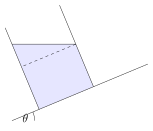
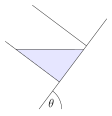
A tall container made of light material of negligible thickness has the form of a prism, with a square base of area \(a^2\). It contains a volume \(ka^3\) of fluid of uniform density. The container is held so that it stands on a rough plane, which is inclined at angle \(\theta\) to the horizontal, with two of the edges of the base of the container horizontal. In the case \(k > \frac12 \tan\theta\), show that the centre of mass of the fluid is at a distance \(x\) from the lower side of the container and at a distance \(y\) from the base of the container, where \[ \frac x a = \frac12 - \frac {\tan\theta}{12k}\;, \ \ \ \ \ \ \frac y a = \frac k 2 + \frac{\tan^2\theta}{24k}\;. \] Determine the corresponding coordinates in the case \(k < \frac12 \tan\theta\). The container is now released. Given that \(k < \frac12\), show that the container will topple if \(\theta >45^\circ\).
Solution:
2001 Paper 1 Q1
The points \(A\), \(B\) and \(C\) lie on the sides of a square of side 1 cm and no two points lie on the same side. Show that the length of at least one side of the triangle \(ABC\) must be less than or equal to \((\sqrt6 -\sqrt2)\) cm.
2001 Paper 2 Q3
The cuboid \(ABCDEFGH\) is such \(AE\), \(BF\), \(CG\), \(DH\) are perpendicular to the opposite faces \(ABCD\) and \(EFGH\), and \(AB =2, BC=1, AE={\lambda}\). Show that if \(\alpha\) is the acute angle between the diagonals \(AG\) and \(BH\) then $$\cos {\alpha} = |\frac {3-{\lambda}^2} {5+{\lambda}^2} |$$ Let \(R\) be the ratio of the volume of the cuboid to its surface area. Show that \(R<\frac{1}{3}\) for all possible values of \(\lambda\). Prove that, if \(R\ge \frac{1}{4}\), then \(\alpha \le \arccos \frac{1}{9}\).
Solution:

2001 Paper 3 Q6
The plane \[ {x \over a} + {y \over b} +{z \over c} = 1 \] meets the co-ordinate axes at the points \(A\), \(B\) and \(C\,\). The point \(M\) has coordinates \(\left( \frac12 a, \frac12 b, \frac 12 c \right)\) and \(O\) is the origin. Show that \(OM\) meets the plane at the centroid \(\left( \frac13 a, \frac13 b, \frac 13 c \right)\) of triangle \(ABC\). Show also that the perpendiculars to the plane from \(O\) and from \(M\) meet the plane at the orthocentre and at the circumcentre of triangle \(ABC\) respectively. Hence prove that the centroid of a triangle lies on the line segment joining its orthocentre and circumcentre, and that it divides this line segment in the ratio \(2 : 1\,\). [The orthocentre of a triangle is the point at which the three altitudes intersect; the circumcentre of a triangle is the point equidistant from the three vertices.]
Solution: The line \(OM\) is \(\lambda \begin{pmatrix} a \\ b \\ c \end{pmatrix}\), then we need \(1 = \lambda \begin{pmatrix} a \\ b \\ c \end{pmatrix} \cdot \begin{pmatrix} \frac1{a} \\ \frac1b \\ \frac1c \end{pmatrix} = 3 \lambda \Rightarrow \lambda = \frac13\). Therefore \(OM\) meets the plane at the centroid. The orthocentre is the point \(\mathbf{h}\) such that \((\mathbf{a}-\mathbf{b}) \cdot (\mathbf{c} - \mathbf{h}) = 0 \Leftrightarrow \begin{pmatrix} a \\ -b \\ 0 \end{pmatrix} \cdot \begin{pmatrix} -p \\ -q \\ c-r \end{pmatrix} \Leftrightarrow ap-bq = 0\) \((\mathbf{b}-\mathbf{c}) \cdot (\mathbf{a} - \mathbf{h}) = 0 \Leftrightarrow \begin{pmatrix} 0 \\ b \\ -c \end{pmatrix} \cdot \begin{pmatrix} a-p \\ -q \\ -r \end{pmatrix} \Leftrightarrow bq-cr = 0\) \((\mathbf{c}-\mathbf{a}) \cdot (\mathbf{b} - \mathbf{h}) = 0 \Leftrightarrow \begin{pmatrix} -a \\ 0 \\ c \end{pmatrix} \cdot \begin{pmatrix} -p \\ b-q \\ -r \end{pmatrix} \Leftrightarrow cr-ap = 0\) ie \(ap = bq = cr\) but this is clearly on the line \(\lambda \begin{pmatrix} \frac1{a} \\ \frac1b \\ \frac1c \end{pmatrix}\) therefore the orthocentre is on the perpendicular from \(O\) \(M-A = \begin{pmatrix} -a/2 \\ b/2 \\ c/2 \end{pmatrix}\) so \(|M-A|=|M-B|=|M-C|\) Also by pythagoras the point of intersection satisfies \(|M-P|^2 + |P-A|^2 = |M-A|^2\) so \(|P-A|^2 = |P-B|^2 = |P-C|^2\), therefore \(P\) is the circumcentre. Since all these points are in the same plane and \(OGM\) is a line, we have the points are in a line. Similar triangles gives the desired ratio
2001 Paper 3 Q10
Three ships \(A\), \(B\) and \(C\) move with velocities \({\bf v}_1\), \({\bf v}_2\) and \(\bf u\) respectively. The velocities of \(A\) and \(B\) relative to \(C\) are equal in magnitude and perpendicular. Write down conditions that \(\bf u\), \({\bf v}_1\) and \({\bf v}_2\) must satisfy and show that \[ \left| {\bf u} -{\textstyle\frac12} \l {\bf v}_1 + {\bf v}_2 \r \right|^2 = \left|{\textstyle\frac12} \l {\bf v}_1 - {\bf v}_2 \r \right|^2 \] and \[ \l {\bf u} -{\textstyle\frac12} \l {\bf v}_1 + {\bf v}_2 \r \r \cdot \l {\bf v}_1 - {\bf v}_2 \r = 0 \;. \] Explain why these equations determine, for given \({\bf v}_1\) and \({\bf v}_2\), two possible velocities for \(C\,\), provided \({\bf v}_1 \ne {\bf v}_2 \,\). If \({\bf v}_1\) and \({\bf v}_2\) are equal in magnitude and perpendicular, show that if \({\bf u} \ne {\bf 0}\) then \({\bf u} = {\bf v}_1 + {\bf v}_2\,\).
2000 Paper 1 Q5
Arthur and Bertha stand at a point \(O\) on an inclined plane. The steepest line in the plane through \(O\) makes an angle \(\theta\) with the horizontal. Arthur walks uphill at a steady pace in a straight line which makes an angle \(\alpha\) with the steepest line. Bertha walks uphill at the same speed in a straight line which makes an angle \(\beta\) with the steepest line (and is on the same side of the steepest line as Arthur). Show that, when Arthur has walked a distance \(d\), the distance between Arthur and Bertha is \(2d \vert\sin\frac12(\alpha-\beta)\vert\). Show also that, if \(\alpha\ne\beta\), the line joining Arthur and Bertha makes an angle \(\phi\) with the vertical, where \[ \cos\phi = \sin\theta \sin \frac12(\alpha+\beta). \]
2000 Paper 3 Q1
Sketch on the same axes the two curves \(C_1\) and \(C_2\), given by
Solution:

2000 Paper 3 Q3
Given that \(\alpha = \e^{\mathrm{i} \pi/3}\) , prove that \(1 + \alpha^2 = \alpha\). A triangle in the Argand plane has vertices \(A\), \(B\), and \(C\) represented by the complex numbers \(p\), \(q\alpha^2\) and \(- r\alpha\) respectively, where \(p\), \(q\) and \(r\) are positive real numbers. Sketch the triangle~\(ABC\). Three equilateral triangles \(ABL\), \(BCM\) and \(CAN\) (each lettered clockwise) are erected on sides \(AB\), \(BC\) and \(CA\) respectively. Show that the complex number representing \(N\) is \mbox{\(( 1 - \alpha) p- \alpha^2 r\)} and find similar expressions for the complex numbers representing \(L\) and \(M\). Show that lines \(LC\), \(MA\) and \(NB\) all meet at the origin, and that these three line segments have the common length \(p+q+r\).