Problems
Filters
66 problems found
1990 Paper 1 Q13
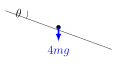
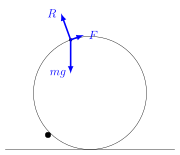
A rough circular cylinder of mass \(M\) and radius \(a\) rests on a rough horizontal plane. The curved surface of the cylinder is in contact with a smooth rail, parallel to the axis of the cylinder, which touches the cylinder at a height \(a/2\) above the plane. Initially the cylinder is held at rest. A particle of mass \(m\) rests in equilibrium on the cylinder, and the normal reaction of the cylinder on the particle makes an angle of \(\theta\) with the upward vertical. The particle is on the same side of the centre of the cylinder as the rail. The coefficient of friction between the cylinder and the particle and between the cylinder and the plane are both \(\mu\). Obtain the condition on \(\theta\) for the particle to rest in equilibrium. Show that, if the cylinder is released, equilibrium of both particle and cylinder is possible provided another inequality involving \(\mu\) and \(\theta\) (which should be found explicitly) is satisfied. Determine the largest possible value of \(\theta\) for equilibrium, if \(m=7M\) and \(\mu=0.75\).
Solution:

1989 Paper 1 Q13
A uniform ladder of mass \(M\) rests with its upper end against a smooth vertical wall, and with its lower end on a rough slope which rises upwards towards the wall and makes an angle of \(\phi\) with the horizontal. The acute angle between the ladder and the wall is \(\theta\). If the ladder is in equilibrium, show that \(N\) and \(F\), the normal reaction and frictional force at the foot of the ladder are given by \[ N=Mg\left(\cos\phi-\frac{\tan\theta\sin\phi}{2}\right), \] \[ F=Mg\left(\sin\phi+\frac{\tan\theta\cos\phi}{2}\right). \] If the coefficient of friction between the ladder and the slope is \(2\), and \(\phi=45^{\circ}\), what is the largest value of \(\theta\) for which the ladder can rest in equilibrium?
Solution: \begin{align*} \overset{\curvearrowleft}{X}: && 0&= \frac{l}{2} Mg\sin \theta - l R_1 \cos \theta \\ \Rightarrow && R_1 &= \frac12 \tan \theta Mg \\ \text{N2}(\uparrow): && 0 &= R\cos \phi +F \sin \phi - Mg \\ \text{N2}(\rightarrow):&& 0&=R_1-F \cos \phi + R \sin \phi \\ \Rightarrow && \frac12 \tan \theta Mg &= F \cos \phi- R \sin \phi \\ && Mg &= F \sin \phi +R \cos \phi \\ \Rightarrow && F &= Mg \left ( \sin \phi + \frac12 \tan \theta \cos \phi \right) \\ && N &= Mg \left (\cos \phi - \frac12 \tan \theta \sin \phi \right ) \end{align*} If \(\mu = 2\) and \(\phi = 45^{\circ}\), we must have \(F \leq 2 N\), so: \begin{align*} && Mg \left ( \sin \phi + \frac12 \tan \theta \cos \phi \right) &\leq 2 Mg \left (\cos \phi - \frac12 \tan \theta \sin \phi \right ) \\ \Rightarrow && 1 + \frac12 \tan \theta \leq 2-\tan \theta \\ \Rightarrow && \frac 32 \tan \theta \leq 1 \\ \Rightarrow && \tan \theta \leq \frac23 \\ \Rightarrow && \theta \leq \tan^{-1} \frac23 \end{align*}
1988 Paper 2 Q13
A librarian wishes to pick up a row of identical books from a shelf, by pressing her hands on the outer covers of the two outermost books and lifting the whole row together. The covers of the books are all in parallel vertical planes, and the weight of each book is \(W\). With each arm, the librarian can exert a maximum force of \(P\) in the vertical direction, and, independently, a maximum force of \(Q\) in the horizontal direction. The coefficient of friction between each pair of books and also between each hand and a book is \(\mu.\) Derive an expression for the maximum number of books that can be picked up without slipping, using this method. {[}You may assume that the books are thin enough for the rotational effect of the couple on each book to be ignored.{]}
Solution:

1988 Paper 3 Q11
A uniform ladder of length \(l\) and mass \(m\) rests with one end in contact with a smooth ramp inclined at an angle of \(\pi/6\) to the vertical. The foot of the ladder rests, on horizontal ground, at a distance \(l/\sqrt{3}\) from the foot of the ramp, and the coefficient of friction between the ladder and the ground is \(\mu.\) The ladder is inclined at an angle \(\pi/6\) to the horizontal, in the vertical plane containing a line of greatest slope of the ramp. A labourer of mass \(m\) intends to climb slowly to the top of the ladder.
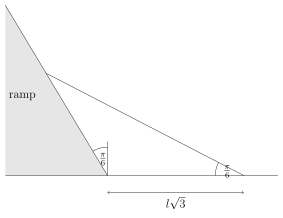
- Find the value of \(\mu\) if the ladder slips as soon as the labourer reaches the midpoint.
- Find the minimum value of \(\mu\) which will ensure that the labourer can reach the top of the ladder.
Solution:
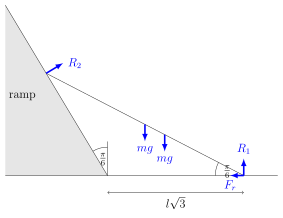
- \begin{align*} \text{N2}(\uparrow): && R_1 + R_2\sin(\frac{\pi}{6})-2mg &= 0 \\ \text{N2}(\rightarrow): && R_2 \cos (\frac{\pi}{6})-F_r &= 0 \\ \overset{\curvearrowleft}{X}: && lmg \cos \tfrac{\pi}{6} - l R_2 \cos \tfrac{\pi}{6} &= 0 \\ \\ \Rightarrow && R_2 &= mg \\ \Rightarrow && R_1 &= 2mg - \frac12mg \\ &&&=\frac32mg \\ \Rightarrow && \frac{\sqrt{3}}2mg - \mu\frac32mg &= 0 \\ \Rightarrow && \mu &= \frac{1}{\sqrt{3}} \end{align*}
- \begin{align*} \text{N2}(\uparrow): && R_1 + R_2\sin(\frac{\pi}{6})-2mg &= 0 \\ \overset{\curvearrowleft}{X}: && \frac12 lmg \cos \tfrac{\pi}{6}+xmg \cos \tfrac{\pi}{6} - l R_2 \cos \tfrac{\pi}{6} &= 0 \\ \\ \Rightarrow && R_2 &= mg(\frac{1}2+\frac{x}{l}) \\ \Rightarrow && R_1 &= 2mg - \frac12mg(\frac{1}2+\frac{x}{l}) \\ &&&=(\frac74 - \frac{x}{2l})mg \\ &&&\geq \frac{5}{4}mg\\ \text{N2}(\rightarrow): && R_2 \cos (\frac{\pi}{6})-\mu R_1& \leq 0 \\ \Rightarrow && \frac{\sqrt{3}}2mg - \mu\frac54mg &\leq 0 \\ \Rightarrow && \mu &\geq \frac{2\sqrt{3}}{5} \end{align*}
1987 Paper 2 Q11
A rough ring of radius \(a\) is fixed so that it lies in a plane inclined at an angle \(\alpha\) to the horizontal. A uniform heavy rod of length \(b(>a)\) has one end smoothly pivoted at the centre of the ring, so that the rod is free to move in any direction. It rests on the circumference of the ring, making an angle \(\theta\) with the radius to the highest point on the circumference. Find the relation between \(\alpha,\theta\) and the coefficient of friction, \(\mu,\) which must hold when the rod is in limiting equilibrium.
Solution:

- The mass of the rod
- The reaction where it meets the ring
- The friction at the ring
1987 Paper 3 Q13
A uniform rod, of mass \(3m\) and length \(2a,\) is freely hinged at one end and held by the other end in a horizontal position. A rough particle, of mass \(m\), is placed on the rod at its mid-point. If the free end is then released, prove that, until the particle begins to slide on the rod, the inclination \(\theta\) of the rod to the horizontal satisfies the equation \[ 5a\dot{\theta}^{2}=8g\sin\theta. \] The coefficient of friction between the particle and the rod is \(\frac{1}{2}.\) Show that, when the particle begins to slide, \(\tan\theta=\frac{1}{26}.\)
Solution: