Problems
Filters
86 problems found
1995 Paper 1 Q13
A scientist is checking a sequence of microscope slides for cancerous cells, marking each cancerous cell that she detects with a red dye. The number of cancerous cells on a slide is random and has a Poisson distribution with mean \(\mu.\) The probability that the scientist spots any one cancerous cell is \(p\), and is independent of the probability that she spots any other one.
- Show that the number of cancerous cells which she marks on a single slide has a Poisson distribution of mean \(p\mu.\)
- Show that the probability \(Q\) that the second cancerous cell which she marks is on the \(k\)th slide is given by \[ Q=\mathrm{e}^{-\mu p(k-1)}\left\{ (1+k\mu p)(1-\mathrm{e}^{-\mu p})-\mu p\right\} . \]
1995 Paper 2 Q12
Bread roll throwing duels at the Drones' Club are governed by a strict etiquette. The two duellists throw alternatively until one is hit, when the other is declared the winner. If Percy has probability \(p>0\) of hitting his target and Rodney has probability \(r>0\) of hitting his, show that, if Percy throws first, the probability that he beats Rodney is \[ \frac{p}{p+r-pr}. \] Algernon, Bertie and Cuthbert decide to have a three sided duel in which they throw in order \(\mathrm{A,B,C,A,B,C,}\ldots\) except that anyone who is hit must leave the game. Cuthbert always his target, Bertie hits his target with probability \(3/5\) and Algernon hits his target with probability \(2/5.\) Bertie and Cuthbert will always aim at each other if they are both still in the duel. Otherwise they aim at Algernon. With his first shot Algernon may aim at either Bertie or Cuthbert or deliberately miss both. Faced with only one opponent Algernon will aim at him. What are Algernon's changes of winning if he:
- sep}{3mm}
- \(\bf (i)\) hits Cuthbert with his first shot?
- \(\bf (ii)\) hits Bertie with his first shot?
- \(\bf (iii)\) misses with his first shot?
1995 Paper 3 Q13
A message of \(10^{k}\) binary digits is sent along a fibre optic cable with high probabilities \(p_{0}\) and \(p_{1}\) that the digits 0 and 1, respectively, are received correctly. If the probability of a digit in the original message being a 1 is \(\alpha,\) find the probability that the entire message is received correctly. Find the probability \(\beta\) that a randomly chosen digit in the message is received as a 1 and show that \(\beta=\alpha\) if, and only if \[ \alpha=\frac{q_{0}}{q_{1}+q_{0}}, \] where \(q_{0}=1-p_{0}\) and \(q_{1}=1-p_{1}.\) If this condition is satisfied and the received message consists entirely of zeros, what is the probability that it is correct? If now \(q_{0}=q_{1}=q\) and \(\alpha=\frac{1}{2},\) find the approximate value of \(q\) which will ensure that a message of one million binary digits has a fifty-fifty chance of being received entirely correctly. The probability of error \(q\) is proportional to the square of the length of the cable. Initially the length is such that the probability of a message of one million binary bits, among which 0 and 1 are equally likely, being received correctly is \(\frac{1}{2}.\) What would this probability become if a booster station were installed at its mid-point, assuming that the booster station re-transmits the received version of the message, and assuming that terms of order \(q^{2}\) may be ignored?
1994 Paper 1 Q12
There are 28 colleges in Cambridge, of which two (New Hall and Newnham) are for women only; the others admit both men and women. Seven women, Anya, Betty, Celia, Doreen, Emily, Fariza and Georgina, are all applying to Cambridge. Each has picked three colleges at random to enter on her application form.
- What is the probability that Anya's first choice college is single-sex?
- What is the probability that Betty has picked Newnham?
- What is the probability that Celia has picked at least one single-sex college?
- Doreen's first choice is Newnham. What is the probability that one of her other two choices is New Hall?
- Emily has picked Newnham. What is the probability that she has also picked New Hall?
- Fariza's first choice college is single-sex. What is the probability that she has also chosen the other single-sex college?
- One of Georgina's choices is a single-sex college. What is the probability that she has also picked the other single-sex college?
Solution:
- \(\frac{2}{28} = \frac{1}{14}\)
- \(1-\frac{27}{28}\frac{26}{27}\frac{25}{26} = \frac{3}{28}\)
- \(1 - \frac{26}{28}\frac{25}{27}\frac{24}{26} = \frac{13}{63}\)
- \(1-\frac{26}{27}\frac{25}{26} = \frac{2}{27}\)
- \(\frac{1}{27}\)
- There are \(\binom{2}{1} \binom{26}{2} + \binom{2}{2}\binom{26}{1}\) ways to choose at least one single sex college and \( \binom{2}{2}\binom{26}{1}\) ways to choose both, therefore \begin{align*} P &= \frac{ \binom{2}{2}\binom{26}{1}}{\binom21 \binom{26}2+ \binom{2}{2}\binom{26}{1}} \\ &= \frac{26}{2\cdot \frac{26\cdot25}{2}+26 }\\ &= \frac{1}{25+1} = \frac{1}{26} \end{align*}
1994 Paper 2 Q12
Calamity Jane sits down to play the game of craps with Buffalo Bill. In this game she rolls two fair dice. If, on the first throw, the sum of the dice is \(2,3\) or \(12\) she loses, while if it is \(7\) or \(11\) she wins. Otherwise Calamity continues to roll the dice until either the first sum is repeated, in which case she wins, or the sum is \(7\), in which case she loses. Find the probability that she wins on the first throw. Given that she throws more than once, show that the probability that she wins on the \(n\)th throw is \[ \frac{1}{48}\left(\frac{3}{4}\right)^{n-2}+\frac{1}{27}\left(\frac{13}{18}\right)^{n-2}+\frac{25}{432}\left(\frac{25}{36}\right)^{n-2}. \] Given that she throws more than \(m\) times, where \(m>1,\) what is the probability that she wins on the \(n\)th throw?
1994 Paper 3 Q12
In certain forms of Tennis two players \(A\) and \(B\) serve alternate games. Player \(A\) has probability \(p\low_{A}\) of winning a game in which she serves and \(p\low_{B}\) of winning a game in which player \(B\) serves. Player \(B\) has probability \(q\low_{B}=1-p\low_{B}\) of winning a game in which she serves and probability \(q\low_{A}=1-p\low_{A}\) of winning a game in which player \(A\) serves. In Shortened Tennis the first player to lead by 2 games wins the match. Find the probability \(P_{\text{short}}\) that \(A\) wins a Shortened Tennis match in which she serves first and show that it is the same as if \(B\) serves first. In Standard Tennis the first player to lead by 2 or more games after 4 or more games have been played wins the match. Show that the probability that the match is decided in 4 games is \[ p^{2}_Ap_{B}^{2}+q_{A}^{2}q_{B}^{2}+2(p\low_{A}p\low_{B}+q\low_{A}q\low_{B})(p\low_{A}q\low_{B}+q\low_{A}p\low_{B}). \] If \(p\low_{A}=p\low_{B}=p\) and \(q\low_{A}=q\low_{B}=q,\) find the probability \(P_{\text{stan}}\) that \(A\) wins a Standard Tennis match in which she serves first. Show that \[ P_{\text{stan}}-P_{\text{short}}=\frac{p^{2}q^{2}(p-q)}{p^{2}+q^{2}}. \]
1994 Paper 3 Q13
During his performance a trapeze artist is supported by two identical ropes, either of which can bear his weight. Each rope is such that the time, in hours of performance, before it fails is exponentially distributed, independently of the other, with probability density function \(\lambda\exp(-\lambda t)\) for \(t\geqslant0\) (and 0 for \(t < 0\)), for some \(\lambda > 0.\) A particular rope has already been in use for \(t_{0}\) hours of performance. Find the distribution for the length of time the artist can continue to use it before it fails. Interpret and comment upon your result. Before going on tour the artist insists that the management purchase two new ropes of the above type. Show that the probability density function of the time until both ropes fail is \[ \mathrm{f}(t)=\begin{cases} 2\lambda\mathrm{e}^{-\lambda t}(1-\mathrm{e}^{-\lambda t}) & \text{ if }t\geqslant0,\\ 0 & \text{ otherwise.} \end{cases} \] If each performance lasts for \(h\) hours, find the probability that both ropes fail during the \(n\)th performance. Show that the probability that both ropes fail during the same performance is \(\tanh(\lambda h/2)\).
Solution: This is the memoryless property of the exponential distribution so it has the same distribution as when \(t = 0\). Let \(T\) be the time the rope fails, then \begin{align*} && \mathbb{P}(T > t | T > t_0) &= \frac{\mathbb{P}(T > t)}{\mathbb{P}(T > t_0)} \\ &&&= \frac{e^{-\lambda t}}{e^{-\lambda t_0}} \\ &&&= e^{-\lambda(t-t_0)} \end{align*} This means that each rope (as long as it hasn't broken) can be considered "as good as new". Suppose \(T_1, T_2 \sim Exp(\lambda)\) are the time to failures for each rope, then \begin{align*} && \mathbb{P}(\max(T_1, T_2) < t) &= \mathbb{P}(T_1 < t, T_2 < t) \\ &&&= (1-e^{-\lambda t})^2 \\ \Rightarrow && f(t) &= 2(1-e^{-\lambda t}) \cdot (\lambda e^{-\lambda t}) \\ &&&= 2\lambda e^{-\lambda t}(1-e^{-\lambda t}) \end{align*} Therefore \(\max(T_1, T_2) \sim Exp(2\lambda)\) and the pdf is as described. \begin{align*} && \mathbb{P}(\text{both fail during the }n\text{th}) &= \left ( \int_{(n-1)h}^{nh} \lambda e^{-\lambda t} \d t \right)^2 \\ &&&=\left (\left [ -e^{-\lambda t}\right]_{(n-1)h}^{nh} \right)^2 \\ &&&= \left ( e^{-\lambda (n-1)h}( 1-e^{-\lambda h}) \right)^2 \\ &&&= e^{-2(n-1)h\lambda}(e^{-\lambda h}-1)^2 \\ \\ && \mathbb{P}(\text{both fail in same performance}) &= \sum_{n=1}^{\infty} \mathbb{P}(\text{both fail during the }n\text{th}) \\ &&&= \sum_{n=1}^{\infty}e^{-2(n-1)h\lambda}(e^{-\lambda h}-1)^2 \\ &&&= (e^{-\lambda h}-1)^2 \frac{1}{1-e^{-2h\lambda}} \\ &&&= \frac{e^{-\lambda h}-1}{1+e^{-h\lambda}} \\ &&&= \tanh(\lambda h/2) \end{align*}
1993 Paper 1 Q15
Captain Spalding is on a visit to the idyllic island of Gambriced. The population of the island consists of the two lost tribes of Frodox and the latest census shows that \(11/16\) of the population belong to the Ascii who tell the truth \(3/4\) of the time and \(5/16\) to the Biscii who always lie. The answers of an Ascii to each question (even if it is the same as one before) are independent. Show that the probability that an Ascii gives the same answer twice in succession to the same question is \(5/8\). Show that the probability that an Ascii gives the same answer twice is telling the truth is \(9/10.\) Captain Spalding addresses one of the natives as follows. \hspace{1.5em} \textsl{Spalding: }My good man, I'm afraid I'm lost. Should I go left or right to reach the nearest town?\nolinebreak \hspace{1.5em}\textsl{Native: }Left. \hspace{1.5em}\textsl{Spalding: }I am a little deaf. Should I go left or right to reach the nearest town? \hspace{1.5em}\textsl{Native (patiently): }Left. Show that, on the basis of this conversation, Captain Spalding should go left to try and reach the nearest town and that there is a probability \(99/190\) that this is the correct direction. The conversation resumes as follows. \hspace{1.5em}\textsl{Spalding: }I'm sorry I didn't quite hear that. Should I go left or right to reach the nearest town? \hspace{1.5em}\textsl{Native (loudly and clearly): }Left. Shouls Captain Spalding go left or right and why? Show that if he follows your advice the probability that this is the correct direction is \(331/628\).
1993 Paper 1 Q16
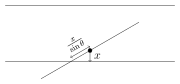
By making the substitution \(y=\cos^{-1}t,\) or otherwise, show that \[ \int_{0}^{1}\cos^{-1}t\,\mathrm{d}t=1. \] A pin of length \(2a\) is thrown onto a floor ruled with parallel lines equally spaced at a distance \(2b\) apart. The distance \(X\) of its centre from the nearest line is a uniformly distributed random variable taking values between \(0\) and \(b\) and the acute angle \(Y\) the pin makes with a direction perpendicular to the line is a uniformly distributed random variable taking values between \(0\) and \(\pi/2\). \(X\) and \(Y\) are independent. If \(X=x\) what is the probability that the pin crosses the line? If \(a < b\) show that the probability that the pin crosses a line for a general throw is \(\dfrac{2a}{\pi b}.\)
Solution: \begin{align*} && I &= \int_0^1 \cos^{-1} t \d t \\ \cos y = t: -\sin y \d y = \d t: &&&= \int_{\frac{\pi}{2}}^0 -y \sin y \d y \\ &&&= \int_0^{\pi/2} y \sin y \d y \\ &&&= \left [-y \cos y \right]_0^{\pi/2} + \int_0^{\pi/2} \cos y \d y \\ &&&= \left [ \sin y \right]_0^{\pi/2} = 1 \end{align*}
1993 Paper 2 Q16
At the terminus of a bus route, passengers arrive at an average rate of 4 per minute according to a Poisson process. Each minute, on the minute, one bus arrives with probability \(\frac{1}{4},\) independently of the arrival of passengers or previous buses. Just after eight o'clock there is no-one at the bus stop.
- What is the probability that the first bus arrives at \(n\) minutes past 8?
- If the first bus arrives at 8:05, what is the probability that there are \(m\) people waiting for it?
- Each bus can take 25 people and, since it is the terminus, the bus arrive empty. Explain carefully how you would calculate, to two significant figures, the probability that when the first bus arrives it is unable to pick up all the passengers. Your method should need the use of a calculator and standard tables only. There is no need to carry out the calculation.
1993 Paper 3 Q16
The time taken for me to set an acceptable examination question it \(T\) hours. The distribution of \(T\) is a truncated normal distribution with probability density \(\f\) where \[ \mathrm{f}(t)=\begin{cases} \dfrac{1}{k\sigma\sqrt{2\pi}}\exp\left(-\dfrac{1}{2}\left(\dfrac{t-\sigma}{\sigma}\right)^{2}\right) & \mbox{ for }t\geqslant0\\ 0 & \mbox{ for }t<0. \end{cases} \] Sketch the graph of \(\f(t)\). Show that \(k\) is approximately \(0.841\) and obtain the mean of \(T\) as a multiple of \(\sigma\). Over a period of years, I find that the mean setting time is 3 hours.
- Find the approximate probability that none of the 16 questions on next year's paper will take more than 4 hours to set.
- Given that a particular question is unsatisfactory after 2 hours work, find the probability that it will still be unacceptable after a further 2 hours work.
1992 Paper 3 Q15
A goat \(G\) lies in a square field \(OABC\) of side \(a\). It wanders randomly round its field, so that at any time the probability of its being in any given region is proportional to the area of this region. Write down the probability that its distance, \(R\), from \(O\) is less than \(r\) if \(0 < r\leqslant a,\) and show that if \(r\geqslant a\) the probability is \[ \left(\frac{r^{2}}{a^{2}}-1\right)^{\frac{1}{2}}+\frac{\pi r^{2}}{4a^{2}}-\frac{r^{2}}{a^{2}}\cos^{-1}\left(\frac{a}{r}\right). \] Find the median of \(R\) and probability density function of \(R\). The goat is then tethered to the corner \(O\) by a chain of length \(a\). Find the conditional probability that its distance from the fence \(OC\) is more than \(a/2\).
1992 Paper 3 Q16
The probability that there are exactly \(n\) misprints in an issue of a newspaper is \(\mathrm{e}^{-\lambda}\lambda^{n}/n!\) where \(\lambda\) is a positive constant. The probability that I spot a particular misprint is \(p\), independent of what happens for other misprints, and \(0 < p < 1.\)
- If there are exactly \(m+n\) misprints, what is the probability that I spot exactly \(m\) of them?
- Show that, if I spot exactly \(m\) misprints, the probability that I have failed to spot exactly \(n\) misprints is \[ \frac{(1-p)^{n}\lambda^{n}}{n!}\mathrm{e}^{-(1-p)\lambda}. \]
Solution:
- \(\binom{m+n}{m} p^m (1-p)^n\)
- \(\,\) \begin{align*} \mathbb{P}(\text{failed to spot }n\text{ misprints}|\text{spotted }m\text{ misprints}) &= \frac{\mathbb{P}(\text{failed to spot }n\text{ misprints and spotted }m\text{ misprints}) }{\mathbb{P}(\text{spotted }m\text{ misprints})} \\ &= \frac{\binom{m+n}{n}p^m(1-p)^n e^{-\lambda} \lambda^{m+n}/(n+m)!}{\sum_{k=0}^{\infty} \binom{m+k}{k}p^m(1-p)^k e^{-\lambda} \lambda^{m+k}/(n+k)!} \\ &= \frac{\binom{m+n}{n}(1-p)^n \lambda^{n}/(n+m)!}{\sum_{k=0}^{\infty} \binom{m+k}{k}(1-p)^k \lambda^{k}/(n+k)!} \\ &= \frac{(1-p)^n \lambda^{n}/n!}{\sum_{k=0}^{\infty} (1-p)^k \lambda^{k}/k!} \\ &= \frac{(1-p)^n\lambda^n}{n!} e^{-(1-p)\lambda} \end{align*} Alternatively, given the missed misprints and spotted misprints are independent, we can view them as both following \(Po(p\lambda)\) and \(Po((1-p)\lambda)\) and so we obtain exactly this result, without calculation.
1991 Paper 1 Q16
At any instant the probability that it is safe to cross a busy road is \(0.1\). A toad is waiting to cross this road. Every minute she looks at the road. If it is safe, she will cross; if it is not safe, she will wait for a minute before attempting to cross again. Find the probability that she eventually crosses the road without mishap. Later on, a frog is also trying to cross the same road. He also inspects the traffic at one minute intervals and crosses if it is safe. Being more impatient than the toad, he may also attempt to cross when it is not safe. The probability that he will attempt to cross when it is not safe is \(n/3\) if \(n\leqslant3,\) where \(n\) minutes have elapsed since he firrst inspected the road. If he attempts to cross when it is not safe, he is run over with probability \(0.8,\) but otherwise he reaches the other side safely. Find the probability that he eventually crosses the road without mishap. What is the probability that both reptiles safely cross the road with the frog taking less time than the toad? If the frog has not arrived at the other side 2 minutes after he began his attempt to cross, what is the probability that the frog is run over (at some stage) in his attempt to cross? \textit{[Once moving, the reptiles spend a negligible time on their attempt to cross the road.]}
Solution: Since the toad never crosses when it's not safe, she is certain to cross. (Probability she hasn't crossed after the \(n\)th minute is \(0.9^n \to 0\)). \begin{array}{c|c|c|c|c|c|c|c} \text{will try dangerously} & \text{is safe} & \text{has tried} & \text{tries safely} & \text{tries unsafely} & \text{succeeds} & \text{succeeds unsafely} & \text{fails} \\ \hline 0 & 0.1 & 0 & 0.1 & 0 & 0.1 & 0 & 0\\ \frac13 & 0.1 & 0.1 & 0.09 & 0.27 & 0.144 & 0.054 & 0.216\\ \frac23 & 0.1 & 0.46 & 0.054 & 0.324 & 0.1188 & 0.0648 & 0.2592\\ 1 & 0.1 & 0.838 & 0.0162 & 0.1458 & 0.04536 & 0.02916 & 0.11664\\ \hline & & & & & 0.40816 & 0.14796 & \\ \hline \end{array} So \(\mathbb{P}(\text{frog crosses safely}) = 0.40816\) and \(\mathbb{P}(\text{frog beats toad across}) = 0.14796\). \begin{align*} \mathbb{P}(\text{frog run over} | \text{frog not crossed after 2 minutes}) &= \frac{\mathbb{P}(\text{frog run over and frog not crossed after 2 minutes})}{\mathbb{P}(\text{frog not crossed after 2 minutes})} \\ &= \frac{\mathbb{P}(\text{frog run over within 2 minutes})}{\mathbb{P}(\text{frog not crossed after 2 minutes})} \\ &= \frac{\mathbb{P}(\text{frog run over within 2 minutes})}{1-\mathbb{P}(\text{crossed after 2 minutes})} \\ &= \frac{0.216+0.2592}{1-0.3628} \\ &= 0.7457\ldots \end{align*}
1990 Paper 1 Q15
A coin has probability \(p\) (\(0 < p < 1\)) of showing a head when tossed. Give a careful argument to show that the \(k\)th head in a series of consecutive tosses is achieved after exactly \(n\) tosses with probability \[ \binom{n-1}{k-1}p^{k}(1-p)^{n-k}\qquad(n\geqslant k). \] Given that it took an even number of tosses to achieve exactly \(k-1\) heads, find the probability that exactly \(k\) heads are achieved after an even number of tosses. If this coin is tossed until exactly 3 heads are obtained, what is the probability that exactly 2 of the heads occur on even-numbered tosses?
Solution: We must have a sequence consisting of \(\underbrace{HTT\cdots TH}_{k-1\text{ heads and }n-k\text{ tails}}\underbrace{H}_{k\text{th head}}\). There are \(\binom{n-1}{k-1}\) ways to chose how to place the \(k-1\) heads in the first \(n-1\) flips, and each sequence has probability \(p^{k-1}(1-p)^{n-k}p\) which gives a probability of \(\displaystyle \binom{n-1}{k-1} p^k (1-p)^{n-k}\). Given that it took an even number of tosses to achieve \(k-1\) heads, this is equivalent to the problem of what is the probability that the first head occurs on an even flip, ie \begin{align*} \mathbb{P}(\text{even flip}) &= \mathbb{P}(2\text{nd flip}) +\mathbb{P}(4\text{th flip}) +\mathbb{P}(6\text{th flip}) + \cdots \\ &= (1-p)p + (1-p)^3p + (1-p)^5p + \cdots \\ &= (1-p)p \left ( \sum_{r=0}^\infty (1-p)^{2r}\right) \\ &= \frac{p(1-p)}{1-(1-p)^2} \\ &= \frac{p(1-p)}{2p-p^2} \\ &= \frac{1-p}{2-p} \end{align*} The ways to achieve \(2\) heads on even tosses are \(EEO\), \(EOE\), \(OEE\). The probability of going from \(O\) to \(E\) is the same as the initial probability of an \(O\) flip, etc. Therefore \begin{align*} \mathbb{P}(EEO) &=\left( \frac{1-p}{2-p} \right)^2 \left ( 1- \frac{1-p}{2-p} \right) \\ &= \left( \frac{1-p}{2-p} \right)^2 \left ( \frac{1}{2-p} \right) \\ \mathbb{P}(EOE) &= \left( \frac{1-p}{2-p} \right) \left ( \frac{1}{2-p} \right)^2 \\ \mathbb{P}(OEE) &= \left ( \frac{1}{2-p} \right)^2 \left( \frac{1-p}{2-p} \right)\\ \mathbb{P}(2 \text{ heads on even tosses}) &= \frac{(1-p)^2 + 2(1-p)}{(2-p)^3} \\ &= \frac{(1-p)(2-p)}{(2-p)^3} \\ &= \frac{1-p}{(2-p)^2} \end{align*}