Problems
Filters
78 problems found
1992 Paper 3 Q8
Show that \[ \sin(2n+1)\theta=\sin^{2n+1}\theta\sum_{r=0}^{n}(-1)^{n-r}\binom{2n+1}{2r}\cot^{2r}\theta, \] where \(n\) is a positive integer. Deduce that the equation \[ \sum_{r=0}^{n}(-1)^{r}\binom{2n+1}{2r}x^{r}=0 \] has roots \(\cot^{2}(k\pi/(2n+1))\) for \(k=1,2,\ldots,n\). Show that
- sep}{3mm}
- \(\bf (i)\) \({\displaystyle \sum_{k=1}^{n}\cot^{2}\left(\frac{k\pi}{2n+1}\right)=\frac{n(2n-1)}{3}},\)
- \(\bf (ii)\) \({\displaystyle \sum_{k=1}^{n}\tan^{2}\left(\frac{k\pi}{2n+1}\right)=n(2n+1)},\)
- \(\bf (iii)\) \({\displaystyle \sum_{k=1}^{n}\mathrm{cosec}^{2}\left(\frac{k\pi}{2n+1}\right)=\frac{2n(n+1)}{3}}.\)
1991 Paper 1 Q3
A path is made up in the Argand diagram of a series of straight line segments \(P_{1}P_{2},\) \(P_{2}P_{3},\) \(P_{3}P_{4},\ldots\) such that each segment is \(d\) times as long as the previous one, \((d\neq1)\), and the angle between one segment and the next is always \(\theta\) (where the segments are directed from \(P_{j}\) towards \(P_{j+1}\), and all angles are measured in the anticlockwise direction). If \(P_{j}\) represents the complex number \(z_{j},\) express \[ \frac{z_{n+1}-z_{n}}{z_{n}-z_{n-1}} \] as a complex number (for each \(n\geqslant2\)), briefly justifying your answer. If \(z_{1}=0\) and \(z_{2}=1\), obtain an expression for \(z_{n+1}\) when \(n\geqslant2\). By considering its imaginary part, or otherwise, show that if \(\theta=\frac{1}{3}\pi\) and \(d=2\), then the path crosses the real axis infinitely often.
Solution: \begin{align*} && | \frac{z_{n+1}-z_{n}}{z_{n}-z_{n-1}} | &= d \\ && \arg \left ( \frac{z_{n+1}-z_{n}}{z_{n}-z_{n-1}} \right) &= \arg (z_{n+1}-z_{n}) - \arg(z_{n}-z_{n-1}) \\ &&&= \theta \\ \Rightarrow && \frac{z_{n+1}-z_{n}}{z_{n}-z_{n-1}} &= d e^{i \theta} \end{align*} \begin{align*} && z_1 &= 0 \\ && z_2 &= 1 \\ && \frac{z_3-z_2}{z_2-z_1} &= de^{i \theta} \\ \Rightarrow && z_3 &= de^{i \theta} + 1 \\ && \frac{z_4-z_3}{z_3-z_2} &= de^{i \theta} \\ \Rightarrow && z_4 &= (d e^{i \theta})^2 + d e^{i \theta} + 1\\ \Rightarrow && z_{n+1} &= \frac{(de^{i \theta})^{n}-1}{de^{i \theta}-1} \end{align*} If \(d = 2, \theta = \tfrac13 \pi\), then, \(2e^{i \tfrac13 \pi} = 1 + \sqrt{3}i\) \begin{align*} \textrm{Im}(z_{n+1})) &= \textrm{Im} \left ( \frac{(2e^{i \tfrac13 \pi})^{n}-1}{2e^{i \tfrac13 \pi}-1}\right) \\ &= \textrm{Im} \left ( \frac{(2e^{i \tfrac13 \pi})^{n}-1}{\sqrt{3}i}\right) \\ &= -\frac{1}{\sqrt{3}}\textrm{Re} \left (2^n e^{i \frac{n}{3} \pi} \right) + \frac{1}{\sqrt{3}} \end{align*} Which clearly changes sign infinitely many times, ie crosses the origin infinitely many times.
1991 Paper 3 Q2
The distinct points \(P_{1},P_{2},P_{3},Q_{1},Q_{2}\) and \(Q_{3}\) in the Argand diagram are represented by the complex numbers \(z_{1},z_{2},z_{3},w_{1},w_{2}\) and \(w_{3}\) respectively. Show that the triangles \(P_{1}P_{2}P_{3}\) and \(Q_{1}Q_{2}Q_{3}\) are similar, with \(P_{i}\) corresponding to \(Q_{i}\) (\(i=1,2,3\)) and the rotation from \(1\) to \(2\) to \(3\) being in the same sense for both triangles, if and only if \[ \frac{z_{1}-z_{2}}{z_{2}-z_{3}}=\frac{w_{1}-w_{2}}{w_{1}-w_{3}}. \] Verify that this condition may be written \[ \det\begin{pmatrix}z_{1} & z_{2} & z_{3}\\ w_{1} & w_{2} & w_{3}\\ 1 & 1 & 1 \end{pmatrix}=0. \]
- Show that if \(w_{i}=z_{i}^{2}\) (\(i=1,2,3\)) then triangle \(P_{1}P_{2}P_{3}\) is not similar to triangle \(Q_{1}Q_{2}Q_{3}.\)
- Show that if \(w_{i}=z_{i}^{3}\) (\(i=1,2,3\)) then triangle \(P_{1}P_{2}P_{3}\) is similar to triangle \(Q_{1}Q_{2}Q_{3}\) if and only if the centroid of triangle \(P_{1}P_{2}P_{3}\) is the origin. {[}The centroid of triangle \(P_{1}P_{2}P_{3}\) is represented by the complex number \(\frac{1}{3}(z_{1}+z_{2}+z_{3})\).{]}
- Show that the triangle \(P_{1}P_{2}P_{3}\) is equilateral if and only if \[ z_{2}z_{3}+z_{3}z_{1}+z_{1}z_{2}=z_{1}^{2}+z_{2}^{2}+z_{3}^{2}. \]
1990 Paper 1 Q2
Let \(\omega=\mathrm{e}^{2\pi\mathrm{i}/3}.\) Show that \(1+\omega+\omega^{2}=0\) and calculate the modulus and argument of \(1+\omega^{2}.\) Let \(n\) be a positive integer. By evaluating \((1+\omega^{r})^{n}\) in two ways, taking \(r=1,2\) and \(3\), or otherwise, prove that \[ \binom{n}{0}+\binom{n}{3}+\binom{n}{6}+\cdots+\binom{n}{k}=\frac{1}{3}\left(2^{n}+2\cos\left(\frac{n\pi}{3}\right)\right), \] where \(k\) is the largest multiple of \(3\) less than or equal to \(n\). Without using a calculator, evaluate \[ \binom{25}{0}+\binom{25}{3}+\cdots+\binom{25}{24} \] and \[ \binom{24}{2}+\binom{24}{5}+\cdots+\binom{24}{23}\,. \] {[}\(2^{25}=33554432.\){]}
Solution: Since \(\omega^3 = 1\) and \(\omega \neq 1\) we must have that \((\omega-1)(1 + \omega + \omega^2) = 0\) but by dividing by \(\omega - 1\) we obtain the desired result. \(1+\omega^2 = -\omega\) so \(|1 + \omega^2| = |-\omega| = 1\) and \(\arg ( 1 + \omega^2) = \arg(-\omega) = \pi - \frac{2\pi}{3} = \frac{\pi}{3}\) \begin{align*} && (1 + 1)^n &= \sum_{k=0}^n \binom{n}{k}\\ && (1+ \omega)^n &= \sum_{k=0}^n \binom{n}{k} \omega^{k} \\ && (1+ \omega^2)^n &= \sum_{k=0}^n \binom{n}{k} \omega^{2k} \\ \Rightarrow && 2^n+(-\omega^2)^n + (-\omega)^n &= \sum_{k=0, k \equiv 0 \pmod{3}}^n (1+1+1)\binom{n}{k} + \sum_{k=0, k \equiv 1 \pmod{3}}^n (1 + \omega + \omega^2) \binom{n}{k} + \sum_{k=0, k \equiv 2 \pmod{3}}^n (1 + \omega^2 + \omega) \binom{n}{k} \\ \Rightarrow && 2^n +((-\omega)^n)^{-1}+(-\omega)^n &= \sum_{k=0, k \equiv 0 \pmod{3}}^n \binom{n}{k} \end{align*} \(2^n +((-\omega)^n)^{-1}+(-\omega)^n = 2^n + 2 \textrm{Re}(-\omega^n) = 2^n + 2 \cos \frac{n\pi}{3}\) Therefore our answer follows. \begin{align*} \binom{25}{0}+\binom{25}{3}+\cdots+\binom{25}{24} &= \frac13 \l 2^{25} + 2\cos (\frac{25 \pi}{3}) \r \\ &= \frac13 \l 2^{25} + 2 \cos \frac{\pi}{3} \r \\ &= \frac13 \l 2^{25} + 1 \r \\ &= \frac13 \l (4096 \cdot 4096 \cdot 2) + 1 \r \\ &= 11\,184\,811 \end{align*} Notice that \(S_2 = \binom{24}{2} + \cdots +\binom{24}{23} = \binom{24}{1} + \cdots + \binom{24}{22} = S_1\) and \(S_0 = \binom{24}0 + \cdots + \binom{24}{21} = \frac13 \l 2^{24} + 2 \r\) Therefore since \(S_0 + 2 \cdot S_2 = 2^{24}\) we must have \begin{align*} S_2 &= \frac12 \l 2^{24} - \frac13 \l 2^{24} + 2 \r \r \\ &= \frac13 \l 2^{24} - 1 \r \\ &= \frac13 \l 16777216- 1 \r \\ &= \frac13 \cdot 16777215 \\ &= 5\,592\,405 \end{align*}
1990 Paper 2 Q5
The distinct points \(L,M,P\) and \(Q\) of the Argand diagram lie on a circle \(S\) centred on the origin and the corresponding complex numbers are \(l,m,p\) and \(q\). By considering the perpendicular bisectors of the chords, or otherwise, prove that the chord \(LM\) is perpendicular to the chord \(PQ\) if and only if \(lm+pq=0.\) Let \(A_{1},A_{2}\) and \(A_{3}\) be three distinct points on \(S\). For any given point \(A_{1}'\) on \(S\), the points \(A_{2}',A_{3}'\) and \(A_{1}''\) are chosen on \(S\) such that \(A_{1}'A_{2}',A_{2}'A_{3}'\) and \(A_{3}'A_{1}''\) are perpendicular to \(A_{1}A_{2},A_{2}A_{3}\) and \(A_{3}A_{1},\) respectively. Show that for exactly two positions of \(A_{1}',\) the points \(A_{1}'\) and \(A_{1}''\) coincide. If, instead, \(A_{1},A_{2},A_{3}\) and \(A_{4}\) are four given distinct points on \(S\) and, for any given point \(A_{1}',\) the points \(A_{2}',A_{3}',A_{4}'\) and \(A_{1}''\) are chosen on \(S\) such that \(A_{1}'A_{2}',A_{2}'A_{3}',A_{3}'A_{4}'\) and \(A_{4}'A_{1}''\) are respectively perpendicular to \(A_{1}A_{2},A_{2}A_{3},A_{3}A_{4}\) and \(A_{4}A_{1},\) show that \(A_{1}'\) coincides with \(A_{1}''.\) Give the corresponding result for \(n\) distinct points on \(S\).
Solution: The perpendicular bisector of the chords runs through the origin, therefore \(LM\) is perpendicular to \(PQ\) if and only if \(\frac{l+m}{2}\) is perpendicular to \(\frac{p+q}{2}\), ie \begin{align*} && (l+m) &= it (p+q) \\ \Leftrightarrow && \frac{l+m}{p+q} & \in i \mathbb{R} \\ \Leftrightarrow && 0 &= \frac{l+m}{p+q} + \frac{l^*+m^*}{p^*+q^*} \\ &&&= \frac{l+m}{p+q} + \frac{\frac{r^2}{l}+\frac{r^2}{m}}{\frac{r^2}{p}+\frac{r^2}{q}} \\ &&&=\frac{l+m}{p+q} + \frac{l+m}{p+q} \frac{pq}{lm} \\ &&&= \frac{l+m}{p+q} \left ( \frac{lm+pq}{lm} \right) \end{align*} Therefore as long as \(l+m, p+q \neq 0\) \(lm+pq = 0\) is equivalent to the chords being perpendicular. In the case where (say) \(l,m\) is a diameter, then the condition for the chords to be perpendicular is that \(p,q\) is also a diameter and at right angles, but clearly this is also equivalent to our condition. Suppose \(A_1, A_2, A_3\) are distinct points on \(S\), and \(A_1'\) is given and suppose \(a_i, a_i'\) are the corresponding complex numbers, then the conditions are: \begin{align*} A_1'A_2' \perp A_1A_2: && 0 &= a_1'a_2' + a_1a_2 \\ A_2'A_3' \perp A_2A_3: && 0 &= a_2'a_3' + a_2a_3 \\ A_3'A_1'' \perp A_3A_1: && 0 &= a_3'a_1'' + a_3a_1 \\ \\ \Rightarrow && a_2' &= -\frac{a_1a_2}{a_1'} \\ && a_3' &= -\frac{a_2a_3}{a_2'} \\ &&&= \frac{a_1'a_2a_3}{a_1a_2} \\ &&&= \frac{a_1'a_3}{a_1} \\ && a_1'' &= - \frac{a_3a_1}{a_3'} \\ &&&= \frac{a_3a_1a_1}{a_1'a_3} \\ &&&= \frac{a_1^2}{a_1'} \\ \Rightarrow && a_1'a_1'' &= a_1^2 \end{align*} Therefore \(a_1' = a_1''\) if \(a_1' = \pm a_1\) Suppose we have \(4\) points, then \begin{align*} A_1'A_2' \perp A_1A_2: && 0 &= a_1'a_2' + a_1a_2 \\ A_2'A_3' \perp A_2A_3: && 0 &= a_2'a_3' + a_2a_3 \\ A_3'A_4' \perp A_3A_4: && 0 &= a_3'a_4' + a_3a_4 \\ A_4'A_1'' \perp A_4A_1: && 0 &= a_4'a_1'' + a_4a_1 \\ \\ \Rightarrow && a_4' &= -\frac{a_3a_4}{a_3'} \\ &&&= -\frac{a_1a_3a_4}{a_1'a_3} \\ &&&= -\frac{a_1a_4}{a_1'} \\ \Rightarrow && a_1'' &= -\frac{a_4a_1}{a_4'} \\ &&&= \frac{a_4a_1a_1'}{a_1a_4} \\ &&&= a_1' \end{align*} So they coincide. For \(n\) points if there are an even number of points they coincide, an odd number and there are two points when they coincide.
1990 Paper 3 Q1
Show, using de Moivre's theorem, or otherwise, that \[ \tan9\theta=\frac{t(t^{2}-3)(t^{6}-33t^{4}+27t^{2}-3)}{(3t^{2}-1)(3t^{6}-27t^{4}+33t^{2}-1)},\qquad\mbox{ where }t=\tan\theta. \] By considering the equation \(\tan9\theta=0,\) or otherwise, obtain a cubic equation with integer coefficients whose roots are \[ \tan^{2}\left(\frac{\pi}{9}\right),\qquad\tan^{2}\left(\frac{2\pi}{9}\right)\qquad\mbox{ and }\qquad\tan^{2}\left(\frac{4\pi}{9}\right). \] Deduce the value of \[ \tan\left(\frac{\pi}{9}\right)\tan\left(\frac{2\pi}{9}\right)\tan\left(\frac{4\pi}{9}\right). \] Show that \[ \tan^{6}\left(\frac{\pi}{9}\right)+\tan^{6}\left(\frac{2\pi}{9}\right)+\tan^{6}\left(\frac{4\pi}{9}\right)=33273. \]
Solution: Writing \(c = \cos \theta, s = \sin \theta\) then de Moivre states that: \begin{align*} && \cos 9 \theta + i \sin 9 \theta &= (c +i s)^9 \\ &&&= c^9 + 9ic^8s - 36c^7s^2-84ic^6s^3+126c^5s^4 + 126ic^4s^5 -84c^3s^6 -36ic^2s^7+9cs^8+is^9 \\ &&&= (c^9-36c^7s^2+126c^5s^3-84c^3s^6+8cs^8)+i(9c^8s-75c^6s^3+126c^4s^5-36c^2s^7+s^9) \\ \Rightarrow && \tan 9\theta &= \frac{(9c^8s-75c^6s^3+126c^4s^5-36s^2c^7+s^9)}{(c^9-36c^7s^2+126c^5s^4-84c^3s^6+8cs^8)} \\ &&&= \frac{9t-75t^3+126s^5-36t^7+t^9}{1-36t^2+126t^4-84t^6+8t^8} \\ &&&= \frac{t(t^{2}-3)(t^{6}-33t^{4}+27t^{2}-3)}{(3t^{2}-1)(3t^{6}-27t^{4}+33t^{2}-1)} \end{align*} If we consider \(\tan 9\theta = 0\) it will have the roots \(\theta = \frac{n \pi}{9}, n \in \mathbb{Z}\), in particular, the numerator of our fraction for \(\tan 9 \theta\) will be zero for \(t = 0, \tan \frac{\pi}{9}, \tan \frac{2\pi}{9}, \tan \frac{3\pi}{9}, \tan \frac{4 \pi}{9}, \tan \frac{5\pi}{9}, \tan \frac{6 \pi}{9}, \tan \frac{7 \pi}{9}, \tan \frac{8\pi}{9}\). It's worth noting all other values of \(\theta\) will repeat these values. Also note that \(0,\tan \frac{\pi}{3}, \tan \frac{2\pi}{3}\) are the roots of \(t\) and \(t^2-3\) respectively. Therefore the other values are the roots of our sextic. However, also note that \(\tan \frac{8\pi}{9} = - \tan \frac{\pi}{9}\) and similar, therefore we can notice that all the roots in pairs can be mapped to \(\tan \frac{\pi}{9}, \tan \frac{2 \pi}{9}\) and \(\tan \frac{4 \pi}{9}\) and all those values are squared, so the roots of: \(x^3 - 33x^2+27x-3\) will be \(\tan^2 \frac{\pi}{9}, \tan^2 \frac{2 \pi}{9}\) and \(\tan^2 \frac{4 \pi}{9}\). The product of the roots will be \(3\), so \begin{align*} && \tan^2 \frac{\pi}{9} \tan^2 \frac{2 \pi}{9} \tan^2 \frac{4 \pi}{9} &= 3 \\ \Rightarrow && \tan \frac{\pi}{9} \tan \frac{2 \pi}{9} \tan \frac{4 \pi}{9} &= \pm \sqrt{3} \\ \underbrace{\Rightarrow}_{\text{all positive}} && \tan \frac{\pi}{9} \tan \frac{2 \pi}{9} \tan \frac{4 \pi}{9} &= \sqrt{3} \\ \end{align*} Notice that \(x^3 + y^3 +z^3 - 3xyz = (x+y+z)((x+y+z)^2-3(xy+yz+zx))\) Therefore \begin{align*} \tan^{6}\left(\frac{\pi}{9}\right)+\tan^{6}\left(\frac{2\pi}{9}\right)+\tan^{6}\left(\frac{4\pi}{9}\right) &= 33(33^2-3\cdot27) + 3 \cdot 3 \\ &= 33\,273 \end{align*}
1990 Paper 3 Q4
Given that \(\sin\beta\neq0,\) sum the series \[ \cos\alpha+\cos(\alpha+2\beta)+\cdots+\cos(\alpha+2r\beta)+\cdots+\cos(\alpha+2n\beta) \] and \[ \cos\alpha+\binom{n}{1}\cos(\alpha+2\beta)+\cdots+\binom{n}{r}\cos(\alpha+2r\beta)+\cdots+\cos(\alpha+2n\beta). \] Given that \(\sin\theta\neq0,\) prove that \[ 1+\cos\theta\sec\theta+\cos2\theta\sec^{2}\theta+\cdots+\cos r\theta\sec^{r}\theta+\cdots+\cos n\theta\sec^{n}\theta=\frac{\sin(n+1)\theta\sec^{n}\theta}{\sin\theta}. \]
Solution: \begin{align*} \sum_{r = 0}^n \cos (\alpha + 2r \beta) &= \sum_{r = 0}^n \textrm{Re} \left ( \exp(i(\alpha + 2r \beta)) \right) \\ &= \textrm{Re} \left (\sum_{r = 0}^n \exp(i(\alpha + 2r \beta)) \right) \\ &= \textrm{Re} \left (e^{i \alpha} \sum_{r = 0}^n \ (e^{i 2 \beta})^r\right) \\ &= \textrm{Re} \left (e^{i \alpha} \frac{e^{2(n+1)\beta i}-1}{e^{2\beta i}-1} \right) \\ &= \textrm{Re} \left (e^{i \alpha} \frac{e^{(n+1)\beta i} (e^{(n+1)\beta i}-e^{-(n+1)\beta i})}{e^{\beta i}(e^{\beta i}-e^{-\beta i})} \right) \\ &= \textrm{Re} \left (\frac{e^{i \alpha} e^{(n+1)\beta i}}{e^{\beta i}} \frac{\sin (n+1) \beta}{\sin \beta} \right) \\ &= \textrm{Re} \left ( e^{i(\alpha + n \beta)}\frac{\sin (n+1) \beta}{\sin \beta} \right) \\ &= \frac{\cos (\alpha + n \beta)\sin (n+1) \beta}{\sin \beta} \end{align*} \begin{align*} \sum_{r = 0}^n \binom{n}{r} \cos (\alpha + 2r \beta) &= \sum_{r = 0}^n \textrm{Re} \left ( \binom{n}{r}\exp(i(\alpha + 2r \beta)) \right) \\ &= \textrm{Re} \left (\sum_{r = 0}^n \binom{n}{r} \exp(i(\alpha + 2r \beta)) \right) \\ &= \textrm{Re} \left (e^{i \alpha}(e^{2\beta i}+1)^n \right) \\ &= \textrm{Re} \left (e^{i \alpha}e^{n\beta i}(e^{\beta i}+e^{-\beta i})^n \right) \\ &= \textrm{Re} \left (e^{i \alpha}e^{n\beta i}2^n \cos^n \beta \right) \\ &= 2^n \cos(\alpha + n \beta) \cos ^n \beta \end{align*} \begin{align*} \sum_{r = 0}^n \cos r \theta \sec^r \theta &= \sum_{r = 0}^n \textrm{Re} ( e^{i r \theta})\sec^r \theta \\ &= \textrm{Re} \left ( \sum_{r=0}^n e^{i r \theta} \sec^r \theta\right) \\ &= \textrm{Re} \left ( \frac{e^{i (n+1) \theta}\sec^{n+1} \theta -1}{e^{i \theta}\sec \theta -1} \right) \\ &= \textrm{Re} \left ( \frac{e^{i (n+1) \theta}\sec^{n} \theta -\cos \theta}{e^{i \theta} -\cos \theta} \right) \\ &= \textrm{Re} \left ( \frac{e^{i (n+1) \theta}\sec^{n} \theta -\cos \theta}{i \sin \theta} \right) \\ &= \frac{1}{\sin \theta} \textrm{Im} \left ( e^{i (n+1) \theta}\sec^{n} \theta -\cos \theta \right) \\ &= \frac{\sin(n+1) \theta \sec^{n} \theta}{\sin \theta} \end{align*}
1989 Paper 1 Q8
By using de Moivre's theorem, or otherwise, show that
- \(\cos4\theta=8\cos^{4}\theta-8\cos^{2}\theta+1;\)
- \(\cos6\theta=32\cos^{6}\theta-48\cos^{4}\theta+18\cos^{2}\theta-1.\)
Solution: Given that \(e^{i \theta} = \cos \theta + i \sin \theta\) we must have that
- \begin{align*} \cos 4 \theta &= \textrm{Re} \l e^{i 4 \theta} \r \\ &= \textrm{Re} \l (\cos \theta + i \sin \theta)^4 \r \\ &= \cos^4 \theta - \binom{4}{2}\cos^2 \theta \sin^2 \theta +\sin^4 \theta \\ &= \cos^4 \theta - 6\cos^2 \theta (1-\cos^2 \theta) +(1-\cos^2 \theta)^2 \\ &= 8\cos^4 \theta - 8\cos^2 \theta + 1 \end{align*}
- Similarly, \begin{align*} \cos 6 \theta &= \textrm{Re} \l e^{i 6 \theta} \r \\ &= \textrm{Re} \l (\cos \theta + i \sin \theta)^6 \r \\ &= \cos^6 \theta -\binom{6}{2}\cos^4 \theta \sin^2 \theta +\binom{6}{4} \cos^2\theta \sin^4 \theta - \sin^6 \theta \\ &= \cos^6 \theta - 15 \cos^4 \theta (1-\cos^2 \theta) + 15\cos^2 \theta (1-\cos^2\theta)^2 - (1-\cos^2 \theta)^3\\ &= 31\cos^6 \theta-45\cos^4\theta+15\cos^2\theta-1+3\cos^2 \theta-3\cos^4 \theta+\cos^6 \theta \\ &= 32 \cos^6 \theta-48\cos^4 \theta+18\cos^2 \theta-1 \end{align*}
1989 Paper 2 Q3
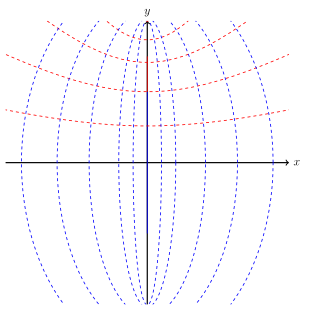
The real numbers \(x\) and \(y\) are related to the real numbers \(u\) and \(v\) by \[ 2(u+\mathrm{i}v)=\mathrm{e}^{x+\mathrm{i}y}-\mathrm{e}^{-x-\mathrm{i}y}. \] Show that the line in the \(x\)-\(y\) plane given by \(x=a\), where \(a\) is a positive constant, corresponds to the ellipse \[ \left(\frac{u}{\sinh a}\right)^{2}+\left(\frac{v}{\cosh a}\right)^{2}=1 \] in the \(u\)-\(v\) plane. Show also that the line given by \(y=b\), where \(b\) is a constant and \(0<\sin b<1,\) corresponds to one branch of a hyperbola in the \(u\)-\(v\) plane. Write down the \(u\) and \(v\) coordinates of one point of intersection of the ellipse and hyperbola branch, and show that the curves intersect at right-angles at this point. Make a sketch of the \(u\)-\(v\) plane showing the ellipse, the hyperbola branch and the line segments corresponding to:
- \(x=0\);
- \(y=\frac{1}{2}\pi,\) \(\quad 0\leqslant x\leqslant a.\)
Solution: \begin{align*} && 2(u+iv) &= e^{a+iy} - e^{-a-iy} \\ && &=(e^a \cos y - e^{-a} \cos y) + (e^a \sin y + e^{-a} \sin y)i \\ &&&= 2 \sinh a \cos y + 2\cosh a \sin y i\\ \Rightarrow && \frac{u}{\sinh a} &= \cos y \\ && \frac{v}{\cosh a} &= \sin y \\ \Rightarrow && 1 &= \left(\frac{u}{\sinh a}\right)^{2}+\left(\frac{v}{\cosh a}\right)^{2} \end{align*} \begin{align*} && 2(u+iv) &= e^{x+ib} - e^{-x-ib} \\ &&&= 2\sinh x \cos b + 2\cosh x \sin b i \\ \Rightarrow && \frac{u}{\cos b} &= \sinh x \\ && \frac{v}{\sin b} &= \cosh x \\ \Rightarrow && 1 &= \left (\frac{v}{\sin b} \right)^2 - \left (\frac{u}{\cos b} \right)^2 \end{align*} Therefore all the points lie of a hyperbola, and since \(\frac{v}{\sin b} > 0 \Rightarrow v > 0\) it's one branch of the hyperbola. (And all points on it are reachable as \(x\) varies from \(-\infty < x < \infty\). \begin{align*} 2(u+iv) &= e^{a+ib} - e^{-a-ib} \\ &= 2 \sinh a \cos b + 2 \cosh a \sin b i \end{align*} so we can take \(u = \sinh a \cos b, v = \cosh a \sin b\). \begin{align*} \frac{\d }{\d u} && 0 &= \frac{2 u}{\sinh^2 a} + \frac{2v}{\cosh^2 a} \frac{\d v}{\d u} \\ \Rightarrow && \frac{\d v}{\d u} &= -\frac{u}{v} \coth^2 a \\ \\ && \frac{\d v}{\d u} \rvert_{(u,v)} &= -\frac{\sinh a \cos b}{\cosh a \sin b} \coth^2 a \\ &&&= -\cot b \coth a \\ \frac{\d }{\d u} && 0 &= \frac{2 v}{\sin^2 b} \frac{\d v}{\d u} - \frac{2u}{\cos^2 b} \\ \Rightarrow && \frac{\d v}{\d u} &= \frac{u}{v} \tan^2 b \\ && \frac{\d v}{\d u} \rvert_{(u,v)} &= \frac{\sinh a \cos b}{\cosh a \sin b} \tan^2 b \\ &&&= \tanh a \tan b \end{align*} Therefore they are negative reciprocals and hence perpendicular.
1989 Paper 2 Q8
Let \(\Omega=\exp(\mathrm{i}\pi/3).\) Prove that \(\Omega^{2}-\Omega+1=0.\) Two transformations, \(R\) and \(T\), of the complex plane are defined by \[ R:z\longmapsto\Omega^{2}z\qquad\mbox{ and }\qquad T:z\longmapsto\dfrac{\Omega z+\Omega^{2}}{2\Omega^{2}z+1}. \] Verify that each of \(R\) and \(T\) permute the four point \(z_{0}=0,\) \(z_{1}=1,\) \(z_{2}=\Omega^{2}\) and \(z_{3}=-\Omega.\) Explain, without explicitly producing a group multiplication table, why the smallest group of transformations which contains elements \(R\) and \(T\) has order at least 12. Are there any permutations of these points which cannot be produced by repeated combinations of \(R\) and \(T\)?
Solution: \(R(0) = 0\), \(R(1) = \Omega^2 1 = \Omega^2\), \(R(\Omega^2) = \Omega^4 = -\Omega\), \(R(-\Omega) = -\Omega^3 = 1\) \(T(0) = \frac{\Omega^2}1 = \Omega^2\), \(T(1) = \frac{\Omega + \Omega^2}{2\Omega^2+1} = \frac{2\Omega - 1}{2\Omega-1} = 1\) \(T(\Omega^2) = \frac{\Omega^3 + \Omega^2}{2\Omega^4+1} = \Omega \frac{\Omega^2+\Omega}{-2\Omega+1} = \Omega \frac{2\Omega-1}{-2\Omega+1} = - \Omega\) \(T(-\Omega) = \frac{-\Omega^2 + \Omega^2}{-2\Omega^3+1} = \frac{0}{3} = 0\) Thinking of \(R\) and \(S\) as elements of \(S_4\), we have that \(R = (234), S = (134)\), we can also construct \(RS = (14)(23), R^2S = (12)(34), RSR^2S = (13)(24)\). Therefore we have the subgroups \(\{e, (234), (243)\}\) of order \(3\) and the subgroup \(\{e, (12)(34), (13)(24), (14)(23) \}\) of order \(4\). By Lagrange's theorem this means that both \(3\) and \(4\) divide the order of the group, therefore the group has order divisible by \(12\) (and therefore is at least \(12\)). Yes, we cannot produce any odd permutation, for example \((12)\) cannot be produced. (Since all our generators are even permutations).
1988 Paper 1 Q6
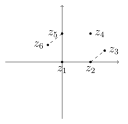
The complex numbers \(z_{1},z_{2},\ldots,z_{6}\) are represented by six distinct points \(P_{1},P_{2},\ldots,P_{6}\) in the Argand diagram. Express the following statements in terms of complex numbers:
- \(\overrightarrow{P_{1}P_{2}}=\overrightarrow{P_{5}P_{4}}\) and \(\overrightarrow{P_{2}P_{3}}=\overrightarrow{P_{6}P_{5}}\,\);
- \(\overrightarrow{P_{2}P_{4}}\) is perpendicular to \(\overrightarrow{P_{3}P_{6}}\,\).
Solution:
- \(\overrightarrow{P_{1}P_{2}}=\overrightarrow{P_{5}P_{4}}\) is equivalent to \(z_2 - z_1 = z_4 - z_5\). \(\overrightarrow{P_{2}P_{3}}=\overrightarrow{P_{6}P_{5}}\) is equivalent to \(z_3-z_2 = z_5 - z_6\).
- \(\overrightarrow{P_{2}P_{4}}\) is perpendicular to \(\overrightarrow{P_{3}P_{6}}\,\) is equivalent to \(\frac{z_4 - z_2}{z_6-z_3} \in i\mathbb{R}\)
1988 Paper 2 Q3
The quadratic equation \(x^{2}+bx+c=0\), where \(b\) and \(c\) are real, has the properly that if \(k\) is a (possibly complex) root, then \(k^{-1}\) is a root. Determine carefully the restriction that this property places on \(b\) and \(c\). If, in addition to this property, the equation has the further property that if \(k\) is a root, then \(1-k\) is a root, find \(b\) and \(c\). Show that \[ x^{3}-\tfrac{3}{2}x^{2}-\tfrac{3}{2}x+1=0 \] is the only cubic equation of the form \(x^{3}+px^{2}+qx+r=0\), where \(p,q\) and \(r\) are real, which has both the above properties.
Solution: Suppose \(k\) is a root of our quadratic. There are two possibilities, if \(k^{-1} = k\) then we must have \(k^2 = 1\) so either \(\pm 1\) is a root or we must have \((x-k)(x-k^{-1}) = x^2+bx+c\). In the first case we can have: \begin{align*} x^2+bx +c = (x-1)^2 &\Rightarrow b = -2, c = 1 \\ x^2+bx +c = (x+1)^2 &\Rightarrow b = 2, c = 1 \\ x^2+bx +c = (x-1)(x+1) &\Rightarrow b = 0, c = 1 \\ \end{align*} In the other cases, \(c = 1\) and \(b = k^{-1}+k\). Therefore we must have \(c = 1\) and \(b\) can take any values. The statement "if \(k\) is a root then \(1-k\) is a root" implies these two roots are different, so we must have \(1-k = k^{-1} \Rightarrow k-k^2 = 1 \Rightarrow k^2-k+1 = 0\) so \(b = -1, c = 1\). Suppose \(x^3+px^2+qx+r = 0\) has the first property, then for any root \(k\) we must have: \(k^3 + pk^2 + qk + r = 0\) and \(1 + pk^{-1} + qk^{-2} + rk^{-3} = 0\) therefore \(x^3+px^2+qx+r\) and \(rx^3+qx^2+px+1 = 0\) must have identical roots (since \(x = \pm\) either wont work here since they imply having the roots \(1, 0\) or \(-1, 2, \frac12\) which is exactly our equation. Therefore \(r = 1, p = q\). Suppose \(x^3 + px^2 + px+1 = 0\) has the property that if \(k\) is a root \(1-k\) is a root, therefore: \begin{align*} 0 &= (1-k)^3+p(1-k)^2 + p(1-k) + 1 \\ &= 1 -3k+3k^2-k^3+p-2kp+pk^2+p-pk+1 \\ &= -k^3+(3+p)k^2+(-3-3p)k+(2+2p) \end{align*} Since these roots must be the same as the original roots, we must have \(3+p = -p, -3-3p = -p, 2+2p = -1 \Rightarrow p = -\frac32\)
1988 Paper 2 Q4
The complex number \(w\) is such that \(w^{2}-2w\) is real.
- Sketch the locus of \(w\) in the Argand diagram.
- If \(w^{2}=x+\mathrm{i}y,\) describe fully and sketch the locus of points \((x,y)\) in the \(x\)-\(y\) plane.
Solution:
- Suppose \(w = u+ vi\) then \(w^2 - 2w = u^2-v^2-2u+(2uv-2v)i\) so to be purely real we must have \(2uv-2v = 2v(u-1) = 0\) ie either \(v = 0\) or \(u = 1\). Therefore the locus is the real axis and the line \(1 + ti\):

- If \(w^2 = x+yi\) then we must have \(x = u^2-v^2\) and \(y = 2uv\), so either \(v = 0, y = 0, x = u^2-2u \geq -1\) or \(u = 1, x = 1-v^2, y = 2v\) which is a parabola:


1988 Paper 2 Q5
By considering the imaginary part of the equation \(z^{7}=1,\) or otherwise, find all the roots of the equation \[ t^{6}-21t^{4}+35t^{2}-7=0. \] You should justify each step carefully. Hence, or otherwise, prove that \[ \tan\frac{2\pi}{7}\tan\frac{4\pi}{7}\tan\frac{6\pi}{7}=\sqrt{7}. \] Find the corresponding result for \[ \tan\frac{2\pi}{n}\tan\frac{4\pi}{n}\cdots\tan\frac{(n-1)\pi}{n} \] in the two cases \(n=9\) and \(n=11.\)
Solution: Suppose \(z^7 = 1\), then we can write \(z = \cos \theta + i \sin \theta\) and we must have that: \begin{align*} 0 &= \textrm{Im}((\cos \theta + i \sin \theta)^7) \\ &= \binom{7}{6}\cos^6 \theta \sin \theta - \binom{7}{4} \cos^4 \theta \sin^3 \theta + \binom{7}{2} \cos^2 \theta \sin^5 \theta - \sin^7 \theta \\ &= 7 \cos^6 \sin \theta - 35 \cos^4 \theta \sin ^3 \theta + 21 \cos^2 \theta \sin^5 \theta - \sin^7 \theta \\ &= -\cos^7 \theta \l \tan^7 \theta - 21 \tan^5 \theta + 35 \tan^3 \theta - 7 \tan \theta\r \\ &= \cos^7 \theta \cdot t (t^7-21t^4+35t^2-7) \end{align*} Where \(t = \tan \theta\). So if \(z\) is a root of \(z^7 = 1\) and \(\cos \theta \neq 0, \tan \theta \neq 0\) then \(t\) is a root of the equation. Thererefore the roots are: \(\tan \frac{2\pi k}{7}\) where \(k = 1, 2, \ldots 6\). Noting that \(\tan \frac{\pi}7 = -\tan \frac{6\pi}{7}, \tan \frac{3\pi}{7} = -\tan \frac{4 \pi}{7}, \tan \frac{5\pi}{7} = -\tan \frac{2 \pi}{7}\) we can conclude that: \begin{align*} && 7 &= \prod_{k=1}^k \tan \frac{k \pi}{6} \\ &&&= \l \tan\frac{2\pi}{7}\tan\frac{4\pi}{7}\tan\frac{6\pi}{7} \r^2 \\ \Rightarrow&& \pm \sqrt{7} &= \tan\frac{2\pi}{7}\tan\frac{4\pi}{7}\tan\frac{6\pi}{7} \end{align*} However, we know that \(\tan \frac{2\pi}{7}\) is positive, \(\tan \frac{4\pi}{7},\tan \frac{6\pi}{7}\) are negative, therefore the result must be positive, ie \(+\sqrt{7}\) Using a similar method, we notice that: \begin{align*} 0 &= \textrm{Im} \l (\cos \theta + i \sin \theta)^n \r \\ &= \cos^n \theta \cdot t (t^{n-1} + \cdots - \binom{n}{n-1}) \end{align*} Therefore \(\prod_{k=0}^{n-1} \tan \frac{k \pi}{n} = n\) and since \(\tan \frac{(2k+1) \pi}{n} = \tan \frac{(n-2k-1)\pi}{n}\) is a map of all the odd numbers to the even numbers (and vice versa) when \(n\) is odd. We also know that the terms less where \(\tan \theta\) has \(\theta < \frac{\pi}{2}\) are positive, and the others even, we can determine the signs: \begin{align*} \tan \frac{2 \pi}{9} \tan \frac{4 \pi}{9} \tan \frac{6 \pi}{9} \tan \frac{8 \pi}{9} & = 3 \\ \tan \frac{2 \pi}{11} \tan \frac{4 \pi}{11} \tan \frac{6 \pi}{11} \tan \frac{8 \pi}{11} \tan \frac{10 \pi}{11} &= -\sqrt{11} \end{align*}
1988 Paper 3 Q3
Give a parametric form for the curve in the Argand diagram determined by \(\left|z-\mathrm{i}\right|=2.\) Let \(w=(z+\mathrm{i})/(z-\mathrm{i}).\) Find and sketch the locus, in the Argand diagram, of the point which represents the complex number \(w\) when \begin{questionparts} \item \(\left|z-\mathrm{i}\right|=2;\) \item \(z\) is real; \item \(z\) is imaginary. \end{questionpart}
Solution: There are many possible parametric forms, for example \(z = i + 2e^{it}, z = 2\ cos \theta + (1 + 2\sin \theta)i\) etc. It is a circle radius \(2\) about the point \(i\).
- \begin{align*}
w &= \frac{z+i}{z-i} \\
&= \frac{2i + 2e^{it}}{2e^{it}} \\
&= 2 + ie^{-it}
\end{align*}
This is obvious a circle radius \(1\) about the point \(2\).

- If \(z\) is real, then \begin{align*} w &= \frac{z+i}{z-i} \\ &= \frac{(z+i)^2}{z^2+1} \\ &= \frac{z^2-1 + 2zi}{z^2+1} \end{align*} We can quickly notice this describes a circle radius \(1\) about \(0\). Alternatively, \(|z+i| = |z-i| \Rightarrow |\frac{z+i}{z-i}| = 1\) so we must be talking about points on the unit circle. Since this is a Mobius transform we know it maps lines and circles to lines and circles, therefore it must map to the unit circle;
- If \(z\) is purely imaginary, say \(it\) then:
\begin{align*}
w &= \frac{z+i}{z-i} \\
&= \frac{(it+i)(i-it)}{(-1+t)^2} \\
&= \frac{t^2-1}{(t-1)^2}
\end{align*}
Which is purely real, and can take all real values.
