Problems
Filters
1531 problems found
2005 Paper 3 Q2
Find the general solution of the differential equation \(\displaystyle \frac{\mathrm{d}y}{\mathrm{d}x} = -\frac{xy}{x^2+a^2}\;\), where \(a\ne0\,\), and show that it can be written in the form \(\displaystyle y^2(x^2+a^2)= c^2\,\), where \(c\) is an arbitrary constant. Sketch this curve. Find an expression for \(\displaystyle \frac{\mathrm{d}}{\mathrm{d}x} (x^2+y^2)\) and show that \[ \frac{\mathrm{d^2}}{\mathrm{d}x^2} (x^2+y^2) = 2\left(1 -\frac {c^2}{(x^2+a^2)^2} \right) + \frac{8c^2x^2}{(x^2+a^2)^3}\;. \]
- Show that, if \(0 < c < a^2\), the points on the curve whose distance from the origin is least are \(\displaystyle \l 0\,,\;\pm \frac{c}{a}\r\).
- If \(c > a^2\), determine the points on the curve whose distance from the origin is least.
Solution: \begin{align*} && \frac{\d y}{\d x} &= - \frac{xy}{x^2+a^2} \\ \Rightarrow && \int \frac{1}{y} \d y &= \int -\frac{x}{x^2+a^2} \d x \\ && \ln |y| &= -\frac12 \ln |x^2 + a^2| + C \\ \Rightarrow && C' &= \ln y^2 + \ln (x^2+a^2) \\ \Rightarrow && c^2 &= y^2(x^2+a^2) \end{align*} (where the final constant \(c^2\) can be taken as a square since it is clearly positive).

- The shortest distance from the origin will have the first derivative as \(0\), ie \(x = 0\) or \(x^2 + a^2 = c\), but if \(c < a^2\) this can only occur for \(x = 0\), so the closest to the origin is \((0, \pm \frac{c}{a})\)
- If \(c > a^2\) then we can have \(x = 0\) or \(x = \pm \sqrt{c-a^2}\). Looking at the second derivative, when \(x = 0\) we have \(2(1- \frac{c^2}{a^4}) < 0\) which is a local maximum. When \(x = \pm\sqrt{c-a^2}\) we have \(8(c-a^2)c^2/c^3 > 0\) which is the minimum, therefore the points are \((\pm \sqrt{c-a^2}, c)\)

2005 Paper 3 Q3
Let \(\f(x)=x^2+px+q\) and \(\g(x)=x^2+rx+s\,\). Find an expression for \(\f ( \g (x))\) and hence find a necessary and sufficient condition on \(a\), \(b\) and \(c\) for it to be possible to write the quartic expression \(x^4+ax^3+bx^2+cx+d\) in the form \(\f ( \g (x))\), for some choice of values of \(p\), \(q\), \(r\) and \(s\). Show further that this condition holds if and only if it is possible to write the quartic expression \(x^4+ax^3+bx^2+cx+d\) in the form \((x^2+vx+w)^2-k\), for some choice of values of \(v\), \(w\) and \(k\). Find the roots of the quartic equation \(x^4-4x^3+10x^2-12x+4=0\,\).
Solution: \begin{align*} && f(g(x)) &= (g(x))^2 + p(g(x)) + q \\ &&&= (x^2+rx+s)^2 + p(x^2+rx+s) + q \\ &&&= x^4 + 2rx^3 + (2s+r^2+p)x^2 +(2rs+pr)x + (s^2+ps+q) \end{align*} So we need \(2r=a ,2s+r^2+p = b, r(2s+p) = c\). (We have full control over \(d\) since we can always chance \(q\) only affecting \(d\). \begin{align*} && r &= \frac{a}{2} \\ && b-r^2 & =rc \\ && b - \frac{a^2}{4} & =\frac{ac}{2} \\ \Rightarrow && 4b-a^2&= 2ac \end{align*} Clearly this condition is necessary. It is sufficient since if it is true the equations are solveable. \((x^2+vx+w)^2 = x^4 + 2vx^3 + (2vw+v^2)x^2+2vw x + w^2\). We don't care about the constant term since we can control this with \(k\), so we just need to check \(4(2vw+v^2) - (2v)^2 = 8wv\) so this does satisfy the condition. The reverse is also clear. \begin{align*} && 0 &= x^4-4x^3+10x^2-12x+4 \\ &&&= (x^2-2x+3)^2-5 \\ \Rightarrow && 0 &= x^2 - 2x+3 \pm \sqrt{5} \\ && x &= \frac{2 \pm \sqrt{4 - 4(3 \pm \sqrt{5})}}{2} \\ &&&= 1 \pm \sqrt{\mp \sqrt{5} -2} \\ &&& = 1 \pm \sqrt{\sqrt{5}-2}, 1 \pm i\sqrt{\sqrt{5}+2} \end{align*}
2005 Paper 3 Q4
The sequence \(u_n\) (\(n= 1, 2, \ldots\)) satisfies the recurrence relation \[ u_{n+2}= \frac{u_{n+1}}{u_n}(ku_n-u_{n+1}) \] where \(k\) is a constant. If \(u_1=a\) and \(u_2=b\,\), where \(a\) and \(b\) are non-zero and \(b \ne ka\,\), prove by induction that \[ u_{2n}=\Big(\frac b a \Big) u_{2n-1} \] \[ u_{2n+1}= c u_{2n} \] for \(n \ge 1\), where \(c\) is a constant to be found in terms of \(k\), \(a\) and \(b\). Hence express \(u_{2n}\) and \(u_{2n-1}\) in terms of \(a\), \(b\), \(c\) and \(n\). Find conditions on \(a\), \(b\) and \(k\) in the three cases:
- the sequence \(u_n\) is geometric;
- \(u_n\) has period 2;
- the sequence \(u_n\) has period 4.
2005 Paper 3 Q5
Let \(P\) be the point on the curve \(y=ax^2+bx+c\) (where \(a\) is non-zero) at which the gradient is \(m\). Show that the equation of the tangent at \(P\) is \[ y-mx=c-\frac{(m-b)^2}{4a}\;. \] Show that the curves \(y=a_1 x^2+b_1 x+c_1\) and \(y=a_2 x^2+b_2 x+c_2\) (where \(a_1\) and \(a_2\) are non-zero) have a common tangent with gradient \(m\) if and only if \[ (a_2 -a_1 )m^2 + 2(a_1 b_2-a_2 b_1)m + 4a_1 a_2(c_2-c_1)+ a_2 b_1^2-a_1 b_2 ^2=0\;. \] Show that, in the case \(a_1 \ne a_2 \,\), the two curves have exactly one common tangent if and only if they touch each other. In the case \(a_1 =a_2\,\), find a necessary and sufficient condition for the two curves to have exactly one common tangent.
Solution: \begin{align*} && y' &= 2ax+b \\ \Rightarrow && m &= 2ax_t+b \\ \Rightarrow && x_t &= \frac{m-b}{2a} \end{align*} Therefore we must have \begin{align*} mx_t &= 2ax_t^2+bx_t \\ y - mx &= ax_t^2+bx_t+c - mx_t \\ &= ax_t^2+bx_t+c - (2ax_t^2+bx_t) \\ &= c - ax_t^2 \\ &= c-a\left (\frac{m-b}{2a} \right)^2 \\ &= c - \frac{(m-b)^2}{4a} \end{align*} They will have a common tangent if and only if the constant terms are equal, ie \begin{align*} && c_1 - \frac{(m-b_1)^2}{4a_1} &= c_2 - \frac{(m-b_2)^2}{4a_2} \\ \Leftrightarrow && (c_1-c_2) &= \frac{(m-b_1)^2}{4a_1} -\frac{(m-b_2)^2}{4a_2} \\ \Leftrightarrow && 4a_1a_2(c_1-c_2) &= a_2(m-b_1)^2-a_1(m-b_2)^2 \\ &&&= (a_2-a_1)m^2+2(a_1b_2-a_2b_1)m+a_2b_1^2-a_1b_2^2 \end{align*} as required. Treating this as a polynomial in \(m\), we can see that the two curves will have exactly one common tangent iff \(\Delta = 0\), ie: \begin{align*} && 0 &= \Delta \\ &&&= (2(a_1b_2-a_2b_1))^2 - 4 (a_2-a_1)(4a_1 a_2(c_2-c_1)+ a_2 b_1^2-a_1 b_2 ^2) \\ &&&= 4a_1^2b_2^2-8a_1a_2b_1b_2+4a_2b_1^2 - 4a_2^2b_1^2-4a_1^2b_2^2 + 4a_1a_2(b_1^2+b_2^2)-16(a_2-a_1)a_1a_2(c_2-c_1) \\ &&&=-8a_1a_2b_1b_2+4a_1a_2(b_1^2+b_2^2)-16(a_2-a_1)a_1a_2(c_2-c_1) \\ &&&=a_1a_2(4(b_1-b_2)^2-16(a_2-a_1)(c_2-c_1)) \\ &&&= 4a_1a_2((b_2-b_1)^2 - 4(a_2-a_1)(c_2-c_1) \end{align*} But this is just the discriminant of the difference, ie equivalent to the two parabolas just touching. (Assuming \(a_1-a_2 \neq 0\) and we do end up with a quadratic). If \(a_1 = a_2 = a\) then we need exactly one solution to \(2a(b_1-b_2)m +4a^2(c_2-c_1)+a(b_1^2-b_2^2) = 0\), ie \(b_1 \neq b_2\).
2005 Paper 3 Q6
In this question, you may use without proof the results \[ 4 \cosh^3 y - 3 \cosh y = \cosh (3y) \ \ \ \ \text{and} \ \ \ \ \mathrm{arcosh} \, y = \ln ( y+\sqrt{y^2-1}). \] \noindent[ {\bf Note: } \(\mathrm{arcosh}y\) is another notation for \(\cosh^{-1}y\,\)] Show that the equation \(x^3 - 3a^2x = 2a^3 \cosh T\) is satisfied by \( 2a \cosh \l \frac13 T \r\) and hence that, if \(c^2\ge b^3>0\), one of the roots of the equation \(x^3-3bx=2c\) is \(\ds u+\frac{b}{u}\), where \(u = (c+\sqrt{c^2-b^3})^{\frac13}\;\). Show that the other two roots of the equation \(x^3-3bx=2c\) are the roots of the quadratic equation \[\ds x^2 + \Big( u+\frac{b}{u}\Big) x + u^2+\frac{b^2}{u^2}-b=0\, ,\] and find these roots in terms of \(u\), \(b\) and \(\omega\), where \(\omega = \frac{1}{2}(-1 + \mathrm{i}\sqrt{3})\). Solve completely the equation \(x^3-6x=6\,\).
2005 Paper 3 Q7
Show that if \(\displaystyle \int\frac1{u \, \f(u)}\; \d u = \F(u) + c\;\), then \(\displaystyle \int\frac{m}{x \, \f(x^m)} \;\d x = \F(x^m) + c\;\), where \(m\ne0\). Find:
- \(\displaystyle\int\frac1{x^n-x} \, \d x\,\);
- \(\displaystyle\int\frac1 {\sqrt{x^n+x^2}}\, \d x\,\).
Solution: \begin{align*} u = x^m, \d u = m x^{m-1} && \int \frac{m}{x f(x^m)} \d x &= \int \frac{m x^{m-1}}{uf(u)} \d x \\ &&&= \int \frac{1}{u f(u)} \d u \\ &&&= F(u) + c \\ &&&= F(x^m) + c \end{align*}
- \begin{align*} && \int \frac{1}{u(u-1)} \d u &= \int \left ( \frac{1}{u-1}-\frac{1}{u} \right ) \d u \\ &&&= \ln \left ( \frac{u-1}{u} \right) + c \\ &&&= \ln \left ( 1 - \frac{1}{u} \right) + c \\ && \int \frac{1}{x^n - x} \d x &= \int \frac{1}{x (x^{n-1}-1)} \d x \\ f(u) = u - 1: && &= \frac{1}{n-1} \ln \left ( 1 - \frac{1}{x^{n-1}} \right) + c \end{align*}
- \begin{align*} v = \sqrt{u+1}, \d v = \tfrac12 (u+1)^{-1/2} \d u && \int \frac{1}{u\sqrt{u+1}} \d u &= \int \frac{1}{(v^2-1)} (u+1)^{-1/2} \d u \\ &&&= \int \frac{2}{v^2-1} \d v \\ &&&=\ln \frac{1-v}{1+v} + c \\ &&&= \ln \left (\frac{1-\sqrt{u+1}}{1+\sqrt{u+1}} \right)+ c \\ f(u) = \sqrt{x+1}:&& \int \frac{1}{\sqrt{x^n + x^2}} \d x &= \int \frac{1}{x\sqrt{x^{n-2}+1}} \d x \\ &&&= \frac{1}{n-2} \ln \left ( \frac{1-\sqrt{x^{n-2}+1}}{1+\sqrt{x^{n-2}+1}} \right)+c \end{align*}
2005 Paper 3 Q8
In this question, \(a\) and \(c\) are distinct non-zero complex numbers. The complex conjugate of any complex number \(z\) is denoted by \(z^*\). Show that \[ |a - c|^2 = aa^* + cc^* -ac^* - ca^* \] and hence prove that the triangle \(OAC\) in the Argand diagram, whose vertices are represented by \(0\), \(a\) and \(c\) respectively, is right angled at \(A\) if and only if \(2aa^* = ac^*+ca^*\,\). Points \(P\) and \(P'\) in the Argand diagram are represented by the complex numbers \(ab\) and \(\ds \frac{a}{b^*}\,\), where \(b\) is a non-zero complex number. A circle in the Argand diagram has centre \(C\) and passes through the point \(A\), and is such that \(OA\) is a tangent to the circle. Show that the point \(P\) lies on the circle if and only if the point \(P'\) lies on the circle. Conversely, show that if the points represented by the complex numbers \(ab\) and \(\ds \frac{a}{b^*}\), for some non-zero complex number \(b\) with \(bb^* \ne 1\,\), both lie on a circle centre \(C\) in the Argand diagram which passes through \(A\), then \(OA\) is a tangent to the circle.
2005 Paper 3 Q9
Two particles, A and B, move without friction along a horizontal line which is perpendicular to a vertical wall. The coefficient of restitution between the two particles is \(e\) and the coefficient of restitution between particle B and the wall is also \(e\), where \( 0< e < 1\). The mass of particle~A is \(4em\) (with \(m > 0\)), and the mass of particle B is \((1-e)^2m\)\,. Initially, A is moving towards the wall with speed \((1-e)v\) (where \(v > 0\)) and B is moving away from the wall and towards A with speed \(2ev\). The two particles collide at a distance \(d\) from the wall. Find the speeds of A and B after the collision. When B strikes the wall, it rebounds along the same line. Show that a second collision will take place, at a distance \(de\) from the wall. Deduce that further collisions will take place. Find the distance from the wall at which the \(n\)th collision takes place, and show that the times between successive collisions are equal.
2005 Paper 3 Q10
Two thin discs, each of radius \(r\) and mass \(m\), are held on a rough horizontal surface with their centres a distance \(6r\) apart. A thin light elastic band, of natural length \(2\pi r\) and modulus \(\dfrac{\pi mg}{12}\), is wrapped once round the discs, its straight sections being parallel. The contact between the elastic band and the discs is smooth. The coefficient of static friction between each disc and the horizontal surface is \(\mu\), and each disc experiences a force due to friction equal to \(\mu mg\) when it is sliding. The discs are released simultaneously. If the discs collide, they rebound and a half of their total kinetic energy is lost in the collision.
- Show that the discs start sliding, but come to rest before colliding, if and only if \mbox{\(\frac23 <\mu <1\)}.
- Show that, if the discs collide at least once, their total kinetic energy just before the first collision is \(\frac43 mgr(2-3\mu)\).
- Show that if \(\frac 4 9 > \mu^2 >\frac{5}{27}\) the discs come to rest exactly once after the first collision.
2005 Paper 3 Q11
A horizontal spindle rotates freely in a fixed bearing. Three light rods are each attached by one end to the spindle so that they rotate in a vertical plane. A particle of mass \(m\) is fixed to the other end of each of the three rods. The rods have lengths \(a\), \(b\) and \(c\), with \(a > b > c\,\) and the angle between any pair of rods is \(\frac23 \pi\). The angle between the rod of length \(a\) and the vertical is \(\theta\), as shown in the diagram. \vspace*{-0.1in}
2005 Paper 3 Q12
Five independent timers time a runner as she runs four laps of a track. Four of the timers measure the individual lap times, the results of the measurements being the random variables \(T_1\) to \(T_4\), each of which has variance \(\sigma^2\) and expectation equal to the true time for the lap. The fifth timer measures the total time for the race, the result of the measurement being the random variable \(T\) which has variance \(\sigma^2\) and expectation equal to the true race time (which is equal to the sum of the four true lap times). Find a random variable \(X\) of the form \(aT+b(T_1+T_2+T_3+T_4)\), where \(a\) and \(b\) are constants independent of the true lap times, with the two properties:
- whatever the true lap times, the expectation of \(X\) is equal to the true race time;
- the variance of \(X\) is as small as possible.
Solution: Let the expected total time for the race be \(\mu\). Let \(X = aT + b(T_1 + T_2+T_3+T_4)\) then \(\E[X] = a\E[T] + b\E[T_1+\cdots+T_4] = a \mu + b \mu = (a+b)\mu\). So \(a+b=1\). \begin{align*} && \var[X] &= a^2\var[T] + b^2(\var[T_1] + \var[T_2] + \var[T_3] + \var[T_4]) \\ &&&= a^2\sigma^2 + 4b^2 \sigma^2 \\ &&& = \sigma^2 (a^2 + 4(1-a)^2 ) \\ &&&= \sigma^2 (5a^2 - 8a + 4) \\ &&&= \sigma^2 \left ( 5 \left ( a - \frac45 \right)^2 - \frac{16}{5}+4 \right)\\ &&&= \sigma^2 \left ( 5 \left ( a - \frac45 \right)^2 + \frac{4}{5}\right) \end{align*} Therefore variance is minimised when \(a = \frac45, b = \frac15\). Let \(Y = cT + d(T_1 + T_2+T_3+T_4)\) then \begin{align*} && \E[Y^2] &= \E \left [c^2T^2 + 2cd T(T_1+T_2+T_3+T_4) + d^2(T_1+T_2+T_3+T_4)^2 \right] \\ &&&= c^2 (\mu^2 + \sigma^2) + 2cd \mu^2 + d^2 (\var[T_1 + \cdots + T_4] + \mu^2) \\ &&&= c^2(\mu^2+\sigma^2) + 2cd \mu^2 + d^2(4\sigma^2 + \mu^2) \\ &&&= (c^2 + 2cd + d^2) \mu^2 + (c^2+4d^2) \sigma^2 \\ &&&= (c+d)^2 \mu^2 + (c^2+4d^2) \sigma^2 \\ \\ \Rightarrow && d &= -c \\ && 1 &= c^2 + 4d^2 \\ \Rightarrow && c &= \pm \frac{1}{\sqrt5} \\ && d &= \mp \frac{1}{\sqrt5} \end{align*} Given our results, our best estimate for \(\mu\) is \(\frac45 \cdot 220 + \frac15 220.5 = 220.1\). Our estimate for \(\sigma^2 = \left( \frac{1}{\sqrt{5}}(220.5-220) \right)^2 = \frac{1}{20}\). Note that \(\var[X] = \frac45\sigma^2 \approx \frac{1}{25}\) so we are looking at an interval \((220.1 - 0.4, 220.1 + 0.4) = (219.7, 220.5)\) using an interval of two standard errors.
2005 Paper 3 Q13
A pack of cards consists of \(n+1\) cards, which are printed with the integers from \(0\) to \(n\). A~game consists of drawing cards repeatedly at random from the pack until the card printed with 0 is drawn, at which point the game ends. After each draw, the player receives \(\pounds 1\) if the card drawn shows any of the integers from \(1\) to \(w\) inclusive but receives nothing if the card drawn shows any of the integers from \(w+1\) to \(n\) inclusive.
- In one version of the game, each card drawn is replaced immediately and randomly in the pack. Explain clearly why the probability that the player wins a total of exactly \(\pounds 3\) is equal to the probability of the following event occurring: out of the first four cards drawn which show numbers in the range \(0\) to \(w\), the numbers on the first three are non-zero and the number on the fourth is zero. Hence show that the probability that the player wins a total of exactly \(\pounds 3\) is equal to \(\displaystyle \frac{w^3}{(w+1)^4}\). Write down the probability that the player wins a total of exactly \(\pounds r\) and hence find the expected total win.
- In another version of the game, each card drawn is removed from the pack. Show that the expected total win in this version is half of the expected total win in the other version.
2005 Paper 3 Q14
In this question, you may use the result \[ \displaystyle \int_0^\infty \frac{t^m}{(t+k)^{n+2}} \; \mathrm{d}t =\frac{m!\, (n-m)!}{(n+1)! \, k^{n-m+1}}\;, \] where \(m\) and \(n\) are positive integers with \(n\ge m\,\), and where \(k>0\,\). The random variable \(V\) has density function \[ \f(x) = \frac{C \, k^{a+1} \, x^a}{(x+k)^{2a+2}} \quad \quad (0 \le x < \infty) \;, \] where \(a\) is a positive integer. Show that \(\displaystyle C = \frac{(2a+1)!}{a! \, a!}\;\). Show, by means of a suitable substitution, that \[ \int_0^v \frac{x^a}{(x+k)^{2a+2}} \; \mathrm{d}x = \int_{\frac{k^2}{v}}^\infty \frac{u^a}{(u+k)^{2a+2}} \; \mathrm{d}u \] and deduce that the median value of \(V\) is \(k\). Find the expected value of \(V\). The random variable \(V\) represents the speed of a randomly chosen gas molecule. The time taken for such a particle to travel a fixed distance \(s\) is given by the random variable \(\ds T=\frac{s}{V}\). Show that \begin{equation} \mathbb{P}( T < t) = \ds \int_{\frac{s}{t}}^\infty \frac{C \, k^{a+1} \, x^a}{(x+k)^{2a+2}}\; \mathrm{d}x \tag{\( *\)} \end{equation} and hence find the density function of \(T\). You may find it helpful to make the substitution \(\ds u = \frac{s}{x}\) in the integral \((*)\). Hence show that the product of the median time and the median speed is equal to the distance \(s\), but that the product of the expected time and the expected speed is greater than \(s\).
Solution: \begin{align*} && f(x) &= \frac{C \, k^{a+1} \, x^a}{(x+k)^{2a+2}} \\ \Rightarrow && 1 &= \int_0^{\infty} f(x) \d x \\ &&&= \int_0^{\infty} \frac{C \, k^{a+1} \, x^a}{(x+k)^{2a+2}} \d x \\ &&&= Ck^{a+1} \int_0^{\infty} \frac{x^a}{(x+k)^{2a+2} }\d x \\ &&&= Ck^{a+1} \frac{a!(2a-a)!}{(2a+1)!k^{2a-a+1}} \\ &&&= C \frac{a!a!}{(2a+1)!} \\ \Rightarrow && C &= \frac{(2a+1)!}{a!a!} \end{align*} \begin{align*} && I &= \int_0^v \frac{x^a}{(x+k)^{2a+2}} \d x\\ u = k^2/x, \d x = -k^2u^{-2} \d u: &&&= \int_{u = +\infty}^{u = k^2/v} \frac{k^{2a}u^{-a}}{(k^2u^{-1} +k)^{2a+2}}(-k^2u^{-2}) \d u \\ &&&= \int_{u = +\infty}^{u = k^2/v} \frac{k^{2a-2a-2}u^{2a+2-a}}{(k +u)^{2a+2}}(-k^2u^{-2}) \d u \\ &&&= \int_{ k^2/v}^{\infty} \frac{u^{a}}{(k +u)^{2a+2}} \d u \\ \end{align*} At the median we want a value \(M\) such that \(M = k^2/M\) ie \(M = k\) \begin{align*} && \mathbb{E}(V) &= \int_0^{\infty} x f(x) \d x \\ &&&= \frac{(2a+1)!k^{a+1}}{a!a!} \int_0^{\infty} \frac{x^{a+1}}{(x+k)^{2a+2}} \d x \\ &&&= \frac{(2a+1)!k^{a+1}}{a!a!} \frac{(a+1)!(2a-(a+1))!}{(2a+1)!k^{2a-(a+1)+1}}\\ &&&= \frac{k^{a+1}}{a!} \frac{(a+1)(a-1)!}{k^{a}} \\ &&&= \frac{k(a+1)}{a} = \frac{a+1}a k \end{align*} \begin{align*} && \mathbb{P}(T < t) &= \mathbb{P}(\frac{s}{V} < t) \\ &&&= \mathbb{P}(V > \frac{s}{t}) \\ &&&= \int_{s/t}^{\infty} f(x) \d x \\ &&&= \int_{s/t}^{\infty} \frac{C \, k^{a+1} \, x^a}{(x+k)^{2a+2}} \d x \\ \\ \Rightarrow && f_T(t) &= \frac{\d}{\d t} \left ( \mathbb{P}(T < t)\right) \\ &&&= \frac{\d}{\d t} \left ( \int_{s/t}^{\infty} \frac{C \, k^{a+1} \, x^a}{(x+k)^{2a+2}} \d x \right) \\ &&&= - \frac{C \, k^{a+1} \, \left ( \frac{s}{t} \right)^a}{(\frac{s}{t}+k)^{2a+2}} \cdot \left (-\frac{s}{t^2} \right) \\ &&&= \frac{Ck^{a+1}s^{a+1}t^{2a+2}}{t^{a+2}(s+kt)^{2a+2}} \\ &&&= \frac{C(ks)^{a+1}t^a}{(s+kt)^{2a+2}} \\ &&&= \frac{C(\frac{s}{k})^{a+1}t^a}{(\frac{s}{k}+t)^{2a+2}} \end{align*} Therefore \(T\) follows the same distribution, but with parameter \(s/k\) rather than \(k\). In particular it has median \(s/k\) (and the product of the medians is \(s\)). However, the product of the expected time and expected speed is \(\frac{a+1}{a} k \frac{a+1}{a} \frac{s}{k} = \left ( \frac{a+1}{a} \right)^2s > s\)
2004 Paper 1 Q1
- Express \(\left(3+2\sqrt{5} \, \right)^3\) in the form \(a+b\sqrt{5}\) where \(a\) and \(b\) are integers.
- Find the positive integers \(c\) and \(d\) such that \(\sqrt[3]{99-70\sqrt{2}\;}\) = \(c - d\sqrt{2} \,\).
- Find the two real solutions of \(x^6 - 198 x^3 + 1 = 0 \,\).
Solution:
- \begin{align*} (3+2\sqrt{5})^3 &= 3^3 + 3 \cdot 3^2 \cdot 2\sqrt{5} + 3 \cdot 3 \cdot (2 \sqrt{5})^2 + (2\sqrt{5})^3 \\ &= 27 + 180 + (54+40)\sqrt{5} \\ &= 207 + 94\sqrt{5} \end{align*}
- \begin{align*} && (c-d\sqrt{2})^3 &= c^3+6cd -(3c^2d+2d^3)\sqrt{2} \\ \Rightarrow && 99 &= c(c^2+6d^2) \\ && 70 &= d(3c^2+2d^2) \\ \Rightarrow && c & \mid 99, d \mid 70 \\ && c &= 3, d = 2 \end{align*}
- \begin{align*} && 0 &= x^6 - 198x^3 + 1 \\ \Rightarrow && 0 &= (x^3-99)^2+1-99^2 \\ \Rightarrow && x^3 &= 99 \pm \sqrt{99^2-1} \\ &&&= 99 \pm 10 \sqrt{98} \\ &&&= 99 \pm 70 \sqrt{2} \\ \Rightarrow && x &= 3 \pm 2 \sqrt{2} \end{align*}
2004 Paper 1 Q2
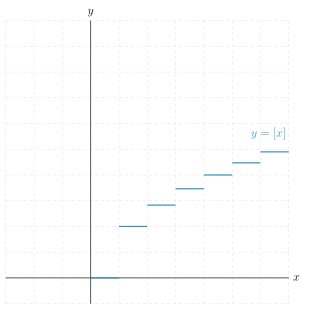
The square bracket notation \(\boldsymbol{[} x\boldsymbol{]}\) means the greatest integer less than or equal to \(x\,\). For example, \(\boldsymbol{[}\pi\boldsymbol{]} = 3\,\), \(\boldsymbol{[}\sqrt{24}\,\boldsymbol{]} = 4\,\) and \(\boldsymbol{[}5\boldsymbol{]}=5\,\).
- Sketch the graph of \(y = \sqrt{\boldsymbol{[}x\boldsymbol{]}}\) and show that \[ \displaystyle \int^a_0 \sqrt{\boldsymbol{[}x\boldsymbol{]}} \; \mathrm{d}x = \sum^{a-1}_{r=0} \sqrt{r} \] when \(a\) is a positive integer.
- Show that $\displaystyle \int^{a}_0 2_{\vphantom{A}}^{\pmb{\boldsymbol {[} } x \pmb{ \boldsymbol{]}} }\; \mathrm{d}x = 2^{a}-1\( when \)a\( is a positive integer.
- Determine an expression for \)\displaystyle \int^{a}_0 2_{\vphantom{\dot A}}^{\pmb{\boldsymbol{[} }x \pmb{ \boldsymbol{]}} } \; \mathrm{d}x\( when \)a$ is positive but not an integer.
Solution:
- \(\,\) \begin{align*} && \int_0^a \sqrt{\boldsymbol{[}x\boldsymbol{]}} \d x &= \sum_{r=0}^{a-1} \int_{x=r}^{x=r+1} \sqrt{\boldsymbol{[}x\boldsymbol{]}} \d x \\ &&&= \sum_{r=0}^{a-1} \int_r^{r+1} \sqrt{r} \d x \\ &&&= \sum_{r=0}^{a-1} \sqrt{r} \\ \end{align*}
- \(\,\) \begin{align*} && \int^{a}_0 2^{\boldsymbol {[} x \boldsymbol{]}} \d x &= \sum_{r=0}^{a-1} \int_{x=r}^{x=r+1} 2^{\boldsymbol {[} x \boldsymbol{]}} \d x \\ &&&= \sum_{r=0}^{a-1} \int_{x=r}^{x=r+1} 2^{r} \d x \\ &&&= \sum_{r=0}^{a-1} 2^{r}\\ &&&= 2^{a}-1 \end{align*}
- \(\,\) \begin{align*} && \int^{a}_0 2^{\boldsymbol {[} x \boldsymbol{]}} \d x &= \int_0^{\boldsymbol {[} a \boldsymbol{]}} 2^{\boldsymbol {[} x \boldsymbol{]}} \d x + \int_{\boldsymbol {[} a \boldsymbol{]}}^a 2^{\boldsymbol {[} x \boldsymbol{]}} \d x \\ &&&= 2^{ \boldsymbol {[} a \boldsymbol{]}}-1 + (a-\boldsymbol {[} a \boldsymbol{]})2^{\boldsymbol {[} a \boldsymbol{]}} \\ &&&= (a-\boldsymbol {[} a \boldsymbol{]}+1)2^{\boldsymbol {[} a \boldsymbol{]}} -1 \end{align*}