Problems
Filters
1531 problems found
2007 Paper 2 Q10
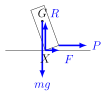
A solid figure is composed of a uniform solid cylinder of density \(\rho\) and a uniform solid hemisphere of density \(3\rho\). The cylinder has circular cross-section, with radius \(r\), and height \(3r\), and the hemisphere has radius \(r\). The flat face of the hemisphere is joined to one end of the cylinder, so that their centres coincide. The figure is held in equilibrium by a force \(P\) so that one point of its flat base is in contact with a rough horizontal plane and its base is inclined at an angle \(\alpha\) to the horizontal. The force \(P\) is horizontal and acts through the highest point of the base. The coefficient of friction between the solid and the plane is \(\mu\). Show that \[\mu \ge \left\vert \tfrac98 -\tfrac12 \cot\alpha\right\vert\,. \]
Solution: The centre of mass of the sphere will be at \((0, \frac{3}{2}r)\) and the centre of mass of the hemisphere will be at \((0, 3r + \frac38r)\), their masses will be \(3\pi r^3 \cdot \rho \) and \(\frac23 \pi r^3 \cdot 3\rho \), meaning the center of mass will be \(\frac{\frac92r + \frac{27}{8} \cdot 2r}{3 + 2} = \frac{45/4}{5}r = \frac{9}{4}r\) above the center of the base.
2007 Paper 2 Q11
{\sl In this question take the acceleration due to gravity to be \(10\,{\rm m \,s}^{-2}\) and neglect air resistance.} The point \(O\) lies in a horizontal field. The point \(B\) lies \(50\,\)m east of \(O\). A particle is projected from \(B\) at speed \(25\,{\rm m\,s}^{-1}\) at an angle \(\arctan \frac12\) above the horizontal and in a direction that makes an angle \(60^\circ\) with \(OB\); it passes to the north of \(O\).
- Taking unit vectors \(\mathbf i\), \(\mathbf j\) and \(\mathbf k\) in the directions east, north and vertically upwards, respectively, find the position vector of the particle relative to \(O\) at time \(t\)~seconds after the particle was projected, and show that its distance from \(O\) is \[ 5(t^2- \sqrt5 t +10)\, {\rm m}. \] When this distance is shortest, the particle is at point \(P\). Find the position vector of \(P\) and its horizontal bearing from \(O\).
- Show that the particle reaches its maximum height at \(P\).
- When the particle is at \(P\), a marksman fires a bullet from \(O\) directly at \(P\). The initial speed of the bullet is \(350\,{\rm m\,s}^{-1}\). Ignoring the effect of gravity on the bullet show that, when it passes through \(P\), the distance between \(P\) and the particle is approximately~\(3\,\)m.
2007 Paper 2 Q12
I have two identical dice. When I throw either one of them, the probability of it showing a 6 is \(p\) and the probability of it not showing a 6 is \(q\), where \(p+q=1\). As an experiment to determine \(p\), I throw the dice simultaneously until at least one die shows a 6. If both dice show a six on this throw, I stop. If just one die shows a six, I throw the other die until it shows a 6 and then stop.
- Show that the probability that I stop after \(r\) throws is \(pq^{r-1}(2-q^{r-1}-q^r)\), and find an expression for the expected number of throws. [{\bf Note:} You may use the result $\ds \sum_{r=0}^\infty rx^r = x(1-x)^{-2}\(.]
- In a large number of such experiments, the mean number of throws was \)m\(. Find an estimate for \)p\( in terms of \)m$.
Solution:
- \(\,\) \begin{align*} \mathbb{P}(\text{stop after r}) &= \mathbb{P}(\text{both stop at r}) + 2\mathbb{P}(\text{first stops before r second stops at r})\\ &= (q^2)^{r-1} p^2 + 2\cdot q^{r-1} p\cdot(1-q^{r-1}) \\ &= q^{r-1}p\left (2-2q^{r-1}+pq^{r-1} \right) \\ &= q^{r-1}p\left (2-q^{r-1}(1+p+q-p) \right) \\ &= q^{r-1}p\left (2-q^{r-1}-q^r\right) \\ \end{align*} \begin{align*} \E[\text{throws}] &= \sum_{r=1}^{\infty} r \mathbb{P}(\text{stop after r}) \\ &= \sum_{r=1}^{\infty} r q^{r-1}p\left (2-q^{r-1}-q^r\right) \\ &= \sum_{r=1}^{\infty} 2r q^{r-1}p-\sum_{r=1}^{\infty}r pq^{2r-2}-\sum_{r=1}^{\infty}r q^{2r-1}p \\ &=2p \sum_{r=1}^{\infty} r q^{r-1}-pq^{-2}\sum_{r=1}^{\infty}r q^{2r}-pq^{-1}\sum_{r=1}^{\infty}r q^{2r} \\ &= 2p(1-q)^{-2} - pq^{-2}q^2(1-q^2)^{-2}-pq^{-1}q^2(1-q^2)^{-2} \\ &= 2pp^{-2} -p(1+q)(1-q^2)^{-2} \\ &= 2p^{-1}-p(1+q)(1+q)^{-2}p^{-2} \\ &= 2p^{-1}-p^{-1}(1+q)^{-1} \\ &= \frac{2(1+q)-1}{p(1+q)} \\ &= \frac{1+2q}{p(1+q)} \\ &= \frac{3-2p}{p(2-p)} \end{align*}
- \(\,\) \begin{align*} && m &= \frac{3-2p}{p(2-p)} \\ \Rightarrow && 2mp-mp^2 &= 3-2p \\ \Rightarrow && 0 &= mp^2-(2m+2)p + 3 \\ \Rightarrow && p &= \frac{2m+2 \pm \sqrt{(2m+2)^2-12m}}{2m} \\ &&&= \frac{m+1- \sqrt{m^2-m + 1}}{m} \\ \end{align*} If we are looking for an approximation, we could say \(p^2 \approx 0\) and \(p \approx \frac{3}{2(m+1)}\)
2007 Paper 2 Q13
Given that \(0 < r < n\) and \(r\) is much smaller than \(n\), show that \(\dfrac {n-r}n \approx \e^{-r/n}\). There are \(k\) guests at a party. Assuming that there are exactly 365 days in the year, and that the birthday of any guest is equally likely to fall on any of these days, show that the probability that there are at least two guests with the same birthday is approximately \(1-\e^{-k(k-1)/730}\). Using the approximation \( \frac{253}{365} \approx \ln 2\), find the smallest value of \(k\) such that the probability that at least two guests share the same birthday is at least \(\frac12\). How many guests must there be at the party for the probability that at least one guest has the same birthday as the host to be at least \(\frac12\)?
Solution: Given \(0 < r \ll n\), then \(\frac{r}{n}\) is small and so, \(e^x \approx 1+x\), therefore: \(\displaystyle e^{-r/n} \approx 1 - \frac{r}{n} = \frac{n-r}{n}\). Line everyone in the room up in some order. The first person is always going to have a birthday we haven't seen before. The probability the second person has a new birthday is \(\displaystyle 1 - \frac{1}{365}\) since they can't be born on the same day as the first person. The third person has a \(\displaystyle 1 - \frac{2}{365}\) probability of having a birthday we've not seen before, since they can't share a birthday with either of the first two people. Similarly the \(k\)th person has a \(\displaystyle 1 - \frac{k-1}{365}\) chance of having a unique birthday. \begin{align*} \prod_{i=1}^k \mathbb{P}(\text{the } i \text{th person has a new birthday}) &= \prod_{i=1}^k \l 1 - \frac{i-1}{365}\r \\ &\approx \prod_{i=1}^k \exp \l -\frac{i-1}{365}\r \\ &= \exp\l - \sum_{i=1}^k\frac{i-1}{365}\r \\ &= \exp\l - \frac{k(k-1)}{2\cdot365}\r \\ &= e^{-k(k-1)/730} \end{align*} But this the probability no-one shares a birthday, so the answer we are looking for is \(1-\) this, ie \(1 - e^{-k(k-1)/730}\) Suppose \(1 - e^{-k(k-1)/730} = \frac12\), then \begin{align*} && 1 - e^{-k(k-1)/730} &= \frac12 \\ \Rightarrow && e^{-k(k-1)/730} &= \frac12 \\ \Rightarrow && -k(k-1)/730 &= -\ln 2 \\ \Rightarrow && k(k-1)/730 &\approx \frac{253}{365} \\ \Rightarrow && k(k-1) &\approx 506 \end{align*} Therefore since \(22 \cdot 23 = 506\), we should expect the number to be approximately \(23\). Since \(e^{-r/n} > \frac{n-r}{n}\) we should expect this to be an overestimate, therefore \(23\) should suffice.
2007 Paper 2 Q14
The random variable \(X\) has a continuous probability density function \(\f(x)\) given by \begin{equation*} \f(x) = \begin{cases} 0 & \text{for } x \le 1 \\ \ln x & \text{for } 1\le x \le k\\ \ln k & \text{for } k\le x \le 2k\\ a-bx & \text{for } 2k \le x \le 4k \\ 0 & \text{for } x\ge 4k \end{cases} \end{equation*} where \(k\), \(a\) and \(b\) are constants.
- Sketch the graph of \(y=\f(x)\).
- Determine \(a\) and \(b\) in terms of \(k\) and find the numerical values of \(k\), \(a\) and \(b\).
- Find the median value of \(X\).
Solution:

- Since \(f(x)\) is continuous, \(a -bx\) joins \((2k, \ln k)\) and \((4k ,0)\). ie it has a gradient of \(\frac{-\ln k}{2k}\) and is zero at \(4k\), hence \(\displaystyle b = -\frac{\ln k}{2k}, a = 2\ln k\). The \(3\) sections have areas \(\int_1^k \ln x \d x = k \ln k -k +1\), \(k \ln k, k \ln k\). Therefore \begin{align*} &&1&= 3k\ln k - k +1 \\ \Rightarrow &&0 &= k(3\ln k - 1) \\ \Rightarrow &&\ln k &= \frac13 \\ \Rightarrow &&k &= e^{1/3} \\ && a &= \frac23 \\ && b&= -\frac16e^{-1/3} \end{align*}
- Clearly \(1 > k \ln k > \frac{1}{3}\), therefore the median must lie between \(k\) and \(2k\). So we need, \(\frac12\) to be the area of the rectangle + the triangle, ie: \begin{align*} && \frac12 &= k \ln k + (2k-M) \ln k \\ &&&= \frac13 k + \frac13 (2k - M) \\ \Rightarrow && M &= 3k - \frac32 \\ \Rightarrow && M &= 3e^{1/3} - \frac32 \end{align*}
2007 Paper 3 Q1
In this question, do not consider the special cases in which the denominators of any of your expressions are zero. Express \(\tan(\theta_1+\theta_2+\theta_3+\theta_4)\) in terms of \(t_i\), where \(t_1=\tan\theta_1\,\), etc. Given that \(\tan\theta_1\), \(\tan\theta_2\), \(\tan\theta_3\) and \(\tan\theta_4\) are the four roots of the equation \[at^4+bt^3+ct^2+dt+e=0 \] (where \(a\ne0\)), find an expression in terms of \(a\), \(b\), \(c\), \(d\) and \(e\) for \(\tan(\theta_1+\theta_2+\theta_3+\theta_4)\). The four real numbers \(\theta_1\), \(\theta_2\), \(\theta_3\) and \(\theta_4\) lie in the range \(0\le \theta_i<2\pi\) and satisfy the equation \[ p\cos2\theta+\cos(\theta-\alpha)+p=0\,,\] where \(p\) and \(\alpha\) are independent of \(\theta\). Show that \(\theta_1+\theta_2+\theta_3+\theta_4=n\pi\) for some integer \(n\).
Solution: \begin{align*} \tan(\theta_1 + \theta_2 + \theta_3 + \theta_4) &= \frac{\tan(\theta_1 + \theta_2) + \tan(\theta_3 + \theta_4)}{1 - \tan(\theta_1 +\theta_2)\tan(\theta_3+\theta_4)} \\ &= \frac{\frac{t_1+t_2}{1-t_1t_2}+\frac{t_3+t_4}{1-t_3t_4}}{1-\frac{t_1+t_2}{1-t_1t_2}\frac{t_3+t_4}{1-t_3t_4}} \\ &= \frac{(t_1+t_2)(1-t_3t_4)+(t_3+t_4)(1-t_1t_2)}{(1-t_1t_2)(1-t_3t_4)-(t_1+t_2)(t_3+t_4)} \\ &= \frac{t_1 +t_2+t_3+t_4 - (t_1t_2t_3+t_1t_2t_4+t_1t_3t_4+t_2t_3t_4)}{1-t_1t_2-t_1t_3-t_1t_4-t_2t_3-t_2t_4-t_3t_4} \end{align*} If \(t_1, t_2, t_3, t_4\) are the roots of \(at^4+bt^3+ct^2+dt+e = 0\), then \(t_1+t_2+t_3+t_4 = -\frac{b}{a}, t_1t_2+t_1t_3+t_1t_4+t_2t_3+t_2t_4+t_3t_4 = \frac{c}{a}, t_1t_2t_3+t_1t_2t_4+t_1t_3t_4+t_2t_3t_4 = -\frac{d}{a}\), therefore the expression is: \begin{align*} \tan(\theta_1 + \theta_2 + \theta_3 + \theta_4) &= \frac{-\frac{b}{a}+\frac{d}{a}}{1 - \frac{c}{a}} \\ &= \frac{d-b}{a-c} \end{align*} \begin{align*} &&0 &= p \cos 2\theta + \cos (\theta - \alpha) + p \\ &&&= p (2\cos^2 \theta -1) + \cos \theta \cos \alpha - \sin \theta \sin \alpha + p \\ &&&= 2p \cos^2 \theta + \cos \theta \cos \alpha - \sin \theta \sin \alpha\\ \Rightarrow && 0 &=2p \cos \theta + \cos \alpha - \tan \theta \sin \alpha \\ \Rightarrow && -2p \cos \theta&= \cos \alpha - \tan \theta \sin \alpha \\ \Rightarrow && 4p^2 \cos^2 \theta &= \cos^2 \alpha - 2 \sin \alpha \cos \alpha \tan \theta + \sin^2 \alpha \tan^2 \theta \\ && 4p^2 \frac{1}{1 + \tan^2 \theta} &= \cos^2 \alpha - \sin 2\alpha \tan \theta + \sin^2 \alpha \tan^2 \theta \\ \Rightarrow && 4p^2 &= \cos^2 \alpha - \sin 2\alpha t+t^2-\sin2\alpha t^3+\sin^2 \alpha t^4 \\ \Rightarrow && \tan (\theta_1+\theta_2 + \theta_3+ \theta_4) &= \frac{0}{\sin^2 \alpha - 1} \\ &&&= 0 \\ \Rightarrow && \theta_1 + \theta_2 + \theta_3 + \theta_4 &= n\pi \end{align*}
2007 Paper 3 Q2
- Show that \(1.3.5.7. \;\ldots \;.(2n-1)=\dfrac {(2n)!}{2^n n!}\;\) and that, for $\vert x \vert < \frac14$, \[ \frac{1}{\sqrt{1-4x\;}\;} =1+\sum_{n=1}^\infty \frac {(2n)!}{(n!)^2} \, x^n \,. \]
- By differentiating the above result, deduce that \[ \sum _{n=1}^\infty \frac{(2n)!}{n!\,(n-1)!} \left(\frac6{25}\right)^{\!\!n} = 60 \,. \]
- Show that \[ \sum _{n=1}^\infty \frac{2^{n+1}(2n)!}{3^{2n}(n+1)!\,n!} = 1 \,. \]
Solution:
- Notice that \(1 \cdot 3 \cdot 5 \cdot 7 \cdot (2n-1) = \frac{1 \cdot 2 \cdot 3 \cdot 4 \cdots \cdots 2n}{2 \cdot 4 \cdot 6 \cdots 2n} = \frac{(2n)!}{2^n \cdot n!}\) as required. When \(|4x| < 1\) or \(|x|<\frac14\) we can apply the generalised binomial theorem to see that: \begin{align*} \frac{1}{\sqrt{1-4x}} &= (1-4x)^{-\frac12} \\ &= 1+\sum_{n=1}^\infty \frac{-\frac12 \cdot \left ( -\frac32\right)\cdots \left ( -\frac{2n-1}2\right)}{n!} (-4x)^n \\ &= 1+\sum_{n=1}^{\infty} (-1)^n\frac{(2n)!}{(n!)^2 2^{2n}} (-4)^n x^n \\ &= 1+\sum_{n=1}^{\infty} \frac{(2n)!}{(n!)^2 } x^n \\ \end{align*}
- Differentiating we obtain \begin{align*} && 2(1-4x)^{-\frac32} &= \sum_{n=1}^\infty \frac{(2n)!}{n!(n-1)!} x^{n-1} \\ \Rightarrow &&\sum_{n=1}^\infty \frac{(2n)!}{n!(n-1)!} \left (\frac{6}{25} \right)^{n} &= \frac{6}{25} \cdot 2\left(1- 4 \frac{6}{25}\right)^{-\frac32} \\ &&&= \frac{12}{25} \left (\frac{1}{25} \right)^{-\frac32} \\ &&&= \frac{12}{25} \cdot 125 = 60 \end{align*}
- By integrating, we obtain \begin{align*} && \int_{t=0}^{t=x} \frac{1}{\sqrt{1-4t}} \d t &= \int_{t=0}^{t=x} \left (1+\sum_{n=1}^{\infty} \frac{(2n)!}{(n!)^2 } t^n \right) \d t \\ \Rightarrow && \left [ -\frac12 \sqrt{1-4t}\right]_0^x &= x + \sum_{n=1}^{\infty} \frac{(2n)!}{n!(n+1)! } x^{n+1} \\ \Rightarrow && \frac12 - \frac12\sqrt{1-4x} - x &= \sum_{n=1}^{\infty} \frac{(2n)!}{n!(n+1)! } x^{n+1} \\ \\ \Rightarrow && 9\sum_{n=1}^{\infty} \frac{(2n)!}{n!(n+1)! } \left ( \frac{2}{9}\right)^{n+1} &=9 \cdot\left( \frac12 - \frac12 \sqrt{1-4\cdot \frac{2}{9}} - \frac29\right )\\ &&&= 9 \cdot \left (\frac12 - \frac{1}{6} - \frac{2}{9} \right) \\ &&&= 1 \end{align*}
2007 Paper 3 Q3
A sequence of numbers, \(F_1, F_2, \ldots\), is defined by \(F_1=1, F_2=1\), and \[ F_n=F_{n-1}+F_{n-2}\, \quad \text{for \(n\ge 3\)}. \]
- Write down the values of \(F_3, F_4, \ldots , F_8\).
- Prove that \(F^{\vphantom{2}}_{2k+3}F^{\vphantom{2}}_{2k+1} -F_{2k+2}^2 = -F^{\vphantom{2}}_{2k+2}F^{\vphantom{2}}_{2k}+F_{2k+1}^2\,\).
- Prove by induction or otherwise that \(F^{\vphantom{2}}_{2n+1}F^{\vphantom{2}}_{2n-1}-F^2_{2n}=1\,\) and deduce that \(F^2_{2n}+1\,\) is divisible by \(F^{\vphantom{2}}_{2n+1}\,.\)
- Prove that \(F^2_{2n-1}+1\,\) is divisible by \(F^{\vphantom{2}}_{2n+1}\,.\)
2007 Paper 3 Q4
A curve is given parametrically by \begin{align*} x&= a\big( \cos t +\ln \tan \tfrac12 t\big)\,,\\ y&= a\sin t\,, \end{align*} where \(0 < t < \frac12 \pi\) and \(a\) is a positive constant. Show that \(\ds \frac{\d y}{\d x} = \tan t\) and sketch the curve. Let \(P\) be the point with parameter \(t\) and let \(Q\) be the point where the tangent to the curve at \(P\) meets the \(x\)-axis. Show that \(PQ=a\). The {\sl radius of curvature}, \(\rho\), at \(P\) is defined by \[ \rho= \frac {\big(\dot x ^2+\dot y^2\big)^{\frac32}} {\vert \dot x \ddot y - \dot y \ddot x\vert \ \ } \,, \] where the dots denote differentiation with respect to \(t\). Show that \(\rho =a\cot t\). The point \(C\) lies on the normal to the curve at \(P\), a distance \(\rho\) from \(P\) and above the curve. Show that \(CQ\) is parallel to the \(y\)-axis.
2007 Paper 3 Q5
Let \(y = \ln (x^2-1)\,\), where \(x >1\), and let \(r\) and \(\theta\) be functions of \(x\) determined by \(r= \sqrt{x^2-1}\) and \(\coth\theta= x\). Show that \[ \frac {\d y}{\d x} = \frac {2\cosh \theta}{r} \text{ and } \frac {\d^2 y}{\d x^2} = -\frac {2 \cosh 2\theta}{r^2}\,, \] and find an expression in terms of \(r\) and \(\theta\) for \(\dfrac {\d^3 y}{\d x^3}\,\). Find, with proof, a similar formula for \(\dfrac{\d^n y}{\d x^n}\) in terms of \(r\) and \(\theta\).
Solution: \begin{align*} && y &= \ln(x^2 -1) \\ && r &= \sqrt{x^2-1} \\ && \coth \theta &= x \\ && r &= \sqrt{\coth^2 \theta - 1} = \sqrt{\textrm{cosech}^2 \theta} = \textrm{cosech} \theta \\ && \frac{\d y}{\d x} &= \frac{2x}{x^2-1} \\ &&&= \frac{2 \coth \theta}{r^2} \\ &&&= \frac{2 \cosh \theta}{\sinh \theta \cdot r \cdot \textrm{cosech} \theta } \\ &&&= \frac{2 \cosh \theta}{r } \\ \\ && \frac{\d^2 y}{\d x^2} &= \frac{2(x^2-1)-4x^2}{(x^2-1)^2} \\ &&&= \frac{-2(1+x^2)}{r^2 \textrm{cosech}^2 r} \\ &&&= -\frac{2(1 + \coth^2 \theta) \sinh^2 \theta}{r^2} \\ &&&= -\frac{2(\sinh^2 \theta + \cosh^2 \theta)}{r^2} \\ &&&= -\frac{2 \cosh 2 \theta}{r^2} \\ \\ && \frac{\d^3 y}{\d x^3} &= \frac{-4x(x^2-1)^2-(-2x^2-2)\cdot2(x^2-1)\cdot 2x}{(x^2-1)^4} \\ &&&= \frac{-4x(x^2-1)+8x(x^2+1)}{(x^2-1)^3}\\ &&&= \frac{4x^3+12x}{(x^2-1)^3} \\ &&&=\frac{\sinh^3 \theta (4\coth^3 \theta + 12\coth \theta )}{r^3} \\ &&&=\frac{4\cosh^3 \theta + 12\cosh \theta \sinh^2 \theta}{r^3} \\ &&&= \frac{4 \cosh 3 \theta}{r^3} \\ \end{align*} Claim: \(\frac{\d^n y}{\d x^n} = (-1)^{n+1}\frac{2(n-1)!\cosh n \theta}{r^n}\) Proof: By induction. Base cases already proven \begin{align*} \frac{\d r}{\d x} &= \frac{x}{\sqrt{x^2-1}} = \frac{\coth \theta}{\textrm{cosech} \theta} = \cosh \theta \\ \frac{\d \theta}{\d x} &= - \sinh^2 \theta \\ \\ \frac{\d^{n+1} y}{\d x^{n+1}} &= (-1)^{n+1}(n-1)!\frac{\d}{\d x} \left ( \frac{2\cosh n \theta}{r^n}\right) \\ &= (-1)^{n+1}\frac{2 n \sinh n \theta \cdot r^n \cdot \frac{\d \theta}{\d x}- 2\cosh n \theta \cdot nr^{n-1} \frac{\d r}{\d x} }{r^{2n}} \\ &= (-1)^{n+2}\frac{2n( \cosh n \theta\cosh \theta + r\sinh n \theta \sinh^2 \theta) }{r^{n+1}} \\ &= (-1)^{n+2}n!\frac{2\cosh(n+1) \theta }{r^{n+1}} \\ \end{align*} We can think of this as \(\ln(x^2-1) = \ln(x+1)+\ln(x-1)\) and also note \(x \pm 1 = \coth \theta \pm 1 = \frac{\cosh \theta \pm \sinh \theta}{\sinh \theta} = \frac{e^{\pm \theta}}{\sinh \theta}\) \begin{align*} && \frac{\d^n}{\d x^n} \ln(x^2-1) &= (n-1)!(-1)^{n-1} \left ( \frac{1}{(x+1)^n} + \frac{1}{(x-1)^n} \right) \\ &&&= (-1)^{n-1}(n-1)! \left ( \frac{\sinh^n \theta}{e^{n\theta}} + \frac{\sinh^n \theta}{e^{-n\theta}} \right) \\ &&&= (-1)^{n-1} (n-1)!2\cosh n \theta \cdot \sinh^n \theta \\ &&&= (-1)^{n-1}(n-1)! \frac{2 \cosh n \theta }{r^n} \end{align*}
2007 Paper 3 Q6
The distinct points \(P\), \(Q\), \(R\) and \(S\) in the Argand diagram lie on a circle of radius \(a\) centred at the origin and are represented by the complex numbers \(p\), \(q\), \(r\) and \(s\), respectively. Show that \[ pq = -a^2 \frac {p-q}{p^*-q^*}\,. \] Deduce that, if the chords \(PQ\) and \(RS\) are perpendicular, then \(pq+rs=0\). The distinct points \(A_1\), \(A_2\), \(\ldots\), \(A_n\) (where \(n\ge3\)) lie on a circle. The points \hbox{\(B_1\), \(B_2\), \(\ldots\), \(B_{n}\)} lie on the same circle and are chosen so that the chords \(B_1B_2\), \(B_2B_3\), \(\ldots\), \(B_nB_{1}\) are perpendicular, respectively, to the chords \(A_1A_2\), \(A_2A_3\), \(\ldots\), \(A_nA_1\). Show that, for \(n=3\), there are only two choices of \(B_1\) for which this is possible. What is the corresponding result for \(n=4\)? State the corresponding results for values of \(n\) greater than 4.
2007 Paper 3 Q7
The functions \(\s(x)\) (\(0\le x<1\)) and \(t(x)\) (\(x\ge0\)), and the real number \(p\), are defined by \[ \s(x) = \int_0^x \frac 1 {\sqrt{1-u^2}}\, \d u\;, \ \ \ \ t(x) = \int_0^x \frac 1 {1+u^2}\, \d u\;, \ \ \ \ p= 2 \int_0^\infty \frac 1 {1+u^2}\, \d u \;. \] For this question, do not evaluate any of the above integrals explicitly in terms of inverse trigonometric functions or the number \(\pi\).
- Use the substitution \(u=v^{-1}\) to show that \(\displaystyle t(x) =\int_{1/x}^\infty\frac 1 {1+v^2}\, \d v \, \). Hence evaluate \(t(1/x) + t(x)\) in terms of \(p\) and deduce that \(2t(1)= \frac12 p\,\).
- Let \(y=\dfrac{u}{\sqrt{1+u^2}}\). Express \(u\) in terms of \(y\), and show that \(\displaystyle \frac{\d u}{\d y} = \frac 1 {\sqrt{(1-y^2)^3}}\). By making a substitution in the integral for \(t(x)\), show that \[ t(x) = \s\left(\frac{x}{\sqrt{1+x^2}}\right)\!. \] Deduce that \(\s\big(\frac1{\sqrt2}\big) =\frac1 4 p\,\).
- Let \(z= \dfrac{u+ \frac1{\sqrt3}}{1-\frac 1{\sqrt3}u}\,\). Show that \(\displaystyle t(\tfrac1{\sqrt3}) = \int_{\frac1{\sqrt3}}^{\sqrt3} \frac1 {1+z^2} \,\d z\;, \) and hence that \(3t(\frac1{\sqrt3}) = \frac12 p\,\).
Solution:
- \begin{align*} && t(x) &= \int_0^x \frac{1}{1+u^2} \d u \\ u = v^{-1}, \d u = -v^{-2} \d v&&&= \int_{v = \infty}^{v = 1/x} \frac{1}{1+v^{-2}} \frac{-1}{v^2} \d v \\ &&&= \int_{1/x}^\infty \frac{1}{1+v^2} \d v \\ \\ \Rightarrow && t(x) + t(1/x) &= \int_0^x \frac{1}{1+u^2} \d u + \int_0^{1/x} \frac{1}{1+u^2} \d u \\ &&&= \int_{1/x}^{\infty} \frac{1}{1+u^2} \d u + \int_0^{1/x} \frac{1}{1+u^2} \d u \\ &&&= \int_0^{\infty} \frac{1}{1+u^2} \d u \\ &&&= \frac12 p \\ \\ \Rightarrow && t(1) +t(1/1) = 2t(1) &= \frac12 p \end{align*}
- \(\,\) \begin{align*} && y &= \frac{u}{\sqrt{1+u^2}} \\ \Rightarrow && y^2 &= \frac{u^2}{1+u^2} \\ &&&= 1-\frac{1}{1+u^2} \\ \Rightarrow && 1+u^2 &= \frac{1}{1-y^2} \\ \Rightarrow && u &= \frac{y}{\sqrt{1-y^2}} \\ \\ && \frac{\d u}{\d y} &= \frac{\sqrt{1-y^2} + y^2(1-y^2)^{-1/2}}{1-y^2} \\ &&&= \frac{1}{(1-y^2)^{3/2}} \\ \\ && t(x) &= \int_0^x \frac{1}{1+u^2} \d u \\ &&&= \int_0^{y = x/\sqrt{1+x^2}} \frac{1}{1 + \frac{y^2}{1-y^2}} \frac{1}{(1-y^2)^{3/2}} \d y \\ &&&= \int_0^{x/\sqrt{1+x^2}} \frac{1-y^2}{(1-y^2)^{3/2}} \d y \\ &&&= \int_0^{x/\sqrt{1+x^2}} \frac{1}{(1-y^2)^{1/2}} \d y \\ &&&= s\left ( \frac{x}{\sqrt{1+x^2}} \right) \\ \\ \Rightarrow && s\left ( \frac{1}{\sqrt{2}} \right) &= t(1) = \frac14p \end{align*}
- \(\,\) \begin{align*} && z &= \frac{u + \frac1{\sqrt{3}}}{1- \frac{1}{\sqrt{3}} u}\\ \Rightarrow && z - \frac{z}{\sqrt{3}}u &= u + \frac{1}{\sqrt{3}} \\ \Rightarrow && u &= \frac{z-\frac{1}{\sqrt{3}}}{1 + \frac{z}{\sqrt{3}}} \\ \\ \Rightarrow && \frac{\d u}{\d z} &= \frac{\sqrt{3}(\sqrt{3}+z ) -(\sqrt{3}z-1)}{\left (\sqrt{3}+z \right)^2} \\ &&&= \frac{4}{(\sqrt{3}+z)^2} \\ \\ \Rightarrow && t \left ( \frac{1}{\sqrt{3}} \right) &= \int_0^{1/\sqrt{3}} \frac{1}{1+u^2} \d u \\ &&&= \int_{z=1/\sqrt{3}}^{z=\sqrt{3}} \frac{1}{1 + \left ( \frac{\sqrt{3}z-1}{\sqrt{3}+z}\right)^2} \frac{4}{(\sqrt{3}+z)^2} \d z\\ &&&= \int_{1/\sqrt{3}}^{\sqrt{3}} \frac{4}{(\sqrt{3}+z)^2+(\sqrt{3}z-1)^2} \d z \\ &&&= \int_{1/\sqrt{3}}^{\sqrt{3}} \frac{4}{4+4z^2} \d z \\ &&&= \int_{1/\sqrt{3}}^{\sqrt{3}} \frac{1}{1+z^2} \d z \end{align*} Notice that \(t(1/\sqrt{3})+t(\sqrt{3}) = \frac12p\) and also notice that \(t(1/\sqrt{3}) + t(1/\sqrt{3}) =t(\sqrt{3})\) so \(3t(1/\sqrt{3}) = \frac12p\)
2007 Paper 3 Q8
- Find functions \({\rm a}(x)\) and \({\rm b}(x)\) such that \(u=x\) and \(u=\e^{-x}\) both satisfy the equation $$\dfrac{\d^2u}{\d x^2} +{\rm a}(x) \dfrac{\d u}{\d x} + {\rm b} (x)u=0\,.$$ For these functions \({\rm a}(x)\) and \({\rm b}(x)\), write down the general solution of the equation. Show that the substitution \(y= \dfrac 1 {3u} \dfrac {\d u}{\d x}\) transforms the equation \[ \frac{\d y}{\d x} +3y^2 + \frac {x} {1+x} y = \frac 1 {3(1+x)} \tag{\(*\)} \] into \[ \frac{\d^2 u}{\d x^2} +\frac x{1+x} \frac{\d u}{\d x} - \frac 1 {1+x} u=0 \] and hence show that the solution of equation (\(*\)) that satisfies \(y=0\) at \(x=0\) is given by \(y = \dfrac{1-\e^{-x}}{3(x+\e^{-x})}\).
- Find the solution of the equation $$ \frac{\d y}{\d x} +y^2 + \frac x {1-x} y = \frac 1 {1-x} $$ that satisfies \(y=2\) at \(x=0\).
2007 Paper 3 Q9
Two small beads, \(A\) and \(B\), each of mass \(m\), are threaded on a smooth horizontal circular hoop of radius \(a\) and centre \(O\). The angle \(\theta\) is the acute angle determined by \(2\theta = \angle AOB\). The beads are connected by a light straight spring. The energy stored in the spring is \[ mk^2 a^2(\theta - \alpha)^2, \] where \(k\) and \(\alpha\) are constants satisfying \(k>0\) and \(\frac \pi 4< \alpha<\frac\pi2\). The spring is held in compression with \(\theta =\beta\) and then released. Find the period of oscillations in the two cases that arise according to the value of \(\beta\) and state the value of \(\beta\) for which oscillations do not occur.
2007 Paper 3 Q10
A particle is projected from a point on a plane that is inclined at an angle~\(\phi\) to the horizontal. The position of the particle at time \(t\) after it is projected is \((x,y)\), where \((0,0)\) is the point of projection, \(x\) measures distance up the line of greatest slope and \(y\) measures perpendicular distance from the plane. Initially, the velocity of the particle is given by \((\dot x, \dot y) = (V\cos\theta, V\sin\theta)\), where \(V>0\) and \(\phi+\theta<\pi/2\,\). Write down expressions for \(x\) and \(y\). The particle bounces on the plane and returns along the same path to the point of projection. Show that \[2\tan\phi\tan\theta =1\] and that \[ R= \frac{V^2\cos^2\theta}{2g\sin\phi}\,, \] where \(R\) is the range along the plane. Show further that \[ \frac{2V^2}{gR} = 3\sin\phi + {\rm cosec}\,\phi \] and deduce that the largest possible value of \(R\) is \(V^2/ (\sqrt{3}\,g)\,\).