Problems
Filters
112 problems found
2010 Paper 1 Q4
Use the substitution \(x=\dfrac{1}{t^{2}-1}\; \), where \(t>1\), to show that, for \( x>0\), \[ \int \frac{1}{\sqrt{x\left(x+1\right) \; } \ }\; \d x =2 \ln \left(\sqrt x+ \sqrt{x +1} \; \right)+c \,. \] Note: You may use without proof the result \(\displaystyle \int \! \frac{1}{t^2-a^2} \, \d t = \frac{1}{2a} \ln \left| \frac{t-a}{t+a}\right| + \rm {constant}\). The section of the curve \[ y=\dfrac{1}{\sqrt{x}\; }-\dfrac{1}{\sqrt{x+1}\; } \] between \(x=\frac{1}{8}\) and \(x=\frac{9}{16}\) is rotated through \(360^{o}\) about the \(x\)-axis. Show that the volume enclosed is \(2\pi \ln \tfrac{5}{4}\,\). \(\phantom{\dfrac AB}\)
Solution: \begin{align*} && x &= \frac{1}{t^2-1} \\ && t &= \sqrt{\frac{x+1}{x}}\\ \Rightarrow && \frac{\d x}{\d t} &= \frac{-2t}{(t^2-1)^2} \\ \Rightarrow && I &= \int \frac{1}{\sqrt{x(x+1)}} \d x \\ &&&= \int \frac{1}{\sqrt{\frac1{t^2-1} \frac{t^2}{t^2-1}}} \cdot \frac{-2 t}{(t^2-1)^2} \d t \\ &&&= \int \frac{t^2-1}{t} \frac{-2t}{(t^2-1)^2} \d t \\ &&&= -\int \frac{2}{t^2-1} \d t \\ &&&= - \frac{2}{2 \cdot 1} \ln \left | \frac{t-1}{t+1} \right| +C \\ &&&= \ln \left | \frac{t+1}{t-1} \right| + C \\ &&&= \ln \left | \frac{\sqrt{\frac{x+1}{x}}+1}{\sqrt{\frac{x+1}{x}}-1} \right| + C \\ &&&= \ln \left | \frac{\sqrt{x+1}+\sqrt{x}}{\sqrt{x+1}-\sqrt{x}} \right| + C \\ &&&= 2\ln \left | \sqrt{x+1}+\sqrt{x}\right| + C \\ &&&= 2\ln \left ( \sqrt{x+1}+\sqrt{x}\right) + C \\ \end{align*} \begin{align*} && V&= \pi \int_{1/8}^{9/16} y^2 \d x \\ &&&= \pi \int_{1/8}^{9/16} \left ( \frac1x + \frac{1}{x+1} - \frac{2}{\sqrt{x(x+1)}}\right) \d x \\ &&&= \pi \left [ \ln x + \ln (x+1) - 4 \ln(\sqrt{x+1} + \sqrt{x}) \right]_{1/8}^{9/16} \\ &&&= \pi \left ( \ln \frac{9}{16} + \ln \frac{25}{16} - 4 \ln \left ( \frac54 + \frac34\right) \right) +\\ &&&\quad -\pi \left ( \ln \frac{1}{8} + \ln \frac{9}{8} - 4 \ln \left ( \frac1{2\sqrt{2}} + \frac3{2\sqrt{2}}\right) \right) \\ &&&= \pi \left ( 2 \ln 3 - 8 \ln 2 + 2 \ln 5 - 4\ln2 \right) - \pi \left ( -6 \ln 2 + 2\ln 3 - 2\ln 2\right) \\ &&&= \pi (2 \ln 5 - 4 \ln 2 ) \\ &&&= 2 \pi \ln \tfrac54 \end{align*}
2010 Paper 1 Q5
By considering the expansion of \(\left(1+x\right)^{n}\) where \(n\) is a positive integer, or otherwise, show that:
- \[\binom{n}{0}+\binom{n}1+\binom{n}2 +\cdots +\binom{n}n=2^{n} \]
- \[\binom{n}{1}+2\binom{n}2+3\binom{n}3 +\cdots +n\binom{n}n=n2^{n-1} \]
- \[\binom{n}{0}+\frac12\binom{n}1+\frac13\binom{n}2 +\cdots +\frac1{n+1}\binom{n}n=\frac1{n+1}(2^{n+1}-1) \]
- \[\binom{n}{1}+2^2\binom{n}2+3^2\binom{n}3 +\cdots +n^2\binom{n}n=n(n+1)2^{n-2} \]
Solution:
- Notice that \begin{align*} && (1+x)^n &= \sum_{i=0}^n \binom{n}{i} x^i \\ \text{Evaluate at }x = 1: && 2^n &= \sum_{i=0}^n \binom{n}{i} \end{align*}
- \(\,\) \begin{align*} && (1+x)^n &= \sum_{i=0}^n \binom{n}{i} x^i \\ \frac{\d}{\d x}: && n(1+x)^{n-1} &= \sum_{i=1}^n i\binom{n}{i} x^{i-1} \\ \text{Evaluate at }x = 1: && n2^{n-1} &= \sum_{i=1}^n i\binom{n}{i} \end{align*}
- \(\,\) \begin{align*} && (1+x)^n &= \sum_{i=0}^n \binom{n}{i} x^i \\ \Rightarrow && \int_0^1(1+x)^n \d x &= \int_0^1 \sum_{i=0}^n \binom{n}{i} x^i \d x \\ \Rightarrow && \frac{1}{n+1}(2^{n+1}-1) &= \sum_{i=0}^n \binom{n}{i}\int_0^1 x^i \d x\\ &&& = \sum_{i=0}^n \frac{1}{i+1}\binom{n}{i} \\ \end{align*}
- \(\,\) \begin{align*} && (1+x)^n &= \sum_{i=0}^n \binom{n}{i} x^i \\ \frac{\d}{\d x}: && n(1+x)^{n-1} &= \sum_{i=1}^n i\binom{n}{i} x^{i-1} \\ \times x: && nx(1+x)^{n-1} &= \sum_{i=1}^n i\binom{n}{i} x^{i} \\ \frac{\d}{\d x}: && n(1+x)^{n-1}+n(n-1)x(1+x)^{n-2} &= \sum_{i=1}^n i^2\binom{n}{i} x^{i-1} \\ \text{Evaluate at }x = 1: && \sum_{i=1}^n i^2\binom{n}{i} &= n(1+1)^{n-1}+n(n-1)x(1+1)^{n-2} \\ &&&= 2^{n-2} \left (n(n-1) + 2n \right) \\ &&&= n(n+1)2^{n-2} \end{align*}
2010 Paper 1 Q6
Show that, if \(y=\e^x\), then \[ (x-1) \frac{\d^2 y}{\d x^2} -x \frac{\d y}{\d x} +y=0\,. \tag{\(*\)} \] In order to find other solutions of this differential equation, now let \(y=u\e^x\), where \(u\) is a function of \(x\). By substituting this into \((*)\), show that \[ (x-1) \frac{\d^2 u}{\d x^2} + (x-2) \frac{\d u}{\d x} =0\,. \tag{\(**\)} \] By setting \( \dfrac {\d u}{\d x}= v\) in \((**)\) and solving the resulting first order differential equation for \(v\), find \(u\) in terms of \(x\). Hence show that \(y=Ax + B\e^x\) satisfies \((*)\), where \(A\) and \(B\) are any constants.
Solution: \begin{align*} && y &= e^x \\ && y' &= e^x \\ && y'' &= e^x \\ \Rightarrow && (x-1)y'' - x y' + y &= (x-1)e^x - xe^x + e^x \\ &&&= 0 \end{align*} Suppose \(y = ue^x\) then \begin{align*} && y' &= u'e^x + ue^x \\ && y'' &= (u''+u')e^x + (u'+u)e^x \\ &&&= (u''+2u' +u)e^x \\ \\ && 0 &= (x-1)y'' - x y' + y \\ &&&= [(x-1)(u''+2u'+u) - x(u'+u)+u]e^x \\ &&&= [(x-1)u'' +(x-2)u']e^x \\ \Rightarrow && 0 &= (x-1)u'' + (x-2)u' \\ v = u': && 0 &= (x-1)v' + (x-2) v \\ \Rightarrow && \frac{v'}{v} &= -\frac{x-2}{x-1} \\ &&&= -1-\frac{1}{x-1} \\ \Rightarrow && \ln v &= -x - \ln(x-1) + C \\ \Rightarrow && v &= A(x-1)e^{-x} \\ && u &= \int Axe^{-x} - Ae^{-x} \d x \\ &&&= \left [-Axe^{-x} +Ae^{-x} \right] + \int Ae^{-x} \d x \\ &&&= -Axe^{-x} + D\\ \Rightarrow && y &= ue^x \\ &&&= -Ax + De^x \end{align*}
2010 Paper 2 Q4
- Let \[ I=\int_0^a \frac {\f(x)}{\f(x)+\f(a-x)} \, \d x\,. \] Use a substitution to show that \[ I = \int_0^a \frac {\f(a-x)}{\f(x)+\f(a-x)} \, \d x\, \] and hence evaluate \(I\) in terms of \(a\). Use this result to evaluate the integrals \[ \int_0^1 \frac{\ln (x+1)}{\ln (2+x-x^2)}\, \d x \ \ \ \ \ \ \text{ and }\ \ \ \ \ \int_0^{\frac\pi 2} \frac{\sin x } {\sin(x+\frac \pi 4 )} \, \d x \,. \]
- Evaluate \[ \int_{\frac12}^2 \frac {\sin x}{x \big(\sin x + \sin \frac 1 x\big)} \, \d x\,. \]
Solution:
- \(\,\) \begin{align*} && I &= \int_0^a \frac{f(x)}{f(x)+f(a-x)} \d x \\ u =a-x, \d u = - \d x: &&& \int_{u=a}^{u=0} \frac{f(a-u)}{f(a-u)+f(u)} (-1) \d u \\ &&&= \int_0^a \frac{f(a-u)}{f(u)+f(a-u)} \d u \\ &&&= \int_0^a \frac{f(a-x)}{f(x)+f(a-x)} \d x \\ \Rightarrow && 2 I &= \int_0^a \left ( \frac{f(x)}{f(x)+f(a-x)} + \frac{f(a-x)}{f(x)+f(a-x)} \right) \d x \\ &&&= \int_0^a 1 \d x \\ &&&= a \\ \Rightarrow && I &= \frac{a}{2} \end{align*} \begin{align*} && J &= \int_0^1 \frac{\ln (x+1)}{\ln (2+x-x^2)}\, \d x \\ &&&= \int_0^1 \frac{\ln (x+1)}{\ln((x+1)(2-x))} \d x \\ &&&= \int_0^1 \frac{\ln (x+1)}{\ln(x+1) + \ln ((1-x)+1)} \d x \\ &&&= \frac{1}{2} \tag{\(f(x) = \ln (x+1)\)} \\ \\ && K &= \int_0^{\frac\pi 2} \frac{\sin x } {\sin(x+\frac \pi 4 )} \, \d x \\ &&&= \int_0^{\frac{\pi}{2}} \frac{\sin x }{\sin x \cos \frac{\pi}{4} + \cos x \sin \frac{\pi}{4}} \\ &&&= \sqrt{2} \int_0^{\frac{\pi}{2}} \frac{\sin x }{\sin x + \sin (\frac{\pi}{2}-x)} \d x\\ &&&= \frac{\pi}{2\sqrt{2}} \end{align*}
- \(\,\) \begin{align*} &&I &= \int_{\frac12}^2 \frac{\sin x }{x(\sin x + \sin \frac1x)} \d x \\ u = 1/x, \d u = -1/x^2 \d x : &&&= \int_{u = 2}^{u=\frac12} \frac{\sin \frac1u}{\frac{1}{u}(\sin \frac1u + \sin u)} (-\frac{1}{u^2} ) \d u \\ &&&= \int_{\frac12}^2 \frac{\sin \frac1u}{u (\sin u + \sin \frac1u)} \d u \\ \Rightarrow && 2I &= \int_{\frac12}^2 \left ( \frac{\sin x }{x(\sin x + \sin \frac1x)} + \frac{\sin \frac1x }{x(\sin x + \sin \frac1x)}\right) \d x \\ &&&= \int_{\frac12}^2 \frac{1}{x} \d x\\ &&&= 2\ln2 \\ \Rightarrow && I &= \ln 2 \end{align*}
2010 Paper 2 Q7
- By considering the positions of its turning points, show that the curve with equation \[ y=x^3-3qx-q(1+q)\,, \] where \(q>0\) and \(q\ne1\), crosses the \(x\)-axis once only.
- Given that \(x\) satisfies the cubic equation \[ x^3-3qx-q(1+q)=0\,, \] and that \[ x=u+q/u\,, \] obtain a quadratic equation satisfied by \(u^3\). Hence find the real root of the cubic equation in the case \(q>0\), \(q\ne1\).
- The quadratic equation \[ t^2 -pt +q =0\, \] has roots \(\alpha \) and \(\beta\). Show that \[ \alpha^3+\beta^3 = p^3 -3qp\,. \] It is given that one of these roots is the square of the other. By considering the expression \((\alpha^2 -\beta)(\beta^2-\alpha)\), find a relationship between \(p\) and \(q\). Given further that \(q>0\), \(q\ne1\) and \(p\) is real, determine the value of \(p\) in terms of \(q\).
2010 Paper 3 Q2
In this question, \(a\) is a positive constant.
- Express \(\cosh a\) in terms of exponentials. By using partial fractions, prove that \[ \int_0^1 \frac 1{ x^2 +2x\cosh a +1} \, \d x = \frac a {2\sinh a}\,. \]
- Find, expressing your answers in terms of hyperbolic functions, \[ \int_1^\infty \frac 1 {x^2 +2x \sinh a -1} \,\d x \, \] and \[ \int_0^\infty \frac 1 {x^4 +2x^2\cosh a +1} \,\d x \,.\]
Solution:
- \(\cosh a = \frac12 (e^a + e^{-a})\) \begin{align*} \int_0^1 \frac 1{ x^2 +2x\cosh a +1} \, \d x &= \int_0^1 \frac{1}{x^2+(e^a+e^{-a})x+e^ae^{-a}} \d x \\ &= \int_0^1 \frac{1}{e^a-e^{-a}}\left (\frac{1}{x+e^{-a}}-\frac{1}{x+e^a} \right)\d x \\ &= \frac{1}{2 \sinh a} \int_0^1 \left (\frac{1}{x+e^{-a}}-\frac{1}{x+e^a} \right)\d x \\ &= \frac{1}{2 \sinh a}\left [\ln(x+e^{-a})-\ln(x+e^a) \right]_0^1 \\ &= \frac{1}{2 \sinh a} \left (\ln(1+e^a)-\ln(1+e^{-a}) - (\ln e^{-a}-\ln e^a) \right) \\ &= \frac{1}{2\sinh a}\left (2a + \ln \frac{1+e^a}{1+e^{-a}}\right) \\ &= \frac1{2\sinh a} \left ( 2a -a \right) \\ &= \frac{a}{2 \sinh a} \end{align*}
- \begin{align*} \int_1^\infty \frac 1 {x^2 +2x \sinh a -1} \,\d x &= \int_1^{\infty} \frac{1}{(x+e^a)(x-e^{-a})} \d x \\ &= \int_1^{\infty} \frac{1}{e^a+e^{-a}} \left ( \frac{1}{x-e^{-a}} - \frac{1}{x+e^{a}} \right)\d x \\ &= \frac{1}{2\cosh a} \int_1^{\infty} \left ( \frac{1}{x-e^{-a}} - \frac{1}{x+e^{a}} \right)\d x \\ &= \frac{1}{2\cosh a} \left [\ln(x-e^{-a}) - \ln (x + e^{a} ) \right]_1^{\infty} \\ &= \frac1{2\cosh a} \left [ \ln \frac{x-e^{-a}}{x+e^{a}} \right]_1^{\infty} \\ &= \frac{1}{2\cosh a} \left ( 0 - \ln \frac{1-e^{-a}}{1+e^a}{}\right) \\ &= \frac{1}{2\cosh a} \ln \frac{1+e^a}{1-e^{-a}}\\ &= \frac{1}{2\cosh a} \left ( a + \ln \coth \frac{a}{2} \right) \end{align*} and \begin{align*} \int_0^\infty \frac 1 {x^4 +2x^2\cosh a +1} \,\d x &= \int_0^\infty\frac{1}{(x^2+e^a)(x^2+e^{-a})} \d x \\ &= \int_0^\infty \frac{1}{e^a-e^{-a}} \left ( \frac{1}{x^2+e^{-a}} - \frac{1}{x^2+e^{a}} \right) \d x \\ &= \frac{1}{2\sinh a} \left [ \frac{1}{e^{-a/2}} \tan^{-1} \frac{x}{e^{-a/2}} - \frac{1}{e^{a/2}}\tan^{-1} \frac{x}{e^{a/2}} \right]_0^{\infty} \\ &= \frac{1}{2\sinh a} \left (e^{a/2}\frac{\pi}{2}-e^{-a/2}\frac{\pi}{2} - 0 \right) \\ &= \frac{1}{2\sinh a} \pi \sinh \frac{a}{2} \\ &= \frac{\pi \sinh \tfrac{a}{2}}{2\sinh a} \\ &= \frac{\pi \sinh \tfrac{a}{2}}{4\sinh \tfrac{a}{2} \cosh \tfrac{a}{2}} \\ &= \frac{\pi}{4\cosh \tfrac{a}{2}} \end{align*}
2009 Paper 1 Q6
- Show that, for \(m>0\,\), \[ \int_{1/m}^m \frac{x^2}{x+1} \, \d x = \frac{(m-1)^3(m+1)}{2m^2}+ \ln m\,. \]
- Show by means of a substitution that \[ \int_{1/m}^m \frac1 {x^n(x+1)}\,\d x = \int_{1/m}^m \frac {u^{n-1}}{u+1}\,\d u \,. \]
- Evaluate:
- \(\bf (a)\) \(\displaystyle \int_{1/2}^2 \frac {x^5+3}{x^3(x+1)}\,\d x \;;\)
- \(\bf (b)\) \(\displaystyle \int_1^2 \frac{x^5+x^3 +1}{x^3(x+1)}\, \d x\;. \)
Solution:
- \(\,\) \begin{align*} && \int_{1/m}^m \frac{x^2}{x+1} \d x &= \int_{1/m}^m \left ( x- 1 + \frac{1}{x+1} \right) \d x \\ &&&= \left [ \frac{x^2}{2} - x + \ln (x+1) \right]_{1/m}^m \\ &&&= \left ( m^2/2 - m + \ln(m+1) \right)- \left ( \frac{1}{2m^2} - \frac{1}{m} + \ln\left(\frac1m+1\right) \right) \\ &&&= \frac{m^4-2m^3-1+2m}{2m^2} + \ln (m+1) - \ln(m+1) + \ln m \\ &&&= \frac{(m-1)^3(m+1)}{2m^2} + \ln m \end{align*}
- \(\,\) \begin{align*} u = \frac{1}x, \d x = -\frac{1}{u^2} \d u:&& \int_{1/m}^m \frac1 {x^n(x+1)}\,\d x &= \int_{u=m}^{u=1/m} \frac{1}{u^{-n}(u^{-1}+1)} \frac{-1}{u^2} \d u \\ &&&= \int_{1/m}^m \frac{u^{n-1}}{u+1} \d u \end{align*}
- \(\bf (a)\) \(\,\) \begin{align*} && I &= \int_{1/2}^2 \frac {x^5+3}{x^3(x+1)}\,\d x \\ &&&= \int_{1/2}^2 \left ( \frac{x^2}{x+1} + \frac{3}{x^3(x+1)} \right) \d x \\ &&&= \int_{1/2}^2 \frac{x^2}{x+1} \d x + 3 \int_{1/2}^2 \frac{x^2}{x+1} \d x \\ &&&= 4 \left ( \frac{(2-1)^3(2+1)}{2 \cdot 2^2} + \ln 2 \right) \\ &&&= \frac32+4 \ln 2 \end{align*}
- \(\bf (b)\) \(\,\) \begin{align*} && J &= \int_1^2 \frac{x^5+x^3 +1}{x^3(x+1)}\, \d x \\ && K &= \int_1^2 \frac{x^5 +1}{x^3(x+1)}\, \d x\\ u = 1/x, \d x = -1/u^2 \d u: &&&= \int_{u=1}^{u=1/2} \frac{u^{-5}+1}{u^{-3}(u^{-1}+1)} \frac{-1}{u^2} \d u \\ &&&= \int_{1/2}^1 \frac{1 + u^5}{u^3(u+1)} \d u \\ \Rightarrow && K &= \frac12 \int_{1/2}^2 \frac{x^5+1}{x^3(x+1)} \d x \\ &&&= \frac{(2-1)^3(2+1)}{2 \cdot 2^2} + \ln 2 \\ &&&= \frac38 + \ln 2 \\ && L &= \int_1^2 \frac{x^3}{x^3(x+1)} \d x \\ &&&= \ln (3) - \ln 2 \\ \Rightarrow && J &= \frac38 + \ln 3 \end{align*}
2009 Paper 2 Q5
Expand and simplify \((\sqrt{x-1}+1)^2\,\).
- Evaluate \[ \int_{5}^{10} \frac{ \sqrt{x+2\sqrt{x-1} \;} + \sqrt{x-2\sqrt{x-1} \;} } {\sqrt{x-1}} \,\d x\;. \]
- Find the total area between the curve \[ y= \frac{\sqrt{x-2\sqrt{x-1}\;}}{\sqrt{x-1}\;} \] and the \(x\)-axis between the points \(x=\frac54\) and \(x=10\).
- Evaluate \[ \int_{\frac54}^{10} \frac{ \sqrt{x+2\sqrt{x-1}\;} + \sqrt{x-2\sqrt{x+1}+2 \;} } {\sqrt{x^2-1} } \;\d x\;. \]
2009 Paper 3 Q4
For any given (suitable) function \(\f\), the Laplace transform of \(\f\) is the function \(\F\) defined by \[ \F(s) = \int_0^\infty \e^{-st}\f(t)\d t \quad \quad \, (s>0) \,. \]
- Show that the Laplace transform of \(\e^{-bt}\f(t)\), where \(b>0\), is \(\F(s+b)\).
- Show that the Laplace transform of \(\f(at)\), where \(a>0\), is \(a^{-1}\F(\frac s a)\,\).
- Show that the Laplace transform of \(\f'(t)\) is \(s\F(s) -\f(0)\,\).
- In the case \(\f(t)=\sin t\), show that \(\F(s)= \dfrac 1 {s^2+1}\,\).
Solution:
- \begin{align*} \mathcal{L}\{e^{-bt}f(t)\}(s) &= \int_0^{\infty}e^{-st}\{ e^{-bt}f(t) \} \d t \\ &= \int_0^{\infty} e^{-(s+b)t}f(t) \d t \\ &= F(s+b) \end{align*}
- \begin{align*} \mathcal{L}\{f(at)\}(s) &= \int_0^{\infty} e^{-st}f(at) \d t \\ &= \int_{u=0}^{\infty}e^{-s \frac{u}{a}} f\left(a \tfrac{u}{a}\right)\frac{1}{a} \d u \\ &= \int_0^{\infty}e^{-su/a}f(u) a^{-1} \d u \\ &= a^{-1} \int_0^{\infty} e^{-(s/a)u}f(u) \d u \\ &= a^{-1} F\left (\frac{s}{a} \right) \end{align*}
- \begin{align*} \mathcal{L}\{f'(t)\}(s) &= \int_0^{\infty} e^{-st}f'(t) \d t \\ &= \left [e^{-st} f(t) \right]_0^{\infty} - \int_0^{\infty} -s e^{-st} f(t) \d t\\ &= -f(0)+sF(s) \\ &= sF(s) - f(0) \end{align*}
- Since \(f''(t) = -f(t)\) we must have: \begin{align*} && -\mathcal{L}(f)&= \mathcal{L}(f'') \\ &&&= s\mathcal{L}(f') -f'(0) \\ &&&= s(s\mathcal{L}(f)-f(0)) - f'(0) \\ &&&= s^2\mathcal{L}(f) - 1 \\ \Rightarrow && (1+s^2) \mathcal{L}(f) &= 1 \\ \Rightarrow && F(s) &= \frac{1}{1+s^2} \end{align*}
2008 Paper 1 Q2
The variables \(t\) and \(x\) are related by \(t=x+ \sqrt{x^2+2bx+c\;} \,\), where \(b\) and \(c\) are constants and \(b^2 < c\). Show that \[ \frac{\d x}{\d t} = \frac{t-x}{t+b}\;, \] and hence integrate \(\displaystyle \frac1 {\sqrt{x^2+2bx+c}}\,\). Verify by direct integration that your result holds also in the case \(b^2=c\) if \(x+b > 0\) but that your result does not hold in the case \(b^2=c\) if \(x+b < 0\,\).
Solution: \begin{align*} && t &= x+ \sqrt{x^2+2bx+c} \\ && \frac{\d t}{\d x} &= 1 + \frac{x+b}{\sqrt{x^2+2bx+c}} \\ &&&= \frac{x + \sqrt{x^2+2bx+c} + b}{\sqrt{x^2+2bx+c}} \\ &&&= \frac{t+b}{t-x} \\ \Rightarrow && \frac{\d x}{\d t} &= \frac{t-x}{t+b} \\ \\ && \int \frac{1}{\sqrt{x^2+2bx+c}} \d x &= \int \frac{1}{t-x} \frac{t-x}{t+b} \d t \\ &&&= \int \frac{1}{t+b} \d t \\ &&&= \ln (t + b) +C \\ &&&= \ln \left (x + \sqrt{x^2+2bx+c} + b \right) + C \end{align*} If \(b^2 = c\) then we have \(x^2+2bx+b^2 = (x+b)^2\) so \(\sqrt{x^2+2bx+c^2} = x+b\) (if \(x+b>0\)), so \begin{align*} && \int \frac{1}{\sqrt{x^2+2bx+c}} \d x &= \int \frac{1}{x+b} \d x\\ &&&= \ln (x + b) + C \\ &&&= \ln(x+b) + \ln 2 + C' \\ &&&= \ln (2(x+b)) + C' \\ &&&= \ln \left(x + b + \sqrt{(x+b)^2} \right)+C'\\ &&&= \ln \left(x + b + \sqrt{x^2+2bx+c} \right)+C'\\ \end{align*} If \(x+b < 0\) then the antiderivative is \(\ln 0\). \begin{align*} && \int \frac{1}{\sqrt{x^2+2bx+c}} \d x &= -\int \frac{1}{x+b} \d x\\ &&&= -\ln |x + b| + C \\ \end{align*} which are clearly different.
2008 Paper 2 Q5
Evaluate the integrals \[\int_0^{\frac{1}{2}\pi} \frac{\sin 2x}{1+\sin^2x} \d x \text{ and } \int_0^{\frac{1}{2}\pi} \frac{\sin x}{1+\sin^2x} \d x\] Show, using the binomial expansion, that \((1+\sqrt2\,)^5<99\). Show also that \(\sqrt 2 > 1.4\). Deduce that \(2^{\sqrt2} > 1+ \sqrt2\,\). Use this result to determine which of the above integrals is greater.
Solution: \begin{align*} && I &= \int_0^{\frac{1}{2}\pi} \frac{\sin 2x}{1+\sin^2x} \d x \\ &&&= \int_0^{\frac{1}{2}\pi} \frac{2 \sin x \cos x}{1+\sin^2x} \d x \\ &&&= \left [\ln (1 + \sin^2 x) \right]_0^{\pi/2} \\ &&&= \ln 2 \\ \\ && J &= \int_0^{\frac{1}{2}\pi} \frac{\sin x}{1+\sin^2x} \d x \\ &&&= \int_0^{\frac{1}{2}\pi} \frac{\sin x}{2-\cos^2x} \d x \\ &&&= \frac{1}{2\sqrt{2}}\int_0^{\frac{1}{2}\pi} \left ( \frac{\sin x}{\sqrt{2}-\cos x}+ \frac{\sin x}{\sqrt{2}+\cos x} \right) \d x \\ &&&= \frac{1}{2\sqrt{2}} \left [\ln (\sqrt{2}-\cos x) - \ln (\sqrt{2}+\cos x) \right]_0^{\pi/2} \\ &&&= \frac{1}{2\sqrt{2}} \left (-\ln(\sqrt{2}-1)+\ln(\sqrt{2}+1) \right) \\ &&&= \frac1{2\sqrt{2}} \ln \left (\frac{\sqrt{2}+1}{\sqrt{2}-1} \right)\\ &&&= \frac1{\sqrt{2}} \ln (\sqrt{2}+1) \end{align*} \begin{align*} && (1+\sqrt{2})^5 + (1-\sqrt{2})^5 &= 2(1+10\cdot2+5\cdot2^2) \\ &&&= 82 \\ && |(1-\sqrt{2})^5| & < 1 \\ && (1+\sqrt{2})^5 &< 83 < 99 \\ \\ && 1.4^2 &= 1.96 \\ &&&< 2 \\ \Rightarrow && 1.4 &<\sqrt{2} \\ \\ \Rightarrow && 2^{\sqrt{2}} &> 2^{1.4} \\ &&&=2^{7/5} \\ &&&= {128}^{1/5} \\ &&&>99^{1/5} \\ &&&>1+\sqrt{2} \end{align*} \begin{align*} && \ln 2 & > \frac{1}{\sqrt{2}} \ln(\sqrt{2}+1) \\ \Leftrightarrow && \sqrt{2} \ln 2 &> \ln(\sqrt{2}+1) \\ \Leftrightarrow && 2^{\sqrt{2}} &> 1+\sqrt{2} \end{align*} which we have already shown, so the first integral is larger.
2008 Paper 2 Q7
- By writing \(y=u{(1+x^2)\vphantom{\dot A}}^{\frac12}\), where \(u\) is a function of \(x\), find the solution of the equation \[ \frac 1 y \frac{\d y} {\d x} = xy + \frac x {1+x^2} \] for which \(y=1\) when \(x=0\).
- Find the solution of the equation \[ \frac 1 y \frac{\d y} {\d x} = x^2y + \frac {x^2 } {1+x^3} \] for which \(y=1\) when \(x=0\).
- Give, without proof, a conjecture for the solution of the equation \[ \frac 1 y \frac{\d y} {\d x} = x^{n-1}y + \frac {x^{n-1} } {1+x^n} \] for which \(y=1\) when \(x=0\), where \(n\) is an integer greater than 1.
2008 Paper 3 Q4
- Show, with the aid of a sketch, that \(y> \tanh (y/2)\) for \(y>0\) and deduce that \begin{equation} \textrm{arcosh} x > \dfrac{x-1}{\sqrt{x^2-1}} \text{ for } x>1. \tag{\(*\)} \end{equation}
- By integrating \((*)\), show that $\textrm{arcosh} x > 2 \dfrac{{x-1}}{\sqrt{x^2-1}} \( for \)x>1$.
- Show that $\textrm{arcosh} x >3 \dfrac{\sqrt{x^2-1}}{{x+2}} \( for \)x>1$.
Solution:
- If \(y = \textrm{arcosh} x \), then \(\tanh\textrm{arcosh} x/2 = \sqrt{\frac{\cosh \textrm{arcosh} x-1}{\cosh \textrm{arcosh} x+1}} = \sqrt{\frac{x-1}{x+1}} = \frac{x-1}{\sqrt{x^2-1}}\)
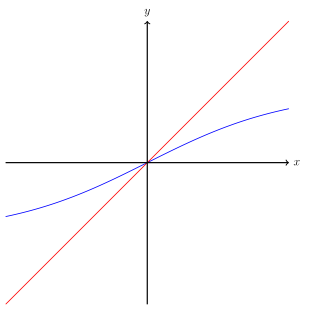
- \begin{align*} \int \textrm{arcosh} x \d x &= \left [x \textrm{arcosh} x \right] - \int \frac{x}{\sqrt{x^2-1}} \d x \\ &= x \textrm{arcosh} x - \sqrt{x^2-1}+C \\ \int \frac{x-1}{\sqrt{x^2-1}} &= \sqrt{x^2-1} - \textrm{arcosh} x +C \end{align*} Therefore \begin{align*} && \int_1^x \textrm{arcosh} t \d t &> \int_1^x \frac{t-1}{\sqrt{t^2-1}} \d t \\ \Rightarrow && x \textrm{arcosh} x - \sqrt{x^2-1} - 0 &> \sqrt{x^2-1} - \textrm{arcosh} x - 0 \\ \Rightarrow && (x+1) \textrm{arcosh} x &> 2\sqrt{x^2-1} \\ \Rightarrow && \textrm{arcosh} x & > 2\frac{\sqrt{x^2-1}}{x+1} \\ &&&= 2 \frac{\sqrt{x-1}}{\sqrt{x+1}} \\ &&&= 2 \frac{x-1}{\sqrt{x^2-1}} \end{align*}
- Integrating both sides again, \begin{align*} && \int_1^x \textrm{arcosh} t \d t &> 2 \int_1^x \frac{t-1}{\sqrt{t^2-1}} \d t \\ \Rightarrow && x \textrm{arcosh} x - \sqrt{x^2-1} &> 2\left (\sqrt{x^2-1} - \textrm{arcosh}x \right) \\ \Rightarrow && (x+2)\textrm{arcosh} x &> 3 \sqrt{x^2-1} \\ \Rightarrow && \textrm{arcosh} x &> 3 \frac{\sqrt{x^2-1}}{x+2} \end{align*}
2008 Paper 3 Q6
In this question, \(p\) denotes \(\dfrac{\d y}{\d x}\,\).
- Given that \[ y=p^2 +2 xp\,, \] show by differentiating with respect to \(x\) that \[ \frac{\d x}{\d p} = -2 - \frac {2x} p . \] Hence show that \(x = -\frac23p +Ap^{-2}\,,\) where \(A\) is an arbitrary constant. Find \(y\) in terms of \(x\) if \(p=-3\) when \(x=2\).
- Given instead that \[ y=2xp +p \ln p\,,\] and that \(p=1\) when \(x=-\frac14\), show that \(x=-\frac12 \ln p - \frac14\,\) and find \(y\) in terms of \(x\).
2007 Paper 1 Q6
- Given that \(x^2 - y^2 = \left( x - y \right)^3\) and that \(x-y = d\) (where \(d \neq 0\)), express each of \(x\) and \(y\) in terms of \(d\). Hence find a pair of integers \(m\) and \(n\) satisfying \(m-n = \left( \sqrt {m} - \sqrt{n} \right)^3\) where \(m > n > 100\).
- Given that \(x^3 - y^3 = \left( x - y \right)^4\) and that \(x-y = d\) (where \(d \neq 0\)), show that \(3xy = d^3 - d^2\). Hence show that \[ 2x = d \pm d \sqrt {\frac{4d-1 }{3}} \] and determine a pair of distinct positive integers \(m\) and \(n\) such that \(m^3 - n^3 = \left( m - n \right)^4\).
Solution:
- \(\,\) \begin{align*} && x^2-y^2 &=(x-y)^3 \\ \Rightarrow && x+y &=d^2 \\ && x-y &= d \\ \Rightarrow && x &= \tfrac12(d^2+d) \\ && y &= \tfrac12(d^2-d) \end{align*} Therefore consider \(x^2 = m, y^2 = n\), so \(m = \tfrac14(d^2+d)^2, n = \tfrac14(d^2-d)^2\) so we want \(d^2-d > 20\), so \(d = 6, n = 225, m = 441\).
- \(\,\) \begin{align*} && x^3-y^3 &= (x-y)^4 \\ \Rightarrow && x^2+xy+y^2 &= (x-y)^3 \\ && d^3 &= (x-y)^2+3xy \\ && d^3 &= d^2 + 3xy \\ \Rightarrow && 3xy &= d^3 - d^2 \\ \Rightarrow && 3x(x-d) &= d^3-d^2 \\ \Rightarrow && 0 &= 3x^2-3dx-(d^3-d^2) \\ \Rightarrow && 2x &=d \pm \sqrt{d^2+4\frac{(d^3-d^2)}{3}} \\ &&&= d \pm d \sqrt{\frac{3+4d-4}{3}} \\ &&&= d \pm d \sqrt{\frac{4d-1}{3}} \end{align*} Therefore we need \(\frac{4d-1}{3}\) to be an odd square. \(y = x-d = -\frac{d}{2} \pm \frac{d}{2} \sqrt{\frac{4d-1}{3}}\). Since we want positive values, we should take the positive square roots. \(d = \frac{3 \cdot 3^2 + 1}{4} = 7\) we have \(2x = 7 +7 \cdot 3 = 28 \Rightarrow x = 14, y = 7\)