Problems
Filters
51 problems found
1993 Paper 1 Q12
In a clay pigeon shoot the target is launched vertically from ground level with speed \(v\). At a time \(T\) later the competitor fires a rifle inclined at angle \(\alpha\) to the horizontal. The competitor is also at ground level and is a distance \(l\) from the launcher. The speed of the bullet leaving the rifle is \(u\). Show that, if the competitor scores a hit, then \[ l\sin\alpha-\left(vT-\tfrac{1}{2}gT^{2}\right)\cos\alpha=\frac{v-gT}{u}l. \] Suppose now that \(T=0\). Show that if the competitor can hit the target before it hits the ground then \(v < u\) and \[ \frac{2v\sqrt{u^{2}-v^{2}}}{g}>l. \]
1992 Paper 2 Q11
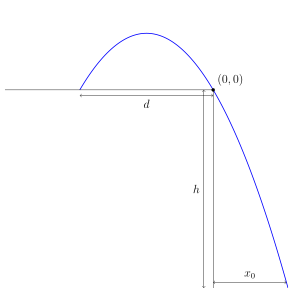
I am standing next to an ice-cream van at a distance \(d\) from the top of a vertical cliff of height \(h\). It is not safe for me to go any nearer to the top of the cliff. My niece Padma is on the broad level beach at the foot of the cliff. I have just discovered that I have left my wallet with her, so I cannot buy her an ice-cream unless she can throw the wallet up to me. She can throw it at speed \(V\), at any angle she chooses and from anywhere on the beach. Air resistance is negligible; so is Padma's height compared to that of the cliff. Show that she can throw the wallet to me if and only if \[ V^{2}\geqslant g(2h+d). \]
Solution:
1991 Paper 2 Q11
The Ruritanian army is supplied with shells which may explode at any time in flight but not before the shell reaches its maximum height. The effect of the explosion on any observer depends only on the distance between the exploding shell and the observer (and decreases with distance). Ruritanian guns fire the shells with fixed muzzle speed, and it is the policy of the gunners to fire the shell at an angle of elevation which minimises the possible damages to themselves (assuming the ground is level) - i.e. they aim so that the point on the descending trajectory that is nearest to them is as far away as possible. With that intention, they choose the angle of elevation that minimises the damage to themselves if the shell explodes at its maximum height. What angle do they choose? Does the shell then get any nearer to the gunners during its descent?
1990 Paper 1 Q11
A shell of mass \(m\) is fired at elevation \(\pi/3\) and speed \(v\). Superman, of mass \(2m\), catches the shell at the top of its flight, by gliding up behind it in the same horizontal direction with speed \(3v\). As soon as Superman catches the shell, he instantaneously clasps it in his cloak, and immediately pushes it vertically downwards, without further changing its horizontal component of velocity, but giving it a downward vertical component of velocity of magnitude \(3v/2\). Calculate the total time of flight of the shell in terms of \(v\) and \(g\). Calculate also, to the nearest degree, the angle Superman's flight trajectory initially makes with the horizontal after releasing the shell, as he soars upwards like a bird. {[}Superman and the shell may be regarded as particles.{]}
Solution: The particle has initial velocity \(\displaystyle \binom{v \cos \frac{\pi}{3}}{v \sin \frac{\pi}{3}}\) and acceleration \(\displaystyle \binom{0}{-g}\). It will have zero vertical speed (ie be at the top of its trajectory) when \(t = \frac{\sqrt{3}v}{2g}\). Since \(0 = v^2-u^2 + 2as\) the height achieved will be \(\frac{3v^2}{8g}\) At this point it will need to travel the same distance again, but this time the initial speed is \(\frac{3v}{2}\) so: \begin{align*} && \frac{3v^2}{8g} &= \frac{3v}{2} t + \frac12 g t^2 \\ \Rightarrow && 0 &= 4g^2t^2+12vgt - 3v^2 \\ \Rightarrow && t &= \l \frac{-3+2\sqrt{3}}{2} \r \frac{v}{g} \end{align*} Therefore the total time is: \begin{align*} \l \frac{\sqrt{3}}{2} - \frac32 + \sqrt{3} \r \frac{v}{g} &= \frac{3\sqrt{3}-3}{2}\frac{v}{g} \end{align*} \begin{align*} COM(\uparrow): && 0 &= 2m v_y - m \frac{3}{2}v \\ \Rightarrow &&v_y &= \frac34 v \\ COM(\rightarrow): && 3mV &= 2m (3v) +m \frac{v}{2} \\ \Rightarrow && V &= \frac{13}6\\ \end{align*} Therefore superman is now travelling at a vector of \(\displaystyle \binom{\frac{13}6}{\frac34}v\) ie an angle of \(\tan^{-1} \frac 9{26}\) to the horizontal, approximately \(19^\circ\)
1989 Paper 1 Q11
A shot-putter projects a shot at an angle \(\theta\) above the horizontal, releasing it at height \(h\) above the level ground, with speed \(v\). Show that the distance \(R\) travelled horizontally by the shot from its point of release until it strikes the ground is given by \[ R=\frac{v^{2}}{2g}\sin2\theta\left(1+\sqrt{1+\frac{2hg}{v^{2}\sin^{2}\theta}}\right). \] The shot-putter's style is such that currently \(\theta=45^{\circ}\). Determine (with justification) whether a small decrease in \(\theta\) will increase \(R\). [Air resistance may be neglected.]
Solution: Notice that \(u_x = v \cos \theta, u_y = v \sin \theta\). We are interested in the time taken for the shot to hit the ground. \(-h = u_y t -\frac12 g t^2\) since our distance will be \(v \cos \theta \cdot t\). Solving this quadratic for \(t\) we obtain: \begin{align*} && 0 &= h + v \sin \theta \cdot t - \frac12 g \cdot t^2 \\ \Rightarrow && t_\pm &= \frac{-v \sin \theta \pm \sqrt{v^2 \sin^2 \theta+2hg}}{-g} \\ \Rightarrow && t_- &= \frac{v \sin \theta+v\sin \theta \sqrt{1 + \frac{2hg}{v^2 \sin^2 \theta}}}{g} \\ \Rightarrow && v \cos \theta t_{-} &= \frac{v^2}{g} \cos \theta \sin \theta \left( 1 + \sqrt{1 + \frac{2hg}{v^2 \sin^2 \theta}} \right) \\ &&&= \frac{v^2}{2g} \sin 2 \theta \left( 1 + \sqrt{1 + \frac{2hg}{v^2 \sin^2 \theta}} \right) \end{align*} Differentiating \(R\) wrt to \(\theta\) at \(\frac{\pi}{4}\) we obtain: \begin{align*} \frac{\d R}{\d \theta} &= \frac{v^2}{2g} \left (2 \cos 2 \theta + 2 \cos 2 \theta \sqrt{1 + \frac{2hg}{v^2 \sin^2 \theta}} + \sin 2\theta \left ( 1 + \frac{2hg}{v^2 \sin^2 \theta}\right)^{-\frac12} \frac12 \frac{2hg} {v^2}(-2) \frac{\cos \theta}{\sin^3 \theta}\right) \\ \frac{\d R}{\d \theta} \biggr \rvert_{\theta = \frac{\pi}{4}} &=\frac{v^2}{2g}\left(0+0- 4\left ( 1 + \frac{4hg}{v^2 }\right)^{-\frac12} \frac{hg} {v^2} \right) \\ &< 0 \end{align*} Therefore, since \(R\) is locally decreasing in \(\theta\) he should reduce his angle of projection slightly.
1988 Paper 1 Q10
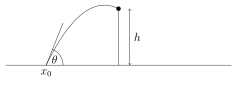
A sniper at the top of a tree of height \(h\) is hit by a bullet fired from the undergrowth covering the horizontal ground below. The position and elevation of the gun which fired the shot are unknown, but it is known that the bullet left the gun with speed \(v\). Show that it must have been fired from a point within a circle centred on the base of the tree and of radius \((v/g)\sqrt{v^{2}-2gh}\). {[}Neglect air resistance.{]}
Solution: