Problems
Filters
233 problems found
2015 Paper 1 Q5
- The function \(\f\) is defined, for \(x>0\), by \[ \f(x) =\int_{1}^3 (t-1)^{x-1} \, \d t \,. \] By evaluating the integral, sketch the curve \(y=\f(x)\).
- The function \(\g\) is defined, for \(-\infty < x < \infty\), by \[ \g(x)= \int_{-1}^1 \frac 1 {\sqrt{1-2xt +x^2} \ }\, \d t \,.\] By evaluating the integral, sketch the curve \(y=\g(x)\).
Solution:
- \(\,\)
\begin{align*}
&& f(x) &= \int_1^3 (t-1)^{x-1} \d t \\
&&&= \left [ \frac1x(t-1)^{x} \right]_1^3 \\
&&&= \frac{2^x}{x}
\end{align*}

- \(\,\)
\begin{align*}
&& g(x) &= \int_{-1}^1 \frac{1}{\sqrt{1-2xt+x^2}} \d t \\
&&&= \left [ -\frac{1}{x}(1 +x^2 - 2xt)^{\frac12} \right]_{-1}^1 \\
&&&= \frac1x \left ( \sqrt{1+x^2+2x}-\sqrt{1+x^2-2x}\right) \\
&&&= \frac1x \left ( |1+x|-|1-x| \right)
\end{align*}

2015 Paper 2 Q6
- Show that \[ \mathrm{sec}^2\left(\tfrac14\pi-\tfrac12 x\right)=\frac{2}{1+\sin x} \,. \] Hence integrate \(\dfrac{1}{1+\sin x}\) with respect to \(x\).
- By means of the substitution \(y=\pi -x\), show that \[ \int_0^\pi x \f (\sin x)\, \d x = \frac \pi 2 \int_0^\pi \f(\sin x) \, \d x ,\] where \(\mathrm{f}\) is any function for which these integrals exist. Hence evaluate \[ \int_0^\pi \frac x {1+\sin x} \, \d x \,. \]
- Evaluate \[ \int_0^\pi\frac{ 2x^3 -3\pi x^2}{(1+\sin x)^2}\, \d x .\]
Solution:
- \(\,\) \begin{align*} && \sec^2\left(\tfrac14\pi-\tfrac12 x\right) &= \frac{1}{\cos^2 \left(\tfrac14\pi-\tfrac12 x\right)} \\ &&&= \frac{1}{\frac{1+\cos 2\left(\tfrac14\pi-\tfrac12 x\right)}{2}} \\ &&&= \frac{2}{1 + \cos \left(\tfrac12\pi- x\right)} \\ &&&= \frac{2}{1+\sin x} \\ \\ && \int \frac{1}{1+\sin x} \d x &= \int \tfrac12\sec^2\left(\tfrac14\pi-\tfrac12 x\right) \d x\\ &&&= - \tan\left(\tfrac14\pi-\tfrac12 x\right) + C \end{align*}
- \(\,\) \begin{align*} && I &= \int_0^{\pi} x f(\sin x) \d x \\ y = \pi - x, \d y = - \d x: &&&= \int_{y=\pi}^{y = 0} (\pi - y) f(\sin(\pi - y))(-1) \d y \\ &&&= \int_0^\pi (\pi - y) f(\sin y) \d y \\ &&&= \pi \int_0^\pi f(\sin y) \d y - I \\ \Rightarrow && I &= \frac{\pi}{2} \int_0^\pi f(\sin x) \d x \\ \\ \Rightarrow && \int_0^{\pi} \frac{x}{1 + \sin x} \d x &= \frac{\pi}{2} \int_0^{\pi} \frac{1}{1 + \sin x} \d x\\ &&&=\frac{\pi}{2} \left [- \tan\left(\tfrac14\pi-\tfrac12 x\right) \right]_0^{\pi} \\ &&&= \frac{\pi}{2} \left (-\tan (-\tfrac{\pi}{4}) + \tan \tfrac{\pi}{4} \right) \\ &&&= \pi \end{align*}
- \(\,\) \begin{align*} && J &= \int_0^{\pi} \frac{2x^3-3\pi x^2}{(1+\sin x)^2} \d x \\ y = \pi - x: &&&= \int_0^{\pi} \frac{2(\pi-y)^3-3\pi (\pi - y)^2}{(1+\sin x)^2 } \d y \\ &&&= \int_0^{\pi} \frac{-2 y^3 + 3 \pi y^2 - \pi^3}{(1+ \sin x)^2}\\ &&&= -\pi^3 \int_0^{\pi} \frac{1}{(1 + \sin x)^2} \d x -J \\ \Rightarrow && J &= -\frac{\pi^3}{2} \int_0^{\pi} \frac{1}{(1 + \sin x)^2} \d x\\ &&&= -\frac{\pi^3}{2} \int_0^\pi \tfrac14 \sec^4\left(\tfrac14\pi-\tfrac12 x\right) \d x \\ &&&= -\frac{\pi^3}{8} \int_0^\pi \sec^2\left(\tfrac14\pi-\tfrac12 x\right)\left (1 + \tan^2\left(\tfrac14\pi-\tfrac12 x\right) \right) \d x \\ &&&= -\frac{\pi^3}{8} \left [-\frac23 \tan^3\left(\tfrac14\pi-\tfrac12 x\right) - 2 \tan\left(\tfrac14\pi-\tfrac12 x\right) \right]_0^{\pi} \\ &&&= -\frac{\pi^3}{8} \left (\frac43+4 \right) \\ &&&= -\frac{2\pi^3}{3} \end{align*}
2015 Paper 3 Q1
- Let \[ I_n= \int_0^\infty \frac 1 {(1+u^2)^n}\, \d u \,, \] where \(n\) is a positive integer. Show that \[ I_n - I_{n+1} = \frac 1 {2n} I_n \] and deduce that \[ I_{n+1} = \frac{(2n)!\, \pi}{2^{2n+1}(n!)^2} \,. \]
- Let \[ J = \int_0^\infty \f\big( (x- x^{-1})^2\big ) \, \d x \,, \] where \(\f\) is any function for which the integral exists. Show that \[ J = \int_0^\infty x^{-2} \f\big( (x- x^{-1})^2\big) \, \d x \, = \frac12 \int_0^\infty (1 + x^{-2}) \f\big( (x- x^{-1})^2\big ) \, \d x \, = \int_0^\infty \f\big(u^2\big) \,\d u \,. \]
- Hence evaluate \[ \int_0^\infty \frac {x^{2n-2}}{(x^4-x^2+1)^n} \, \d x \,, \] where \(n\) is a positive integer.
Solution: \begin{align*} I_n - I_{n+1} &= \int_0^\infty \frac 1 {(1+u^2)^n}\, \d u - \int_0^\infty \frac 1 {(1+u^2)^{n+1}}\, \d u \\ &= \int_0^\infty \l \frac 1 {(1+u^2)^n}- \frac 1 {(1+u^2)^{n+1}} \r\, \d u \\ &= \int_0^\infty \frac {u^2} {(1+u^2)^{n+1}} \, \d u \\ &= \left [ u \frac{u}{(1+u^2)^{n+1}} \right]_0^{\infty} - \frac{-1}{2n}\int_0^{\infty} \frac{1}{(1+u^2)^n} \d u \tag{\(IBP: u = u, v' = \frac{u}{(1+u^2)^{n+1}}\)}\\ &= \frac{1}{2n} I_n \end{align*} \(\displaystyle I_1 = \int_0^{\infty} \frac{1}{1+u^2} \d u = \left [ \tan^{-1} u \right]_0^\infty = \frac{\pi}{2}\) as expected. We also have, \(I_{n+1} = \frac{2n(2n-1)}{2n \cdot 2n} I_n \), by rearranging the recurrence relation. Therefore, when we multiply out the top we will have \(2n!\) and the bottom we will have two factors of \(n!\) and two factors of \(2^n\) combined with the original \(\frac{\pi}{2}\) we get \[ I_{n+1} = \frac{(2n)! \pi}{2^{2n+1} (n!)^2} \] \begin{align*} J = \int_0^\infty f\big( (x- x^{-1})^2\big ) \, \d x &= \int_{u = \infty}^{u = 0} f((u^{-1}-u)^2)(-u^{-2} )\d u \tag{\(u = x^{-1}, \d u = -x^{-2} \d x\)} \\ &= \int^{u = \infty}_{u = 0} f((u^{-1}-u)^2)u^{-2} \d u \\ &= \int^{\infty}_{0} u^{-2}f((u-u^{-1})^2) \d u \\ \end{align*} Therefore adding the two forms for \(J\) we have \begin{align*} 2 J &= \int_0^\infty f\big( (x- x^{-1})^2\big ) \, \d x + \int_0^\infty x^{-2} f\big( (x- x^{-1})^2\big ) \, \d x \\ &= \int_0^\infty (1+x^{-2}) f\big( (x- x^{-1})^2\big ) \, \d x \end{align*} And letting \(u = x - x^{-1}\), we have \(\d u = (1 + x^{-2}) \d x\), and \(u\) runs from \(-\infty\) to \(\infty\) so we have: \begin{align*} \int_0^\infty (1+x^{-2}) f\big( (x- x^{-1})^2\big ) \, \d x &= \int_{-\infty}^\infty f(u^2) \, \d u \\ &=2 \int_{0}^\infty f(u^2) \, \d u \end{align*} Since both of these are \(2J\) we have the result we are after. Finally, \begin{align*} \int_0^\infty \frac {x^{2n-2}}{(x^4-x^2+1)^n} \, \d x &= \int_0^{\infty} \frac{x^{2n-2}}{x^{2n}(x^2-1+x^{-2})^n} \d x \\ &= \int_0^{\infty} \frac{x^{-2}}{((x-x^{-1})^2+1)^n} \d x \\ &= \int_0^{\infty} \frac{1}{(x^2+1)^n} \d x \tag{Where \(f(x) = (1+x^2)^{-n}\) in \(J\) integral} \\ &= I_n = \frac{(2n-2)! \pi}{2^{2n-1} ((n-1)!)^2} \end{align*}
2015 Paper 3 Q3
In this question, \(r\) and \(\theta\) are polar coordinates with \(r \ge0\) and \(- \pi < \theta\le \pi\), and \(a\) and \(b\) are positive constants. Let \(L\) be a fixed line and let \(A\) be a fixed point not lying on \(L\). Then the locus of points that are a fixed distance (call it \(d\)) from \(L\) measured along lines through \(A\) is called a conchoid of Nicomedes.
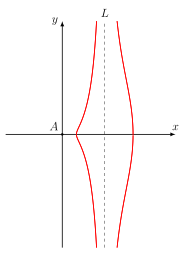
- Show that if \[ \vert r- a \sec\theta \vert = b\,, \tag{\(*\)} \] where \(a>b\), then \(\sec\theta >0\). Show that all points with coordinates satisfying (\(*\)) lie on a certain conchoid of Nicomedes (you should identify \(L\), \(d\) and \(A\)). Sketch the locus of these points.
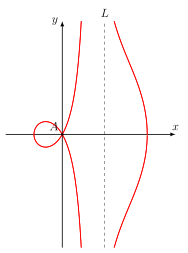
- In the case \(a < b\), sketch the curve (including the loop for which \(\sec\theta<0\)) given by \[ \vert r- a \sec\theta \vert = b\, . \] Find the area of the loop in the case \(a=1\) and \(b=2\). [Note: $ %\displaystyle \int \! \sec\theta \,\d \theta = \ln \vert \sec\theta + \tan\theta \vert + C \,. $]
Solution:
- \(r = a \sec \theta \pm b\). The points on \(r = a \sec \theta \Leftrightarrow r \cos \theta = a \Leftrightarrow x = a\) are points on the line \(x = a\). Therefore points on the curve \(r = a \sec \theta \pm b\) are points which are a distance \(b\) from the line \(x = a\) measured towards \(O\). So \(A\) is the origin and \(d = b\).
- The loop starts and ends when \(r = a \sec \theta - b = 0 \Rightarrow \cos \theta = \frac{a}{b}\), so when \(a = 1, b = 2\), this is \(-\frac{\pi}{3}\) to \(\frac{\pi}{3}\) \begin{align*} && A &= \frac12 \int r^2 \d \theta \\ &&&= \frac12 \int_{-\pi/3}^{\pi/3} \left ( \sec \theta - 2 \right)^2 \d \theta \\ &&&= \frac12 \int_{-\pi/3}^{\pi/3} \left (\sec^2 \theta - 4 \sec \theta + 4\right)\d \theta \\ &&&= \frac12 \left [ \tan \theta -4 \ln | \sec \theta + \tan \theta| + 4 \theta \right]_{-\pi/3}^{\pi/3} \\ &&&= \frac12 \left (\left (\tan \frac{\pi}3 - 4 \ln | \sec \frac{\pi}3 + \tan \frac{\pi}3 | + 4\left ( \frac{\pi}3 \right)\right) - \left (\tan \left (-\frac{\pi}3 \right) - 4 \ln | \sec \left (-\frac{\pi}3 \right)+ \tan\left ( -\frac{\pi}3 \right) | + 4\left ( -\frac{\pi}3 \right)\right) \right) \\ &&&= \frac12 \left ( 2\sqrt{3} - 4 \ln |2 + \sqrt{3}| + 4 \ln |2-\sqrt{3}| + \frac{8\pi}3 \right) \\ &&&= \sqrt{3} + 2\ln \frac{2-\sqrt{3}}{2+\sqrt{3}} + \frac{4\pi}3 \\ &&&= \sqrt{3} + 4 \ln (2 - \sqrt{3})+ \frac{4\pi}3 \end{align*}
2014 Paper 1 Q2
- Show that \(\int \ln (2-x) \d x = -(2-x)\ln (2-x) + (2-x) + c \,,\ \) where \(x<2\).
- Sketch the curve \(A\) given by \(y= \ln \vert x^2-4\vert\).
- Show that the area of the finite region enclosed by the positive \(x\)-axis, the \(y\)-axis and the curve \(A\) is \(4\ln(2+\sqrt3)-2\sqrt3\,\).
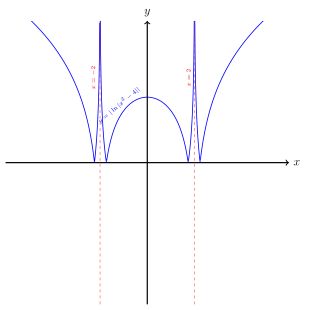
- The curve \(B\) is given by \(y= \vert \ln \vert x^2-4\vert \vert\,\). Find the area between the curve \(B\) and the \(x\)-axis with \(| x| <2\). Note: you may assume that \(t \ln t \to 0\) as \(t\to 0\).
Solution:
- \(\,\) \begin{align*} && \int \ln (2- x) \d x &= \left [ (x-2) \ln (2- x) \right] - \int -\frac{x-2}{2-x} \d x \\ && \int \ln (2- x) \d x &= \left [ (x-2) \ln (2- x) \right] + \int 1 \d x \\ &&&= -(2-x) \ln (2-x) +(2-x) + C \end{align*}
- \(\,\)
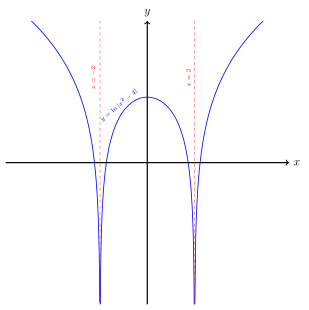
- \begin{align*} && \text{Area} &= \int_0^{\sqrt{3}} \ln | x^2 - 4 | \d x \\ &&&= \int_0^\sqrt{3} \ln(4-x^2) \d x \\ &&&= \int_0^\sqrt{3} \left ( \ln(2-x) + \ln (2+x) \right) \d x \\ &&&= \left [ -(2-x) \ln (2-x) +(2-x) +(2+x)\ln(2+x)-(2+x)\right]_0^{\sqrt{3}} \\ &&&= \left ( -(2-\sqrt{3}) \ln (2-\sqrt{3}) +(2-\sqrt{3}) +(2+\sqrt{3})\ln(2+\sqrt{3})-(2+\sqrt{3}) \right) - \\ &&&\quad \quad \left (- 2\ln (2)+2 +2\ln(2)-2 \right) \\ &&&=\left ( -(2-\sqrt{3}) \ln \left ( \frac{1}{2+\sqrt{3}} \right) -2\sqrt{3} +(2+\sqrt{3})\ln(2+\sqrt{3}) \right) \\ &&&= 4\ln(2 + \sqrt{3}) - 2 \sqrt{3} \end{align*}
- \begin{align*} && \text{Area} &= 2 \left ( \int_0^\sqrt{3} \ln (4-x^2) \d x - \lim_{t \to 2}\int_{\sqrt{3}}^t \ln(4-x^2) \d x \right) \\ &&&= 8\ln(2 + \sqrt{3})-4\sqrt{3} - 2 \lim_{t \to 2}\int_{\sqrt{3}}^t \left ( \ln (2-x) + \ln (2+x) \right) \d x \\ &&&= 8\ln(2 + \sqrt{3})-4\sqrt{3} - 2 \lim_{t \to 2} \left [ -(2-x) \ln (2-x) +(2-x) +(2+x)\ln(2+x)-(2+x)\right]_{\sqrt{3}}^{t} \\ &&&= 16 \ln(2+\sqrt{3})-8\sqrt{3} - 2 \lim_{t \to 2} \left(-(2-t) \ln (2-t) +(2-t) +(2+t)\ln(2+t)-(2+x) \right) \\ &&&= 16 \ln(2+\sqrt{3})-8\sqrt{3} -2(4 \ln4-4) \\ &&&= 16 \ln(2 + \sqrt{3}) - 16 \ln 2 +8(1-\sqrt{3}) \end{align*}
2014 Paper 1 Q3
The numbers \(a\) and \(b\), where \(b > a\ge0\), are such that \[ \int_a^b x^2 \d x = \left ( \int_a^b x \d x\right)^{\!\!2}\,. \]
- In the case \(a=0\) and \(b>0\), find the value of \(b\).
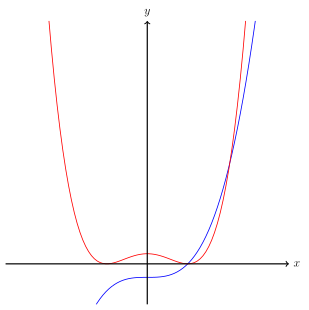
- In the case \(a=1\), show that \(b\) satisfies \[ 3b^3 -b^2-7b -7 =0\,. \] Show further, with the help of a sketch, that there is only one (real) value of \(b\) that satisfies this equation and that it lies between \(2\) and \(3\).
- Show that \(3p^2 + q^2 = 3p^2q\), where \(p=b+a\) and \(q=b-a\), and express \(p^2\) in terms of \(q\). Deduce that \(1< b-a\le\frac43\).
Solution:
- \(\,\) \begin{align*} && \int_0^b x^2 \d x &= \left ( \int_0^b x \d x \right)^2 \\ \Rightarrow && \frac{b^3}{3} &= \left ( \frac{b^2}{2} \right)^2 \\ \Rightarrow && b &= \frac{4}{3} \end{align*}
- \(\,\)
\begin{align*}
&& \int_1^b x^2 \d x &= \left ( \int_1^b x \d x \right)^2 \\
\Rightarrow && \frac{b^3}{3} - \frac{1}{3} &= \left ( \frac{b^2}{2} - \frac{1}{2} \right)^2 \\
\Rightarrow && 4(b^3 - 1) &= 3(b^2-1)^2 \\
\Rightarrow && 4(b^3-1) &= 3(b^4-2b^2+1) \\
\Rightarrow && 0 &= 3b^4-4b^3-6b^2+7 \\
&&&= (b-1)(3b^3-b^2-7b-7) \\
\Rightarrow && 0 &= 3b^3-b^2-7b-7
\end{align*}
Let \(f(x) = 3x^3-x^2-7x-7\) then \(f(2) = 3 \cdot 8 - 4 - 14 - 7 = -1 < 0\), \(f(3) = 3 \cdot 27 - 9 - 21 - 7 = 44 > 0\) therefore the root must lie between \(2\) and \(3\).
- \(,\) \begin{align*} && \int_a^b x^2 \d x &= \left ( \int_a^b x \d x \right)^2 \\ \Rightarrow && \frac{b^3}{3} - \frac{a^3}{3} &= \left ( \frac{b^2}{2} - \frac{a^2}{2} \right)^2 \\ \Rightarrow && 4(b^3 - a^3) &= 3(b^2-a^2)^2 \\ \Rightarrow && 4(b^2+ab+a^2) &= 3(b-a)(b+a)^2 \\ \Rightarrow && 4 \left ( \left ( \frac{p+q}{2}\right)^2+\left ( \frac{p+q}{2}\right)\left ( \frac{p-q}{2}\right)+\left ( \frac{p-q}{2}\right)^2\right) &= 3qp^2 \\ \Rightarrow && 3p^2 + q^2 &= 3qp^2 \\ \Rightarrow && 3p^2(q-1) &= q^2 \\ \Rightarrow && p^2 &= \frac{q^2}{3(q-1)} \\ \Rightarrow && 1 &\leq \frac{1}{3(q-1)} \\ \Rightarrow && 3(q-1) &\leq 1 \\ \Rightarrow && q & \leq \frac{4}{3} \\ \end{align*}
2014 Paper 1 Q13
A continuous random variable \(X\) has a triangular distribution, which means that it has a probability density function of the form \[ \f(x) = \begin{cases} \g(x) & \text{for \(a< x \le c\)} \\ \h(x) & \text{for \(c\le x < b\)} \\ 0 & \text{otherwise,} \end{cases} \] where \(\g(x)\) is an increasing linear function with \(\g(a)=0\), \(\h(x)\) is a decreasing linear function with \(\h(b) =0\), and \(\g(c)=\h(c)\). Show that \(\g(x) = \dfrac{2(x-a)}{(b-a)(c-a)}\) and find a similar expression for \(\h(x)\).
- Show that the mean of the distribution is \(\frac13(a+b+c)\).
- Find the median of the distribution in the different cases that arise.
Solution: Since \(\int f(x) \, dx = 1\), and \(f(x)\) is a triangle with base \(b-a\), it must have height \(\frac{2}{b-a}\) in order to have the desired area. Since \(g(a) = 0, g(c) = \frac{2}{b-a}\), \(g(x) = A(x-a)\) and \(\frac{2}{b-a} = A (c-a) \Rightarrow g(x) = \frac{2(x-a)}{(b-a)(c-a)}\) as required. Similarly, \(h(x) = B(x-b)\) and \(\frac{2}{b-a} = B(c-b) \Rightarrow h(x) = \frac{2(b-x)}{(b-a)(b-c)}\) The mean of the distribution will be: \begin{align*} \int_a^b xf(x) \, dx &= \int_a^c xg(x) \, dx + \int_c^b xh(x) \, dx \\ &= \frac{2}{(b-a)(c-a)} \int_a^c x(x-a) dx + \frac{2}{(b-a)(b-c)} \int_c^b x(b-x) \, dx \\ &= \frac{2}{(b-a)} \l \frac{1}{c-a} \left [ \frac{x^3}{3} - a\frac{x^2}{2} \right ]_a^c + \frac{1}{b-c} \left [ b\frac{x^2}{2} - \frac{x^3}{3} \right ]_c^b\r \\ &= \frac{2}{(b-a)} \l \frac{1}{c-a} \l \frac{c^3}{3} - a\frac{c^2}{2} - \frac{a^3}{3} + \frac{a^3}{2} \r + \frac{1}{b-c} \l \frac{b^3}{2} - \frac{b^3}{3} - \frac{bc^2}{2} + \frac{c^3}{3} \r \r \\ &= \frac{2}{(b-a)} \l \l \frac{c^2+ac+a^2}{3} - \frac{a(a+c)}{2} \r +\l \frac{b(b+c)}{2} - \frac{b^2+bc+c^2}{3} \r\r \\ &= \frac{2}{(b-a)} \l \frac{2c^2+2ac+2a^2}{6} - \frac{3a^2+3ac}{6} + \frac{3b^2+3bc}{6} - \frac{2b^2+2bc+2c^2}{6} \r \\ &= \frac{2}{(b-a)} \l \frac{-a^2+b^2-ac+bc}{6} \r \\ &= \frac{a+b+c}{3} \\ \end{align*} The median \(M\) satisfies: \begin{align*} && \int_a^M f(x) \, dx &= \frac12 \\ \end{align*} The left hand triangle will have area: \(\frac{c-a}{b-a}\) which will be \(\geq \frac12\) if \(c \geq \frac{a+b}{2}\). In this case we need \begin{align*} && \frac{(M-a)^2}{(b-a)(c-a)} &= \frac12 \\ \Rightarrow && M &= a + \sqrt{\frac12 (b-a)(c-a)} \end{align*} Otherwise, we need: \begin{align*} && \frac{(b-M)^2}{(b-a)(b-c)} &= \frac12 \\ \Rightarrow && M &= b - \sqrt{\frac12 (b-a)(b-c)} \end{align*} These are consistent, if \(c = \frac{b+a}{2}\)
2014 Paper 2 Q2
This question concerns the inequality \begin{equation} \int_0^\pi \bigl( f(x) \bigr)^2 \d x \le \int_0^\pi \bigl( f'(x)\bigr)^2 \d x\,.\tag{\(*\)} \end{equation}
- Show that \((*)\) is satisfied in the case \(f(x)=\sin nx\), where \(n\) is a positive integer. Show by means of counterexamples that \((*)\) is not necessarily satisfied if either \(f(0) \ne 0\) or \(f(\pi)\ne0\).
- You may now assume that \((*)\) is satisfied for any (differentiable) function \(f\) for which \(f(0)=f(\pi)=0\). By setting \(f(x) = ax^2 + bx +c\), where \(a\), \(b\) and \(c\) are suitably chosen, show that \(\pi^2\le 10\). By setting \(f(x) = p \sin \frac12 x + q\cos \frac12 x +r\), where \(p\), \(q\) and \(r\) are suitably chosen, obtain another inequality for \(\pi\). Which of these inequalities leads to a better estimate for \(\pi^2\,\)?
Solution:
- If \(f(x) = \sin nx\) then \(f'(x) = n \cos n x\) and so \begin{align*} && LHS &= \int_0^\pi \sin^2 n x \d x \\ &&&= \left [ \frac{x+\frac1{2n}\sin 2n x}{2} \right ]_0^{\pi} \\ &&&= \frac{\pi}{2} \\ \\ && RHS &= \int_0^{\pi} n^2 \cos^2 n x \d x \\ &&&= n^2 \left [ \frac{\frac{1}{2n}\sin 2n x + x}{2} \right]_0^{\pi} \\ &&&= n^2\frac{\pi}{2} \geq LHS \end{align*} [\(f(0) = 0, f(\pi) \neq 0\)] Suppose \(f(x) = x\) then \(f'(x) = 1\) and \(LHS = \frac{\pi^3}{3} > \pi = RHS\). [\(f(0) \neq 0, f(\pi) = 0\)] Suppose \(f(x) = \pi - x\) then \(f'(x) = -1\) and \(LHS = \frac{\pi^3}{3} > \pi = RHS\)
- Suppose \(f(x) = x(\pi - x)\) then \(f'(x) = \pi - 2x\) and so \begin{align*} && \int_0^\pi x^2(\pi-x)^2 \d x &\leq \int_0^\pi (\pi-2x)^2 \d x \\ \Leftrightarrow && \left [\pi^2 \frac{x^3}{3} - 2\pi \frac{x^4}{4} + \frac{x^5}{5} \right]_0^{\pi} &\leq \left [ \pi^2x - 4\pi \frac{x^2}{2} + \frac{4x^3}{3} \right]_0^{\pi} \\ \Leftrightarrow && \pi^5 \left (\frac13 - \frac12+\frac15 \right) &\leq \pi^3 \left ( 1 - 2+\frac43 \right) \\ \Leftrightarrow && \pi^2 \frac{1}{30} &\leq \frac13 \\ \Leftrightarrow && \pi^2 &\leq 10 \end{align*} Suppose \(f(x) = p\sin \tfrac12 x + q \cos \tfrac12 x + r\), so \(f(0) = q + r\) and \(f(\pi) = p + r\), so say \(p = q = 1, r = -1\) \begin{align*} && LHS &= \int_0^{\pi} \left ( \sin \tfrac12 x + \cos \tfrac12 x-1\right)^2 \d x \\ &&&=\int_0^\pi \left ( \sin^2 \tfrac12 x + \cos^2 \tfrac12 x+1-2\sin \tfrac12 x - 2\cos \tfrac12 x+ \sin x \right)\\ &&&= \left [2x + 4\cos \tfrac12 x - 4\sin \tfrac12 x - \cos x \right]_0^{\pi} \\ &&&= \left ( 2\pi -4+1 \right) - \left ( 4-1 \right) \\ &&&= 2\pi -6\\ \\ && RHS&= \int_0^{\pi} \left ( \tfrac12 \cos \tfrac12 x -\tfrac12 \sin \tfrac12 x\right)^2 \d x \\ &&&= \int_0^{\pi} \left ( \tfrac14 \cos^2 \tfrac12 x +\tfrac14 \sin^2 \tfrac12 x-\tfrac14 \sin x\right) \d x \\ &&&= \frac{\pi}{4} - \frac12 \\ \Rightarrow && 2\pi -6 &\leq \frac{\pi}{4} - \frac12 \\ \Rightarrow && \frac{7\pi}{4} &\leq \frac{11}{2} \\ \Rightarrow && \pi &\leq \frac{22}{7} \end{align*} \(22^2/7^2 = 484/49 < 10\) therefore \(\pi \leq \frac{22}{7}\) is the better estimate.
2014 Paper 2 Q4
- By using the substitution \(u=1/x\), show that for \(b>0\) \[ \int_{1/b}^b \frac{x \ln x}{(a^2+x^2)(a^2x^2+1)} \d x =0 \,. \]
- By using the substitution \(u=1/x\), show that for \(b>0\), \[ \int_{1/b}^b \frac{\arctan x}{x} \d x = \frac{\pi \ln b} 2\,. \]
- By using the result \( \displaystyle \int_0^\infty \frac 1 {a^2+x^2} \d x = \frac {\pi}{2 a} \) (where \(a > 0\)),and a substitution of the form \(u=k/x\), for suitable \(k\), show that \[ \int_0^\infty \frac 1 {(a^2+x^2)^2} \d x = \frac {\pi}{4a^3 } \, \ \ \ \ \ \ (a > 0). \]
Solution:
- \begin{align*} && I &= \int_{1/b}^b \frac{x \ln x}{(a^2+x^2)(a^2x^2+1} \d x \\ u = 1/x, \d u = -1/x^2 \d x: &&&= \int_{u=b}^{u=1/b} \frac{1/u \ln(1/u)}{(a^2+u^{-2})(a^2u^{-2}+1)} (- \frac{1}{u^2}) \d u \\ &&&= \int_{1/b}^b \frac{-u\ln u}{(a^2u^2+1)(a^2+u^2)} \d u \\ &&&= -I \\ \Rightarrow && I &= 0 \end{align*}
- \(\,\) \begin{align*} && I &= \int_{1/b}^b \frac{\arctan x}{x} \d x \\ u = 1/x, \d x = -1/u^2 \d u: &&&= \int_{u=b}^{u=1/b} \frac{\arctan \frac1u}{\frac1u} \frac{-1}{u^2} \d u \\ &&&= \int_{1/b}^b \frac{\arctan \frac1u}{u} \d u \\ \Rightarrow && 2I &= \int_{1/b}^b \frac{\arctan x + \arctan \frac1x}{x} \d x \\ &&&= \int_{1/b}^b \frac{\frac{\pi}2}{x} \d x \\ &&&= \pi \ln b \\ \Rightarrow && I &= \frac{\pi}{2} \ln b \end{align*}
- \(\,\) \begin{align*} && I_a &= \int_0^{\infty} \frac{1}{(a^2+x^2)^2} \d x \\ u = a/x, \d x = -a/u^2 \d u:&&&= \int_{u=0}^{u=\infty} \frac{1}{\left (a^2+\frac{a^2}{u^2} \right)^2} \frac{a}{u^2} \d u \\ &&&= \frac1{a^3}\int_0^{\infty} \frac{1}{(u+1/u)^2} \d u \\ &&&= \frac{1}{a^3} \int_0^{\infty} \frac{u^2}{(u^2+1)^2} \d u \\ &&&= \frac{1}{a^3} \int_0^{\infty} \frac{u^2+1-1}{(u^2+1)^2} \d u \\ &&&= \frac{1}{a^3} \int_0^{\infty} \frac{1}{(u^2+1)} - \frac{1}{(u^2+1)^2} \d u \\ &&&= \frac1{a^3} \frac{\pi}{2} - \frac{1}{a^3} I_1 \\ \Rightarrow && 2I_1 &= \frac{\pi}{2} \\ \Rightarrow && I_1 &= \frac{\pi}{4} \\ \Rightarrow && I_a &= \frac{\pi}{4a^3} \end{align*}
2014 Paper 3 Q2
- Show, by means of the substitution \(u=\cosh x\,\), that \[ \int \frac{\sinh x}{\cosh 2x} \d x = \frac 1{2\sqrt2} \ln \left\vert \frac{\sqrt2 \cosh x - 1}{\sqrt2 \cosh x + 1 } \right\vert + C \,.\]
- Use a similar substitution to find an expression for \[ \int \frac{\cosh x}{\cosh 2x} \d x \,.\]
- Using parts (i) and (ii) above, show that \[ \int_0^1 \frac 1{1+u^4} \d u = \frac{\pi + 2\ln(\sqrt2 +1)}{4\sqrt2}\,. \]
Solution:
- \begin{align*} && \int \frac{\sinh x}{\cosh 2x} \d x &= \int \frac{\sinh x}{2\cosh^2 x -1} \d x \\ u = \cosh x, \d u = \sinh x \d x &&&= \int \frac{1}{2u^2 -1} \d u \\ &&&= \int\frac12 \left ( \frac{1}{\sqrt{2}u-1}-\frac{1}{\sqrt{2}u+1} \right) \d u \\ &&&= \frac1{2\sqrt{2}} \left (\ln (\sqrt{2}u-1) - \ln(\sqrt{2}u+1) \right) + C \\ &&&= \frac{1}{2\sqrt{2}} \ln \left ( \frac{\sqrt{2}\cosh x -1}{\sqrt{2}\cosh x +1} \right) + C \end{align*}
- \begin{align*} && \int \frac{\cosh x}{\cosh 2x} \d x &= \int \frac{\cosh x}{1+2\sinh^2 x} \d x \\ u = \sinh x && &= \int \frac{1}{1+2u^2} \d u \\ &&&=\frac{1}{\sqrt{2}} \tan^{-1} (\sqrt{2}u) + C \\ &&&= \frac{1}{\sqrt{2}} \tan^{-1}(\sqrt{2}\sinh x) + C \end{align*}
- \begin{align*} u = e^x : && \int_0^1 \frac{1}{1+u^4} \d u &= \int_{x=-\infty}^{x=0} \frac{1}{1+e^{4x}}e^{x} \d x \\ &&&= \int_{-\infty}^{0} \frac{e^{-x}}{e^{2x}+e^{-2x}} \d x \\ &&&= \int_{-\infty}^{0} \frac{\cosh x - \sinh x}{2\cosh 2x } \d x \\ &&&= \frac12 \int_{-\infty}^{0} \frac{\cosh x}{\cosh 2x} \d x - \frac12 \int_{-\infty}^{0} \frac{\sinh x}{\cosh 2x} \\ &&&= \frac12 \left [\frac{1}{\sqrt{2}} \tan^{-1}(\sqrt{2}\sinh x) \right]_{-\infty}^{0}-\frac12 \left [ \frac{1}{2\sqrt{2}}\ln \left ( \frac{\sqrt{2}\cosh x -1}{\sqrt{2}\cosh x +1} \right) \right]_{-\infty}^{0} \\ &&&= 0 - \frac1{2\sqrt{2}} \frac{-\pi}{2}-\left (\frac1{4\sqrt{2}} \ln \left (\frac{\sqrt{2}-1}{\sqrt{2}+1} \right) - 0 \right) \\ &&&= \frac{\pi - \ln((\sqrt{2}-1)^2)}{4\sqrt{2}} \\ &&&= \frac{\pi + 2 \ln(1+\sqrt{2})}{4\sqrt{2}} \end{align*}
2014 Paper 3 Q4
- Let \[ I = \int_0^1 \bigl((y')^2 -y^2\bigr)\d x \qquad\text{and}\qquad I_1=\int_0^1 (y'+y\tan x)^2 \d x \,, \] where \(y\) is a given function of \(x\) satisfying \(y=0\) at \(x=1\). Show that \(I-I_1=0\) and deduce that \(I\ge0\). Show further that \(I=0\) only if \(y=0\) for all \(x\) (\(0\le x \le 1\)).
- Let \[ J = \int_0^1 \bigl((y')^2 -a^2y^2\bigr)\d x \,, \] where \(a\) is a given positive constant and \(y\) is a given function of \(x\), not identically zero, satisfying \(y=0\) at \(x=1\). By considering an integral of the form \[ \int_0^1 (y'+ay\tan bx)^2 \d x \,, \] where \(b\) is suitably chosen, show that \(J\ge0\). You should state the range of values of \(a\), in the form \(a < k\), for which your proof is valid. In the case \(a=k\), find a function \(y\) (not everywhere zero) such that \(J=0\).
Solution:
- \begin{align*} && I - I_1 &= \int_0^1 \left ( \left ( y' \right)^2 - y^2 \right) \d x - \int_0^1 \left ( y' + y \tan x \right)^2 \d x\\ &&&= \int_0^1 \left ( \left ( y' \right)^2 - y^2 \right) - \left ( y' + y \tan x \right)^2 \d x\\ &&&= \int_0^1 \left (-y^2-2yy' \tan x - y^2 \tan^2 x \right) \d x\\ &&&= \int_0^1 \left (-2yy' \tan x - y^2(1+ \tan^2 x )\right) \d x\\ &&&= \int_0^1 \left (-2yy' \tan x - y^2 \sec^2 x\right) \d x\\ &&&= \int_0^1 -\frac{\d}{\d x} \left (y^2 \tan x \right) \d x\\ &&&= \left [-y^2 \tan x \right]_0^1 \\ &&&= 0 \\ \\ \Rightarrow && I &= I_1 = \int_0^1 \left ( y' + y \tan x \right)^2 d x \geq 0 \end{align*} The only way \(I_0 = 0\) is is \(y' + y \tan x =0\), so \begin{align*} && \frac{\d y}{\d x} &= - y \tan x \\ \Rightarrow && \int \frac{1}{y} &= \int -\tan x \d x \\ \Rightarrow && \ln |y| &= \ln |\cos x| + C \\ \Rightarrow && y &= A \cos x \\ \Rightarrow && A &= 0 \Rightarrow y = 0 \end{align*}
- Let \(J_1 = \int_0^1 (y'+ay\tan ax)^2 \d x\), then \begin{align*} && J-J_1 &= \int_0^1 \left ( \left ( y' \right)^2 - a^2y^2 \right) - \left ( y' + ya \tan ax \right)^2 \d x\\ &&&= \int_0^1 \left (-a^2y^2-2yy' a \tan a x-y^2a^2 \tan^2 ax \right) \d x \\ &&&= \int_0^1 \left (-2yy' a \tan ax - a^2y^2(1+\tan^2 ax) \right) \d x \\ &&&= \int_0^1 \left (-2yy' a \tan ax - a^2y^2\sec^2 ax \right) \d x \\ &&&= \left [ - a y^2 \tan a x \right]_0^1 = 0 \end{align*} This is true if \(a < \frac{\pi}{2}\), since otherwise we might care about the order of the zero for \(y\) at \(x = 1\). Consider \(y = \cos \frac{\pi}{2} x\), then \(y' = -\frac{\pi}{2} \sin^2\frac{\pi}{2} x\) and \begin{align*} && \int_0^1 \frac{\pi^2}{4} \left (\sin^2 \frac{\pi}{2}x - \cos^2 \frac{\pi}{2} x \right) \d x &= -\frac{\pi^2}{4} \int_0^1 \cos(\pi x) \d x \\ &&&= 0 \end{align*}
2014 Paper 3 Q6
Starting from the result that \[ \.h(t) >0\ \mathrm{for}\ 0< t < x \Longrightarrow \int_0^x \.h(t)\ud t > 0 \,, \] show that, if \(\.f''(t) > 0\) for \(0 < t < x_0\) and \(\.f(0)=\.f'(0) =0\), then \(\.f(t)>0\) for \(0 < t < x_0\).
- Show that, for \(0 < x < \frac12\pi\), \[ \cos x \cosh x <1 \,. \]
- Show that, for \(0 < x < \frac12\pi\), \[ \frac 1 {\cosh x} < \frac {\sin x} x < \frac x {\sinh x} \,. \] %
- Show that, for \(0 < x < \frac12\pi\), \(\tanh x < \tan x\).
2013 Paper 1 Q4
- Show that, for \(n> 0\), \[ \int_0^{\frac14\pi} \tan^n x \,\sec^2 x \, \d x = \frac 1 {n+1} \; \text{ and } \int_0^{\frac14\pi} \!\! \sec ^n\! x \, \tan x \, \d x = \frac{(\sqrt 2)^n - 1}n \,. \]
- Evaluate the following integrals: \[ \displaystyle \int_0^{\frac14\pi} \!\! x\, \sec ^4 \! x\, \tan x \, \d x \, \text{ and } \int_0^{\frac14\pi} \!\! x^2 \sec ^2 \! x\, \tan x \, \d x \,. \]
Solution:
- \begin{align*} u = \tan x, \d u = \sec^2 x \d x: &&\int_0^{\pi/4} \tan^n x \sec^2 x \d x &= \int_0^1 u^n \d u \\ &&&= \frac{1}{n+1} \end{align*} \begin{align*} u = \sec x, \d u = \sec x \tan x \d x: &&\int_0^{\pi/4} \sec^n x \tan x \d x &= \int_{u=1}^{u=\sqrt{2}} u^{n-1} \d u \\ &&&= \left [ \frac{u^n}{n}\right] \\ &&&= \frac{(\sqrt{2})^n - 1}n \end{align*}
- \begin{align*} &&\int_0^{\frac14\pi} x \sec ^4 x \tan x \d x &= \left [x \frac{1}{4} \sec^4 x \right]_0^{\frac14\pi} - \frac14 \int_0^{\frac14\pi} \sec^4 x \d x \\ &&&= \frac{\pi}{4} - \frac14 \int_0^{\frac14\pi} \sec^2 x(1+ \tan^2 x) \d x \\ &&&= \frac{\pi}{4} - \frac14 \left [ \tan x+ \frac13 \tan^3 x \right] _0^{\frac14\pi} \\ &&&= \frac{\pi}{4} - \frac{1}{3} \end{align*} \begin{align*} \int_0^{\frac14\pi} \!\! x^2 \sec ^2 \! x\, \tan x \, \d x &= \left [x^2 \frac12 \tan^2 x \right]_0^{\frac14\pi} - \int_0^{\frac14\pi} x \tan^2 x \d x\\ &= \frac{\pi^2}{32} - \int_0^{\frac14\pi} x (\sec^2 x - 1) \d x\\ &= \frac{\pi^2}{32} - \left [x (-x + \tan x) \right]_0^{\frac14\pi} + \int_0^{\frac14\pi}-x + \tan x \d x \\ &= \frac{\pi^2}{32} - \frac{\pi}{4} (-\frac{\pi}{4} + 1) -\frac{\pi^2}{32} + \left [ -\ln \cos x \right]_0^{\pi/4} \\ &= \frac{\pi^2}{16}- \frac{\pi}{4} + \frac12 \ln 2 \end{align*}
2013 Paper 1 Q7
- Use the substitution \(y=ux\), where \(u\) is a function of \(x\), to show that the solution of the differential equation \[ \frac{\d y}{\d x} = \frac x y + \frac y x \quad \quad (x > 0, y> 0) \] that satisfies \(y=2\) when \(x=1\) is \[ y= x\, \sqrt{4+2\ln x \, } ( x > \e^{-2}). \]
- Use a substitution to find the solution of the differential equation \[ \frac{\d y}{\d x} = \frac x y + \frac {2y} x \quad \quad (x > 0, y > 0) \] that satisfies \(y=2\) when \(x=1\).
- Find the solution of the differential equation \[ \frac{\d y}{\d x} = \frac {x^2} y + \frac {2y} x \quad \quad (x> 0, \ y> 0) \] that satisfies \(y=2\) when \(x=1\).
Solution:
- Let \(y = ux\), then \(\frac{\d y}{\d x} = x\frac{\d u}{\d x} = u\) and the differential equation becomes, \begin{align*} && xu' + u &= \frac{1}{u} +u \\ \Rightarrow && u' &= \frac{1}{ux} \\ \Rightarrow && u u' &= \frac1{x} \\ \Rightarrow && \frac12 u^2 &= \ln x + C \\ (x,y) = (1,2): && \frac12 4 &= C \\ \Rightarrow && \frac12 \frac{y^2}{x^2} &= \ln x + 2 \\ \Rightarrow && y^2 &= x^2 \l 2\ln x + 4 \r \\ \Rightarrow && y &= x \sqrt{4 + 2 \ln x} \quad (x > e^{-2}) \end{align*}
- Let \(y = ux^2\) then \begin{align*} && \frac{\d y}{\d x} &= \frac{x^2}{y} + \frac{2y}{x} \\ \Rightarrow && u' x^2 + 2x u &= \frac{1}{u} + 2x u \\ \Rightarrow && u' u &= \frac{1}{x^2} \\ \Rightarrow && \frac12 u^2 &= -\frac{1}{x} + C \\ (x,y) = (1,2): && 2 &= C - 1 \\ \Rightarrow && \frac12 \frac{y^2}{x^4} &= 3 - \frac{1}{x} \\ \Rightarrow && y &= x\sqrt{2(3x^2-x)}, \quad (x > \frac13) \end{align*}
2013 Paper 2 Q2
For \(n\ge 0\), let \[ I_n = \int_0^1 x^n(1-x)^n\d x\,. \]
- For \(n\ge 1\), show by means of a substitution that \[ \int_0^1 x^{n-1}(1-x)^n\d x = \int_0^1 x^n(1-x)^{n-1}\d x\, \] and deduce that \[ 2 \int_0^1 x^{n-1}(1-x)^n\d x = I_{n-1}\,. \] Show also, for \(n\ge1\), that \[ I_n = \frac n {n+1} \int_0^1 x^{n-1} (1-x)^{n+1} \d x \] and hence that \(I_n = \dfrac{n}{2(2n+1)} I_{n-1}\,.\)
- When \(n\) is a positive integer, show that \[ I_n = \frac{(n!)^2}{(2n+1)!}\,. \]
- Use the substitution \(x= \sin^2 \theta\) to show that \(I_{\frac12}= \frac \pi 8\), and evaluate \(I_{\frac32}\).
Solution:
- \(\,\) \begin{align*} u = 1-x, \d u = -\d x && \int_0^1 x^{n-1}(1-x)^n \d x &= \int_{u=1}^{u=0} (1-u)^{n-1}u^n (-1) \d u \\ &&&= \int_0^1 u^n (1-u)^{n-1} \d u \\ &&&= \int_0^1 x^n (1-x)^{n-1} \d x \\ \\ \Rightarrow && 2\int_0^1 x^{n-1}(1-x)^n \d x &= \int_0^1 \left ( x^{n-1}(1-x)^n + x^{n}(1-x)^{n-1} \right)\d x \\ &&&= \int_0^1x^{n-1}(1-x)^{n-1} \left ( (1-x) + x \right) \d x\\ &&&= I_{n-1} \\ \\ && I_n &= \left [x^n \cdot (-1)\frac{(1-x)^{n+1}}{n+1}\right]_0^1 + \int_0^1 n x^{n-1} \frac{(1-x)^{n+1}}{n+1} \d x\\ &&&= \frac{n}{n+1} \int_0^1 x^{n-1} (1-x)^{n+1} \d x \\ \\ && I_n &= \frac{n}{n+1} \int_0^1 x^{n-1} (1-x)^{n+1} \d x \\ &&&= \frac{n}{n+1} \int_0^1 \left ( x^{n-1} (1-x)^{n} - x^n(1-x)^n \right) \d x \\ &&&= \frac{n}{n+1} \left (\frac12 I_{n-1} - I_n \right) \\ \Rightarrow && I_n \cdot \left ( \frac{2n+1}{n+1} \right) &= \frac{n}{2(n+1)} I_{n-1}\\ \Rightarrow && I_n &= \frac{n}{2(2n+1)} I_{n-1} \end{align*}
- \(\,\) \begin{align*} && I_0 &= \int_0^1 1 \d x = 1 \\ \Rightarrow && I_1 &= \frac{1}{2 \cdot 3} \\ && I_n &= \frac{n}{2(2n+1)} \cdot \frac{n-1}{2(2n-1)}\cdot \frac{n-2}{2(2n-3)} \cdots \frac{1}{2 \cdot 3} \\ &&&= \frac{n!}{2^n (2n+1)(2n-1)(2n-3) \cdots 3} \\ &&&= \frac{n! (2n)(2n-2)\cdots 2}{2^n (2n+1)!} \\ &&&= \frac{(n!)^2 2^n}{2^n(2n+1)!} \\ &&&= \frac{(n!)^2}{(2n+1)^2} \end{align*}
- \(\,\) \begin{align*} && I_{\frac12} &= \int_0^1 \sqrt{x(1-x)} \d x\\ x = \sin^2 \theta, \d x = 2 \sin \theta \cos \theta \d \theta: &&&= \int_{\theta =0}^{\theta = \frac{\pi}{2}} \sin \theta \cos \theta 2 \sin \theta \cos \theta \d \theta \\ &&&= \frac12 \int_0^{\pi/2} \sin^2 2 \theta \d \theta \\ &&&= \frac12 \int_0^{\pi/2} \frac{1-\cos 2 \theta}{2} \d \theta \\ &&&= \frac14 \left [\theta - \frac12 \sin 2 \theta \right]_0^{\pi/2} \\ &&&= \frac{\pi}{8} \\ \\ && I_{\frac32} &= \frac{3/2}{2 \cdot ( 2 \cdot \frac32 + 1)} I_{\frac12} \\ &&&= \frac{3}{4 \cdot 4} \frac{\pi}{8} \\ &&&= \frac{3 \pi}{128} \end{align*}