Problems
Filters
124 problems found
2008 Paper 3 Q3
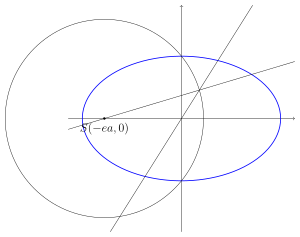
The point \(P(a\cos\theta\,,\, b\sin\theta)\), where \(a>b>0\), lies on the ellipse \[\dfrac {x^2}{a^2} + \dfrac {y^2}{b^2}=1\,.\] The point \(S(-ea\,,\,0)\), where \(b^2=a^2(1-e^2)\,\), is a focus of the ellipse. The point \(N\) is the foot of the perpendicular from the origin, \(O\), to the tangent to the ellipse at \(P\). The lines \(SP\) and \(ON\) intersect at \(T\). Show that the \(y\)-coordinate of \(T\) is \[\dfrac{b\sin\theta}{1+e\cos\theta}\,.\] Show that \(T\) lies on the circle with centre \(S\) and radius \(a\).
Solution: Find the gradient of the tangent of the ellipse at \(P\): \begin{align*} && \frac{2x}{a^2} + \frac{2y}{b^2} \frac{\d y}{\d x} &= 0 \\ \Rightarrow && \frac{\d y}{\d x} &= - \frac{2xb^2}{2ya^2} \\ &&&=- \frac{a \cos \theta b^2}{b \sin \theta a^2} \\ &&&=-\frac{b}{a} \cot \theta \end{align*} Therefore the gradient of \(ON\) is \(\frac{a}{b} \tan \theta\). \begin{align*} && y &= \frac{a}{b} \tan \theta x \\ && \frac{y-0}{x-(-ea)} &= \frac{b\sin \theta-0}{a\cos \theta -(-ea)} \\ && y &= \frac{b \sin \theta}{a(e+\cos \theta)}(x+ea) \\ \Rightarrow && y &= \frac{b \sin \theta}{a(\cos \theta+e)}\frac{b}{a} \cot \theta y+ \frac{eb \sin \theta}{\cos \theta + e} \\ &&&= \frac{b^2 \cos \theta}{a^2(\cos \theta +e)}y + \frac{eb \sin \theta}{\cos \theta + e} \\ \Rightarrow && (\cos \theta+e)y &= (1-e^2)\cos \theta y +eb \sin \theta\\ && e(1+e\cos \theta)y &= eb \sin \theta \\ \Rightarrow && y &= \frac{b \sin \theta}{1+e\cos \theta} \\ && x &= \frac{b \sin \theta}{1+e\cos \theta} \frac{b}{a} \cot \theta \\ &&&= \frac{b^2 \cos \theta}{a(1+e\cos \theta)} \end{align*} Therefore \(\displaystyle T\left (\frac{b^2 \cos \theta}{a(1+e\cos \theta)}, \frac{b \sin \theta}{1+e\cos \theta} \right)\). Finally, we can look at the distance of \(T\) from \(S\) \begin{align*} && d^2 &= \left (\frac{b^2 \cos \theta}{a(1+e\cos \theta)}-(-ea) \right)^2 + \left (\frac{b \sin \theta}{1+e\cos \theta} -0\right)^2 \\ &&&= \frac{\left (b^2 \cos \theta+ea^2(1+e\cos\theta)\right)^2 + \left ( ab \sin \theta\right)^2}{a^2(1+e\cos \theta)^2} \\ &&&= \frac{b^4\cos^2\theta+e^2a^4(1+e\cos\theta)^2+2ea^2b^2(1+e\cos\theta)+a^2b^2\sin^2\theta}{a^2(1+e\cos\theta)^2} \\ &&&= \frac{a^4(1-e^2)^2\cos^2\theta+e^2a^4(1+e\cos\theta)^2+2ea^2a^2(1-e^2)(1+e\cos\theta)+a^4(1-e^2)\sin^2\theta}{a^2(1+e\cos\theta)^2} \\ &&&= a^2 \left ( \frac{(1-e^2)^2\cos^2\theta+e^2(1+e\cos\theta)^2+2e(1-e^2)(1+e\cos\theta)+(1-e^2)(1-\cos^2\theta)}{(1+e\cos\theta)^2} \right) \\ &&&= a^2 \left ( \frac{e^2(1+e\cos\theta)^2+(1-e^2)((1-e^2)\cos^2\theta+2e(1+e\cos\theta)+(1-\cos^2\theta))}{(1+e\cos\theta)^2} \right) \\ &&&= a^2 \left ( \frac{e^2(1+e\cos\theta)^2+(1-e^2)(1+e\cos\theta)^2}{(1+e\cos\theta)^2} \right) \\ &&&= a^2 \end{align*} Therefore a circle radius \(a\) centre \(S\).
2008 Paper 3 Q7
The points \(A\), \(B\) and \(C\) in the Argand diagram are the vertices of an equilateral triangle described anticlockwise. Show that the complex numbers \(a\), \(b\) and \(c\) representing \(A\), \(B\) and \(C\) satisfy \[2c= (a+b) +\mathrm{i}\sqrt3(b-a).\] Find a similar relation in the case that \(A\), \(B\) and \(C\) are the vertices of an equilateral triangle described clockwise.
- The quadrilateral \(DEFG\) lies in the Argand diagram. Show that points \(P\), \(Q\), \(R\) and \(S\) can be chosen so that \(PDE\), \(QEF\), \(RFG\) and \(SGD\) are equilateral triangles and \(PQRS\) is a parallelogram.
- The triangle \(LMN\) lies in the Argand diagram. Show that the centroids \(U\), \(V\) and \(W\) of the equilateral triangles drawn externally on the sides of \(LMN\) are the vertices of an equilateral triangle. \noindent [{\bf Note:} The {\em centroid} of a triangle with vertices represented by the complex numbers \(x\),~\(y\) and~\(z\) is the point represented by \(\frac13(x+y+z)\,\).]
2007 Paper 1 Q5
Note: a regular octahedron is a polyhedron with eight faces each of which is an equilateral triangle.
- Show that the angle between any two faces of a regular octahedron is \(\arccos \left( -{\frac1 3} \right)\).
- Find the ratio of the volume of a regular octahedron to the volume of the cube whose vertices are the centres of the faces of the octahedron.
Solution:
- Suppose the vertices are \((\pm1, 0,0), (0,\pm1,0), (0,0,\pm1)\), then clearly this is an octahedron. We can measure the angle between the faces, by looking at vectors in the same plane and also in two of the faces: \(\langle \frac12, \frac12, - 1\rangle\) and \(\langle \frac12, \frac12, 1\rangle\), then by considering the dot product: \begin{align*} && \cos \theta &= \frac{\frac14+\frac14-1}{\frac14+\frac14+1} \\ &&&= \frac{-2}{6} = -\frac13 \end{align*}
- The volume of our octahedron is \(2 \cdot \frac13 \cdot \underbrace{\sqrt{2}^2}_{\text{base}} \cdot \underbrace{1}_{\text{height}} = \frac43\). The centre of two touching faces are \(\langle \frac13, \frac13, \frac13 \rangle\) and \(\langle \frac13, \frac13, -\frac13 \rangle\) and so the length of the side of the cube is \(\frac23\) and so the volume of the cube is \(\frac8{27}\). Therefore the ratio is \(\frac{2}{9}\)
2007 Paper 2 Q8
The points \(B\) and \(C\) have position vectors \(\mathbf{b}\) and \(\mathbf{c}\), respectively, relative to the origin \(A\), and \(A\), \(B\) and \(C\) are not collinear.
- The point \(X\) has position vector \(s \mathbf{b}+t\mathbf{c}\). Describe the locus of \(X\) when \(s+t=1\).
- The point \(P\) has position vector \(\beta \mathbf{b}+\gamma\mathbf{c}\), where \(\beta\) and \(\gamma\) are non-zero, and \(\beta+\gamma\ne1\). The line \(AP\) cuts the line \(BC\) at \(D\). Show that \(BD:DC=\gamma:\beta\).
- The line \(BP\) cuts the line \(CA\) at \(E\), and the line \(CP\) cuts the line \(AB\) at \(F\). Show that \[ \frac{AF}{FB} \times \frac{BD}{DC} \times \frac{CE}{EA}=1\,. \]
Solution:
- \(X\) lies on the line including \(B\) and \(C\).
- points on the line \(AP\) have the form \(\lambda(\beta \mathbf{b}+\gamma\mathbf{c})\), and the point \(D\) will be the point where \(\lambda\beta + \lambda \gamma = 1\). \begin{align*} && \frac{|BD|}{|DC|} &= \frac{|\mathbf{b} -\lambda(\beta \mathbf{b}+\gamma\mathbf{c})| }{|\lambda(\beta \mathbf{b}+\gamma\mathbf{c})- \mathbf{c}|} \\ &&&= \frac{|(1-\lambda \beta)\mathbf{b} - \lambda \gamma \mathbf{c}|}{|\lambda \beta \mathbf{b}+(\lambda \gamma -1)\mathbf{c}|}\\ &&&= \frac{|\lambda \gamma\mathbf{b} - \lambda \gamma \mathbf{c}|}{|\lambda \beta \mathbf{b}-(\lambda \beta)\mathbf{c}|} \\ &&&= \frac{\gamma}{\beta} \end{align*}
- The line \(BP\) is \(\mathbf{b} + \mu(\beta \mathbf{b}+\gamma\mathbf{c})\) and will meet \(CA\) when \(1+\mu\beta = 0\), ie \(\mu = -\frac{1}{\beta}\), therefore \(E\) is \(-\frac{\gamma}{\beta}\mathbf{c}\), and so \(\frac{|CE|}{|EA|} = \frac{1+\gamma/\beta}{\gamma/\beta} = \frac{\beta+\gamma}{\gamma}\). Similarly, \(F\) is \(-\frac{\beta}{\gamma}\mathbf{b}\) and \(\frac{|AF|}{|FB|} = \frac{\beta/\gamma}{1+\frac{\beta}{\gamma}} = \frac{\beta}{\gamma+\beta}\), and so \[\frac{AF}{FB} \times \frac{BD}{DC} \times \frac{CE}{EA} = \frac{\beta}{\gamma+\beta} \frac{\gamma}{\beta} \frac{\beta+\gamma}{\gamma} = 1 \]
2007 Paper 3 Q4
A curve is given parametrically by \begin{align*} x&= a\big( \cos t +\ln \tan \tfrac12 t\big)\,,\\ y&= a\sin t\,, \end{align*} where \(0 < t < \frac12 \pi\) and \(a\) is a positive constant. Show that \(\ds \frac{\d y}{\d x} = \tan t\) and sketch the curve. Let \(P\) be the point with parameter \(t\) and let \(Q\) be the point where the tangent to the curve at \(P\) meets the \(x\)-axis. Show that \(PQ=a\). The {\sl radius of curvature}, \(\rho\), at \(P\) is defined by \[ \rho= \frac {\big(\dot x ^2+\dot y^2\big)^{\frac32}} {\vert \dot x \ddot y - \dot y \ddot x\vert \ \ } \,, \] where the dots denote differentiation with respect to \(t\). Show that \(\rho =a\cot t\). The point \(C\) lies on the normal to the curve at \(P\), a distance \(\rho\) from \(P\) and above the curve. Show that \(CQ\) is parallel to the \(y\)-axis.
2007 Paper 3 Q6
The distinct points \(P\), \(Q\), \(R\) and \(S\) in the Argand diagram lie on a circle of radius \(a\) centred at the origin and are represented by the complex numbers \(p\), \(q\), \(r\) and \(s\), respectively. Show that \[ pq = -a^2 \frac {p-q}{p^*-q^*}\,. \] Deduce that, if the chords \(PQ\) and \(RS\) are perpendicular, then \(pq+rs=0\). The distinct points \(A_1\), \(A_2\), \(\ldots\), \(A_n\) (where \(n\ge3\)) lie on a circle. The points \hbox{\(B_1\), \(B_2\), \(\ldots\), \(B_{n}\)} lie on the same circle and are chosen so that the chords \(B_1B_2\), \(B_2B_3\), \(\ldots\), \(B_nB_{1}\) are perpendicular, respectively, to the chords \(A_1A_2\), \(A_2A_3\), \(\ldots\), \(A_nA_1\). Show that, for \(n=3\), there are only two choices of \(B_1\) for which this is possible. What is the corresponding result for \(n=4\)? State the corresponding results for values of \(n\) greater than 4.
2006 Paper 1 Q2
A small goat is tethered by a rope to a point at ground level on a side of a square barn which stands in a large horizontal field of grass. The sides of the barn are of length \(2a\) and the rope is of length \(4a\). Let \(A\) be the area of the grass that the goat can graze. Prove that \(A\le14\pi a^2\) and determine the minimum value of \(A\).
Solution:

2006 Paper 1 Q4
By sketching on the same axes the graphs of \(y=\sin x\) and \(y=x\), show that, for \(x>0\):
- \(x>\sin x\,\);
- \(\dfrac {\sin x} {x} \approx 1\) for small \(x\).
2006 Paper 2 Q7
An ellipse has equation $\dfrac{x^2}{a^2} +\dfrac {y^2}{b^2} = 1$. Show that the equation of the tangent at the point \((a\cos\alpha, b\sin\alpha)\) is \[ y=- \frac {b \cot \alpha} a \, x + b\, {\rm cosec\,}\alpha\,. \] The point \(A\) has coordinates \((-a,-b)\), where \(a\) and \(b\) are positive. The point \(E\) has coordinates \((-a,0)\) and the point \(P\) has coordinates \((a,kb)\), where \(0 < k < 1\). The line through \(E\) parallel to \(AP\) meets the line \(y=b\) at the point \(Q\). Show that the line \(PQ\) is tangent to the above ellipse at the point given by \(\tan(\alpha/2)=k\). Determine by means of sketches, or otherwise, whether this result holds also for \(k=0\) and \(k=1\).
2006 Paper 2 Q8
Show that the line through the points with position vectors \(\bf x\) and \(\bf y\) has equation \[{\bf r} = (1-\alpha){\bf x} +\alpha {\bf y}\,, \] where \(\alpha\) is a scalar parameter. The sides \(OA\) and \(CB\) of a trapezium \(OABC\) are parallel, and \(OA>CB\). The point \(E\) on \(OA\) is such that \(OE : EA = 1:2\), and \(F\) is the midpoint of \(CB\). The point \(D\) is the intersection of \(OC\) produced and \(AB\) produced; the point \(G\) is the intersection of \(OB\) and \(EF\); and the point \(H\) is the intersection of \(DG\) produced and \(OA\). Let \(\bf a\) and \(\bf c\) be the position vectors of the points \(A\) and \(C\), respectively, with respect to the origin \(O\).
- Show that \(B\) has position vector \(\lambda {\bf a} + {\bf c}\) for some scalar parameter \(\lambda\).
- Find, in terms of \(\bf a\), \(\bf c\) and \(\lambda\) only, the position vectors of \(D\), \(E\), \(F\), \(G\) and \(H\). Determine the ratio \(OH:HA\).
2006 Paper 3 Q5
Show that the distinct complex numbers \(\alpha\), \(\beta\) and \(\gamma\) represent the vertices of an equilateral triangle (in clockwise or anti-clockwise order) if and only if \[ \alpha^2 + \beta^2 +\gamma^2 -\beta\gamma - \gamma \alpha -\alpha\beta =0\,. \] Show that the roots of the equation \begin{equation*} z^3 +az^2 +bz +c=0 \tag{\(*\)} \end{equation*} represent the vertices of an equilateral triangle if and only if \(a^2=3b\). Under the transformation \(z=pw+q\), where \(p\) and \(q\) are given complex numbers with \(p\ne0\), the equation (\(*\)) becomes \[ w^3 +Aw^2 +Bw +C=0\,. \tag{\(**\)} \] Show that if the roots of equation \((*)\) represent the vertices of an equilateral triangle, then the roots of equation \((**)\) also represent the vertices of an equilateral triangle.
Solution: The complex numbers represent an equilateral triangle iff \(\gamma\) is a \(\pm 60^\circ\) rotation of \(\beta\) around \(\alpha\), ie \begin{align*} && \gamma - \alpha &= \omega(\beta - \alpha) \\ \Leftrightarrow && \omega &= \frac{\gamma - \alpha}{\beta - \alpha} \\ \Leftrightarrow && -1 &= \left (\frac{\gamma - \alpha}{\beta - \alpha} \right)^3 \\ \Leftrightarrow && -(\beta - \alpha)^3 &=(\gamma - \alpha)^3 \\ \Leftrightarrow && 0 &= (\gamma-\alpha)^3+(\beta-\alpha)^3 \\ &&&= \gamma^3-3\gamma^2\alpha +3\gamma\alpha^2-\alpha^3 +\beta^3-3\beta^2\alpha+3\beta\alpha^2-\alpha^3 \\ &&&= (\beta + \gamma - 2\alpha)(\alpha^2+\beta^2+\gamma^2 - \alpha\beta - \beta\gamma - \gamma \delta) \\ \Leftrightarrow && 0 &= \alpha^2+\beta^2+\gamma^2 - \alpha\beta - \beta\gamma - \gamma \delta \end{align*} The roots of the equation \(z^3+az^2+bz+c = 0\) represents the vertices of an equilateral triangle iff \(a^2-3b = (\alpha+\beta+\gamma^2) - 3(\alpha\beta+\beta\gamma+\gamma\alpha) = \alpha^2+\beta^2+\gamma^2 - \alpha\beta - \beta\gamma - \gamma \delta = 0\) as erquired. Suppose \(a^2 = 3b\), then consider \(z = pw +q\), we must have \begin{align*} && 0 &= (pw+q)^3+a(pw+q)^2 + b(pw+q)+c \\ &&&= p^3w^3 +(3p^2q+ap^2)w^2+(3pq^2+2apq+bp)w+(q^3+aq^2+bq+c) \\ &&&= p^3w^3+p^2(3q+a)w^2+p(3q^2+2aq+b)w+(q^3+aq^2+bq+c) \\ \end{align*} We need to check if \(\left(\frac{3q+a}{p} \right)^2 = 3 \left (\frac{3q^2+2qa+b}{p^2} \right)\). Clearly the denominators match, so consider the numerators \begin{align*} && (3q+a)^2 &= 9q^2+6aq+a^2 \\ &&&= 9q^2+6aq+3b \\ &&&= 3(3q^2+2qa+b) \end{align*} as required
2006 Paper 3 Q6
Show that in polar coordinates the gradient of any curve at the point \((r,\theta)\) is \[ \frac{ \ \ \dfrac{\d r }{\d\theta} \tan\theta + r \ \ } { \dfrac{\d r }{\d\theta} -r\tan\theta}\,. \] \noindent
2005 Paper 1 Q2
The point \(P\) has coordinates \(\l p^2 , 2p \r\) and the point \(Q\) has coordinates \(\l q^2 , 2q \r\), where \(p\) and~\(q\) are non-zero and \(p \neq q\). The curve \(C\) is given by \(y^2 = 4x\,\). The point \(R\) is the intersection of the tangent to \(C\) at \(P\) and the tangent to \(C\) at \(Q\). Show that \(R\) has coordinates \(\l pq , p+q \r\). The point \(S\) is the intersection of the normal to \(C\) at \(P\) and the normal to \(C\) at \(Q\). If \(p\) and \(q\) are such that \(\l 1 , 0 \r\) lies on the line \(PQ\), show that \(S\) has coordinates \(\l p^2 + q^2 + 1 , \, p+q \r\), and that the quadrilateral \(PSQR\) is a rectangle.
2005 Paper 3 Q8
In this question, \(a\) and \(c\) are distinct non-zero complex numbers. The complex conjugate of any complex number \(z\) is denoted by \(z^*\). Show that \[ |a - c|^2 = aa^* + cc^* -ac^* - ca^* \] and hence prove that the triangle \(OAC\) in the Argand diagram, whose vertices are represented by \(0\), \(a\) and \(c\) respectively, is right angled at \(A\) if and only if \(2aa^* = ac^*+ca^*\,\). Points \(P\) and \(P'\) in the Argand diagram are represented by the complex numbers \(ab\) and \(\ds \frac{a}{b^*}\,\), where \(b\) is a non-zero complex number. A circle in the Argand diagram has centre \(C\) and passes through the point \(A\), and is such that \(OA\) is a tangent to the circle. Show that the point \(P\) lies on the circle if and only if the point \(P'\) lies on the circle. Conversely, show that if the points represented by the complex numbers \(ab\) and \(\ds \frac{a}{b^*}\), for some non-zero complex number \(b\) with \(bb^* \ne 1\,\), both lie on a circle centre \(C\) in the Argand diagram which passes through \(A\), then \(OA\) is a tangent to the circle.
2004 Paper 2 Q6
The vectors \({\bf a}\) and \({\bf b}\) lie in the plane \(\Pi\,\). Given that \(\vert {\bf a} \vert= 1\) and \({\bf a}.{\bf b} = 3,\) find, in terms of \({\bf a}\) and \({\bf b}\,\), a vector \({\bf p}\) parallel to \({\bf a}\) and a vector \({\bf q}\) perpendicular to \({\bf a}\,\), both lying in the plane \(\Pi\,\), such that $${\bf p}+{\bf q}={\bf a}+{\bf b}\;.$$ The vector \({\bf c}\) is not parallel to the plane \(\Pi\) and is such that \({\bf a}.{\bf c} = -2\) and \({\bf b}.{\bf c} = 2\,\). Given that \(\vert {\bf b} \vert = 5\,\), find, in terms of \({\bf a}, {\bf b}\) and \({\bf c},\) vectors \({\bf P}\), \({\bf Q}\) and \({\bf R}\) such that \({\bf P}\) and \({\bf Q}\) are parallel to \({\bf p}\) and \({\bf q},\) respectively, \({\bf R}\) is perpendicular to the plane \(\Pi\) and $${\bf P} + {\bf Q} + {\bf R} = {\bf a}+{\bf b}+{\bf c}\;.$$
Solution: Suppose \({\bf p} = \lambda {\bf a}\) and \({\bf p} + {\bf q} = {\bf a} + {\bf b}\) then \begin{align*} {\bf a} \cdot : && {\bf a} \cdot {\bf p} + {\bf a} \cdot {\bf p} &= {\bf a} \cdot {\bf a} + {\bf a} \cdot {\bf b} \\ && \lambda + 0 &= 1 + 3 = 4 \\ \Rightarrow && \mathbf{p} &= 4 \mathbf{a} \\ && \mathbf{q} &= \mathbf{b} - 3\mathbf{a} \\ \\ && \mathbf{P} &= 4p\mathbf{a} \\ && \mathbf{Q} &= q\mathbf{b} - 3q\mathbf{a} \\ \\ \mathbf{a} \cdot : && \mathbf{a} \cdot \mathbf{P} + \mathbf{a} \cdot \mathbf{Q} + \mathbf{a} \cdot \mathbf{R} &= \mathbf{a} \cdot \mathbf{a} + \mathbf{a} \cdot \mathbf{b} + \mathbf{a} \cdot \mathbf{c} \\ && 4p &= 1+3-2 \\ \Rightarrow && p &= \tfrac12 \\ \\ && {\bf P} + {\bf Q} + {\bf R} &= {\bf a}+{\bf b}+{\bf c} \\ \mathbf{b} \cdot : && \mathbf{b} \cdot \mathbf{P} + \mathbf{b} \cdot \mathbf{Q} + \mathbf{b} \cdot \mathbf{R} &= \mathbf{b} \cdot \mathbf{a} + \mathbf{b} \cdot \mathbf{b} + \mathbf{b} \cdot \mathbf{c} \\ && 12p + 25q - 9q &= 3+25+2 \\ && 6+16q &= 30 \\ \Rightarrow && q &= \tfrac{3}{2}\\ && \\ && \mathbf{P} &= 2\mathbf{a} \\ && \mathbf{Q} &= \tfrac32 \mathbf{b} - \tfrac92 \mathbf{a} \\ && \mathbf{R} &= \tfrac72\mathbf{a} -\tfrac12 \mathbf{b} + \mathbf{c} \end{align*}