Problems
Filters
78 problems found
1995 Paper 1 Q4
By applying de Moivre's theorem to \(\cos5\theta+\mathrm{i}\sin5\theta,\) expanding the result using the binomial theorem, and then equating imaginary parts, show that \[ \sin5\theta=\sin\theta\left(16\cos^{4}\theta-12\cos^{2}\theta+1\right). \] Use this identity to evaluate \(\cos^{2}\frac{1}{5}\pi\), and deduce that \(\cos\frac{1}{5}\pi=\frac{1}{4}(1+\sqrt{5}).\)
Solution: \begin{align*} && (\cos \theta + i \sin \theta)^n &= \cos n \theta + i \sin n \theta \\ n = 5: && \cos 5 \theta + i \sin 5 \theta &= (\cos \theta + i \sin \theta)^5 \\ \textrm{Im}: && \sin 5 \theta &= \binom{5}{1}\cos^4 \theta \sin \theta + \binom{5}{3} \cos^2 \theta (- \sin^3 \theta) + \binom{5}{5} \sin^5 \theta \\ &&&= \sin \theta (5\cos^4 \theta-10\cos^2 \theta \sin^2 \theta+\sin^4 \theta) \\ &&&= \sin \theta (5\cos^4 \theta-10\cos^2 \theta (1-\cos^2 \theta)+(1-\cos^2 \theta)^2) \\ &&&= \sin \theta((5+10+1)\cos^4 \theta +(-10-2)\cos^2 \theta + 1) \\ &&&= \sin \theta(16\cos^4 \theta -12\cos^2 \theta + 1) \\ \end{align*} Suppose \(\theta= \frac{\pi}{5}\), then \(\sin 5 \theta = 0, \sin \theta \neq 0\), therefore if \(c = \cos \theta\) we must have \begin{align*} && 0 &= 16c^4-12c^2+1 \\ \Rightarrow && c^2 &= \frac{3 \pm \sqrt{5}}{8} \\ &&&= \frac{6\pm 2\sqrt{5}}{16} \\ &&&= \frac{(1 \pm \sqrt{5})^2}{16} \\ \Rightarrow && c &= \pm \frac{1 \pm \sqrt{5}}{4} \end{align*} Since \(c > 0\) we either have \(\cos \frac15 \pi = \frac{1+\sqrt{5}}4\) or \(\cos \frac15 \pi = \frac{\sqrt{5}-1}4\), however \(\sqrt{5}-1 < 1.5\) and so \(\frac{\sqrt{5}-1}{4} < \frac12 = \cos \frac13 \pi\) we must have \(\cos \frac15 \pi = \frac{1+\sqrt{5}}4\)
1995 Paper 2 Q6
If \(u\) and \(v\) are the two roots of \(z^{2}+az+b=0,\) show that \(a=-u-v\) and \(b=uv.\) Let \(\alpha=\cos(2\pi/7)+\mathrm{i}\sin(2\pi/7).\) Show that \(\alpha\) is a root of \(z^{6}-1=0\) and express the roots in terms of \(\alpha.\) The number \(\alpha+\alpha^{2}+\alpha^{4}\) is a root of a quadratic equation \[ z^{2}+Az+B=0 \] where \(A\) and \(B\) are real. By guessing the other root, or otherwise, find the numerical values of \(A\) and \(B\). Show that \[ \cos\frac{2\pi}{7}+\cos\frac{4\pi}{7}+\cos\frac{8\pi}{7}=-\frac{1}{2}, \] and evaluate \[ \sin\frac{2\pi}{7}+\sin\frac{4\pi}{7}+\sin\frac{8\pi}{7}, \] making it clear how you determine the sign of your answer.
Solution: \begin{align*} 0 &= z^2+az+b \\ &= (z-u)(z-v) \\ &= z^2-(u+v)z+uv \end{align*} Therefore by comparing coefficients, \(a = -u-v\) and \(b = uv\). Suppose \(\alpha = \cos(2\pi/7) + i \sin (2\pi/7)\), then by De Moivre, \(\alpha^7 = \cos(2\pi) + i \sin (2\pi) = 1\), ie \(\alpha^7-1 = 0\). Notice that \((\alpha+\alpha^2 + \alpha^4) + (\alpha^3+\alpha^5+\alpha^6) = -1\) and \begin{align*} P &= (\alpha+\alpha^2 + \alpha^4)(\alpha^3+\alpha^5+\alpha^6) \\ &= \alpha^4 + \alpha^6 + \alpha^7 + \alpha^5 + \alpha^7 + \alpha^8 + \alpha^{7}+\alpha^{9}+\alpha^{10} \\ &= 3 + \alpha+ \alpha^2 + \alpha^3 + \alpha^4 + \alpha^5 + \alpha^6 \\ &= 2 \end{align*} Therefore it is a root of \(x^2+x+2 = 0 \Rightarrow x = \frac{-1 \pm i\sqrt{7}}{2}\) Therefore $\cos\frac{2\pi}{7} + \cos \frac{4\pi}{7} + \cos \frac{8\pi}{7} = \textrm{Re}(\alpha + \alpha^2 + \alpha^4) = -\frac12$ And \(\sin\frac{2\pi}{7} + \sin\frac{4\pi}{7} + \sin\frac{8\pi}{7} = \textrm{Im}(\alpha + \alpha^2 + \alpha^4) = \pm\frac{\sqrt{7}}2\) since it is positive it is \(\frac{\sqrt{7}}{2}\)
1995 Paper 3 Q4
Let \[ \mathrm{C}_{n}(\theta)=\sum_{k=0}^{n}\cos k\theta \] and let \[ \mathrm{S}_{n}(\theta)=\sum_{k=0}^{n}\sin k\theta, \] where \(n\) is a positive integer and \(0<\theta<2\pi.\) Show that \[ \mathrm{C}_{n}(\theta)=\frac{\cos(\tfrac{1}{2}n\theta)\sin\left(\frac{1}{2}(n+1)\theta\right)}{\sin(\frac{1}{2}\theta)}, \] and obtain the corresponding expression for \(\mathrm{S}_{n}(\theta)\). Hence, or otherwise, show that for \(0<\theta<2\pi,\) \[ \left|\mathrm{C}_{n}(\theta)-\frac{1}{2}\right|\leqslant\frac{1}{2\sin(\frac{1}{2}\theta)}. \]
Solution: \begin{align*} && C_n(\theta) &= \sum_{k=0}^n \cos k \theta \\ &&&= \textrm{Re} \left ( \sum_{k=0}^n \exp (ik \theta)\right)\\ &&&= \textrm{Re} \left ( \frac{e^{i(n+1)\theta}-1}{e^{i\theta}-1}\right)\\ &&&= \textrm{Re} \left ( \frac{e^{i(n+1)\theta/2}}{e^{i\theta/2}}\frac{e^{i(n+1)\theta/2}-e^{-i(n+1)\theta/2}}{e^{i\theta/2}-e^{-i\theta/2}}\right)\\ &&&= \textrm{Re} \left ( e^{in\theta/2}\frac{\sin \left ( (n+1)\theta/2 \right)}{\sin \left ( \theta/2 \right)}\right)\\ &&&= \frac{\sin \left ( (n+1)\theta/2 \right)}{\sin \left ( \theta/2 \right)}\textrm{Re} \left ( e^{in\theta/2}\right)\\ &&&= \frac{\sin \left ( (n+1)\theta/2 \right)}{\sin \left ( \theta/2 \right)}\cos \left ( \frac12n\theta\right)\\ \\ && S_n(\theta) &= \sum_{k=0}^n \sin k \theta \\ &&&= \textrm{Im} \left ( \sum_{k=0}^n \exp (ik \theta)\right)\\ &&&= \frac{\sin \left ( (n+1)\theta/2 \right)}{\sin \left ( \theta/2 \right)}\textrm{Im} \left ( e^{in\theta/2}\right)\\ &&&= \frac{\sin \left ( (n+1)\theta/2 \right)}{\sin \left ( \theta/2 \right)}\sin\left ( \frac12n\theta\right)\\ \\ && C_n(\theta) - \frac12 &= \frac{\sin \left ( (n+1)\theta/2 \right)}{\sin \left ( \theta/2 \right)}\cos \left ( \frac12n\theta\right) - \frac12 \\ &&&= \frac{2\sin \left ( (n+1)\theta/2 \right)\cos\left ( n\theta/2 \right)-\sin (\theta/2)}{2 \sin (\theta/2)} \\ &&&= \frac{\sin\left ( (n+1)\theta/2+n\theta/2\right)+\sin\left ( (n+1)\theta/2-n\theta/2\right)-\sin (\theta/2)}{2 \sin (\theta/2)} \\ &&&= \frac{\sin\left ( (n+1)\theta/2+n\theta/2\right)+\sin\left ( \theta/2\right)-\sin (\theta/2)}{2 \sin (\theta/2)} \\ &&&= \frac{\sin\left ( (2n+1)\theta/2\right)}{2 \sin (\theta/2)} \leqslant\frac{1}{2 \sin (\theta/2)} \\ \end{align*}
1995 Paper 3 Q6
The variable non-zero complex number \(z\) is such that \[ \left|z-\mathrm{i}\right|=1. \] Find the modulus of \(z\) when its argument is \(\theta.\) Find also the modulus and argument of \(1/z\) in terms of \(\theta\) and show in an Argand diagram the loci of points which represent \(z\) and \(1/z\). Find the locus \(C\) in the Argand diagram such that \(w\in C\) if, and only if, the real part of \((1/w)\) is \(-1\).
Solution:

1995 Paper 3 Q7
Consider the following sets with the usual definition of multiplication appropriate to each. In each case you may assume that the multiplication is associative. In each case state, giving adequate reasons, whether or not the set is a group.
- the complex numbers of unit modulus;
- the integers modulo 4;
- the matrices \[ \mathrm{M}(\theta)=\begin{pmatrix}\cos\theta & -\sin\theta\\ \sin\theta & \cos\theta \end{pmatrix}, \] where \(0\leqslant\theta<2\pi\);
- the integers \(1,3,5,7\) modulo 8;
- the \(2\times2\) matrices all of whose entries are integers;
- the integers \(1,2,3,4\) modulo 5.
Solution:
- \(\{ z \in \mathbb{C} : |z| = 1\}\) is a group.
- (Closure) \(|z_1z_2| = |z_1||z_2| = 1\). Set is closed under multiplication
- (Associativity) Multiplication of complex numbers is associative
- (Identity) \(|1| = 1\)
- (Inverses) \(| \frac{1}{z} | = \frac{1}{|z|} = \frac{1}{1} = 1\), the set contains inverses
- the integers \(\pmod{4}\) are not a group under multiplication, \(2\) has no inverse, since \(0 \times k \equiv 0 \pmod{4}\)
- The set of rotation matrices is a group:
- (Closure) \begin{align*} \begin{pmatrix}\cos\theta_1 & -\sin\theta_1\\ \sin\theta_1 & \cos\theta_1 \end{pmatrix} \begin{pmatrix}\cos\theta_2 & -\sin\theta_2\\ \sin\theta_2 & \cos\theta_2 \end{pmatrix} &= {\scriptscriptstyle\begin{pmatrix}\cos\theta_1 \cos \theta_2 - \sin \theta_1\sin \theta_2 & -\sin\theta_1\ \cos \theta_1 - \sin \theta_2\cos\theta_1\\ \sin\theta_1\ \cos \theta_1 + \sin \theta_2\cos\theta_1 & \cos\theta_1 \cos \theta_2 - \sin \theta_1\sin \theta_2 \end{pmatrix}} \\ &= \begin{pmatrix}\cos(\theta_1+\theta_2) & -\sin(\theta_1+\theta_2)\\ \sin(\theta_1+\theta_2) & \cos(\theta_1+\theta_2) \end{pmatrix} \end{align*} Since \(\cos, \sin\) are periodic with period \(2\pi\), we can find \(\theta_3 = \theta_1 + \theta_2 + 2k\pi\) such that \(0 \leq \theta_3 < 2 \pi\), so our set is closed
- (Associativity) Matrix multiplication is associative
- (Identity) Consider \(\theta = 0\)
- (Inverses) Consider \(2\pi - \theta\)
- \(\{1, 3, 5, 7\} \pmod{8}\) is a group:
1 3 5 7 1 1 3 5 7 3 3 1 7 5 5 5 7 1 3 7 7 5 3 1 - (Closure) See Cayley table
- (Associativity) Integer multiplication is associative
- (Identity) \(1\)
- (Inverses) \(x \mapsto x\) (See Cayley table)
- \(2\times2\) matrices are not a group, consider $0 = \begin{pmatrix} 0 & 0 \\ 0 & 0 \end{pmatrix}\(, then \)\mathbf{0}\mathbf{M} = \mathbf{0}$ for all other matrices.
1 2 3 4 1 1 2 3 4 2 2 4 1 3 3 3 1 4 2 4 4 3 2 1 - (Closure) See Cayley table
- (Associativity) Integer multiplication is associative
- (Identity) \(1\)
- (Inverses) \(1 \mapsto 1, 2 \mapsto 3, 3 \mapsto 2, 4 \mapsto 4\) (See Cayley table)
| (i) | (iii) | (iv) | (vi) | |
| (i) | \(\checkmark\) | \(\checkmark\) consider \(z \mapsto \begin{pmatrix} \cos \arg (z) | - \sin \arg(z) | |
| \sin \arg(z) | \cos \arg(z) \end{pmatrix}\) | not finite | not finite | |
| (iii) | \(\checkmark\) | not finite | not finite | |
| (iv) | \(\checkmark\) | no element order \(4\) | ||
| (vi) | \(\checkmark\) |
1994 Paper 1 Q6
The function \(\mathrm{f}\) is defined, for any complex number \(z\), by \[ \mathrm{f}(z)=\frac{\mathrm{i}z-1}{\mathrm{i}z+1}. \] Suppose throughout that \(x\) is a real number.
- Show that \[ \mathrm{Re}\,\mathrm{f}(x)=\frac{x^{2}-1}{x^{2}+1}\qquad\mbox{ and }\qquad\mathrm{Im}\,\mathrm{f}(x)=\frac{2x}{x^{2}+1}. \]
- Show that \(\mathrm{f}(x)\mathrm{f}(x)^{*}=1,\) where \(\mathrm{f}(x)^{*}\) is the complex conjugate of \(\mathrm{f}(x)\).
- Find expressions for \(\mathrm{Re}\,\mathrm{f}(\mathrm{f}(x))\) and \(\mathrm{Im}\,\mathrm{f}(\mathrm{f}(x)).\)
- Find \(\mathrm{f}(\mathrm{f}(\mathrm{f}(x))).\)
Solution:
- \begin{align*} && f(x) &= \frac{ix-1}{ix+1} \\ &&&= \frac{ix-1}{ix+1} \frac{1-ix}{1-ix} \\ &&&= \frac{ix-1+x^2+ix}{1^2+x^2} \\ &&&= \frac{x^2-1}{x^2+1} + i \frac{2x}{x^2+1} \\ \Rightarrow && \textrm{Re}(f(x)) &= \frac{x^2-1}{x^2+1} \\ && \textrm{Im}(f(x)) &= \frac{2x}{x^2+1} \end{align*}
- \begin{align*} && f(x)f(x)^* &= \frac{ix-1}{ix+1} \frac{(ix-1)^*}{(ix+1)^*} \\ &&&= \frac{ix-1}{ix+1} \frac{-ix-1}{-ix+1} \\ &&&= \frac{ix-1}{ix+1} \frac{-(ix+1)}{-(ix-1)} \\ &&&= 1
- \begin{align*} && \begin{pmatrix} i & -1 \\ i & 1 \end{pmatrix}^2 &= \begin{pmatrix} -1-i & -i-1 \\ -1+i & -i+1 \end{pmatrix} \\ \Rightarrow && f(f(z)) &= \frac{-(1+i)(z+1)}{(-1+i)(z-1)} \\ &&&= \frac{2i}{2} \frac{z+1}{z-1} \\ &&&= i \frac{z+1}{z-1} \\ \Rightarrow && \textrm{Re}(f(f(x))) &= 0 \\ && \textrm{Im}(f(f(x))) &= \frac{x+1}{x-1} \end{align*}
- \begin{align*} && \begin{pmatrix} i & -1 \\ i & 1 \end{pmatrix} \begin{pmatrix} i & i \\ 1 & -1 \end{pmatrix} &= \begin{pmatrix} -2 & 0 \\ 0 & -2 \end{pmatrix} \\ \Rightarrow && f(f(f(z))) &= z \end{align*}
1994 Paper 3 Q6
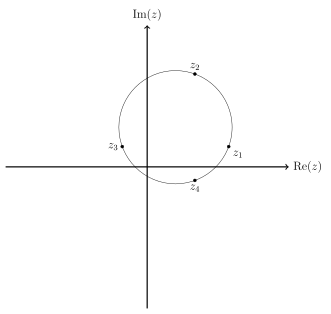
The four points \(A,B,C,D\) in the Argand diagram (complex plane) correspond to the complex numbers \(a,b,c,d\) respectively. The point \(P_{1}\) is mapped to \(P_{2}\) by rotating about \(A\) through \(\pi/2\) radians. Then \(P_{2}\) is mapped to \(P_{3}\) by rotating about \(B\) through \(\pi/2\) radians, \(P_{3}\) is mapped to \(P_{4}\) by rotating about \(C\) through \(\pi/2\) radians and \(P_{4}\) is mapped to \(P_{5}\) by rotating about \(D\) through \(\pi/2\) radians, each rotation being in the positive sense. If \(z_{i}\) is the complex number corresponding to \(P_{i},\) find \(z_{5}\) in terms of \(a,b,c,d\) and \(z_{1}.\) Show that \(P_{5}\) will coincide with \(P_{1},\) irrespective of the choice of the latter if, and only if \[a-c=\mathrm{i}(b-d)\] and interpret this condition geometrically. The points \(A,B\) and \(C\) are now chosen to be distinct points on the unit circle and the angle of rotation is changed to \(\theta,\) where \(\theta\neq0,\) on each occasion. Find the necessary and sufficient condition on \(\theta\) and the points \(A,B\) and \(C\) for \(P_{4}\) always to coincide with \(P_{1}.\)
1994 Paper 3 Q7
Let \(S_{3}\) be the group of permutations of three objects and \(Z_{6}\) be the group of integers under addition modulo 6. List all the elements of each group, stating the order of each element. State, with reasons, whether \(S_{3}\) is isomorphic with \(Z_{6}.\) Let \(C_{6}\) be the group of 6th roots of unity. That is, \(C_{6}=\{1,\alpha,\alpha^{2},\alpha^{3},\alpha^{4},\alpha^{5}\}\) where \(\alpha=\mathrm{e}^{\mathrm{i}\pi/3}\) and the group operation is complex multiplication. Prove that \(C_{6}\) is isomorphic with \(Z_{6}.\) Is there any (multiplicative or additive) subgroup of the complex numbers which is isomorphic with \(S_{3}\)? Give a reason for your answer.
Solution: \(S_3 \) $\begin{array}{c | c |c |c |c |c |c |} \text{elements} & e & (12) & (13) & (23) & (123) & (132) \\ \text{order} & 1 & 2 & 2 & 2 & 3 & 3 \\ \end{array}$ \(\mathbb{Z}_6\) $\begin{array}{c | c |c |c |c |c |c |} \text{elements} & 0 & 1 & 2 & 3 & 4 & 5 \\ \text{order} & 1 & 6 & 3 & 2 & 3 & 6 \\ \end{array}$ \(S_3\) is not isomorphic to \(\mathbb{Z}_6\) since \(\mathbb{Z}_6\) has two elements of order \(6\) but \(S_3\) has none. Consider the map \(f : \mathbb{Z}_6 \to C_6\) with \(i \mapsto \alpha^i\). This is an isomorphism, since \(i + j \mapsto \alpha^{i+j} = \alpha^i\alpha^j\) \(S_3\) is non-abelian, since \((12)(123) = (23) \neq (13) = (123)(12)\) but multiplication and addition of complex numbers is commutative.
1994 Paper 3 Q8
Let \(a,b,c,d,p,q,r\) and \(s\) be real numbers. By considering the determinant of the matrix product \[ \begin{pmatrix}z_{1} & z_{2}\\ -z_{2}^{*} & z_{1}^{*} \end{pmatrix}\begin{pmatrix}z_{3} & z_{4}\\ -z_{4}^{*} & z_{3}^{*} \end{pmatrix}, \] where \(z_{1},z_{2},z_{3}\) and \(z_{4}\) are suitably chosen complex numbers, find expressions \(L_{1},L_{2},L_{3}\) and \(L_{4},\) each of which is linear in \(a,b,c\) and \(d\) and also linear in \(p,q,r\) and \(s,\) such that \[ (a^{2}+b^{2}+c^{2}+d^{2})(p^{2}+q^{2}+r^{2}+s^{2})=L_{1}^{2}+L_{2}^{2}+L_{3}^{2}+L_{4}^{2}. \]
Solution: Supppose \(z_1 = a+ib, z_2 = c+id, z_3 = p+iq, z_4 = r+is\) then: \begin{align*} && \det \left (\begin{pmatrix}z_{1} & z_{2}\\ -z_{2}^{*} & z_{1}^{*} \end{pmatrix}\begin{pmatrix}z_{3} & z_{4}\\ -z_{4}^{*} & z_{3}^{*} \end{pmatrix} \right) &= \det \begin{pmatrix}z_{1} & z_{2}\\ -z_{2}^{*} & z_{1}^{*} \end{pmatrix}\det\begin{pmatrix}z_{3} & z_{4}\\ -z_{4}^{*} & z_{3}^{*} \end{pmatrix} \\ && \det \begin{pmatrix}z_{1}z_3-z_2z_4^* & z_1z_4+z_2z_3^*\\ -z_2^*z_3-z_1^*z_4*& -z_2^*z_4+z_{1}^*z_3^* \end{pmatrix}&= (z_1z_1^*+z_2z_2^*)(z_3z_3^*+z_4z_4^*) \\ && |z_{1}z_3-z_2z_4^*|^2+|z_1z_4+z_2z_3^*|^2&= (a^2+b^2+c^2+d^2)(p^2+q^2+r^2+s^2) \\ && L_1^2 + L_2^2+L_3^2+L_4^2 &= \ldots \end{align*}
1993 Paper 1 Q5
If \(z=x+\mathrm{i}y\) where \(x\) and \(y\) are real, define \(\left|z\right|\) in terms of \(x\) and \(y\). Show, using your definition, that if \(z_{1},z_{2}\in\mathbb{C}\) then \(\left|z_{1}z_{2}\right|=\left|z_{1}\right|\left|z_{2}\right|.\) Explain, by means of a diagram, or otherwise, why \(\left|z_{1}+z_{2}\right|\leqslant\left|z_{1}\right|+\left|z_{2}\right|.\) Suppose that \(a_{j}\in\mathbb{C}\) and \(\left|a_{j}\right|\leqslant1\) for \(j=1,2,\ldots,n.\) Show that, if \(\left|z\right|\leqslant\frac{1}{2},\) then \[ \left|a_{n}z^{n}+a_{n-1}z^{n-1}+\cdots+a_{1}z\right|<1, \] and deduce that any root \(w\) of the equation \[ a_{n}z^{n}+a_{n-1}z^{n-1}+\cdots+a_{1}z+1=0 \] must satisfy \(\left|x\right|>\frac{1}{2}.\)
1993 Paper 2 Q9
\textit{In this question, the argument of a complex number is chosen to satisfy \(0\leqslant\arg z<2\pi.\)} Let \(z\) be a complex number whose imaginary part is positive. What can you say about \(\arg z\)? The complex numbers \(z_{1},z_{2}\) and \(z_{3}\) all have positive imaginary part and \(\arg z_{1}<\arg z_{2}<\arg z_{3}.\) Draw a diagram that shows why \[ \arg z_{1}<\arg(z_{1}+z_{2}+z_{3})<\arg z_{3}. \] Prove that \(\arg(z_{1}z_{2}z_{3})\) is never equal to \(\arg(z_{1}+z_{2}+z_{3}).\)
1993 Paper 3 Q5
The set \(S\) consists of ordered pairs of complex numbers \((z_1,z_2)\) and a binary operation \(\circ\) on \(S\) is defined by $$ (z_1,z_2)\circ(w_1,w_2)= (z_1w_1-z_2w^*_2, \; z_1w_2+z_2w^*_1). $$ Show that the operation \(\circ\) is associative and determine whether it is commutative. Evaluate \((z,0)\circ(w,0)\), \((z,0)\circ(0,w)\), \((0,z)\circ(w,0)\) and \((0,z)\circ(0,w)\). The set \(S_1\) is the subset of \(S\) consisting of \(A\), \(B\), \(\ldots\,\), \(H\), where \(A=(1,0)\), \(B=(0,1)\), \(C=(i,0)\), \(D=(0,i)\), \(E=(-1,0)\), \(F=(0,-1)\), \(G=(-i,0)\) and \(H=(0,-i)\). Show that \(S_1\) is closed under \(\circ\) and that it has an identity element. Determine the inverse and order of each element of \(S_1\). Show that \(S_1\) is a group under \(\circ\). \hfil\break [You are not required to compute the multiplication table in full.] Show that \(\{A,B,E,F\}\) is a subgroup of \(S_1\) and determine whether it is isomorphic to the group generated by the \(2\times2\) matrix $\begin{pmatrix}0 & 1\\ -1 & 0 \end{pmatrix}$ under matrix multiplication.
1993 Paper 3 Q6
The point in the Argand diagram representing the complex number \(z\) lies on the circle with centre \(K\) and radius \(r\), where \(K\) represents the complex number \(k\). Show that $$ zz^* -kz^* -k^*z +kk^* -r^2 =0. $$ The points \(P\), \(Q_1\) and \(Q_2\) represent the complex numbers \(z\), \(w_1\) and \(w_2\) respectively. The point \(P\) lies on the circle with \(OA\) as diameter, where \(O\) and \(A\) represent \(0\) and \(2i\) respectively. Given that \(w_1=z/(z-1)\), find the equation of the locus \(L\) of \(Q_1\) in terms of \(w_1\) and describe the geometrical form of \(L\). Given that \(w_2=z^*\), show that the locus of \(Q_2\) is also \(L\). Determine the positions of \(P\) for which \(Q_1\) coincides with \(Q_2\).
1992 Paper 1 Q4
Sketch the following subsets of the complex plane using Argand diagrams. Give reasons for your answers.
- \(\{z:\mathrm{Re}((1+\mathrm{i})z)\geqslant0\}.\)
- \(\{z: |z^{2}| \leqslant2,\mathrm{Re}(z^{2})\geqslant0\}.\)
- \(\{z=z_{1}+z_{2}:\left|z_{1}\right|=2,\left|z_{2}\right|=1\}.\)
Solution:
- Multiplication by \(1+i\) rotates by \(45^{\circ}\) anticlockwise

- \(|z| \leq \sqrt{2}\), \(\textrm{Re}(z^2) \geq 0\) means \(\textrm{Re}{z} \geq \textrm{Im}{z}\)

- These are all points within \(1\) unit from a circle radius \(2\) units.

1992 Paper 2 Q10
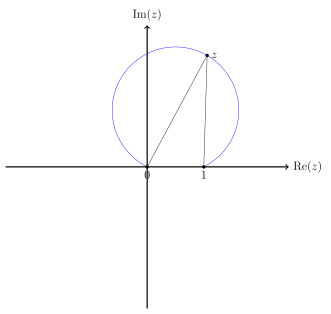
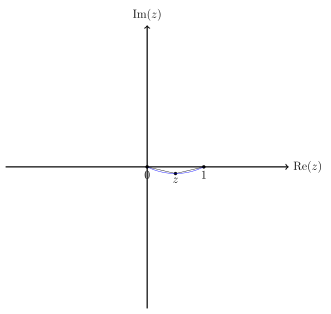
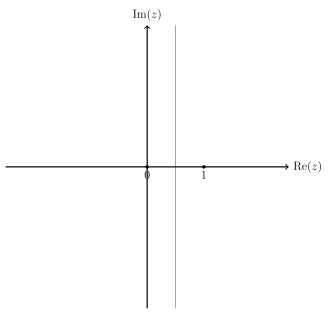
Let \(\alpha\) be a fixed angle, \(0 < \alpha \leqslant\frac{1}{2}\pi.\) In each of the following cases, sketch the locus of \(z\) in the Argand diagram (the complex plane):
- \({\displaystyle \arg\left(\frac{z-1}{z}\right)=\alpha,}\)
- \({\displaystyle \arg\left(\frac{z-1}{z}\right)=\alpha-\pi,}\)
- \(|\dfrac{z-1}{z}|=1.\)
Solution: