Problems
Filters
49 problems found
1989 Paper 3 Q1
Prove that the area of the zone of the surface of a sphere between two parallel planes cutting the sphere is given by \[ 2\pi\times(\mbox{radius of sphere})\times(\mbox{perpendicular distance between the planes}). \] A tangent from the origin \(O\) to the curve with cartesian equation \[ (x-c)^{2}+y^{2}=a^{2}, \] where \(a\) and \(c\) are positive constants with \(c>a,\) touches the curve at \(P\). The \(x\)-axis cuts the curve at \(Q\) and \(R\), the points lying in the order \(OQR\) on the axis. The line \(OP\) and the arc \(PR\) are rotated through \(2\pi\) radians about the line \(OQR\) to form a surface. Find the area of this surface.
Solution:


1988 Paper 1 Q10
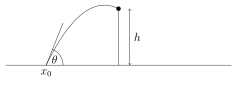
A sniper at the top of a tree of height \(h\) is hit by a bullet fired from the undergrowth covering the horizontal ground below. The position and elevation of the gun which fired the shot are unknown, but it is known that the bullet left the gun with speed \(v\). Show that it must have been fired from a point within a circle centred on the base of the tree and of radius \((v/g)\sqrt{v^{2}-2gh}\). {[}Neglect air resistance.{]}
Solution:
1988 Paper 3 Q3
Give a parametric form for the curve in the Argand diagram determined by \(\left|z-\mathrm{i}\right|=2.\) Let \(w=(z+\mathrm{i})/(z-\mathrm{i}).\) Find and sketch the locus, in the Argand diagram, of the point which represents the complex number \(w\) when \begin{questionparts} \item \(\left|z-\mathrm{i}\right|=2;\) \item \(z\) is real; \item \(z\) is imaginary. \end{questionpart}
Solution: There are many possible parametric forms, for example \(z = i + 2e^{it}, z = 2\ cos \theta + (1 + 2\sin \theta)i\) etc. It is a circle radius \(2\) about the point \(i\).
- \begin{align*}
w &= \frac{z+i}{z-i} \\
&= \frac{2i + 2e^{it}}{2e^{it}} \\
&= 2 + ie^{-it}
\end{align*}
This is obvious a circle radius \(1\) about the point \(2\).

- If \(z\) is real, then \begin{align*} w &= \frac{z+i}{z-i} \\ &= \frac{(z+i)^2}{z^2+1} \\ &= \frac{z^2-1 + 2zi}{z^2+1} \end{align*} We can quickly notice this describes a circle radius \(1\) about \(0\). Alternatively, \(|z+i| = |z-i| \Rightarrow |\frac{z+i}{z-i}| = 1\) so we must be talking about points on the unit circle. Since this is a Mobius transform we know it maps lines and circles to lines and circles, therefore it must map to the unit circle;
- If \(z\) is purely imaginary, say \(it\) then:
\begin{align*}
w &= \frac{z+i}{z-i} \\
&= \frac{(it+i)(i-it)}{(-1+t)^2} \\
&= \frac{t^2-1}{(t-1)^2}
\end{align*}
Which is purely real, and can take all real values.

1987 Paper 1 Q15
A point \(P\) is chosen at random (with uniform distribution) on the circle \(x^{2}+y^{2}=1\). The random variable \(X\) denotes the distance of \(P\) from \((1,0)\). Find the mean and variance of \(X\). Find also the probability that \(X\) is greater than its mean.
Solution: Consider the angle from the origin, then \(P = (\cos \theta, \sin \theta)\) where \(\theta \sim U(0, 2\pi)\), and \(X = \sqrt{(\cos \theta - 1)^2 + \sin^2 \theta}\) \begin{align*} \mathbb{E}[X] &= \int_0^{2\pi} \sqrt{(\cos \theta - 1)^2 + \sin^2 \theta} \frac1{2\pi} \d \theta \\ &= \frac1{2\pi}\int_0^{2\pi} \sqrt{2 - 2\cos \theta} \d \theta \\ &= \frac{1}{2\pi}\int_0^{2\pi} \sqrt{4\sin^2 \frac{\theta}{2}} \d \theta \\ &= \frac{1}{\pi}\int_0^{2\pi} \left |\sin \frac{\theta}{2} \right| \d \theta \\ &= \frac{1}{\pi} \left [ -2\cos \frac{\theta}{2} \right]_0^{2\pi} \\ &= \frac1{\pi} \l 2 + 2\r \\ &= \frac{4}{\pi} \end{align*} \begin{align*} \mathbb{E}(X^2) &= \frac1{2\pi}\int_0^{2\pi} (\cos \theta - 1)^2 + \sin^2 \theta \d \theta \\ &= \frac1{2\pi}\int_0^{2\pi} 2 - 2 \cos \theta \d \theta \\ &= \frac{4\pi}{2\pi} \\ &= 2 \\ \end{align*} \(\Rightarrow\) \(\mathrm{Var}(X) = \mathbb{E}(X^2) - \mathbb{E}(X)^2 = 2 - \frac{16}{\pi^2} = \frac{2\pi^2 - 16}{\pi^2}\).
