Problems
Filters
1531 problems found
2010 Paper 2 Q8
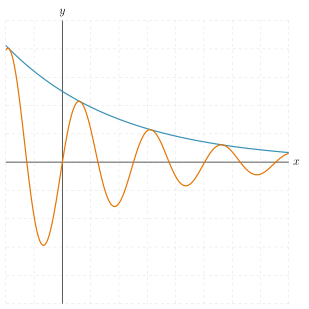
The curves \(C_1\) and \(C_2\) are defined by \[ y= \e^{-x} \quad (x>0) \quad \text{ and } \quad y= \e^{-x}\sin x \quad (x>0), \] respectively. Sketch roughly \(C_1\) and \(C_2\) on the same diagram. Let \(x_n\) denote the \(x\)-coordinate of the \(n\)th point of contact between the two curves, where \(0 < x_1 < x_2 < \cdots\), and let \(A_n\) denote the area of the region enclosed by the two curves between \(x_n\) and \(x_{n+1}\). Show that \[ A_n = \tfrac12(\e^{2\pi}-1) \e^{-(4n+1)\pi/2} \] and hence find \(\displaystyle \sum_{n=1}^\infty A_n\).
Solution:
2010 Paper 2 Q9
Two points \(A\) and \(B\) lie on horizontal ground. A particle \(P_1\) is projected from \(A\) towards \(B\) at an acute angle of elevation \(\alpha\) and simultaneously a particle \(P_2\) is projected from \(B\) towards \(A\) at an acute angle of elevation \(\beta\). Given that the two particles collide in the air a horizontal distance \(b\) from \(B\), and that the collision occurs after \(P_1\) has attained its maximum height \(h\), show that \[ 2h \cot\beta < b < 4h \cot\beta \hphantom{\,,} \] and \[ 2h \cot\alpha < a < 4h \cot\alpha \,, \] where \(a\) is the horizontal distance from \(A\) to the point of collision.
2010 Paper 2 Q10
- In an experiment, a particle \(A\) of mass \(m\) is at rest on a smooth horizontal table. A particle \(B\) of mass \(bm\), where \(b >1\), is projected along the table directly towards \(A\) with speed \(u\). The collision is perfectly elastic. Find an expression for the speed of \(A\) after the collision in terms of \(b\) and \(u\), and show that, irrespective of the relative masses of the particles, \(A\) cannot be made to move at twice the initial speed of \(B\).
- In a second experiment, a particle \(B_1\) is projected along the table directly towards \(A\) with speed \(u\). This time, particles \(B_2\), \(B_3\), \(\ldots\,\), \(B_n\) are at rest in order on the line between \(B_1\) and \(A\). The mass of \(B_i\) (\(i=1\), \(2\), \(\ldots\,\), \(n\)) is \(\lambda^{n+1-i}m\), where \(\lambda>1\). All collisions are perfectly elastic. Show that, by choosing \(n\) sufficiently large, there is no upper limit on the speed at which \(A\) can be made to move. In the case \(\lambda=4\), determine the least value of \(n\) for which \(A\) moves at more than \(20u\). You may use the approximation \(\log_{10}2 \approx 0.30103\).
Solution:
- Since the collision is perfectly elastic, the speed of approach and separation are equal, ie \(v_B = v_A - u\) \begin{align*} \text{COM}: && bmu &= bm(v_A - u) + mv_A \\ \Rightarrow && (b+1)v_A &= 2bu \\ \Rightarrow && v_A &= \frac{2b}{b+1} u \end{align*} Since \(0 < \frac{b}{b+1} < 1\), the largest \(0 < v_A < 2u\)

- After the first collision with each \(B_i\) we will have \(\displaystyle v_{i+1} = \frac{2\lambda}{\lambda + 1}v_i\), ie \(\displaystyle v_{i+1} = \left (\frac{2\lambda}{\lambda + 1} \right)^i u\) and so \(\displaystyle v_A = \left (\frac{2\lambda}{\lambda + 1} \right)^n u\) which can be arbitrarily large. Suppose \(\lambda = 4\), then \begin{align*} && 20u &< v_A \\ &&&= \left (\frac{8}{5} \right)^n u \\ \Rightarrow && \log_{10} 20 < n \log_{10}(16/10) \\ && \log_{10} 2 + 1 < n 4\log_{10} 2 - n \\ \Rightarrow && n &> \frac{ \log_{10} 2 + 1}{ 4\log_{10} 2 - 1} \\ &&&\approx \frac{0.30103+1}{4 \times 0.30103 -1}\\ &&&= \frac{1.30103}{0.20412} \\ &&&>6 \end{align*} So \(n =7\) is the smallest possible
2010 Paper 2 Q11
A uniform rod \(AB\) of length \(4L \) and weight \(W\) is inclined at an angle \(\theta\) to the horizontal. Its lower end \(A\) rests on a fixed support and the rod is held in equilibrium by a string attached to the rod at a point \(C\) which is \(3L \) from \(A\). The reaction of the support on the rod acts in a direction \(\alpha\) to \(AC\) and the string is inclined at an angle \(\beta\) to \(CA\). Show that \[ \cot\alpha = 3\tan \theta + 2 \cot \beta\,. \] Given that \(\theta =30^\circ\) and \(\beta = 45^\circ\), show that \(\alpha= 15^\circ\).
2010 Paper 2 Q12
The continuous random variable \(X\) has probability density function \(\f(x)\), where \[ \f(x) = \begin{cases} a & \text {for } 0\le x < k \\ b & \text{for } k \le x \le 1\\ 0 & \text{otherwise}, \end{cases} \] where \(a > b > 0\) and \(0 < k < 1\). Show that \(a > 1\) and \(b < 1\).
- Show that \[ \E(X) = \frac{1-2b+ab}{2(a-b)}\,. \]
- Show that the median, \(M\), of \(X\) is given by \(\displaystyle M=\frac 1 {2a}\) if \(a+b\ge 2ab\) and obtain an expression for the median if \(a+b\le 2ab\).
- Show that \(M < \E(X)\,\).
Solution: \begin{align*} && 1 &= \int_0^1 f(x) \d x \\ &&&= ak + b(1-k) \\ &&&= b + (a-b)k \\ \Rightarrow && k &= \frac{1-b}{a-b} \\ \Rightarrow && b & < 1 \tag{\(0 < k, \,a > b\)} \\ && k &> 1 \\ \Rightarrow && a-b & > 1-b \\ \Rightarrow && a > 1 \end{align*}
- \(\,\) \begin{align*} && \E[X] &= \int_0^1 x \cdot f(x) \d x \\ &&&= \int_0^k ax \d x + \int_k^1 b x \d x \\ &&&= a \frac{k^2}{2} + b \frac{1-k^2}{2} \\ &&&= \frac12b + (a-b) \frac{(1-b)^2}{2(a-b)^2} \\ &&&= \frac{(1-b)^2+b(a-b)}{2(a-b)} \\ &&&= \frac{1-2b+ab}{2(a-b)} \end{align*}
- \(\,\) The median \(M\) satisfies \[\frac12 = \int_0^M f(x) \d x \] If \(ka = \frac{a-ab}{a-b} \leq \frac12 \Leftrightarrow 2a-2ab \leq a-b \Leftrightarrow a+b \leq 2ab\) then \(M > k\) otherwise \(M < k\). In the latter case: \begin{align*} && \frac12 &= Ma \\ \Rightarrow && M &= \frac{1}{2M} \end{align*} In the former case \begin{align*} && \frac12 &= ka + (M-k)b \\ &&&= k(a-b) + Mb \\ &&&= 1-b + M b \\ \Rightarrow && M &= 1-\frac1{2b} \end{align*}
2010 Paper 2 Q13
Rosalind wants to join the Stepney Chess Club. In order to be accepted, she must play a challenge match consisting of several games against Pardeep (the Club champion) and Quentin (the Club secretary), in which she must win at least one game against each of Pardeep and Quentin. From past experience, she knows that the probability of her winning a single game against Pardeep is \(p\) and the probability of her winning a single game against Quentin is \(q\), where \(0 < p < q < 1\).
- The challenge match consists of three games. Before the match begins, Rosalind must choose either to play Pardeep twice and Quentin once or to play Quentin twice and Pardeep once. Show that she should choose to play Pardeep twice.
- In order to ease the entry requirements, it is decided instead that the challenge match will consist of four games. Now, before the match begins, Rosalind must choose whether to play Pardeep three times and Quentin once (strategy 1), or to play Pardeep twice and Quentin twice (strategy 2) or to play Pardeep once and Quentin three times (strategy 3). Show that, if \(q-p > \frac 12\), Rosalind should choose strategy 1. If \(q-p<\frac12\), give examples of values of \(p\) and \(q\) to show that strategy 2 can be better or worse than strategy 1.
Solution:
- If she plays \(P\) twice her probability is \(q(p^2+2p(1-p)) = qp(2-p)\). If she plays \(Q\) twice her probability is \(pq(2-q)\). Since \(p < q\) she should play \(P\) twice.
- Under strategy 1, her probability is \(q(p^3+3p^2(1-p)+3p(1-p)^2) = qp(p^2+3p-3p^2+3-6p+3p^2) = qp(3-3p+p^2)\) Under strategy 2 her probability is \((p^2+2p(1-p))(q^2+2q(1-q)) = pq(2-p)(2-q)\). Under strategy 3 her probability is \(qp(3-3q+q^2)\) \begin{align*} && q - p &> \frac12 \\ \Rightarrow && (2-p)(2-q) & < (2-p)(\frac32 - p) \\ &&&= 3 - \frac72p + p^2 \\ &&&< 3- 3p + p^2 \end{align*} Therefore Strategy 1 dominates if \(q-p > \frac12\). If \(p = \frac14, q = \frac12\) then \((2-p)(2-q) =\frac74 \cdot \frac32 = \frac{21}{8}\) and \(3-3p + p^2 = 3 - \frac34 + \frac1{16} = \frac{48-12+1}{16} = \frac{37}{16} < \frac{42}{16}\) so strategy 2 dominates. Notice that strategy 1 always dominates strategy 3 since \(f(x) = 3-3x+x^2\) is decreasing for \(x < 1.5\). If \(p = \frac14, q = \frac12\) then \((2-p)(2-q) =\frac74 \cdot \frac32 = \frac{21}{8}\) and \(3-3p + p^2 = 3 - \frac34 + \frac1{16} = \frac{48-12+1}{16} = \frac{37}{16} < \frac{42}{16}\) so strategy 2 dominates. For strategy 1 to dominate, we need \(3-3p+p^2 > (2-q)(2-p)\) or \(\frac{3-3p+p^2}{2-p} > 2-q\). When \(p = \frac12\) this is \(\frac{3-\frac32 + \frac14}{2 - \frac12} = \frac{\frac{7}{4}}{\frac{3}{2}} = \frac76 = 2-\frac{5}{6}\) so take any value of \(q\) larger than \(\frac56\).
2010 Paper 3 Q1
Let \(x_{\low1}\), \(x_{\low2}\), \ldots, \(x_n\) and \(x_{\vphantom {\dot A} n+1}\) be any fixed real numbers. The numbers \(A\) and \(B\) are defined by \[ A = \frac 1 n \sum_{k=1}^n x_{ \low k} \,, \ \ \ B= \frac 1 n \sum_{k=1}^n (x_{\low k}-A)^2 \,, \ \ \ \] and the numbers \(C\) and \(D\) are defined by \[ C = \frac 1 {n+1} \sum\limits_{k=1}^{n+1} x_{\low k} \,, \ \ \ D = \frac1{n+1} \sum_{k=1}^{n+1} (x_{\low k}-C)^2 \,. \]
- Express \( C\) in terms of \(A\), \(x_{\low n+1}\) and \(n\).
- Show that $ \displaystyle B= \frac 1 n \sum_{k=1}^n x_{\low k}^2 - A^2\,\(.
- Express \)D \( in terms of \)B\(, \)A\(, \)x_{\low n+1}\( and \)n$. Hence show that \((n + 1)D \ge nB\) for all values of \(x_{\low n+1}\), but that \(D < B\) if and only if \[ A-\sqrt{\frac{(n+1)B}{n}} < x_{\low n+1} < A+\sqrt{\frac{(n+1)B}{n}}\,. \]
2010 Paper 3 Q2
In this question, \(a\) is a positive constant.
- Express \(\cosh a\) in terms of exponentials. By using partial fractions, prove that \[ \int_0^1 \frac 1{ x^2 +2x\cosh a +1} \, \d x = \frac a {2\sinh a}\,. \]
- Find, expressing your answers in terms of hyperbolic functions, \[ \int_1^\infty \frac 1 {x^2 +2x \sinh a -1} \,\d x \, \] and \[ \int_0^\infty \frac 1 {x^4 +2x^2\cosh a +1} \,\d x \,.\]
Solution:
- \(\cosh a = \frac12 (e^a + e^{-a})\) \begin{align*} \int_0^1 \frac 1{ x^2 +2x\cosh a +1} \, \d x &= \int_0^1 \frac{1}{x^2+(e^a+e^{-a})x+e^ae^{-a}} \d x \\ &= \int_0^1 \frac{1}{e^a-e^{-a}}\left (\frac{1}{x+e^{-a}}-\frac{1}{x+e^a} \right)\d x \\ &= \frac{1}{2 \sinh a} \int_0^1 \left (\frac{1}{x+e^{-a}}-\frac{1}{x+e^a} \right)\d x \\ &= \frac{1}{2 \sinh a}\left [\ln(x+e^{-a})-\ln(x+e^a) \right]_0^1 \\ &= \frac{1}{2 \sinh a} \left (\ln(1+e^a)-\ln(1+e^{-a}) - (\ln e^{-a}-\ln e^a) \right) \\ &= \frac{1}{2\sinh a}\left (2a + \ln \frac{1+e^a}{1+e^{-a}}\right) \\ &= \frac1{2\sinh a} \left ( 2a -a \right) \\ &= \frac{a}{2 \sinh a} \end{align*}
- \begin{align*} \int_1^\infty \frac 1 {x^2 +2x \sinh a -1} \,\d x &= \int_1^{\infty} \frac{1}{(x+e^a)(x-e^{-a})} \d x \\ &= \int_1^{\infty} \frac{1}{e^a+e^{-a}} \left ( \frac{1}{x-e^{-a}} - \frac{1}{x+e^{a}} \right)\d x \\ &= \frac{1}{2\cosh a} \int_1^{\infty} \left ( \frac{1}{x-e^{-a}} - \frac{1}{x+e^{a}} \right)\d x \\ &= \frac{1}{2\cosh a} \left [\ln(x-e^{-a}) - \ln (x + e^{a} ) \right]_1^{\infty} \\ &= \frac1{2\cosh a} \left [ \ln \frac{x-e^{-a}}{x+e^{a}} \right]_1^{\infty} \\ &= \frac{1}{2\cosh a} \left ( 0 - \ln \frac{1-e^{-a}}{1+e^a}{}\right) \\ &= \frac{1}{2\cosh a} \ln \frac{1+e^a}{1-e^{-a}}\\ &= \frac{1}{2\cosh a} \left ( a + \ln \coth \frac{a}{2} \right) \end{align*} and \begin{align*} \int_0^\infty \frac 1 {x^4 +2x^2\cosh a +1} \,\d x &= \int_0^\infty\frac{1}{(x^2+e^a)(x^2+e^{-a})} \d x \\ &= \int_0^\infty \frac{1}{e^a-e^{-a}} \left ( \frac{1}{x^2+e^{-a}} - \frac{1}{x^2+e^{a}} \right) \d x \\ &= \frac{1}{2\sinh a} \left [ \frac{1}{e^{-a/2}} \tan^{-1} \frac{x}{e^{-a/2}} - \frac{1}{e^{a/2}}\tan^{-1} \frac{x}{e^{a/2}} \right]_0^{\infty} \\ &= \frac{1}{2\sinh a} \left (e^{a/2}\frac{\pi}{2}-e^{-a/2}\frac{\pi}{2} - 0 \right) \\ &= \frac{1}{2\sinh a} \pi \sinh \frac{a}{2} \\ &= \frac{\pi \sinh \tfrac{a}{2}}{2\sinh a} \\ &= \frac{\pi \sinh \tfrac{a}{2}}{4\sinh \tfrac{a}{2} \cosh \tfrac{a}{2}} \\ &= \frac{\pi}{4\cosh \tfrac{a}{2}} \end{align*}
2010 Paper 3 Q3
For any given positive integer \(n\), a number \(a\) (which may be complex) is said to be a primitive \(n\)th root of unity if \(a^n=1\) and there is no integer \(m\) such that \(0 < m < n\) and \(a^m = 1\). Write down the two primitive 4th roots of unity. Let \({\rm C}_n(x)\) be the polynomial such that the roots of the equation \({\rm C}_n(x)=0\) are the primitive \(n\)th roots of unity, the coefficient of the highest power of \(x\) is one and the equation has no repeated roots. Show that \({\rm C}_4(x) = x^2+1\,\).
- Find \({\rm C}_1(x)\), \({\rm C}_2(x)\), \({\rm C}_3(x)\), \({\rm C}_5(x)\) and \({\rm C}_6(x)\), giving your answers as unfactorised polynomials.
- Find the value of \(n\) for which \({\rm C}_n(x) = x^4 + 1\).
- Given that \(p\) is prime, find an expression for \({\rm C}_p(x)\), giving your answer as an unfactorised polynomial.
- Prove that there are no positive integers \(q\), \(r\) and \(s\) such that \({\rm C}_q(x) \equiv {\rm C}_r(x) {\rm C}_s(x)\,\).
Solution: The primitive 4th roots of unity are \(i\) and \(-i\). (Since the other two roots of \(x^4-1\) are also roots of \(x^2-1\) \({\rm C}_4(x) = (x-i)(x+i) = x^2+1\) as required.
- \(\,\) \begin{align*} && {\rm C}_1 (x) &= x-1 \\ && {\rm C}_2 (x) &= x+1 \\ && {\rm C}_3 (x) &= x^2+x+1 \\ && {\rm C}_5 (x) &= x^4+x^3+x^2+x+1 \\ && {\rm C}_6 (x) &= x^2-x+1 \\ \end{align*}
- Since \((x^4+1)(x^4-1) = x^8-1\) we must have \(n \mid 8\). But \(n \neq 1,2,4\) so \(n = 8\).
- \({\rm C}_p(x) = x^{p-1} +x^{p-2}+\cdots+x+1\)
- Suppose \({\rm C_q}(x) \equiv {\rm C}_r(x){\rm C}_s(x)\), then if \(\omega\) is a primitive \(q\)th root of unity we must \({\rm C}_q(\omega) = 0\), but that means that one of \({\rm C}_r(\omega)\), \({\rm C}_s(\omega)\) is \(0\). But that's only possible if \(r\) or \(s\) \(=q\). If this were the case, then what would the other value be? There are no possible values, hence it's not possible.
2010 Paper 3 Q4
- The number \(\alpha\) is a common root of the equations \(x^2 +ax +b=0\) and \(x^2+cx+d=0\) (that is, \(\alpha\) satisfies both equations). Given that \(a\ne c\), show that \[ \alpha =- \frac{b-d}{a-c}\,. \] Hence, or otherwise, show that the equations have at least one common root if and only if \[ (b-d)^2 -a(b-d)(a-c) + b(a-c)^2 =0\,. \] Does this result still hold if the condition \(a\ne c\) is not imposed?
- Show that the equations \(x^2+ax+b=0\) and \(x^3+(a+1)x^2+qx+r=0\) have at least one common root if and only if \[ (b-r)^2-a(b-r)(a+b-q) +b(a+b-q)^2=0\,. \] Hence, or otherwise, find the values of \(b\) for which the equations \(2x^2+5 x+2 b=0\) and \(2x^3+7x^2+5x+1=0\) have at least one common root.
Solution:
- \begin{align*} && 0 &= \alpha^2 + a \alpha + b \tag{1} \\ && 0 &= \alpha^2 + c \alpha + d \tag{2} \\ \\ (1) - (2): && 0 & =\alpha ( a-c) + (b-d) \\ \Rightarrow && \alpha &= - \frac{b-d}{a-c} \tag{\(a\neq c\)} \end{align*} (\(\Rightarrow\)) Suppose they have a common root, then given we know it's form, we must have: \begin{align*} && 0 &= \left ( - \frac{b-d}{a-c} \right)^2 +a\left ( - \frac{b-d}{a-c} \right) + b \\ \Rightarrow && 0 &= (b-d)^2 - a(b-d)(a-c) + b(a-c)^2 \end{align*} (\(\Leftarrow\)) Suppose the equation holds, then \begin{align*} && 0 &= (b-d)^2 - a(b-d)(a-c) + b(a-c)^2 \\ \Rightarrow && 0 &= \left ( - \frac{b-d}{a-c} \right)^2 +a\left ( - \frac{b-d}{a-c} \right) + b \\ \end{align*} So \(\alpha\) is a root of the first equation. Considering \((1) - (2)\) we must have that \(\alpha(a-c) +(b-d) = t\) (whatever the second equation is), but that value is clearly \(0\), therefore \(\alpha\) is a root of both equations. If \(a = c\) then the equation becomes \(0 = (b-d)^2\), ie the two equations are the same, therefore they must have common roots!
- \begin{align*} && 0 &= x^2+ax+b \tag{1} \\ && 0 &= x^3+(a+1)x^2+qx+r \tag{2} \\ \\ (2) - x(1) && 0 &= x^2 + (q-b)x + r \tag{3} \end{align*} Therefore if the equations have a common root, \((1)\) and \((3)\) have a common root, ie \((b-r)^2-a(b-r)(a-(q-b))+b(a-(q-b))^2 = 0\) which is exactly our condition. \(a = \frac52, q = \frac52, r = \frac12\) \begin{align*} && 0 &= \left (b-\frac12 \right)^2 - \frac52\left (b-\frac12\right) b + b^3 \\ &&&= b^2 -b + \frac14 - \frac52 b^2+\frac54b + b^3 \\ &&&= b^3 -\frac32 b^2 +\frac14 b + \frac14 \\\Rightarrow && 0 &= 4b^3 - 6b^2+b + 1 \\ &&&= (b-1)(4b^2-2b-1) \\ \Rightarrow && b &= 1, \frac{1 \pm \sqrt{5}}{4}\end{align*}
2010 Paper 3 Q5
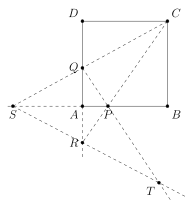
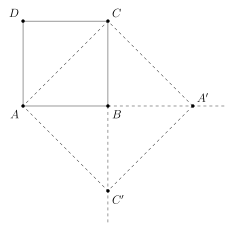
The vertices \(A\), \(B\), \(C\) and \(D\) of a square have coordinates \((0,0)\), \((a,0)\), \((a,a)\) and \((0,a)\), respectively. The points \(P\) and \(Q\) have coordinates \((an,0)\) and \((0,am)\) respectively, where \(0 < m < n < 1\). The line \(CP\) produced meets \(DA\) produced at \(R\) and the line \(CQ\) produced meets \(BA\) produced at \(S\). The line \(PQ\) produced meets the line \(RS\) produced at \(T\). Show that \(TA\) is perpendicular to \(AC\). Explain how, given a square of area \(a^2\), a square of area \(2a^2\) may be constructed using only a straight-edge. [Note: a straight-edge is a ruler with no markings on it; no measurements (and no use of compasses) are allowed in the construction.]
Solution:
2010 Paper 3 Q6
The points \(P\), \(Q\) and \(R\) lie on a sphere of unit radius centred at the origin, \(O\), which is fixed. Initially, \(P\) is at \(P_0(1, 0, 0)\), \(Q\) is at \(Q_0(0, 1, 0)\) and \(R\) is at \(R_0(0, 0, 1)\).
- The sphere is then rotated about the \(z\)-axis, so that the line \(OP\) turns directly towards the positive \(y\)-axis through an angle \(\phi\). The position of \(P\) after this rotation is denoted by \(P_1\). Write down the coordinates of \(P_1\).
- The sphere is now rotated about the line in the \(x\)-\(y\) plane perpendicular to \(OP_1\), so that the line \(OP\) turns directly towards the positive \(z\)-axis through an angle \(\lambda\). The position of \(P\) after this rotation is denoted by \(P_2\). Find the coordinates of \(P_2\). Find also the coordinates of the points \(Q_2\) and \(R_2\), which are the positions of \(Q\) and \(R\) after the two rotations.
- The sphere is now rotated for a third time, so that \(P\) returns from \(P_2\) to its original position~\(P_0\). During the rotation, \(P\) remains in the plane containing \(P_0\), \(P_2\) and \(O\). Show that the angle of this rotation, \(\theta\), satisfies \[ \cos\theta = \cos\phi \cos\lambda\,, \] and find a vector in the direction of the axis about which this rotation takes place.
2010 Paper 3 Q7
Given that \(y = \cos(m \arcsin x)\), for \(\vert x \vert <1\), prove that \[ (1-x^2) \frac {\d^2 y}{\d x^2} -x \frac {\d y}{\d x} +m^2y=0\,. \] Obtain a similar equation relating \(\dfrac{\d^3y}{\d x^3}\,\), \(\dfrac{\d^2y}{\d x^2}\, \) and \(\, \dfrac{\d y}{\d x}\,\), and a similar equation relating \(\dfrac{\d^4y}{\d x^4}\,\), \(\dfrac{\d^3y}{\d x^3}\,\) and \(\,\dfrac{\d^2 y}{\d x^2}\,\). Conjecture and prove a relation between \(\dfrac{\d^{n+2}y}{\d x^{n+2}}\,\), \(\dfrac{\d^{n+1}y}{\d x^{n+1}}\;\) and \(\;\dfrac{\d^n y}{\d x^n}\,\). Obtain the first three non-zero terms of the Maclaurin series for \(y\). Show that, if \(m\) is an even integer, \(\cos m\theta\) may be written as a polynomial in \(\sin\theta\) beginning \[ 1 - \frac{m^2\sin^2\theta}{2!}+ \frac{m^2(m^2-2^2)\sin^4\theta}{4!} -\cdots \,. \, \tag{\(\vert\theta\vert < \tfrac12 \pi\)} \] State the degree of the polynomial.
Solution: \begin{align*} && y &= \cos(m \arcsin x) \\ && y' &= -m \sin (m \arcsin x) \cdot (1-x^2)^{-\frac12} \\ && y'' &= -m^2 \cos(m \arcsin x) \cdot (1-x^2)^{-1} -m \sin(m \arcsin x) \cdot (1-x^2)^{-\frac32} \cdot (-x) \\ &&&= -m^2 y (1-x^2)^{-1} + x(1-x^2)^{-1} y' \\ \Rightarrow && 0 &= (1-x^2)y'' - x y' + m^2y \\ \\ && 0 &= (1-x^2)y^{(3)} -2xy'' - xy''-y' + m^2y' \\ &&&= (1-x^2)y^{(3)} - 3xy'' + (m^2-1)y' \\ \\ && 0 &= (1-x^2)y^{(4)} - 2xy^{(3)} - 3xy^{(3)} - 3y^{(2)} + (m^2-1)y^{(2)} \\ &&&= (1-x^2)y^{(4)}- 5xy^{(3)} - (m^2-4)y^{(2)} \end{align*} Claim: \(0 = (1-x^2)y^{(n+2)} - (2n+1)y^{(n+1)} + (m^2-n^2)y^{(n)}\) Proof: (By induction) Clearly the first few base cases are true. Suppose it is true for some \(n\), then \begin{align*} && 0 &= (1-x^2)y^{(n+2)} - (2n+1)xy^{(n+1)} + (m^2-n^2)y^{(n)} \\ \Rightarrow && 0 &= (1-x^2)y^{(n+3)} - 2xy^{(n+2)} - (2n+1)xy^{(n+2)} - (2n+1)y^{(n+1)} + (m^2-n^2)y^{(n+1)} \\ &&&= (1-x^2)y^{(n+3)} - (2n+3)xy^{(n+2)} + (m^2-n^2-2n-1)y^{(n+1)} \\ &&&= (1-x^2)y^{(n+1+2)} - (2(n+1)+1)xy^{(n+1+1)} +(m^2-(n+1)^2)y^{(n)} \end{align*} And so we can conclude the result by induction. Notice that \begin{align*} && y(0) &= \cos(m 0) = 1 \\ && y'(0) &= -m\sin(m 0) = 0 \\ && y''(0) &= -m^2 y(0) = -m^2\\ \end{align*} Notice that \(y^{(n+2)}(0) + (m^2-n^2)y^{(n)} = 0\) so in particular all the odd terms will be \(0\) and the even terms will be \(1, -m^2, m^2(m^2-2^2), \cdots\), therefore \begin{align*} && \cos (m \arcsin x) &= 1 -\frac{m^2}{2!} x^2 + \frac{m^2(m^2-2^2)}{4!}x^4 - \cdots \\ \Rightarrow && \cos(m \theta) &= 1 - \frac{m^2}{2!} \sin^2 \theta + \frac{m^2(m^2-2^2)}{4!} \sin^4 \theta \end{align*} Notice that if \(m\) is even, then at some point we will have \(m^2-m^2\) appearing in our expansion and all remaining terms will be zero. Therefore we will end up with a polynomial series, of degree \(m\) in \(\sin \theta\)
2010 Paper 3 Q8
Given that \({\rm P} (x) = {\rm Q} (x){\rm R}'(x) - {\rm Q}'(x){\rm R}(x)\), write down an expression for \[ \int \frac{{\rm P} ( x)}{ \big( {\rm Q} ( x)\big )^ 2}\, \d x\, . \]
- By choosing the function \({\rm R}(x)\) to be of the form \(a +bx+c x^2\), find \[ \int \frac{5x^2 - 4x - 3} {(1 + 2x + 3x^2 )^2 } \, \d x \,.\] Show that the choice of \({\rm R}(x)\) is not unique and, by comparing the two functions \({\rm R}(x)\) corresponding to two different values of \(a\), explain how the different choices are related.
- Find the general solution of \[ (1+\cos x +2 \sin x) \frac {\d y}{\d x} +(\sin x -2 \cos x)y = 5 - 3 \cos x + 4 \sin x\,. \]
Solution: \begin{align*} && \int \frac{{\rm P} ( x)}{ \big( {\rm Q} ( x)\big )^ 2}\, \d x &= \int \frac{{\rm Q} (x){\rm R}'(x) - {\rm Q}'(x){\rm R}(x)}{ \big( {\rm Q} ( x)\big )^ 2}\, \d x \\ &&&= \int \frac{\d}{\d x} \left ( \frac{R(x)}{Q(x)} \right) \d x \\ &&&= \frac{R(x)}{Q(x)} + C \end{align*}
- Suppose \(Q(x) = 1 + 2x + 3x^2, P(x) = 5x^2-4x-3\), and \(R(x) = a +bx + cx^2\), then \begin{align*} && 5x^2-4x-3 &= (1 + 2x + 3x^2)(2cx+b) - (6x+2)(a+bx+cx^2) \\ &&&= (6c-6c)x^3 + (3b+4c-6b-2c)x^2 + \\ &&&\quad+(2c+2b-6a-2b)x + (b-2a) \\ \Rightarrow && 2c-3b &= 5 \\ && 2c-6a &= -4 \\ && b - 2a &= -3 \\ \Rightarrow && b &= 2a - 3\\ && c &= 3a-2 \end{align*} So say \(a = 0, b = -3, c = -2\) we will have \begin{align*} \int \frac{5x^2 - 4x - 3} {(1 + 2x + 3x^2 )^2 } \, \d x &= \frac{-3x-2x^2}{1+2x+3x^2} + C \end{align*} Suppose we have a different value of \(a\), then we end up with: \begin{align*} \frac{a+(2a-3)x+(3a-2)x^2}{1+2x+3x^2} = a +\frac{-3x-2x^2}{1+2x+3x^2} \end{align*} So the different antiderivatives differ by a constant.
- \(\,\) \begin{align*} && \frac{\d }{\d x} \left ( \frac{1}{1+\cos x + 2 \sin x } y\right) &= \frac{5-3\cos x + 4 \sin x }{(1+\cos x + 2 \sin x)^2} \\ \end{align*} We want to find \(R(x) = A \cos x + B\sin x + C\) such that \begin{align*} &&5-3\cos x + 4 \sin x &= (1+\cos x + 2 \sin x)R'(x) - R(x)(-\sin x + 2 \cos x) \\ &&&= (1+\cos x + 2 \sin x)(-A\sin x + B \cos x) \\ &&&\quad- (A\cos x + B \sin x + C)(-\sin x + 2 \cos x) \\ &&&=(-A+C) \sin x + (B-2C)\cos x +\\ &&&\quad\quad (2B-A+A-2B)\sin x \cos x \\ &&&\quad\quad (-2A+B)\sin^2x+(B-2A)\cos^2x \\ &&&= (-A+C)\sin x + (B-2C)\cos x +(B-2A) \\ \Rightarrow && B-2A &= 5\\ && C-A &= 4 \\ && B-2C &= -3 \\ \end{align*} There are many solutions so WLOG \(C=4, A = 0, B = 5\) and so \begin{align*} && \int \frac{5-3\cos x + 4 \sin x }{(1+\cos x + 2 \sin x)^2} \d x &= \frac{5\sin x +4}{1+\cos x + 2 \sin x} + K \\ \Rightarrow && y &= 5\sin x + 4 + K(1 + \cos x + 2 \sin x) \end{align*}
2010 Paper 3 Q9
\(\,\)