Problems
Filters
1531 problems found
2010 Paper 1 Q6
Show that, if \(y=\e^x\), then \[ (x-1) \frac{\d^2 y}{\d x^2} -x \frac{\d y}{\d x} +y=0\,. \tag{\(*\)} \] In order to find other solutions of this differential equation, now let \(y=u\e^x\), where \(u\) is a function of \(x\). By substituting this into \((*)\), show that \[ (x-1) \frac{\d^2 u}{\d x^2} + (x-2) \frac{\d u}{\d x} =0\,. \tag{\(**\)} \] By setting \( \dfrac {\d u}{\d x}= v\) in \((**)\) and solving the resulting first order differential equation for \(v\), find \(u\) in terms of \(x\). Hence show that \(y=Ax + B\e^x\) satisfies \((*)\), where \(A\) and \(B\) are any constants.
Solution: \begin{align*} && y &= e^x \\ && y' &= e^x \\ && y'' &= e^x \\ \Rightarrow && (x-1)y'' - x y' + y &= (x-1)e^x - xe^x + e^x \\ &&&= 0 \end{align*} Suppose \(y = ue^x\) then \begin{align*} && y' &= u'e^x + ue^x \\ && y'' &= (u''+u')e^x + (u'+u)e^x \\ &&&= (u''+2u' +u)e^x \\ \\ && 0 &= (x-1)y'' - x y' + y \\ &&&= [(x-1)(u''+2u'+u) - x(u'+u)+u]e^x \\ &&&= [(x-1)u'' +(x-2)u']e^x \\ \Rightarrow && 0 &= (x-1)u'' + (x-2)u' \\ v = u': && 0 &= (x-1)v' + (x-2) v \\ \Rightarrow && \frac{v'}{v} &= -\frac{x-2}{x-1} \\ &&&= -1-\frac{1}{x-1} \\ \Rightarrow && \ln v &= -x - \ln(x-1) + C \\ \Rightarrow && v &= A(x-1)e^{-x} \\ && u &= \int Axe^{-x} - Ae^{-x} \d x \\ &&&= \left [-Axe^{-x} +Ae^{-x} \right] + \int Ae^{-x} \d x \\ &&&= -Axe^{-x} + D\\ \Rightarrow && y &= ue^x \\ &&&= -Ax + De^x \end{align*}
2010 Paper 1 Q7
Relative to a fixed origin \(O\), the points \(A\) and \(B\) have position vectors \(\bf{a}\) and \(\bf{b}\), respectively. (The points \(O\), \(A\) and \(B\) are not collinear.) The point \(C\) has position vector \(\bf c\) given by \[ {\bf c} =\alpha {\bf a}+ \beta {\bf b}\,, \] where \(\alpha\) and \(\beta\) are positive constants with \(\alpha+\beta<1\,\). The lines \(OA\) and \(BC\) meet at the point \(P\) with position vector \(\bf p\) and the lines \(OB\) and \(AC\) meet at the point \(Q\) with position vector \(\bf q\). Show that \[ {\bf p} =\frac{\alpha {\bf a} }{1-\beta}\,, \] and write down \(\bf q\) in terms of \(\alpha,\ \beta\) and \(\bf {b}\). Show further that the point \(R\) with position vector \(\bf r\) given by \[ {\bf r} =\frac{\alpha {\bf a} + \beta {\bf b}}{\alpha + \beta}\,, \] lies on the lines \(OC\) and \(AB\). The lines \(OB\) and \(PR\) intersect at the point \(S\). Prove that $ \dfrac{OQ}{BQ} = \dfrac{OS}{BS}\,$.
2010 Paper 1 Q8
- Suppose that \(a\), \(b\) and \(c\) are integers that satisfy the equation \[ a^{3}+3b^{3}=9c^{3}. \] Explain why \(a\) must be divisible by 3, and show further that both \(b\) and \(c\) must also be divisible by 3. Hence show that the only integer solution is \(a=b=c=0\,\).
- Suppose that \(p\), \(q\) and \(r\) are integers that satisfy the equation \[ p^4 +2q^4 = 5r^4 \,.\] By considering the possible final digit of each term, or otherwise, show that \(p\) and \(q\) are divisible by 5. Hence show that the only integer solution is \(p=q=r=0\,\).
Solution:
- Since \(a^3 = 9c^3 - 3b^3 = 3(3c^3-b^3)\) we must have \(3 \mid a^3\). But since \(3\) is prime, \(3 \mid a\). Since \(3 \mid a\) we can write \(a = 3a'\) for some \(a' \in \mathbb{Z}\). Therefore our equation is \(27(a')^3 + 3b^3 = 9c^3 \Rightarrow 9(a')^3 + b^3 = 3c^3\) which means that \(3 \mid b\) by the same argument from earlier. So \(b = 3b'\) so the equation is \(9(a')^3 + 27(b')^3 = 3c^3 \Rightarrow 3(a')^3 + 9(b')^3 = c^3\) which means that \(3 \mid c\). Suppose \((a,b,c)\) is the smallest measured by \(a^2+b^2+c^2\) with \(a, b, c\neq 0\). Then \((\frac{a}{3}, \frac{b}{3}, \frac{c}{3})\) is also a solution. But this contradicts that we had found the smallest solution. Therefore the only possible solution is \((0,0,0)\) which clearly works.
- Consider \(p, q \pmod{5}\). By \(FLT\) \(p^4, q^4 = 0, 1 \pmod{5}\) so \(p^4+2q^4 \in \{0, 1, 2, 3\}\) and in particular the only way they are divisible by \(5\) is if \(p \equiv q \equiv 0 \pmod{5}\). Therefore \(p = 5p', q = 5q'\) and so \(5^4(p')^4 + 5^4(q')^4 = 5r^4 \Rightarrow r^4 = 5(25(p')^4 + 25(q')^4) \Rightarrow 5\mid r^4 \Rightarrow 5 \mid r\). Therefore we can use the same argument about the smallest solution to show that \(p = q= r = 0\)
2010 Paper 1 Q9

Solution:


2010 Paper 1 Q10
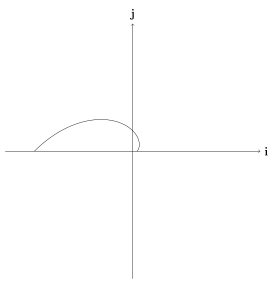
A particle \(P\) moves so that, at time \(t\), its displacement \( \bf r \) from a fixed origin is given by \[ {\bf r} =\left( \e^{t}\cos t \right) {\bf i}+ \left(\e^t \sin t\right) {\bf j}\,.\] Show that the velocity of the particle always makes an angle of \(\frac{\pi}{4}\) with the particle's displacement, and that the acceleration of the particle is always perpendicular to its displacement. Sketch the path of the particle for \(0\le t \le \pi\). A second particle \(Q\) moves on the same path, passing through each point on the path a fixed time \(T\) after \(P\) does. Show that the distance between \(P\) and \(Q\) is proportional to \(\e^{t}\).
Solution: \begin{align*} && {\bf r} &=\left( \e^{t}\cos t \right) {\bf i}+ \left(\e^t \sin t\right) {\bf j} \\ \Rightarrow && \dot{\bf r} &= \left( \e^{t}\cos t -\e^t \sin t\right) {\bf i}+ \left(\e^t \sin t+\e^t \cos t\right) {\bf j} \\ \Rightarrow && \mathbf{r}\cdot\dot{ \mathbf{r}} &= e^{2t}(\cos^2 t - \sin t \cos t) + e^{2t}(\sin^2 t+ \sin t \cos t) \\ &&&= e^{2t} (\cos^2 t + \sin ^2 t)\\ &&&= e^{2t} \\ \\ && | {\bf r}| &= e^{t} \\ && |{\bf \dot{r}}| &= e^t \sqrt{(\cos t - \sin t)^2 + (\sin t + \cos t)^2} \\ &&&= e^t \sqrt{2 \cos^2 t + 2 \sin^2 t} \\ &&&= \sqrt{2} e^t \\ \\ \Rightarrow && \frac{\mathbf{r}\cdot\dot{ \mathbf{r}}}{ |{\bf {r}}| |{\bf \dot{r}}|} &= \frac{e^{2t}}{\sqrt{2}e^te^t} \\ &&&= \frac{1}{\sqrt{2}} \end{align*} Therefore the angle between the velocity and displacement is \(\frac{\pi}{4}\). \begin{align*} && \ddot{\bf{r}} &= \left( \e^{t}(\cos t - \sin t) - \e^t (\sin t + \cos t)\right) {\bf i}+ \left(\e^t (\sin t + \cos t) + \e^t(\cos t - \sin t)\right) {\bf j} \\ &&&= \left ( -2\e^{t} \sin t \right) {\bf i}+ \left ( 2\e^{t} \cos t \right) {\bf j} \\ \Rightarrow && {\bf r} \cdot \ddot{\bf{r}} &= 2e^{2t} \left ( -\sin t \cos t + \sin t \cos t \right) \\ &&&= 0 \end{align*} Therefore the acceleration is perpendicular.
2010 Paper 1 Q11
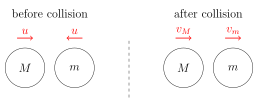
Two particles of masses \(m\) and \(M\), with \(M>m\), lie in a smooth circular groove on a horizontal plane. The coefficient of restitution between the particles is \(e\). The particles are initially projected round the groove with the same speed \(u\) but in opposite directions. Find the speeds of the particles after they collide for the first time and show that they will both change direction if \(2em> M-m\). After a further \(2n\) collisions, the speed of the particle of mass \(m\) is \(v\) and the speed of the particle of mass \(M\) is \(V\). Given that at each collision both particles change their directions of motion, explain why \[ mv-MV = u(M-m), \] and find \(v\) and \(V\) in terms of \(m\), \(M\), \(e\), \(u\) and \(n\).
Solution: All the forces in the circular groove will be perpendicular to the direction of motion. Therefore the particles will continue moving with constant speed at all times (aside from collisions). We can consider the collisions to occur as if along a tangent, (since they will be travelling perfectly perpendicular at the collisions).
2010 Paper 1 Q12
A discrete random variable \(X\) takes only positive integer values. Define \(\E(X)\) for this case, and show that \[\E(X) =\sum^{\infty}_{n=1}\P\left(X\ge n \right).\] I am collecting toy penguins from cereal boxes. Each box contains either one daddy penguin or one mummy penguin. The probability that a given box contains a daddy penguin is \(p\) and the probability that a given box contains a mummy penguin is \(q\), where \(p\ne0\), \(q\ne0\) and \(p+q=1\,\). Let \(X\) be the number of boxes that I need to open to get at least one of each kind of penguin. Show that \(\P(X\ge 4)= p^{3}+q^{3}\), and that \[ \E(X)=\frac{1}{pq}-1.\, \] Hence show that \(\E(X)\ge 3\,\).
Solution: \[ \E[X] := \sum_{n=1}^{\infty} n \mathbb{P}(X=n) \] \begin{align*} && \sum^{\infty}_{n=1}\mathbb{P}\left(X\ge n \right) &= \sum^{\infty}_{n=1}\sum_{k=n}^\infty \mathbb{P}(X=k) \\ &&&= \sum_{k=1}^\infty k \cdot \mathbb{P}(X=k) \\ &&&= \E[X] \end{align*} \begin{align*} &&\mathbb{P}(X \geq 4) &= \mathbb{P}(\text{first 3 are daddies}) +\mathbb{P}(\text{first 3 are mummies}) \\ &&&= p^3 + q^3 \\ \Rightarrow && \E[X] &= \sum_{n=1}^{\infty} \mathbb{P}\left(X\ge n \right) \\ &&&= 1+\sum_{n=2}^{\infty} \left ( p^{n-1} + q^{n-1}\right) \\ &&&= 1+\frac{p}{1-p} + \frac{q}{1-q} \\ &&&= 1+\frac{p}q + \frac{q}p \\ &&&= 1+\frac{p^2+q^2}{pq} \\ &&&= 1+\frac{(p+q)^2-2pq}{pq} \\ &&&= \frac{1}{pq} -1 \\ &&& \underbrace{\geq}_{AM-GM} \frac{1}{4}-1 = 3 \end{align*}
2010 Paper 1 Q13
The number of texts that George receives on his mobile phone can be modelled by a Poisson random variable with mean \(\lambda\) texts per hour. Given that the probability George waits between 1 and 2 hours in the morning before he receives his first text is \(p\), show that \[ p\e^{2\lambda}-\e^{\lambda}+1=0. \] Given that \(4p<1\), show that there are two positive values of \(\lambda\) that satisfy this equation. The number of texts that Mildred receives on each of her two mobile phones can be modelled by independent Poisson random variables with different means \(\lambda_{1}\) and \(\lambda_{2}\) texts per hour. Given that, for each phone, the probability that Mildred waits between 1 and 2 hours in the morning before she receives her first text is also \(p\), find an expression for \(\lambda_{1}+\lambda_{2}\) in terms of \(p\). Find the probability, in terms of \(p\), that she waits between 1 and 2 hours in the morning to receive her first text.
Solution: Let \(X_t\) be the number of texts he recieves before \(t\) hours. So \(X_t \sim P(t\lambda)\) \begin{align*} &&\mathbb{P}(X_1 = 0 \, \cap \, X_2 > 0) &= e^{-\lambda} \cdot \left ( 1-e^{-\lambda}\right) = p \\ \Rightarrow && e^{2\lambda}p &= e^{\lambda} - 1 \\ \Rightarrow && 0 &= pe^{2\lambda}-e^{\lambda} + 1 \\ \Rightarrow && e^{\lambda} &= \frac{1 \pm \sqrt{1-4p}}{2p} \end{align*} Which clearly has two positive roots if \(4p < 1\). We need to show both roots are \(>1\). So considering the smaller one we are looking at: \begin{align*} && \frac{1-\sqrt{1-4p}}{2p} & > 1 \\ \Leftrightarrow && 1-\sqrt{1-4p} &> 2p \\ \Leftrightarrow && 1-2p&> \sqrt{1-4p} \\ \Leftrightarrow && (1-2p)^2&> 1-4p \\ \Leftrightarrow && 1-4p+4p^2&> 1-4p \\ \end{align*} which is clearly true. We must have \(e^{\lambda_1}\cdot e^{\lambda_2} = \frac{1}{p}\), so \(\lambda_1 + \lambda_2 = -\ln p\) by considering the product of the roots in our quadratic. (Vieta). Therefore the probability she waits between 1 and 2 hours in the morning is \(e^{-(\lambda_1 + \lambda_2)} \cdot ( 1- e^{-(\lambda_1+\lambda_2)}) = p \cdot (1-p)\)
2010 Paper 2 Q1
Let \(P\) be a given point on a given curve \(C\). The \textit{osculating circle} to \(C\) at \(P\) is defined to be the circle that satisfies the following two conditions at \(P\): it touches \(C\); and the rate of change of its gradient is equal to the rate of change of the gradient of \(C\). Find the centre and radius of the osculating circle to the curve \(y=1-x+\tan x\) at the point on the curve with \(x\)-coordinate \(\frac14 \pi\).
Solution: The condition is that we match the first and second derivative (as well as passing through the point in question, which is \((\frac{\pi}{4}, 2 - \frac{\pi}{4})\) The gradient is \(y' = -1 + \sec^2 x\), so the value is \(1\). The second derivative is \(y'' = 2 \sec^2 x \tan x\), which is \(4\) If we have a circle, radius \(r\), so \((x-a)^2 + (y-b)^2 = r^2\) then \(2(x-a) + 2(y-b) \frac{\d y}{\d x} = 0\) and \(2 + 2 \left ( \frac{\d y}{\d x} \right)^2 + 2(y-b) \frac{\d^2y}{\d x^2} = 0\). Therefore we must have \(1+1+(2-\frac{\pi}{4}-b)4 = 0 \Rightarrow b =\frac52-\frac{\pi}{4}\) We know that the centre lies on the line \(y = 2-x\), so we must have \(a = \frac{\pi}{4}-\frac12\) and so the centre is \(( \frac{\pi}{4} - \frac12,\frac52 - \frac{\pi}{4})\) and the radius is \(\sqrt{\frac14 + \frac14} = \frac{\sqrt{2}}{2}\)
2010 Paper 2 Q2
Prove that \[ \cos 3x = 4 \cos^3 x - 3 \cos x \,. \] Find and prove a similar result for \(\sin 3x\) in terms of \(\sin x\).
- Let \[ {\rm I}(\alpha) = \int_0^\alpha \big(7\sin x - 8 \sin^3 x\big) \d x\,. \] Show that \[ {\rm I}(\alpha) = -\tfrac 8 3 c^3 + c +\tfrac5 3\,, \] where \(c = \cos \alpha\). Write down one value of \(c\) for which \({\rm I}(\alpha) =0\).
- Useless Eustace believes that \[ \int \sin^n x \, \d x =\dfrac {\sin^{n+1}x}{n+1}\, \] for \(n=1, \ 2, \ 3, \ldots\, \). Show that Eustace would obtain the correct value of \({\rm I}(\beta)\,\), where \(\cos \beta= -\frac16\). Find all values of \(\alpha\) for which he would obtain the correct value of \({\rm I}(\alpha)\).
Solution: \begin{align*} \cos 3x &\equiv \cos (2x + x) \\ &\equiv \cos 2x \cos x - \sin 2x \sin x \\ &\equiv (2\cos^2 x - 1) \cos x - 2 \sin x \cos x \sin x \\ &\equiv 2 \cos^3 x - \cos x - 2\cos x (\sin^2 x) \\ &\equiv 2 \cos^3 x - \cos x - 2\cos x (1- \cos^2 x) \\ &\equiv 4\cos^3 x - 3\cos x \end{align*} Similarly, \begin{align*} \sin 3x &\equiv \sin (2x + x) \\ &\equiv \sin 2x \cos x + \cos 2x \sin x \\ &\equiv 2 \sin x \cos x \cos x + (1-2\sin^2 x) \sin x \\ &\equiv 2 \sin x (1-\sin^2 x) + \sin x - 2 \sin^3 x \\ &\equiv 3 \sin x -4 \sin ^3 x \end{align*}
- \begin{align*} I(\alpha) &= \int_0^{\alpha} (7 \sin x - 8 \sin^3 x) \d x \\ &= \int_0^{\alpha} (7 \sin x - (6\sin x-2 \sin 3x) ) \d x \\ &= \int_0^{\alpha} (\sin x +2 \sin 3x ) \d x \\ &= -\cos \alpha - \frac23 \cos 3\alpha +1+\frac23 \\ &= -c - \frac23 (4c^3-3c) + \frac53 \\ &= -\frac83 c^3 +c + \frac53 \end{align*} as required. When \(c = -1\) this value is \(0\). Eustace will obtain the value \(\frac{7}{2} \sin^2 \beta - 2 \sin^4 \beta = \frac72 (1-\cos^2 \beta) - 2(1-\cos^2 \beta)^2 = \frac32 + \frac12\cos^2 \beta -2\cos^4 \beta\) So if \(\cos \beta = -\frac16\) he will obtain \(\frac32 + \frac{1}{2\cdot36} - \frac{2}{6^4}\) and he should obtain \(\frac{8}{3} \frac{1}{6^3} - \frac{1}{6} + \frac{5}{3}\) which are equal. We want to find all roots of: \begin{align*} && \frac32 + \frac12 c^2 - 2c^4 &= -\frac83 c^3+ c + \frac53 \\ \Rightarrow && 0 &=2c^4-\frac83c^3-\frac12 c^2+c +\frac{1}{6} \\ &&&= 12c^4-16c^3-3c^2+6c+1\\ &&&= (6c+1)(2c^3-3c^2+1) \\ &&&= (6c+1)(2c+1)(c-1)^2 \end{align*} Therefore \(\cos \alpha = - \frac16, -\frac12, 1\) will give the correct answers.
2010 Paper 2 Q3
The first four terms of a sequence are given by \(F_0=0\), \(F_1=1\), \(F_2=1\) and \(F_3=2\). The general term is given by \[ F_n= a\lambda^n+b\mu^n\,, \tag{\(*\)} \] where \(a\), \(b\), \(\lambda\) and \(\mu\) are independent of \(n\), and \(a\) is positive.
- Show that \(\lambda^2 +\lambda\mu+ \mu^2 = 2\), and find the values of \(\lambda\), \(\mu\), \(a\) and \(b\).
- Use \((*)\) to evaluate \(F_6\).
- Evaluate \(\displaystyle \sum_{n=0}^\infty \frac{F_n}{2^{n+1}}\,.\)
Solution:
- \(\,\) \begin{align*} && 0 &= a+b \tag{1}\\ && 1 &= a\lambda -a\mu \tag{2} \\ && 1 &= a\lambda^2 -a\mu^2 \tag{3} \\ && 2 &= a\lambda^3 - a\mu^3 \tag{4} \\ (4) \div (2): && 2 & = \lambda^2+\lambda \mu + \mu^2 \\ (3) \div (2): && 1 &= \lambda + \mu \\ \Rightarrow && 2 &= \lambda^2 + \lambda(1-\lambda) + (1-\lambda)^2 \\ &&&= \lambda^2-\lambda+1\\ \Rightarrow && \lambda, \mu &= \frac{1 \pm \sqrt{5}}{2} \\ \Rightarrow && a &= \frac{1}{\lambda - \mu} = \frac{1}{\sqrt{5}} \\ \Rightarrow && b &= -\frac{1}{\sqrt{5}} \end{align*} (NB: This is Binet's formula)
- \(\,\) \begin{align*} F_6 &= \frac{1}{\sqrt{5}} \left ( \left ( \frac{1 +\sqrt{5}}{2} \right)^6- \left ( \frac{1 -\sqrt{5}}{2} \right)^6 \right) \\ &= \frac{1}{2^6 \sqrt{5}} \left ( (1+\sqrt{5})^6-(1-\sqrt{5})^6 \right) \\ &= \frac{1}{2^5 \cdot \sqrt{5}} \left (6 \sqrt{5} +\binom{6}{3} (\sqrt{5})^3+\binom{6}{5}(\sqrt{5})^5 \right)\\ &= \frac{1}{2^5} \left (6 +20\cdot 5+6\cdot 5^2 \right)\\ &= \frac{1}{2^5} 256 = 2^3 = 8 \end{align*} (way more painful than just computing it by adding terms!)
- \(\,\) \begin{align*} && \sum_{n=0}^{\infty} \frac{F_n}{2^{n+1}} &= \sum_{n=0}^{\infty} \frac{a\lambda^n + b\mu^n}{2^{n+1}} \\ &&&= \frac12 \left ( \frac{a}{1-\frac{\lambda}2} + \frac{b}{1-\frac{\mu}2} \right) \\ &&&= \frac12 \left ( \frac{2a}{2-\lambda} + \frac{2b}{2-\mu}\right) \\ &&&= \frac{2a}{4-2\lambda} + \frac{2b}{4-2\mu}\\ &&&= \frac{2a}{4-(1+\sqrt{5})} - \frac{2a}{4-(1-\sqrt{5})} \\ &&&= \frac{2}{3\sqrt{5}-5} - \frac{2}{3\sqrt{5}+5} \\ &&&= \frac{6\sqrt{5}+10-6\sqrt{5}+10}{45-25} \\ &&&= 1 \end{align*}
2010 Paper 2 Q4
- Let \[ I=\int_0^a \frac {\f(x)}{\f(x)+\f(a-x)} \, \d x\,. \] Use a substitution to show that \[ I = \int_0^a \frac {\f(a-x)}{\f(x)+\f(a-x)} \, \d x\, \] and hence evaluate \(I\) in terms of \(a\). Use this result to evaluate the integrals \[ \int_0^1 \frac{\ln (x+1)}{\ln (2+x-x^2)}\, \d x \ \ \ \ \ \ \text{ and }\ \ \ \ \ \int_0^{\frac\pi 2} \frac{\sin x } {\sin(x+\frac \pi 4 )} \, \d x \,. \]
- Evaluate \[ \int_{\frac12}^2 \frac {\sin x}{x \big(\sin x + \sin \frac 1 x\big)} \, \d x\,. \]
Solution:
- \(\,\) \begin{align*} && I &= \int_0^a \frac{f(x)}{f(x)+f(a-x)} \d x \\ u =a-x, \d u = - \d x: &&& \int_{u=a}^{u=0} \frac{f(a-u)}{f(a-u)+f(u)} (-1) \d u \\ &&&= \int_0^a \frac{f(a-u)}{f(u)+f(a-u)} \d u \\ &&&= \int_0^a \frac{f(a-x)}{f(x)+f(a-x)} \d x \\ \Rightarrow && 2 I &= \int_0^a \left ( \frac{f(x)}{f(x)+f(a-x)} + \frac{f(a-x)}{f(x)+f(a-x)} \right) \d x \\ &&&= \int_0^a 1 \d x \\ &&&= a \\ \Rightarrow && I &= \frac{a}{2} \end{align*} \begin{align*} && J &= \int_0^1 \frac{\ln (x+1)}{\ln (2+x-x^2)}\, \d x \\ &&&= \int_0^1 \frac{\ln (x+1)}{\ln((x+1)(2-x))} \d x \\ &&&= \int_0^1 \frac{\ln (x+1)}{\ln(x+1) + \ln ((1-x)+1)} \d x \\ &&&= \frac{1}{2} \tag{\(f(x) = \ln (x+1)\)} \\ \\ && K &= \int_0^{\frac\pi 2} \frac{\sin x } {\sin(x+\frac \pi 4 )} \, \d x \\ &&&= \int_0^{\frac{\pi}{2}} \frac{\sin x }{\sin x \cos \frac{\pi}{4} + \cos x \sin \frac{\pi}{4}} \\ &&&= \sqrt{2} \int_0^{\frac{\pi}{2}} \frac{\sin x }{\sin x + \sin (\frac{\pi}{2}-x)} \d x\\ &&&= \frac{\pi}{2\sqrt{2}} \end{align*}
- \(\,\) \begin{align*} &&I &= \int_{\frac12}^2 \frac{\sin x }{x(\sin x + \sin \frac1x)} \d x \\ u = 1/x, \d u = -1/x^2 \d x : &&&= \int_{u = 2}^{u=\frac12} \frac{\sin \frac1u}{\frac{1}{u}(\sin \frac1u + \sin u)} (-\frac{1}{u^2} ) \d u \\ &&&= \int_{\frac12}^2 \frac{\sin \frac1u}{u (\sin u + \sin \frac1u)} \d u \\ \Rightarrow && 2I &= \int_{\frac12}^2 \left ( \frac{\sin x }{x(\sin x + \sin \frac1x)} + \frac{\sin \frac1x }{x(\sin x + \sin \frac1x)}\right) \d x \\ &&&= \int_{\frac12}^2 \frac{1}{x} \d x\\ &&&= 2\ln2 \\ \Rightarrow && I &= \ln 2 \end{align*}
2010 Paper 2 Q5
The points \(A\) and \(B\) have position vectors \(\bf i +j+k\) and \(5{\bf i} - {\bf j} -{\bf k}\), respectively, relative to the origin \(O\). Find \(\cos2\alpha\), where \(2\alpha\) is the angle \(\angle AOB\).
- The line \(L _1\) has equation \({\bf r} =\lambda(m{\bf i}+n {\bf j} + p{\bf k})\). Given that \(L _1\) is inclined equally to \(OA\) and to \(OB\), determine a relationship between \(m\), \(n\) and~\(p\). Find also values of \(m\), \(n\) and~\(p\) for which \(L _1\) is the angle bisector of \(\angle AOB\).
- The line \(L _2\) has equation \({\bf r} =\mu(u{\bf i}+v {\bf j} + w{\bf k})\). Given that \( L _2\) is inclined at an angle \(\alpha\) to \(OA\), where \(2\alpha = \angle AOB\), determine a relationship between \(u\), \(v\) and \(w\). Hence describe the surface with Cartesian equation \(x^2+y^2+z^2 =2(yz+zx+xy)\).
2010 Paper 2 Q6
Each edge of the tetrahedron \(ABCD\) has unit length. The face \(ABC\) is horizontal, and \(P\) is the point in \(ABC\) that is vertically below \(D\).
- Find the length of \(PD\).
- Show that the cosine of the angle between adjacent faces of the tetrahedron is \(1/3\).
- Find the radius of the largest sphere that can fit inside the tetrahedron.
Solution:
- \(D\) must be above the centre (of any kind) of the equilateral triangle \(ABC\). Therefore it is a distance \(\frac23 \frac{\sqrt{3}}2 = \frac{\sqrt{3}}3\) from \(A\). \(D\) is \(1\) from \(A\), therefore by Pythagoras \(PD = \sqrt{1-\frac13} = \sqrt{\frac23}\)
- We can place \(D\) at \(\langle 0,0,\sqrt{\frac23}\rangle\) and \(A'\) (the midpoint of \(BC\)) at \(\langle-\frac{\sqrt{3}}{6},0,0 \rangle\) and we find: \begin{align*} && \cos \theta &= \frac{(\mathbf{a}'-\mathbf{d})\cdot \mathbf{a}'}{|\mathbf{a}'-\mathbf{d}|| \mathbf{a}'|} \\ &&&= \frac{|\mathbf{a}'|}{|\mathbf{a}'-\mathbf{d}|} \\ &&&= \frac{\frac{\sqrt{3}}{6}}{\sqrt{\frac23+\frac{3}{36}}} = \frac13 \end{align*}
- We have And therefore we must have \(\tan \frac{\cos^{-1} \frac13}{2} = \frac{r}{\frac{\sqrt{3}}{6}}\) therefore \begin{align*} && r &= \frac{\sqrt{3}}{6} \tan \left (\frac{\cos^{-1} \frac13}{2} \right) \\ &&&= \frac{\sqrt{3}}6 \sqrt{\frac{1-\cos(\cos^{-1}\frac13)}{1+\cos(\cos^{-1}\frac13)}} \\ &&&= \frac{\sqrt{3}}6 \sqrt{\frac{\frac23}{\frac43}} \\ &&&= \frac{\sqrt{6}}{12} \end{align*}

2010 Paper 2 Q7
- By considering the positions of its turning points, show that the curve with equation \[ y=x^3-3qx-q(1+q)\,, \] where \(q>0\) and \(q\ne1\), crosses the \(x\)-axis once only.
- Given that \(x\) satisfies the cubic equation \[ x^3-3qx-q(1+q)=0\,, \] and that \[ x=u+q/u\,, \] obtain a quadratic equation satisfied by \(u^3\). Hence find the real root of the cubic equation in the case \(q>0\), \(q\ne1\).
- The quadratic equation \[ t^2 -pt +q =0\, \] has roots \(\alpha \) and \(\beta\). Show that \[ \alpha^3+\beta^3 = p^3 -3qp\,. \] It is given that one of these roots is the square of the other. By considering the expression \((\alpha^2 -\beta)(\beta^2-\alpha)\), find a relationship between \(p\) and \(q\). Given further that \(q>0\), \(q\ne1\) and \(p\) is real, determine the value of \(p\) in terms of \(q\).