Problems
Filters
48 problems found
1993 Paper 2 Q15
Two computers, LEP and VOZ are programmed to add numbers after first approximating each number by an integer. LEP approximates the numbers by rounding: that is, it replaces each number by the nearest integer. VOZ approximates by truncation: that is, it replaces each number by the largest integer less than or equal to the number. The fractional parts of the numbers to be added are uniformly and independently distributed. (The fractional part of a number \(a\) is \(a-\left\lfloor a\right\rfloor ,\) where \(\left\lfloor a\right\rfloor \) is the largest integer less than or equal to \(a\).) Both computers approximate and add 1500 numbers. For each computer, find the probability that the magnitude of error in the answer will exceed 15. How many additions can LEP perform before the probability that the magnitude of error is less than 10 drops below 0.9?
1993 Paper 2 Q16
At the terminus of a bus route, passengers arrive at an average rate of 4 per minute according to a Poisson process. Each minute, on the minute, one bus arrives with probability \(\frac{1}{4},\) independently of the arrival of passengers or previous buses. Just after eight o'clock there is no-one at the bus stop.
- What is the probability that the first bus arrives at \(n\) minutes past 8?
- If the first bus arrives at 8:05, what is the probability that there are \(m\) people waiting for it?
- Each bus can take 25 people and, since it is the terminus, the bus arrive empty. Explain carefully how you would calculate, to two significant figures, the probability that when the first bus arrives it is unable to pick up all the passengers. Your method should need the use of a calculator and standard tables only. There is no need to carry out the calculation.
1993 Paper 3 Q1
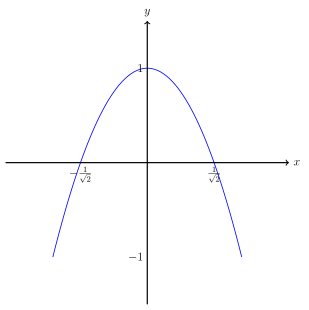
The curve \(P\) has the parametric equations $$ x= \sin\theta, \quad y=\cos2\theta \qquad\hbox{ for }-\pi/2 \le \theta \le \pi/2. $$ Show that \(P\) is part of the parabola \(y=1-2x^2\) and sketch \(P\). Show that the length of \(P\) is \(\surd (17) + {1\over 4} \sinh^{-1}4\). Obtain the volume of the solid enclosed when \(P\) is rotated through \(2\pi\) radians about the line \(y=-1\).
Solution: First notice that \(y = \cos 2 \theta = 1 - 2\sin^2 \theta = 1- 2x^2\), therefore \(P\) is lies on that parabola.
1993 Paper 3 Q2
The curve \(C\) has the equation \(x^3+y^3 = 3xy\).
- Show that there is no point of inflection on \(C\). You may assume that the origin is not a point of inflection.
- The part of \(C\) which lies in the first quadrant is a closed loop touching the axes at the origin. By converting to polar coordinates, or otherwise, evaluate the area of this loop.
1993 Paper 3 Q3
The matrices \(\mathbf{A},\mathbf{B}\) and \(\mathbf{M}\) are given by \[ \mathbf{A}=\begin{pmatrix}a & 0 & 0\\ b & c & 0\\ d & e & f \end{pmatrix},\quad\mathbf{B}=\begin{pmatrix}1 & p & q\\ 0 & 1 & r\\ 0 & 0 & 1 \end{pmatrix},\quad\mathbf{M}=\begin{pmatrix}1 & 3 & 2\\ 4 & 13 & 5\\ 3 & 8 & 7 \end{pmatrix}, \] where \(a,b,\ldots,r\) are real numbers. Given that \(\mathbf{M=AB},\) show that \(a=1,b=4,c=1,d=3,e=1,f=-2,p=3,q=2\) and \(r=-3\) gives the unique solution for \(\mathbf{A}\) and \(\mathbf{B}.\) Evaluate \(\mathbf{A}^{-1}\) and \(\mathbf{B}^{-1},\) Hence, or otherwise, solve the simultaneous equations \begin{alignat*}{1} x+3y+2z & =7\\ 4x+13y+5z & =18\\ 3x+8y+7z & =25. \end{alignat*}
Solution: \begin{align*} && \begin{pmatrix}1 & 3 & 2\\ 4 & 13 & 5\\ 3 & 8 & 7 \end{pmatrix} &= \begin{pmatrix}a & 0 & 0\\ b & c & 0\\ d & e & f \end{pmatrix}\begin{pmatrix}1 & p & q\\ 0 & 1 & r\\ 0 & 0 & 1 \end{pmatrix} \\ &&&= \begin{pmatrix} a & ap & aq \\ b & pb + c & qb + cr\\ d & pd + e & qd + er +f \end{pmatrix} \\ \Rightarrow && a,b,d,p,q&=1,4,3,3,2\\ &&&= \begin{pmatrix} 1 & 3 & 2 \\ 4 & 12 + c & 8+ cr\\ 3 & 9 + e & 6 + er +f \end{pmatrix} \\ \Rightarrow && c, e&=1,-1\\ &&&= \begin{pmatrix} 1 & 3 & 2 \\ 4 & 13 & 8+ r\\ 3 & 8 & 6 -r +f \end{pmatrix} \\ \Rightarrow && r, f &= -3, -2 \end{align*} \begin{align*} \mathbf{A}^{-1} &= \begin{pmatrix} 1 & 0 & 0 \\ 4 & 1 & 0\\ 3 & -1 & -2 \end{pmatrix}^{-1} \\ &=\frac{1}{-2} \begin{pmatrix} -2 & 0 & 0 \\ 8 & -2 & 0\\ -7 & 1 & 1 \end{pmatrix} \\ \\ \mathbf{B}^{-1} &= \begin{pmatrix} 1 & 3 & 2 \\ 0 & 1 & -3\\ 0 & 0 & 1 \end{pmatrix}^{-1} \\ &= \begin{pmatrix} 1 & -3 & -11 \\ 0 & 1 & 3\\ 0 & 0 & 1 \end{pmatrix} \\ \end{align*} We want to solve \(\mathbf{M}\mathbf{v} = \begin{pmatrix} 7 \\ 18 \\ 25 \end{pmatrix}\), ie \begin{align*} \mathbf{v} &= \mathbf{M}^{-1}\begin{pmatrix} 7 \\ 18 \\ 25 \end{pmatrix} \\ &= \mathbf{B}^{-1} \mathbf{A}^{-1}\begin{pmatrix} 7 \\ 18 \\ 25 \end{pmatrix} \\ &= \frac{1}{-2}\mathbf{B}^{-1} \begin{pmatrix} -2 & 0 & 0 \\ 8 & -2 & 0\\ -7 & 1 & 1 \end{pmatrix} \begin{pmatrix} 7 \\ 18 \\ 25 \end{pmatrix} \\ &= \frac{1}{-2}\mathbf{B}^{-1} \begin{pmatrix} -14 \\ 20 \\ -6 \end{pmatrix} \\ &= \begin{pmatrix} 1 & -3 & -11 \\ 0 & 1 & 3\\ 0 & 0 & 1 \end{pmatrix}\begin{pmatrix} 7 \\ -10 \\ 3 \end{pmatrix} \\ &= \begin{pmatrix} 4\\ -1 \\ 3 \end{pmatrix} \end{align*} This algorithm is called the "LU-decomposition"
1993 Paper 3 Q4
Sum the following infinite series.
- \[ 1 + \frac13 \bigg({\frac12}\bigg)^2 +\frac15\bigg(\frac12\bigg)^4 + \cdots + \frac{1}{2n+1} \bigg(\frac12\bigg)^{2n} + \cdots \] .
- \[ 2 -x -x^3 +2x^4 - \cdots + 2x^{4k} - x^{4k+1} - x^{4k+3} +\cdots \] where \(|x| < 1\).
- \[ \sum _{r=2}^\infty {r\, 2^{r-2} \over 3^{r-1} } \].
- \[ \sum_{r=2}^\infty {2 \over r(r^2-1) } \].
Solution:
- \begin{align*} && \sum_{i=0}^{\infty} x^{2i+1}&= \frac{x}{1-x^2} \\ \Rightarrow &&&=\frac12 \left ( \frac{1}{1-x} - \frac{1}{1+x} \right) \\ \underbrace{\Rightarrow}_{\int} && \sum_{i=0}^{\infty} \frac{1}{2i+1} x^{2i+2} &= \frac12 \left ( -\ln (1-x) - \ln(1+x) \right) \\ \underbrace{\Rightarrow}_{x = 1/2} && \sum_{i=0}^\infty \frac{1}{2i+1} \left (\frac12 \right)^{2i+2} &= -\frac12 \ln \frac12 - \frac12 \ln \frac32 \\ &&&= -\frac12 \ln \frac34 \\ &&\frac14\sum_{i=0}^\infty \frac{1}{2i+1} \left (\frac12 \right)^{2i}&= \frac12 \ln \frac43 \\ \Rightarrow&& S &= 2 \ln \frac43 \end{align*}
- \begin{align*} \sum_{k=0}^{\infty} \left (2x^{4k} - x^{4k+1} - x^{4k+3} \right) &= \sum_{k=0}^{\infty} \left (2 - x^{1} - x^{3} \right) x^{4k} \\ &= \frac{2-x-x^3}{1-x^4} \\ &= \frac{(1-x)(2+x+x^2)}{(1-x)(1+x+x^2+x^3)} \\ &= \frac{2+x+x^2}{1+x+x^2+x^3} \end{align*}
- \begin{align*} && \frac{1}{(1-x)^2} &= \sum_{r=0}^{\infty} r x^{r-1} \\ \Rightarrow && 9 &= \sum_{r=1}^{\infty} r \left ( \frac23 \right)^{r-1} \\ \Rightarrow && \sum_{r=2}^{\infty} r \left ( \frac{2^{r-2}}{3^{r-1}} \right) &= \frac12 \left ( 9 - 1 \right) \\ &&&= 4 \end{align*}
- \begin{align*} && \frac{2}{r(r^2-1)} &= \frac{1}{r-1} - \frac{2}{r} + \frac{1}{r+1} \\ \Rightarrow && \sum_{r=2}^{\infty} \left ( \frac{1}{r-1} - \frac{2}{r} + \frac{1}{r+1} \right) &= \sum_{r=2}^{\infty} \left ( \frac{1}{r-1} - \frac{1}{r} - \frac{1}{r} + \frac{1}{r+1} \right) \\ &&&= \sum_{r=2}^{\infty} \left ( \frac{1}{r-1} - \frac{1}{r} \right)-\sum_{r=2}^{\infty} \left ( \frac{1}{r} - \frac{1}{r+1} \right) \\ &&&= 1 - \frac12 \\ &&&= \frac12 \end{align*}
1993 Paper 3 Q5
The set \(S\) consists of ordered pairs of complex numbers \((z_1,z_2)\) and a binary operation \(\circ\) on \(S\) is defined by $$ (z_1,z_2)\circ(w_1,w_2)= (z_1w_1-z_2w^*_2, \; z_1w_2+z_2w^*_1). $$ Show that the operation \(\circ\) is associative and determine whether it is commutative. Evaluate \((z,0)\circ(w,0)\), \((z,0)\circ(0,w)\), \((0,z)\circ(w,0)\) and \((0,z)\circ(0,w)\). The set \(S_1\) is the subset of \(S\) consisting of \(A\), \(B\), \(\ldots\,\), \(H\), where \(A=(1,0)\), \(B=(0,1)\), \(C=(i,0)\), \(D=(0,i)\), \(E=(-1,0)\), \(F=(0,-1)\), \(G=(-i,0)\) and \(H=(0,-i)\). Show that \(S_1\) is closed under \(\circ\) and that it has an identity element. Determine the inverse and order of each element of \(S_1\). Show that \(S_1\) is a group under \(\circ\). \hfil\break [You are not required to compute the multiplication table in full.] Show that \(\{A,B,E,F\}\) is a subgroup of \(S_1\) and determine whether it is isomorphic to the group generated by the \(2\times2\) matrix $\begin{pmatrix}0 & 1\\ -1 & 0 \end{pmatrix}$ under matrix multiplication.
1993 Paper 3 Q6
The point in the Argand diagram representing the complex number \(z\) lies on the circle with centre \(K\) and radius \(r\), where \(K\) represents the complex number \(k\). Show that $$ zz^* -kz^* -k^*z +kk^* -r^2 =0. $$ The points \(P\), \(Q_1\) and \(Q_2\) represent the complex numbers \(z\), \(w_1\) and \(w_2\) respectively. The point \(P\) lies on the circle with \(OA\) as diameter, where \(O\) and \(A\) represent \(0\) and \(2i\) respectively. Given that \(w_1=z/(z-1)\), find the equation of the locus \(L\) of \(Q_1\) in terms of \(w_1\) and describe the geometrical form of \(L\). Given that \(w_2=z^*\), show that the locus of \(Q_2\) is also \(L\). Determine the positions of \(P\) for which \(Q_1\) coincides with \(Q_2\).
1993 Paper 3 Q7
The real numbers \(x\) and \(y\) satisfy the simultaneous equations $$ \sinh (2x) = \cosh y \qquad\hbox{and}\qquad \sinh(2y) = 2 \cosh x. $$ Show that \(\sinh^2 y\) is a root of the equation $$ 4t^3 + 4t^2 -4t -1=0 $$ and demonstrate that this gives at most one valid solution for \(y\). Show that the relevant value of \(t\) lies between \(0.7\) and \(0.8\), and use an iterative process to find \(t\) to 6 decimal places. Find \(y\) and hence find \(x\), checking your answers and stating the final answers to four decimal places.
Solution: Let \(t = \sinh^2 y\), then \begin{align*} && \sinh(2x) &= \cosh y \tag{1}\\ && \sinh(2y) &= 2 \cosh x \tag{2} \\ \\ && \cosh(2x) &= 2 \cosh^2 x -1 \\ (2): &&&= \frac12 \sinh^2(2y) -1 \\ && 1 &= \left (\frac12 \sinh^2(2y) -1 \right)^2 - \cosh^2 y \\ &&&= \frac14 \sinh^4(2y)-\sinh^2(2y)+1-\cosh^2 y \\ \Rightarrow && 0 &= \frac14 (\cosh^2 (2y)-1)^2- (\cosh^2 (2y)-1) - \cosh^2 y \\ &&&= \frac14 \left ( \left (1+2\sinh^2 y \right)^2-1 \right)^2 -\left ( \left (1+2\sinh^2 y \right)^2 -1\right) - (1 + \sinh^2 y ) \\ &&&= \frac14 \left ( 1 + 4t+4t^2 -1\right)^2 - \left ( 1+4t+4t^2-1\right) - (1 + t) \\ &&&= \frac14 (4t + 4t^2)^2 - (4t+4t^2)-1-t \\ &&&= 4(t+t^2)^2 - 4t^2-5t-1 \\ &&&= 4t^4+8t^3+4t^2-4t^2-5t-1 \\ &&& = 4t^4+8t^3-5t-1 \\ &&&= (t+1)(4t^3+4t^2-4t-1) \end{align*} Since \(\sinh^2 y\) is positive, we must be a root of the second cubic. Let \(f(t) = 4t^3+4t^2-4t-1\), then \(f(0) = -1\) and \(f'(t) = 12t^2+8t-4 = 4(t+1)(3t-1)\), so we have turning points at \(-1\) and \(\frac13\). Since \(f(-1) = 3 > 0\) and \(f(0) < 0\) we must have exactly one root larger than zero. Therefore there is a unique root. \(f(0.7) = -0.468 < 0\) \(f(0.8) = 0.408 > 0\) since \(f\) is continuous and changes sign, the root must fall in the interval \((0.7, 0.8)\). Let \(t_{n+1} = t_n - \frac{f(t_n)}{f'(t_n)}\), and \(t_0 = 0.75\), then \begin{align*} t_0 &= 0.75 \\ t_1 &= 0.7571428571 \\ t_2 &= 0.7570684728 \\ t_3 &= 0.7570684647 \end{align*} So \(t \approx 0.757068\), \(\sinh y \approx 0.870097\), \(y \approx 0.786474\), \(x \approx 0.546965\)
1993 Paper 3 Q8
A square pyramid has its base vertices at the points \(A\) \((a,0,0)\), \(B\) \((0,a,0)\), \(C\) \((-a,0,0)\) and \(D\) \((0,-a,0)\), and its vertex at \(E\) \((0,0,a)\). The point \(P\) lies on \(AE\) with \(x\)-coordinate \(\lambda a\), where \(0<\lambda<1\), and the point \(Q\) lies on \(CE\) with \(x\)-coordinate \(-\mu a\), where \(0<\mu<1\). The plane \(BPQ\) cuts \(DE\) at \(R\) and the \(y\)-coordinate of \(R\) is \(-\gamma a\). Prove that $$ \gamma = {\lambda \mu \over \lambda + \mu - \lambda \mu}. $$ Show that the quadrilateral \(BPRQ\) cannot be a parallelogram.
1993 Paper 3 Q9
For the real numbers \(a_1\), \(a_2\), \(a_3\), \(\ldots\),
- prove that \(a_1^2+a_2^2 \ge 2a_1a_2\),
- prove that \(a_1^2+a_2^2 +a_3^2 \ge a_2a_3 + a_3a_1 +a_1a_2\),
- prove that $3(a_1^2+a_2^2 +a_3^2 +a_4^2) \ge 2(a_1a_2+a_1a_3 + a_1a_4 +a_2a_3 + a_2a_4 +a_3a_4)\(,
- state and prove a generalisation of (iii) to the case of \)n$ real numbers,
- prove that
$$
\left(\sum_{i=1}^n a_i \right)^2 \ge {2n\over n-1} \sum_{i,j} a_ia_j,
$$
where the latter sum is taken over all pairs \((i,j)\) with $1\le i
1993 Paper 3 Q10
The transformation \(T\) of the point \(P\) in the \(x\),\(y\) plane to the point \(P'\) is constructed as follows: \hfil\break Lines are drawn through \(P\) parallel to the lines \(y=mx\) and \(y=-mx\) to cut the line \(y=kx\) at \(Q\) and \(R\) respectively, \(m\) and \(k\) being given constants. \(P'\) is the fourth vertex of the parallelogram \(PQP'R\). Show that if \(P\) is \((x_1,y_1)\) then \(Q\) is $$ \left( {mx_1-y_1 \over m-k}, {k(mx_1-y_1)\over m-k}\right). $$ Obtain the coordinates of \(P'\) in terms of \(x_1\), \(y_1\), \(m\) and \(k\), and express \(T\) as a matrix transformation. Show that areas are transformed under \(T\) into areas of the same magnitude.
1993 Paper 3 Q11
In this question, all gravitational forces are to be neglected. A rigid frame is constructed from 12 equal uniform rods, each of length \(a\) and mass \(m,\) forming the edges of a cube. Three of the edges are \(OA,OB\) and \(OC,\) and the vertices opposite \(O,A,B\) and \(C\) are \(O',A',B'\) and \(C'\) respectively. Forces act along the lines as follows, in the directions indicated by the order of the letters: \begin{alignat*}{3} 2mg\mbox{ along }OA, & \qquad & mg\mbox{ along }AC', & \qquad & \sqrt{2}mg\mbox{ along }O'A,\\ \sqrt{2}mg\mbox{ along }OA', & & 2mg\mbox{ along }C'B, & & mg\mbox{ along }A'C. \end{alignat*}
- The frame is freely pivoted at \(O\). Show that the direction of the line about which it will start to rotate is $\begin{pmatrix}1\\ 1\\ 2 \end{pmatrix}$ with respect to axes along \(OA\), \(OB\) and \(OC\) respectively.
- Show that the moment of inertia of the rod \(OA\) about the axis \(OO'\) is \(2ma^2/9\) and about a parallel axis through its mid-point is \(ma^2/18\). Hence find the moment of inertia of \(B'C\) about \(OO'\) and show that the moment of inertia of the frame about \(OO'\) is \(14ma^2/3\). If the frame is freely pivoted about the line \(OO'\) and the forces continue to act along the specified lines, find the initial angular acceleration of the frame.
1993 Paper 3 Q12
\(ABCD\) is a horizontal line with \(AB=CD=a\) and \(BC=6a\). There are fixed smooth pegs at \(B\) and \(C\). A uniform string of natural length \(2a\) and modulus of elasticity \(kmg\) is stretched from \(A\) to \(D\), passing over the pegs at \(B\) and \(C\). A particle of mass \(m\) is attached to the midpoint \(P\) of the string. When the system is in equilibrium, \(P\) is a distance \(a/4\) below \(BC\). Evaluate \(k\). The particle is pulled down to a point \(Q\), which is at a distance \(pa\) below the mid-point of \(BC\), and is released from rest. \(P\) rises to a point \(R\), which is at a distance \(3a\) above \(BC\). Show that \(2p^2-p-17=0\). Show also that the tension in the strings is less when the particle is at \(R\) than when the particle is at \(Q\).
1993 Paper 3 Q13
\(\ \)\vspace{-1cm} \noindent