Problems
Filters
48 problems found
1992 Paper 2 Q15
A point moves in unit steps on the \(x\)-axis starting from the origin. At each step the point is equally likely to move in the positive or negative direction. The probability that after \(s\) steps it is at one of the points \(x=2,x=3,x=4\) or \(x=5\) is \(\mathrm{P}(s).\) Show that \(\mathrm{P}(5)=\frac{3}{16},\) \(\mathrm{P}(6)=\frac{21}{64}\) and \[ \mathrm{P}(2k)=\binom{2k+1}{k-1}\left(\frac{1}{2}\right)^{2k} \] where \(k\) is a positive integer. Find a similar expression for \(\mathrm{P}(2k+1).\) Determine the values of \(s\) for which \(\mathrm{P}(s)\) has its greatest value.
Solution: After \(5\) steps we can get to: \begin{array}{c|c} x & \text{ways} \\ \hline 5 & 1 \text { - go positive every time}\\ 4 & 0 \\ 3 & \binom{5}{1} \text { - go positive every time but 1} \\ 2 &0 \\ \hline & 6 \end{array} Therefore there are \(\frac{6}{2^5} = \frac{3}{16}\) ways to get to \(\{2,3,4,5\}\) After \(6\) steps we can get to: \begin{array}{c|c} x & \text{ways} \\ \hline 5 & 0 \\ 4 & \binom{6}{1} \text { - go positive every time but 1}\\ 3 & 0 \\ 2 & \binom{6}{2} - \text{ - go positive every time but 2} \\ \hline & 21 \end{array} Therefore there are \(\frac{21}{2^6} = \frac{21}{64}\) ways to get to \(\{2,3,4,5\}\) After \(2k\) steps we can reach \(2\) or \(4\). To get to \(2\) we must take \(k+1\) positive steps and \(k-1\) negative steps, ie \(\binom{2k}{k-1}\). To get to \(4\) we must take \(k+2\) positive steps and \(k-2\) negative steps, ie \(\binom{2k}{k-2}\) Therefore there are \(\binom{2k+1}{k-1}\) routes, ie a probability of \(\frac{1}{2^{2k}} \binom{2k+1}{k-1}\) After \(2k+1\) steps we can reach \(3\) or \(5\). To get to \(3\) we must take \(k+2\) positive steps and \(k-1\) negative steps, ie \(\binom{2k+1}{k-1}\). To get to \(5\) we must take \(k+3\) positive steps and \(k-2\) negative steps, ie \(\binom{2k+1}{k-2}\) Therefore there are \(\binom{2k+2}{k-1}\) routes, ie a probability of \(\frac{1}{2^{2k+1}} \binom{2k+2}{k-1}\) To find the maximum of \(P(s)\) notice that \begin{align*} && \frac{P(2k+1)}{P(2k)} &= \frac12 \frac{\binom{2k+2}{k-1}}{\binom{2k+1}{k-1}} \\ &&&= \frac12 \frac{(2k+2)!(k-1)!(k+2)!}{(2k+1)!(k-1)!(k+3)!} \\ &&&= \frac12 \frac{2k+2}{k+3} = \frac{k+1}{k+3} < 1 \end{align*} So we should only look at the even terms. \begin{align*} && \frac{P(2k+2)}{P(2k)} &= \frac14 \frac{\binom{2k+3}{k}}{\binom{2k+1}{k-1}} \\ &&&= \frac14 \frac{(2k+3)!(k-1)!(k+2)!}{(2k+1)!k!(k+3)!} \\ &&&= \frac14 \frac{(2k+3)(2k+2)}{k(k+3)} \\ &&&= \frac{(2k+3)(k+1)}{2k(k+3)} \geq 1 \\ \Leftrightarrow && (2k+3)(k+1) &\geq 2k(k+3) \\ \Leftrightarrow && 2k^2+5k+3 &\geq 2k^2+6k \\ \Leftrightarrow && 3 &\geq k \\ \end{align*} Therefore the maximum is when \(s = 2\cdot 3\) or \(s = 2\cdot 4\) which we computed earlier to be \(\frac{21}{64}\)
1992 Paper 2 Q16
A taxi driver keeps a packet of toffees and a packet of mints in her taxi. From time to time she takes either a toffee (with probability \(p\)) or mint (with probability \(q=1-p\)). At the beginning of the week she has \(n\) toffees and \(m\) mints in the packets. On the \(N\)th occasion that she reaches for a sweet, she discovers (for the first time) that she has run out of that kind of sweet. What is the probability that she was reaching for a toffee?
Solution: \begin{align*} \mathbb{P}(\text{run out reading for toffee on } N\text{th occassion}) &= \binom{N-1}{n}p^nq^{N-1-n}p \end{align*} Since out of the first \(N-1\) times, we need to choose toffee \(n\) times, and then choose it again for the \(N\)th time. Therefore: \begin{align*} \mathbb{P}(\text{reaching for toffee} | \text{run out on }N\text{th occassion}) &= \frac{\mathbb{P}(\text{reaching for toffee and run out on }N\text{th occassion})}{\mathbb{P}(\text{reaching for toffee and run out on }N\text{th occassion}) + \mathbb{P}(\text{reaching for mint and run out on }N\text{th occassion})} \\ &= \frac{ \binom{N-1}{n}p^nq^{N-1-n}p}{ \binom{N-1}{n}p^nq^{N-1-n}p + \binom{N-1}{m}q^mp^{N-1-m}q} \\ &= \frac{ \binom{N-1}{n}}{ \binom{N-1}{n} + \binom{N-1}{m} \l \frac{q}{p} \r^{m+ n+ 2-N}} \end{align*} Some conclusions we can draw from this are: As \(p \to 1, q \to 0\), the probability they were reaching for a Toffee tends to \(1\). (And vice versa). If \(p = q\), then the probability is: \begin{align*} \frac{ \binom{N-1}{n}}{ \binom{N-1}{n} + \binom{N-1}{m} } \end{align*} Since \(n+1 \leq N \leq n+m+1\) where \(n \geq m\) we can notice that: \begin{align*} \text{if } N = m + n + 1 && \binom{m+n+1 - 1}{n} &= \binom{m+n+1 - 1}{m} & \text{ so } \mathbb{P} = \frac12 \\ \text{if } N = n+k && \binom{n+k-1}{n} &< \binom{n+k-1}{m} & \text{ so } \mathbb{P} < \frac12 \\ \end{align*}
1992 Paper 3 Q1
- Given that \[ \mathrm{f}(x)=\ln(1+\mathrm{e}^{x}), \] prove that \(\ln[\mathrm{f}'(x)]=x-\mathrm{f}(x)\) and that \(\mathrm{f}''(x)=\mathrm{f}'(x)-[\mathrm{f}'(x)]^{2}.\) Hence, or otherwise, expand \(\mathrm{f}(x)\) as a series in powers of \(x\) up to the term in \(x^{4}.\)
- Given that \[ \mathrm{g}(x)=\frac{1}{\sinh x\cosh2x}, \] explain why \(\mathrm{g}(x)\) can not be expanded as a series of non-negative powers of \(x\) but that \(x\mathrm{g}(x)\) can be so expanded. Explain also why this latter expansion will consist of even powers of \(x\) only. Expand \(x\mathrm{g}(x)\) as a series as far as the term in \(x^{4}.\)
Solution:
- \begin{align*} && f(x) &= \ln (1+e^x) \\ && f'(x) &= \frac{1}{1+e^x} \cdot e^x \\ &&&= \frac{e^x}{1+e^x} \\ \Rightarrow && \ln [f'(x)] &= x - \ln (1+e^x) \\ &&&= x - f(x) \\ \\ \Rightarrow && \frac{f''(x)}{f'(x)} &= 1 - f'(x) \\ \Rightarrow && f''(x) &= f'(x) - [f'(x)]^2 \\ && f'''(x) &= f''(x) - 2f'(x) f''(x) \\ && f^{(4)}(x) &= f'''(x) - 2[f''(x)]^2-2f'(x)f'''(x) \end{align*} \begin{align*} f(0) &= \ln 2 \\ f'(0) &= \tfrac12 \\ f''(0) &= \tfrac12 -\tfrac14 \\ &= \tfrac 14 \\ f'''(0) &= \tfrac14 - 2 \tfrac12 \tfrac 14 \\ &= 0 \\ f^{(4)}(0) &= -2 \cdot \tfrac1{16} \\ &= -\frac18 \end{align*} Therefore \(f(x) = \ln 2 + \tfrac12 x + \tfrac18 x^2 - \frac1{8 \cdot 4!} x^4 + O(x^5)\)
- As \(x \to 0\), \(g(x) \to \infty\) therefore there can be no power series about \(0\). But as \(x \to 0, x g(x) \not \to \infty\) as \(\frac{x}{\sinh x}\) is well behaved. We can also notice that \(x g(x)\) is an even function, since \(\cosh x\) is even and \(\frac{x}{\sinh x}\) is even, therefore the power series will consist of even powers of \(x\) \begin{align*} \lim_{x \to 0} \frac{x}{\sinh x \cosh 2 x} &= \lim_{x \to 0} \frac{x}{\sinh x} \cdot \lim_{x \to 0} \frac{1}{\cosh2 x} \\ &= 1 \end{align*} Notice that \begin{align*} \frac{x}{\sinh x \cosh 2 x} &= \frac{4x}{(e^x - e^{-x})(e^{2x}+e^{-2x})} \\ &= \frac{4x}{(2x + \frac{x^3}{3} + \cdots)(2 + 4x^2 + \frac43 x^4 + \cdots )} \\ &= \frac{1}{1+\frac{x^2}{6}+\frac{x^4}{5!} + \cdots } \frac{1}{1 + 2x^2 + \frac23 x^4 + \cdots } \\ &= \left (1-(\frac{x^2}{6} + \frac{x^4}{5!})+ (\frac{x^2}{6} )^2 + O(x^6)\right) \left (1-(2x^2+\frac23 x^4)+ (2x^2)^2 + O(x^6)\right) \\ &= \left (1 - \frac16 x^2 + \frac{7}{360} x^4 + O(x^6) \right) \left (1 - 2x^2+ \frac{10}3x^4 + O(x^6) \right) \\ &= 1 - \frac{13}{6} x^2 + \frac{1327}{360}x^4 + O(x^6) \end{align*}
1992 Paper 3 Q2
The matrices \(\mathbf{I}\) and \(\mathbf{J}\) are \[ \mathbf{I}=\begin{pmatrix}1 & 0\\ 0 & 1 \end{pmatrix}\quad\mbox{ and }\quad\mathbf{J}=\begin{pmatrix}1 & 1\\ 1 & 1 \end{pmatrix} \] respectively and \(\mathbf{A}=\mathbf{I}+a\mathbf{J},\) where \(a\) is a non-zero real constant. Prove that \[ \mathbf{A}^{2}=\mathbf{I}+\tfrac{1}{2}[(1+2a)^{2}-1]\mathbf{J}\quad\mbox{ and }\quad\mathbf{A}^{3}=\mathbf{I}+\tfrac{1}{2}[(1+2a)^{3}-1]\mathbf{J} \] and obtain a similar form for \(\mathbf{A}^{4}.\) If \(\mathbf{A}^{k}=\mathbf{I}+p_{k}\mathbf{J},\) suggest a suitable form for \(p_{k}\) and prove that it is correct by induction, or otherwise.
Solution: If $\mathbf{J}=\begin{pmatrix}1 & 1\\ 1 & 1 \end{pmatrix}\(, them \)\mathbf{J}^2=\begin{pmatrix}2 & 2\\ 2 & 2 \end{pmatrix} = 2\mathbf{J}\(. Therefore \)\mathbf{J}^n = 2\mathbf{J}^{n-1} = 2^{n-1}\mathbf{J}$ Let \(\mathbf{A}=\mathbf{I}+a\mathbf{J}\) then \begin{align*} \mathbf{A}^2 &=\l \mathbf{I}+a\mathbf{J}\r^2 \\ &= \mathbf{I}+2a\mathbf{J} + a^2\mathbf{J}^2 \\ &= \mathbf{I}+2a\mathbf{J} + 2a^2\mathbf{J} \\ &= \mathbf{I}+(2a+ 2a^2)\mathbf{J} \\ &= \mathbf{I}+\frac12(1+4a+ 4a^2-1)\mathbf{J} \\ &= \mathbf{I}+\frac12((1+2a)^2-1)\mathbf{J} \\ \end{align*} \begin{align*} \mathbf{A}^3 &=\l \mathbf{I}+a\mathbf{J}\r^3 \\ &= \mathbf{I}+3a\mathbf{J} + a^2\mathbf{J} + a^3\mathbf{J}^3 \\ &= \mathbf{I}+3a\mathbf{J} + 6a^2\mathbf{J} + 4a^3\mathbf{J} \\ &= \mathbf{I}+(3a+ 6a^3+4a^3)\mathbf{J} \\ &= \mathbf{I}+\frac12(1+3\cdot2a+3\dot4a^2+ 8a^3-1)\mathbf{J} \\ &= \mathbf{I}+\frac12((1+2a)^3-1)\mathbf{J} \\ \end{align*} \begin{align*} \mathbf{A}^4 &=\l \mathbf{I}+a\mathbf{J}\r^4 \\ &= \mathbf{I}+4a\mathbf{J} + 6a^2\mathbf{J}^2 + 4a^3\mathbf{J}^3+a^4\mathbf{J}^4 \\ &= \mathbf{I}+4a\mathbf{J} + 12a^2\mathbf{J} + 16a^3\mathbf{J}+8a^4\mathbf{J}\\ &= \mathbf{I}+(4a+ 12a^3+16a^3+8a^4)\mathbf{J} \\ &= \mathbf{I}+\frac12(1+4\cdot2a+6\cdot4a^2+ 4\cdot8a^3+16a^4-1)\mathbf{J} \\ &= \mathbf{I}+\frac12((1+2a)^4-1)\mathbf{J} \\ \end{align*} Claim: \(\mathbf{A}^k = \mathbf{I} + \frac12 ((1+2a)^{k}-1)\mathbf{J}\) Proof: Firstly, note that \(\mathbf{I}\) commutes with everything, so we can just apply the binomial theorem as if we were using real numbers: \begin{align*} \mathbf{A}^k &=\l \mathbf{I}+a\mathbf{J}\r^k \\ &= \sum_{i=0}^k \binom{k}{i}a^i\mathbf{J}^i \\ &= \mathbf{I} + \sum_{i=1}^k \binom{k}{i}a^i2^{i-1}\mathbf{J} \\ &= \mathbf{I} + \frac12\l\sum_{i=1}^k \binom{k}{i}a^i2^{i}\r\mathbf{J} \\ &= \mathbf{I} + \frac12\l\sum_{i=0}^k \binom{k}{i}a^i2^{i} - 1\r\mathbf{J} \\ &= \mathbf{I} + \frac12\l(1+2a)^k - 1\r\mathbf{J} \end{align*} as required
1992 Paper 3 Q3
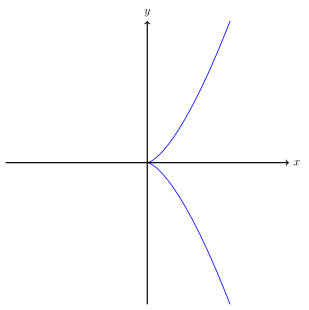
Sketch the curve \(C_{1}\) whose parametric equations are \(x=t^{2},\) \(y=t^{3}.\) The circle \(C_{2}\) passes through the origin \(O\). The points \(R\) and \(S\) with real non-zero parameters \(r\) and \(s\) respectively are other intersections of \(C_{1}\) and \(C_{2}.\) Show that \(r\) and \(s\) are roots of an equation of the form \[ t^{4}+t^{2}+at+b=0, \] where \(a\) and \(b\) are real constants. By obtaining a quadratic equation, with coefficients expressed in terms of \(r\) and \(s\), whose roots would be the parameters of any further intersections of \(C_{1}\) and \(C_{2},\) or otherwise, show that \(O\), \(R\) and \(S\) are the only real intersections of \(C_{1}\) and \(C_{2}.\)
Solution:
1992 Paper 3 Q4
A set of curves \(S_{1}\) is defined by the equation \[ y=\frac{x}{x-a}, \] where \(a\) is a constant which is different for different members of \(S_{1}.\) Sketch on the same axes the curves for which \(a=-2,-1,1\) and \(2\). A second of curves \(S_{2}\) is such that at each intersection between a member of \(S_{2}\) and a member of \(S_{1}\) the tangents of the intersecting curves are perpendicular. On the same axes as the already sketched members of \(S_{1},\) sketch the member of \(S_{2}\) that passes through the point \((1,-1)\). Obtain the first order differential equation for \(y\) satisfied at all points on all members of \(S_{1}\) (i.e. an equation connecting \(x,y\) and \(\mathrm{d}y/\mathrm{d}x\) which does not involve \(a\)). State the relationship between the values of \(\mathrm{d}y/\mathrm{d}x\) on two intersecting curves, one from \(S_{1}\) and one from \(S_{2},\) at their intersection. Hence show that the differential equation for the curves of \(S_{2}\) is \[ x=y(y-1)\dfrac{\mathrm{d}y}{\mathrm{d}x}. \] Find an equation for the member of \(S_{2}\) that you have sketched.
1992 Paper 3 Q5
The tetrahedron \(ABCD\) has \(A\) at the point \((0,4,-2)\). It is symmetrical about the plane \(y+z=2,\) which passes through \(A\) and \(D\). The mid-point of \(BC\) is \(N\). The centre, \(Y\), of the sphere \(ABCD\) is at the point \((3,-2,4)\) and lies on \(AN\) such that \(\overrightarrow{AY}=3\overrightarrow{YN}.\) Show that \(BN=6\sqrt{2}\) and find the coordinates of \(B\) and \(C\). The angle \(AYD\) is \(\cos^{-1}\frac{1}{3}.\) Find the coordinates of \(D\). [There are two alternative answers for each point.]
Solution: Since \(B\) and \(C\) are reflections of each other in the plane \(y+z=2\) (since that's what it means to be symmetrical), we must have that \(N\) also lies on the plane \(y+z=2\). Since \(\overrightarrow{AY}=3\overrightarrow{YN}.\) we must have \(\overrightarrow{AN}=\overrightarrow{AY}+\overrightarrow{YN} = \frac43\overrightarrow{AY} = \frac43\begin{pmatrix} 3\\-6\\6\end{pmatrix} = \begin{pmatrix} 4\\-8\\8\end{pmatrix}\) and \(N\) is the point \((4,-4,6)\) (which fortunately is on our plane as expected). \(Y\) is the point \((3,-2,4)\) \(|\overrightarrow{AY}| = \sqrt{3^2+(-6)^2+6^2} = 3\sqrt{1+4+4} = 9\)

1992 Paper 3 Q6
Given that \({\displaystyle I_{n}=\int_{0}^{\pi}\frac{x\sin^{2}(nx)}{\sin^{2}x}\,\mathrm{d}x,}\) where \(n\) is a positive integer, show that \(I_{n}-I_{n-1}=J_{n},\) where \[ J_{n}=\int_{0}^{\pi}\frac{x\sin(2n-1)x}{\sin x}\,\mathrm{d}x. \] Obtain also a reduction formula for \(J_{n}.\) The curve \(C\) is given by the cartesian equation \[ y=\dfrac{x\sin^{2}(nx)}{\sin^{2}x}, \] where \(n\) is a positive integer and \(0\leqslant x\leqslant\pi.\) Show that the area under the curve \(C\) is \(\frac{1}{2}n\pi^{2}.\)
Solution: \begin{align*} I_n - I_{n-1} &= \int_0^{\pi} \frac{x \sin^2(nx)}{\sin ^2 x} \d x-\int_0^{\pi} \frac{x \sin^2((n-1)x)}{\sin ^2 x} \d x \\ &= \int_0^{\pi} \frac{x}{\sin^2 x} \left ( \sin^2 (nx) - \sin^2((n-1)x) \right) \d x \\ &= \int_0^{\pi} \frac{x}{\sin^2 x}\frac12 \left ( \cos (2(n-1)x) - \cos(2nx) \right) \d x \\ &= \int_0^{\pi} \frac{x}{\sin^2 x}\frac12 2 \sin ((2n-1)x )\sin x \d x \\ &= \int_0^{\pi} \frac{x\sin ((2n-1)x )}{\sin x}d x \\ &= J_n \\ \\ J_{n+1} - J_{n} &= \int_0^{\pi} \frac{x \left (\sin ((2n+1)x )-\sin ((2n-1)x )\right)}{\sin x} \d x \\ &= \int_0^{\pi} \frac{x \left ( 2 \cos (\frac{4n x}{2}) \sin \frac{2x}{2} \right)}{\sin x} \d x \\ &= \int_0^{\pi}2x \cos (2n x) \d x \\ &= \left [ \frac{x}{2n} \sin (2n x) \right]_0^{\pi} - \int_0^{\pi} \frac{1}{2n} \sin (2n x) \d x \\ &= \left [ \frac{1}{4n^2} \cos (2n x)\right]_0^{\pi} \\ &= 0 \\ \\ J_1 &= \int_0^\pi x \d x \\ &= \frac{\pi^2}{2} \\ \Rightarrow J_n &= \frac{\pi^2}{2} \\ \end{align*} And so \(I_n = I_1 + (n-1) \frac{\pi^2}{2}\) and \(I_1 = \frac{\pi^2}{2}\) so \(I_n = \frac12 n \pi^2\). But \(I_n\) is exactly the area under the curve described.
1992 Paper 3 Q7
The points \(P\) and \(R\) lie on the sides \(AB\) and \(AD,\) respectively, of the parallelogram \(ABCD.\) The point \(Q\) is the fourth vertex of the parallelogram \(APQR.\) Prove that \(BR,CQ\) and \(DP\) meet in a point.
Solution: Let \(\overrightarrow{AX} = \mathbf{x}\) for all points, so: \begin{align*} \mathbf{p} &= p\mathbf{b}\\ \mathbf{r} &= r\mathbf{d}\\ \mathbf{q} &= \mathbf{p}+\mathbf{r} \\ &= p\mathbf{b} + r\mathbf{d} \end{align*} Therefore \begin{align*} BR: && \mathbf{b} + \lambda(\mathbf{r}-\mathbf{b}) \\ &&= (1-\lambda) \mathbf{b}+ \lambda r \mathbf{d} \\ CQ: && \mathbf{c} + \mu(\mathbf{q} - \mathbf{c}) \\ &&= \mathbf{b}+\mathbf{d} + \mu(p\mathbf{b}+r\mathbf{d} - (\mathbf{b}+\mathbf{d}) ) \\ &&= (1+\mu(p-1))\mathbf{b} + (1+\mu(r-1))\mathbf{d} \\ DP: && \mathbf{d} + \nu (\mathbf{p} - \mathbf{d}) \\ &&= \nu p\mathbf{b} +(1-\nu) \mathbf{d} \end{align*} So we need \(1-\nu = \lambda r, \nu p = 1-\lambda, \) so lets say \(1 = \nu + \lambda r, 1 = \lambda + \nu p \Rightarrow \lambda(pr-1) = p-1 \Rightarrow \lambda = \frac{p-1}{pr-1}\) so they intersect at \(\frac{rp-r}{pr-1} \mathbf{d} + \frac{pr-p}{pr-1}\mathbf{b}\). If we take \(\mu = -\frac{\lambda}{p-1} = 1-pr\) this is clearly also on \(CQ\) hence they all meet at a point
1992 Paper 3 Q8
Show that \[ \sin(2n+1)\theta=\sin^{2n+1}\theta\sum_{r=0}^{n}(-1)^{n-r}\binom{2n+1}{2r}\cot^{2r}\theta, \] where \(n\) is a positive integer. Deduce that the equation \[ \sum_{r=0}^{n}(-1)^{r}\binom{2n+1}{2r}x^{r}=0 \] has roots \(\cot^{2}(k\pi/(2n+1))\) for \(k=1,2,\ldots,n\). Show that
- sep}{3mm}
- \(\bf (i)\) \({\displaystyle \sum_{k=1}^{n}\cot^{2}\left(\frac{k\pi}{2n+1}\right)=\frac{n(2n-1)}{3}},\)
- \(\bf (ii)\) \({\displaystyle \sum_{k=1}^{n}\tan^{2}\left(\frac{k\pi}{2n+1}\right)=n(2n+1)},\)
- \(\bf (iii)\) \({\displaystyle \sum_{k=1}^{n}\mathrm{cosec}^{2}\left(\frac{k\pi}{2n+1}\right)=\frac{2n(n+1)}{3}}.\)
1992 Paper 3 Q9
The straight line \(OSA,\) where \(O\) is the origin, bisects the angle between the positive \(x\) and \(y\) axes. The ellipse \(E\) has \(S\) as focus. In polar coordinates with \(S\) as pole and \(SA\) as the initial line, \(E\) has equation \(\ell=r(1+e\cos\theta).\) Show that, at the point on \(E\) given by \(\theta=\alpha,\) the gradient of the tangent to the ellipse is given by \[ \frac{\mathrm{d}y}{\mathrm{d}x}=\frac{\sin\alpha-\cos\alpha-e}{\sin\alpha+\cos\alpha+e}. \] The points on \(E\) given by \(\theta=\alpha\) and \(\theta=\beta\) are the ends of a diameter of \(E\). Show that \[ \tan(\alpha/2)\tan(\beta/2)=-\frac{1+e}{1-e}. \] [Hint. A diameter of an ellipse is a chord through its centre.]
Solution:

1992 Paper 3 Q10
Sketch the curve \(C\) whose polar equation is \[ r=4a\cos2\theta\qquad\mbox{ for }-\tfrac{1}{4}\pi<\theta<\tfrac{1}{4}\pi. \] The ellipse \(E\) has parametric equations \[ x=2a\cos\phi,\qquad y=a\sin\phi. \] Show, without evaluating the integrals, that the perimeters of \(C\) and \(E\) are equal. Show also that the areas of the regions enclosed by \(C\) and \(E\) are equal.
Solution:

1992 Paper 3 Q11
\(\,\)
1992 Paper 3 Q12
\(\,\)
1992 Paper 3 Q13
\(\,\)