Problems
Filters
48 problems found
1990 Paper 2 Q15
A target consists of a disc of unit radius and centre \(O\). A certain marksman never misses the target, and the probability of any given shot hitting the target within a distance \(t\) from \(O\) it \(t^{2}\), where \(0\leqslant t\leqslant1\). The marksman fires \(n\) shots independently. The random variable \(Y\) is the radius of the smallest circle, with centre \(O\), which encloses all the shots. Show that the probability density function of \(Y\) is \(2ny^{2n-1}\) and find the expected area of the circle. The shot which is furthest from \(O\) is rejected. Show that the expected area of the smallest circle, with centre \(O\), which encloses the remaining \((n-1)\) shots is \[ \left(\frac{n-1}{n+1}\right)\pi. \]
Solution: Another way to describe \(Y\) is the maximum distance of any shot from \(O\). Let \(X_i\), \(1 \leq i \leq n\) be the \(n\) shots then, \begin{align*} F_Y(y) &= \mathbb{P}(Y \leq y) \\ &= \mathbb{P}(X_i \leq y \text{ for all } i) \\ &= \prod_{i=1}^n \mathbb{P}(X_i \leq y) \tag{each shot independent}\\ &= \prod_{i=1}^n y^2\\ &= y^{2n} \end{align*} Therefore \(f_Y(y) = \frac{\d}{\d y} (y^{2n}) = 2n y^{2n-1}\). \begin{align*} \mathbb{E}(\pi Y^2) &= \int_0^1\pi y^2 \f_Y(y) \d y \\ &=\pi \int_0^1 2n y^{2n+1} \d y \\ &=\left ( \frac{n}{n+1} \right )\pi \end{align*}. Let \(Z\) be the distance of the second furthest shot, then: \begin{align*} && F_Z(z) &= \mathbb{P}(Z \leq z) \\ &&&= \mathbb{P}(X_i \leq z \text{ for at least } n - 1\text{ different } i) \\ &&&= n\mathbb{P}(X_i \leq z \text{ for all but 1}) + \mathbb{P}(X_i \leq z \text{ for all } i) \\ &&&= n \left ( \prod_{i=1}^{n-1} \mathbb{P}(X_i \leq z) \right) \mathbb{P}(X_n > z) + z^{2n} \\ &&&= nz^{2n-2}(1-z^2) + z^{2n} \\ &&&= nz^{2n-2} -(n-1)z^{2n} \\ \Rightarrow && f_Z(z) &= n(2n-2)z^{2n-3}-2n(n-1)z^{2n-1} \\ \Rightarrow && \mathbb{E}(\pi Z^2) &= \int_0^1 \pi z^2 \left (n(2n-2)z^{2n-3}-2n(n-1)z^{2n-1} \right) \d z \\ &&&= \pi \left ( \frac{n(2n-2)}{2n} - \frac{2n(n-1)}{2n+2}\right) \\ &&&= \left ( \frac{n-1}{n+1} \right) \pi \end{align*}
1990 Paper 2 Q16
Each day, I choose at random between my brown trousers, my grey trousers and my expensive but fashionable designer jeans. Also in my wardrobe, I have a black silk tie, a rather smart brown and fawn polka-dot tie, my regimental tie, and an elegant powder-blue cravat which I was given for Christmas. With my brown or grey trousers, I choose ties (including the cravat) at random, except of course that I don\textquoteright t wear the cravat with the brown trousers or the polka-dot tie with the grey trousers. With the jeans, the choice depends on whether it is Sunday or one of the six weekdays: on weekdays, half the time I wear a cream-coloured sweat-shirt with \(E=mc{}^{2}\) on the front and no tie; otherwise, and on Sundays (when naturally I always wear a tie), I just pick at random from my four ties. This morning, I received through the post a compromising photograph of myself. I often receive such photographs and they are equally likely to have been taken on any day of the week. However, in this particular photograph, I am wearing my black silk tie. Show that, on the basis of this information, the probability that the photograph was taken on Sunday is \(11/68\). I should have mentioned that on Mondays I lecture on calculus and I therefore always wear my jeans (to make the lectures seem easier to understand). Find, on the basis of the complete information, the probability that the photograph was taken on Sunday. [The phrase `at random' means `with equal probability'.]
1990 Paper 3 Q1
Show, using de Moivre's theorem, or otherwise, that \[ \tan9\theta=\frac{t(t^{2}-3)(t^{6}-33t^{4}+27t^{2}-3)}{(3t^{2}-1)(3t^{6}-27t^{4}+33t^{2}-1)},\qquad\mbox{ where }t=\tan\theta. \] By considering the equation \(\tan9\theta=0,\) or otherwise, obtain a cubic equation with integer coefficients whose roots are \[ \tan^{2}\left(\frac{\pi}{9}\right),\qquad\tan^{2}\left(\frac{2\pi}{9}\right)\qquad\mbox{ and }\qquad\tan^{2}\left(\frac{4\pi}{9}\right). \] Deduce the value of \[ \tan\left(\frac{\pi}{9}\right)\tan\left(\frac{2\pi}{9}\right)\tan\left(\frac{4\pi}{9}\right). \] Show that \[ \tan^{6}\left(\frac{\pi}{9}\right)+\tan^{6}\left(\frac{2\pi}{9}\right)+\tan^{6}\left(\frac{4\pi}{9}\right)=33273. \]
Solution: Writing \(c = \cos \theta, s = \sin \theta\) then de Moivre states that: \begin{align*} && \cos 9 \theta + i \sin 9 \theta &= (c +i s)^9 \\ &&&= c^9 + 9ic^8s - 36c^7s^2-84ic^6s^3+126c^5s^4 + 126ic^4s^5 -84c^3s^6 -36ic^2s^7+9cs^8+is^9 \\ &&&= (c^9-36c^7s^2+126c^5s^3-84c^3s^6+8cs^8)+i(9c^8s-75c^6s^3+126c^4s^5-36c^2s^7+s^9) \\ \Rightarrow && \tan 9\theta &= \frac{(9c^8s-75c^6s^3+126c^4s^5-36s^2c^7+s^9)}{(c^9-36c^7s^2+126c^5s^4-84c^3s^6+8cs^8)} \\ &&&= \frac{9t-75t^3+126s^5-36t^7+t^9}{1-36t^2+126t^4-84t^6+8t^8} \\ &&&= \frac{t(t^{2}-3)(t^{6}-33t^{4}+27t^{2}-3)}{(3t^{2}-1)(3t^{6}-27t^{4}+33t^{2}-1)} \end{align*} If we consider \(\tan 9\theta = 0\) it will have the roots \(\theta = \frac{n \pi}{9}, n \in \mathbb{Z}\), in particular, the numerator of our fraction for \(\tan 9 \theta\) will be zero for \(t = 0, \tan \frac{\pi}{9}, \tan \frac{2\pi}{9}, \tan \frac{3\pi}{9}, \tan \frac{4 \pi}{9}, \tan \frac{5\pi}{9}, \tan \frac{6 \pi}{9}, \tan \frac{7 \pi}{9}, \tan \frac{8\pi}{9}\). It's worth noting all other values of \(\theta\) will repeat these values. Also note that \(0,\tan \frac{\pi}{3}, \tan \frac{2\pi}{3}\) are the roots of \(t\) and \(t^2-3\) respectively. Therefore the other values are the roots of our sextic. However, also note that \(\tan \frac{8\pi}{9} = - \tan \frac{\pi}{9}\) and similar, therefore we can notice that all the roots in pairs can be mapped to \(\tan \frac{\pi}{9}, \tan \frac{2 \pi}{9}\) and \(\tan \frac{4 \pi}{9}\) and all those values are squared, so the roots of: \(x^3 - 33x^2+27x-3\) will be \(\tan^2 \frac{\pi}{9}, \tan^2 \frac{2 \pi}{9}\) and \(\tan^2 \frac{4 \pi}{9}\). The product of the roots will be \(3\), so \begin{align*} && \tan^2 \frac{\pi}{9} \tan^2 \frac{2 \pi}{9} \tan^2 \frac{4 \pi}{9} &= 3 \\ \Rightarrow && \tan \frac{\pi}{9} \tan \frac{2 \pi}{9} \tan \frac{4 \pi}{9} &= \pm \sqrt{3} \\ \underbrace{\Rightarrow}_{\text{all positive}} && \tan \frac{\pi}{9} \tan \frac{2 \pi}{9} \tan \frac{4 \pi}{9} &= \sqrt{3} \\ \end{align*} Notice that \(x^3 + y^3 +z^3 - 3xyz = (x+y+z)((x+y+z)^2-3(xy+yz+zx))\) Therefore \begin{align*} \tan^{6}\left(\frac{\pi}{9}\right)+\tan^{6}\left(\frac{2\pi}{9}\right)+\tan^{6}\left(\frac{4\pi}{9}\right) &= 33(33^2-3\cdot27) + 3 \cdot 3 \\ &= 33\,273 \end{align*}
1990 Paper 3 Q2
The distinct points \(O\,(0,0,0),\) \(A\,(a^{3},a^{2},a),\) \(B\,(b^{3},b^{2},b)\) and \(C\,(c^{3},c^{2},c)\) lie in 3-dimensional space.
- Prove that the lines \(OA\) and \(BC\) do not intersect.
- Given that \(a\) and \(b\) can vary with \(ab=1,\) show that \(\angle AOB\) can take any value in the interval \(0<\angle AOB<\frac{1}{2}\pi\), but no others.
Solution:
- The line \(OA\) is \(\lambda \begin{pmatrix} a^3 \\ a^2 \\ a \end{pmatrix}\). The line \(BC\) is \(\begin{pmatrix} b^3 \\ b^2 \\ b \end{pmatrix} + \mu \begin{pmatrix} c^3-b^3 \\ c^2-b^2 \\ c-b \end{pmatrix}\). If these lies are concurrent then there would be \(\mu\) and \(\lambda\) such that they are equal, and in particular, \begin{align*} && \frac{b^2 + \mu(c^2-b^2)}{b + \mu (c-b)} &= \frac{b^3 + \mu(c^3-b^3)}{b^2 + \mu (c^2-b^2)} \\ \Leftrightarrow && (b^2 + \mu(c^2-b^2))^2 &= (b+\mu(c-b))(b^3+\mu(c^3-b^3)) \\ && b^4 +2\mu b^2 (c^2-b^2) + \mu^2 (c^2-b^2) &= b^4 + \mu(c-b)b^3 + \mu b(c^3-b^3) + \mu^2 (c-b)(c^3-b^3) \\ \Leftrightarrow && 2\mu b^2 (c+b) + \mu^2(c-b)(c+b)^2 &= \mu (b^3 + b(c^2+bc+b^2)) + \mu^2 (c^3-b^3) \\ && \mu = 0 & \Rightarrow a = b \\ \Leftrightarrow && b^2c - bc^2 &= \mu (c^3-b^3-(c-b)(c+b)^2) \\ \Leftrightarrow && bc(b-c) &= \mu (c-b)(c^2+bc+b^2-c^2-2bc-b^2) \\ \Leftrightarrow && bc &= \mu (bc) \\ \Leftrightarrow && \mu &= 1 \\ && \mu = -1 & \Rightarrow a = c \end{align*} Therefore there are no solutions.
- \begin{align*} \cos \angle AOB &= \frac{ab+a^2b^2+a^3b^3}{\sqrt{a^2+a^4+a^6}\sqrt{b^2+b^4+b^6}} \\ &= \frac{3}{\sqrt{1 + a^2 + a^4} \sqrt{1 + b^2 + b^4}} \\ &> 0 \end{align*} Therefore the angle satisfies \(\angle AOB < \tfrac12 \pi\). We cannot achieve \(0\), since that would require \(a = b = 1\), therefore it falls in the range \(0 < \angle AOB < \tfrac12 \pi\)
1990 Paper 3 Q3
The elements \(a,b,c,d\) belong to the group \(G\) with binary operation \(*.\) Show that
- if \(a,b\) and \(a*b\) are of order 2, then \(a\) and \(b\) commute;
- \(c*d\) and \(d*c\) have the same order;
- if \(c^{-1}*b*c=b^{r},\) then \(c^{-1}*b^{s}*c=b^{sr}\) and \(c^{-n}*b^{s}*c^{n}=b^{sr^{n}}.\)
Solution: \begin{questionparts} \item \((ab)^2 = abab = e\) (since \(ab\) has order \(2\)), but \(a^2 = e, b^2 = e \Rightarrow a^{-1} = a, b^{-1} = b\) (since \(a\) and \(b\) have order 2) so \(ba = ab\) by multiplication on the left by \(a\) and right by \(b\). \item Suppose \((cd)^n = e \Leftrightarrow d(cd)^nc = dc \Leftrightarrow (dc)^n(dc) = e \Leftrightarrow (dc)^n = e\) Therefore any number for which \((cd)^n = e\) has the property that \((dc)^n = e\) and vice-versa, in particular the smallest number for either \(cd\) or \(dc\) will also be the smallest number for the other. \item Given \(c^{-1}bc=b^r\), then \(b^{rs} = (b^r)^s = (c^{-1}bc)^s =\underbrace{(c^{-1}bc)(c^{-1}bc) \cdots (c^{-1}bc)}_{s \text{ times}} = c^{-1}\underbrace{bb\cdots b}_{s \text{ times}}c = c^{-1}b^sc\) We proceed by induction on \(n\). When \(n = 0\), we have \(b^s = b^{sr^0}\) so the base case is true. Suppose it is true for some \(n = k\), ie \(c^{-k}b^sc^k = b^{sr^k}\). Now consider \(c^{-{k+1}}b^sc^{k+1} = c^{-1}c^{-k}b^sc^kc = c^{-1}b^{sr^k}c = (b^{sr^k \cdot r}) = b^{sr^{k+1}}\) (where the second to last equality was by the previous part). Therefore if our statement is true for \(n=k\) it is true for \(n = k+1\). Therefore, since it is also true for \(n=0\), by the principle of mathematical induction it is true for all non-negative integers \(n\).
1990 Paper 3 Q4
Given that \(\sin\beta\neq0,\) sum the series \[ \cos\alpha+\cos(\alpha+2\beta)+\cdots+\cos(\alpha+2r\beta)+\cdots+\cos(\alpha+2n\beta) \] and \[ \cos\alpha+\binom{n}{1}\cos(\alpha+2\beta)+\cdots+\binom{n}{r}\cos(\alpha+2r\beta)+\cdots+\cos(\alpha+2n\beta). \] Given that \(\sin\theta\neq0,\) prove that \[ 1+\cos\theta\sec\theta+\cos2\theta\sec^{2}\theta+\cdots+\cos r\theta\sec^{r}\theta+\cdots+\cos n\theta\sec^{n}\theta=\frac{\sin(n+1)\theta\sec^{n}\theta}{\sin\theta}. \]
Solution: \begin{align*} \sum_{r = 0}^n \cos (\alpha + 2r \beta) &= \sum_{r = 0}^n \textrm{Re} \left ( \exp(i(\alpha + 2r \beta)) \right) \\ &= \textrm{Re} \left (\sum_{r = 0}^n \exp(i(\alpha + 2r \beta)) \right) \\ &= \textrm{Re} \left (e^{i \alpha} \sum_{r = 0}^n \ (e^{i 2 \beta})^r\right) \\ &= \textrm{Re} \left (e^{i \alpha} \frac{e^{2(n+1)\beta i}-1}{e^{2\beta i}-1} \right) \\ &= \textrm{Re} \left (e^{i \alpha} \frac{e^{(n+1)\beta i} (e^{(n+1)\beta i}-e^{-(n+1)\beta i})}{e^{\beta i}(e^{\beta i}-e^{-\beta i})} \right) \\ &= \textrm{Re} \left (\frac{e^{i \alpha} e^{(n+1)\beta i}}{e^{\beta i}} \frac{\sin (n+1) \beta}{\sin \beta} \right) \\ &= \textrm{Re} \left ( e^{i(\alpha + n \beta)}\frac{\sin (n+1) \beta}{\sin \beta} \right) \\ &= \frac{\cos (\alpha + n \beta)\sin (n+1) \beta}{\sin \beta} \end{align*} \begin{align*} \sum_{r = 0}^n \binom{n}{r} \cos (\alpha + 2r \beta) &= \sum_{r = 0}^n \textrm{Re} \left ( \binom{n}{r}\exp(i(\alpha + 2r \beta)) \right) \\ &= \textrm{Re} \left (\sum_{r = 0}^n \binom{n}{r} \exp(i(\alpha + 2r \beta)) \right) \\ &= \textrm{Re} \left (e^{i \alpha}(e^{2\beta i}+1)^n \right) \\ &= \textrm{Re} \left (e^{i \alpha}e^{n\beta i}(e^{\beta i}+e^{-\beta i})^n \right) \\ &= \textrm{Re} \left (e^{i \alpha}e^{n\beta i}2^n \cos^n \beta \right) \\ &= 2^n \cos(\alpha + n \beta) \cos ^n \beta \end{align*} \begin{align*} \sum_{r = 0}^n \cos r \theta \sec^r \theta &= \sum_{r = 0}^n \textrm{Re} ( e^{i r \theta})\sec^r \theta \\ &= \textrm{Re} \left ( \sum_{r=0}^n e^{i r \theta} \sec^r \theta\right) \\ &= \textrm{Re} \left ( \frac{e^{i (n+1) \theta}\sec^{n+1} \theta -1}{e^{i \theta}\sec \theta -1} \right) \\ &= \textrm{Re} \left ( \frac{e^{i (n+1) \theta}\sec^{n} \theta -\cos \theta}{e^{i \theta} -\cos \theta} \right) \\ &= \textrm{Re} \left ( \frac{e^{i (n+1) \theta}\sec^{n} \theta -\cos \theta}{i \sin \theta} \right) \\ &= \frac{1}{\sin \theta} \textrm{Im} \left ( e^{i (n+1) \theta}\sec^{n} \theta -\cos \theta \right) \\ &= \frac{\sin(n+1) \theta \sec^{n} \theta}{\sin \theta} \end{align*}
1990 Paper 3 Q5
Prove that, for any integers \(n\) and \(r\), with \(1\leqslant r\leqslant n,\) \[ \binom{n}{r}+\binom{n}{r-1}=\binom{n+1}{r}. \] Hence or otherwise, prove that \[ (uv)^{(n)}=u^{(n)}v+\binom{n}{1}u^{(n-1)}v^{(1)}+\binom{n}{2}u^{(n-2)}v^{(2)}+\cdots+uv^{(n)}, \] where \(u\) and \(v\) are functions of \(x\) and \(z^{(r)}\) means \(\dfrac{\mathrm{d}^{r}z}{\mathrm{d}x^{r}}\). Prove that, if \(y=\sin^{-1}x,\) then \((1-x^{2})y^{(n+2)}-(2n+1)xy^{(n+1)}-n^{2}y^{(n)}=0.\)
Solution: \begin{align*} \binom{n}{r} + \binom{n}{r-1} &= \frac{n!}{r!(n-r)!} + \frac{n!}{(r-1)!(n-r+1)!} \\ &= \frac{n!}{(r-1)!(n-r)!} \left ( \frac{1}{r} + \frac{1}{n-r+1} \right) \\ &= \frac{n!}{(r-1)!(n-r)!} \frac{(n-r+1)+r}{r(n-r+1)} \\ &= \frac{n! (n+1)}{r! (n-r+1)!} \\ &= \frac{(n+1)!}{r!(n+1-r)!} \\ &= \binom{n+1}{r} \end{align*} Claim: \(\displaystyle (uv)^{(n)} = \sum_{r=0}^n \binom{n}{r} u^{(n-r)} v^{(r)}\) Proof: (By induction on \(n\)). Base case: \(n = 0\) is clear. Inductive step: Suppose it is true for \(n = k\), then consider \begin{align*} (uv)^{(k+1)} &= \left ( (uv)^{(k)} \right)' \\ &= \left ( \sum_{r=0}^k \binom{k}{r} u^{(k-r)} v^{(r)} \right)' \tag{by assumption} \\ &=\sum_{r=0}^k \binom{k}{r} \left ( u^{(k-r)} v^{(r)}\right)' \tag{linearity} \\ &=\sum_{r=0}^k \binom{k}{r} \left ( u^{(k-r+1)} v^{(r)} + u^{(k-r)}v^{(r+1)}\right) \\ &= \sum_{r=0}^{k} \binom{k}{r} u^{(k-r+1)} v^{(r)} + \sum_{r=0}^{k} \binom{k}{r} u^{(k-r)}v^{(r+1)} \\ &= \sum_{r=0}^{k} \binom{k}{r} u^{(k-r+1)} v^{(r)} + \sum_{r=1}^{k+1} \binom{k}{r-1} u^{(k-r+1)}v^{(r)} \\ &= u^{(k+1)}v + \sum_{r=1}^k \left (\binom{k}{r} + \binom{k}{r-1} \right)u^{(k-r+1)}v^{(r)} + u v^{(k+1)}\\ &= u^{(k+1)}v + \sum_{r=1}^k \binom{k+1}{r} u^{(k-r+1)}v^{(r)} + u v^{(k+1)}\\ &= \sum_{r=0}^{k+1} \binom{k+1}{r} u^{(k-r+1)}v^{(r)}\\ \end{align*} Therefore if our statement is true for \(n = k\) it is true for \(n = k+1\). Since it is true for \(n = 0\) by the principle of mathematical induction it is true for all integer \(n \geq 0\) Suppose \( y = \sin^{-1} x\), then \(y' = \frac{1}{\sqrt{1-x^2}}\), \(y'' = \frac{x}{(1-x^2)^{3/2}}\). Not that this means that \((1-x^2)y'' - xy' = 0\) (which is our formula when \(n = 0\)). Now apply Leibniz's formula to this. \begin{align*} 0 &= \left ( (1-x^2)y'' - xy' \right)^{(n)} \\ &= \left ( (1-x^2)y'' \right)^{(n)} -\left ( xy' \right)^{(n)} \\ &= \left ( (1-x^2)y^{(n+2)} - n\cdot 2x \cdot y^{(n+1)}-\binom{n}{2} \cdot 2 \cdot y^{(n)} \right )- \left (xy^{(n+1)}+ny^{(n)} \right) \\ &= (1-x^2)y^{(n+2)} - (2n+1)y^{(n+1)} - \left ( n(n-1)+n \right)y^{(n)} \\ &= (1-x^2)y^{(n+2)} - (2n+1)y^{(n+1)} - n^2y^{(n)} \\ \end{align*} as required
1990 Paper 3 Q6
The transformation \(T\) from \(\begin{pmatrix} x \\ y \end{pmatrix}\) to \(\begin{pmatrix} X \\ Y \end{pmatrix}\) is given by \[ \begin{pmatrix}X\\ Y \end{pmatrix}=\frac{2}{5}\begin{pmatrix}9 & -2\\ -2 & 6 \end{pmatrix}\begin{pmatrix}x\\ y \end{pmatrix}. \] Show that \(T\) leaves the vector \(\begin{pmatrix} 1\\ 2 \end{pmatrix}\) unchanged in direction but multiplied by a scalar, and that \(\begin{pmatrix} 2\\ -1 \end{pmatrix}\) is similarly transformed. The circle \(C\) whose equation is \(x^{2}+y^{2}=1\) transforms under \(T\) to a curve \(E\). Show that \(E\) has equation \[ 8X^{2}+12XY+17Y^{2}=80, \] and state the area of the region bounded by \(E\). Show also that the greatest value of \(X\) on \(E\) is \(2\sqrt{17/5}.\) Find the equation of the tangent to \(E\) at the point which corresponds to the point \(\frac{1}{5}(3,4)\) on \(C\).
Solution: \begin{align*} T\begin{pmatrix}1\\ 2 \end{pmatrix} &= \frac{2}{5}\begin{pmatrix}9 & -2\\ -2 & 6 \end{pmatrix}\begin{pmatrix}1\\ 2 \end{pmatrix} \\ &= \frac25\begin{pmatrix}9 - 4\\ -2+12 \end{pmatrix} \\ &= \begin{pmatrix}2\\ 4 \end{pmatrix} \\ &= 2 \begin{pmatrix}1\\ 2 \end{pmatrix} \end{align*} \begin{align*} T\begin{pmatrix}1\\ 2 \end{pmatrix} &= \frac{2}{5}\begin{pmatrix}9 & -2\\ -2 & 6 \end{pmatrix}\begin{pmatrix}2\\ -1 \end{pmatrix} \\ &= \frac25\begin{pmatrix}18+2\\ -4-6 \end{pmatrix} \\ &= \begin{pmatrix}8\\ -4 \end{pmatrix} \\ &= 4 \begin{pmatrix}2\\ -1 \end{pmatrix} \end{align*} Consider $T^{-1} = \frac{5}{2} \frac{1}{50}\begin{pmatrix}6 & 2\\ 2 & 9 \end{pmatrix}\(, so \)T^{-1} \begin{pmatrix}X\\ Y \end{pmatrix} = \begin{pmatrix}x\\ y \end{pmatrix}$ and so: \begin{align*} x^2 + y^2 & = \begin{pmatrix}x& y \end{pmatrix}\begin{pmatrix}x\\ y \end{pmatrix} \\ &= \begin{pmatrix}X& Y \end{pmatrix} (T^{-1})^T T^{-1} \begin{pmatrix}X\\ Y \end{pmatrix} \\ &= \frac{1}{400}\begin{pmatrix}X& Y \end{pmatrix}\begin{pmatrix}6 & 2\\ 2 & 9 \end{pmatrix}\begin{pmatrix}6 & 2\\ 2 & 9 \end{pmatrix} \begin{pmatrix}X\\ Y \end{pmatrix} \\ &= \frac{1}{400}\begin{pmatrix}X& Y \end{pmatrix}\begin{pmatrix}6 & 2\\ 2 & 9 \end{pmatrix} \begin{pmatrix}6X+2Y\\ 2X+9Y \end{pmatrix} \\ &= \frac{1}{400}\begin{pmatrix}X& Y \end{pmatrix} \begin{pmatrix}6(6X+2Y)+2(2X+9Y)\\ 2(6X+2Y)+9(2X+9Y) \end{pmatrix} \\ &= \frac{1}{400}\begin{pmatrix}X& Y \end{pmatrix} \begin{pmatrix}40X+30Y\\ 30X +85Y \end{pmatrix} \\ &= \frac{1}{80}\begin{pmatrix}X& Y \end{pmatrix} \begin{pmatrix}8X+6Y\\ 6X +17Y \end{pmatrix} \\ &= \frac{1}{80} \l 8X^2 + 12XY + 17Y^2\r \end{align*} Therefore \(8X^2 + 12XY + 17Y^2 = 80\). The area will be \(\det T \cdot \pi = \frac{4}{25} \cdot 50 \cdot \pi = 8 \pi\). Differentiating we obtain \(2 \cdot 8 \cdot X \cdot \frac{dX}{dY} + 2 \cdot 6 \cdot X + 2 \cdot 6 \cdot Y \cdot \frac{dX}{dY} + 2 \cdot 17 Y \Rightarrow \frac{dX}{dY} = -\frac{6X + 17Y}{8X+6Y}\), at a maximum (or minimum, \(6X = -17Y\)). Therefore \begin{align*} \Rightarrow && 8X^2 + 12 \cdot \frac{6}{17}X^2 + 17 ( -\frac{6}{17} X)^2 &= 80 \\ \Rightarrow && \frac{100}{17}X^2 &= 80 \\ \Rightarrow &&X^2 &= \frac{17 \cdot 4}{5} \\ \Rightarrow && |X| = 2 \sqrt {\frac{17}{5}} \end{align*} The point \(\frac15 (3,4)\) maps to \begin{align*} \frac{2}{5}\frac{1}{5}\begin{pmatrix}9 & -2\\ -2 & 6 \end{pmatrix}\begin{pmatrix}3\\ 4 \end{pmatrix} &= \frac{2}{25} \begin{pmatrix}19\\ 18 \end{pmatrix} \end{align*} So the point is \((\frac{38}{25}, \frac{36}{25})\), with gradient \(\frac{dY}{dX} = -\frac{8X+6Y}{6X + 17Y}\) which is \(-\frac{8 \cdot 19+6 \cdot 18}{6\cdot 19 + 17 \cdot 18} = -\frac{13}{21}\) therefore the equation is \(21Y+13X = 50\)
1990 Paper 3 Q7
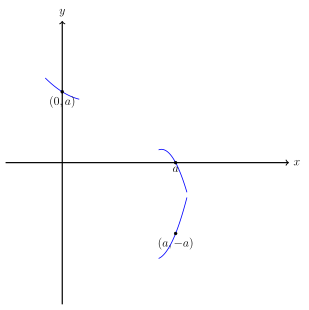
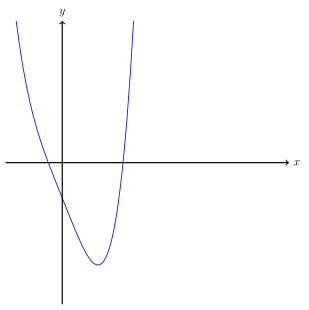
The points \(P\,(0,a),\) \(Q\,(a,0)\) and \(R\,(a,-a)\) lie on the curve \(C\) with cartesian equation \[ xy^{2}+x^{3}+a^{2}y-a^{3}=0,\qquad\mbox{ where }a>0. \] At each of \(P,Q\) and \(R\), express \(y\) as a Taylor series in \(h\), where \(h\) is a small increment in \(x\), as far as the term in \(h^{2}.\) Hence, or otherwise, sketch the shape of \(C\) near each of these points. Show that, if \((x,y)\) lies on \(C\), then \[ 4x^{4}-4a^{3}x-a^{4}\leqslant0. \] Sketch the graph of \(y=4x^{4}-4a^{3}x-a^{4}.\) Given that the \(y\)-axis is an asymptote to \(C\), sketch the curve \(C\).
Solution: \begin{align*} && 0 &= xy^{2}+x^{3}+a^{2}y-a^{3} \\ \frac{\d }{\d x} : && 0 &= y^2+2xyy' + 3x^2+a^2y' \\ \Rightarrow && y' &= -\frac{y^2+3x^2}{a^2+2xy} \\ \\ \frac{\d^2 }{\d x^2}: && 0 &= 2yy'+2yy'+2x(y')^2+2xyy''+6x+a^2y'' \\ \Rightarrow && y'' &= -\frac{4yy'+2x(y')^2+6x}{a^2+2xy} \\ \\ P: && y &= a \\ && y' &= -\frac{a^2}{a^2} = -1 \\ && y'' &= -\frac{-4a}{a^2} = \frac{4}{a} \\ \Rightarrow && y &\approx a - h+\frac{2}{a}h^2 \\ \\ Q: && y &= 0 \\ && y' &= -\frac{3a^2}{a^2} = -3 \\ && y'' &= -\frac{18a+6a}{a^2} = -\frac{24}{a} \\ \Rightarrow && y &\approx 0-3h-\frac{12}{a}h \\ \\ R: && y &= -a \\ && y' &= -\frac{a^2+3a^2}{a^2-2a^2} = 4 \\ && y'' &= -\frac{-16a+32a+6a}{a^2-2a^2} = \frac{22}{a} \\ \Rightarrow && y &\approx -a+4h + \frac{11}{a}h^2 \end{align*} Alternatively: \begin{align*} && 0 &= xy^{2}+x^{3}+a^{2}y-a^{3} \\ P(0,a): && y &\approx a + c_1h + c_2h^2 \\ && 0 &= h(a+c_1h)^2 + a^2(a + c_1h + c_2h^2)-a^3 \\ &&&= a^3-a^3 + (a^2+a^2c_1)h+(2ac_1+a^2c_2)h^2 \\ \Rightarrow && c_1 &=-1, c_2 =\frac{2}{a} \\ \Rightarrow && y &\approx a - h + \frac{2}{a}h^2 \\ \\ Q(a,0): && y &\approx c_1h + c_2h^2 \\ && 0 &= (a+h)(c_1h)^2+(a+h)^3+a^2(c_1h + c_2h^2 )-a^3 \\ &&&= a^3-a^3+(3a^2+a^2c_1)h + (ac_1^2+3a+a^2c_2)h^2 + \cdots \\ \Rightarrow && c_1 &=-3, c_2 = -\frac{12}{a} \\ \Rightarrow && y &\approx -3h -\frac{12}{a}h \\ \\ R(a,-a): && y &\approx -a + c_1h + c_2h^2 \\ && 0 &= (a+h)(-a + c_1h+c_2h^2)^2+(a+h)^3+a^2(-a + c_1h + c_2h^2)-a^3 \\ &&&= (a^2-2a^2c_1+3a^2+a^2c_1)h+(-2ac_1+c_1^2+\cdots)h^2 \\ \Rightarrow && c_1 &=4, c_2 = \frac{11}{a} \\ \Rightarrow && y &\approx -a + 4h + \frac{11}{a} \end{align*}

1990 Paper 3 Q8
Let \(P,Q\) and \(R\) be functions of \(x\). Prove that, for any function \(y\) of \(x\), the function \[ Py''+Qy'+Ry \] can be written in the form \(\dfrac{\mathrm{d}}{\mathrm{d}x}(py'+qy),\) where \(p\) and \(q\) are functions of \(x\), if and only if \(P''-Q'+R=0.\) Solve the differential equation \[ (x-x^{4})y''+(1-7x^{3})y'-9x^{2}y=(x^{3}+3x^2)\mathrm{e}^{x}, \] given that when \(x=2,y=2\mathrm{e}^{2}\) and \(y'=0.\)
Solution: Suppose \(Py'' + Qy' + Ry = \frac{\d}{\d x}(p y' + qy)\), then \begin{align*} Py'' + Qy' + Ry &= \frac{\d}{\d x}(p y' + qy) \\ &= py'' + p'y' + qy' + q' y \\ &= py'' + (p'+q)y' + q' y \end{align*} Therefore \(P = p, Q = p'+q, R = q'\), Therefore \(q = Q-P'\) and \(R = Q'-P''\) or \(P'' -Q'+R = 0\). \((\Rightarrow)\) Suppose it can be written in that form, then the logic we have applied shows that equation is true. \((\Leftarrow)\) Suppose \(P''-Q'+R = 0\), then letting \(p = P, q = Q-P'\) we find functions of the form which will be expressed correctly. Notice that if \(P = x-x^4, Q = (1-7x^3), R = -9x^2\) then: \begin{align*} P'' - Q' + R &= -12x^2+21x^2-9x^2 \\ &= 0 \end{align*} Therefore we can write our second order ODE as: \begin{align*} && (x^{3}+3x)\mathrm{e}^{x} &= \frac{\d}{\d x} \left ( (x-x^4) y' +(1-7x^3-(1-4x^3))y \right) \\ &&&= \frac{\d}{\d x} \left ( (x-x^4) y' -3x^3y \right) \end{align*} Suppose \(z = (x-x^4)y' - 3x^2y\), then \(z = (2-2^4) \cdot 0 - 3 \cdot 2^2 \cdot 2e^2 = -24e^2\) when \(x = 2\). and we have: \begin{align*} && \frac{\d z}{\d x} &= (x^3+3x^2)e^x \\ \Rightarrow && z &= \int (x^3+3x^2)e^x \d x \\ &&&= x^3 e^x+c \\ \Rightarrow && -48e^2 &= e^2(8) + c \\ \Rightarrow && c &= -56e^2 \\ \Rightarrow && z &= e^x(x^3)-56e^2 \\ \end{align*} So our differential equation is: \begin{align*} && (x-x^4)y'-3x^3 y &= x^3e^x -5 6e^2 \\ \Rightarrow && (1-x^3)y' -3x^2y &= x^2 e^x - \frac{6e^2}{x} \\ \Rightarrow && \frac{\d }{\d x} \left ( (1-x^3)y \right) &= x^2e^x - \frac{56e^2}{x} \\ \Rightarrow && (1-x^3)y &= (x^2-2x+2)e^x - 56e^2 \ln x + k \\ \underbrace{\Rightarrow}_{x=2} && (1-2^3)2e^2 &= (2^2-2\cdot2 + 2)e^2 -56e^2 \ln 2 + k \\ \Rightarrow && k &= -16e^2+56 \ln 2 \cdot e^2 \\ \Rightarrow && y &= \frac{(x^2-2x+2)e^x - 56e^2 \ln x -16e^2+56 \ln 2 \cdot e^2}{(1-x^3)} \end{align*}
1990 Paper 3 Q9
The real variables \(\theta\) and \(u\) are related by the equation \(\tan\theta=\sinh u\) and \(0\leqslant\theta<\frac{1}{2}\pi.\) Let \(v=\mathrm{sech}u.\) Prove that
- \(v=\cos\theta;\)
- \(\dfrac{\mathrm{d}\theta}{\mathrm{d}u}=v;\)
- \(\sin2\theta=-2\dfrac{\mathrm{d}v}{\mathrm{d}u}\quad\) and \(\quad\cos2\theta=-\cosh u\dfrac{\mathrm{d}^{2}v}{\mathrm{d}u^{2}};\)
- \({\displaystyle \frac{\mathrm{d}u}{\mathrm{d}\theta}\frac{\mathrm{d}^{2}v}{\mathrm{d}\theta^{2}}+\frac{\mathrm{d}v}{\mathrm{d}\theta}\frac{\mathrm{d}^{2}u}{\mathrm{d}\theta^{2}}+\left(\frac{\mathrm{d}u}{\mathrm{d}\theta}\right)^{2}=0.}\)
Solution:
- \begin{align*} v &= \mathrm{sech} u \\ &= \frac{1}{\mathrm{cosh } u} \\ &= \frac{1}{\sqrt{1+\mathrm{sinh}^2 u}} \tag{\(u > 0\)} \\ &= \frac{1}{\sqrt{1+\tan^2 \theta}} \\ &= \frac{1}{\sqrt{\mathrm{sec}^2 \theta}} \\ &= \cos \theta \tag{\(0 < \theta < \tfrac{\pi}{2}\)} \end{align*}
- \begin{align*} && \tan \theta &= \textrm{sinh} u \\ \underbrace{\Rightarrow}_{\frac{\d}{\d u}} && \sec^2 \theta \cdot \frac{\d \theta}{\d u} &= \cosh u \\ \Rightarrow && \frac{\d \theta}{\d u} &=\cosh u \cdot \cos^2 \theta \\ &&&= \frac{1}{v} \cdot v^2 \\ &&&=v \end{align*}
- \begin{align*} \sin 2 \theta &= 2 \sin \theta \cos \theta \\ &= 2 \sin \theta \cdot \frac{\d \theta}{\d u} \\ &= -2 \frac{\d v}{\d \theta} \cdot \frac{\d \theta}{\d u} \tag{\(\cos \theta = v\)} \\ &= -2 \frac{\d v}{\d u} \end{align*} \begin{align*} && \sin 2 \theta &= -2 \frac{\d v}{\d u} \\ \underbrace{\Rightarrow}_{\frac{\d}{\d u}} && 2 \cos 2 \theta \cdot \frac{\d \theta}{\d u} &= -2 \frac{\d^2 v}{\d u^2} \\ \Rightarrow && \cos 2 \theta &= - \frac{\d^2 v}{\d u^2} \frac{1}{v} \\ &&&= -\frac{\d ^2v}{\d u^2} \cosh u \end{align*}
- \begin{align*} && \frac{\d u}{\d \theta} &= \frac{1}{v} \\ \Rightarrow && \frac{\d^2 u}{\d \theta^2} &= -\frac{1}{v^2} \frac{\d v}{\d \theta} \\ &&&= \frac{1}{v^2} \sin \theta \\ && \frac{\d v}{\d \theta} &= -\sin \theta \\ \Rightarrow && \frac{\d^2 v}{\d \theta^2} &= -\cos \theta \\ &&&= - v \\ \end{align*} Therefore \begin{align*} \frac{\mathrm{d}u}{\mathrm{d}\theta}\frac{\mathrm{d}^{2}v}{\mathrm{d}\theta^{2}}+\frac{\mathrm{d}v}{\mathrm{d}\theta}\frac{\mathrm{d}^{2}u}{\mathrm{d}\theta^{2}}+\left(\frac{\mathrm{d}u}{\mathrm{d}\theta}\right)^{2} &= \frac{1}{v} \cdot \left (-v\right) + \left ( - \sin \theta \right ) \cdot \left (\frac{1}{v^2} \sin \theta \right) + \frac{1}{v^2} \\ &= -1 + \frac{1-\sin^2 \theta}{v^2} \\ &= -1 + \frac{\cos^2 \theta}{v^2} \\ &= -1 + 1 \\ &= 0 \end{align*}
1990 Paper 3 Q10
By considering the graphs of \(y=kx\) and \(y=\sin x,\) show that the equation \(kx=\sin x,\) where \(k>0,\) may have \(0,1,2\) or \(3\) roots in the interval \((4n+1)\frac{\pi}{2} < x < (4n+5)\frac{\pi}{2},\) where \(n\) is a positive integer. For a certain given value of \(n\), the equation has exactly one root in this interval. Show that \(k\) lies in an interval which may be written \(\sin\delta < k < \dfrac{2}{(4n+1)\pi},\) where \(0 < \delta < \frac{1}{2}\pi\) and \[ \cos\delta=\left((4n+5)\frac{\pi}{2}-\delta\right)\sin\delta. \] Show that, if \(n\) is large, then \(\delta\approx\dfrac{2}{(4n+5)\pi}\) and obtain a second, improved, approximation.
Solution:

- be below \(((4n+1)\tfrac{\pi}{2}, 1)\) and
- not touch the second gradient
1990 Paper 3 Q11
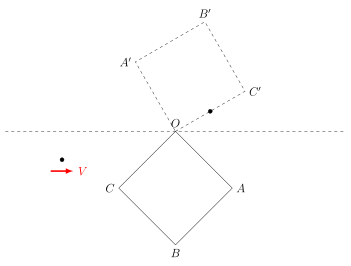
The points \(O,A,B\) and \(C\) are the vertices of a uniform square lamina of mass \(M.\) The lamina can turn freely under gravity about a horizontal axis perpendicular to the plane of the lamina through \(O\). The sides of the lamina are of length \(2a.\) When the lamina is haning at rest with the diagonal \(OB\) vertically downwards it is struck at the midpoint of \(OC\) by a particle of mass \(6M\) moving horizontally in the plane of the lamina with speed \(V\). The particle adheres to the lamina. Find, in terms of \(a,M\) and \(g\), the value which \(V^{2}\) must exceed for the lamina and particle to make complete revolutions about the axis.
Solution:
1990 Paper 3 Q12
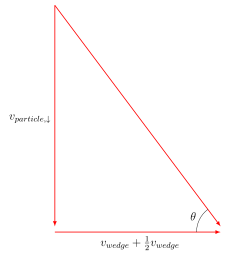
A uniform smooth wedge of mass \(m\) has congruent triangular end faces \(A_{1}B_{1}C_{1}\) and \(A_{2}B_{2}C_{2},\) and \(A_{1}A_{2},B_{1}B_{2}\) and \(C_{1}C_{2}\) are perpendicular to these faces. The points \(A,B\) and \(C\) are the midpoints of \(A_{1}A_{2},B_{1}B_{2}\) and \(C_{1}C_{2}\) respectively. The sides of the triangle \(ABC\) have lengths \(AB=AC=5a\) and \(BC=6a.\) The wedge is placed with \(BC\) on a smooth horizontal table, a particle of mass \(2m\) is placed at \(A\) on \(AC,\) and the system is released from rest. The particle slides down \(AC,\) strikes the table, bounces perfectly elastically and lands again on the table at \(D\). At this time the point \(C\) of the wedge has reached the point \(E\). Show that \(DE=\frac{192}{19}a.\)
Solution: Conservation of energy, tells us that \(2m \cdot g \cdot 4a = 8amg\) is equal to \(\frac12 m v_{wedge}^2 + \frac12(2m)v_{particle}^2\). Conservation of momentum (horizontally) tells us that \(m v_{wedge}+2mv_{particle, \rightarrow} = 0 \Rightarrow v_{particle, \rightarrow} = -\frac12 v_{wedge}\).
1990 Paper 3 Q13
A particle \(P\) is projected, from the lowest point, along the smooth inside surface of a fixed sphere with centre \(O\). It leaves the surface when \(OP\) makes an angle \(\theta\) with the upward vertical. Find the smallest angle that must be exceeded by \(\theta\) to ensure that \(P\) will strike the surface below the level of \(O\). You may find it helpful to find the time at which the particle strikes the sphere.
Solution:
