Problems
Filters
87 problems found
2010 Paper 2 Q9
Two points \(A\) and \(B\) lie on horizontal ground. A particle \(P_1\) is projected from \(A\) towards \(B\) at an acute angle of elevation \(\alpha\) and simultaneously a particle \(P_2\) is projected from \(B\) towards \(A\) at an acute angle of elevation \(\beta\). Given that the two particles collide in the air a horizontal distance \(b\) from \(B\), and that the collision occurs after \(P_1\) has attained its maximum height \(h\), show that \[ 2h \cot\beta < b < 4h \cot\beta \hphantom{\,,} \] and \[ 2h \cot\alpha < a < 4h \cot\alpha \,, \] where \(a\) is the horizontal distance from \(A\) to the point of collision.
2010 Paper 2 Q11
A uniform rod \(AB\) of length \(4L \) and weight \(W\) is inclined at an angle \(\theta\) to the horizontal. Its lower end \(A\) rests on a fixed support and the rod is held in equilibrium by a string attached to the rod at a point \(C\) which is \(3L \) from \(A\). The reaction of the support on the rod acts in a direction \(\alpha\) to \(AC\) and the string is inclined at an angle \(\beta\) to \(CA\). Show that \[ \cot\alpha = 3\tan \theta + 2 \cot \beta\,. \] Given that \(\theta =30^\circ\) and \(\beta = 45^\circ\), show that \(\alpha= 15^\circ\).
2010 Paper 3 Q6
The points \(P\), \(Q\) and \(R\) lie on a sphere of unit radius centred at the origin, \(O\), which is fixed. Initially, \(P\) is at \(P_0(1, 0, 0)\), \(Q\) is at \(Q_0(0, 1, 0)\) and \(R\) is at \(R_0(0, 0, 1)\).
- The sphere is then rotated about the \(z\)-axis, so that the line \(OP\) turns directly towards the positive \(y\)-axis through an angle \(\phi\). The position of \(P\) after this rotation is denoted by \(P_1\). Write down the coordinates of \(P_1\).
- The sphere is now rotated about the line in the \(x\)-\(y\) plane perpendicular to \(OP_1\), so that the line \(OP\) turns directly towards the positive \(z\)-axis through an angle \(\lambda\). The position of \(P\) after this rotation is denoted by \(P_2\). Find the coordinates of \(P_2\). Find also the coordinates of the points \(Q_2\) and \(R_2\), which are the positions of \(Q\) and \(R\) after the two rotations.
- The sphere is now rotated for a third time, so that \(P\) returns from \(P_2\) to its original position~\(P_0\). During the rotation, \(P\) remains in the plane containing \(P_0\), \(P_2\) and \(O\). Show that the angle of this rotation, \(\theta\), satisfies \[ \cos\theta = \cos\phi \cos\lambda\,, \] and find a vector in the direction of the axis about which this rotation takes place.
2009 Paper 1 Q4
The sides of a triangle have lengths \(p-q\), \(p\) and \(p+q\), where \(p>q> 0\,\). The largest and smallest angles of the triangle are \(\alpha\) and \(\beta\), respectively. Show by means of the cosine rule that \[ 4(1-\cos\alpha)(1-\cos\beta) = \cos\alpha + \cos\beta \,. \] In the case \(\alpha = 2\beta\), show that \(\cos\beta=\frac34\) and hence find the ratio of the lengths of the sides of the triangle.
Solution: The largest angle will be opposite the side with length \(p+q\). Similarly the smallest angle will be opposite the side with length \(p-q\). The cosine rule tells us that: \begin{align*} && (p+q)^2 &= p^2 + (p-q)^2 - 2p(p-q) \cos \alpha \\ && 0 &= p(p-4q-2(p-q)\cos \alpha)\\ && 0 &= p(1-2\cos \alpha) + q(2\cos \alpha - 4)\\ \Rightarrow && \frac{p}{q} & = \frac{4-2 \cos \alpha}{1-2 \cos \alpha} \\ && (p-q)^2 &= p^2 + (p+q)^2 - 2p(p+q) \cos \beta \\ && 0 &= p(p+4q-2(p+q) \cos \beta) \\ && 0 &= p(1-2\cos \beta)+q(4-2\cos \beta) \\ \Rightarrow && \frac{p}{q} &= \frac{2\cos \beta - 4}{1-2\cos \beta} \\ \Rightarrow && \frac{4-2 \cos \alpha}{1-2 \cos \alpha} &= \frac{2\cos \beta - 4}{1-2\cos \beta} \\ \Rightarrow && (2-\cos \alpha)(1-2\cos \beta) &= (\cos \beta - 2)(1 - 2 \cos \alpha) \\ \Rightarrow && 2 - \cos \alpha -4\cos \beta+2\cos \alpha \cos \beta &= \cos \beta - 2-2\cos \alpha \cos \beta + 4 \cos \alpha \\ \Rightarrow && 4-4\cos \alpha - 4\cos \beta+4\cos \alpha\cos \beta &= \cos \alpha + \cos \beta \\ \Rightarrow && 4(1-\cos \alpha)(1-\cos \beta) &= \cos \alpha + \cos \beta \end{align*} If \(\alpha = 2 \beta\), and let \(c = \cos \beta\) \begin{align*} && 4 (1- \cos 2 \beta)(1-\cos \beta) &= \cos 2 \beta + \cos \beta \\ \Rightarrow && 4(1-(2c^2-1))(1-c) &= 2c^2-1+c\\ \Rightarrow && 8(1+c)(1-c)^2 &= (2c-1)(c+1) \\ \Rightarrow && 0 &= (c+1)(8(1-c)^2-(2c-1)) \\ &&&= (c+1)(8c^2-18c+9) \\ &&&= (c+1)(4c-3)(2c-3) \\ \end{align*} Therefore \(c = -1, \frac32, \frac34\). Clearly \(\cos \beta \neq -1, \frac32\), since they are not valid angles in a triangle (or valid values of \(\cos \beta\)). \(\frac{p}{q} = \frac{2 \cdot \frac34-4 }{1 - 2\cdot \frac34} = \frac{3-8}{2-3} = 5\) so \(4:5:6\)
2008 Paper 1 Q7
The point \(P\) has coordinates \((x,y)\) with respect to the origin \(O\). By writing \(x=r\cos\theta\) and \(y=r\sin\theta\), or otherwise, show that, if the line \(OP\) is rotated by \(60^\circ\) clockwise about \(O\), the new \(y\)-coordinate of \(P\) is \(\frac12(y-\sqrt3\,x)\). What is the new \(y\)-coordinate in the case of an anti-clockwise rotation by \(60^\circ\,\)? An equilateral triangle \(OBC\) has vertices at \(O\), \((1,0)\) and \((\frac12,\frac12 \sqrt3)\), respectively. The point \(P\) has coordinates \((x,y)\). The perpendicular distance from \(P\) to the line through \(C\) and \(O\) is \(h_1\); the perpendicular distance from \(P\) to the line through \(O\) and \(B\) is \(h_2\); and the perpendicular distance from \(P\) to the line through \(B\) and \(C\) is \(h_3\). Show that \(h_1=\frac12 \big\vert y-\sqrt3\,x\big\vert\) and find expressions for \(h_2\) and \(h_3\). Show that \(h_1+h_2+h_3=\frac12 \sqrt3\) if and only if \(P\) lies on or in the triangle \(OBC\).
2008 Paper 2 Q6
A curve has the equation \(y=\f(x)\), where \[ \f(x) = \cos \Big( 2x+ \frac \pi 3\Big) + \sin \Big ( \frac{3x}2 - \frac \pi 4\Big). \]
- Find the period of \(\f(x)\).
- Determine all values of \(x\) in the interval \(-\pi\le x \le \pi\) for which \(\f(x)=0\). Find a value of \(x\) in this interval at which the curve touches the \(x\)-axis without crossing it.
- Find the value or values of \(x\) in the interval \(0\le x \le 2\pi\) for which \(\f(x)=2\,\).
Solution: \begin{align*} && f(x) &= \cos \left( 2x+ \frac \pi 3\right) + \sin \left ( \frac{3x}2 - \frac\pi 4\right) \\ &&&= \cos \left( 2x+ \frac \pi 3\right) + \cos\left (\frac{\pi}{2} - \left ( \frac{3x}2 - \frac\pi 4\right) \right)\\ &&&= \cos \left( 2x+ \frac \pi 3\right) + \cos\left (\frac{3\pi}{4} - \frac{3x}2 \right)\\ &&&= 2 \cos \left (\frac{2x+ \frac \pi 3+\frac{3\pi}{4} - \frac{3x}2}{2} \right) \cos \left ( \frac{\left (2x+ \frac \pi 3 \right) - \left (\frac{3\pi}{4} - \frac{3x}2 \right)}{2} \right)\\ &&&= 2 \cos \left (\frac{\frac{x}{2}+ \frac {13\pi}{12}}{2} \right) \cos \left ( \frac{\frac{7x}{2}- \frac {5\pi}{12}}{2} \right)\\ &&&= 2 \cos \left (\frac{x}{4}+ \frac {13\pi}{24} \right) \cos \left ( \frac{7x}{4}- \frac {5\pi}{24} \right)\\ \end{align*}
- The period of \(f\) will be the LCM of \(\frac{2\pi}{\pi}\) and \(\frac{2\pi}{\frac32} = \frac{4\pi}{3}\) which is \(4\pi\). (This is also clear from the factorised form).
- \(f(x) = 0\) means one of those two factors is zero, ie \begin{align*} \text{first factor}: && 0 &= \cos \left (\frac{x}{4}+ \frac {13\pi}{24} \right) \\ &&n\pi + \frac{\pi}{2}&= \frac{x}{4}+ \frac {13\pi}{24} \\ \Rightarrow && x &= 4n\pi - \frac{\pi}{6} \\ \Rightarrow && x &= -\frac{\pi}{6} \\ \\ \text{second factor}: && 0 &= \cos \left ( \frac{7x}{4}- \frac {5\pi}{24} \right) \\ && n\pi + \frac{\pi}{2} &= \frac{7x}{4}- \frac {5\pi}{24} \\ \Rightarrow && 7x &= 4n\pi + \frac{17}{6}\pi \\ \Rightarrow && x &= \frac{4n}7\pi + \frac{17}{42}\pi \\ \Rightarrow && x &= -\frac{31}{42} \pi, -\frac16\pi, \frac{17}{42}\pi, \frac{41}{42}\pi \end{align*} Therefore all solutions are \(-\frac{31}{42} \pi, -\frac16\pi, \frac{17}{42}\pi, \frac{41}{42}\pi\) We can see that \(-\frac{\pi}{6}\) is a repeated root, therefore it touches the axis and does not cross.
- \(f(x) = 2\) requires both factors to be \(1\) or \(-1\). \begin{align*} \text{first factor}: && \pm1 &= \cos \left (\frac{x}{4}+ \frac {13\pi}{24} \right) \\ &&n\pi &= \frac{x}{4}+ \frac {13\pi}{24} \\ \Rightarrow && x &= 4n\pi - \frac{13\pi}{6} \\ \Rightarrow && x &= \frac{11}{6}\pi \\ \end{align*} We only need to test this value, where it's \(-1\), so we look at \( \cos \left ( \frac{77\pi}{24}- \frac {5\pi}{24} \right) = \cos (3\pi) = -1\), so the only value is \(\frac{11}{6}\pi\)
2008 Paper 2 Q9
In this question, use \(g=10\,\)m\,s\(^{-2}\). In cricket, a fast bowler projects a ball at \(40\,\)m\,s\(^{-1}\) from a point \(h\,\)m above the ground, which is horizontal, and at an angle \(\alpha\) above the horizontal. The trajectory is such that the ball will strike the stumps at ground level a horizontal distance of \(20\,\)m from the point of projection.
- Determine, in terms of \(h\), the two possible values of \(\tan\alpha\). Explain which of these two values is the more appropriate one, and deduce that the ball hits the stumps after approximately half a second.
- State the range of values of \(h\) for which the bowler projects the ball below the horizontal.
- In the case \(h=2.5\), give an approximate value in degrees, correct to two significant figures, for \(\alpha\). You need not justify the accuracy of your approximation.
2008 Paper 2 Q10
The lengths of the sides of a rectangular billiards table \(ABCD\) are given by \(AB = DC = a\) and \(AD=BC = 2b\). There are small pockets at the midpoints \(M\) and \(N\) of the sides \(AD\) and \(BC\), respectively. The sides of the table may be taken as smooth vertical walls. A small ball is projected along the table from the corner \(A\). It strikes the side \(BC\) at \(X\), then the side \(DC\) at \(Y\) and then goes directly into the pocket at \(M\). The angles \(BAX\), \(CXY\) and \(DY\!M\) are \(\alpha\), \(\beta\) and \(\gamma\) respectively. On each stage of its path, the ball moves with constant speed in a straight line, the speeds being \(u\), \(v\) and \(w\) respectively. The coefficient of restitution between the ball and the sides is \(e\), where \(e>0\).
- Show that \(\tan\alpha \tan \beta = e\) and find \(\gamma\) in terms of \(\alpha\).
- Show that \(\displaystyle \tan\alpha = \frac {(1+2e)b} {(1+e)a}\) and deduce that the shot is possible whatever the value of \(e\).
- Find an expression in terms of \(e\) for the fraction of the kinetic energy of the ball that is lost during the motion.
Solution:
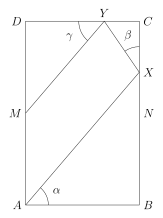
- The initial velocity is \(u = \binom{u \cos\alpha}{u \sin \alpha}\), therefore \(v = \binom{v_x}{u \sin \alpha}\). Newton's experimental law tells us \(v_x = -e u_x = -eu \cos\alpha\), therefore \(v = \binom{-eu \cos \alpha}{u \sin \alpha} = \binom{-v \sin \beta}{v\cos \beta} \Rightarrow -\tan \beta = -e \cot \alpha \Rightarrow \tan \alpha \tan \beta = e\). There is nothing special about the result here, and so it must also be the case that \(\tan \beta \tan \gamma = e \Rightarrow \tan \gamma = \tan \alpha\)
- \(\tan \alpha = \frac{XB}{BA}\) so the point \(X\) is at \((a, \tan \alpha a)\). The point \(Y\) satisfies \(\tan \beta = \frac{CY}{CX} = \frac{CY}{2b - \tan \alpha a}\) so the point \(Y\) is \((a-(2b - a \tan \alpha)\tan \beta,2b) = (a - 2b\tan \beta + ea, 2b) = ((1+e)a-2b\tan \beta, 2b)\). Finally, the point \(M\) is the midpoint, so \(\tan \gamma = \frac{DM}{DY}\) so \(M\) is the point \((0, 2b - ((1+e)a-2b\tan \beta)\tan \gamma) = (0, 2b - (1+e)a \tan \gamma - 2b e) = (0, (2b(1-e) - (1+e)a \tan \gamma)\), but \(M\) is the point \((0, b)\), ie \begin{align*} && b &= 2b(1-e) - (1+e)a \tan \gamma \\ \Rightarrow && b+2eb &= (1+e)a \tan \gamma \\ \Rightarrow && \tan \gamma &= \frac{(1+2e)b}{(1+e)a} \\ \Rightarrow && \tan \alpha &= \frac{(1+2e)b}{(1+e)a} \end{align*} Since \( \frac{(1+2e)b}{(1+e)a} = \frac{b}{a} + \frac{e}{1+e}b\) which is clearly an increasing function of \(e\) on \([0,1]\), so \(\tan \alpha \in \left [\frac{b}{a}, \frac{3b}{2a} \right]\) which are all all angles which place \(X\) in sensible places, therefore we can always hit the middle pocket. (Except \(e = 0\), where we would put the ball in \(N\), but we are given \(e > 0\)).
- After the first collision the velocity is \(\binom{-eu \cos \alpha}{u \sin \alpha}\) after the second collision the velocity is \(\binom{-eu \cos \alpha}{-eu \sin \alpha}\). Initial kinetic energy is therefore \(\frac12 m u^2\) and final kinetic energy is \(\frac12 m e^2u^2\) therefore the fraction lost is \(\frac{\frac12 m u^2 - \frac12 m e^2u^2}{\frac12 m u^2} = 1-e^2\)
2007 Paper 1 Q2
- Given that \(A = \arctan \frac12\) and that \(B = \arctan\frac13\,\) (where \(A\) and \(B\) are acute) show, by considering \(\tan \left( A + B \right)\), that \(A + B = {\frac{1}{4}\pi }\). The non-zero integers \(p\) and \(q\) satisfy \[ \displaystyle \arctan {\frac1 p} + \arctan {\frac1 q} = {\frac\pi 4}\,. \] Show that \( \left ( p-1 \right) \left(q-1 \right) = 2\) and hence determine \(p\) and \(q\).
- Let \(r\), \(s\) and \(t\) be positive integers such that the highest common factor of \(s\) and \(t\) is \(1\). Show that, if \[ \arctan {\frac1 r} + \arctan \frac s {s+t} = {\frac\pi 4}\,, \] then there are only two possible values for \(t\), and give \(r\) in terms of \(s\) in each case.
Solution:
- \begin{align*} && \tan (A+B) &= \frac{\tan A + \tan B}{1-\tan A \tan B}\\ &&&= \frac{\tan \arctan \frac12 + \tan \arctan \frac13}{1-\tan \arctan \frac12 \tan \arctan \frac13}\\ &&&= \frac{\frac12+\frac13}{1-\frac16} \\ &&&= \frac{3+2}{5} \\ &&&= 1 \\ \Rightarrow && A+B &= \frac{\pi}{4} + n \pi \end{align*} but since \(A,B\) are acute \(0 < A+B < \pi\), so \(A+B = \frac{\pi}{4}\) \begin{align*} && 1 &= \tan \frac{\pi}{4} \\ &&&= \tan \left ( \arctan {\frac1 p} + \arctan {\frac1 q}\right) \\ &&&= \frac{\frac1p + \frac1q}{1-\frac1{pq}} \\ &&&= \frac{q+p}{pq-1} \\ \Rightarrow && pq-1 &= q+p \\ \Rightarrow && 0 &= pq-q-p-q \\ &&&= (p-1)(q-1)-2 \\ \Rightarrow && 2 &= (p-1)(q-1) \end{align*} But \(p\),\(q\) are integers, so \(p-1 \in \{-2,-1,1,1\} \Rightarrow p \in \{-1,0,2,3\}\) but we cannot have \(p= 0\), so we must have \((p,q) = (2,3), (3,2)\)
- \begin{align*} && 1 &= \tan \frac{\pi}{4} \\ &&&= \tan \left ( \arctan {\frac1 r} + \arctan \frac s {s+t} \right) \\ &&&= \frac{\frac1r + \frac{s}{s+t}}{1-\frac{s}{r(s+t)}} \\ &&&= \frac{s+t+sr}{r(s+t)-s} \\ \Rightarrow && rs+rt-s &= s+t + sr \\ \Rightarrow && 0 &= rt-2s-t \\ &&2s&= t(r-1) \end{align*} Since \((s,t) =1\), we must have \(t \mid 2\), so \( t = 1,2\) and \(r = 2s+1\) or \(r=s+1\) respectively.
2007 Paper 2 Q4
Given that \(\cos A\), \(\cos B\) and \(\beta\) are non-zero, show that the equation \[ \alpha \sin(A-B) + \beta \cos(A+B) = \gamma \sin(A+B) \] reduces to the form \[ (\tan A-m)(\tan B-n)=0\,, \] where \(m\) and \(n\) are independent of \(A\) and \(B\), if and only if \(\alpha^2=\beta^2+\gamma^2\). Determine all values of \(x\), in the range \(0\le x <2\pi\), for which:
- $2\sin(x-\frac14\pi) + \sqrt{3} \cos(x+\frac14\pi) = \sin(x+\frac14\pi)\(
- \)2\sin(x-\frac16\pi) + \sqrt{3} \cos(x+\frac16\pi) = \sin(x+\frac16\pi)\(
- \)2\sin(x+\frac13\pi) + \sqrt{3} \cos(3x) = \sin(3x)$
Solution: \begin{align*} && \alpha \sin(A-B) + \beta \cos (A + B) &= \gamma \sin(A+B) \\ \Leftrightarrow && \alpha \sin A \cos B - \alpha \cos A \sin B + \beta \cos A \cos B - \beta \sin A \sin B &= \gamma \sin A \cos B + \gamma \cos A \sin B \\ \Leftrightarrow && \alpha \tan A - \alpha \tan B + \beta - \beta \tan A \tan B &= \gamma \tan A + \gamma \tan B \\ \Leftrightarrow && \beta \tan A \tan B +(\gamma-\alpha) \tan A + (\gamma +\alpha)\tan B&=\beta \\ \Leftrightarrow && \tan A \tan B +\left (\frac{\gamma-\alpha}{\beta} \right) \tan A + \left (\frac{\gamma +\alpha}{\beta} \right)\tan B&=1\\ \Leftrightarrow && \left ( \tan A + \left ( \frac{\gamma+\alpha}{\beta} \right) \right) \left ( \tan B + \left ( \frac{\gamma-\alpha}{\beta} \right)\right) - \frac{\gamma^2 - \alpha^2}{\beta^2}&=1\\ \Leftrightarrow && \left ( \tan A + \left ( \frac{\gamma+\alpha}{\beta} \right) \right) \left ( \tan B + \left ( \frac{\gamma-\alpha}{\beta} \right)\right) &= \frac{\beta^2+\gamma^2-\alpha^2}{\beta^2}\\ \end{align*} Which has the desired form iff \(\beta^2+\gamma^2 = \alpha^2\).
- \(\,\) \begin{align*} && 2\sin(x-\tfrac14\pi) + \sqrt 3 \cos(x+\tfrac14\pi) &=\sin(x+\tfrac14\pi) \\ && 3 + 1 &= 4 \\ \Rightarrow && \left (\tan x + \frac{1+2}{\sqrt3} \right) \left ( \tan \frac{\pi}{4} + \frac{1-2}{\sqrt3}\right) &= 0\\ \Rightarrow && \tan x &= -\sqrt3 \\ \Rightarrow && x &= \tfrac23\pi, \tfrac53\pi \end{align*}
- \(\,\) \begin{align*} && 2\sin(x-\frac16\pi) + \sqrt 3 \cos(x+\frac16\pi) &=\sin(x+\frac16\pi) \\ \Leftrightarrow && \left (\tan x + \frac{1+2}{\sqrt3} \right) \left ( \tan \frac{\pi}{3} + \frac{1-2}{\sqrt3}\right) &= 0\\ && x &\in [0, 2\pi) \end{align*}
- \(\,\) \begin{align*} && 2\sin(x+\frac13\pi) + \sqrt 3 \cos(3x) = \sin(3x) \\ && A-B =x + \tfrac13\pi, A+B &= 3x \\ \Rightarrow && A = 2x + \tfrac\pi6, B &= x-\tfrac{\pi}{6} \\ \Rightarrow && \tan (2x+\tfrac\pi6)&=-\sqrt3 \\ && 2x + \tfrac{\pi}{6} &= \tfrac23\pi, \tfrac53\pi, \tfrac83 \pi, \tfrac{11}3\pi \\ && x &= \tfrac{\pi}{4}, \tfrac{3\pi}{4}, \tfrac{5\pi}{4}, \tfrac{7\pi}{4} \\ && \tan(-x-\tfrac{\pi}{6}) &= \frac1{\sqrt{3}} \\ \Rightarrow && x-\tfrac{\pi}{6} &= \ldots, \tfrac{\pi}{6}, \tfrac{7\pi}{6}, \ldots \\ \Rightarrow && x &= \tfrac{\pi}3, \tfrac{4\pi}{3} \\ \\ \Rightarrow && x &= \tfrac{\pi}{4}, \tfrac{3\pi}{4}, \tfrac{5\pi}{4}, \tfrac{7\pi}{4} , \tfrac{\pi}3, \tfrac{4\pi}{3} \end{align*}
2007 Paper 2 Q5
In this question, \(\f^2(x)\) denotes \(\f(\f(x))\), \(\f^3(x)\) denotes \(\f( \f (\f(x)))\,\), and so on.
- The function \(\f\) is defined, for \(x\ne \pm 1/ \sqrt3\,\), by $$ \f(x) = \ds \frac{x+\sqrt3} {1-\sqrt3\, x }\,. $$ Find by direct calculation \(\f^2(x) \) and \(\f^3(x)\), and determine \(\f^{2007}(x)\,\).
- Show that \(\f^n(x) = \tan(\theta + \frac 13 n\pi)\), where \(x=\tan\theta\) and \(n\) is any positive integer.
- The function \(\g(t)\) is defined, for \(\vert t\vert\le1\) by \(\g(t) = \frac {\sqrt3}2 t + \frac 12 \sqrt {1-t^2}\,\). Find an expression for \(\g^n(t)\) for any positive integer \(n\).
Solution:
- \(\,\) \begin{align*} && f(x) &= \frac{x+\sqrt3}{1-\sqrt3x} \\ \Rightarrow && f(f(x)) &= \frac{f(x)+\sqrt3}{1-\sqrt3f(x)} \\ &&&= \frac{\frac{x+\sqrt3}{1-\sqrt3x}+\sqrt3}{1-\sqrt3 \frac{x+\sqrt3}{1-\sqrt3x}} \\ &&&= \frac{x+\sqrt{3}+\sqrt3(1-\sqrt3x)}{1-\sqrt3x-\sqrt3(x+\sqrt3)} \\ &&&= \frac{-2x+2\sqrt3}{-2-2\sqrt3x} \\ &&&= \frac{x-\sqrt3}{1+\sqrt3 x} \\ \\ && f^3(x) &= f^2(f(x)) \\ &&&= \frac{f(x)-\sqrt3}{1+\sqrt3 f(x)} \\ &&&=\frac{\frac{x+\sqrt3}{1-\sqrt3x}-\sqrt3}{1+\sqrt3 \frac{x+\sqrt3}{1-\sqrt3x}} \\ &&&= \frac{(x+\sqrt3)-\sqrt3(1-\sqrt3 x)}{(1-\sqrt3x)+\sqrt3 (x+\sqrt3)} \\ &&&= \frac{-2x}{-2} = x \\ \\ && f^{2007}(x) &= x \end{align*}
- If \(x = \tan \theta\) then \(f(x) = \frac{\tan \theta + \tan \frac{\pi}{3}}{1 - \tan \frac{\pi}{3} \tan \theta} = \tan (\theta + \frac{\pi}{3})\) and hence \(f^n(x) = \tan (\theta + \frac{n \pi}{3})\)
- Note that if \(t = \sin \theta\) then \(g(t) = \cos \frac{\pi}{6} t\sin \theta + \frac12 \cos \theta = \sin(\theta + \frac{\pi}6)\) therefore \(g^n(t) = \sin(\sin^{-1}(t) + \frac{n\pi}{6})\)
2005 Paper 1 Q4
- Given that \(\displaystyle \cos \theta = \frac35\) and that \(\displaystyle \frac{3\pi }{ 2} \le \theta \le 2\pi\), show that \(\displaystyle \sin 2 \theta = -\frac{24}{25}\), and evaluate \(\cos 3 \theta\).
- Prove the identity \(\displaystyle \tan 3\theta \equiv \frac {3 \tan \theta - \tan^3 \theta}{1 - 3 \tan^2 \theta}\). Hence evaluate \(\tan \theta\), given that \(\displaystyle \tan 3\theta = \frac{11}{ 2}\) and that \(\displaystyle \frac{\pi}{ 4} \le \theta \le \frac{\pi}{2}\).
Solution:
- Since \(\cos^2 \theta + \sin^2 \theta \equiv 1\), \(\sin \theta = \pm \frac45\) and since \(\displaystyle \frac{3\pi }{ 2} \le \theta \le 2\pi\) it must be the case that \(\sin\) is negative, ie \(\sin \theta = -\frac45\). Therefore \(\sin 2 \theta = 2 \sin \theta \cos \theta = 2 \cdot \frac35 \cdot (-\frac45) = -\frac{24}{25}\). \begin{align*} \cos 3 \theta &= \cos 2 \theta \cos \theta - \sin 2\theta \sin \theta \\ &= (\cos^2 \theta - \sin^2 \theta) \cos \theta - \sin 2 \theta \sin \theta \\ &= (\frac{9}{25} - \frac{16}{25}) \frac35 + \frac{24}{25} \cdot (-\frac{4}{5}) \\ &= -\frac{21}{125} - \frac{96}{125} \\ &= -\frac{117}{125} \end{align*}
- \begin{align*} \tan 3 \theta &\equiv \frac{\tan 2 \theta + \tan \theta}{1 - \tan 2 \theta \tan \theta} \\ &\equiv \frac{\frac{2 \tan \theta}{1- \tan^2 \theta} + \tan \theta}{1 - \frac{2 \tan^2 \theta}{1- \tan^2 \theta}} \\ &\equiv \frac{2\tan \theta + \tan \theta -\tan^3 \theta}{1 - \tan^2 \theta - 2 \tan^2 \theta} \\ &\equiv \frac {3 \tan \theta - \tan^3 \theta}{1 - 3 \tan^2 \theta} \end{align*} Let \(t = \tan \theta\), then \begin{align*} && \frac{11}{2} &= \frac{3t - t^3}{1-3t^2} \\ \Leftrightarrow && 11 - 33t^2 &= 6t -2t^3 \\ \Leftrightarrow && 0 &= 2t^3-33t^2-6t+11 \\ \Leftrightarrow && 0 &= (2t-1)(t^2-16t-11) \end{align*} Therefore \(\tan \theta = \frac12, \tan \theta = \frac{16 \pm \sqrt{16^2+4 \cdot 1 \cdot 11}}{2} = \frac{16\pm10\sqrt{3}}{2} = 8 \pm 5 \sqrt{3}\). Since \(\displaystyle \frac{\pi}{ 4} \le \theta \le \frac{\pi}{2}\) we must have that \(\tan\) is both positive and \(\geq 1\), therefore \(\tan \theta = 8 + 5 \sqrt{3}\)
2005 Paper 1 Q7
The notation \(\displaystyle \prod^n_{r=1} \f (r)\) denotes the product $\f (1) \times \f (2) \times \f(3) \times \cdots \times \f(n)$. %For example, \(\displaystyle \prod_{r=1}^4 r = 24\). %Simplify \(\displaystyle \prod^n_{r=1} \frac{\g (r) }{ \g (r-1) }\). %You may assume that \(\g (r) \neq 0\) for any integer \(0 \le r \le n \). Simplify the following products as far as possible:
- \(\displaystyle \prod^n_{r=1} \l \frac{r+ 1 }{ r } \r\,\);
- \(\displaystyle \prod^n_{r=2} \l \frac{r^2 -1}{r^2 } \r\,\);
- $\displaystyle \prod^n_{r=1} \l {\cos \frac{2\pi }{ n} + \sin \frac{2\pi}{ n} \cot \frac{\l 2r-1 \r \pi }{ n} }\r\,$, where \(n\) is even.
Solution:
- \(\,\) \begin{align*} \prod^n_{r=1} \left ( \frac{r+ 1 }{ r } \right) &= \frac{2}{1} \cdot \frac{3}{2} \cdot \frac{4}{3} \cdots \frac{n-1}{n-2} \cdot \frac{n}{n-1} \cdot \frac{n+1}{n} \\ &= \frac{n+1}{1} = n+1 \end{align*}
- \(\,\) \begin{align*} \prod^n_{r=2} \left ( \frac{r^2 -1}{r^2 } \right) &= \prod^n_{r=2} \left ( \frac{(r -1)(r+1)}{r^2 } \right) \\ &= \left ( \frac{1}{2} \cdot \frac{3}{2} \right) \cdot \left ( \frac{2}{3} \cdot \frac{4}{3} \right) \cdots \left ( \frac{r-1}{r} \cdot \frac{r+1}{r}\right) \cdots \frac{n-1}{n} \cdot \frac{n+1}{n} \\ &= \frac{1}{n} \cdot \frac{n+1}{2} \\ &= \frac{n+1}{2n} \end{align*}
- When \(n\) is odd, the product is undefined, since we have a \(\cot \pi\) lurking in there. \begin{align*} \prod^n_{r=1} \left ( {\cos \frac{2\pi }{ n} + \sin \frac{2\pi}{ n} \cot \frac{ (2r-1 ) \pi }{ n} } \right) &= \prod^n_{r=1} \left ( {\cos \frac{2\pi }{ n} + \sin \frac{2\pi}{ n} \frac{\cos \frac{ (2r-1 ) \pi }{ n}}{\sin\frac{ (2r-1 ) \pi }{ n}} } \right) \\ &= \prod^n_{r=1} \frac{1}{\sin\frac{ (2r-1 ) \pi }{ n}} \left ( {\cos \frac{2\pi }{ n} \sin\frac{ (2r-1 ) \pi }{ n} + \sin \frac{2\pi}{ n} \cos \frac{ (2r-1 ) \pi }{ n} } \right) \\ &= \prod^n_{r=1} \frac{1}{\sin\frac{ (2r-1 ) \pi }{ n}} \sin \left ( \frac{2\pi}{n} + \frac{(2r-1)\pi}{n} \right) \\ &= \prod^n_{r=1} \frac{1}{\sin\frac{ (2r-1 ) \pi }{ n}} \sin \left ( \frac{(2r+1)\pi}{n} \right) \\ &= \frac{\sin \frac{3\pi}{n}}{\sin \frac{\pi}{n}} \cdot \frac{\sin \frac{5\pi}{n}}{\sin \frac{3\pi}{n}} \cdots \frac{\sin \frac{(2n+1)\pi}{n}}{\sin \frac{(2n-1)\pi}{n}} \\ &= \frac{\sin \frac{(2n+1)\pi}{n}}{\sin \frac{\pi}{n}} \\ &= 1 \end{align*}
2005 Paper 1 Q9
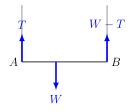
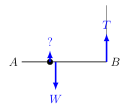
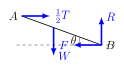
A non-uniform rod \(AB\) has weight \(W\) and length \(3l\). When the rod is suspended horizontally in equilibrium by vertical strings attached to the ends \(A\) and \(B\), the tension in the string attached to \(A\) is \(T\). When instead the rod is held in equilibrium in a horizontal position by means of a smooth pivot at a distance \(l\) from \(A\) and a vertical string attached to \(B\), the tension in the string is \(T\). Show that \(5T = 2W\). When instead the end \(B\) of the rod rests on rough horizontal ground and the rod is held in equilibrium at an angle \(\theta\) to the horizontal by means of a string that is perpendicular to the rod and attached to \(A\), the tension in the string is \(\frac12 T\). Calculate \(\theta\) and find the smallest value of the coefficient of friction between the rod and the ground that will prevent slipping.
Solution:
2005 Paper 2 Q4
The positive numbers \(a\), \(b\) and \(c\) satisfy \(bc=a^2+1\). Prove that $$ \arctan\left(\frac1 {a+b}\right)+ \arctan\left(\frac1 {a+c}\right)= \arctan\left(\frac1 a \right). $$ The positive numbers \(p\), \(q\), \(r\), \(s\), \(t\), \(u\) and \(v\) satisfy $$ st = (p+q)^2 + 1 \;, \ \ \ \ \ \ uv=(p+r)^2 + 1 \;, \ \ \ \ \ \ qr = p^2+1\;. $$ Prove that $$ \arctan \! \!\left(\!\frac1 {p+q+s}\!\right) + \arctan \! \!\left(\!\frac 1{p+q+t}\!\right) + \arctan \! \!\left(\!\frac 1 {p+r+u}\!\right) + \arctan \! \!\left(\!\frac1 {p+r+v}\!\right) =\arctan \! \!\left( \! \frac1 p \! \right) . $$ Hence show that $$ \arctan\left(\frac1 {13}\right) +\arctan\left(\frac1 {21}\right) +\arctan\left(\frac1 {82}\right) +\arctan\left(\frac1 {187}\right) =\arctan\left(\frac1 {7}\right). $$ [Note that \(\arctan x\) is another notation for \( \tan^{-1}x \,.\,\)]
Solution: \begin{align*} && \tan \left (\arctan\left(\frac1 {a+b}\right)+ \arctan\left(\frac1 {a+c}\right) \right) &= \frac{\frac1{a+b}+\frac1{a+c}}{1-\frac{1}{(a+b)(a+c)}} \\ &&&= \frac{a+c+a+b}{(a+b)(a+c)-1} \\ &&&= \frac{2a+b+c}{a^2+ab+ac+bc-1} \\ &&&= \frac{2a+b+c}{2a^2+ab+ac} \\ &&&= \frac{1}{a} \\ &&&= \tan \arctan \frac1a\\ \Rightarrow && \arctan\left(\frac1 {a+b}\right)+ \arctan\left(\frac1 {a+c}\right) &= \arctan \frac{1}{a} + n \pi \end{align*} Since \(\arctan x \in (-\frac{\pi}{2}, \frac{\pi}{2})\) the LHS \(\in (0, \pi)\) so \(n = 0\). \begin{align*} a=p+q, b = s, c = t:&& \arctan \! \!\left(\!\frac1 {p+q+s}\!\right) + \arctan \! \!\left(\!\frac 1{p+q+t}\!\right) &= \arctan \left ( \frac{1}{p+q} \right) \\ a=p+r, b= u, c = v && \arctan \! \!\left(\!\frac 1 {p+r+u}\!\right) + \arctan \! \!\left(\!\frac1 {p+r+v}\!\right) &= \arctan \! \!\left(\!\frac1 {p+r}\!\right) \\ a = p, b = q, c = r:&& \arctan \left ( \frac{1}{p+q} \right) +\arctan \! \!\left(\!\frac1 {p+r}\!\right) &= \arctan \left ( \frac1p \right) \end{align*} and the result follows. Taking \(p = 7\) we need to solve \[ \begin{cases} q+s &= 6 \\ q+t &= 14 \\ r+u &= 75 \\ r+v &= 180 \end{cases} \] also satisfying \(qr = 50\) etc, so say \(q = 1, r = 50, s = 5, v=25\)