Problems
Filters
85 problems found
2007 Paper 3 Q2
- Show that \(1.3.5.7. \;\ldots \;.(2n-1)=\dfrac {(2n)!}{2^n n!}\;\) and that, for $\vert x \vert < \frac14$, \[ \frac{1}{\sqrt{1-4x\;}\;} =1+\sum_{n=1}^\infty \frac {(2n)!}{(n!)^2} \, x^n \,. \]
- By differentiating the above result, deduce that \[ \sum _{n=1}^\infty \frac{(2n)!}{n!\,(n-1)!} \left(\frac6{25}\right)^{\!\!n} = 60 \,. \]
- Show that \[ \sum _{n=1}^\infty \frac{2^{n+1}(2n)!}{3^{2n}(n+1)!\,n!} = 1 \,. \]
Solution:
- Notice that \(1 \cdot 3 \cdot 5 \cdot 7 \cdot (2n-1) = \frac{1 \cdot 2 \cdot 3 \cdot 4 \cdots \cdots 2n}{2 \cdot 4 \cdot 6 \cdots 2n} = \frac{(2n)!}{2^n \cdot n!}\) as required. When \(|4x| < 1\) or \(|x|<\frac14\) we can apply the generalised binomial theorem to see that: \begin{align*} \frac{1}{\sqrt{1-4x}} &= (1-4x)^{-\frac12} \\ &= 1+\sum_{n=1}^\infty \frac{-\frac12 \cdot \left ( -\frac32\right)\cdots \left ( -\frac{2n-1}2\right)}{n!} (-4x)^n \\ &= 1+\sum_{n=1}^{\infty} (-1)^n\frac{(2n)!}{(n!)^2 2^{2n}} (-4)^n x^n \\ &= 1+\sum_{n=1}^{\infty} \frac{(2n)!}{(n!)^2 } x^n \\ \end{align*}
- Differentiating we obtain \begin{align*} && 2(1-4x)^{-\frac32} &= \sum_{n=1}^\infty \frac{(2n)!}{n!(n-1)!} x^{n-1} \\ \Rightarrow &&\sum_{n=1}^\infty \frac{(2n)!}{n!(n-1)!} \left (\frac{6}{25} \right)^{n} &= \frac{6}{25} \cdot 2\left(1- 4 \frac{6}{25}\right)^{-\frac32} \\ &&&= \frac{12}{25} \left (\frac{1}{25} \right)^{-\frac32} \\ &&&= \frac{12}{25} \cdot 125 = 60 \end{align*}
- By integrating, we obtain \begin{align*} && \int_{t=0}^{t=x} \frac{1}{\sqrt{1-4t}} \d t &= \int_{t=0}^{t=x} \left (1+\sum_{n=1}^{\infty} \frac{(2n)!}{(n!)^2 } t^n \right) \d t \\ \Rightarrow && \left [ -\frac12 \sqrt{1-4t}\right]_0^x &= x + \sum_{n=1}^{\infty} \frac{(2n)!}{n!(n+1)! } x^{n+1} \\ \Rightarrow && \frac12 - \frac12\sqrt{1-4x} - x &= \sum_{n=1}^{\infty} \frac{(2n)!}{n!(n+1)! } x^{n+1} \\ \\ \Rightarrow && 9\sum_{n=1}^{\infty} \frac{(2n)!}{n!(n+1)! } \left ( \frac{2}{9}\right)^{n+1} &=9 \cdot\left( \frac12 - \frac12 \sqrt{1-4\cdot \frac{2}{9}} - \frac29\right )\\ &&&= 9 \cdot \left (\frac12 - \frac{1}{6} - \frac{2}{9} \right) \\ &&&= 1 \end{align*}
2006 Paper 2 Q5
The notation \({\lfloor } x \rfloor\) denotes the greatest integer less than or equal to the real number \(x\). Thus, for example, \(\lfloor \pi\rfloor =3\,\), \(\lfloor 18\rfloor =18\,\) and \(\lfloor-4.2\rfloor = -5\,\).
- Two curves are given by \(y= x^2+3x-1\) and \(y=x^2 +3\lfloor x\rfloor -1\,\). Sketch the curves, for \(1\le x \le 3\,\), on the same axes. Find the area between the two curves for \(1\le x \le n\), where \(n\) is a positive integer.
- Two curves are given by \(y= x^2+3x-1\) and \(y=\lfloor x\rfloor ^2+3\lfloor x\rfloor -1\,\). Sketch the curves, for \(1\le x \le 3\,\), on the same axes. Show that the area between the two curves for \(1\le x \le n\), where \(n\) is a positive integer, is \[ \tfrac 16 (n-1)(3n+11)\,. \]
Solution:
- \(\,\)
The difference between the curves is \(3x - 3\lfloor x \rfloor\), which has area \(\frac32\) for each step. Therefore the area between the curves from \(1 \leq x \leq n\) is \(\frac32 (n-1)\)

- \(\,\)
The area between the curves is \(x^2 - \lfloor x \rfloor ^2 + 3(x - \lfloor x \rfloor)\). Looking at \begin{align*} && A &= \int_1^n \left ( x^2 - \lfloor x \rfloor ^2 \right )\d x \\ &&&= \frac{n^3-1^3}{3} - \sum_{k=1}^{n-1} k^2 \\ &&&= \frac{(n-1)(n^2+n+1)}{3} - \frac{(n-1)n(2n-1)}{6} \\ &&&= \frac{(n-1) \left (2n^2+2n+2-2n^2+n \right)}{6} \\ &&&= \frac{(n-1)(3n+2)}{6} \end{align*} Therefore the total area is \(\frac{(n-1)(3n+2)}{6}+\frac32(n-1) = \frac{(n-1)}{6}\left ( 3n+2+9\right) =\frac{(n-1)(3n+11)}{6}\)

2006 Paper 2 Q13
I know that ice-creams come in \(n\) different sizes, but I don't know what the sizes are. I am offered one of each in succession, in random order. I am certainly going to choose one - the bigger the better - but I am not allowed more than one. My strategy is to reject the first ice-cream I am offered and choose the first one thereafter that is bigger than the first one I was offered; if the first ice-cream offered is in fact the biggest one, then I have to put up with the last one, however small. Let \(\P_n(k)\) be the probability that I choose the \(k\)th biggest ice-cream, where \(k=1\) is the biggest and \(k=n\) is the smallest.
- Show that \(\P_4(1) = \frac{11}{24}\) and find \(\P_4(2)\), \(\P_4(3)\) and \(\P_4(4)\).
- Find an expression for \(\P_n(1)\).
2005 Paper 2 Q6
- Write down the general term in the expansion in powers of \(x\) of \((1-x)^{-1}\), \((1-x)^{-2}\) and \((1-x)^{-3}\), where \(|x| <1\). Evaluate \(\displaystyle \sum_{n=1}^\infty n 2^{-n}\) and \(\displaystyle \sum_{n=1}^\infty n^22^{-n}\).
- Show that $\displaystyle (1-x)^{-\frac12} = \sum_{n=0}^\infty \frac{(2n)!}{(n!)^2} \frac{x^n}{2^{2n}}\( , for \)|x|<1$. Evaluate \(\displaystyle \sum_{n=0}^\infty \frac{(2n)!} {(n!)^2 2^{2n}3^{n}} \) and \(\displaystyle \sum_{n=1}^\infty \frac{n(2n)!} {(n!)^2 2^{2n}3^{n}}\).
Solution:
- \(\displaystyle (1-x)^{-1} = \sum_{n=0}^\infty x^n\), \(\displaystyle (1-x)^{-2} = \sum_{n=0}^\infty (n+1)x^n\), \(\displaystyle (1-x)^{-3} = \sum_{n=0}^\infty \frac{(n+2)(n+1)}{2}x^n\) \begin{align*} && \sum_{n=1}^{\infty} n2^{-n} &= \frac12\sum_{n=0}^{\infty}(n+1)2^{-n} \\ &&&= \frac12 (1-\tfrac12)^{-2} = 2 \\ \\ && \sum_{n=1}^{\infty} nx^n&= x(1-x)^{-2} \\ \Rightarrow && \sum_{n=1}^{\infty} n^2x^{n-1}&= (1-x)^{-2}+2x(1-x)^{-3} \\ \Rightarrow && \sum_{n=1}^{\infty} n^22^{-n} &= \frac12 \left ( (1-\tfrac12)^{-2}+2\cdot \tfrac12 \cdot (1-\tfrac12)^{-3} \right) \\ &&&= \frac12 \left ( 4 +8\right) = 6 \end{align*}
- By the generalised binomial theorem, \begin{align*} && (1-x)^{-\frac12} &= 1 + \sum_{n=1}^{\infty} \frac{(-\tfrac12)\cdot(-\tfrac32)\cdots(-\tfrac12-n+1)}{n!}(-x)^n \\ &&&= 1 + \sum_{n=1}^{\infty} \frac{(-1)^n(\tfrac12)\cdot(\tfrac32)\cdots(\tfrac{2n-1}2)}{n!}(-x)^n \\ &&&= 1 + \sum_{n=1}^{\infty} \frac{1 \cdot 3 \cdot 5 \cdots (2n-1)}{2^nn!}x^n \\ &&&= 1 + \sum_{n=1}^{\infty} \frac{(2n)!}{2^nn! \cdot 2^n n!}x^n \\ &&&= 1 + \sum_{n=1}^{\infty} \frac{(2n)!}{2^{2n}(n!)^2}x^n \\ &&&= \sum_{n=0}^{\infty} \frac{(2n)!}{2^{2n}(n!)^2}x^n \\ \end{align*} \begin{align*} && \sum_{n=0}^\infty \frac{(2n)!} {(n!)^2 2^{2n}3^{n}} &= (1-\tfrac13)^{-\frac12} \\ &&&= \sqrt{\frac32} \\ \\ && (1-x)^{-\frac12} &= \sum_{n=0}^{\infty} \frac{(2n)!}{2^{2n}(n!)^2}x^n \\ \Rightarrow && \tfrac12(1-x)^{-\frac32} &= \sum_{n=0}^{\infty} \frac{n(2n)!}{2^{2n}(n!)^2}x^{n-1} \\ \Rightarrow && \sum_{n=1}^\infty \frac{n(2n)!} {(n!)^2 2^{2n}3^{n}} &= \frac16(1-\tfrac13)^{-3/2} \\ &&&= \frac16 \sqrt{\frac{27}{8}} = \frac14\sqrt{\frac{3}2} \end{align*}
2004 Paper 1 Q2
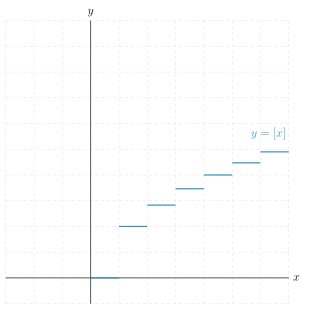
The square bracket notation \(\boldsymbol{[} x\boldsymbol{]}\) means the greatest integer less than or equal to \(x\,\). For example, \(\boldsymbol{[}\pi\boldsymbol{]} = 3\,\), \(\boldsymbol{[}\sqrt{24}\,\boldsymbol{]} = 4\,\) and \(\boldsymbol{[}5\boldsymbol{]}=5\,\).
- Sketch the graph of \(y = \sqrt{\boldsymbol{[}x\boldsymbol{]}}\) and show that \[ \displaystyle \int^a_0 \sqrt{\boldsymbol{[}x\boldsymbol{]}} \; \mathrm{d}x = \sum^{a-1}_{r=0} \sqrt{r} \] when \(a\) is a positive integer.
- Show that $\displaystyle \int^{a}_0 2_{\vphantom{A}}^{\pmb{\boldsymbol {[} } x \pmb{ \boldsymbol{]}} }\; \mathrm{d}x = 2^{a}-1\( when \)a\( is a positive integer.
- Determine an expression for \)\displaystyle \int^{a}_0 2_{\vphantom{\dot A}}^{\pmb{\boldsymbol{[} }x \pmb{ \boldsymbol{]}} } \; \mathrm{d}x\( when \)a$ is positive but not an integer.
Solution:
- \(\,\) \begin{align*} && \int_0^a \sqrt{\boldsymbol{[}x\boldsymbol{]}} \d x &= \sum_{r=0}^{a-1} \int_{x=r}^{x=r+1} \sqrt{\boldsymbol{[}x\boldsymbol{]}} \d x \\ &&&= \sum_{r=0}^{a-1} \int_r^{r+1} \sqrt{r} \d x \\ &&&= \sum_{r=0}^{a-1} \sqrt{r} \\ \end{align*}
- \(\,\) \begin{align*} && \int^{a}_0 2^{\boldsymbol {[} x \boldsymbol{]}} \d x &= \sum_{r=0}^{a-1} \int_{x=r}^{x=r+1} 2^{\boldsymbol {[} x \boldsymbol{]}} \d x \\ &&&= \sum_{r=0}^{a-1} \int_{x=r}^{x=r+1} 2^{r} \d x \\ &&&= \sum_{r=0}^{a-1} 2^{r}\\ &&&= 2^{a}-1 \end{align*}
- \(\,\) \begin{align*} && \int^{a}_0 2^{\boldsymbol {[} x \boldsymbol{]}} \d x &= \int_0^{\boldsymbol {[} a \boldsymbol{]}} 2^{\boldsymbol {[} x \boldsymbol{]}} \d x + \int_{\boldsymbol {[} a \boldsymbol{]}}^a 2^{\boldsymbol {[} x \boldsymbol{]}} \d x \\ &&&= 2^{ \boldsymbol {[} a \boldsymbol{]}}-1 + (a-\boldsymbol {[} a \boldsymbol{]})2^{\boldsymbol {[} a \boldsymbol{]}} \\ &&&= (a-\boldsymbol {[} a \boldsymbol{]}+1)2^{\boldsymbol {[} a \boldsymbol{]}} -1 \end{align*}
2004 Paper 3 Q3
Given that \(\f''(x) > 0\) when \(a \le x \le b\,\), explain with the aid of a sketch why \[ (b-a) \, \f \Big( {a+b \over 2} \Big) < \int^b_a \f(x) \, \mathrm{d}x < (b-a) \, \displaystyle \frac{\f(a) + \f(b)}{2} \;. \] By choosing suitable \(a\), \(b\) and \(\f(x)\,\), show that \[ {4 \over (2n-1)^2} < {1 \over n-1} - {1 \over n} < {1 \over 2} \l {1 \over n^2} + {1 \over (n-1)^2}\r \,, \] where \(n\) is an integer greater than 1. Deduce that \[ 4 \l {1 \over 3^2} +{1 \over 5^2} + {1 \over 7^2} + \cdots \r < 1 < {1 \over 2} + \left( {1 \over 2^2} +{1 \over 3^2} + {1 \over 4^2} + \cdots \right)\,. \] Show that \[ {1 \over 2} \l {1 \over 3^2} + {1 \over 4^2} + {1 \over 5^2} + \frac 1 {6^2} + \cdots \r < {1 \over 3^2} +{1 \over 5^2} + {1 \over 7^2} + \cdots \] and hence show that \[ {3 \over 2} \displaystyle < \sum_{n=1}^\infty {1 \over n^2} <{7 \over 4}\;. \]
2004 Paper 3 Q4
The triangle \(OAB\) is isosceles, with \(OA = OB\) and angle \(AOB = 2 \alpha\) where \(0< \alpha < {\pi \over 2}\,\). The semi-circle \(\mathrm{C}_0\) has its centre at the midpoint of the base \(AB\) of the triangle, and the sides \(OA\) and \(OB\) of the triangle are both tangent to the semi-circle. \(\mathrm{C}_1, \mathrm{C}_2, \mathrm{C}_3, \ldots\) are circles such that \(\mathrm{C}_n\) is tangent to \(\mathrm{C}_{n-1}\) and to sides \(OA\) and \(OB\) of the triangle. Let \(r_n\) be the radius of \(\mathrm{C}_n\,\). Show that \[ \frac{r_{n+1}}{r_n} = \frac{1-\sin\alpha}{1+\sin\alpha}\;. \] Let \(S\) be the total area of the semi-circle \(\mathrm{C}_0\) and the circles \(\mathrm{C}_1\), \(\mathrm{C}_2\), \(\mathrm{C}_3\), \(\ldots\;\). Show that \[ S = {1 + \sin^2 \alpha \over 4 \sin \alpha} \, \pi r_0^2 \;. \] Show that there are values of \(\alpha\) for which \(S\) is more than four fifths of the area of triangle~\(OAB\).
2004 Paper 3 Q7
For \(n=1\), \(2\), \(3\), \(\ldots\,\), let \[ I_n = \int_0^1 {t^{n-1} \over \l t+1 \r^n} \, \mathrm{d} t \, . \] By considering the greatest value taken by \(\displaystyle {t \over t+1}\) for \(0 \le t \le 1\) show that \(I_{n+1} < {1 \over 2} I_{n}\,\). Show also that \(\; \displaystyle I_{n+1}= - \frac 1{\; n\, 2^n} + I_{n}\,\). Deduce that \(\; \displaystyle I_n < \frac1 {\; n \, 2^{n-1}}\,\). Prove that \[ \ln 2 = \sum_{r=1}^n {1 \over \; r\, 2^r} + I_{n+1} \] and hence show that \({2 \over 3} < \ln 2 < {17 \over 24}\,\).
Solution: \begin{align*} && \frac{t}{t+1} &= 1 - \frac{1}{t+1} \geq \frac12 \\ \Rightarrow && I_{n+1} &= \int_0^1 \frac{t^{n}}{(t+1)^{n+1}} \d t \\ &&&= \int_0^1\frac{t}{t+1} \frac{t^{n-1}}{(t+1)^{n}} \d t \\ &&&< \int_0^1\frac12\frac{t^{n-1}}{(t+1)^{n}} \d t \\ &&&= \frac12 I_n \\ \\ && I_{n+1} &= \int_0^1 \frac{t^{n}}{(t+1)^{n+1}} \d t \\ &&&= \left [ t^n \frac{(1+t)^{-n}}{-n} \right]_0^1 +\frac1n \int_0^1 n t^{n-1}(1+t)^{-n} \d t \\ &&&= -\frac{1}{n2^n} + I_n \\ \Rightarrow && \frac12 I_n &> -\frac1{n2^n} + I_n \\ \Rightarrow && \frac{1}{n2^{n-1}} &> I_n \end{align*} \begin{align*} && \ln 2 &= \int_0^1 \frac{1}{1+t} \d t \\ &&&= I_1 \\ &&&= \frac1{2} + I_2 \\ &&&= \frac1{2} + \frac{1}{2 \cdot 2^2} + I_3 \\ &&&= \sum_{r=1}^n \frac{1}{r2^r} + I_{n+1} \\ \\ && \ln 2 &= \frac12 + \frac18 + \frac1{24} + I_4 \\ \Rightarrow && \ln 2 &> \frac12 + \frac18 + \frac1{24} = \frac{12+3+1}{24} = \frac{16}{24} = \frac23 \\ \Rightarrow && \ln 2 &= \frac12 + \frac18 + I_3 \\ &&&< \frac12 + \frac18 +\frac{1}{3 \cdot 4} \\ &&&< \frac{12}{24} + \frac{3}{24} + \frac{2}{24} = \frac{17}{24} \end{align*}
2004 Paper 3 Q13
A men's endurance competition has an unlimited number of rounds. In each round, a competitor has, independently, a probability \(p\) of making it through the round; otherwise, he fails the round. Once a competitor fails a round, he drops out of the competition; before he drops out, he takes part in every round. The grand prize is awarded to any competitor who makes it through a round which all the other remaining competitors fail; if all the remaining competitors fail at the same round the grand prize is not awarded. If the competition begins with three competitors, find the probability that:
- all three drop out in the same round;
- two of them drop out in round \(r\) (with \(r \ge 2\)) and the third in an earlier round;
- the grand prize is awarded.
Solution:
- This is the same as the sum of the probability that they all drop out in the \(k\)th round for all values of \(k\), ie \begin{align*} \mathbb{P}(\text{all drop in same round}) &= \sum_{k=0}^\infty \mathbb{P}(\text{all drop out in the }k+1\text{th round}) \\ &= \sum_{k=0}^{\infty}(p^k(1-p))^3 \\ &= (1-p)^3 \sum_{k=0}^{\infty}p^{3k} \\ &= \frac{(1-p)^3}{1-p^3} \\ &= \frac{1+3p(1-p)(p-(1-p))-p^3}{1-p^3} \\ &= \frac{1-p^3-3p(1-p)(1-2p)}{1-p^3} \end{align*}
- There are \(3\) ways to choose the person who drops out earlier, and then they can drop out in round \(0, 1, \cdots r-1\) \begin{align*} \mathbb{P}(\text{exactly two drop out in round }r\text{ and one before}) &= 3\sum_{k=0}^{r-2} (p^{r-1}(1-p))^2p^k(1-p) \\ &= 3p^{2r-2}(1-p)^3 \sum_{k=0}^{r-2}p^k \\ &= 3p^{2r-2}(1-p)^3 \frac{1-p^{r-1}}{1-p} \\ &= 3p^{2r-2}(1-p)^2(1-p^{r-1}) \end{align*}
- The probability exactly \(2\) finish after the third \begin{align*} \mathbb{P}(\text{exactly two drop out after third}) &= \sum_{r=2}^{\infty}\mathbb{P}(\text{exactly two drop out in round }r\text{ and one before}) \\ &= \sum_{r=2}^{\infty}3p^{2r-2}(1-p)^2(1-p^{r-1}) \\ &= 3(1-p)^2p^{-2}\sum_{r=2}^{\infty}(p^{2r}-p^{3r-1}) \\ &= 3(1-p)^2p^{-2} \left( \frac{p^4}{1-p^2} - \frac{p^5}{1-p^3} \right) \\ &= \frac{3(1-p)^2(p^2(1-p^3)-p^3(1-p^2))}{(1-p^2)(1-p^3)}\\ &= \frac{3(1-p)^3p^2}{(1-p^2)(1-p^3)}\\ \end{align*} Therefore the probability the grand prize is not awarded is \begin{align*} P &= 1 - \frac{(1-p)^3}{1-p^3} - \frac{3(1-p)^3p^2}{(1-p^2)(1-p^3)} \\ &= \frac{(1-p^3)(1-p^2) - (1-p)^3(1-p^2)-3(1-p)^3p^2}{(1-p^2)(1-p^3)} \\ &= \frac{(1-p^3)(1-p^2) - (1-p)^3(1+2p^2)}{(1-p^2)(1-p^3)} \\ \end{align*}
2003 Paper 1 Q1
It is given that \(\sum\limits_{r=-1}^ {n} r^2\) can be written in the form \(pn^3 +qn^2+rn+s\,\), where \(p\,\), \(q\,\), \(r\,\) and \(s\) are numbers. By setting \(n=-1\), \(0\), \(1\) and \(2\), obtain four equations that must be satisfied by \(p\,\), \(q\,\), \(r\,\) and \(s\) and hence show that \[ { \sum\limits_{r=0} ^n} r^2= {\textstyle \frac16} n(n+1)(2n+1)\;. \] Given that \(\sum\limits_{r=-2}^ nr^3\) can be written in the form \(an^4 +bn^3+cn^2+dn +e\,\), show similarly that \[ { \sum\limits_{r=0} ^n} r^3= {\textstyle \frac14} n^2(n+1)^2\;. \]
Solution: \begin{align*} n = -1: && (-1)^2 &= s - r+q -p \\ n = 0: && 1 + 0 &= s \\ n = 1: && 1 + 1 &= s + r + q + p \\ n = 2: && 2 + 2^2 &= s + 2r + 4q + 8p \\ \Rightarrow &&& \begin{cases} 1 &= s \\ 1 &= s - r + q - p \\ 2 &= s + r + q + p \\ 6 &= s + 2r + 4q + 8p \end{cases} \\ \Rightarrow && s &= 1 \\ && q &= \frac12 \\ &&& \begin{cases} \frac12 &= r + p \\ 3 &= 2r + 8p \end{cases} \\ \Rightarrow && r &= \frac16 \\ && p &= \frac13 \\ \Rightarrow && \sum_{r=0}^n r^2 &= 1 + \frac16 n + \frac12 n^2 + \frac13 n^3 - (-1)^2 \\ &&&= \frac{n}{6} \l 1 + 3n + 2n^2 \r \\ &&&= \frac{n(n+1)(2n+1)}{6} \end{align*} Similarly, \begin{align*} n = -2: && (-2)^3 &= e - 2d + 4c - 8b + 16a \\ n = -1: && -8 + (-1)^3 &= e -d+c-b+a \\ n = 0: && -9 + 0^3 &= e \\ n = 1: && -9 + 1^3 &= e+d+c+b+a \\ n = 2: && -8 + 2^3 &= e+2d+4c+8b+16a \\ \Rightarrow &&& \begin{cases} -9 &= e \\ -9 &= e - d+c -b + a \\ -8 &= e +d+c+b+a \\ -8 &= e-2d+4c-8b+16a \\ 0 &= e+2d+4c+8b+16a \\ \end{cases} \\ \Rightarrow && e &= -9 \\ \Rightarrow &&& \begin{cases} 1 &= 2c+2a \\ 10 &= 8c+32a \\ 1 &= 2d+2b \\ 8 &= 4d+16b \\ \end{cases} \\ \Rightarrow && a &= \frac14 \\ && c &= \frac14 \\ && b &= \frac12 \\ && d &= 0 \\ \\ \Rightarrow && \sum_{r=0}^n r^3 &= -9 + \frac14n^2 + \frac12 n^3+\frac14 n^4 -((-1)^3+(-2)^3) \\ &&&= \frac14n^2 \l1 + 2n+n^2\r \\ &&&= \frac{n^2(n+1)^2}{4} \end{align*} as required
2003 Paper 1 Q12
In a bag are \(n\) balls numbered 1, 2, \(\ldots\,\), \(n\,\). When a ball is taken out of the bag, each ball is equally likely to be taken.
- A ball is taken out of the bag. The number on the ball is noted and the ball is replaced in the bag. The process is repeated once. Explain why the expected value of the product of the numbers on the two balls is \[ \frac 1 {n^2} \sum_{r=1}^n\sum_{s=1}^n rs \] and simplify this expression.
- A ball is taken out of the bag. The number on the ball is noted and the ball is not replaced in the bag. Another ball is taken out of the bag and the number on this ball is noted. Show that the expected value of the product of the two numbers is \[ \frac{(n+1)(3n+2)}{12}\;. \]
Solution:
- Since the second draw is independently of the first draw \(\mathbb{P}(F=r, S=s) = \mathbb{P}(F=r)\mathbb{P}(S=s) = \frac{1}{n^2}\) and so \begin{align*} && \E[FS] &= \sum_{r=1}^n \sum_{s=1}^n rs \mathbb{P}(F=r, S = s) \\ &&&= \frac{1}{n^2} \sum_{r=1}^n \sum_{s=1}^n rs \\ &&&= \frac{1}{n^2} \left ( \sum_{r=1}^n r \right)\left ( \sum_{s=1}^n s \right) \\ &&&= \frac{1}{n^2} \left ( \frac{n(n+1)}{2} \right)^2 \\ &&&= \frac{(n+1)^2}{4} \end{align*}
- Under this methodology, \(\mathbb{P}(F=r, S=s) = \frac{1}{n(n-1)}\) as long as \(r \neq s\), therefore \begin{align*} && \E[FS] &= \sum_{r=1}^n \sum_{s\neq r} rs \mathbb{P}(F = r, S = s) \\ &&&= \frac{1}{n(n-1)} \sum_{r=1}^n \left ( \sum_{s=1}^n rs - r^2 \right) \\ &&&= \frac{1}{n(n-1)} \left ( \frac{n^2(n+1)^2}{4} - \frac{n(n+1)(2n+1)}{6} \right) \\ &&&= \frac{n+1}{12(n-1)} \left ( 3n(n+1)-2(2n+1) \right) \\ &&&= \frac{n+1}{12(n-1)} \left ( 3n^2 -n -2 \right) \\ &&&= \frac{n+1}{12(n-1)} (3n+2)(n-1)\\ &&&= \frac{(n+1)(3n+2)}{12} \end{align*}
2003 Paper 1 Q13
If a football match ends in a draw, there may be a "penalty shoot-out". Initially the teams each take 5 shots at goal. If one team scores more times than the other, then that team wins. If the scores are level, the teams take shots alternately until one team scores and the other team does not score, both teams having taken the same number of shots. The team that scores wins. Two teams, Team A and Team B, take part in a penalty shoot-out. Their probabilities of scoring when they take a single shot are \(p_A\) and \(p_B\) respectively. Explain why the probability \(\alpha\) of neither side having won at the end of the initial \(10\)-shot period is given by $$\alpha =\sum_{i=0}^5\binom{5}{i}^2(1-p_A)^i(1-p_B)^i\,p_A^{5-i}p_B^{5-i}.$$ Show that the expected number of shots taken is \(\displaystyle 10+ \frac{2\alpha}\beta\;,\) where \(\beta=p_A+p_B-2p_Ap_B\,.\)
Solution: Note that in the first \(10\)-short period the number of goals scored by each team is \(B(5, \p_i)\). For them to be equal they must both have scored the same number of goals, ie \begin{align*} && \alpha &= \sum_{i=0}^5 \mathbb{P}(\text{both teams score }5-i) \\ &&&= \sum_{i=0}^5 \binom{5}{i} (1-p_A)^ip_A^{5-i} \binom{5}{i} (1-p_B)^i p_B^{5-i} \\ &&&= \sum_{i=0}^5 \binom{5}{i} ^2(1-p_A)^i (1-p_B)^i p_A^{5-i} p_B^{5-i} \\ \end{align*} Suppose we make it to the end of the shoot out with scores tied. The probability that we finish each round is \(p_A(1-p_B) + p_B(1-p_A)\) (the probability \(A\) wins or \(B\) wins). This is \(p_A + p_B - 2p_Ap_B = \beta\)). Therefore the number of additional rounds is geometric with parameter \(\beta\) and the expected number of rounds is \(\frac{1}{\beta}\). Each round has two shots, and there is a probability \(\alpha\) of this occuring, ie \(\frac{2\alpha}{\beta}\). Added to the \(10\) guaranteed shots we get the desired result
2003 Paper 2 Q7
Show that, if \(n>0\,\), then $$ \int_{e^{1/n}}^\infty\,{{\ln x} \over {x^{n+1}}}\,\d x = {2 \over {n^2\e}}\;. $$ You may assume that \(\ds \frac{\ln x} x \to 0\;\) as \(x\to\infty\,\). Explain why, if \(1 < a < b\,\), then $$ \int_b^\infty\,{{\ln x} \over {x^{n+1}}}\,\d x < \int_a^\infty\,{{\ln x} \over {x^{n+1}}}\,\d x\;. $$ Deduce that $$ \sum_{n=1}^{N}{1 \over n^2} < {\e \over 2}\int_{\e^{1/N}}^{\infty} \left({1-x^{-N}} \over {x^2-x}\right) \ln x\,\d x\;, $$ where \(N\,\) is any integer greater than \(1\).
2003 Paper 3 Q2
Show that $\ds ^{2r} \! {\rm C}_r =\frac{1\times3\times\dots\times (2r-1)}{r!} \, \times 2^r \;, $ for \(r\ge1\,\).
- Give the first four terms of the binomial series for \(\l 1 - p \r^{-\frac12}\). By choosing a suitable value for \(p\) in this series, or otherwise, show that $$ \displaystyle \sum_{r=0}^\infty \frac{ {\vphantom {\A}}^{2r} \! {\rm C}_r }{ 8^r} = \sqrt 2 \; .$$
- Show that $$ \displaystyle \sum_{r=0}^\infty \frac{\l 2r + 1 \r \; {\vphantom{A}}^{2r} \! {\rm C} _r }{ 5^r} =\big( \sqrt 5\big)^3 \;. $$
Solution: \begin{align*} \binom{2r}{r} &= \frac{(2r)!}{r!r!} \\ &= \frac{1 \cdot 2 \cdot 3 \cdot 4 \cdots (2r-1)(2r)}{r! r!} \\ &= \frac{1 \cdot 3 \cdot 5 \cdots (2r-1) \cdot (2 \cdot 1) \cdot (2 \cdot 2) \cdots (2 \cdot r)}{r!}{r!} \\ &= \frac{1\cdot 3 \cdots (2r-1) \cdot 2^r \cdot 1 \cdot 2 \cdots r}{r!r!} \\ &= \frac{1\cdot 3 \cdots (2r-1) \cdot 2^r \cdot r!}{r!r!} \\ &= \frac{1\cdot 3 \cdots (2r-1)}{r!} \cdot 2^r \end{align*} which is what we wanted to show
- \begin{align*} (1 - p)^{-\frac12} &= 1 + \left ( -\frac12 \right )(-p) + \frac{1}{2!} \left (-\frac12 \right )\left (-\frac32 \right )(-p)^2 + \ldots \\ & \quad \quad \quad \cdots +\frac{1}{3!} \left (-\frac12 \right )\left (-\frac32 \right )\left (-\frac52 \right )(-p)^3 + O(p^4) \\ &= \boxed{1 + \frac{1}{2}p + \frac{3}{8}p^2 + \frac{5}{16}p^3} + O(p^4) \end{align*} More generally: \begin{align*} \binom{-\frac{1}{2}}{k} &=\frac{(-\frac{1}{2})\cdot(-\frac{1}{2} -1)\cdots(-\frac12 -k+1)}{k!} \\ &= \frac{(-1)(-3)(-5)\cdots(-(2k-1))}{k!2^k} \\ &= \frac{(-1)^k(1)(3)(5)\cdots((2k-1))}{k!2^k} \\ &= (-1)^k \frac{1}{4^k}\binom{2k}{k} \\ \end{align*} Therefore, \begin{align*} \sqrt{2} = \left (1-\frac12 \right)^{-\frac12} &= \sum_{r=0}^{\infty} \binom{-\frac12}{r} \left (-\frac12 \right )^r \tag{\(\frac12 < 1\) so series is valid} \\ &= \sum_{r=0}^{\infty} (-1)^r \frac{1}{4^r}\binom{2r}{r} \left (-\frac12 \right )^r \\ &= \sum_{r=0}^{\infty} \frac{1}{8^r}\binom{2r}{r} \end{align*}, which is what we wanted to show.
- \begin{align*} p(1-p^2)^{-\frac12} &= \sum_{r=0}^{\infty} \binom{-\frac12}{r} \left (-p^2 \right )^rp \\ &= \sum_{r=0}^{\infty} \frac{1}{4^r}\binom{2r}{r} p^{2r+1} \end{align*} Differentiating with respect to \(p\), \begin{align*} (1-p^2)^{-\frac12} +p^2(1-p^2)^{-\frac32} &= \sum_{r=0}^{\infty} \frac{1}{4^r}(2r+1)\binom{2r}{r} p^{2r} \\ (1-p^2)^{-\frac32} &= \sum_{r=0}^{\infty} \frac{1}{4^r}(2r+1)\binom{2r}{r} p^{2r} \end{align*} Letting \(p = \frac{2}{\sqrt{5}}\), and \(|\frac2{\sqrt{5}}| < 1\) we have \begin{align*} \left (1-\frac45 \right )^{-\frac32} &= \sum_{r=0}^{\infty} \frac{1}{5^r}(2r+1)\binom{2r}{r} \\ (\sqrt{5})^3 &= \sum_{r=0}^{\infty} \frac{1}{5^r}(2r+1)\binom{2r}{r} \end{align*} (Alternative) \begin{align*} (\sqrt5)^3 &= \left ( \frac{1}{5} \right )^{-\frac32} \\ &= \left ( 1- \frac{4}{5} \right )^{-\frac32} \\ &= \sum_{r=0}^{\infty} \binom{-\frac32}{r} \left (-\frac45 \right)^r \\ &= \sum_{r=0}^{\infty} \binom{-\frac12}{r} \frac{-\frac32-(r-1)}{-\frac12} \left (-\frac45 \right)^r \\ &= \sum_{r=0}^{\infty} \binom{-\frac12}{r} (2r+1) \left (-\frac45 \right)^r \\ &= \sum_{r=0}^{\infty} (-1)^r \frac{1}{4^r}\binom{2r}{r} (2r+1) \left (-\frac45 \right)^r \\ &= \sum_{r=0}^{\infty}(2r+1)\binom{2r}{r} \left (\frac15 \right)^r \\ (\sqrt{5})^3 &= \sum_{r=0}^{\infty}\frac{1}{5^r}(2r+1)\binom{2r}{r} \\ \end{align*}
2003 Paper 3 Q6
Show that \[ 2\sin \frac12 \theta \, \cos r\theta = \sin\big(r+\frac12\big)\theta - \sin\big(r-\frac12\big)\theta \;. \] Hence, or otherwise, find all solutions of the equation \[ \cos a\theta + \cos (a + 1) \theta + \dots + \cos(b-2)\theta+\cos (b - 1 ) \theta = 0 \;, \] where \(a\) and \(b\) are positive integers with \(a < b-1\,\).
Solution: \begin{align*} && \sin\left(r+\frac12\right)\theta - \sin\left(r-\frac12\right)\theta &= \sin r \theta \cos \tfrac12 \theta+\cos r \theta \sin \tfrac12 \theta- \left (\sin r \theta \cos \tfrac12 \theta-\cos r \theta \sin \tfrac12 \theta \right)\\ &&&= 2 \cos r\theta \sin \tfrac12 \theta \end{align*} \begin{align*} && S &= \cos a\theta + \cos (a + 1) \theta + \dots + \cos(b-2)\theta+\cos (b - 1 ) \theta \\ && 2\sin\tfrac12 \theta S &= \sum_{r=a}^{b-1} 2\sin\tfrac12 \theta \cos r \theta \\ &&&= \sum_{r=a}^{b-1} \left ( \sin\left(r+\frac12\right)\theta - \sin\left(r-\frac12\right)\theta \right) \\ &&&= \sin \left (b-\frac12 \right)\theta - \sin \left (a -\frac12 \right)\theta \\ \Rightarrow && \sin \left (b-\frac12 \right)\theta &= \sin \left (a -\frac12 \right)\theta \\ \end{align*} Case 1: \(A = B + 2n\pi\) \begin{align*} && \left (b-\frac12 \right)\theta &= \left (a -\frac12 \right)\theta + 2n\pi \\ \Rightarrow && (b-a) \theta &= 2n \pi \\ \Rightarrow && \theta &= \frac{2n\pi}{b-a} \end{align*} Case 2: \(A = (2n+1)\pi - B\) \begin{align*} && \left (b-\frac12 \right)\theta &= (2n+1)\pi -\left (a -\frac12 \right)\theta \\ \Rightarrow && (b+a-1) \theta &= (2n+1) \pi \\ \Rightarrow && \theta &= \frac{2n\pi}{b+a-1} \end{align*}