Problems
Filters
45 problems found
1992 Paper 3 Q9
The straight line \(OSA,\) where \(O\) is the origin, bisects the angle between the positive \(x\) and \(y\) axes. The ellipse \(E\) has \(S\) as focus. In polar coordinates with \(S\) as pole and \(SA\) as the initial line, \(E\) has equation \(\ell=r(1+e\cos\theta).\) Show that, at the point on \(E\) given by \(\theta=\alpha,\) the gradient of the tangent to the ellipse is given by \[ \frac{\mathrm{d}y}{\mathrm{d}x}=\frac{\sin\alpha-\cos\alpha-e}{\sin\alpha+\cos\alpha+e}. \] The points on \(E\) given by \(\theta=\alpha\) and \(\theta=\beta\) are the ends of a diameter of \(E\). Show that \[ \tan(\alpha/2)\tan(\beta/2)=-\frac{1+e}{1-e}. \] [Hint. A diameter of an ellipse is a chord through its centre.]
Solution:

1992 Paper 3 Q10
Sketch the curve \(C\) whose polar equation is \[ r=4a\cos2\theta\qquad\mbox{ for }-\tfrac{1}{4}\pi<\theta<\tfrac{1}{4}\pi. \] The ellipse \(E\) has parametric equations \[ x=2a\cos\phi,\qquad y=a\sin\phi. \] Show, without evaluating the integrals, that the perimeters of \(C\) and \(E\) are equal. Show also that the areas of the regions enclosed by \(C\) and \(E\) are equal.
Solution:

1992 Paper 3 Q14
\(\,\)
1991 Paper 2 Q10
A straight stick of length \(h\) stands vertically. On a sunny day, the stick casts a shadow on flat horizontal ground. In cartesian axes based on the centre of the Earth, the position of the Sun may be taken to be \(R(\cos\theta,\sin\theta,0)\) where \(\theta\) varies but \(R\) is constant. The positions of the base and tip of the stick are \(a(0,\cos\phi,\sin\phi)\) and \(b(0,\cos\phi,\sin\phi)\), respectively, where \(b-a=h\). Show that the displacement vector from the base of the stick to the tip of the shadow is \[ Rh(R\cos\phi\sin\theta-b)^{-1}\begin{pmatrix}-\cos\theta\\ -\sin^{2}\phi\sin\theta\\ \cos\phi\sin\phi\sin\theta \end{pmatrix}. \] {[}`Stands vertically' means that the centre of the Earth, the base of the stick and the tip of the stick are collinear, `horizontal' means perpendicular to the stick.
1991 Paper 3 Q4
The point \(P\) moves on a straight line in three-dimensional space. The position of \(P\) is observed from the points \(O_{1}(0,0,0)\) and \(O_{2}(8a,0,0).\) At times \(t=t_{1}\) and \(t=t_{1}'\), the lines of sight from \(O_{1}\) are along the lines \[ \frac{x}{2}=\frac{z}{3},y=0\quad\mbox{ and }\quad x=0,\frac{y}{3}=\frac{z}{4} \] respectively. At times \(t=t_{2}\) and \(t=t_{2}'\), the lines of sight from \(O_{2}\) are \[ \frac{x-8a}{-3}=\frac{y}{1}=\frac{z}{3}\quad\mbox{ and }\quad\frac{x-8a}{-4}=\frac{y}{2}=\frac{z}{5} \] respectively. Find an equation or equations for the path of \(P\).
1991 Paper 3 Q9
The parametric equations \(E_{1}\) and \(E_{2}\) define the same ellipse, in terms of the parameters \(\theta_{1}\) and \(\theta_{2}\), (though not referred to the same coordinate axes). \begin{alignat*}{2} E_{1}:\qquad & x=a\cos\theta_{1}, & \quad & y=b\sin\theta_{1},\\ E_{2}:\qquad & x=\dfrac{k\cos\theta_{2}}{1+e\cos\theta_{2}}, & \quad & y=\dfrac{k\sin\theta_{2}}{1+e\cos\theta_{2}}, \end{alignat*} where \(0< b< a,\) \(0< e< 1\) and \(0< k\). Find the position of the axes for \(E_{2}\) relative to the axes for \(E_{1}\) and show that \(k=a(1-e^{2})\) and \(b^{2}=a^{2}(1-e^{2}).\) {[}The standard polar equation of an ellipse is \(r=\dfrac{\ell}{1+e\cos\theta}.]\) By considering expressions for the length of the perimeter of the ellipse, or otherwise, prove that \[ \int_{0}^{\pi}\sqrt{1-e^{2}\cos^{2}\theta}\,\mathrm{d}\theta=\int_{0}^{\pi}\frac{1-e^{2}}{(1+e\cos\theta)^{2}}\sqrt{1+e^{2}+2e\cos\theta}\,\mathrm{d}\theta. \] Given that \(e\) is so small that \(e^{6}\) may be neglected, show that the value of either integral is \[ \tfrac{1}{64}\pi(64-16e^{2}-3e^{4}). \]
1991 Paper 3 Q12
A smooth tube whose axis is horizontal has an elliptic cross-section in the form of the curve with parametric equations \[ x=a\cos\theta\qquad y=b\sin\theta \] where the \(x\)-axis is horizontal and the \(y\)-axis is vertically upwards. A particle moves freely under gravity on the inside of the tube in the plane of this cross-section. By first finding \(\ddot{x}\) and \(\ddot{y},\) or otherwise, show that the acceleration along the inward normal at the point with parameter \(\theta\) is \[ \frac{ab\dot{\theta}^{2}}{\sqrt{a^{2}\sin^{2}\theta+b^{2}\cos^{2}\theta}}. \] The particle is projected along the surface in the vertical cross-section plane, with speed \(2\sqrt{bg},\) from the lowest point. Given that \(2a=3b,\) show that it will leave the surface at the point with parameter \(\theta\) where \[ 5\sin^{3}\theta+12\sin\theta-8=0. \]
1990 Paper 1 Q3
Given a curve described by \(y=\mathrm{f}(x)\), and such that \(y\geqslant0\), a push-off of the curve is a new curve obtained as follows: for each point \((x,\mathrm{f}(x))\) with position vector \(\mathbf{r}\) on the original curve, there is a point with position vector \(\mathbf{s}\) on the new curve such that \(\mathbf{s-r}=\mathrm{p}(x)\mathbf{n},\) where \(\mathrm{p}\) is a given function and \(\mathbf{n}\) is the downward-pointing unit normal to the original curve at \(\mathbf{r}\).
- For the curve \(y=x^{k},\) where \(x>0\) and \(k\) is a positive integer, obtain the function \(\mathrm{p}\) for which the push-off is the positive \(x\)-axis, and find the value of \(k\) such that, for all points on the original curve, \(\left|\mathbf{r}\right|=\left|\mathbf{r-s}\right|\).
- Suppose that the original curve is \(y=x^{2}\) and \(\mathrm{p}\) is such that the gradient of the curves at the points with position vectors \(\mathbf{r}\) and \(\mathbf{s}\) are equal (for every point on the original curve). By writing \(\mathrm{p}(x)=\mathrm{q}(x)\sqrt{1+4x^{2}},\) where \(\mathrm{q}\) is to be determined, or otherwise, find the form of \(\mathrm{p}\).
Solution:
- Suppose we have \(y = x^k\), then the tangent at \((t,t^k)\) has gradient \(\frac{\d y}{\d x} = kx^{k-1} = kt^{k-1}\) and the normal has gradient \(-\frac1k x^{1-k}\). For the push-off to be the positive \(x\)-axis, we need \(p(x)\) to be the length of the line. The line will have the equation: \begin{align*} && \frac{y - t^k}{x - t} &= -\frac1k t^{1-k} \\ y = 0: && x-t &= \frac{kt^k}{t^{1-k}} \\ && x& =t + kt^{2k-1} \end{align*} The distance from \((t,t^k)\) to \((t+kt^{2k-1},0)\) is \(\sqrt{t^{2k} + k^2t^{4k-2}} = t^k \sqrt{1+k^2t^{2k-2}} = y \sqrt{1+k^2 \frac{y^2}{x^2}} = \frac{y}{x} \sqrt{x^2 + k^2y^2}\), ie \(p(x) = \frac{y}{x}\sqrt{x^2+k^2y^2}\) If \(\left|\mathbf{r}\right|=\left|\mathbf{r-s}\right|\), then we need \(\sqrt{x^2+y^2} = \frac{y}{x}\sqrt{x^2+ky^2}\), but clearly this is satisfied when \(k = 1\).
- The points are \((t, t^2)\) and the normal has graident \(-\frac{1}{2t}\), the normal vector is \(\frac{1}{\sqrt{1+\frac{1}{4t^2}}}\binom{1}{-\frac1{2t}} = \frac{1}{\sqrt{4t^2+1}} \binom{2t}{-1}\). If we write \(p(x) = q(x)\sqrt{4x^2+1}\) then the the new points are at \(\binom{t+q(t)2t}{t^2-\q(t)}\) an the gradient will be \(\frac{2t-q'(t)}{1+q'(t)2t+2q(t)}\). We need it to be the case that \begin{align*} && 2t &= \frac{2t-q'(t)}{1+2q(t)+2tq'(t)} \\ \Rightarrow && 4tq(t) &= -q'(t)(1+4t^2) \\ \Rightarrow && \frac{q'(t)}{q(t)} &= -\frac{4t}{1+4t^2} \\ \Rightarrow && \ln q(t) &= -\frac12 \ln(1+4t^2)+C \\ \Rightarrow && q(t) &= A(1+4t^2)^{-1/2} \\ \Rightarrow && p(x) &= A \end{align*} So the push-off's are constants.
1990 Paper 3 Q2
The distinct points \(O\,(0,0,0),\) \(A\,(a^{3},a^{2},a),\) \(B\,(b^{3},b^{2},b)\) and \(C\,(c^{3},c^{2},c)\) lie in 3-dimensional space.
- Prove that the lines \(OA\) and \(BC\) do not intersect.
- Given that \(a\) and \(b\) can vary with \(ab=1,\) show that \(\angle AOB\) can take any value in the interval \(0<\angle AOB<\frac{1}{2}\pi\), but no others.
Solution:
- The line \(OA\) is \(\lambda \begin{pmatrix} a^3 \\ a^2 \\ a \end{pmatrix}\). The line \(BC\) is \(\begin{pmatrix} b^3 \\ b^2 \\ b \end{pmatrix} + \mu \begin{pmatrix} c^3-b^3 \\ c^2-b^2 \\ c-b \end{pmatrix}\). If these lies are concurrent then there would be \(\mu\) and \(\lambda\) such that they are equal, and in particular, \begin{align*} && \frac{b^2 + \mu(c^2-b^2)}{b + \mu (c-b)} &= \frac{b^3 + \mu(c^3-b^3)}{b^2 + \mu (c^2-b^2)} \\ \Leftrightarrow && (b^2 + \mu(c^2-b^2))^2 &= (b+\mu(c-b))(b^3+\mu(c^3-b^3)) \\ && b^4 +2\mu b^2 (c^2-b^2) + \mu^2 (c^2-b^2) &= b^4 + \mu(c-b)b^3 + \mu b(c^3-b^3) + \mu^2 (c-b)(c^3-b^3) \\ \Leftrightarrow && 2\mu b^2 (c+b) + \mu^2(c-b)(c+b)^2 &= \mu (b^3 + b(c^2+bc+b^2)) + \mu^2 (c^3-b^3) \\ && \mu = 0 & \Rightarrow a = b \\ \Leftrightarrow && b^2c - bc^2 &= \mu (c^3-b^3-(c-b)(c+b)^2) \\ \Leftrightarrow && bc(b-c) &= \mu (c-b)(c^2+bc+b^2-c^2-2bc-b^2) \\ \Leftrightarrow && bc &= \mu (bc) \\ \Leftrightarrow && \mu &= 1 \\ && \mu = -1 & \Rightarrow a = c \end{align*} Therefore there are no solutions.
- \begin{align*} \cos \angle AOB &= \frac{ab+a^2b^2+a^3b^3}{\sqrt{a^2+a^4+a^6}\sqrt{b^2+b^4+b^6}} \\ &= \frac{3}{\sqrt{1 + a^2 + a^4} \sqrt{1 + b^2 + b^4}} \\ &> 0 \end{align*} Therefore the angle satisfies \(\angle AOB < \tfrac12 \pi\). We cannot achieve \(0\), since that would require \(a = b = 1\), therefore it falls in the range \(0 < \angle AOB < \tfrac12 \pi\)
1989 Paper 2 Q3
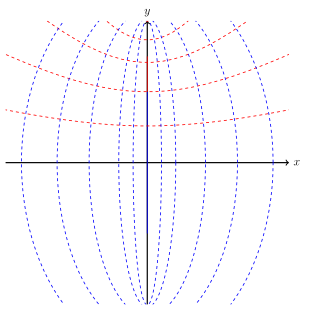
The real numbers \(x\) and \(y\) are related to the real numbers \(u\) and \(v\) by \[ 2(u+\mathrm{i}v)=\mathrm{e}^{x+\mathrm{i}y}-\mathrm{e}^{-x-\mathrm{i}y}. \] Show that the line in the \(x\)-\(y\) plane given by \(x=a\), where \(a\) is a positive constant, corresponds to the ellipse \[ \left(\frac{u}{\sinh a}\right)^{2}+\left(\frac{v}{\cosh a}\right)^{2}=1 \] in the \(u\)-\(v\) plane. Show also that the line given by \(y=b\), where \(b\) is a constant and \(0<\sin b<1,\) corresponds to one branch of a hyperbola in the \(u\)-\(v\) plane. Write down the \(u\) and \(v\) coordinates of one point of intersection of the ellipse and hyperbola branch, and show that the curves intersect at right-angles at this point. Make a sketch of the \(u\)-\(v\) plane showing the ellipse, the hyperbola branch and the line segments corresponding to:
- \(x=0\);
- \(y=\frac{1}{2}\pi,\) \(\quad 0\leqslant x\leqslant a.\)
Solution: \begin{align*} && 2(u+iv) &= e^{a+iy} - e^{-a-iy} \\ && &=(e^a \cos y - e^{-a} \cos y) + (e^a \sin y + e^{-a} \sin y)i \\ &&&= 2 \sinh a \cos y + 2\cosh a \sin y i\\ \Rightarrow && \frac{u}{\sinh a} &= \cos y \\ && \frac{v}{\cosh a} &= \sin y \\ \Rightarrow && 1 &= \left(\frac{u}{\sinh a}\right)^{2}+\left(\frac{v}{\cosh a}\right)^{2} \end{align*} \begin{align*} && 2(u+iv) &= e^{x+ib} - e^{-x-ib} \\ &&&= 2\sinh x \cos b + 2\cosh x \sin b i \\ \Rightarrow && \frac{u}{\cos b} &= \sinh x \\ && \frac{v}{\sin b} &= \cosh x \\ \Rightarrow && 1 &= \left (\frac{v}{\sin b} \right)^2 - \left (\frac{u}{\cos b} \right)^2 \end{align*} Therefore all the points lie of a hyperbola, and since \(\frac{v}{\sin b} > 0 \Rightarrow v > 0\) it's one branch of the hyperbola. (And all points on it are reachable as \(x\) varies from \(-\infty < x < \infty\). \begin{align*} 2(u+iv) &= e^{a+ib} - e^{-a-ib} \\ &= 2 \sinh a \cos b + 2 \cosh a \sin b i \end{align*} so we can take \(u = \sinh a \cos b, v = \cosh a \sin b\). \begin{align*} \frac{\d }{\d u} && 0 &= \frac{2 u}{\sinh^2 a} + \frac{2v}{\cosh^2 a} \frac{\d v}{\d u} \\ \Rightarrow && \frac{\d v}{\d u} &= -\frac{u}{v} \coth^2 a \\ \\ && \frac{\d v}{\d u} \rvert_{(u,v)} &= -\frac{\sinh a \cos b}{\cosh a \sin b} \coth^2 a \\ &&&= -\cot b \coth a \\ \frac{\d }{\d u} && 0 &= \frac{2 v}{\sin^2 b} \frac{\d v}{\d u} - \frac{2u}{\cos^2 b} \\ \Rightarrow && \frac{\d v}{\d u} &= \frac{u}{v} \tan^2 b \\ && \frac{\d v}{\d u} \rvert_{(u,v)} &= \frac{\sinh a \cos b}{\cosh a \sin b} \tan^2 b \\ &&&= \tanh a \tan b \end{align*} Therefore they are negative reciprocals and hence perpendicular.
1989 Paper 2 Q10
State carefully the conditions which the fixed vectors \(\mathbf{a,b,u}\) and \(\mathbf{v}\) must satisfy in order to ensure that the line \(\mathbf{r=a+}\lambda\mathbf{u}\) intersects the line \(\mathbf{r=b+\mu}\mathbf{v}\) in exactly one point. Find the two values of the fixed scalar \(b\) for which the planes with equations \[ \left.\begin{array}{c} x+y+bz=b+2\\ bx+by+z=2b+1 \end{array}\right\} \tag{*} \] do not intersect in a line. For other values of \(b\), express the line of intersection of the two planes in the form \(\mathbf{r=a}+\lambda\mathbf{u},\) where \(\mathbf{a\cdot u}=0\). Find the conditions which \(b\) and the fixed scalars \(c\) and \(d\) must satisfy to ensure that there is exactly one point on the line \[ \mathbf{r=}\left(\begin{array}{c} 0\\ 0\\ c \end{array}\right)+\mu\left(\begin{array}{c} 1\\ d\\ 0 \end{array}\right) \] whose coordinates satisfy both equations \((*)\).
Solution: There are two requirements (assuming they are lines not fixed points): 1. They cannot be parallel, ie \(\mathbf{u} \neq \lambda \mathbf{v}\) for any \(\lambda\) 2. They must lie in the same plane, ie \((\mathbf{b}-\mathbf{a})\cdot (\mathbf{u} \times \mathbf{v}) = 0\) The planes will not intersect in a line if they are either parallel and separate or parallel and the same. If \(b = 1\) or \(b=-1\) the planes are parallel. \begin{align*} && (x+y) + b z &= b+ 2\\ &&b(x+y) + z &= 2b + 1 \\ \Rightarrow && (1-b^2)z &= 2b+1 - b^2 -2b \\ &&&= 1-b^2 \\ \Rightarrow && z &= 1 \\ && x+ y &= 2 \\ \end{align*} Therefore our line is \(\mathbf{r} = \begin{pmatrix} 1+t \\ 1-t \\ 1 \end{pmatrix} = \begin{pmatrix} 1 \\ 1 \\ 1 \end{pmatrix} + t \begin{pmatrix} 1 \\ -1 \\ 0 \end{pmatrix} \) We must have: \(d \neq -1\) to ensure that the lines aren't parallel. We must also have: \begin{align*} 0 &= \left ( \begin{pmatrix} 1 \\ 1 \\ 1 \end{pmatrix} -\begin{pmatrix} 0 \\ 0 \\ c \end{pmatrix}\right) \cdot \left ( \begin{pmatrix} 1 \\ -1 \\ 0 \end{pmatrix} \times \begin{pmatrix} 1 \\ d \\ 0 \end{pmatrix} \right) \\ &= \begin{pmatrix} 1 \\ 1 \\ 1-c \end{pmatrix} \cdot \begin{pmatrix} 0 \\ 0 \\ d+1 \end{pmatrix} \\ &= (1-c)(d+1) \end{align*} So \(c =1\)
1989 Paper 3 Q6
Show that, for a given constant \(\gamma\) \((\sin\gamma\neq0)\) and with suitable choice of the constants \(A\) and \(B\), the line with cartesian equation \(lx+my=1\) has polar equations \[ \frac{1}{r}=A\cos\theta+B\cos(\theta-\gamma). \] The distinct points \(P\) and \(Q\) on the conic with polar equations \[ \frac{a}{r}=1+e\cos\theta \] correspond to \(\theta=\gamma-\delta\) and \(\theta=\gamma+\delta\) respectively, and \(\cos\delta\neq0.\) Obtain the polar equation of the chord \(PQ.\) Hence, or otherwise, obtain the equation of the tangent at the point where \(\theta=\gamma.\) The tangents at \(L\) and \(M\) to a conic with focus \(S\) meet at \(T.\) Show that \(ST\) bisects the angle \(LSM\) and find the position of the intersection of \(ST\) and \(LM\) in terms of your chosen parameters for \(L\) and \(M.\)
Solution: \begin{align*} && \frac1{r} &= A \cos \theta + B \cos (\theta - \gamma) \\ &&&= A \cos \theta + B \cos \theta \cos \gamma + B \sin \theta \sin \gamma \\ &&&= (A+B \cos \gamma) \cos \theta + B \sin \gamma \sin \theta \\ \Longleftrightarrow && 1 &= (A+B \cos \gamma) x + B \sin \gamma y \end{align*} So if we choose \(B = \frac{m}{\sin \gamma}\) and \(A = l-m \cot \gamma\) we have the desired result. \begin{align*} && \frac{1 + e \cos (\gamma -\delta)}a &= A \cos (\gamma - \delta) + B \cos (\gamma - \delta - \gamma) \\ &&&= A \cos(\gamma-\delta) +B \cos \delta\\ && \frac{1 + e \cos (\gamma +\delta)}{a} &= A \cos (\gamma + \delta) + B \cos (\gamma + \delta - \gamma) \\ &&&= A \cos(\gamma + \delta) + B \cos \delta\\ \Rightarrow && \frac1{r} &= \frac{e}{a} \cos \theta + \frac{1}{a \cos \delta} \cos (\theta - \gamma) \\ \lim{\delta \to 0} &&\frac1{r} &= \frac{e}{a} \cos \theta+ \frac{1}{a} \cos (\theta - \gamma) \end{align*} Suppose we have have points \(L\) and \(M\) with \(\theta = \gamma_L, \gamma_M\) then our tangents are: \begin{align*} && \frac{a}{r} &= \cos \theta + \cos (\theta - \gamma_L) \\ && \frac{a}{r} &= \cos \theta + \cos (\theta - \gamma_M) \\ \Rightarrow && 0 &= \cos (\theta - \gamma_L) -\cos(\theta - \gamma_M) \\ &&&= - 2 \sin \frac{(\theta - \gamma_L)+(\theta - \gamma_M)}{2} \sin \frac{(\theta - \gamma_L)-(\theta - \gamma_M)}{2} \\ &&&= -2 \sin \left ( \theta - \frac{\gamma_L+\gamma_M}2 \right) \sin \left ( \frac{\gamma_M - \gamma_L}{2}\right) \\ \Rightarrow && \theta &= \frac{\gamma_L+\gamma_M}{2} \end{align*} Therefore clearly \(ST\) bisects \(LSM\). The line \(LM\) can be seen as the chord from the points \(\frac{\gamma_L+\gamma_M}{2} \pm \frac{\gamma_L-\gamma_M}{2}\), so the line is: \begin{align*} && \frac{a}{r} &= e \cos \theta + \frac{1}{\cos \left ( \frac{\gamma_L-\gamma_M}{2}\right)} \cos \left (\theta - \frac{\gamma_L+\gamma_M}{2} \right) \end{align*} and we want the point on the line where \(\theta =\frac{\gamma_L+\gamma_M}{2}\) so \begin{align*} && \frac{a}{r} &= e \cos \left ( \frac{\gamma_L+\gamma_M}{2} \right) + \frac{1}{\cos \left ( \frac{\gamma_L-\gamma_M}{2}\right)} \\ \Rightarrow && r &= \frac{a}{e \cos \left ( \frac{\gamma_L+\gamma_M}{2} \right) + \frac{1}{\cos \left ( \frac{\gamma_L-\gamma_M}{2}\right)}} \end{align*}
1988 Paper 3 Q3
Give a parametric form for the curve in the Argand diagram determined by \(\left|z-\mathrm{i}\right|=2.\) Let \(w=(z+\mathrm{i})/(z-\mathrm{i}).\) Find and sketch the locus, in the Argand diagram, of the point which represents the complex number \(w\) when \begin{questionparts} \item \(\left|z-\mathrm{i}\right|=2;\) \item \(z\) is real; \item \(z\) is imaginary. \end{questionpart}
Solution: There are many possible parametric forms, for example \(z = i + 2e^{it}, z = 2\ cos \theta + (1 + 2\sin \theta)i\) etc. It is a circle radius \(2\) about the point \(i\).
- \begin{align*}
w &= \frac{z+i}{z-i} \\
&= \frac{2i + 2e^{it}}{2e^{it}} \\
&= 2 + ie^{-it}
\end{align*}
This is obvious a circle radius \(1\) about the point \(2\).

- If \(z\) is real, then \begin{align*} w &= \frac{z+i}{z-i} \\ &= \frac{(z+i)^2}{z^2+1} \\ &= \frac{z^2-1 + 2zi}{z^2+1} \end{align*} We can quickly notice this describes a circle radius \(1\) about \(0\). Alternatively, \(|z+i| = |z-i| \Rightarrow |\frac{z+i}{z-i}| = 1\) so we must be talking about points on the unit circle. Since this is a Mobius transform we know it maps lines and circles to lines and circles, therefore it must map to the unit circle;
- If \(z\) is purely imaginary, say \(it\) then:
\begin{align*}
w &= \frac{z+i}{z-i} \\
&= \frac{(it+i)(i-it)}{(-1+t)^2} \\
&= \frac{t^2-1}{(t-1)^2}
\end{align*}
Which is purely real, and can take all real values.

1988 Paper 3 Q4
A kingdom consists of a vast plane with a central parabolic hill. In a vertical cross-section through the centre of the hill, with the \(x\)-axis horizontal and the \(z\)-axis vertical, the surface of the plane and hill is given by \[ z=\begin{cases} \dfrac{1}{2a}(a^{2}-x^{2}) & \mbox{ for }\left|x\right|\leqslant a,\\ 0 & \mbox{ for }\left|x\right|>a. \end{cases} \] The whole surface is formed by rotating this cross-section about the \(z\)-axis. In the \((x,z)\) plane through the centre of the hill, the king has a summer residence at \((-R,0)\) and a winter residence at \((R,0)\), where \(R>a.\) He wishes to connect them by a road, consisting of the following segments: \begin{itemize} \item a path in the \((x,z)\) plane joining \((-R,0)\) to \((-b,(a^{2}-b^{2})/2a),\) where \(0\leqslant b\leqslant a.\) \item a horizontal semicircular path joining the two points \((\pm b,(a^{2}-b^{2})/2a),\) if \(b\neq0;\) \item a path in the \((x,z)\) plane joining \((b,(a^{2}-b^{2})/2a)\) to \((R,0).\) \end{itemiz} The king wants the road to be as short as possible. Advise him on his choice of \(b.\)
Solution: The path can be broken down into \(5\) sections. 1. The section from \((-R,0)\) to \((-a,0)\) which will have distance \(R-a\) and is unchangeable. 2. The distance from \((-a,0)\) to \((-b, \frac{a^2-b^2}{2a})\) whose distance we will calculate shortly. 3. The distance from \((-b, \frac{a^2-b^2}{2a})\) to \((b, \frac{a^2-b^2}{2a})\) which will have distance \(\pi b\). 4. The distance from \((b, \frac{a^2-b^2}{2a})\) to \((a,0)\) which will have the same distance as 2. 5. The distance from \((a,0)\) to \((R,0)\) which will have distance \(R-a\) and we have no control over. \begin{align*} \text{distance 2.} &= \int_b^a \sqrt{1 + \left ( \frac{x}{a}\right)^2 } \d x \end{align*} We want to minimize the total, by varying \(b\), so it makes sense to differentiate and set to zero. \begin{align*} &&0&= -2\sqrt{1+\frac{b^2}{a^2}} + \pi \\ \Rightarrow && \frac{\pi^2}{4} &= 1 + \frac{b^2}{a^2} \\ \Rightarrow && b &= a \sqrt{\frac{\pi^2}{4}-1} \end{align*} Since \(\pi \approx 3\) this point is outside our range \(0 \leq b \leq a\), and our derivative is always positive. Therefore the distance is always increasing and the king would be better off going around the hill as soon as he arrives at it.
1988 Paper 3 Q8
Find the equations of the tangent and normal to the parabola \(y^{2}=4ax\) at the point \((at^{2},2at).\) For \(i=1,2,\) and 3, let \(P_{i}\) be the point \((at_{i}^{2},2at_{i}),\) where \(t_{1},t_{2}\) and \(t_{3}\) are all distinct. Let \(A_{1}\) be the area of the triangle formed by the tangents at \(P_{1},P_{2}\) and \(P_{3},\) and let \(A_{2}\) be the area of the triangle formed by the normals at \(P_{1},P_{2}\) and \(P_{3}.\) Using the fact that the area of the triangle with vertices at \((x_{1},y_{1}),(x_{2},y_{2})\) and \((x_{3},y_{3})\) is the absolute value of \[ \tfrac{1}{2}\det\begin{pmatrix}x_{1} & y_{1} & 1\\ x_{2} & y_{2} & 1\\ x_{3} & y_{3} & 1 \end{pmatrix}, \] show that \(A_{3}=(t_{1}+t_{2}+t_{3})^{2}A_{1}.\) Deduce a necessary and sufficient condition in terms of \(t_{1},t_{2}\) and \(t_{3}\) for the normals at \(P_{1},P_{2}\) and \(P_{3}\) to be concurrent.
Solution: \(\frac{dy}{dt} = 2a, \frac{dx}{dt} = 2at \Rightarrow \frac{dy}{dx} = \frac{1}{t}\). Therefore the equation of the tangent will be \(\frac{y - 2at}{x-at^2} = \frac{1}{t} \Rightarrow y = \frac1tx +at\) and normal will be \(\frac{y-2at}{x-at^2} = -t \Rightarrow y = t(at^2-x+2a)\). The tangents will meet when: \begin{align*} && \begin{cases} t_iy -x &= at_i^2 \\ t_j y - x &= at_j^2 \\ \end{cases} \\ \Rightarrow &&(t_i - t_j)y &= a(t_i-t_j)(t_i+t_j) \\ \Rightarrow && y &= a(t_i+t_j) \\ && x &= at_it_j \end{align*} The normals will meet when: \begin{align*} && \begin{cases} y +t_i x &= at_i^3+2at_i \\ y +t_j x &= at_j^3+2at_j \\ \end{cases} \\ \Rightarrow &&(t_i - t_j)x &= a(t_i-t_j)(t_i^2+t_it_j+t_j^2+2) \\ \Rightarrow && x&= a(t_i^2+t_it_j+t_j^2+2) \\ && y &= -at_it_j(t_i+t_j) \end{align*} Therefore the area of our triangles will be: \begin{align*} \tfrac{1}{2}\det\begin{pmatrix}at_1t_2 & a(t_1+t_2) & 1\\ at_2t_3 & a(t_2+t_3) & 1\\ at_3t_1 & a(t_3+t_1) & 1 \end{pmatrix} &= \frac{a^2}{2}\det\begin{pmatrix}t_1t_2 & (t_1+t_2) & 1\\ t_2t_3 & (t_2+t_3) & 1\\ t_3t_1 & (t_3+t_1) & 1 \end{pmatrix} \\ &= \frac{a^2}{2}\det\begin{pmatrix}t_1t_2 & (t_1+t_2) & 1\\ t_2(t_3-t_1) & (t_3-t_1) & 0\\ t_1(t_3-t_2) & (t_3-t_2) & 0 \end{pmatrix} \\ &= \frac{a^2}{2}|(t_2-t_1)(t_3-t_2)(t_1-t_3)| \end{align*} and \begin{align*} \tfrac{1}{2}\det\begin{pmatrix}a(t_1^2+t_1t_2+t_2^2+2) & -at_1t_2(t_1+t_2) & 1\\ a(t_2^2+t_2t_3+t_3^2+2) & -at_2t_3(t_2+t_3) & 1\\ a(t_3^2+t_3t_1+t_1^2+2) & -at_3t_1(t_3+t_1) & 1\\ \end{pmatrix} &= \frac{a^2}{2}\det\begin{pmatrix}(t_1^2+t_1t_2+t_2^2+2) & -t_1t_2(t_1+t_2) & 1\\ (t_2^2+t_2t_3+t_3^2+2) & -t_2t_3(t_2+t_3) & 1\\ (t_3^2+t_3t_1+t_1^2+2) & -t_3t_1(t_3+t_1) & 1\\ \end{pmatrix} \\ &= \frac{a^2}{2}\det\begin{pmatrix}(t_1^2+t_1t_2+t_2^2+2) & -t_1t_2(t_1+t_2) & 1\\ t_3^2-t_1^2+t_2(t_3-t_1) & t_2(t_1^2+t_1t_2-t_2t_3-t_3^2) & 0\\ t_3^2-t_2^2+t_1(t_3-t_2) & t_1(t_2^2+t_2t_1-t_1t_3-t_3^2) & 0\\ \end{pmatrix} \\ &= \frac{a^2}{2}\det\begin{pmatrix}(t_1^2+t_1t_2+t_2^2+2) & -t_1t_2(t_1+t_2) & 1\\ (t_3-t_1)(t_3+t_2+t_1) & t_2(t_1-t_3)(t_1+t_3+t_2) & 0\\ (t_3-t_2)(t_3+t_2+t_1) & t_1(t_2-t_3)(t_1+t_2+t_3)& 0\\ \end{pmatrix} \\ &= \frac{a^2}{2}(t_1+t_2+t_3)^2|(t_2-t_1)(t_3-t_2)(t_1-t_3)| \end{align*} as required. The normals will be concurrent iff the area of their triangle is \(0\). This is certainly true if \(t_1+t_2+t_3 = 0\). In fact the only if is also true, since no \(3\) tangents can be concurrent.